A summary of the June posts from the MORE TO COME newsletter.
Later this week we’ll celebrate the 250th anniversary of the founding of the United States. Much will be said and written about our past, present, and future as a country. About promises kept and promises broken.
Too often we perceive history as a linear path leading to the present day. But in a post this month reviewing the most recent book by historian and activist Rebecca Solnit, I use her words to remind us that we are Standing in a present that had once been an unimaginable future. Change is all around us, she writes. “If you don’t see time on the scale of change,” however, “you don’t see change; if you don’t remember how things use to be, you don’t know they’re different than they were and how that unfolded.” A well-known metamorphosis from nature is her metaphor for the transformation of society.
“A chrysalis is the beginning of a butterfly, but in that chrysalis is no elegant transition. The caterpillar falls apart—it turns to goo, and something profoundly different reconstitutes from it . . . A butterfly is the end of a caterpillar. The beginning—the next era—comes after the end of the last one, and in between comes a lot of falling apart.”
At the time of our 250th anniversary, we may be in the time of goo.
In June I’ve been reading, thinking, and writing about beginnings and ends. Paths taken and not taken. Visions delayed. Intercultural dialogues that produce unexpected treasures. Harder truths avoided in favor of easy-to-digest myths. Compelling storytelling, solid scholarship, and diverse perspectives have a way of opening our eyes to the messy complexity of our past as well as to the broader possibilities for our future.
Historian and University of Richmond president emeritus Edward L. Ayers—whose book American Visions: 1800-1860 I reviewed this month in Possibility and promise have long been contested—describes himself as “an optimistic person who has written and taught about the worst wrongs in American history.” Ed does so because he believes that “by addressing these evils we can perceive and counter their insidious legacies.” That can seem difficult in our present age, especially when nativists, racists, and those who politicize religious faith claim the sanction of history.
“But we can choose to remember a fuller American history, one that is more truly patriotic, one that evokes the nation’s highest ideals of equality and mutual respect in the face of the nation’s failings.”
This month’s MORE TO COME newsletter looks at a range of topics, subjects, and issues that help us think more broadly about past, present, and future. Let’s jump in.
READER FAVORITES

Two posts topped the list of reader favorites in June.
- Exploring intercultural dialogues where Europe and Africa meet is the final installment from my accounts of our recent trip to Morocco and Andalusia. The history, architecture, and landscape of this part of the world—where Africa meets Europe—help us understand the possibilities and challenges of intercultural connection.
- Napping is in the news these days as our president is caught snoozing on camera. It first came to my attention during his 2024 Manhattan criminal trial. In late May he came back from his third “annual” physical in 13 months at Walter Reed Military Medical Center and promptly fell asleep at a Cabinet meeting. I used that event to kick off the post Our country has a lot of problems. Napping isn’t one of them. Naps. Billionaires. Corruption. Misdirection. I promise there’s a thread here.
TALKING WITH AUTHORS

When history, myth, and memory clash is the latest in my Author Q&A series. John Garrison Marks takes an insightful look into how we as a country have wrestled with George Washington’s conflicted status as one of the nation’s most prolific enslavers and the architect of one of its largest private emancipations. It is a debate that began days after his death in 1799 and continues to 2026. I was delighted when John agreed to chat with me about this timely book on the eve of the 250th anniversary.
Next month I’ll be chatting with Wright Thompson about his 2024 book The Barn: The Secret History of a Murder in Mississippi, named the #1 Nonfiction Book of the Year by TIME, and a Best Book of the Year by The Washington Post, Slate, Vanity Fair, Buzzfeed, Smithsonian, BookPage, KCUR, Kirkus, and Boston Globe. I’m looking forward to sharing that conversation with you.
CONNECTING THE DOTS

Four posts this month were about connections and finding out about the person we are meant to be.
First off, who knew that a NBA finals could excite an entire country and make us think differently about sports, cities, and life in America today? Several writers took different approaches to the wonder that was the 2026 New York Knicks which I chronicle in A Saturday grab bag: The Summer Solstice edition. I especially liked this quote from Anand Giridharadas:
“In cheering for New York’s Knicks, we were also cheering for the Knicks’ New York. Rooting for a team that staged jaw-dropping comebacks is also rooting for a city whose raison d’etre is comebacks—second chances in a new nation, reinventions of the self, overcomings of odds. In relishing a team whose superpower is instinctual mutual knowledge, who know each other like kin even though they are not, we saw a reflection of the chosen families so many of us forge in New York. And in celebrating a team built not on the superstar model but that of the orchestra, we were standing up for the power of what emerges spontaneously from diverse groups, no matter what the autocrats will tell you.”
Next, to stay on the sport theme, I posted Oedipus, Odysseus and the Baltimore Orioles: Sharing a story which is simply a link to the essay where the classics scholar Elizabeth Bobrick and I became friends. I posted this so that you would click on this link to Elizabeth’s Substack and read about how Eddie Murray and the rest of the Baltimore Orioles helped change the life of a miserable 23-year-old graduate student who had never shown any interest in baseball.
“As I followed the team more intently, something mysterious happened, something that seems unbelievable to me now even a little nuts. I began to take on the players as role models. They seemed to have exactly the strengths that I lacked, and I was desperate for inspiration and a sense of belonging. The men I read about in the papers somehow provided me with both. What I knew of them through the written word—ever my guide to life—was enough to change my idea of heroism, and of myself.”
It is a wonderful mini memoir and a marvelous piece of writing. Do yourself a favor and read it.
Finally, two posts are about music and Pride month. You may be surprised to learn about the LGBTQ+ presence in traditional music. Yes, Virginia, there is a Bluegrass Pride group that not only exists but its members play great music. And they are not afraid to widen the boundaries of what has traditionally been a fairly conservative music community, as I write in Bluegrass is for everyone.
Music at Emmanuel is both a look back (at a recent performance of the three-part fusion oratorio Considering Matthew Shepard) and a look forward at the 2026-2027 season for one of Baltimore’s leading centers for music and the arts.
LEARN TO THINK AS OTHER PEOPLE WRITE

I was at a funeral in 2021 that forever changed how I live. I knew the author, teacher, and poet Judith Farr and her husband George on a pretty cursory basis, but it was in listening to the eulogies and remembrances that I began to truly appreciate Judith’s depth of scholarship into Emily Dickinson’s life and literary canon.
That realization set me on a path to build what has become a life-enriching friendship with Judith’s beloved husband George, to reach out to others in meaningful ways so that I’m not just finding out about their amazing lives at their funerals, and—finally—to return to a poet I had not considered in any seriousness since my high school English class. Judith Farr’s intimate study of Emily Dickinson as poet and gardener—which I reviewed this month in Consider the lilies—is, to put it simply, a delight.
In addition to my takes on the works by Ayers, Marks, Solnit, and Farr you’ll also find reviews of the following in this month’s MTC:
- A brilliant and timeless classic that is about so much more than a game — John McPhee wrote one of the great tennis books of all time. On one level it is sportswriting; on another a joint profile; on yet another a time capsule of an America recently torn apart by the murders of Dr. Martin Luther King, Jr., and Robert Kennedy. Finally, it is also “a highly original way of looking at human behavior.”
- A constant movement into an endless mystery — Former Archbishop of Canterbury Rowan Williams explores the essential elements of the Christian life in a post where I also remember the life of my mother-in-law, Irene Ann Holsey Colando.
- The return of the septuagenarian sleuths — Richard Osman’s second installment of the Thursday Murder Club is just as delightful as the debut.
From the bookshelf: May 2026 summarizes the books I read and reviewed last month.
COMMENTS I LOVED

I am always surprised at the number of fans of detective fiction. Regular readers know that I didn’t get into this genre until the pandemic, and now I find that all sorts of regulars here at MORE TO COME not only read the genre but have great recommendations. Who knew?!
Brilliant Reader Charity, who I recently saw at a memorial service for her mother, commented on my most recent post about the Thursday Murder Club.
“I will definitely be reading your mystery recommendations. I wanted to share 2 mystery writers I have enjoyed—Martin Walker, writing a mystery series based in the Dordogne, and Abir Mukherjee who has written a small (5-6) series that take place around the early 1900’s in India. Both might interest you.”
That was followed by this comment by Brilliant Reader Bluestocking:
“I had seen Richard Osman as a panelist on the quiz show ‘QI’ and liked his intelligence and quiet sense of humor, and so was intrigued when I heard that he’d written a mystery novel—I was not disappointed! I’ve really enjoyed all of the Thursday Murder Club books now, especially for the characters and their interactions. The casting of the movie was superb, and I could perfectly picture the actors when I read the next books, though I have to say that the Netflix version was far too short, and left out too much of both the plot and the interplay between the Murder Club members to be quite enjoyable.
I’ve also liked reading the Bruno series by Martin Walker—again, as much for the characters, perhaps more, than for the plot!”
When two Brilliant Readers join up to make a recommendation, I pay attention. Looks like Walker and Mukherjee are real possibilities for the TBR pile!
DON’T POSTPONE JOY
Thanks, as always, for reading. Your friendship, support and feedback mean more than I can ever express.
As you travel life’s highways be open to love; thirst for wonder; undertake some mindful, transformative walking every day. Recognize the incredible privilege that most of us have and think about how to put that privilege to use for good. Women, people of color, LGBTQ+ individuals, immigrants, public servants, and others can feel especially vulnerable . . . because they are. Work hard for justice and democracy as the fight never ends.
But also keep some room in your heart for the unimaginable. Take time to dawdle and dream. Let yourself be bewildered!
Leave enough empty space to feel and experience life. Those gaps are where the magic begins. When times get rough, let your memories wander back to some wonderful place with remembrances of family and friends. But don’t be too hard on yourself if a few of the facts slip. Just get the poetry right.
Be comfortable in the mystery. Seek the uplifting spirit that leads to a life of grace and wonder.
Grace to help us remember that we can do hard things. “Grace to never sell yourself short; Grace to risk something big for something good; and Grace to remember the world is now too dangerous for anything but the truth and too small for anything but love . . .”
Wonder to help us remember that “we are here to keep watch, not to keep.” Pay attention. Be astonished. Tell about it. And bash into some joy along the way.
Life is finite . . . love is not.
Try to be nice. Always be kind.
More to come . . .
DJB
For the May 2026 summary, click here.
You can subscribe to MORE TO COME by going to the small “Follow” box that is on the right-hand column of the site (on the desktop version) or at the bottom right on your mobile device. It is great to hear from readers, and if you like them feel free to share these posts on your own social media platforms.
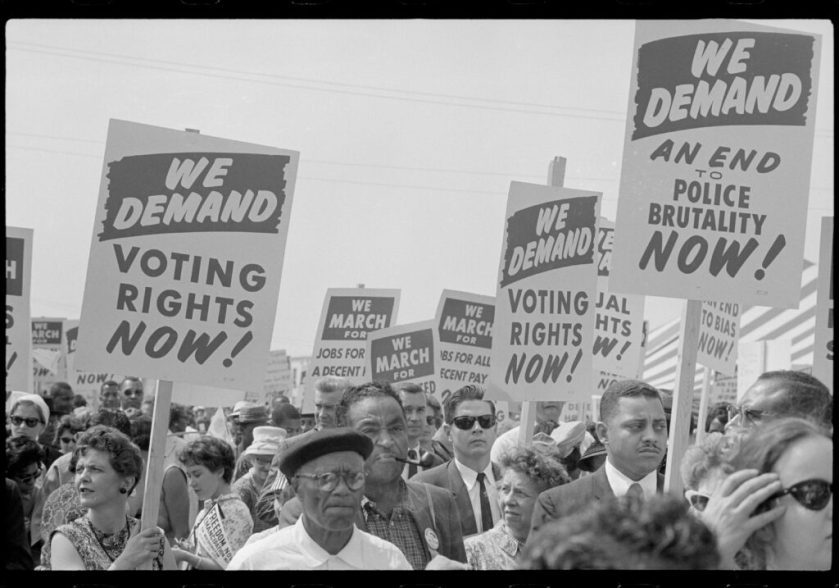
Photo: Marchers support voting rights for all Americans at the 1963 March on Washington. Photo by Marion S. Trikosko (Library of Congress, via Unsplash).


Pingback: Observations from . . . July 2026 | MORE TO COME...