
Living in the past doesn’t honor the lives of those we have loved.
Candice and I attended a celebration of the life of Elizabeth Fisher late last month. We were both friends with this brilliant woman who was Professor Emerita and the long-time Chair of the Department of Classical and Near Eastern Languages and Civilizations at The George Washington University. However various ties—including their work together on the healing ministry and a mutual fondness for long conversations over leisurely lunches—meant that Candice and Elizabeth had a special bond.
At the service I read a remembrance written by her cousin Bill Fawcett, who could not attend. Elizabeth’s parents passed away when she was a teenager and she went to live with her aunt and uncle, Bill’s parents. While Elizabeth went on to have a distinguished academic career as a classics scholar, Bill wanted us to know about her childhood. Of trips taken to hunting camps and lodges. Of her beloved parrots.

Bill Fawcett wrote a lovely piece about growing up with the person he knew as “Sister Betty” and he ended it with the David Harkins’ poem She is Gone.
You can shed tears that she is gone
Or you can smile because she has lived
You can close your eyes and pray that she will come back
Or you can open your eyes and see all that she has left
Your heart can be empty because you can’t see her
Or you can be full of the love that you shared
You can turn your back on tomorrow and live yesterday
Or you can be happy for tomorrow because of yesterday
You can remember her and only that she is gone
Or you can cherish her memory and let it live on
You can cry and close your mind, be empty and turn your back
Or you can do what she would want: smile, open your eyes, love and go on.
I love so much about this poem, but I’m especially drawn to the line that calls us to be happy for tomorrow because of yesterday.
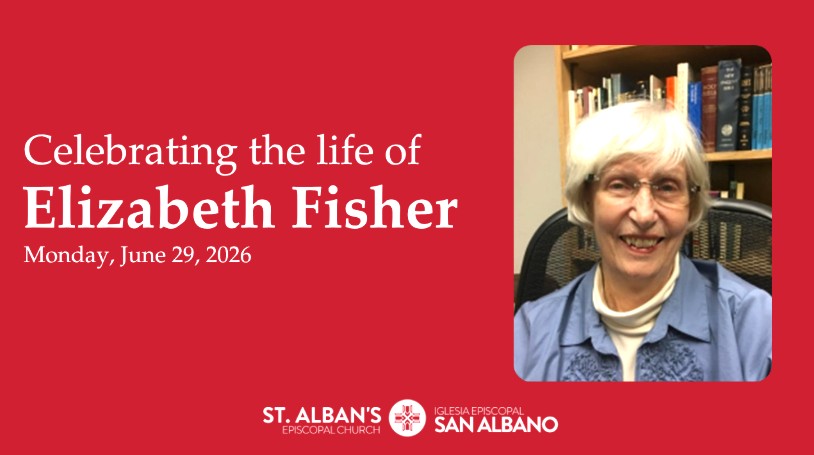
Elizabeth was a long-time member of the choir at St. Alban’s so it is appropriate to also remember her with a song. The St. Olaf Choir’s acapella version of Wondrous Love from the old Southern Harmony hymnal is a beautiful version that touches the soul.
I always admired Elizabeth’s quiet leadership at St. Alban’s, especially in the ministry of healing. I believe her legacy there will be in the reminder that while pain―physical, emotional, spiritual―is often deeply personal, healing happens best in communion and community. She lived that out every day through the way she lived and through the ministry she established which touched so many lives and lives on in different ways in the church today.
Rest in peace, dear Elizabeth.
More to come . . .
DJB
Photo of flowers by Georg Eiermann on Unsplash.


Hi David,
My name is Amelia, and I write for the GW Hatchet. I’m interested in hearing more about Elizabeth Fisher for an article we are writing about her life and legacy. Please feel free to reach out at anelson@gwhatchet.com if you are interested. Thanks.
Dear Amelia,
Thank you for reaching out, and I’m pleased that the GW paper is preparing an article. I’m going to ask my wife, Candice Brown, to reach out to you to set up a call. Candice worked with Elizabeth on ministries at St. Alban’s Episcopal Church and was also a longtime personal friend. I think she could be of more help to you. I’ll ask her to write to you today.
All the best,
DJB
Amelia Nelson wrote a lovely remembrance of Elizabeth for the GW Hatchet, and I wanted to share it with you here.
Pingback: Observations from . . . July 2026 | MORE TO COME...