The whitewashing and bulldozing of our history seeks to serve the vision of a small group of powerful people. “We are living through a revolt against the future. The future will prevail.”
In a career that has extended over more than 50 years I have worked with a wide variety of individuals and organizations to save the buildings, landscapes, monuments, and neighborhoods that help tell America’s story. Historic preservation was not only a profession but a personal passion to connect people in thriving, sustainable, and vibrant communities. The underpinning of much of that work is the National Historic Preservation Act (NHPA) which became law in 1966, less than a decade before I joined the field. Often misunderstood, NHPA was passed by Congress and signed by President Johnson “primarily to acknowledge the importance of protecting our nation’s heritage from rampant federal development.”
As it has done with other institutions, scholars, and citizens working to protect America’s history and tell a more complete and complex story about our past, the Trump administration is now attacking the National Historic Preservation Act.
Historian Heather Cox Richardson—as she often does—takes our disparate and messy news feed and weaves it into a coherent narrative about what is really at stake. In her July 25, 2026 Letters from an American post she tackles the administration’s attempt to whitewash history with a proposed major rule change in the National Historical Preservation Act.
“Trump installed a loyalist as vice chair of the Advisory Council on Historic Preservation. On Friday, July 17, the chair proposed dramatic revisions to Section 106 of the NHPA. This is the section of the 60-year-old law that requires federal agencies to ‘take into account’ what their actions will do to historic properties and places. This is the requirement that gives the public, as well as local, state, and tribal governments, a voice in the changes to historic and cultural sites . . .
Yesterday the Advisory Council on Historic Preservation, packed with 21 Trump appointees on a 24-member board, voted to move the revisions to Section 106 forward. Rachel Treisman of NPR noted that the National Register of Historic Places lists more than 100,000 properties with more than 1.8 million sites, structures, objects, and districts, all of which will lose protections if the new rule takes effect. [Greg] Werkheiser told Treisman: ‘What it means is that the federal government, in its own discretion, can decide whether—if ever—to tell an American community that it’s about to do a major project that could harm or destroy a historic resource. The public will be completely cut out of any conversation around the future of places that matter to them in this country.’”
The National Trust for Historic Preservation—where I have been a member since 1975, worked for almost half of my career, and remain a financial supporter—called out the most disturbing aspects of these proposed changes. Proposals to end public comment, allow federal agencies to move forward with plans that damage America’s historic architecture, remove all cultural landscape features such as the Grand Canyon from consideration as historic properties and more are inconsistent with the National Historic Preservation Act and would violate the Council’s own rules and procedures. As we have seen with other reports and regulatory changes from this administration, the proposals are also internally inconsistent and riddled with errors, likely to cause enormous regulatory confusion, chaos, and unnecessary expense.
Richardson’s entire post is worth your time. For the conclusion she states—in clear and direct language—what these changes to an obscure (to some) federal law means:
“What is at stake is more than just buildings. It is the whitewashing and bulldozing of our history and culture, created over centuries by the many people who have built the United States, in service to the small vision of Trump and his enablers.”
The whitewashing of history has been a recurring topic in my writing. Monuments and historic places help carry forward the story of America, and our stories tell what we choose to believe. The dispiriting upheavals we are seeing today would be completely disorienting if we hadn’t seen similar challenges before. Racial injustice, the whitewashing of history, book banning, our gun fetish, misogyny, homegrown terrorism, fake news, religious intolerance, the marginalization of LGBTQ communities, oligarch-favoring government, and more are all part of our past and present.
Too many people want to ignore this part of our nation’s history.
So much of what we are experiencing comes down to money and power, just as it did with the Southern slaveowners and the Gilded Age oligarchs of the 19th and 20th centuries. Seeing others as unequal is the price that must be paid in order for those who feel threatened by democracy to maintain their grip on power. They reject the fundamental American ideal of equality.
Nesrine Malik has written about the myths we believe that subvert freedom. Many of these myths are behind the drive to whitewash and bulldoze our history and culture. These myths “work hard to prevent change from happening. They are powerful. But they are not all-powerful.” The strength of the myths is not in facts, but in the narratives, so it is impossible to fight fake facts with other facts. What is needed, Malik asserts, are new stories that are not just the correction of old stories, but are visions that assert that “for societies to evolve, an old order must change.”
The fight for a fuller understanding of our history, for the preservation of those places that help us acknowledge our past, and for democracy and justice never ends. As Anand Giridharadas reminds us, “We are living through a revolt against the future. The future will prevail.”
More to come . . .
DJB
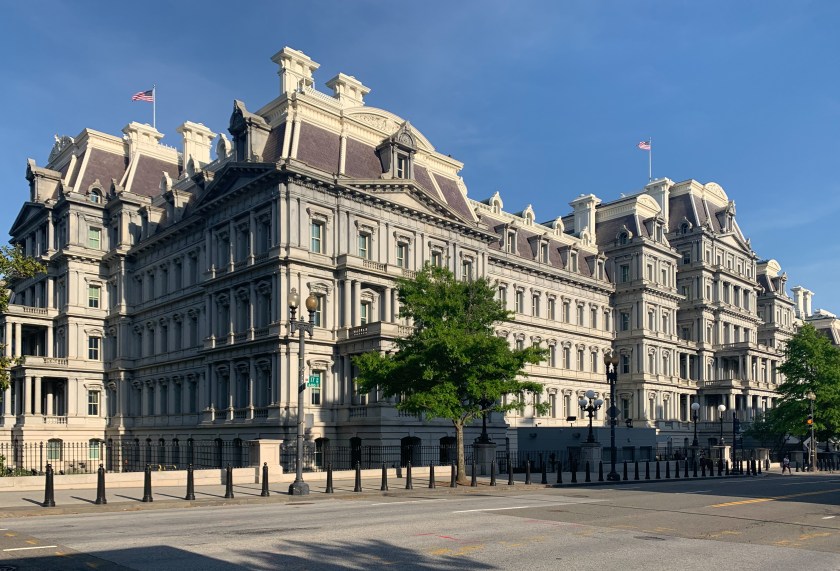
Photo of Eisenhower Executive Office Building via Wikimedia


The regime has yet to do anything positive. They wreck, destroy and cause pain. Why does the maga base not see through the smoke screen and remain loyal. “Beware of stupid people in large numbers” Georgle Carlin
Thanks, Jim. I agree with you. A friend and I were talking about the question you raise this morning and we both think the hard core base remains loyal because it gives them permission to discriminate or, similarly, to hate the same people. Love the Carlin quote.
DJB
POPULAR INFORMATION newsletter – which is the home of investigative reporter Judd Legum – had an eye-opening report entitled The fake historian advising Trump’s anti-Smithsonian crusade. Worth the read. DJB
Pingback: Observations from . . . July 2026 | MORE TO COME...