
Claire Keegan’s triptych of stories about women and men is a potent and insightful work. Capitol Hill’s East City Book Shop, a place where one can “dive into any one of a thousand realities” and connect with others who appreciate the written word, had Keegan’s newest work in stock. As a bonus, I read “Foster,” an earlier Claire Keegan short story, and found the slim book packed a strong emotional punch.
Installment #14 in my series on the region’s independent bookshops.
The diversity of the Washington region’s independent bookshops is one of the great discoveries I’ve made in my 2026 bucket list quest to visit all thirty. On the same day I spent time in a used bookstore packed to the gills and a niche shop with fascinating but limited offerings, it was a pleasure to discover a third neighborhood store with new works and a welcoming space to sit, read, talk, and revel in community.

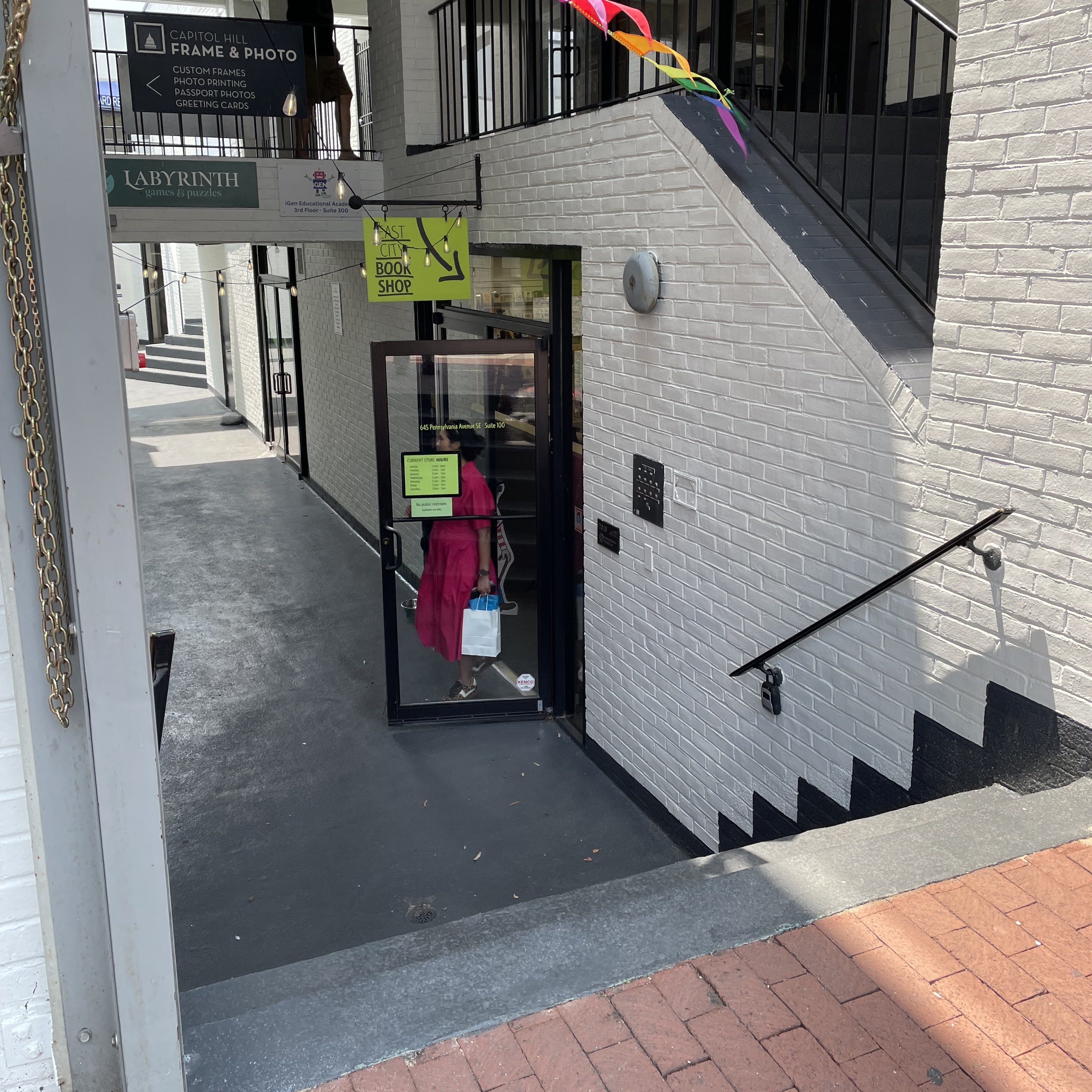
East City Book Shop located on Pennsylvania Avenue, SE in Capitol Hill was founded a decade ago to fill a gap left by the earlier closing of a beloved neighborhood bookstore. I walked down a few steps from the sidewalk and walked in to a light filled and airy space designed for people and books. Owner Laurie Gillman wanted to create a gathering space for book lovers of all ages in a neighborhood full of smart and curious people, and she has made that dream come true.
After entering a small space of new arrivals I was greeted by a friendly East City staff member. After describing my quest (and getting a few queries about which stores I most enjoyed), she directed me to the larger downstairs area which was filled with bookcases of new and newish releases from a variety of genres. A generous children’s section brightened part of that level and there was space throughout the store to stop, sit, read, and think about how wonderful the world is when filled with books.
I had very much enjoyed Claire Keegan’s Small Things Like These, a short, powerful, gem of a novel that was shortlisted for the Booker Prize. Her most recent book of stories, therefore, was high on my acquisition list. East City had the work in stock, and I left, thrilled to have found the specific book I was looking for (which isn’t always the case) and a new shop to explore on my occasional trips to Capitol Hill and the Eastern Market neighborhood.

So Late in the Day: Stories of Women and Men (2023) by Claire Keegan features three recently expanded works that explore gender dynamics through the lens of love, betrayal, lack of generosity, lust, and the weight of expectations. Keegan is a brilliant writer who brings simplicity and power together in a way that calls you to return to re-read passages and stories to unlock their mystery and savor her observations. These are not simple and easy works of romance. Conflict is at the heart of each story and it is clear where Keegan places much of the blame. As a NPR reviewer wrote at the time of the book’s publication, “when the title story was published in France earlier this year, it was called, ‘Misogynie.'” In this piece we find an office worker named Cathal heading home late on a Friday. He cannot get his former fiancé off his mind. As Keegan explores his thoughts and reimagines the conversations that led to the breakup, the reader can better understand that French title.
A second work features a successful woman and a man—a professor—who cannot find it in himself to be happy for her success. Finally, the third story in So Late in the Day is the most disturbing, with a foreboding “woman in peril” feeling right from the beginning as a married woman wants to discover what it would be like to sleep with another man.
Not all readers will find this collection appealing or even fair. One reviewer called it “mean.” But I found, upon first reading and a subsequent rereading of key segments, that Keegan’s book resonated with me as a very thoughtful and challenging work with depths of emotion that one might not expect with such clear, simple writing. And as a member of the gender that shoulders the brunt of the criticism in her writing, I can see much, unfortunately, that rings true.
Only The Long and Painful Death, the second of the three stories, has what one would consider a happy ending, yet even then I was frustrated by the actions of the envious male professor. As I find myself saying more and more these days, those of us born on third base need to wake up and admit the unearned privilege that put us there.

Foster (2010, 2022) by Claire Keegan was a perfect introduction for, and complement to, her more recent work. I had purchased Foster—recently published as a standalone book—earlier in the year and decided to dive into this simple but emotionally compelling story after finishing So Late in the Day. Set in rural Ireland it tells the story of a young girl who is taken by her father to live with relatives on a nearby farm while her mother is having a baby. The nameless narrator has no idea when, or if, she will return to her own home. It is clear that the girl’s family is overwhelmed, while the relatives, Mr. and Mrs. Kinsella, are affectionate and clearly intent on providing loving care to a person whose day-to-day existence has been rough and chaotic. The Kinsella farm is orderly and provides a steady foundation for the young girl to grow and blossom. Yet the Kinsellas are hiding something. At the same time the young girl’s mother and father are working hard to keep their secrets of poverty, drinking, and depression from others in the village. But these secrets are not far from the surface as the story progresses.
Keegan’s writing “is sparse but not lacking in depth” notes one reviewer, an observation I would echo. When a neighbor describes the girl as “quiet,” Kinsella responds with “she says what she has to say, and no more.” As this reviewer notes, “That is the perfect way to describe Claire Keegan’s writing. It tells us what we need to know and understands when to stay quiet . . . There is so much to be found in what we aren’t told and the silences.”
“You don’t have to say anything [Kinsella tells the young girl] . . . Always remember that as a thing you need never do. Many’s the man lost much just because he missed a perfect opportunity to say nothing.”
NPR’s Heller McAlpin captured the essence of this book perfectly. Foster is a heartbreaking story of childhood, loss, and how “painful unaccustomed love and tenderness can be, because they accentuate what’s been lacking.” It breaks one’s heart, but then also offers up hope out of the loss.
“More than most books four times its size, Foster does several of the things we ask of great literature: It expands our world, diverting our attention outward, and it opens up our hearts and minds. This is a small book with a miraculously outsized impact.”
More to come . . .
DJB
Photo of Dublin at sunset by Eduardo Drapier on Unsplash


I’m so happy you wrote about Claire Keegan, one of my favorite Irish writers but also one of my favorite writer overall. Her stories continue to resonate long after I read them. The leanness of the writing makes it even more powerful. Foster and Small Things Like These have both been made into very good movies.
Thank you, Sarah. Claire Keegan has also become one of my favorite writers. She is so spare in her words yet there is a depth and power in everything she does. As one reviewer noted, if she’s written anything that isn’t perfect, I haven’t found it yet.
Small Things Like These is one of those books I recommend to friends and know that they will love it. I suggested it to someone recently and he wrote back with one word: “Wow.”
Thanks for reading.
DJB
Pingback: Observations from . . . August 2026 | MORE TO COME...
Pingback: Exploring DC’s independent bookshops: A Labor Day update | MORE TO COME...
Pingback: A remarkable debut | MORE TO COME...
Pingback: From the bookshelf: August 2026 | MORE TO COME...
Pingback: Banned books photo: Friday | MORE TO COME...