
I found Molly Crabapple’s story of the Jewish Bund to be an ambitious yet flawed work of personal discovery. It was appropriate that I came upon the work at Lost City Books, where one has the chance to visit diverse places, ideas, time periods and experiences.
Installment #17 in my series on the region’s independent bookshops.
During the 2026 Independent Bookstore Crawl in late April, we visited a very crowded Lost City Books in the Adams Morgan neighborhood of DC. To put it simply, I loved this bookshop dedicated to a rediscovery of both past and present, “a chance to visit diverse places, ideas, time periods and experiences.” Through the sale of both used and new books, Lost City wants to reach those who are “curious—emotionally, intellectually, psychologically—about the world, the mind, and the imagination.”
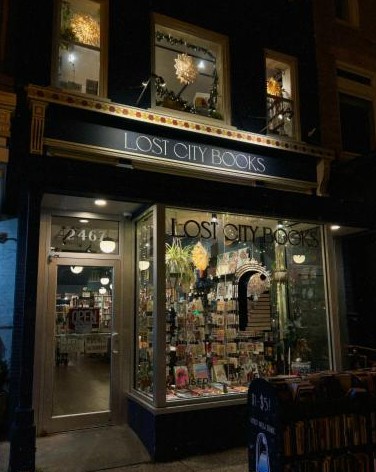
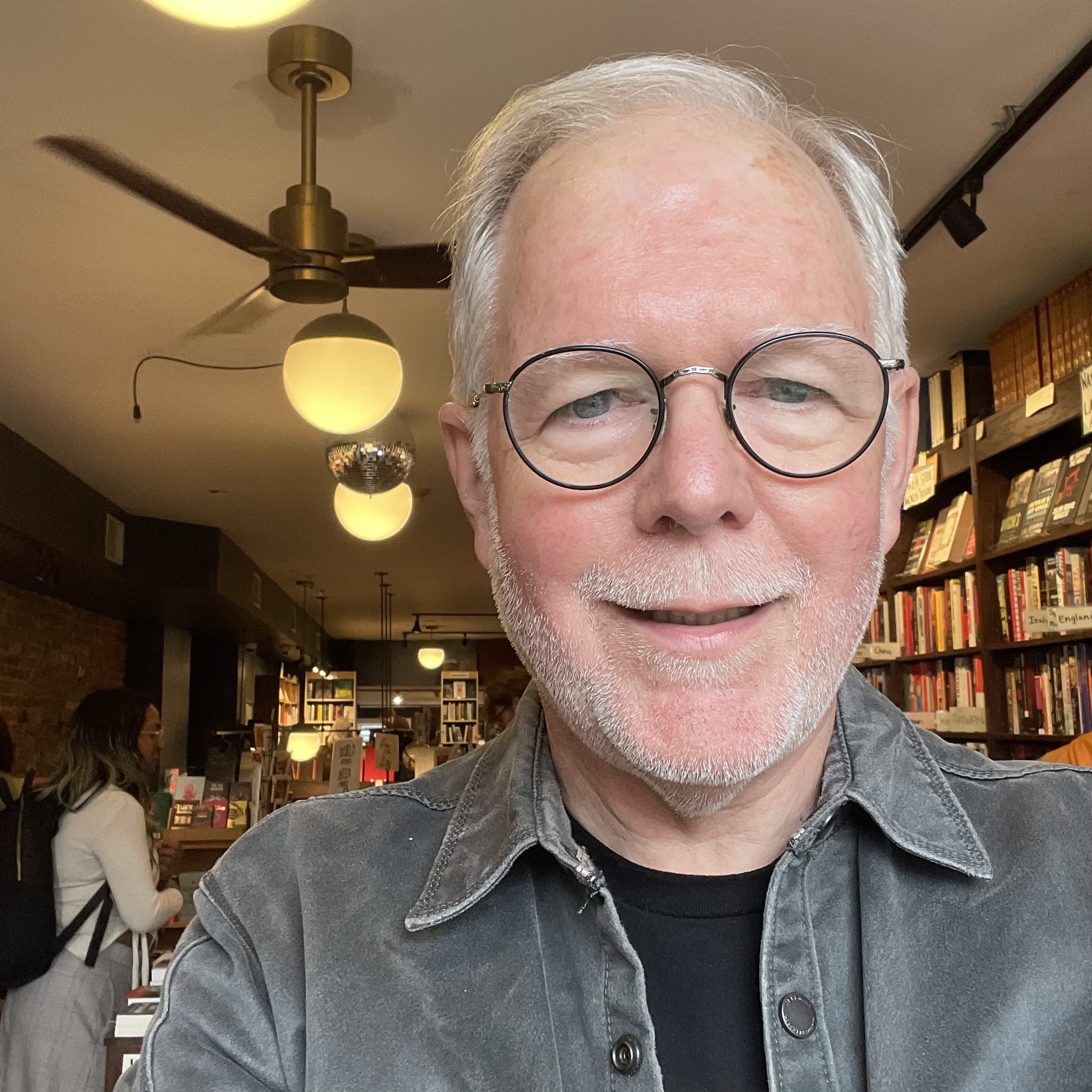
Lost City describes itself as “the place for explorers, for deep divers, who want the books they find to take them to a new horizon.” I’ve now made two visits and am more than inclined to say that Lost City lives up to that lofty goal.
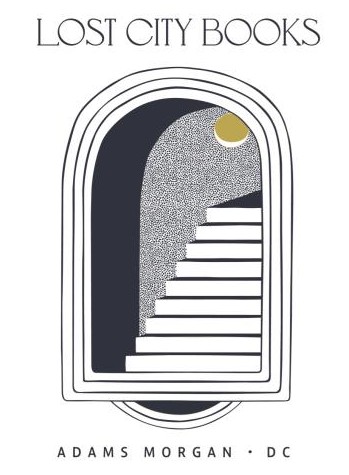
A great deal of thought has gone into this bookshop. One can see it in the curation of both new and used books, in the layout of the store and the use of space, in the explicit way they tell Amazon to eff off, and in the care that went into their logo design.
“Our logo came from our desire to invoke the mystery of open doorways and the steps leading to the unknown, the occult and deeply spiritual symbolism of the moon . . . The shape of the doorway was inspired by the wrought iron street call boxes all over DC. These call boxes, no longer used for their original purpose, are very much an object out of time, an anachronistic object present in our current lives. This seemed a fitting shape to inform the logo of our bookstore. Its the combination of our rich histories, our passionate presence, and our bright futures that make Lost City Books the ever-growing community that it is.”
Lost City has a wide variety of works, many more than one might expect in a store this size. On my most recent visit I found an impressive display of books from “small presses we admire.” The landing between the first and second floors is a place to stop for volumes on architecture and art. The handwritten staff recommendations which can be found throughout the store lead shoppers down many interesting paths. As one might expect in Adams Morgan, there is a good selection of LGBTQ+ works and authors. I found the juxtaposition of new and used books in virtually every display pointed me in unexpected directions.
Virtually all of the independent bookstores I have visited in this year-long journey to sample all 30 in the Washington region have been created out of love and a vision for a better world through reading. Lost City Books certainly comes out of that impulse, and it follows that vision with an inspiring intentionality.
During that initial April visit I found a recently published work that was creating a good bit of buzz for its subject, style, and politics. Just the type of work to find on a discovery to broaden one’s horizons of past, present, and future.
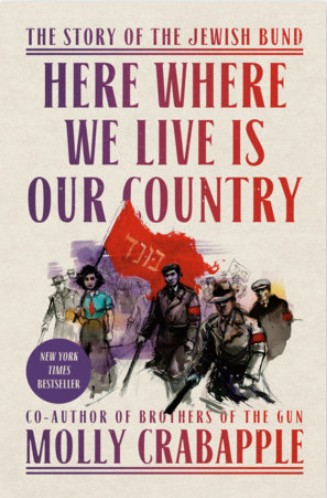
Here Where We Live Is Our Country: The Story of the Jewish Bund (2026) by Molly Crabapple is history and memoir with an anti-Zionist point of view. Crabapple (née Jennifer Caban), a New York born and based award-winning illustrator, comes across a watercolor—Itka the Bundist, Breaking Windows—among a group of paintings by her great-grandfather Sam Rothbort. In the aftermath of the Holocaust, Rothbort created “memory paintings” with the hope of resurrecting the vanished world of his shtetl childhood in Volkovysk, a small town in the Russian Empire’s Pale of Settlement. The watercolor was the great-granddaughter’s introduction to the Jewish Bund and it led her on a years-long search to discover more about this major force in the revolutionary Left of Tsarist Russia.
As Crabapple explains, the Bund was a secular, socialist movement devoted to class struggle that was launched and had its first period of growth in the late 19th century. The Bund organized workers’ councils and fighting units during the 1905 Russian revolution, which was ultimately suppressed. The group provided armed protection for Jewish communities during the bloody pogroms of the early 20th century, and although it was defeated and pushed out of the Soviet Union by Lenin and the Bolsheviks, the Bund continued as a political force in interwar Poland. The Bund cultivated the Yiddish language and culture; sponsored schools, health facilities, sports clubs, youth groups and other institutions; and was the largest vote-getter of any Jewish party in Poland on the eve of the Nazi onslaught. Crabapple, calling upon deep historical research and sources, goes into great detail on how this early-20th-century socialist movement broke with the Bolsheviks, fought the Zionists, and tried to resist the fascists. Each of these efforts is important, but in this politically influenced work Crabapple returns on numerous occasions to focus on the Bund’s fight with the Zionists.
The title comes from a phrase that is repeated again and again in different contexts. The Bunds were not looking to move to a new/old homeland in Ottoman or British Palestine. They believed in “hereness.” To Crabapple, that meant that “Jews had the right to live in freedom and dignity wherever it was they stood. They would fight for a better and more beautiful world, even alongside people they had been raised to see as enemies.”
I had challenges in reading this work. First, Crabapple is an award-winning illustrator whose writing skills do not meet that same standard. The book’s organization, with frequent interruptions to examine lives of individual members and leaders of the Bund, makes for a choppy read. Second, Crabapple likes to insert herself into the history. For instance, she relates a historical event associated with the Bund to her involvement and arrest in the Occupy Wall Street protests. She draws a parallel between the Bund and the Black Panthers. While some reviewers found them graceful and appropriate, these modern insertions into the story did not work for me.
Crabapple is writing to use the Bund’s history as a way to discredit Zionism in today’s world. As Sam Adler-Bell wrote in The Guardian,
“The Bundists rejected Zionism because it offended the core principle of their project: that ethnic particularity need not lead to nationalism, that it could be the basis for organizing across difference. . . . The Bundists dreamed of deliverance without exodus; the liberation of the Jews in concert with the liberation of their neighbors.”
The Holocaust made this dream, for many Jews, naive. But Crabapple makes the case that the Bund didn’t fail; it was defeated. “The difference between failure and defeat is that you fail when your own errors are what lead to your collapse,” she says. “Whereas to lose is just to be overcome by a greater force.”
The book has received glowing reviews, as in the New York Times (What Does Judaism Look Like Without Zionism), and negative reactions, as can be found in the Fathom Journal‘s Jewish Bund Ghosts vs. Living Jewish State.
There is much to like in Here Where We Live Is Our Country. Along with others I also found much to question. This is a history of a part of Jewish life that deserves more attention. The nationalism of Zionism should also be examined, most especially in light of current events.
Crabapple’s work for me is ambitious, yet flawed. In an epigraph that she returns to at the end of the book, the author quotes the composer Gustav Mahler, a Jew who converted to Catholicism: “Tradition is not the worship of ashes. It is the preservation of fire.”
Fire, of course, is notoriously hard to tame.
More to come . . .
DJB
Photo of open air gathering of the Bundist Youth Organization in Warsaw, June of 1932 credit Bund Archives of the Jewish Labor Movement, New York


Pingback: Observations from . . . August 2026 | MORE TO COME...
Pingback: Exploring DC’s independent bookshops: A Labor Day update | MORE TO COME...
Pingback: From the bookshelf: August 2026 | MORE TO COME...