
Georges Simenon’s twelfth installment in the legendary Maigret series was a perfect ending for my month of reading dangerously.
For October’s fifth book of detective fiction in celebration of Hallowe’en, I turned to an old favorite. The sparse, descriptive writing of Georges Simenon always works in putting the reader right in the center of the conflicting emotions around crime, betrayal, and the search for justice.
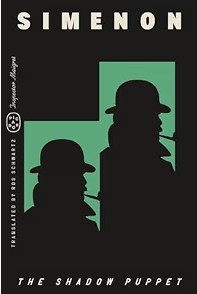
The Shadow Puppet (1932) by Georges Simenon is the twelfth installment in the legendary Inspector Maigret series. A businessman has been shot dead in his office and the monthly payroll taken from his safe. While walking on the dimly lit Place des Vosges, Maigret hears the sound of a woman in distress. But this is deceiving, as she is giving birth in a room above. However, as the lights of the apartments across the courtyard flicker, Maigret sees shadowy figures at the windows. He soon comes to understand that behind one of those windows is the dead man and his empty safe. His job is to discover who, behind those other windows, may know of—or have committed—the murder.
The plot begins in earnest as Inspector Maigret investigates the murder of businessman Raymond Couchet in his office at Place des Vosges, Paris. Couchet was shot in the heart and he died instantly. 360,000 francs are missing from the safe, but they must have been taken before the murder, because the dead man’s body blocks access to the safe. Couchet, who was shot sometime between 8 and 9 p.m,, had been set to meet his mistress, Nine Moinard, at the Café Select at 8:00. Maigret notices Monsieur Martin, a resident of the nearby apartments, searching the rubbish bins in the courtyard. He is looking for his lost glove. He later learns that Madame Martin—who is Coucet’s first wife and the mother of their son Roger—was also searching in the bins that evening. It quickly gets very complicated, with contested wills, Roger’s addiction and eventual suicide, Madame Martin’s incessant complaining about money, and the bourgeoisie family of Coucet’s second wife pulling together to protect her interests.
In this installment of the Maigret series, Simenon uses vivid characterizations to have us see into the lives of Parisian businessmen, petty officials, and high-bourgeoisie. His descriptions of the various settings—the Place des Vosges, cafes, and residences—adds to the allure of the mystery.
In the end, Maigret uncovers a tragic story of “desperate lives, unhappy families, addiction, and a terrible, fatal greed.”
This is the fifth and final installment of my “month of reading dangerously” in anticipation of Hallowe’en. To see the others, check out the most recent listings under the Reading Dangerously (AKA Murder Mysteries) tab.
Enjoy!
More to come . . .
DJB
Shadows photo by Maria Ionova on Unsplash

