Dolly Parton—singer, songwriter, entertainer, actress, entrepreneur, philanthropist, and “what your mom used to refer to as just plain good people”—passed away on Tuesday at the age of 80 after a brief battle with cancer. Her death leaves a big hole in hearts around the world.
Dolly Parton passed away on Tuesday at the age of 80 after a brief battle with cancer. Few people—much less entertainers and celebrities—could bring together blue and red Americans, straight and gay communities, grandmothers and granddaughters, rich and poor.
Dolly Parton bridged those divides, and more.
In its obituary, the New York Times wrote:
“With her voluptuous figure, sparkly stage costumes and blond bouffant wigs, she was likened by the writer Chet Flippo to the Big Rock Candy Mountain, the Depression-era symbol of abundance. Her songs spoke to millions, confronting privation and loss even as they radiated possibility and hope.”
Growing up near Nashville in the 1960s, I was first introduced to Dolly and her exceptional gifts through the Porter Wagoner TV show where she was featured as the “girl singer.” But she had higher aspirations, and over the course of a career spanning six decades she earned the affection so many bestowed upon her. She was always well known as an entertainer, but it took longer for her songwriting talent to be recognized as among the best in popular music.
Dolly wrote the truth from a woman’s perspective in a way that broke through the tight gender-defining rules imposed by country music.
On the occasion of Dolly’s 50th anniversary on the Grand Ole Opry in 2019, writer Mary Elizabeth Williams had an article in Salon on why Dolly was such a force of nature. Williams wrote,
“Dolly Parton is, quantifiably, one of the most loved personalities in the world. She’s also a deceptively complex American figure. On a superficial level, she’s a twangy blonde with a wig collection to rival RuPaul, a body that defies the laws of physics and a proudly gaudy sartorial aesthetic. ‘It costs a lot of money to look this cheap,’ she’s famously explained. But you don’t have to look very far under the rhinestones to see that she’s one our greatest American songwriters, a virtuoso musician, an actress, an entrepreneur, a philanthropist and what your mom used to refer to as just plain good people. Her larger-than-life persona makes her a great entertainer. Her intelligence and authenticity make her an icon.”
Writing yesterday in The Musical Box, Walter Tunis framed it well when he suggested that “we talk about ‘larger than life’ figures all the time, but Dolly’s stature as an artist and humanitarian went a few light years beyond large.” After noting the debt that country and female artists owed to Parton for her trailblazing work over almost 60 years, Tunis notes:
“And, really, anyone with a sense of moral decency, is in her debt for the simple but unending good she promoted, whether it was through children’s literacy programs, scholarships, vaccine research or the obvious right that everyone, regardless of genre, race, sexual orientation or ethnic background was deserving of love, respect and acknowledgement.
The latter may prove to be the most vital and lasting component of Parton’s legacy. Exclusivity simply did not exist in her world. Her music and life embraced everyone. And let’s face it, folks, not all artists and entertainers, especially select members of country music’s more self-righteous regions, promoted such generosity.”
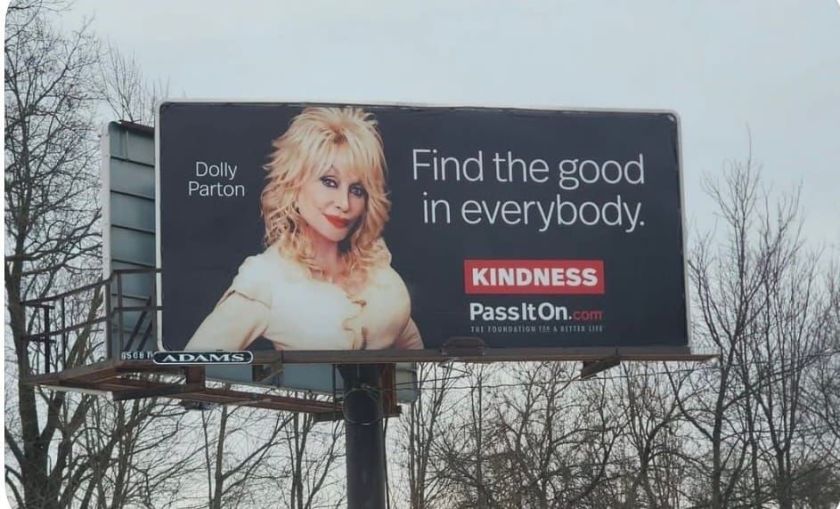
The historian and social critic Rebecca Solnit, writing in her Meditations in an Emergency newsletter, called her “Our Goddess of Kindness,” and featured the billboard with Dolly’s picture on it imploring us to “find the good in everybody.”
“Down home and brilliant, feminist and feminine, glitter-bedecked and generous, country and cosmopolitan, funny and soulful. In her songs and interviews and in 9 to 5, the movie about workplace sexual harassment she co-starred in with Jane Fonda and Lily Tomlin, she was a hell of a feminist all the way back to songs like 1968’s Just Because I’m a Woman, with the lyrics:
My mistakes are no worse than yours
Just because I’m a woman“
Solnit notes that Parton took stands, “often in her own country way, trying to avoid what might seem like partisanship.” She spoke up “against racism and, in the summer of 2020, for Black Lives Matter, for queer and trans people, for women’s rights.”
“And she sang it too, most recently in Traveling Through for the trans-themed film Transamerica and the song Rainbowland with her goddaughter Miley Cyrus. Dolly Parton was hugely loved by the queer community and she loved them back. In Rainbowland godmother and goddaughter sing:
Wouldn’t it be nice to live in paradise?
Where we’re free to be exactly who we are
Let’s all dig down deep inside
Brush the judgment and fear aside“
Personally, I always loved Dolly’s take on the Black Lives Matter protests sweeping the country in 2020. “I understand people having to make themselves known and felt and seen,” she told Billboard magazine.
“And of course Black lives matter. Do we think our little white asses are the only ones that matter? No!”
God, we’re going to miss that refreshing honesty. And all the good she did in the world.
At the height of the pandemic I wrote a post entitled Did you have Dolly Parton helping to fund COVID-19 vaccine on your 2020 bingo card? Of course we didn’t, but of course, she did.
There’s so much of Dolly’s musical catalog to explore, and I definitely recommend what Parton self-describes as her “sad ass songs” from the early years. Here she was often taking traditional murder ballads like Knoxville Girl and recasting them from the woman’s (i.e., the victim’s) point of view. She also wrote great songs of empowerment, such as Coat of Many Colors, a fantastic song about not letting poverty, and others’ point of view, change your self perception.
“But they didn’t understand it, and I tried to make them see
One is only poor, only if they choose to be
Now I know we had no money, but I was rich as I could be
In my coat of many colors my momma made for me”
Dolly penned some of the best lines in country music, like, “In my Tennessee mountain home, life is as peaceful as a baby’s sigh.” One of my favorites is, “You don’t know love from Shinola.” I can think of so many people in a certain administration this line could apply to:
“Your attitude stinks and I hate it
You’re arrogant, cocky and rude
You’re selfish, conceited and jaded
Everything’s all about you
You think that I’m lucky to have you
You think you’re so handsome, so what
I’m callin’ you out cause I don’t need this crap
I’m gettin’ myself outta Dodge
Cause you don’t know love from Shinola”
Being a bluegrass fan I was thrilled when Dolly turned her attention to her roots in that music with 1999’s The Grass is Blue. Her next two albums, Little Sparrow in 2001 and 2002’s Halos & Horns, carried on a similar vein. The latter included the wonderful “I’m Gone”—one of my favorite Parton tunes because it so clearly captures the “I’m in charge of me” part of Parton’s persona in the humorous way that endears her to so many.
“You can tell the truth or you can lie
You can say I left you or I died
Say I’m in the Himalayas on some spiritual quest
And could spend years lookin’ for the light
Say I’m in the witness program with the F.B.I.,
Say a U.F.O. abducted me from home
You can say what you chose, but I tell you the truth
You can say for sure I’m gone, ’cause I’m gone”
Williams’ 2019 article covered Dolly’s ability to connect with so many, her status as “a full blown hero” cemented by her “supreme grace.”
“When an embittered Porter Wagoner sued his star protégé for breach of contract, she simply settled out of court. When he fell on hard times later, she bought his songwriting catalogue and then gave it back to him, because, as she recalls on Dolly Parton’s America, ‘I wanted his kids to have it. That was one of my gifts thanking him.’
When the scientists behind the world’s first cloned sheep named her Dolly — because she sprang from a mammary gland cell, GET IT? — Parton laughed it off by inviting her woolly namesake to visit Dollywood. And when she wanted to honor her father, who had to quit school to support his family and never learned to read, she started her Imagination Library. Since 1995, it’s given away over 100 million books* to children around the world. Those are the actions of a person whose seat of power comes from a place of profound compassion.”
My son Andrew came up to my writing studio yesterday with the news of Dolly’s passing. He knew I’d want to know. Later he mentioned that he’d listened to her sing the song Applejack, which could be a description of her life after death:
“That’s when I was just a kid and now that I am grown
All I have are memories, old AppleJack is gone
Oh but he left me his banjo and it always takes me back
And everytime I play it I still hear AppleJack
Play a song for me AppleJack, AppleJack
Play a song for me and I’ll sing
Play a song for me AppleJack, AppleJack
Play a song, let your banjo ring”
A true treasure. Let’s all play and sing and live life with the supreme grace and kindness that she modeled for us all.
Rest in peace, Dolly Parton.
More to come . . .
DJB
UPDATE: In addition to the admirations and remembrances included above, several writers have written especially poignant and/or insightful posts about Parton and her impact on the world. I encourage you to check out the following:
Historian Heather Cox Richardson—Letters from an American, August 26, 2026
“When children age out of Dolly’s Imagination Library, they receive a final letter from her hoping they would ‘have a great time’ in school and urging them to keep reading.
The letter ends: ‘You and all of your friends are very special. There is no limit to what you can do or how far you can go. Just remember the lessons my family taught me—dream big dreams; learn everything you can learn; and care for all those who care for you. You do all of these things and you can be anyone you want to be.
‘You are terrific, and remember…
‘I Will Always Love You,
‘Dolly.’”
Journalist and author Leonard Pitts, Jr.—Leonard’s Substack, She Walked in Grace
“Her family is asking that in lieu of flowers, mourners donate to Dolly’s Imagination Library. That would be an excellent way to honor her. Here’s another: make it a point today to take yourself a little less seriously, to have a good laugh or to not look down on somebody because they are different. Instead of looking down, maybe look beyond the boundaries and limits of your own life. Say or give something nice to somebody else, do a decent turn for some stranger, for no other reason than that they need it. That, after all, is the ultimate lesson of her life, the real reason this loss stings just a little more than others.
It doesn’t hurt like this because Dolly Parton was great.
It hurts because Dolly Parton was good.”
Tommy Tomlinson—The Writing Shed, The greatest living American
“The photo above is the Dolly Parton mural in West Asheville, North Carolina. There’s a story about it that I’ll tell in a minute. For now I wanted to mention that it’s the mural in West Asheville so I could distinguish it from the Dolly Parton mural in Indianapolis; or the Dolly Parton mural in Chicago; or the one in Ringgold, Georgia; the one in Costa Mesa, California; the one in Lexington, Kentucky; the one in Appomattox, Virginia; the ones all over Tennessee—Nashville, Knoxville, Pigeon Forge—or the one here in Charlotte, not two miles from our house. I’m sure there are more but I stopped scrolling the Dolly Parton mural image search so I could get down some words.
One way to measure who we love in this country is to see who we paint on the sides of buildings. I doubt there are many people painted on the sides of more buildings in this great land than Dolly Parton, who somehow died Tuesday at the age of 80, although death is an odd notion when it comes to Dolly, because obviously what she did and who she was will live forever.”
*The number of books distributed to children through Dolly’s Imagination Library has now grown to 300 million.
Photo of Dolly Parton’s “Kindness” billboard via Meditations in an Emergency.


Such a loss for us all, and I know, especially for Tennesseans. I saw there is a petition going around to name the Nashville airport after her. I’d support that!
I think that’s a magnificent idea, Kathy!
Truly a national treasure. She also had one of the best giggles I’ve ever heard.
Thanks for reminding me of that giggle. It was one of a kind.
In her Letters from an American for August 26th, Heather Cox Richardson had a wonderful summation of, and appreciation for, Dolly Parton’s life. It is worth the read. DJB
Pingback: Dolly Parton, an American treasure | MORE TO COME...
Pingback: Observations from . . . August 2026 | MORE TO COME...
Pingback: I love the pithy proverb: Volume 13 (The Dolly Parton edition) | MORE TO COME...