
The first book in what has become a long and successful series featuring the delightful Chief of Police in a small village in the South of France, was a satisfying tale for my month of reading dangerously.
Book recommendations from intelligent and well-traveled friends are a delightful way to expand one’s viewpoint and horizons. After I reviewed a piece of detective fiction earlier this year, my friend and Brilliant Reader Charity wrote to suggest that I consider the “Bruno, Chief of Police” series.
I was unfamiliar with the writer, who splits his time between Washington, DC and the Dordogne. However, Charity’s thoughtful comments and her family’s love of language and literature steered me toward the mystery section at Politics & Prose bookshop, where I found the first in what is now a series of 20 main novels. *
Here in October―as part of my celebration of Hallowe’en―I boarded a plane for Europe and opened a book to enter the enticing world of land, food, family, culture, and history that is small town Southern France. Shortly after our plane landed I was wrapping up the novel described as “satisfying as a French pastry but with none of the guilt or calories.”
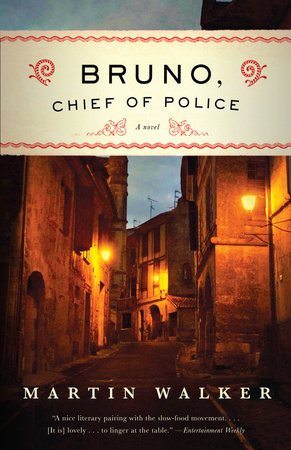
Bruno, Chief of Police: A Novel (2008) by Martin Walker is the reader’s introduction to “Benoit Courrèges, chief of police for the small commune of St. Denis and its 2,900 souls.” Universally known as Bruno, the sole policeman in this French village is single; a veteran of the war in Bosnia; the beloved coach of the youth tennis team; gourmet cook; and a defender of the old ways of gardening as well as “the makers of the crottins of goat cheese and the foie gras, the jams, the oils flavored with walnuts and truffles, and the confits that assured that this corner of France was known as the very heart of the nation’s gastronomic culture.” Life is no more complicated than protecting his neighbors and friends from the “nuisances of Brussels” with their food inspectors and petty rules.
Uncomplicated until an elderly resident—a WWII war hero who had migrated decades earlier from Algeria and was the father and grandfather to a local family of French citizens—is found brutally murdered in his isolated farmhouse, with a swastika carved in his chest.
First novels in a series must, by nature, focus on character introduction and development and more scene setting than is required once we have welcomed these fictional individuals into our lives. Walker handles that with skill and grace and at a leisurely pace.
The first forty pages describe village rituals such as weekly markets and annual parades. We meet Captain Duroc, newly appointed as head of the local gendarmerie who seems to do everything by the book. Fat Jeanne, as the schoolboys called her: spherical in shape, jolly in soul, and collector of the fees required from the market vendors. Jean-Pierre and Bachelot, who fought in the Resistance yet had a falling out and haven’t spoken to each other for more than 60 years, although both spent those decades in subtle but determined efforts to seduce the other man’s wife. Chief Detective Jean-Jacques Jalipeau of the regional headquarters of the Police Nationale, inevitably known as J-J, who has worked amicably with Bruno in the past. J-J’s new female inspector, Isabelle. Montsouris, the only communist council member, and his wife who is even a more strident left winger. Mayor Mangin, an ally and Bruno’s boss and confidant. The burly North African Karim and his wife Colette, who run a local café and is the grandson of the murdered man.
Walker lets the story develop at a relaxing pace, with stops along the way to savor food and wine, including Bruno’s local foie gras and a glass of his homemade vin de noix. There are tennis games on grass courts. More parades. And it is at one of the latter that the ancient tensions and the tangle of wartime crimes emerge. A group of thugs from the far right Front National party start a fight with locals during a remembrance of the man who was murdered. We learn that the son of a local doctor and a pretty teenager from nearby Lalinde were at a Front National rally recently. Investigations continue and expand, and suddenly we have multiple suspects, teenage drug use and sex that may be connected to the murder, irritating prosecutors from Paris looking to make a name for themselves, and rising racial tensions that threaten to split the peaceful village.
Bruno navigates all the turmoil skillfully, using his local knowledge, contacts, and common sense to keep the investigation on course to its surprising conclusion. Isabelle is smart and a martial arts expert who comes to Bruno’s aid during the riot with the thugs. The two of them come closer as the book progresses. In the end justice and truth—as is so often the case—don’t always align, but the outcome still feels very satisfying.
In describing this book recently I used a term favored by one of the reviewers: it is a “slow food” type of mystery. The meal was excellent, relaxing, ground in the locality, and left one ready for the next turn at the table.
More to come . . .
DJB
*Walker’s Bruno (also known as the Dordogne Mysteries) series features 20 main titles, plus several short stories and companion pieces. I discovered the first in the series at Politics and Prose bookstore. To see my description of P&P in my series on DC’s independent bookshops, see Installment #6.
French village photo by Olivie Strauss on Unsplash.

