Author: DJB

I’m Afraid Every Day…and I Jump Anyway

A friend sent out a recent Tedx Pasadena Talk by a friend of hers entitled Making the Jump:  The Year of No Fear.  The speaker, Grace Killelea, begins with a very funny story of how — at age 52 and weighing 247 pounds — she decided to go skydiving to begin a “Year of No Fear.”  In spite of the fact that she was a Senior VP for a Fortune 50 company, she had decided she needed to undertake a personal “Year of No Fear” because she was “afraid she would always feel afraid.”  Research shows that she is not alone. Killelea goes on to ask, “What would a jump look like for you?”  Based on the comments to the video, fears range from personal relationships, to job and work satisfaction, to the current political climate.  Killelea’s point is that we all have our fears.  Facing our fears “doesn’t have to be big and bold, like jumping out of a plane.”  What’s important is that you “identify (your jump), and then decide what’s keeping you …
Resolutions

Several years ago I stopped making New Years’ resolutions.  A recent New York Times article on making and keeping resolutions noted that one-third of our resolutions don’t make it to the end of January, while another Times article suggested that only 10% of resolutions are fully met by year’s end.  I’m proud to say I’ve kept my particular resolution since 2014! What I did in 2014 was to set seven rules for how I wanted to live for the next third of my life, and I recently added an eighth.  Because they are part of my computer wallpaper, I look at them every day.  The one that generates the most comment is the last one, which is basically “Don’t be a grumpy old man.”  That may be a hard one for setting metrics (laughs per day?) but I basically know when I’m following this rule or when my crotchety index is on the rise. Many of us make resolutions or set rules for our lives, counting on our willpower to reinforce good habits or to …

Memories

For the past two decades, New Year’s Day has had memories of loss mixed in with the anticipation of the coming year.  Mother passed away on January 1, 1998, and while a day doesn’t go by when I don’t think of her, the memories are especially poignant on New Year’s Day. Thankfully, mother’s life left many legacies in her family, her church, and her community.  Mom’s love of family never changed and was unconditional. She loved each one of us as individuals who had unique gifts and ways to serve. The lives lived by her children, grandchildren, great-grandchildren (who she never met) and in-laws are part of her legacy. Her commitment to her faith and her church was just as strong.  She was a life-long reader (as was my father) and she shared that love through her decades of service at church libraries in Tennessee.  She also believed in the power of women in the church, and became the first female deacon at First Baptist in Murfreesboro.  Mom served her communities in so many ways, …

Farewell 2017, Hello 2018

I was so discouraged with our country’s direction at the end of 2016, that I missed what had become an annual More to Come… year-end update.  Many commentators described 2017 as a “dumpster fire of a year.” Even Dave Barry had a hard time coming up with outrageous examples that exceeded our twisted reality.  The title of this year’s review by Barry says it all:  “2017: Did that really happen?” My optimism for our country’s future hasn’t fully recovered in part because I find myself agreeing with Lewis Lapham when he writes: “If the American system of government at present seems so patently at odds with its constitutional hopes and purposes, it is not because the practice of democracy no longer serves the interests of the presiding oligarchy (which it never did), but because the promise of democracy no longer inspires or exalts the citizenry lucky enough to have been born under its star. It isn’t so much that liberty stands at bay but, rather, that it has fallen into disuse, regarded as insufficient by …

Tenement Museum

A war on whose Christmas?

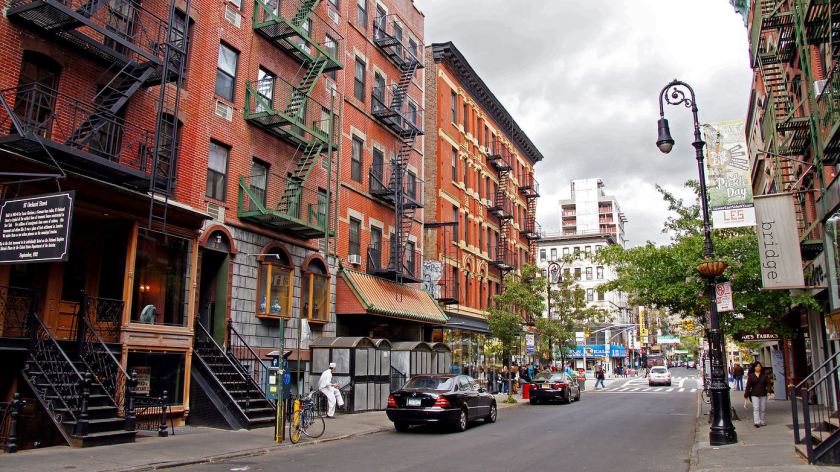
On Tuesday I spent a good part of the day at the Tenement Museum, on New York’s Lower East Side.  I was there to meet with the museum’s new president, Kevin Jennings, and to tour their new Under One Roof exhibit with Annie Polland, the EVP for Programs and Interpretation.  An affiliate historic site of the National Trust, the Tenement Museum tells the full American story about how many have come together to make our nation today. Which brings me to the so-called War on Christmas. The day I arrived, Kevin had just published an op-ed in Newsweek entitled “A War on Christmas?  What Christmas Are You Talking About?”  Early in the piece he asks the key question: “In recent years, a new holiday tradition seems to have emerged in America. From pundits to Presidents, the airwaves fill each December with people decrying the so-called “War on Christmas.” As a historian and museum President, I find myself wanting to ask “War on whose Christmas?” Those bemoaning the “War on Christmas” harken back to a mythical …

Respect is a Decision

We are heading into a season when generations will mix together with more frequency than they may at other times of the year (around a dining table for a holiday meal, for instance.)  While we interact with people of a variety of ages at work, the differences in generations are often much wider when we move outside the office. I was thinking of the clashes that often arise during these gatherings as I was reading a new book of essays by the science fiction writer Ursula K. Le Guin entitled No Time to Spare:  Thinking About What Matters.  Le Guin is 88 and, in this delightful and insightful book, she is not shy about saying she is old.  In fact, don’t suggest otherwise.  As she notes, “Encouragement by denial, however well-meaning, backfires.  Fear is seldom wise and never kind.  Who is it you’re cheering up, anyhow?  Is it really the geezer?” But what got me to thinking about relationships between generations, and the importance respect plays in all of our dealings with each other, is …

Cotton Fields

Telling the full story

For whatever reason, I’ve been plowing through books this fall.  Perhaps that is what a great deal of time on planes and trains does for one’s reading habits.  In any event, this has been my first chance to stop and reflect on these recent readings for the blog, so I’m seizing the moment. One of the two I’ve included here is a very important work, significantly moving the scholarship forward in its field.  The other is a small, family story that nonetheless captures the heart as it tells of a charming, privileged woman who struggled to live as a lesbian in the South of the jazz age.  Both, now a couple of years old, are recommended. Edward Baptist’s The Half Has Never Been Told:  Slavery and the Making of American Capitalism is a troubling and ultimately persuasive 2014 book by historian Edward E. Baptist.  In this ambitious work, Baptist sets out to to demonstrate, in great detail, that slavery was not the pre-modern institution on the verge of extinction with paternalistic slave-owners as claimed by …

History as an antidote to folly

Kurt Vonnegut has called him America’s greatest satirist, while others suggest he was born of Mark Twain and H.L. Mencken.  Lewis Lapham—editor emeritus of Harper’s Magazine, founding editor of Lapham’s Quarterly, and the object of those accolades—is a writer of great eloquence and “lethal wit.”  I was delighted to see that some of the best of Lapham’s essays from the past twenty-five years have now been collected into a new work, Age of Folly:  America Abandons Its Democracy. This is both a wonderful and important book. Lapham surveys the past twenty-five years to make the case that America’s imperial impulses have shaken our democratic principles.  You can agree or disagree with his premise, but his arguments are lucid, thoughtful, and often challenging. In the very first essay, from 1990, Lapham states his case succinctly and directly. “If the American system of government at present seems so patently at odds with its constitutional hopes and purposes, it is not because the practice of democracy no longer serves the interests of the presiding oligarchy (which it never …