In the coming weeks, if we are able as individuals to stay healthy, we may all be looking at books in our “to be read” pile to fill up this time of coronavirus. For very good reasons sports leagues and tournaments are shutting down. Opera houses and theatres are going dark. Schools are closing. Restaurants may be next on the list. Watching cable news is just too damn depressing (and not always very informative). As I was writing this, Major League Baseball cancelled the rest of spring training and has pushed back opening day at least two weeks.
If you are looking for a good sports book to fill up your hours, I wish I could send you to Jane Leavy’s 2018 The Big Fella: Babe Ruth and the World He Createdwith more enthusiasm. Those who know my reading habits are aware that I always read a baseball book as part of my personal spring training. (The other part of the regimen is watching Bull Durham, the best baseball movie ever.) In 2020, The Big Fella was the book of choice.
While there are stories and sections to like in this hefty new biography, there is — as is often the case — too much of a good thing.
Leavy has gone all Ruthian on us with prodigious amounts of material. But, just like the Babe, she plows through almost 500 pages without a sense of discipline in deciding what’s worth keeping and what is best left untouched.
Leavy has structured her story around a three-week barnstorming tour that the Babe and fellow Yankee Lou Gehrig took following the 1927 season. It was during that historic year in baseball when Ruth broke the seasonal home run record with 60 blasts. “Let’s see some son of a bitch try to top that one,” he reportedly said at the time. Gehrig, who batted behind Ruth in the Yankees order, was the winner of the league’s Most Valuable Player award. After the season ended with a Yankee sweep in the World Series, the two players headed out across America, playing in games featuring local talent renamed the Bustin’ Babes and the Larrupin’ Lous for the day.
Their agent Christy Walsh is at the heart of this story, and much of what works well throughout the book involves the descriptions of how Babe and Walsh quickly understand and take advantage of the possibilities of synergy in building fame. Leavy is working to show how Ruth became our first modern celebrity, and she pulls together a number of disparate threads to make that argument.
I couldn’t help but think of the current occupant of the White House when reading Leavy’s description that “Ruth’s relationship with New York’s sporting press was cozy, complex, and complicit.” One sportswriter of the era said Ruth had more talent for staying on the front page than your average earthquake. Sound like anyone we know? But Ruth produced in his chosen field: on the baseball diamond. As he said in a different context, when asked about making a higher salary than the president, “I know, but I had a better year than Hoover.”
The structure of the book doesn’t always work, and I would get lost in the back and forth between the tour and the biographical information. Leavy can write a terrific sentence. But as they pile up one upon another, the reader often loses sight of those disparate threads. She can go on and on about the legal issues surrounding the naming of the Baby Ruth Candy Bar and lose our interest in the process. (Short story: Babe didn’t get a penny, although it was clearly named for him.) And she often writes about specific and sometimes iconic pictures (the best example being Nat Fein’s Pulitzer Prize winning photo of the Babe’s final appearance at Yankee Stadium) without including them in the book’s collection of photos. It is frustrating to read her wonderful description of how Fein came to capture that moment, and then look for the well-known picture of Babe standing at the top of the dugout steps, leaning on a bat, taking in the adulation of a full house just months before he died, and finding it absent.
In Leavy’s portrait, Babe Ruth comes across as the man who helped shape many facets of modern America that we know today. His love for baseball, food, beer, women, and attention are at the forefront of this work. Unfortunately, the excesses of modern life in the new age of celebrity also come across in ways intended and unintended in The Big Fella. The end result — perhaps like an episode of The Apprentice* — is something less than fully satisfying.
More to come…
DJB
*Full disclosure: I never watched a single episode of The Apprentice. Even then I couldn’t see why anyone would waste any time on Donald Trump.
“The first responsibility of a leader is to define reality. The last is to say thank you. In between, the leader is a servant.”
Max DePree, the long-time CEO of the furniture and design pacesetter Herman Miller, wrote those words in his small but influential book Leadership is an Art, and they’ve stuck with me through the years.
Greenleaf’s words resonated with me, even if I didn’t come close to fully understanding their implications. “The servant-leader is servant first,” he wrote. “It begins with the natural feeling that one wants to serve, to serve first.”
I went on to study other management and leadership theories, attended a Harvard Business School executive leadership institute, and adapted what seemed to work best from each one for my particular situation. But it wasn’t until I joined the National Trust for Historic Preservation in 1996 and saw true servant leadership in action that I understood the philosophy and set of practices behind the concept “that enriches the lives of individuals, builds better organizations and ultimately creates a more just and caring world.”
This week, the National Trust is celebrating the career of John Hildreth, a true servant leader.
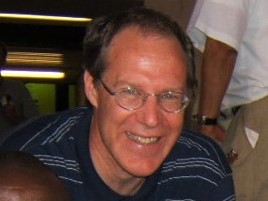
John Hildreth
John began his career as the Director of the Preservation Resource Center at the Preservation Society of Charleston in 1981. In his 34 years at the National Trust he rose through the ranks from Field Representative to serve as the Director of the Southern Regional Office, Vice President for Eastern Regional Field Services, and Vice President for Preservation Partnerships. Yet it is not in the titles, but through the scope and depth of his work, where the true nature of his servant leadership comes through.
When the Trust began talks a few years ago with the Lilly Endowment about what would become the $20 million National Fund for Sacred Places, I told our CEO that John was the right person to help conceptualize and lead this work. John is a man of faith who believes deeply in the importance of places of worship as community landmarks in all the meanings of that word. I knew well his empathy and concern for others, having watched it first hand through his work on providing housing and restoring communities in New Orleans following the devastation of Hurricane Katrina. I saw it first hand in Charleston with his work to help the parishioners of Mother Emanuel A.M.E. Church retain and preserve the physical manifestations of the outpouring of love and support received from around the world following the horrific shooting there in 2015. As the VP who built the National Fund, John has worked in a servant leadership arrangement alongside Partners for Sacred Places, congregations around the country, and his National Trust colleagues, helping preserve historic houses of worship and keeping them in active use.
John also exhibits the characteristics of servant leadership through his eagerness to hold up and celebrate forgotten stories of sometimes marginalized communities. It was with John’s support that one of his staff members brought the Pauli Murray House project to our attention a few years ago. This National Treasure, which now houses the Pauli Murray Center for History and Social Justice, is very relevant; not just as a historic site where a major figure of the civil rights struggles spent her formative years, but because of the work that is accomplished there today. John led the Trust efforts in the work to identify, save, restore, and reuse segregation-era Rosenwald Schools throughout the South. His desire to serve brought him in touch with thousands of alumni, the descendants of Julius Rosenwald, and local groups throughout the country. He will retire knowing that the creation of an endowment at the National Trust will support the preservation of these simple, yet iconic treasures.
The best test of servant leadership is this: do those served grow as persons? The Greenleaf Center notes that, “A servant-leader focuses primarily on the growth and well-being of people and the communities to which they belong.” There is, simply, not a better description of John’s career. “While traditional leadership generally involves the accumulation and exercise of power…the servant-leader shares power, puts the needs of others first and helps people develop and perform as highly as possible.”
John is closing out a consequential professional career that has made a difference in communities and in the lives of people living in those cities and towns. I’ve been honored to serve with him for parts of that journey. While he often reported to me, in truth, I was the one who was learning from him about true leadership and what really matters. It has been a privilege to count him as a colleague and a friend.
So in the best tradition of Max DePree, I want to say thank you, John Hildreth, for the example of servant leadership you’ve given to so many of us during the past four decades.
With best wishes for what comes next to you and Barb.
Have a great week.
More to come…
DJB
Installment #24 of The Gap Year Chronicles
Image: John Hildreth speaking at the Cincinnati Icons National Treasures event
I’ve always loved the old Utah Phillips tune Rock, Salt, and Nails. It has such a lonesome sound that connects on so many levels. And surprisingly, for a song that sounds so ancient, no one sings it with greater feeling than the young country singer Tyler Childers, who is featured this week on Saturday Soundtrack.
“By the banks of the river, where the willows hang down, Where the wild birds they warble with a low moaning sound, Way down in the hollow where the water runs cold, It was there I first listened to the lies that you told.
Now I lie on my back and I see your sweet face. The past I remember, time can’t erase. The letters you wrote me, they were written in shame, And I know that your conscience still echoes my name.”
Childers is from Kentucky, having grown up in Lawrence County where his father worked in the coal industry and his mother worked as a nurse. Like many a country musician, he began singing in church—in his case the local Free Will Baptist congregation. His grandfather gave him a guitar, he absorbed the music of the 1980s, and began writing songs. At 15, when his grandfather died, Childers turned to bluegrass as a way to remember him.
“Now the nights are so long, my sorrow runs deep. Nothing is worse than a night without sleep. I walk out alone, I look at the sky, Too empty to sing, too lonesome to cry.
Now if the ladies were blackbirds if the ladies were thrushes, I’d lie there for hours in the chilly cold marshes. And if the women were squirrels with them high bushy tails, I’d fill up my shotgun with rock, salt and nails.”
Childers first major studio album was 2017’s Purgatory, produced by Sturgill Simpson and David Ferguson, and it earned him a 2018 Emerging Artist of the Year award from the Americana Music Association. He released a live album, Tyler Childers: Live on Red Barn Radio I & II, in 2018, and last year saw the release of Country Squire, which has solidified his reputation as a major new player in the country music mix of artists like Simpson and Chris Stapleton.
All Your’nfrom Country Squire received a Grammy nomination as Best Country Solo Performance.
To my taste, Childer’s best work to date is the solo acoustic work you find on the Red Barn Radio sessions and on YouTube videos. Nose on the Grindstone, which hasn’t been included on one of his studio albums, is about a coal miner and addiction, and a poignant reminder of the pain of eastern Kentucky. That’s a recurring theme in his music. Childers is all about hard lives and hard loves, and his simple guitar playing and aching voice are a perfect match for these stories of pain and love. White House Road may be one of the best of these songs, as the singer from Paintsville, Kentucky—famous for its lawlessness, religion, and booze—puts his own spin on life in rural Appalachia.
When they lay me in the cold hard clay Singing them hymns while the banjo plays Tell those ladies that they ought not frown Cause there ain’t been nothing ever held me down Well the lawman, women or a shallow grave Same old blues just a different day
On a brighter note, 22nd Winter is about the first time Childers was snowed in at his in-laws. As he explains in one performance, it isn’t a blues, but a love song. Childers has clearly made his mark, and with that voice and songwriting ability he has a great future ahead.
Tyler Childers opens for Sturgill Simpson at the Anthem in the Wharf in D.C. on March 15th (sold out) and the 16th.
Enjoy.
More to come…
DJB
UPDATE: Due to closings amid rational, well-intended and well-studied efforts to slow the spread of infection, the Sturgill Simpson + Tyler Childers shows at the Anthem have been rescheduled for May 17-18, 2020.*
*Emily Winthrop had this right when she tweeted, “Hey media friends. Can we please stop saying things are closing “amid fears of coronavirus” when it’s actually “amid rational, well-intended and well-studied efforts to slow the spread of infection?” The frame of fear is helping no one.
Early in the beautiful Céline Sciamma film Portrait of a Lady on Fireyou notice the silences. They are as much a part of this wondrous work of art as the rough terrain, crashing waves, and gorgeous landscape. Set on a remote island off the coast of Brittany in 1760, the film begins as Marianne, a painter, arrives via a small ship tender after jumping into the sea to save the box holding the canvas for her work.
Marianne has been commissioned to do the wedding portrait of Héloïse, a young lady who has just left the convent and is to be married to a nobleman in Milan. Deposited on the rocky shore by the last man we see for a couple of hours, she finds her way to the mansion where Héloïse, a reluctant bride to be, lives with her mother and a young maid, Sophie. Marianne is told that she must paint Héloïse without her knowing, so they spend their days on long walks, with Marianne stealing glances at face and hands whenever possible. The silences have been there all along, but it is on those walks that the quiet between the conversation, the focus on gaze and view, along with the lack of a traditional musical soundtrack, becomes a key to the beauty of this film.
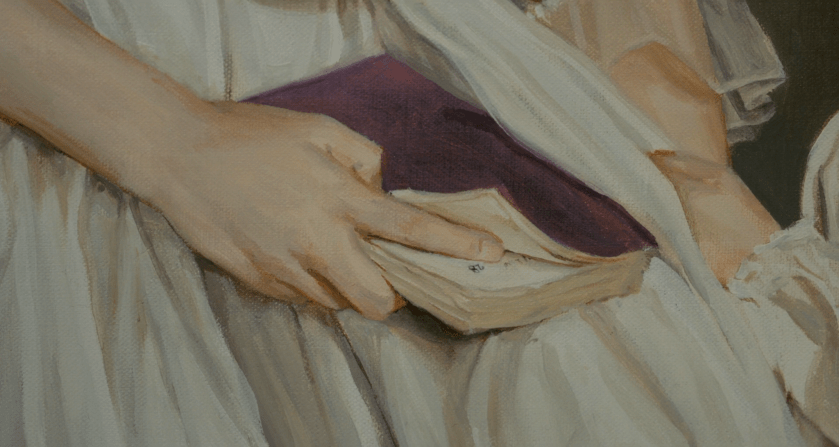
Told as a flashback, Portrait is a remarkable achievement on multiple levels. Hands shown in the cycle of paint applied and removed bring the viewer into Marianne’s worldview. The arresting cinematography captures the candlelit darkness of the mansion, where faces often are the only feature in the light, as well as the stark sun and rugged beauty of the coastline. We watch the love that grows between Marianne and Héloïse develop at a deliberate pace that somehow manages to convey both the urgency of the precious few days available to them when the mother goes to Italy and a romance outside time and space. The attraction of the lovers is sensual and real. There is a bond built between the two women of privilege and Sophie that is genuine and affecting. The movie is a triumph of love told from the woman’s viewpoint, yet the specter of the unwanted marriage to a man she’s never met is just one of several references to the stilting nature of patriarchy that is critical to understanding the exceptional storytelling that undergirds the film.
One of the most incredible musical moments I can recall seeing in any movie in recent history takes place just a little past the halfway point. Writing in IndieWire, Chris O’Falt describes the scene: “Marianne (Noémie Merlant) and Héloïse (Adèle Haenel) have yet to acknowledge their growing desire when they are brought to an evening gathering of the women who live on the isolated island in Brittany. As the two soon-to-be-lovers exchange glances across the bonfire, a low, slow chant starts to rise as the rest of the women gather to sing.”
Here the song grows as does the obvious feeling between Marianne and Héloïse, the women of the island begin clapping in groups of twos, and they begin to repeat a lyric. O’Falt continues.
In an effort to get a song that had the beats per minute, polyphonic, and polyrhythmic qualities she needed, Sciamma decided to write the lyrics herself.
“I wrote the lyrics in Latin. They’re saying, ‘fugere non possum,’ which means ‘they come fly,’” said Sciamma. “It’s an adaptation of a sentence by [Friedrich] Nietzsche, who says basically, ‘The higher we soar, the smaller we appear to those who cannot fly.’”
You can hear the song halfway through the official trailer, beginning around the 1:00 mark.
The musical feast is central to a larger group of scenes after Héloïse’s mother has left the island. The remaining three women — in very utilitarian fashion — eat, drink wine, and debate Ovid’s version of the “Orpheus and Eurydice” myth. Orpheus, in looking backward on his way out of Hades, dooms Eurydice, his lover, to remain in the underworld. Héloïse suggests that Eurydice told Orpheus to turn back to look at her. Marianne has a different interpretation, suggesting that, “He doesn’t make the lover’s choice, but the poet’s. He chooses the memory of her.” Soon thereafter the bonfire lights not only Héloïse’s dress, but also the love between Marianne and Héloïse, and the passion soon follows. The “turning back” at the end of the myth, returns to full force late in the film.
This is a wonderful story of love and remembrance. The powerful ending features the movie’s only other musical connection, with an orchestral performance of Vivaldi that is another memory for Marianne and Héloïse.
Portrait of a Lady on Fire is a stunning movie, created by artists who bring craft and vision to their work. It is well worth your time and emotional investment. In French with subtitles.
Birthdays that end in 0 are much easier for me to handle than the ones that end in 5.
I came to that rather trivial realization sometime over the past year. Approaching 30, 40, 50, or 60? No big deal. In fact, for that last one I used the occasion to gather 60 lessons I’ve learned over six decades. It was great fun.
The ones that end in 5, however? Umm…they seem to be more problematic. Perhaps it is because I’m suddenly closer to the next 0 and the next decade than to the one in my rear view mirror. At 35 most of us finally realize, if we haven’t already, that we are no longer a kid. At 45 you can claim with some degree of persuasiveness to fall in the middle age bracket, but that has its own set of challenges. (Mortgages, anyone?) By the time you hit 55 you are conscious of the fact that few people live to be 110, and you are face-to-face with all that implies. And at 65? Well, no one makes it to 130 so you have no claim to that middle age moniker. Of course, as if to drive that point home, at age 65 all the senior discounts, Medicare, and Social Security benefits kick in across the board. Not to mention aches in places you didn’t know existed.
Thankfully, I now have a very different outlook than when I reached 35, or 45, or 55. I am approaching my 65th birthday this week with a great deal more excitement for whatever lies ahead and what I’ve yet to learn, in whatever time is left. My gap year exploration of what’s next has certainly helped. Watching my father successfully navigate the final third of his life changed my perspective on the possibilities. But the primary reason that I’m optimistic is my recent work to look at personal experiences through a lens of remembrance without regret.
It hasn’t always been this way.
Regrets tend to lock us in a past where we constantly relitigate our actions. Truth be told, I’ve not always handled the “no regret” part of remembrance very well. From an early age I was a first-class worrier, and I still hold on to a part of that history. They may not matter to anyone else, but regrets matter to those who hold on to them. Regrets stop us from moving beyond past experiences in order to revel in fresh challenges. Yet we don’t realize that those past experiences, when ultimately faced, can turn out to be much less of an issue than they appear in our clouded memories.
I doubt there’s a person alive who remembers that at age 9, as I was playing in a piano competition in front of a room full of people, my memory suddenly went blank.
But I remember.
I stopped playing piano that day and suddenly found it took a great deal of effort to play any music in public, no matter how much I might love it. The regret of failure was too present. Knowing I wanted to move past this, I challenged myself at age 40, took a year of piano lessons, and then sat down in front of my teacher — and her group of elementary school students with all their parents — to play in a recital. And I aced it!
It was a step past regret to build new memories, new remembrances, of joy.
It is so tempting to sleepwalk through many phases of life, avoiding the places, literal and figurative, where we might have to face our regrets in order to learn anew. While these places appear countless times throughout our lives, major milestones often amplify their significance. The culmination of a career or the ending of a job, voluntary or otherwise, can be an occasion when regrets arise for work undone. The end of a relationship can push us to forget the wonder of a love once held outside time and space. Instead we focus on regrets and recriminations. When family and dear friends get ill and die, we struggle with regret instead of remembrance and, where possible, celebration. We forget the notes, and in the process overlook what brought us to love music in the first place.
The challenge to cut through the knot in the stomach is one I still face on occasion, more than fifty years after sitting all alone on that piano stool. But traveling through that challenge is necessary to reach these places where affirming memories are formed, connecting over time, to create our true identities. And the travel may very well be symbolic. “The real voyage of discovery,” as Marcel Proust once said, “consists not in seeking new landscapes, but in having new eyes.”
Thankfully, I realize there is so much yet to do. Musicians and actors I’ve admired have been incredibly productive later in life. Many of my favorite writers are still turning out meaningful work well into their seventh and eighth decades. I’ve always been fond of Madeleine L’Engle’s observation that “I am still every age that I have been.” It reminds me that simply because I am now well into the sixth decade, I don’t have to forget the astonishment that came so easily during the first ten years. We’ve all seen examples of people who, as they move through life, fear what’s next and want to hang on to what they have and what they wish to be true. As the writer Ursula K. Le Guin notes in No Time to Spare, these are the ones who have “given up on the long-range view.” I keep reminding myself: don’t be that person!
Fortunately, there are also those who, in her words, realize the incredible amount we learn “between our birthday and our last day.” If we are flexible enough in mind and spirit to recognize “how rich we are in knowledge, and in all that lies around us yet to learn,” we can maintain the seeking, trusting capacity for learning and life that we had as a two-year-old. We can build hope for the future grounded in memory.
Observing and listening to make sense of life leads to interior places not normally visited in our daily routines. But looking at this voyage of almost 65 years through new eyes helps me remember the basic things that make us human. It helps me find ways to get to the heartbeat.
I want to say thank you to the many family, friends, colleagues, and even strangers who have been there for me over 65 years. Your support has led me to a place where I now move quickly past feelings of regret to memories that provide a solid foundation for whatever is next.
You may, or may not, remember what you did to lift me up. But I remember.
New York-born Haitian-American multi-instrumentalist Leyla McCalla is the fifth and final featured artist in our Black History Month tribute to musicians at the forefront of the work to reclaim the African American contributions to folk, old-time, country and roots music. I kicked off the Saturday Soundtrack series with my January tribute to Amythyst Kiah and then celebrated throughout February the music of Rhiannon Giddens, followed by Dom Flemons, Otis Taylor, and last week’s artist, Keb’ Mo’.
McCalla grew up in the cultural mix of New York City but relocated to Accra, Ghana for two years while a teenager. She returned to the States to study cello performance and chamber music at NYU. Taking that knowledge—and “armed with Bach’s Cello Suites”—she left to play cello on the streets of the French Quarter in New Orleans. There she sang in French, Haitian Creole, and English, and played cello, tenor banjo and guitar. McCalla spent two years and gained greater fame as cellist of the Grammy award-winning African-American string band, the Carolina Chocolate Drops, alongside bandmates Giddens and Flemons. She left the group in 2013 to pursue her solo career.
I’ll begin this look at a small sample of McCalla’s music with the Haitian love song Rose-Marie, which she sings in this video from Delfest with the Chocolate Drops. Little Sparrowis a beautiful and sorrowful tune from the 2016 solo album A Day for the Hunter, A Day for the Prey. “Through deeply felt originals and interpretations of traditional songs,” her website notes, “the album depicts a diverse American experience and Leyla’s struggles with and acceptance of her own cultural identity.”
The witty official video of the tune Money Is Kingis from her 2018 album Capitalist Blues. The song highlights McCalla’s incorporation of traditional Creole, Cajun and Haitian music into her contemporary work. With this record, it has been suggested that McCalla is processing the current political environment in her own way. NPR noted that the album
“…imaginatively maps her vision of the Afro-Caribbean diaspora while gently taking Anglocentricism (and capitalism) down a notch. She’s partly in the moment and partly looking beyond it, and seeing truths that we’ve missed.”
Singing with Our Native Daughters, McCalla’s tune I Knew I Could Flyis based on an Etta Baker-style Piedmont Blues. I love this video because it has short explanations from McCalla on her the creative process interspersed with the music.
To close out this Black History Month special series, I’ll quote NPR again, to remind us of the importance of this work.
“The roots-music scene can display assimilationist tendencies, too, but it’s also home to a small but growing number of artists — including Leyla McCalla and her sometime bandmate Rhiannon Giddens, Hurray for the Riff Raff’s Alynda Segarra, Dom Flemons and Kaia Kater — who don’t stand by and accept the whitewashing of culturally distinct origins. Instead, their work does the intellectual labor of clarifying; of reconnecting the dots, reconstructing context, retelling and sometimes personalizing neglected stories.”
If I had just one piece of advice to give to colleagues, friends, and family, it would be pretty simple. Say “Thank you.” Say it early and often.
Two recent conversations raised this in my consciousness. First, a senior professional and former colleague was assisting an emerging professional with a networking and outreach discussion. They met, and because she was impressed, the former colleague offered up additional assistance. While a verbal thank you may have been given at the end of lunch, there was no follow-up communication after the initial meeting to acknowledge the gift of time and offer of additional assistance.
In a second instance, a friend mentioned that a member of her family found it difficult, if not impossible, to say thank you, even when she was the recipient of an extraordinary gift. These family members have had their differences through the years. But despite that, my friend expected an acknowledgement of minimal gratefulness. It never came.
Connecting to say thank you is, from my perspective, extraordinarily important. Saying thank you, as my Grandmother Brown was fond of noting, is just common courtesy.
But there is much more to gratefulness than meeting basic societal norms.
Saying thank you is a recognition that an interaction — from a minor courtesy to an extraordinary effort — has taken place and that you recognize and acknowledge the connection. The level of benefit you’ve received is immaterial in my book.*
People enjoy being thanked. They may shuffle, say “aw shucks,” and deflect the gratitude. But your effort to recognize someone else’s presence, their work, and the gift(s) they have given is (almost) always appreciated. Great leaders are very good at saying thank you. They do it early and often. In those few instances where people don’t appreciate being thanked, then recognize that saying thank you is good for you and your personal well-being.
Gratefulness is a recognition that we all count on the kindness of others: friends and strangers alike. No one got to where they are by themselves. Recognizing this basic fact of life is key to building circles of friends, networks of support, and real self-esteem. It is also key to a deeper understanding of grace.
A number of years ago I became intentional about saying “thank you” to someone every day. It is one of the smartest things I ever did.
Try it. You’ll (perhaps) thank me for it someday.
More to come…
DJB
*Oftentimes a thank you note or email does, however, acknowledge receipt of a gift. I don’t want to even think of the number of wedding and shower gifts we’ve sent over the years where we had to — after a long period of radio silence — reach out to the parents or even the recipients to ask if the gift was received. Don’t be that person.
What do the Houston Astros have to do with the state of our democracy? Let’s see.
Baseball—rightly or wrongly—has long been compared to life, or vice-versa. Washington sportswriter Thomas Boswell’s first book was a 1982 collection of essays entitled How Life Imitates the World Series.* In the essay that gave the book its title, Boswell makes the observation that the pressures in baseball differ from those of other sports. It is a pressure that ebbs and flows, day-by-day, over the length of a long season played out every day as opposed to the once a week or twice a week rhythm of the games in football, basketball, or hockey. Yet baseball pressures are heightened at key tipping points, such as during a pennant race, when one’s true character and strength comes through. Just like in real life.
What’s more pressure-packed than a World Series? Or an impeachment trial? Recently, it struck me that Boswell’s premise was perfect when the subject—as it often does these days—turns to the future of our democracy. To see how baseball and life overlap, let’s begin in Houston.
For those not immersed in baseball, the sports world is currently up-in-arms over the sign-stealing scandal by the 2017, 2018, and—perhaps—2019 Astros. In 2017, when Houston captured the World Series title, the Astros developed an elaborate and effective way to use a complicated computer program to decode the signs that the catcher was giving to the opposing pitcher coupled with center field cameras positioned to capture those signs in real time. Then—by the rather primitive method of checking a video monitor and banging on a trash can—they would relay those signs to their batter who was standing at the plate waiting for the pitch.
It is important to note that attempting to steal the catcher’s signs, if you are a player and on base, is a time-honored tradition in baseball. If the catcher and pitcher are sloppy enough to let baserunners see their signs and gain an advantage, then that’s their fault. Why does it matter? Well, if the batter knows that the pitcher is getting ready to throw a 95-mile-an-hour fastball, then he doesn’t have to hold back slightly to see if he is going to get an 88-mile-an-hour curve or an 85-mile-an-hour change-up. In other words, he can go all-in for the fastball. Given that a 95-mile-an-hour fastball travels the distance from the release of the pitch until it gets to the plate in around 425-450 milliseconds and a major league batter takes 150 milliseconds, on average, to get his bat around, it helps to know what’s coming. Good hitting verses a swing-and-a-miss or a pop-up or foul ball comes down to a few milliseconds.
Where the Astros went (way) over the line was in using video equipment (clearly illegal) and relaying those pitches from the dugout (also illegal). There are unsubstantiated rumors that some Astros batters received their signals from the bench via a buzzer they wore on their bodies. And while it is certain that the scheme took place in 2017 and 2018, no one is certain about this past year, when the Astros were shocked by the underdog Washington Nationals in the 2019 World Series. The Nationals went to great lengths to ensure that Houston’s sign-stealing scheme would not give them an advantage. However, Nationals’ catcher Kurt Suzuki is adamant that the cheating continued through last year’s fall classic. Thanks to the caution of the Nationals, it just wasn’t successful.
Major league baseball undertook an investigation after a former Astro pitcher became a whistleblower and turned in the team. Found guilty, there were major penalties assessed to the ballclub and its leadership, and the top two baseball men—the general manager and the manager—were subsequently fired by the owner. While the Astros ballpark is no longer named Enron Field, the stench of the corrupt energy company apparently remains imbedded in the brick and mortar in what is now known as Minute Maid Park. The team was penalized, but the commissioner decided not to punish the players and he also decided not to rescind the 2017 World Series Championship. That’s when all hell really broke loose.
Players as mild-mannered and upstanding as the Angels Mike Trouthave called out the Astros for “cheating” and have criticized the commissioner’s actions towards the players. Many have noted that players on other teams lost their jobs or were penalized with lower-paying contracts or loss of incentives because of Houston’s actions. Even sportswriters who specialize in humor columns are outraged, and know the right thing to do.
So what does this have to do with democracy today? A great deal, I would suggest.
The Astros have been less than contrite in admitting their guilt, and have taken on the characteristics of a tribe that protects each member and has each member’s back. Some have said, “We should have spoken up when we saw the sign-stealing, but didn’t.” Virtually the entire team has refused to use the word “cheat” in describing what happened. The owner claims that the cheating had “no impact” on the games. Right. There have been suggestions that others have done similar things (including the World Champion 2018 Red Sox), so it is okay. Some in baseball have called out the whistleblower, with Red Sox legend David Ortiz going so far as to call him a “snitch.”
Sound familiar?
This is what happens when the tribe and the need to win becomes more important than living by a moral compass and being guided by a larger purpose in life. When we look at our country today, it is pretty obvious that the president is comfortable with breaking not only norms but laws, if it gets him what he wants. Donald Trump has taken actions his entire life that fall on the other side of the law. He has openly admitted, and even bragged about, the illegal actions for which he was impeached by the House of Representatives. He has invited foreign countries in to tamper with our elections. After the Republican members of the Senate let him off on impeachment, he began punishing his perceived enemies, including decorated veterans and individuals he appointed to office, while pardoning his political friends. He has called the whistleblower, whose complaint began the impeachment process, a snitch and a traitor.
Donald Trump is who he is, and he hasn’t changed just because he shocked the world and became president of the United States. If it talks like a duck and walks like a duck, chances are really good it is a duck. But like the Houston Astros players, those who enable him as elected officials or members of the media have turned a blind eye to the cheating and stealing that is taking place right under their noses. The lack of a moral compass has never been more obvious.
There are multiple reasons people cheat at sports and in politics. Most relate to gaining and retaining power and money. In our country at the moment, both are on vivid display. But those involved often strongly deny they are cheating because they fear being called out as a fraud. With both the Astros and with Donald Trump, their over-the-top responses to the charges of cheating are made in response to a fear of an asterisk. They fear someone saying their “wins” weren’t legitimate.
People with a strong moral compass see through this charade. Robert Glazer has written that “Great leaders encourage dissent, welcome whistleblowing and encourage contrasting points of view. Weak leaders demand blind obedience and threaten those who would dare point out any shortcomings or question their decisions. What has become clear,” he continues, “is that when leaders lower the ethical bar, followers are compelled to do the limbo, resulting in the lowering of their own standards. It’s a downward spiral for everyone.”
Boswell—still writing about baseball going into his fifth decade—called out the Astros and, by extension, today’s Republican party:
“Once we are reminded of the great damage that cheating does, we are forced to see the cheaters not as mere rascals and rule-benders but as profoundly selfish and destructive people whose lack of a moral compass cannot be shrugged off with rationalizations that make us feel comfortable. Such as ‘everybody does it’—when we know they don’t. Or ‘why punish only the ones who get caught?’— when that’s exactly what we do in every area of daily life, from murder to insider trading.”
Or it is what we use to do…when we had a fully functioning democracy.
It will be the citizens of this country who decide if we will abandon our experiment in self-governance. Lewis Lapham puts the case forward in the following way:
“It isn’t so much that liberty stands at bay but, rather, that it has fallen into disuse, regarded as insufficient by both its enemies and its nominal friends. What is the use of free expression to people so frightened of the future that they prefer the comforts of the authoritative lie?”
Baseball. Democracy. There is a wide gulf between what matters at the core of these two enterprises. Yet, in many ways Boswell was right. There are so many similarities. And we see that today in knowing that we all have to make our decisions, when we reach those tipping points of pressure, on where we will stand. It may be helpful to remember that in one of the most influential works about the journey of the soul, Dante wrote that there is a special place in infamy for those unwilling to choose between good and evil.
In the end, not making a decision is a decision.
More to come…
DJB
*The context behind that proposition could be seen in his very first essay, which has the feisty title: “This Ain’t a Football Game. We Do This Every Day.“
Keb’ Mo’ has been playing traditional blues and roots music for more than three decades. So he seemed a natural to be included in our Black History Month tribute to musicians at the forefront of the work to reclaim the African American contributions to folk, old-time, country and roots music. I kicked off the series with my January tribute to Amythyst Kiah and then began it in earnest the last three weeks; first with a celebration of the music of Rhiannon Giddens, followed by Dom Flemons and then Otis Taylor.
Kevin Roosevelt Moore (rechristened Keb’ Mo’ around 1994) has been at the work of reclaiming disappeared African American musical contributions for his entire career. His inaugural album included two Robert Johnson covers and he has a well-earned reputation for his mastery of multiple blues styles. But it is his ability to combine traditional approaches with a contemporary attitude, while working with a wide variety of artists, that generates such enthusiasm for his work.
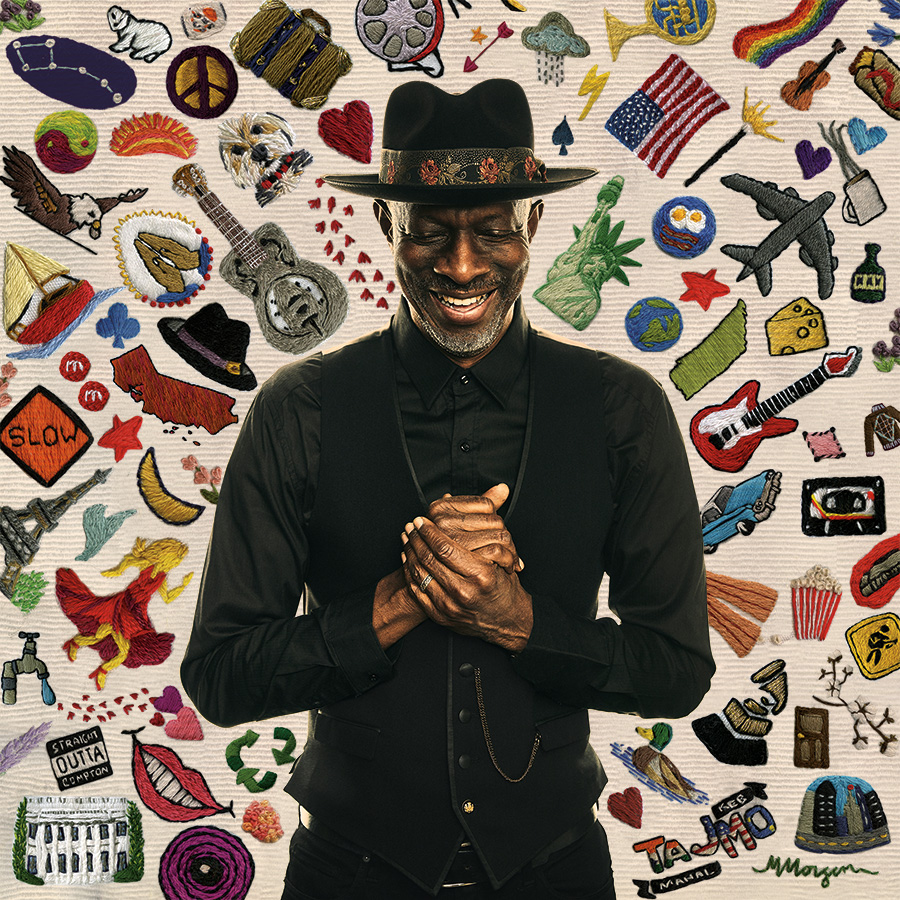
The cover to Keb’ Mo’s Grammy winning album “Oklahoma”
Keb’ Mo’ is more than just a highly skilled retro act. As Nashville Scenemagazine writes, he
“…manages the tough task of hovering in and around the blues while not being confined to them. His music creatively incorporates strains of multiple styles, among them folk, pop, gospel, jazz, even at times a Caribbean feel that reflects his earlier time playing steel drums and bass in a calypso band. He’s also a gifted songwriter, able to creatively craft standard 12-bar sagas and tunes with complex, unpredictable scenarios and situations….
His impact has also extended into a curator’s role with his involvement in the 2003 Martin Scorsese documentary series The Blues. So his genre bona fides are unquestioned, even as he continually weaves other elements into his work.
The music does indeed cover a great deal of ground, and I’ll just whet your appetite. Let’s begin with Robert Johnson’s Kind Hearted Woman, which Moore presents in a simple and beautiful arrangement. You can compare it here with Johnson’s original version from 1936.
As James Taylor says in his introduction to Hank Williams’ I’m So Lonesome I Could Cry from a performance at the White House, “Appalachian hymns, Texas swing, and the blues came together in Nashville to become country.” Keb’ Mo’ opens this heartbreaker by showcasing the blues influence that often gets lost in commercial country.
Put a Woman in Charge, with Nashville royalty Rosanne Cash, came at a time when Moore’s mother had recently passed away at the age of 91. He remembers, “She was smart. She was strong. She was a leader.” He dedicated the video of the tune to his mother, along with “amazing women everywhere that are getting the job done.” His version of Rosanne’s father’s famous Folsom Prison Blueson the tribute to Johnny Cash show demonstrates his skill at taking music from one genre and reinterpreting it in a way that makes it his own.
After gigs in New England in the early spring, Keb’ Mo’ will play two nights at the City Winery in New York City on June 5th and 6th. He’ll be at the famous Birchmere in Alexandria, Virginia, for two shows on June 10th and 11th, followed by dates at the Avalonin Easton, Maryland on the 12th and the Rams Head in Annapolis on June 13th.
The February 10th newsletter of Chapter 16, a website celebrating Tennessee literature, was titled Paying Attention. Editor Maria Browning writes that, to her mind, February is “the most fickle month of the year in Tennessee,” with shifts between the stirrings of spring and days of snow (or, worse, ice).
She continues, “Wardrobe challenges notwithstanding, this is a wonderful time to pay attention to the ever-dynamic natural world.”
Her suggestion for some inspiration led me to read “Eleven Ways of Smelling a Tree” by Sewanee writer David George Haskell. As Browning notes, the piece at Emergence Magazine is a collaborative effort, with musician Katherine Lehman and art by Studio Airport.
I’ve recommended Haskell’s The Forest Unseen in the past as a delightful book written by a scientist with the soul of a poet. “Eleven Ways of Smelling a Tree” has the same observational mix and magic. Haskell opens his piece with an ode to the American Basswood.
“Harlem, New York City Vintage: 1908
We crack the windows on summer’s first warm days. I taste diesel smoke, acid and oily. The fumes rise from the bus stop directly under the fourth-floor apartment. The odor sinks to my gut, a thin sheen. The ice-cream truck across the street runs its generator all day, into the night. Its exhalations cling high in my nose, a bitter sinus-cloud. Then, one morning in June, honey and wild rose reach through the window. Combustion odors flee. A hint of lemon rind rolls close behind.
All week, the street air is drunk on basswood flowers. The knots inside us loosen.
The tree is a giant, rooted in a roadside park across four lanes of gunning engines from our window….Herbalists and biochemists agree: tinctures and teas made from the flowers or leaves of basswood and its sibling, linden, soothe our harried nerves. The tree lays a calming green hand on anxiety’s brow, tranquilizes the neural pathways of pain, and weaves its aromas into the fractures in our central nervous systems. We breathe the tree, no longer dis-eased….
Another favorite among the eleven is Haskell’s description of the Ginkgo* (Sewanee, Tennessee; Vintage: circa 1930):
“The tree, a giant ginkgo planted in the early twentieth century, holds up a middle finger to college quadrangle aesthetics. I love it for its defiance. Here is messy fecundity on full display, an affront to the mown, suppressed conformity of the tidy campus lawns….
As I walk under the tree, I think, too, of the melted stone and metal of Hiroshima. The first and often the only life to grow back after the nuclear blast were ginkgo trees at the temples. Deep roots and physiological resilience carried the trees through a calamity that killed all else. Ginkgo’s ability to withstand assault also accounts for the tree’s presence on polluted city streets. The tree weathers the chemical and physical assaults of urban life and is a favorite of urban horticulturalists. Ginkgo is now mostly a species of the street, its roots sunk into sidewalk openings in Tokyo, New York, and Beijing….”
This gift is full of wonderful surprises. (Have you ever thought about the tree you are smelling in your gin and tonic?) Do yourself a favor, and click through to experience Haskell’s work. And when you finish, take the time to click through to “The Aromas of Trees: Five Practices,” which, as Maria Browning notes, will help deepen your own observations.
Enjoy.
More to come…
DJB
*Also check out the blog post from the Sewanee Herbarium on “When a Ginkgo is No Longer a Ginkgo.” I believe you will enjoy the transformation seen on campus each year.
Installment #21 of The Gap Year Chronicles
Image of the Ginkgo tree after it sheds its leaves at the University of the South at Sewanee (photo credit: Sewanee Herbarium)