It is surprising that a field that has focused so much on the preservation of history has an unfortunate blind spot to its own history. Historic preservation is one of the longest-lasting examples of community development, land use reform, and public history in the United States. The stories of the past efforts of our fellow citizens to ensure that parts of our history are with us today and tomorrow are varied and fascinating. Yet many, both inside and outside preservation, tell themselves a simplistic and usually inaccurate story of how we came to value parts of our past in a country that too often only values the new and what’s over the horizon.
Giving Preservation a History
The recently released second edition of Giving Preservation a History, edited by Randall Mason and Max Page, is a strong attempt to reverse our trend at historical amnesia in the preservation field. Through seven essays retained from the first edition, six new essays prepared for the 2020 book, and two concluding chapters to wrap both works together, the editors have endeavored to put forward arguments that may rebut old myths around the elite nature of the movement’s founding while also challenging the field to consider how it has fallen short in the embrace of multi-culturalism and issues of social justice. Like much else in life, historic preservation has a mixed, layered history. But it is a history worth considering, for those who care about the future of the movement.
One of the best essays of those retained from the first edition is Mason’s own contribution, “Historic Preservation, Public Memory, and the Making of Modern New York City.” Mason begins by busting myths, such as the one which suggests that preservation in the city began with the 1963 destruction of Pennsylvania Station. Another myth holds that “preservation emerged in the nineteenth century as the marginal gesture of a dying elite, and has stayed that way.” In a contrary point of view, Mason shows that by the 1900s, “preservation was thoroughly embedded in broader economic, cultural, environmental, and other social processes driving urbanization.” He takes the reader through the efforts of those working to save the historic houses we traditionally associate with early preservation efforts, such as the Morris-Jumel Mansion that overlooks the Harlem River in Upper Manhattan. But he also examines the broad scope of the mission of early preservation groups dealing with “past, present, and future”— organizations such as the American Scenic and Historic Preservation Society—which projected a “holistic vision of a landscape in which towns and cities were enriched by the presence and preservation of historic landmarks and natural places.” In his study of New York City, Mason outlines these contrasting curatorial and urbanistic approaches to preservation, the latter including individuals who “saw preservation as one aspect of their larger project of transforming the city and its citizens,” work that put the field squarely in the midst of other early 20th century reform efforts.
From the essays new to the second edition, I found Stephanie Ryberg-Webster’s contrast of the varying degrees of success in integrating preservation into community development in Pittsburgh and Cincinnati to be enlightening and helpful to practitioners active today. Amber Wiley’s study of Washington’s Dunbar High School controversy digs deeply into issues of power and African American cultural heritage. Gail Dubrow’s overview of LGBTQ preservation initiatives is also a helpful scan of the growth of this important segment of preservation work in the late 20th and early 21st centuries. Having been a part of some of the discussions and decisions she describes, I would quibble at the margins with her descriptions of the motives of the National Trust in a few instances. More importantly, I would also call out the Trust’s significant and ongoing role in the saving of the Pauli Murray Family Home in Durham, North Carolina, a fact which goes unmentioned in the essay.
This is an important work in the growing understanding of the history of historic preservation. The book is not without its issues, however. On the minor side, several copy-editing errors popped up in ways that were annoying in a book of this caliber. The editors and authors deserved better from the publisher. Somewhat more significantly, of the city-specific case studies, the vast majority focus on communities and issues from the original thirteen colonies. (The best of those that break from the bonds of the east coast is Chris Wilson’s excellent look at Santa Fe from the original edition in “Place Over Time.”) The editors’ stated intent on promoting preservation as a force for broad social change led to certain decisions on the topics to be included. There is much to be learned, however, from study of the issues facing preservationists and communities beyond the east coast which would enrich any history of the movement.
Giving Preservation a History reminds us that understanding our own past is worth knowing as we envision the future. With the preservation movement adapting amid significant societal change, those who understand this past are best equipped to use preservation as an effective tool today and tomorrow.
Recommended.
More to come…
DJB
Image: New York City’s Morris-Jumel Mansion (photo credit: Library of Congress)
Depending on your age and where you lived, your childhood construction toys of choice may have been Tinkertoys (my favorite); Meccano (if you or your grandparents were European); an Erector Set (I may still have the scar from falling off the top bunk onto one of our construction sites); or Legos (our children’s favorite).
I started thinking about construction toys while standing on the top level of the Silver Spring transit center this afternoon, talking with an engineer, and looking down at the vast construction site that is now our front yard (of sorts). My mind wandered to, “These men and women on the site below may have started out on the family rug many years ago with the Erector Set.” Some of them may, in fact, be living their dream!
View from the Sarbanes Transit Center of the Purple Line construction site in Silver Spring
For the past twenty years, we have lived in downtown Silver Spring. We cross a relatively narrow residential street and a small plaza set in the center of an office complex to get to the Metro station, which houses the Red Line. I use to say that I rolled out of bed and onto the train to get to work. Five years ago the multi-modal Paul S. Sarbanes Transit Center opened next door to the station (after a host of embarrassing construction problems), to consolidate bus lines and other forms of transportation. And in 2022 or 2023 (depending on who you believe), we will have a new Purple Line light rail station as well as a downtown connection to the Capital Crescent Bike Trail which goes from Silver Spring to Georgetown (and connects with other bike trails on both ends). It is this Purple Line project that has me walking the edges of the construction site on a daily basis, taking pictures to send to my children, and—yes—thinking about Tinkertoys.
View from the corner of Second Avenue (our street) and Colesville Road toward the Metro station for the first of what promises to be a long line of weekend road closures)
We’ve watched for the past year as sites were cleared for the light rail; massive concrete and steel girders were constructed to support the elevated Purple Line and Capital Crescent Trail tracks; and cars, buses, pedestrians, and bicycles were rerouted on a regular basis. But beginning in early January, the first of what promises to be multiple weekend closings of Colesville Road took place. It was time, dear reader, to begin the process of flying the Purple Line tracks over the Red Line and a major four-lane highway in the heart of our city.
In January, the construction crews—working 24 hours from Friday evening until Monday morning—placed the bridge for the Capital Crescent trail across Colesville Road.
Capital Crescent bridge over Colesville Road under construction. The concrete girder in the center is to hold the Purple Line bridge.
As planned, the Purple Line will rise over the existing Red Line tracks, beside the Transit Center, before coming down to ground level near the intersection of Bonifant Street and Ramsey Avenue. We began to see the approach for this bridge show up in early February.
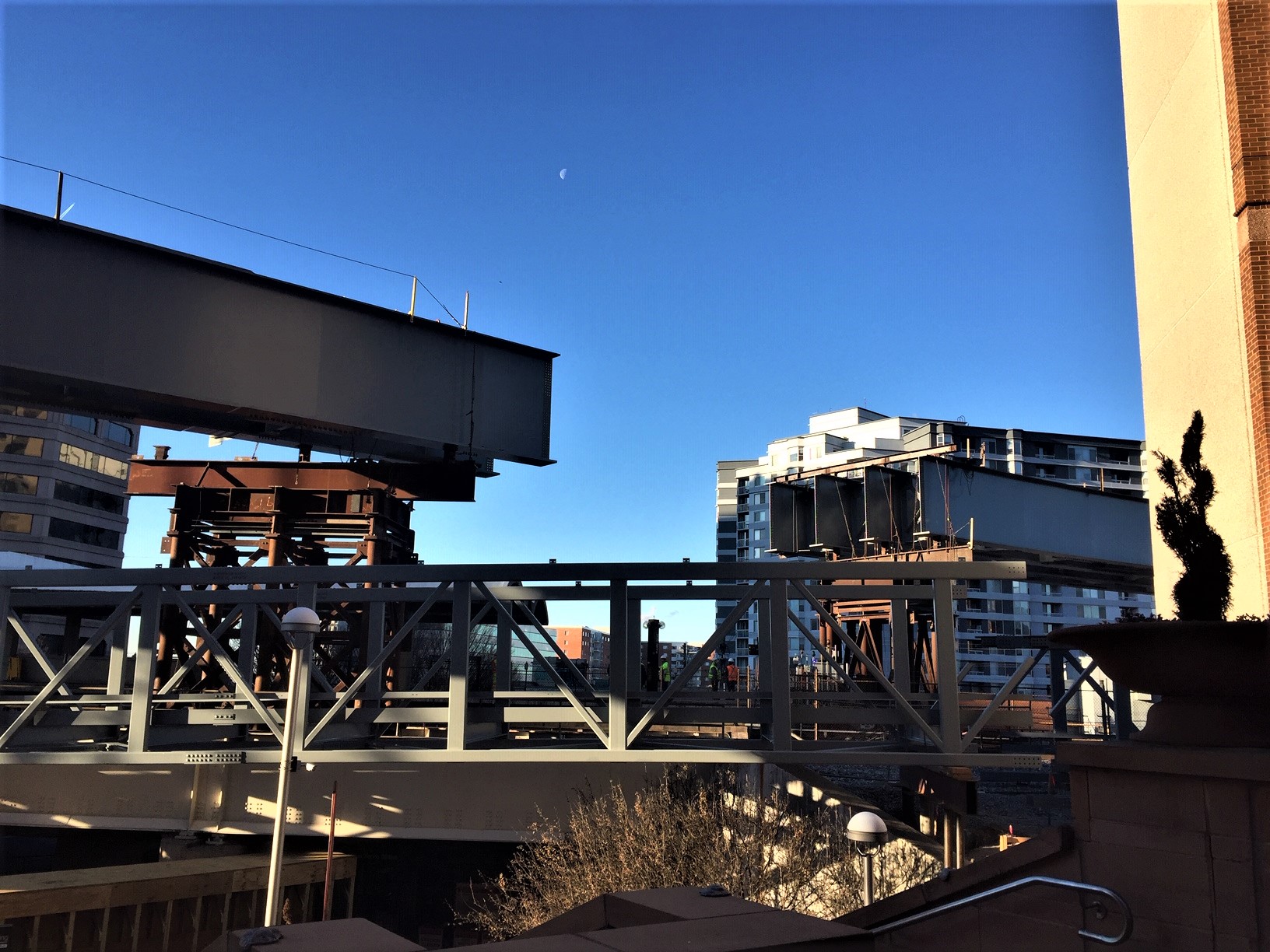
Purple Line bridge under construction as it begins to rise over the Silver Spring Metro Station and the red line. View from the Metro station platform, looking north.
The construction crews chose this weekend — President’s Day — to take advantage of the Monday holiday and begin to connect the light rail bridge over the metro tracks and up to the edge of Colesville Road.
Construction crews begin to connect the light rail bridge over the Metro tracks
Light rail bridge comes to the northern edge of Colesville Road
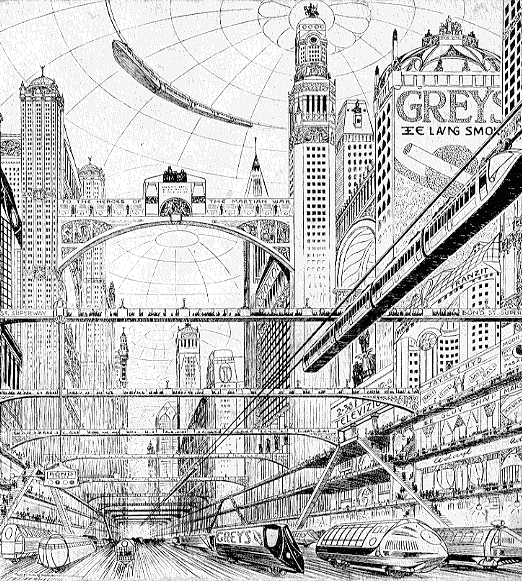
As I’ve talked about this project with friends and family, I’m often asked, “What’s it like?” My answer is always the same. Remember those great pictures from the 1900s showing an artist’s depiction of the city of the future? Well, here it is. We have your multi-modal transportation systems, with tracks flying over other roads and railways, and everything appears to be humming along without any problems.
Funny how the future didn’t quite turn out that way.
Grey’s “London of the Future”
Downtown Silver Spring has been a perpetual construction zone for much of the time we’ve lived here. We’ve seen changes for the good (such as the well-designed courthouse across the street from us, that replaced a gas station which doubled as a drug dealing hangout.) We’ve seen changes that aren’t to our taste (such as the proposed design for the downtown Silver Spring development). We’ve certainly seen construction delays, screw-ups, miscommunication, and more.
In two weeks time, Colesville Road will be closed again so that the bridge span across the highway can be completed.
But this is just one more stage to live through. As I was traveling by car to Bethesda several nights in a row a few weeks ago to catch the final six Best Picture films, I often had the thought: I wish I could just jump on the Purple Line train. Give it a couple of years. Until then, just watch your head as you come visit us.
More to come…
DJB
P.S. – For those who want to keep up with the project, visit the gallery pages for the Purple Line website.
Singer, songwriter, and multi-instrumentalist Otis Taylor is the next featured artist in our Saturday Soundtrack Black History Month tribute to musicians at the forefront of the work to reclaim the African American contributions to folk, old-time, country and roots music. I kicked off the series with my January tribute to Amythyst Kiah and then began it in earnest the last two weeks; first with a celebration of the music of Rhiannon Giddens, followed last week by Dom Flemons.
Otis Taylor was born in Chicago but moved to Denver early in life with his family. Taylor’s parents were jazz music fans. “My dad worked for the railroad and knew a lot of jazz people,” notes Taylor, while his mother “had a penchant for Etta James and Pat Boone.”
Their house in Colorado was near the Denver Folklore Center, where he bought his first instrument, a banjo. During a NPR Music Tiny Desk concert, Taylor tells how he broke a string on his mother’s ukulele and went to the Center to get it fixed. While there, he became entranced with the banjo, and “never left.” The staff at the folklore center saw this African-American kid from the poorer side of town and gave him free lessons. It wasn’t until much later—when he was, in fact, listening to NPR—that Taylor learned of the African roots of the instrument and became dedicated to bringing that part of the banjo’s past to life.
A music store, concert hall and instrument dealer, the Folklore Center was, “four blocks from my house, and every day after school I’d sit there and listen to records and play their instruments,” Taylor says in an interview in No Depression magazine. “It was a really wonderful experience, and my home away from home.”
As a teenager, Taylor use to play the banjo while riding his unicycle to high school, which melded his love of the instrument with his love of cycles. The Folklore Center was also the place where he first heard Mississippi John Hurt and country blues, and where he learned to play guitar and harmonica. By his mid-teens he had formed his first group and began to play around the country and overseas, including a stint in the T&O Short Line band with legendary Deep Purple singer/guitarist Tommy Bolin. Taylor took an almost two-decade hiatus from the music business in 1977, during which he established a successful career as an antiques dealer and also began coaching a professional bicycle team.
Taylor explains that his blues “is more closely related to African tribal rhythms, which don’t rely on chord changes.” The banjo’s droning fifth string also contributes sonically to his primal sound. The NPR Music Tiny Desk concert from 2011 highlights his mesmerizing banjo work, beginning with the haunting Ten Million Slaves.
The banjo’s history is even more complex than the one that has emerged in recent years through the exposure of millions of Americans to the music of groups like the Carolina Chocolate Drops. The instrument did come to America from Africa, via the Caribbean, brought here by enslaved Africans. Not only the instrument, but string band music itself was appropriated from enslaved communities and spread into the greater American popular culture through minstrel shows and blackface performances. And the banjo was used for a variety of styles, not simply old-time and bluegrass string music.
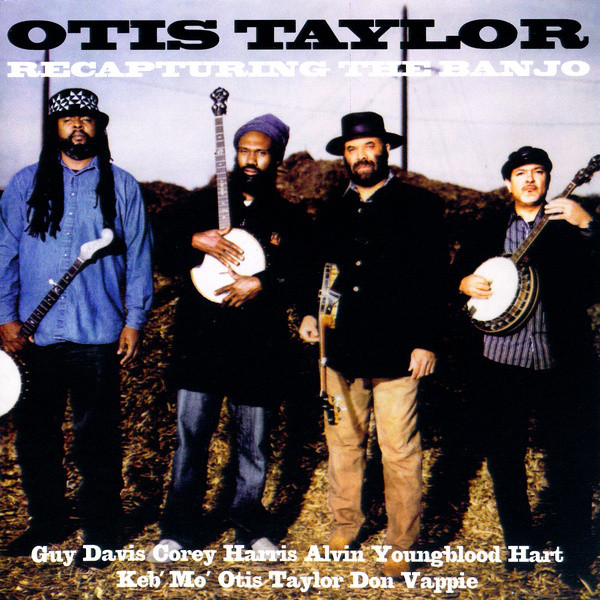
Otis Taylor’s “Recapturing the Banjo”
Otis Taylor’s work on the banjo showcases these different influences as he has played his style of blues throughout a varied career on stage and on record. In 2008 he released an album entitled Recapturing The Banjo, in which he layers the instrument on a variety of songs and styles. No Depression suggests that “retools” might be a better word. The writer notes, “Recapturing The Banjo allows him to jump-start the historical continuum while relaxing—if that’s the word—with material that stands ready for recontextualization.” The Archives of African American Music and Culture suggests that the album’s “roster of musicians and their diverse contributions render the idea of a uniform ‘black’ way to play the banjo dead on arrival.”
His most recent recording, Fantasizing About Being Black,
“…is a stark and poetic lesson on the historical trauma of the African American experience, from the voyages of slave ships to the Mississippi Delta. Taylor simultaneously travels back in time while moving forward as a musical artist. Blending his unique songwriting and the compelling musical approach that he calls “trance blues,” the recording—on Taylor’s Trance Blues Festival label—inspires with stories of the enduring human spirit, letting its hypnotic sound as well as Taylor’s lyrics tell a story of continuing struggle.
The artist explains that his 15th album is about ‘the different levels of racism in the African American experience that are unfortunately still with us today. The history of African Americans is the history of America,’ Taylor says.”
The Otis Taylor Santa Cruz signature model guitar
Taylor also has one of the most beautiful and unique signature guitars I’ve ever seen, the Santa Cruz Otis Taylor model. As the company’s web site notes, “As a fine arts professional, Otis Taylor’s vision is a combination of vintage retro and ultra sharp European styling; this guitar looks like an expensive Italian suit from the 1930s.” I couldn’t agree more. The fact that the guitar doesn’t have frets above the 14th fret is because Taylor said, “I never play up there.” Here on video he puts the guitar through its paces, showing the various strengths of this instrument. Otis Taylor’s father, Otis Taylor Sr., was an artist and he signed his paintings with the distinctive OT logo, found near the guitar’s soundhole. Otis has said that “using that signature made the guitar feel even more special, more linked to his family, yet the very modern look is a beautiful complement to the whole instrument.”
Nasty Letter, from the movie Shooter, showcases Taylor’s songwriting and his skills on his signature guitar. When the Wind Come Inis an example of trance blues, also played on acoustic guitar.
Taylor’s website bio has a good summation of what makes him such an interesting musician.
“Part of Taylor’s appeal is his contrasting character traits. But it is precisely this element of surprise that makes him one of the most compelling artists to emerge in recent years. In fact, Guitar Player magazine writes, ‘Otis Taylor is arguably the most relevant blues artist of our time.’ Whether it’s his unique instrumentation (he fancies banjo and cello), or it’s the sudden sound of a female vocal, or a seemingly upbeat optimistic song takes a turn for the forlorn, what remains consistent is poignant storytelling based in truth and history.”
But then she adds, “the flip side of ignorance is astonishment, and I am good at astonishment.”
“Late Migrations: A Natural History of Love and Loss” by Margaret Renkl
So many today seem content to settle in the midst of their ignorance and not face life with astonishment, awe, and a sense of wonder. As Renkl shows, that approach is their loss, but also, in many ways, ours as well. We are all connected, humans and non-human. Those who choose to abandon a sense of astonishment and wonder and settle in their ignorance continue to make decisions—often with very harmful consequences—that affect every other thing on this planet.
“Every day the world is teaching me what I need to know to be in the world,” Renkl writes in another passage in this beautiful collection of short essays about nature, family, community, love, and loss. Late Migrations opens the reader up to Renkl’s experiences growing up in Lower Alabama and the inevitable imperfections of life. We are all drifting towards death, as Renkl explains so lovingly to her three-year-old in the essay “All Birds?” (As in “All birds die? All dogs die? All teachers die? All mommies die? I will die?”) Yet we are missing why we’re here if we don’t inhabit this imperfect world fully, with astonishment and awe.
Renkl’s story is like so many others. She lives with generations of strong women; grapples with how the men and women in her family deal with poverty, grief, and loss; and moves from her cherished countryside to cities that have much to offer, but require work to maintain her connection with the natural world. Where Renkl differs from those sleepwalking through life is in her powers of observation and the willingness to examine, re-examine, and re-examine again her own story. In doing so, she unfolds that inclination to be astonished in bits and pieces which come together for the reader as a coherent and very engaging whole.
I was reading Renkl’s book while many in our country were wallowing in their ignorance, refusing to re-examine decisions and “knowledge” that is clearly hurting them and their fellow travelers in the world. A capacity for astonishment has been replaced, too often, with a capacity for self-delusion, a focus on fear, and a need to “own” those who are different. Hate—the emotion that so often results from these decisions—is based on ignorance and a refusal to learn from the world that is around us about how to live in the world. It seems easier to live within our tribes and follow authoritarian leaders who will do our thinking for us. And simply because someone has a formal education, it doesn’t mean that they have stepped out of their ignorance.
Renkl now lives in Nashville, writes regular opinion columns for the New York Times, and was the founding editor of the wonderful Chapter 16, an online community celebrating Tennessee literature. Her self-taught naturalist tendencies remind me of how our powers of observation can open up worlds that we too often think of as reserved for the experts. Renkl’s love and care for the natural world reminded me of the writings of another Tennessee-based writer, biologist and poet David George Haskell, in The Forest Unseen. Haskell’s work over his year in the forest outside Sewanee was an attempt to “put down scientific tools and to listen: to come to nature without a hypothesis, without a scheme for data extraction, without a lesson plan to convey answers to students, without machines and probes.” Listening—as both Renkl and Haskell demonstrate—moves us beyond what we know and into the deeper knowledge to be found when we tap into the roots of nature and humanity.
“My favorite season is spring—until fall arrives,” Renkl writes in this highly recommended debut, “and then my favorite season is fall: the seasons of change, the seasons that tell me to wake up, to remember that every passing moment of every careening day is always the last moment….”
Wake up. Be astonished. Have a good week.
More to come…
DJB
Image by Sergey Nemo from Pixabay. The flip side of ignorance is astonishment
Singer, multi-instrumentalist, and musical historian Dom Flemons is the next featured artist in our Black History Month tribute to musicians at the forefront of the work to reclaim the African American contributions to folk, old-time, country and roots music. I kicked off the series a little early with my January tribute to Amythyst Kiah and then began it in earnest last week with a celebration of Rhiannon Giddens. This week we’ll look at “The American Songster,” a name Flemons has earned with a repertoire that covers over 100 years of American folklore, ballads, and tunes.
Don Flemons at Red Wing 2016
Along with Giddens and fiddle player Justin Robinson, Flemons was one of the co-founders of the influential African American string band the Carolina Chocolate Drops, playing with the group from 2005 until 2014 when he left to begin a solo career. He has performed at a wide variety of venues with a range of collaborators, including English folk legend Martin Simpson and Old Crow Medicine Show. (He has a cameo in the latter’s hilarious official video for their song Brushy Mountain Conjugal Trailer.)
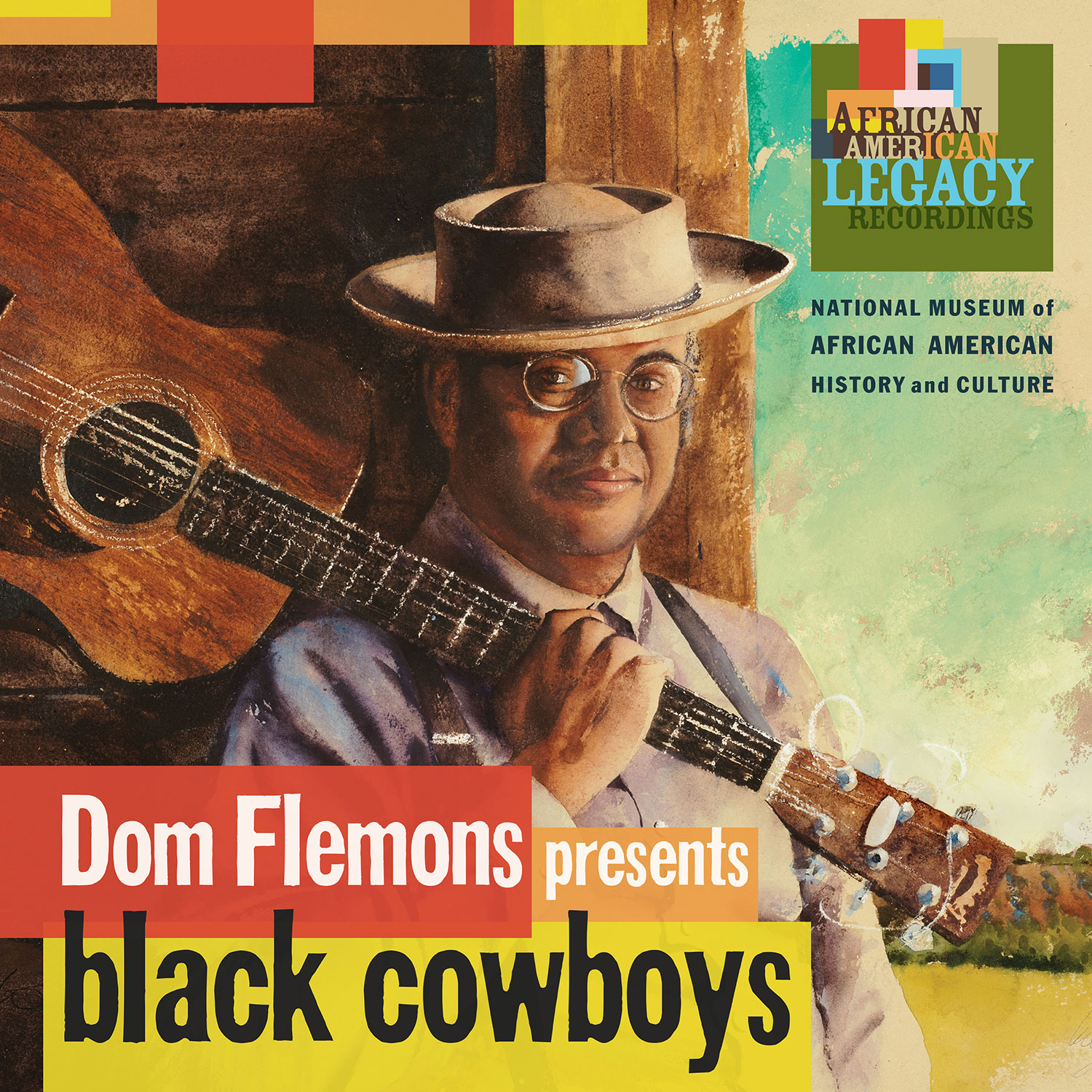
In 2018, Smithsonian Folkways released the album Dom Flemons Presents Black Cowboys. This project “sheds a light on the music, culture, and the complex history of the golden era of the Wild West” while celebrating “the thousands of African American pioneers that helped build the United States of America.”
He’s a Lone Ranger is from that album and tells the story about Bass Reeves, the first African American U.S. Marshall west of the Mississippi.
Don Flemons wows the crowd at Red Wing with his brand of old time music
I was fortunate to hear Flemons with the Chocolate Drops in 2009 at Merlefest, and then caught him again in 2016 at the Red Wing Folk Music Festival. He is a consummate performer, bringing high energy and deep historical context to his music. You can see that in his live performance of Hot Chickenfrom the New York Guitar Festival. Going Down the Road Feelin’ Badis a song heard in many traditions. Flemons plays it here from his Black Cowboys album.
And those who want to learn how to play “the bones” need look no further than Flemons short video where he demonstrates his style by using the tune Cindy Gal in How to Play The Bones.
For those in the Washington, D.C. region, Dom Flemons plays the Barns of Rose Hill in Berryville, Virginia, on Friday, February 21st.
An annual feature of More to Come is my take on the movies nominated for the “Best Picture” Oscar. However, it wasn’t until the 2019 Academy Awards show that I saw all of the nominees for the year in question. I was determined to do it again in 2020, and as of late yesterday evening, I’m pleased to say, “Mission Accomplished!”
I always remind readers that I make no claims to be a movie critic. These are personal views without any understanding of the nuances of filmmaking and without a deep well of knowledge of the movies of the late 20th and early 21st century. (I’ve come late to the joys of film.)
There is usually at least one movie I really loved that didn’t make the cut, and that’s the case again in 2020. I thought filming Aretha Franklin—at the height of her musical powers in 1972—singing 90 minutes of gospel music in a black Baptist church in Los Angeles, was transcendent cinema. As I wrote in my initial review of Amazing Grace, you have that voice, which is a national treasure, so what else do you need? But documentaries are not going to be considered for Best Picture awards.
As for other films that didn’t make the cut, I very much enjoyed The Farewell, would see it again, and would have ranked it high in the Best Picture category against the other competition. If you haven’t seen it, I highly recommend it. Also, I loved A Beautiful Day in the Neighborhood. This story of children’s television star Fred Rogers is a well-made and well-directed movie about an uplifting theme, focused on a hero that we desperately need in these times, and starring one of our most beloved actors of the era. While neither may be the year’s “best” picture, they are—spoiler alert—much more satisfying than Joker. I also found The Last Black Man in San Franciscoto be a very thoughtful film, but I’m not arguing that it should have made the list.
(First Intermission: I apologize up front for the length of this post. The only thing longer is The Irishman. More on that in a bit. I usually break these reviews into 2-3 posts, but the fact that I saw five in the last seven days—all on the big screen, no less—pushed me to place all my reviews in this one post. However, the last week of binge movie watching was a lot of fun and made all the movies fresh in my mind, so I’m not too sorry about the length.*)
This was a tough year to pick a winner, as there were several very good films but no obvious standout for me. Plus, these movies were all over the place. However, three of the films separated themselves from the pack, so I’ll start with this top tier. And, much to my surprise, the ranking of those three changed with the movie I watched last evening.
My choice for Best Picture: The Irishman
I wasn’t sure how I was going to respond to The Irishman, other than assuming I would squirm (and worse) through the 3 hours and 29 minutes of runtime. But I was captivated right from the beginning and remained engrossed all the way until the end of Martin Scorsese’s mobster epic. The Irishman is a finely crafted character study of hit man Frank Sheeran—played in an incredible performance by Robert De Niro—who looks back on the choices he made that shattered his life and that of his family and friends.
De Niro, Al Pacino as the charismatic and temperamental Teamster boss Jimmy Hoffa, and Joe Pesci as the ruthless and ruthlessly efficient crime boss Russell Bufalino are naturals for these roles. The immense talent both in front of and behind the camera comes through with every shot and scene. The movie also has excellent supporting actors as well, and I was especially taken with Kathrine Narducci as mob wife Carrie Bufalino, Ray Romano as Russell’s son Bill Bufalino, and Anna Paquin as Frank’s daughter Peggy Sheeran. It is her estrangement from her father—with the final break coming after a gripping few seconds of locked eyes as the news of her beloved “Uncle Jimmy” Hoffa’s disappearance is announced on the news—that tears at Frank for the rest of his life.
The last forty-five minutes of the movie, when we are shown more of how Frank came to be telling this story, is a moving look at the end of life and how choices can lead to moral isolation that is crushing in its effect. This is clearly a film Scorsese wanted to make at this point in his life. And that final coda made the length not only bearable, but absolutely necessary.
Since someone has to win Best Picture, I’m going with The Irishman. I could happily support either of the next two on the list, but Scorsese has made a film that brings together so many pieces from his illustrious career and, I believe, will stand the test of time.
Movie poster from “Parasite”
Before seeing The Irishman, my vote for Best Picture was headed toward Parasite, a strange dark comedy out of South Korea that is more than worthy of the Oscar. The story of the intertwined lives of the poor Kim and wealthy Park families is full of unexpected twists and turns, right down to the end. The contrast between the city slums where the Kim’s live and the Park’s beautiful architect-designed house hits at the inequality that is at the heart of this story. It also reminds you of how so many of us have no idea how others live and survive.
The ensemble acting in Parasite is very strong, and I appreciated how all the characters played off each other to great effect. The first half of the movie is a classic heist film, and you’re watching in fascination, wondering if the Kim family will get away with it. However, Parasite isn’t really a clash of classes (although many have suggested that it is), as the wealthy Park family are generally sympathetic characters and the Kim family certainly acts like a bunch of rogues. As the movie twists towards its unexpected, and unexpectedly violent, ending, the story of the suffocating nature of the system, and how it drives all of us into becoming parasites, pushes the viewer to think about uncomfortable issues. In spite of the fact that the ending violence is Tarantino-like, it seems to have more of a point within the movie as a whole. Parasite is, in my view, a terrific piece of film craft and I would recommend it highly.
I’ll note that the Academy had the chance to do the right thing last year. I picked what should have been the first foreign language film to win the Best Picture award in tapping Romain my wrap-up before the awards ceremony. Alas, the Academy went with the safe—and not very good— buddy film Green Book. Maybe they’ll right that wrong this year. Of course, it may be best to remember what the director Bong Joon-ho has said: “’The Oscars are not an international film festival,’ he said airily when quizzed on the subject. ‘They’re very local.’”
Also high on my list is 1917. This story of two soldiers tasked with stopping a battalion’s march into a death trap during World War I grabs you right from the beginning and never lets go. We’re each pulled along with nary a chance to catch our breath. Much has been written, appropriately, about the “one-shot” filming technique to let you see the story as through the eyes of a soldier, and that perspective keeps you riveted. The depiction of the trench warfare of World War I was effective and gripping from an emotional perspective. We’ve seen so many movies about World War II and Vietnam, but many people do not know as much about this earlier conflict which set the world on a path of endless war. Without going into which side was right or wrong, the film, to me, focuses on the general horrors of war.
In that vein, I was also taken by how young our two heroes are, and how much we’ve sacrificed our youth for stupid ideology and power. 1917 reminded me again of how modern warfare began during the American Civil War, but the level of brutality and slaughter really came of age in the second decade of the 20th century. I also recommend this movie as one not to miss.
Following the top tier, I have bunched three other movies closely together in the middle. They are very different, all have problems, and while perhaps not Best Picture quality they are very good nonetheless. The order of these three could be picked out of a hat, from my perspective.
I was surprised by how much I enjoyed Ford vs. Ferrari. I’ve never been a big car enthusiast, and I certainly do not follow auto racing as a sport. However, many reviewers commented that this was a classic “Dad movie,” so perhaps I liked it because I clearly fall into that category.
But seriously, there is so much to admire in this movie, beginning with Christian Bale, who plays the British-born race-car driver Ken Miles. Is there anyone Bale cannot play? (Trick question. The answer is no. Just look at his list of credits. I’m still amazed that this is the same actor who played Dick Chaney last year in Vice.) Bale and Matt Damon, who plays American race-car designer Carroll Shelby, have great chemistry throughout the film. Tracy Letts, as Henry Ford II, is another terrific addition to what makes this film work, as his insecurities come through the bluster. One of the best scenes I’ve viewed all year is when Shelby takes Ford (or The Deuce, as he’s called) out for a wild ride in the race car they are developing. After being scared out of his wits, the car stops and Ford cries for what seems like an eternity, and you wonder if the tears are of fear or joy. (Spoiler alert: they are both.) Oh, and did I mention the incredible race car scenes. While the ending is a bit weak (this is based on a real-life story, so you can Google it to see what happens), this is an excellent movie which I highly recommend. I’m glad I got to watch this in the theatre on the big screen. (Did I mention the race scenes are grip-your-seat good?!)
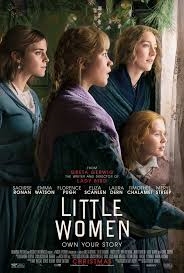
Movie poster for Little Women
Greta Gerwig’s adaptation of the classic Little Women probably won’t win Best Picture, but perhaps it should. It is a top notch film that tells a story which resonates beyond the 19th century setting. Full disclosure: I’ve never read the novel. However, I quickly picked up the story line and most of the time switches, and found it all very satisfying. Gerwig’s direction was superb, and yet she was inexplicably left out of the running for Best Director. That’s a shame, as her directorial choices here made this movie, much as they did with Lady Bird, another terrific film. I really enjoy the perspective women directors bring to their films and want to see more. And can I just say that the Academy is too damn white male dominated (and that’s coming from a white male)?
Saoirse Ronan as Jo Marsh, Eliza Scanlen as Beth, and Laura Dern as their mother Marmee shine throughout the two hours. Like Parasite, this entire ensemble works well together. The ending is surprising (which is a good thing) and, apparently, can be read in multiple ways depending on your perspective and knowledge of the book. For those who have read the book and seen the earlier movie adaptations, I can only call out the strong reviews from your peers. Highly recommended.
Jojo Rabbitis good but not great, and I place it this high with some trepidation. I generally do not like Nazi comedies, even when well done, but this movie seems to be less about Nazi’s in particular and more about hate. In fact, the movie bills itself as an anti-hate satire, and that strikes me as appropriate. Yet, the reality of the brutality of Nazi Germany—and the fact that so many Americans are now following a leader with strong authoritarian tendencies—strikes me as topics requiring more serious thought. You don’t get that type of reflection until the second half of the movie, when Jojo has to confront his own losses (as well as those of others). Roman Griffin Davis as Jojo is just about the cutest kid imaginable, and he does a great job with this part. Scarlett Johansson as Jojo’s mother Rosie, and Thomasin McKenzie as Elsa Korr, a Jewish girl whom Rosie hides in her home, are also excellent. When one reviewer said this movie has a Wes Anderson vibe, I agreed completely. I love Wes Anderson movies, so this one comes recommended.
(Second intermission: I apologize at this point for the rants I’m about to make. I’m not a movie critic, but I do have opinions. Of course, opinions are like noses, in that everyone has them.**)
Marriage Story, for me, has too many flaws to be a serious Best Picture contender. It is not a bad movie, just one that seems a little sloppy in the execution and too male-centric (there’s that vibe again), to merit serious consideration. First, let’s talk about what’s good in this movie. My first star vote goes to every scene where Laura Dern plays Nora, the divorce lawyer. She just takes over the screen when she’s involved. In fact, all three divorce lawyers—the husband goes through two, Alan Alda and Ray Liotta—are excellent. Scarlett Johansson and Adam Driver, as Nicole and Charlie, the artistic couple living in New York City with their eight-year old son, are also excellent. So, there is a good bit to like.
The film lost me, however, in several ways.
First, it is sloppy. Who flies back and forth between LA and New York with a pocket knife on their key ring? Answer: No one…except, apparently Charlie who must have bribed the TSA agent with a lot of money. It doesn’t help that the knife plays a key role at one point in the film. Also, who still puts an eight-year-old kid in a car seat? Answer: Very few people.*** The child would have to be very small…so why is the car seat another big thing at one point in the film? And what is it with an eight-year-old who can barely read and has potty issues? I’ll just say that the child, Henry, doesn’t seem believable in this movie. He’s a device for the screenwriter, and the fact that he goes back and forth in terms of abilities and basic life skills is just plain frustrating.
On a more fundamental level, I have to agree with those who see this as another film about a man-child working his way through the horrors of divorce, while his equally talented wife has to cover for him with the child, family, friends, and others. One reviewer mentioned that Charlie gets to work through all his emotions on screen while Nicole’s character—with the exception of one very-moving monologue in Nora’s office—is written in a way where she’s either already dealt with her emotional challenges brought on by the separation, or has to hide them while Charlie gets to rant. I thought this movie, had it been written from a woman’s perspective, would have been very different and probably more satisfying for me. And while neither of the songs from Companyat the end of the movie work for me (Nicole sings “You Could Drive a Person Crazy”), I especially found Charlie’s version of “Being Alive” hard to take. It just seemed so manufactured.
So I guess that I thought this movie was okay, but just not of the quality of many of the other nominees.
Finally, I have two films at the bottom of my list, but the order surprised me.
After seeing Inglourious Basterds several years ago, I have avoided (boycotted perhaps) Quentin Tarantino movies. I find them childish on one level and I really don’t like the bloody revenge fantasies that appropriate the pain of others for his box-office glory. Plus, the guy is a one-trick pony. Something bothering you that happened in the past? Nazi Germany? Slavery? The Manson murders? Well, just conjure up some fake history (which we have quite enough of now coming out of a certain residence in Washington) to change the outcome. Oh, and did I mention that Tarantino is a terrible misogynist?
Still, with all that, Once Upon a Time…In Hollywoodwas better than my low bar expectations. Not great, but better than I would have predicted. First of all, the music from 1969 is incredible. And I get that everyone likes to watch Brad Pitt take off his shirt and shake out his hair (some of us just to go, “Damn…how does anyone look that good?”) and he does some fine acting in this movie (besides just playing “being Brad Pitt”). He really is good in this role as the aging stuntman. Leonardo DiCaprio as the washed-up actor Rick Dalton is a perfect match with Pitt, who plays his long-time body-double in the movie. Margaret Qualley, as one of the “Manson girls,” is also excellent. However, we don’t learn much about them as a group, and we certainly don’t explore the fact that they were brainwashed and victims of a sexual predator. I still don’t recommend the movie, but I didn’t go running out the door and I also thought parts of it were very good. And I understand that some people say that Tarantino is playing 12-dimensional chess and is making a great statement about how the movies always turn to violence to defeat evil and violence…but I’m not one of them.
However, I went into my reviews of this year’s nominees assuming nothing would rank lower than Once Upon a Time. Man, was I wrong!
Take Joker. Yes, please, just take it. There is no way this movie should be anywhere near the Best Picture award. Do we really need an origin story for a cartoon villain that tries so, so hard to be Taxi Driver but ends up looking like the lead actor and director just sat around and said, “what little vignette can we film that will take off on the internet?” I get it that some will say that Joaquin Phoenix gives an amazing performance, but it did not work for me. And as some have said, this movie isn’t nearly as edgy as it seems to think. There’s a lot worse just on the internet and in the news.
I agree with the reviewer who asserted that the Oscar the Grouch parody from Saturday Night Live tells you everything you need to know about how serious to take this movie. And the SNL parody only takes three minutes instead of two hours. I’m just not going to say more. This was a terrible movie and I wouldn’t wish it on my worst enemy.
So there you have it. If my luck holds, Joker will win all 11 categories for which it is nominated. And the wonderful movies I love—often made by women or looking at things in life other than violence—will end up getting no love from the Academy at the end of the night.
Oh well. C’est la vie.
More to come…
DJB
*I want to call out the wonderful decision of Landmark Bethesda Row Cinema to show all the Best Picture nominees in the 10 days or so before the Awards show, all for $5 each and with NO previews. Between our Landmark cinemas in DC and Maryland, as well as AFI Silver, we are well-served with thoughtful movie options all year long. Thank you!
**If you have something serious to say about my take on these last three (or any of the others), feel free to do so. But don’t try trolling me. This is especially true of those who love Joker. I get to approve all comments, and I’m sure I’ve already blocked worse trolls. So don’t waste your time (or mine).
***UPDATE: A careful reader came back and said his adult daughter had pointed out that the recommendations on car seats from the American Pediatrics Association had changed since I was dealing with them back in the 1990s. And there is some truth to that. The APA indicates that weight is what drives the decision about when to move from a car seat to a booster seat, so — at first I thought I was completely wrong on this point. Then I read more closely, and the APA said that booster seats are generally used for children ages 8-12. Ah ha! The filmmakers were clearly using a big car seat and not a booster! So I’m going to take points for being, perhaps, half-right. In any event, it didn’t change my perception of the movie.
One often hears the saying, “Under promise and over deliver.” It could even be labeled a Dad-ism. I know I’ve certainly said it more than once to my children over the years.
But some recent research suggests that it isn’t the best way to relate to customers, stakeholders, clients, and—perhaps—even children.
I began thinking about this old chestnut after being involved in a situation where someone promised several outcomes, none of which came to fruition in the timeframe suggested. The individual actually over promised and under delivered—a big issue in my book.
Here’s the Cliff Notes version of the story: I did a walking tour through downtown with staff from our local government to discuss several design and development issues. In the follow-up, I was told that specific actions—graffiti removed from new posts in the bike lane, tree stumps removed, trees replaced, paving patches restored—would be taken by a certain time. In each instance, even though I didn’t ask, specific dates were part of the promise.
Four weeks later and none of the deadlines had been met. Granted, most (but not all) were eventually met later in the year, but somehow their value was subtly diminished in my mind by the missing of the promised deadlines. Note that I had not asked for a specific deadline, but one had been promised, which changed the nature of the understanding. And therein lies the issue.
I don’t want to lay this all at the feet of government staffers. This is not a challenge restricted to one group or sector. No, in fact I’ve seen similar failures in for-profit businesses, nonprofit organizations, religious institutions, hospitals and medical facilities, and all volunteer groups, as well as in family settings. I’ve seen those types of failures in my own actions. The examples can range from major construction projects and missed report deadlines to simple tasks like taking out the garbage. (“I’ll get right on that, Dad!”)
As I was thinking about the “under promise/over deliver” truism, I decided to undertake some research. Lo and behold, some real research, undertaken by a behavioral scientist and a business professor, found that going above and beyond a promise didn’t seem to be valued at all with business customers. The authors of the study speculate that “promises function something like a contract in our minds, nailing down expectations. Once we’ve received a promise, we strongly expect it to be met but do not in any way anticipate more than has been promised.”
Fair enough. It isn’t that I was expecting more trees to be planted than necessary, or an entire block repaved due to a poor, but relatively small, asphalt patching job by the utility company.
But I keep coming back to the promise and the delivery. I’d prefer you not tell me you are going to do something by this afternoon, or next week, or this month if there is a good chance it isn’t going to happen in that timeframe. If you don’t have great expectations you can meet a deadline, I’d rather hear that news so I can plan accordingly. In other words, I’d rather have realistic promises and deadlines.
I will suggest there are times when over-delivering is appreciated. I once was involved in a capital campaign that began with a $110 million goal. As we pushed closer to that number, we expanded it to $125 million. Each time we set and then expanded our goal, we were making a promise; one I took very seriously. I told our staff I wanted to blow by that last goal, to give our board, stakeholders, donors, and colleagues confidence that people wanted to see the organization succeed and were willing to invest in us. I still have a few hats around the house with the name of the campaign on the front and the words, “$100 million and still climbing” on the back. We ended the campaign having raised $135 million, or $10 million more than “promised.”
There are times when over-delivering is very much appreciated.
So, be thoughtful about your promises and base them on reality. Deliver on those promises, day in and day out. And in the times when over-delivery will make a difference, then go for it!
It sure the heck beats over promising and under delivering. I can “promise” you that such an approach will not be well received, by your client, your boss, your mom, or whoever is on the receiving end of your conversation.
Have a good week.
More to come…
DJB
Note: This is the third in a series of posts around interactions with government and property owners in downtown Silver Spring, Maryland, where I live. The first involved an inability to connect dots to ensure that projects were coordinated. The second involved quality of work. This final segment of the story on reliability is still playing out.
Black History Month is the perfect time to use the five Saturdays in February 2020 to highlight five different musicians at the forefront of the work to reclaim the African American contributions to folk, old-time, country and roots music.
I was so excited about this project that, naturally, I jumped the gun with this special themed edition of Saturday Soundtrack posts. Providing readers with a taste of what was to come, I celebrated the music of Amythyst Kiah—the self-described “Southern Gothic” singer of “alt-country blues”—at the beginning of the year. So let’s officially begin this project with the founder of the band Our Native Daughters, one of Kiah’s collaborators, and the woman who has one of the most visible roles in leading, in Rolling Stone’s words, the “movement of 21st-century singers, artists, songwriters and instrumentalists of color who have been reclaiming the racially heterogeneous lineages of folk, country and American roots music.”
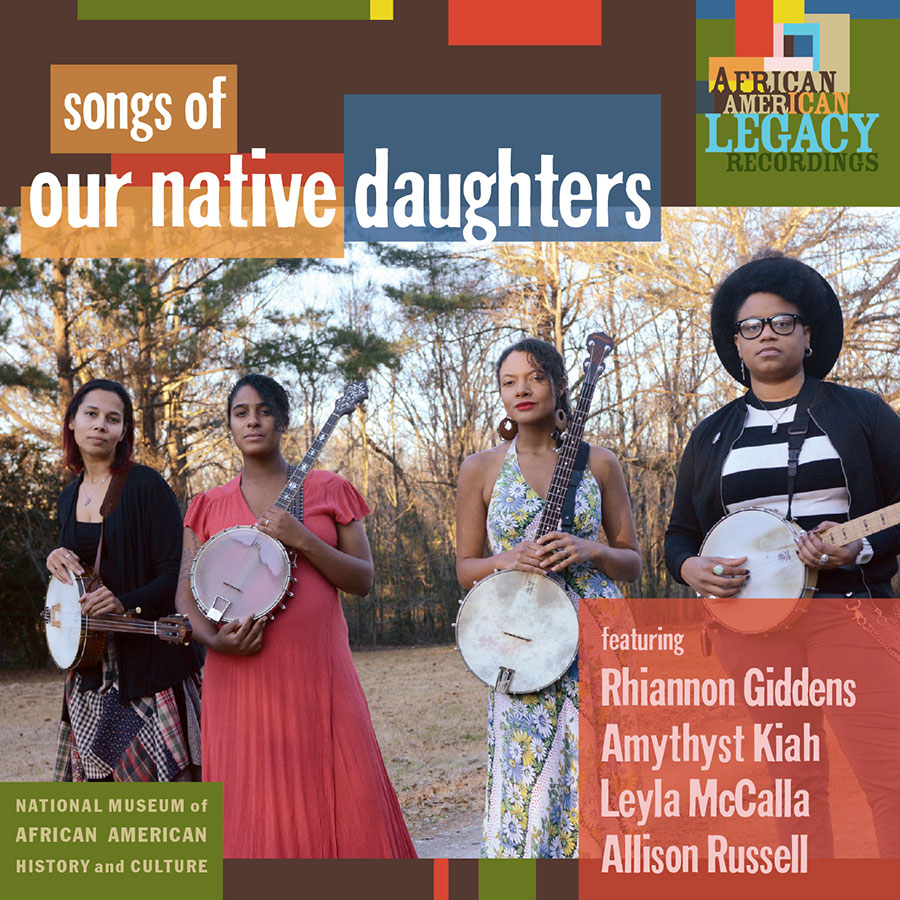
That musician, Rhiannon Giddens, is a force of nature, and one of the best things to happen, not just to African American roots music, but music in general in a very long time. After studying opera at Oberlin Conservatory, she came onto the scene in 2005 with the traditional African American string band, The Carolina Chocolate Drops. Giddens has one Grammy win (for the album Genuine Negro Jig) and has been nominated six times, including in this year’s Best American Roots Performance category. She was the 2016 winner of the Steve Martin prize for Excellence in Banjo and Bluegrass, while in 2017 she won a prestigious MacArthur Foundation Fellowship (the “genius” award.) And, of course, the album Songs of Our Native Daughtershas sparked conversations, beginning with the four banjo-playing black women who came together to make this groundbreaking Smithsonian Folkways album. Or, as Giddens described them, “People who are talking now about what happened then, and what it means for tomorrow.”
Rhiannon Giddens with The Carolina Chocolate Drops at Merlefest 2009
I first heard Giddens live at Merlefest in 2009, but The Chocolate Drops got their start four years earlier with original members Giddens, Don Flemons, and fiddle player Justin Robinson. They had met at the Black Banjo Gathering at Appalachian State University in Boone, NC, a conference dedicated to exploring the roots of banjo music. Living in Durham, North Carolina, the three would travel every Thursday night to the home of old-time fiddler and songster Joe Thompson to “learn tunes, listen to stories and, most importantly, to jam.” A black fiddler in his 80s, Joe inherited his music and playing style from generations of family musicians. With these Thursday evening sessions, he was passing those lessons on to a new generation. “When the three students decided to form a band, they didn’t have big plans,” notes the Chocolate Drops website. “It was mostly a tribute to Joe, a chance to bring his music back out of the house again and into dancehalls and public places.”
To begin a sampling of Giddens music, I’ll share Hit ’em Up Style from The Chocolate Drops Genuine Negro Jig, a version of the Blu Cantrell song which, in the words of the BBC reviewer, “totally countrifies an urban classic to create a tune that would be just as at home in hoedown as any blinging city nightclub.”
Country Girl is from the album Leaving Eden. Enjoy this live version from the Americana Awards.
Moon Meets the Sunfrom Songs of our Native Daughters is a Giddens tune that is beautiful and optimistic.
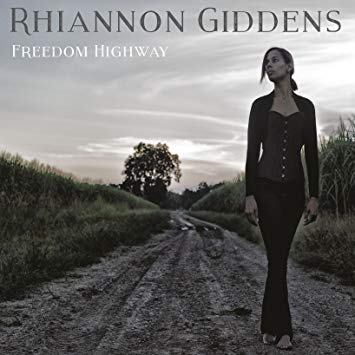
I’m On My Way is from her most recent album, There Is No Other, and well worth a listen. Finally, At the Purchaser’s Option, from the album Freedom Highway, is a heartbreaking, achingly sad, and ultimately powerful song. It was written by Giddens after she read an ad for a young slave woman which added, as an afterthought, that the young woman had a 9-month old baby “available at the purchaser’s option.”
“I’ve got a babe but shall I keep him ‘Twill come the day when I’ll be weepin’ But how can I love him any less This little babe upon my breast
You can take my body You can take my bones You can take my blood But not my soul You can take my body You can take my bones You can take my blood But not my soul
I’ve got a body dark and strong I was young but not for long You took me to bed a little girl Left me in a woman’s world
You can take my body You can take my bones You can take my blood But not my soul…
Day by day I work the line Every minute overtime Fingers nimble, fingers quick My fingers bleed to make you rich
You can take my body You can take my bones You can take my blood But not my soul…
I’ve got a babe but shall I keep him”
There is so much to take in with the music of Rhiannon Giddens. And there’s so much to know about all the other work she is doing to tell forgotten and “disappeared” stories. To that end, I strongly recommend her interview in The Guardian from 2018 titled “‘White people are so fragile, bless ’em’…meet Rhiannon Giddens, banjo warrior.”
The award citation from Steve Martin has this brief synopsis of her importance:
“In an interview in the February 2016 issue of Banjo Newsletter, Giddens said “I was attracted to the banjo before I knew the history of it. I just loved it. In the beginning I felt like I was kind of an interloper, and then I realized actually it’s everybody’s music. When you look at the history of it, it’s everybody’s music. It doesn’t belong to anybody. And then getting into the African roots of it I was just flabbergasted. . . . It’s a huge history that nobody talks about. And that really drew me.” Giddens’s work recognizes how big and versatile and multicultural the banjo can be, and how deep its roots go. Her electrifying performances have made the banjo exciting to new audiences, while simultaneously reaching back to the instrument’s earliest origins.”
As she told the International Bluegrass Music Association, “The question isn’t ‘How do we get diversity into bluegrass?’ The question is, ‘How do we get diversity back into bluegrass?'”
Americans have a long history of living with an eye on the horizon, seeking something shiny and new.
The first religious communities of New England, founded to escape the tyranny of the established churches in Europe, led to Roger Williams and others leaving those new settlements for Rhode Island to escape the tyranny of the Puritans. The Jeffersonian search for freedom in land led to grid-and-garden patterns of development across much of the Midwest and West and, eventually, the push out of the city into the “land” of the suburb. Communitarian journeys to places like New Harmony, the Shaker villages, and (a personal favorite) the 19th century English town of Rugby, Tennessee are part of the story. Henry Ford noted that, “We shall solve the problem of the city by leaving the city,” so Ford, George Pullman and other industrialists, up to and including today’s Silicon Valley elites, have constructed company towns and “E-topias” to build something new in the land of opportunity.
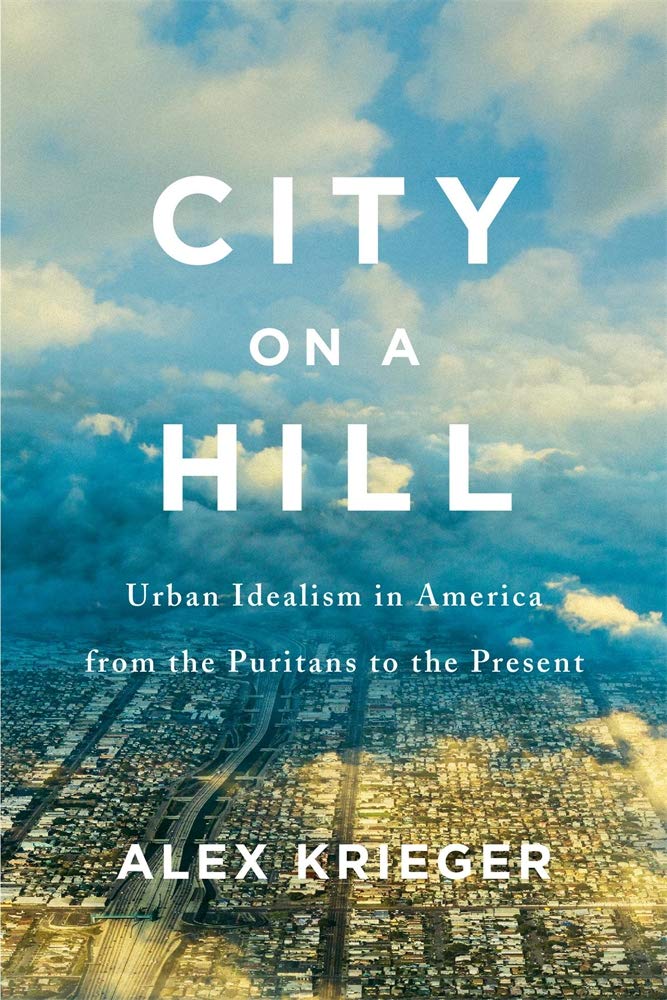
All of these examples and many more are part of Alex Krieger’s new book City on a Hill: Urban Idealism in America from the Puritans to the Present. Krieger, longtime professor in urban design at the Harvard Graduate School of Design and a practicing urban planner, has written an accessible book about the many strands of utopia that have shaped the American landscape and personality.
And what a collection of big ideas it is!
We read about Thomas Jefferson’s vision of a society of homesteaders and Ebenezer Howard’s garden suburbs. Frank Lloyd Wright’s decentralized “Broadacre City” is covered, as is Walt Disney’s planned community of Celebration, Florida. General Motors had ideas of “magic motorways” which could connect to Le Corbusier’s urban “towers in the park.” Frederick Law Olmstead and his disciples worked to create urban public spaces in cities open to a broader public, while Robert Moses pushed slum clearance in exchange for freeways. There are chapters on Daniel Burnham’s City Beautiful movement and Las Vegas, the casino city in the desert. Levittown and Jane Jacobs’s urban village all fall into Krieger’s description of our American utopian vision. You may not agree with all of Krieger’s assessments, but there are many other examples he could have included to make his point.
The book succeeds in showing how strong the vision for the “new” is in American life. There is much to like about the idealist fervor that is a long-time element in this country. It has brought many achievements and advancements. But Krieger’s work also highlights the ways that this tendency to discard the past and its “limitations” wastes resources, runs roughshod over existing populations and communities, and—in the end—is a way of running away from, rather than facing and addressing, our problems. In a different context, the words of author Isabel Wilkerson fit here as well. We refuse to see that our country is “like a really old house” where we don’t want to go into the basement. However, “if you really don’t go into that basement, it’s at your own peril.” Krieger’s book shows that we have often run away looking for other utopian visions, hoping that what we are ignoring will just go away. But, as Wilkerson asserts, “Whatever you’re ignoring is only going to get worse. Whatever you’re ignoring will be there to be reckoned with until you reckon with it.”
Thomas Hughes Free Public Library at Rugby, TennesseeInterior of The Thomas Hughes Library, with its one-of-a-kind collection of Victorian era books
Krieger notes in his preface that to write about utopian visions can seem “Pollyannaish” when one considers “many of the nation’s dystopic features.” I agree to a point, and found his work missing a deep dive into some of the uglier results of the vision of American Exceptionalism and Manifest Destiny. Yet Krieger largely succeeds at what he set out to do in examining the utopian impulse in America.
The book begins with an extensive look at Thomas Jefferson, who harbored a well-known disdain for cities. Krieger quotes historian Joseph J. Ellis in describing Jefferson as someone “who combined great depth with great shallowness, massive learning with extraordinary naivete, piercing insights into others with daunting powers of self-deception” and then adds that this is a “near-perfect description of a utopian.” Many of the others highlighted in the book display similar tendencies. Their visions are rarely fully realized, and what does come to pass often results in serious unintended consequences.
In a short postscript, Krieger highlights a handful of themes focused on ways forward to keep the vision but change how our utopian experiences have benefited the few at the expense of the many. His most important desire is that the tendency to decamp—”to go West, young man”—should continue to wane. We have our cities of the future now, but they require maintenance, repair, and revitalization. Given great inequalities and increasing environmental challenges, we must focus on that important work in the years ahead instead of leaving what we have and striking out again for some imagined utopia over the horizon
Have you ever noticed how easy it is to break into a rant?
Come to think of it, that could be an opening line from an Andy Rooney parody. I’ve been thinking of that cranky curmudgeon from CBS’s 60 Minutes recently as I’ve listened to some of our political discussions. Rooney would fit right in as a television pundit in our age of grievance.
I am afraid I understand the allure of grievances all too well. The temptation to rant is very enticing at times, and on very serioussubjects, no less. For example…
In recent weeks I’ve had the thought that what the world needs to hear is my take on the grating personality of Clemson football coach Dabo Swinney. Most recently he claimed his team was “favored by God” after they beat Ohio State in the college football semifinal. I usually quote the late Lewis Grizzard on God and sports: “As best as I can tell, God was undefeated in all sports last year. Anybody who won thanked Him, and I never heard a single loser blame Him.” Thankfully, LSU stomped on Swinney’s God-favored football team in the national championship game and saved me the trouble of writing.
And I know that everyone wants to know what I think about the consensus that Derek Jeter should have been the second unanimous choice to enter Baseball’s Hall of Fame, after Mariano Rivera made it last year on 100% of the ballots. Seriously? Jeter had a better-than-good but not exceptional career; is handsome (I’ll grant him that); was lucky to be where he was at times (ahem, I’m looking at you, Jeffrey Maier, before the advent of instant replay would have called Jeter’s “home run” an out); and played for the most PR-conscious team in all of sports. But a unanimous choice? No way. If Willie Mays was only selected on 95% of the ballots in his first year, no one deserves to be elected with 100% support. (By the way, after Mays was not placed on every ballot, sportswriter Dick Young had this classic comment: “If Jesus Christ were to show up with his old baseball glove, some guys wouldn’t vote for him. He dropped the cross three times, didn’t he?”) In any event, some anonymous sportswriter didn’t include Jeter on his ballot, and so I didn’t have to rant about this. I know you’re glad to hear that.
See, I told you it was easy to go down the ranting rabbit hole. And sports is clearly one area where outrage has overtaken sportsmanship and just plain old common sense.
Thankfully, many times when I rise up to rant about some trouble, slight, or loss of privilege, I remember that much of our outrage is wrapped up in perceivedgrievances. It is so easy to get worked up. And so we do. Sometimes we get worked up to get out of facing hard realities. Some 50 years ago, historian Richard Hofstadter discussed how these grievances infiltrate our civic life in The Paranoid Style in American Politics.
As noted by Steve Almond in Bad Stories: What the Hell Just Happened to Our Country, we take our grievances oh so seriously; yet, we dismiss the vulnerabilities that should give us pause in seeking to right all the wrongs that we believe have been perpetrated against us. We get worked up and cast protest votes, or choose not to vote at all, without realizing that we are helping the very politicians and their corporate and media enablers who have promised to upend much that we hold dear or things on which our lives or livelihood depends. Or perhaps we realize it, but don’t quite believe it will happen to us. In any event, there are vulnerabilities all around us that we would do well to take as seriously as our grievances.
Helping hands (photo credit: James Chan from Pixabay)
Instead of grievances, how would our lives differ if we focused on empathy?
Our grievances can come from the fact that we don’t know, and don’t connect, with the people who we assault through our online rants. I’ll be honest, I have never met Dabo Swinney or Derek Jeter. So it is easy for me, even in jest, to—in the words of Dr. Helen Riess in her TEDx talk on empathy—”inflict harm on people you never see.”
Just as we learn how to perceive grievances, Dr. Riess—of the Harvard Medical School and founder of Empathetics, an empathy and interpersonal skills training company for medical professionals—suggests that our capacity for empathy is not just an innate trait. It is also a skill that we can learn and expand.
Vivien Fellegi, writing in the magazine Broadview, notes,
“The impulse to help others isn’t simply the result of a good upbringing, a strong moral compass or adherence to a faith-based code of conduct. The drive to assist is born in empathy—that ability to feel and understand what others are feeling—and according to recent neuroscience, empathy is hardwired into all mammals. ‘At a fundamental level, the default is to help—in order not to help you have to actively suppress that urge,’ says Peggy Mason, a neuroscientist and professor at the University of Chicago.” (emphasis added)
We’re hardwired to care, but we have to nurture it. To not help others, we have to suppress that urge, which is exactly what we’re doing when we focus on grievances.
Unfortunately, we can’t nurture empathy if we are buried in our electronic devises reading tweets and posts designed to build up our grievances and turn us into tribes. As Dr. Riess notes, we “probably have more significant contact with our smartphones than with our significant others.” With that in mind, she goes on to quote American novelist Jonathan Safran Foer who said, “When we accept diminished substitutes, we become diminished substitutes.”
We have to connect with and care for people who don’t look like us if we want to get at the heart of empathy. And it is a better way forward for us, and for others we meet, than indulging the short-term high of a rant.