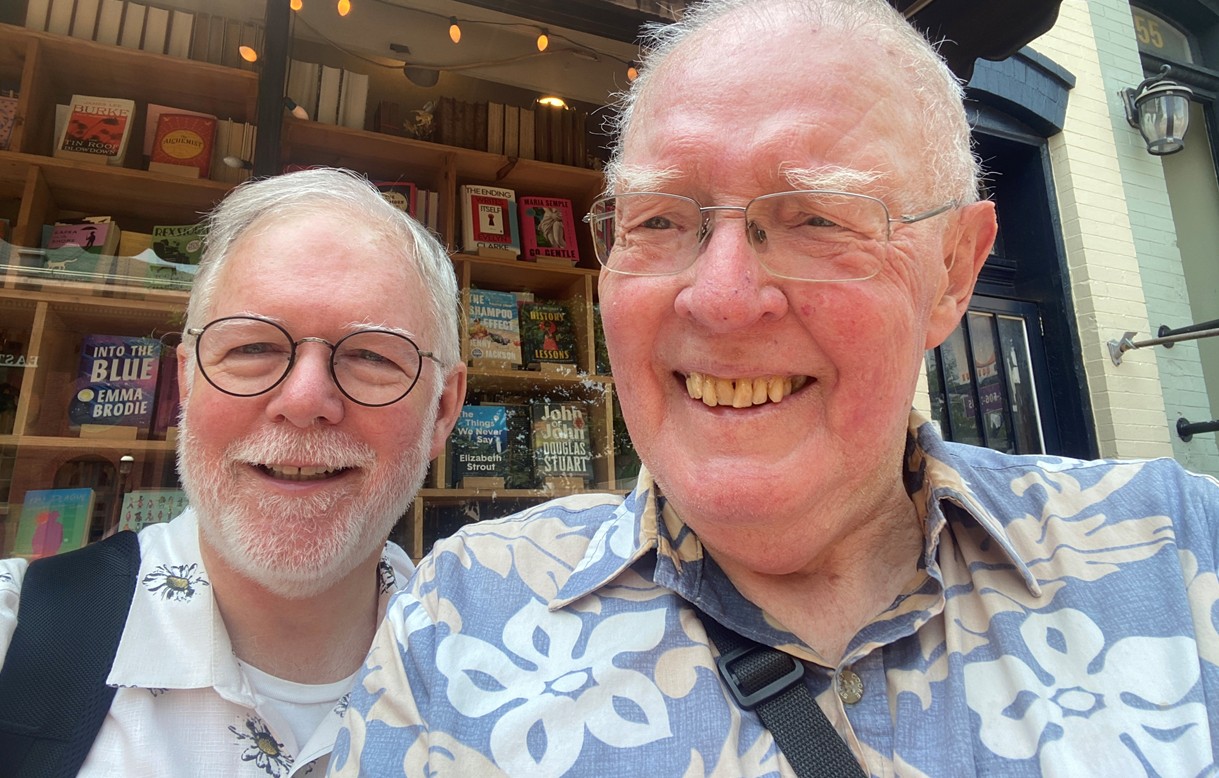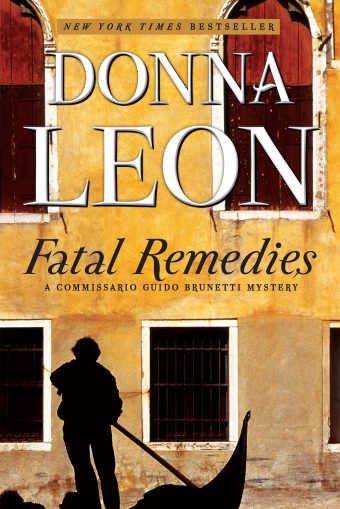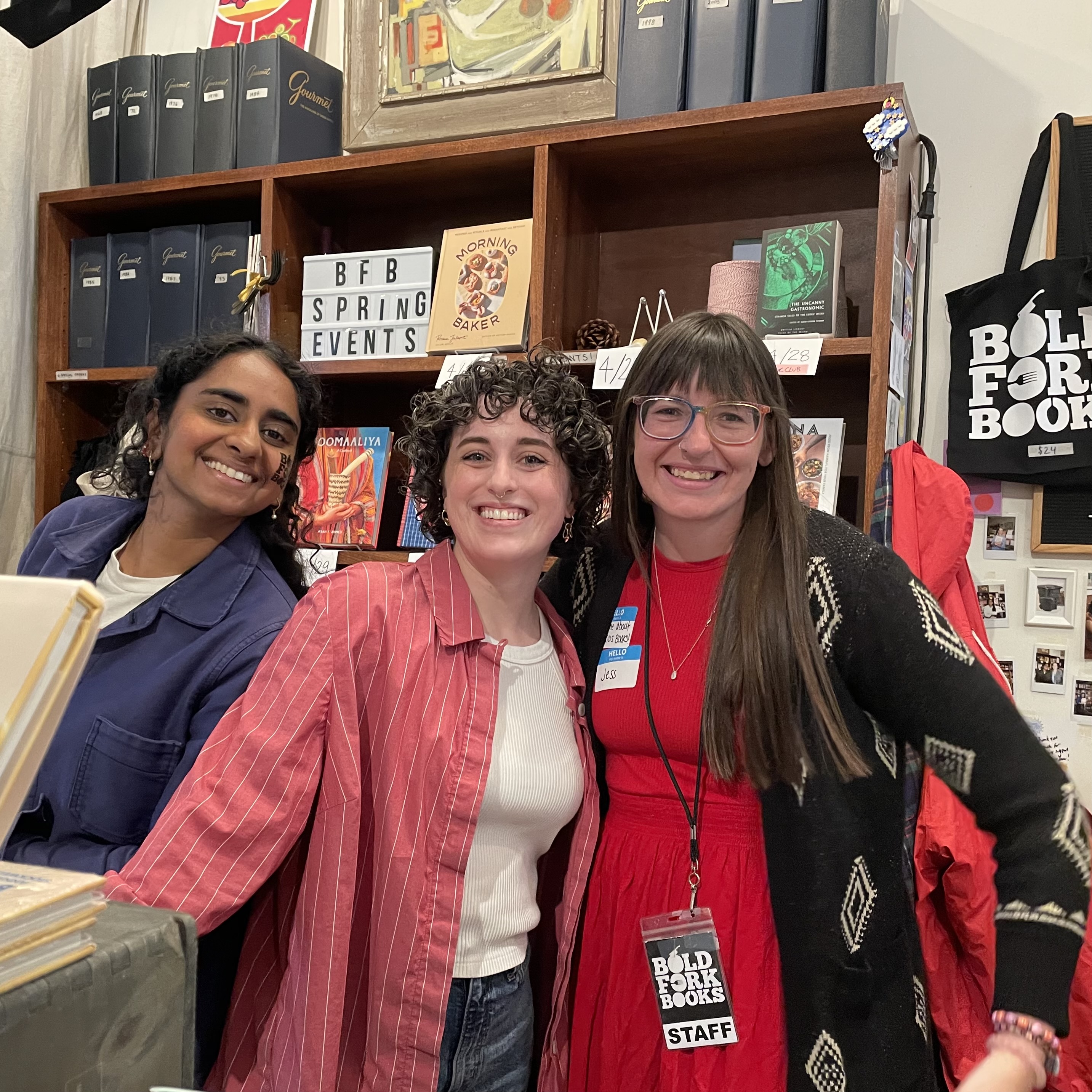
Diving into the Elizabeth George novels while beginning my quest to visit all the area’s independent bookshops.
Fans of detective fiction have been singing the praises of Elizabeth George since the arrival of her first novel in 1988. Friends who have been my guides in this newfound passion for murder mysteries have spoken of the beauty of her writing and the depth of her characters. Mystery writer Anna Scotti gave her especially high praise:
“Elizabeth George’s Inspector Lynley novels are marvelous―she’s incredibly talented. What she did with the back-to-back novels, With No One as Witness and What Came Before He Shot Her provides a masterclass for mystery writers, as well as a feast for readers.”
As I began a new personal project in 2026, this seemed an appropriate place to start.
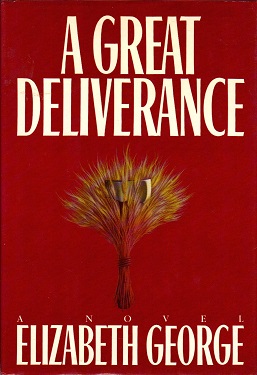
A Great Deliverance (1988) by Elizabeth George introduces us to Inspector Thomas Lynley, the eighth earl of Asherton, and his unconventional working-class partner, Detective Sergeant Barbara Havers. Lynley and Havers are assigned to investigate a gruesome murder in the Yorkshire Moors. The unlovely Roberta Teys has been found in her best dress, an axe in her lap, seated in the old stone barn beside her father’s headless corpse. Her first and last words were “I did it. And I’m not sorry.” The residents of the usually peaceful village of Keldale cannot believe that Roberta is the killer. Scotland Yard Superintendent Malcolm Webberly has sent two unconventional detectives into the situation knowing they will be met with several old external and internal grievances, but believing that their pairing can break through a difficult case.
What they find in their investigations uncovers deep, dark secrets—some held for generations. There are myths to uncover and reputations to reconsider. Lynley and Havers establish an unlikely chemistry that, while combative at first, moves toward a grudging respect for what each brings to the work at hand. And with great care and little asides that illuminate the whole, George fleshes out their character. As when a local schoolteacher tells them that nearly everyone in the village passed through her classroom except for Father Hart:
“‘He and I are of the same generation.’
‘I should never have guessed,’ Lynley said solemnly.
She laughed. ‘Why is it that truly charming men always know when a woman is fishing for a compliment?'”
The Inspector Lynley mysteries have been adapted for television twice by the BBC, first in a well-loved series that ran from 2001 – 2008 and which can still be seen on Brit Box, and then in a new series debuting in 2025. Adaptation is the operative word, especially for the most recent series which seems to borrow very little from the novels except for the most basic of structures. I’ve watched several episodes of both and very much prefer the earlier series, especially the work of actress Sharon Small as the gritty Barbara Havers. I will say, however, when I was buying the book two of the women helping with the purchase mentioned that the new Inspector Lynley was “a hunk.” (I think I’m quoting correctly.) That seems to be a universal view, given the reviews.
All of which brings me to that special project I mentioned above.
THE YEAR OF THE INDEPENDENT BOOKSHOP
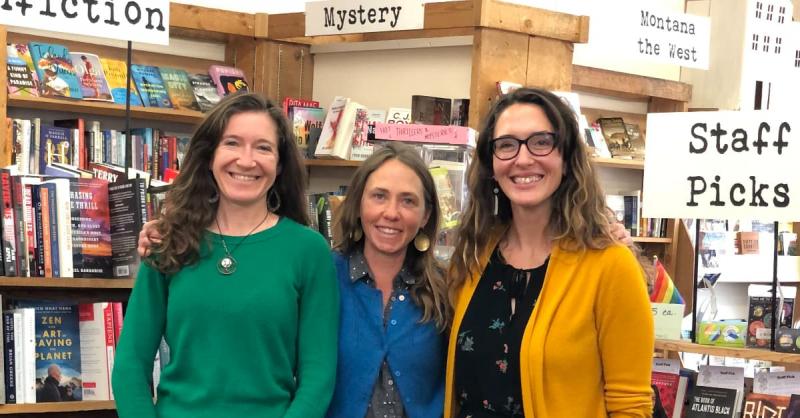
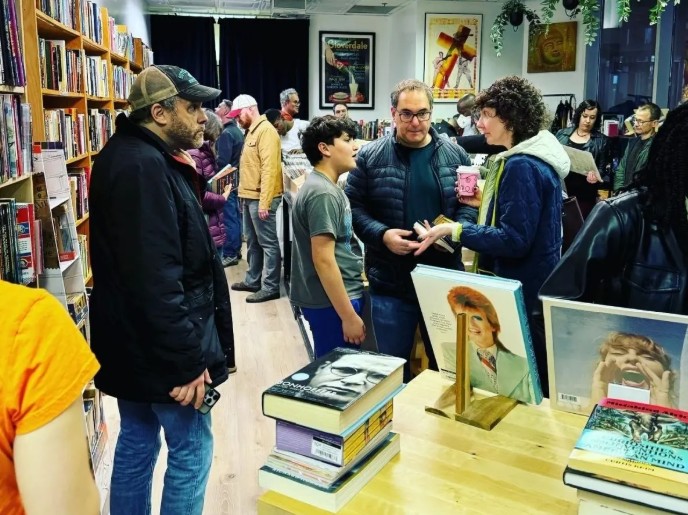
In 2026 I am on a quest to visit all the independent bookshops in the immediate Washington vicinity (the DMV). A few weeks ago I made my way to a cozy shop on a Georgetown side street and climbed the stairs into The Lantern Bookshop. As I did, I was greeted by my friend, neighbor, and Brilliant Reader Noell who was working that day at the front desk and who had encouraged me to put The Lantern on my list. After the warm welcome, I spent the better part of a half hour looking through the shop’s used and rare books.
The Lantern was founded in 1977 and is run by volunteers, most of whom—like Noell—are local Bryn Mawr College alumnae. Its mission is to provide financial assistance to women at Bryn Mawr College, with all of the profits going to the college to support students’ summer internships.
The selection is eclectic, due to the fact that all the books are donated, so the offerings are curated by the tastes of the donors. I found several that interested me, but ended up choosing a hardback version of the George novel from the original press run.
The bookshop—like the novel—is a jewel. So that’s one down, twenty-four bookshops to go!
“The only thing I know that can effectively change hearts and minds is story. The ONLY thing that I have ever, ever seen melt an icy soul is when someone hears another’s story.”*
Two people may look at a situation and see two very different things. That’s not necessarily a bad thing. Two heads are better than one, as the old saying goes. But when one of the two is working to seize the narrative and shape facts to belief, two stories can become very problematic. Let’s take a few minutes to consider stories and myths that stretch from Eden to Birmingham to Minneapolis.
TWO STORIES. ONE GIFT.
Some of the oldest stories known to humankind are creation stories.
“There are many Bible readers who, out of a sense of loyalty to a literal-historical understanding of Genesis 1, feel compelled to deny the conclusions of modern sciences. But this feeling is unnecessary because Genesis 1–2:3 does not claim to be a literal-historical text. Rather, it’s a part of a common genre of ancient religious literature known as the creation myth, which is not intended to be a historical representation of events.”
The second creation story in Genesis contradicts much of the first. To count the ways, click on the link.
The Bible does us a favor by beginning with two contradictory stories, signaling “at the outset what this text actually is: a diverse collection of religious traditions that have been brought together by different communities of faith over a long period of time. When you read the Bible,” Bashaw and Higashi argue, “you’re reading an anthology of ancient religious literature—not a textbook, not an instructional manual, not a love letter from God, and not a complete work of systematic theology.”
“Now, just because it’s an anthology of ancient religious literature doesn’t mean it can’t be inspired by God, or say true things about God, or be helpful in trying to understand God. Its being an anthology just means that whatever is in it that is true, inspired, or helpful will come through in many, sometimes conflicting, voices.”
We should not work to protect belief from scrutiny but rather we should subject our beliefs to the light of day and have the courage to trust the result.
Which takes me to recent events in Minnesota.
WHEN TWO STORIES DON’T LEAD TO THE TRUTH
In Nineteen Eighty-Four George Orwell famously wrote: “The Party told you to reject the evidence of your eyes and ears. It was their final, most essential command.” Rebecca Solnit adds that it “is only by learning to distrust yourself that you come to trust those who are unworthy of it, who are transparently dishonest and self-serving, who offer lies that contradict yesterday’s lies and new promises after breaking the old ones.”
The attempts at erasure and memory manipulation we are seeing in today’s world are everywhere. As has been reported, the administration is working overtime at narrative control, whether it be after the killing of a young woman by a federal agent in Minnesota, with the unbelievable infatuation with Greenland, or the slow-walking of the release of the Epstein files, the latter in direct violation of federal law.
While many involved with political journalism have lost their way, one of the journalist who continues to speak truth to power is Greg Sargent. Writing in The New Republic, Sargent has shown how the administration is trying to restore ethnic engineering to the center of immigration policy. Yet few in the mainstream media have made this connection. Sargent reminds us that the White House Deputy Chief of Staff, by taking this path, is denying to millions the blessings that his Jewish ancestors—who fled antisemitic oppression when they first arrived here in 1903—and he himself have been so fortunate to enjoy.
But the shooting of Renee Good is breaking through the both-siderism of the media, at least on some levels, even at the New York Times.
The strength of the myths is not in facts, but in the narratives, so it is impossible to fight fake facts with other facts. What is needed, Malik asserts, are new stories that are not just the correction of old stories, but are visions that assert that “for societies to evolve, an old order must change.”
FROM BIRMINGHAM TO MINNEAPOLIS
Quaker activist Parker J. Palmer looks at two stories which he frames as moving from Birmingham to Minneapolis. Palmer reminds us that while we will speak of MLK with reverence on the holiday celebrating his birthday—“lifting up his famous I Have a Dream speech”—we need to remember “that during King’s years as an unwanted civil rights activist and unheeded prophet, he was at the top of white America’s most-hated list.”
On April 12, 1963, King was jailed in Birmingham, charged with violating a state court injunction banning anti-segregation activity in that city. King used his time there to write his 6,500 word Letter from a Birmingham Jail, encouraging whites to join the nonviolent protests for love, truth, and justice. Palmer suggests we use our celebrations of the MLK holiday to wrap our hearts and minds around the words of the prophet:
“If America does not respond creatively to the challenge to banish racism, some future historian will have to say that a great civilization died because it lacked the soul and commitment to make justice a reality for all [people].“
Palmer asks us to take King’s question seriously: “Where do we go from here—chaos or community?”
Anand Giridharadas in his Substack The Ink also sees two stories.
“I see then that this is both a very dark time and, potentially, a very bright time. It’s important to hold these truths together.
When I look down at the ground of the present right now, I feel depressed. If I lift my head to the horizon, I see a different picture.
This is not the chaos of the beginning of something. This is the chaos of the end of something. . . . We are living through a revolt against the future. The future will prevail.”
STORIES CAN HELP US LINK PAST AND PRESENT
Consider once again those creation stories, which were collected and put into their final form after the Babylonian exile, around the mid-5th century BCE. “In the aftermath of their national calamity, the Jewish people realized that their heritage might indeed be lost if it were not written down.”
Their stories were the links between past and present.
Richard Rohr suggests the most important thing to bear in mind when reading the first eleven chapters of Genesis is that they are written not only about the past but about the present—”the perennial present that is always with us.”
All good stories ask us to consider past and present. Birmingham and Minneapolis. Our beliefs are meant to be held up to scrutiny, not covered up with lies.
The Chinese have a saying, “Most of what we see is behind our eyes.” We see what we expect to see, not necessarily what is really there.
This is an important time for seeing exactly what’s going on around us and not fall back just on what we believe or wish to be true. Most importantly, we should all seek to understand when different perspectives and stories are being used for enlightenment and, conversely, when an alternative narrative is being used to hide the truth.
America is an idea founded on ideals of freedom and equality. We each need to do our part to continue this work-in-progress, recognizing that what we do—no matter how small—is meaningful, significant and worth doing.
On the national holiday to remember heroes of past resistance movements in America, many of us struggle to be worthy of our moment in history. At the very least we look, as one writer suggests, for “permission to keep believing—to stay awake to justice without burning out or turning away.” Martin Luther King’s clear and compelling language reminds us of the ideal . . . and the work required to get closer to that dream.
These are difficult times. There is no denying it. But Rebecca Solnit answers the doomsayers who loudly proclaim that our problems are too big, our times too unique, our enemies too powerful, with a quote from her book Hope in the Dark.
“The analogy that has helped me most is this: in Hurricane Katrina, hundreds of boat-owners rescued people—single moms, toddlers, grand- fathers—stranded in attics, on roofs, in flooded housing projects, hospitals, and school buildings. None of them said, I can’t rescue everyone, therefore it’s futile; therefore my efforts are flawed and worthless, though that’s often what people say about more abstract issues in which, nevertheless, lives, places, cultures, species, rights are at stake. They went out there in fishing boats and rowboats and pirogues and all kinds of small craft, some driving from as far as Texas and eluding the authorities to get in, others refugees themselves working within the city. There was bumper-to-bumper boat-trailer traffic—the celebrated Cajun Navy—going toward the city the day after the levees broke. None of those people said, I can’t rescue them all. All of them said, I can rescue someone, and that’s work so meaningful and important I will risk my life and defy the authorities to do it. And they did.”
Solnit knows it’s not necessarily a perfect example of how change works at its best. But it is “an example that illustrates one point: that what we do is worth doing even if we can’t do everything and save everyone.”
Ordinary American citizens are at work every day to protect their neighbors from the cruelty that wants to divide us. Whatever the threat, whatever the tactic, these citizens are showing that what we do is worth doing.
Those who threaten democracy are striving to throw us off balance and make us think our actions are insignificant, they must be obeyed, their success is inevitable. It isn’t. What ordinary Americans do in opposition to authoritarianism, large or small, counts.
TENDING TO BODY AND SOUL
In the time of year when nature provides an example of resting before a period of new life and growth—a period of wintering—we can follow a similar path, taking care of ourselves when necessary and finding ways to maintain our equilibrium for the long fight ahead. Tending is the operative word. As writer John Sarvay notes, tending goes two ways. Yes, we need to tend to others—our families, those we love, those we encounter in our communities, and those in peril. But we also need to be open to letting others tend to our hurts and pains. Tending also involves “the hard practice of opening the door,” and learning to invite others inside perhaps—maybe especially—before we’re ready.
This is important for all ages but the need may be greater as we move into our later years.
Those of us in the last third of life are susceptible to cognitive and physical decline in the best of times. When surrounded by stress and manufactured chaos we can feel even more adrift. In a recent story on ways to tend to your mental health the New York Times provided a number of recommendations. Take a walk every day. Get plenty of rest. Disengage from your misery machine (aka phones). Connect more with people.
That last one is especially important in today’s world.
PEOPLE ARE GOOD FOR YOU
Extended isolation and loneliness are not good at any age. As the writers of the Times piece noted, people 80 and up who have the memory ability of someone 20 to 30 years younger “don’t share a magic diet, exercise regimen or medication. The one thing that does unite them is how they view the importance of social relationships.”
Those who seek to destroy democracy try and isolate us from our friends, neighbors, and fellow citizens. They want to prioritize the individual over the community. That myth of the rugged American cowboy who can handle all his business on his own is powerful . . . but it is just a myth.
We need each other.
Meaning survives at the human scale. In a world of social media and AI, Sarvay suggests we find ways to build and protect the smaller narratives, local and human-scaled, that might still hold meaning across political divides. “In rooms you can stand in, voices you can hear, systems you can touch.”
REMEMBER, WE’VE BEEN HERE BEFORE
Omaha Beach, Normandy
There is a growing temptation to believe that our moment is unique and unlike anything we have seen before. Mike Madrid offers some much-needed perspective.
“Every generation of Americans has been summoned to defend the promise of democracy. Some have stood in snow-covered camps with no shoes and no certainty of survival. Others have crossed oceans into fire, fighting for freedom not only for themselves but for the world. Some marched in the Deep South against the racist laws that have scarred us since our founding. And some have stood their ground at home, marching, organizing, speaking up, so that our institutions might endure and our ideals might live.
Now, it is our turn.”
Remember that when our government kills its own citizens, we have been here before. “The machinery of authoritarianism depends on our exhaustion,” Madrid writes. “But our history tells a different story—not one of inevitable progress, but one of deliberate resilience forged in moments far bleaker than this.”
“If we remember those times and places—and there are so many—where people have behaved magnificently, this gives us the energy to act, and at least the possibility of sending this spinning top of a world in a different direction. And if we do act, in however small a way, we don’t have to wait for some grand utopian future. The future is an infinite succession of presents, and to live now as we think human beings should live, in defiance of all that is bad around us, is itself a marvelous victory.”
Hope is a start. How else can we be worthy of the moment?
CHOP WOOD, CARRY WATER
We each need to choose the path that works for us.
Embracing the simple, daily process of the work at hand (chopping wood, carrying water) rather than focusing on the outcome proves helpful to many Americans. Activists provide lists of possible tasks to choose from, if that’s easier.
I met a woman earlier this year who had a gift for one-on-one conversation that engaged thoughtful responses from those across the political spectrum. If this is your gift, use it.
However, remember that people are good for you. Bill McKibben, the indefatigable climate activist has been asked “what’s the best thing I can do for the climate as an individual?” He usually replies, “Stop being an individual,” by which he means join something. For most of us, our power to change the world comes as collective power, when we’re members of movements, organizations, uprisings.
Whatever you do, don’t give up. Look to the poets and writers who not only serve as the recorders of history but as pillars to keep us upright and strong, as William Faulkner suggested in his Nobel Prize speech.
“I believe that man will not merely endure: he will prevail. He is immortal, not because he alone among creatures has an inexhaustible voice, but because he has a soul, a spirit capable of compassion and sacrifice and endurance. The poet’s, the writer’s, duty is to write about these things. It is his privilege to help man endure by lifting his heart, by reminding him of the courage and honor and hope and pride and compassion and pity and sacrifice which have been the glory of his past. The poet’s voice need not merely be the record of man, it can be one of the props, the pillars to help him endure and prevail.”
WHAT IS YOUR DREAM?
As we remember the life and legacy of the Rev. Dr. Martin Luther King, Jr., it may be helpful to stop and think about what we believe about our country and its future.
What is the personal dream that you hold dear? For me, I believe that the idea of America is a beautiful thing. That we are a nation founded on ideals and not on a common ethnicity, language, religion, or culture. The idea of the United States is that anybody—anybody—can be an American if you agree to respect the principles of representative democracy. Our ideals say we don’t care about your skin color, your religion, your accent, your beliefs, or where you’re from.
But I know that the truth of how our past has played out into our present is much different than my idea of America or our common ideals. So yes, my dream is about values that I hold dear, but it also recognizes that America is a project, a work-in-progress. My dream is based on a vision and values, but the simple fact that I believe that vision to be true doesn’t make it so.
We have to take increased devotion to the idea of America and to democracy, as historian Heather Cox Richardson recently reminded us in the worlds of a hero from another era.
“In 1863, when our system of government was unraveling under pressure from those who wanted to base society on a system of enslavement that enriched an elite, Republican president Abraham Lincoln asked Americans to remember those who had died to protect a nation ‘conceived in liberty, and dedicated to the proposition that all men are created equal.’
Lincoln asked Americans to ‘take increased devotion to that cause for which they here, gave the last full measure of devotion,’ and to resolve that ‘these dead shall not have died in vain; that the nation, shall have a new birth of freedom, and that government of the people, by the people, for the people, shall not perish from the earth.’”
Abraham Lincoln called to the better angels of our nature from one of the darkest periods in our history. Dr. King showed us what that can look like in Selma, Birmingham, Atlanta, and Memphis. Let us now remember that the fight for democracy never ends. And our legacy—what we do in this moment—lives on past our time on this earth.
Music of hope and freedom for the Martin Luther King, Jr. weekend.
Music has often been at the heart of American freedom movements but it was an especially powerful part of the the push for civil rights in the 1950s and 60s. To honor the legacy of the Rev. Dr. Martin Luther King, Jr., I turned to Black Music Sunday, a weekly series curated by professor/activist Denise Oliver-Velez that highlights all things Black music. With almost 300 stories covering performers, genres, history, and more—each featuring its own vibrant soundtrack—it is a treasure trove of musical history.
A LASTING MESSAGE OF CHANGE
One of the anthems of the 1960s that continues to resonate today is Bob Dylan’s iconic The Times They Are A-Changin’, and Oliver-Velez highlights the tune in a post in her series. Wikipedia suggests that the universality of the song’s lyrics’ give it a lasting message of change. While some have said its time has passed, others—myself included—disagree.
“In 1985, [Dylan] told Cameron Crowe, ‘This was definitely a song with a purpose. It was influenced of course by the Irish and Scottish ballads …’Come All Ye Bold Highway Men’, ‘Come All Ye Tender Hearted Maidens’. I wanted to write a big song, with short concise verses that piled up on each other in a hypnotic way. The civil rights movement and the folk music movement were pretty close for a while and allied together at that time.'”
The great Nina Simone recorded a slow, deliberate version that seems to squeeze every bit of sadness and anger out of the song. One commentator has noted that the slow and deliberate pace of the performance intensifies the sense of drama. “Every note and word is delivered with clear intention, making the musical experience even more immersive and emotionally engaging.”
“Critic Andy Gill points out [via Wikipedia] that the song’s lyrics echo lines from the Book of Ecclesiastes, which Pete Seeger adapted to create his anthem “Turn, Turn, Turn!”. The climactic line about the first later being last, likewise, is a direct scriptural reference to Mark 10:31: ‘But many that are first shall be last, and the last first.'”
Blues artist Keb’ Mo’—who plays in nearby Tysons, VA in February—put his distinctive and soulful musical touch to the tune . . .
To expand this weekend’s offerings, let’s also remember a few other icons of the musical soundtrack of freedom, beginning with Sweet Honey in the Rock. When a musical group carries the torch for justice and love over decades, it goes without saying that they have seen and persevered through life challenges that would have stopped the less hopeful and determined along the way.
Through her Daily Kos series Oliver-Velez introduced me and many others to the Resistance Revival Chorus, a collective of more than 60 women, and non-binary singers, who join together to breathe joy and song into the resistance, and to uplift and center women’s voices.”
Oliver-Valez writes,
“I’m sure you can agree with the women of the RCC when they sing that Everybody Deserves to Be Free. Deva Mahal, (who happens to be the daughter of blues icon Taj Mahal) takes the lead.”
Of course, it doesn’t get any more iconic than Mavis Staples. Mavis was, of course, a member of The Staple Singers with her siblings Yvonne, Cleotha, and Pervis, and their father, “Pops” Staples. The group’s music was key to the soundtrack of the civil rights movement of the 1950s and 60s, and Mavis has been carrying the torch ever since.
And let’s tie one icon with another. First Mavis and Aretha Franklin brings together two of the greatest and most powerful Soul and Rhythm & Blues voices not just of their generation, but of all time, to sing the gospel tune Oh Happy Day. Gospel has always been a key part of the freedom movement’s soundtrack. And for fun, check out the interplay between these two amazing talents at about the 1:50 segment and then again at 4:00. Good gawd!
And we’ll end with Aretha’s live version of Amazing Grace. This is from Amazing Grace, the movie of Aretha Franklin’s 1972 recording of the gospel album of the same name. It is—like the lady herself—a national treasure. I can only describe the film as a 90-minute church service.
Hallelujah!
Remember the legacy of Dr. King this weekend and throughout the year as we continue our fight for democracy.
More to come . . .
DJB
Check out these other MTC posts on music for the MLK Weekend:
Five books. Every month. A variety of topics from different genres.
Here is the list from December 2025. Clicking on the title will direct you to the original post.
A Child is Born: A Beginner’s Guide to Nativity Stories (2025) by Amy-Jill Levine is a short but insightful book that examines the other nativity stories in the Hebrew Bible. Christians easily recall the narrative around the birth of Jesus, but how many know, much less think about, the nativity stories of Moses, Isaac and Ishmael, Samson, and Samuel. Just in time for Advent, author AJ Levine has prepared a fascinating four-part study explaining the context that would have been basic knowledge for the faithful in the first century CE while showing the connections between these ancient stories of displacement, pilgrimage, and exploration and the one we now celebrate on December 25th. A Child is Born is a book full of insight and wisdom.
Thomas Paine: Enlightenment, Revolution, and the Birth of Modern Nations (2006) by Craig Nelson is an excellent biography of the man who though he was born in England, was truly a citizen of the Enlightenment world. Paine would write three of the bestsellers of the eighteenth century, topped only by the Bible. Common Sense cemented his reputation. Rights of Manhelped shape the French Revolution and—although it would take more than a century—inspire constitutional reform in Great Britain and foreshadow Franklin Roosevelt’s New Deal. The Age of Reason, a forceful call against organized religion, finds Paine sticking to his Enlightenment and deist values even at the expense of his public reputation. Paine’s mind was clearly a force of nature, and Nelson characterizes him as “the Enlightenment Mercury who sparked political common cause between men who worked for a living and empowered aristocrats across all three nations.”
Common Sense (1776) by Thomas Paine, published just six months before the Declaration of Independence, has been called the most influential polemic in all of American history. It is a fiery call for his adopted countrymen to throw off the yoke of British rule, and especially to revolt against the crown. Common Sense provided the vision of independence that would move millions in that fateful year to change their hearts and minds away from their deference and loyalty to Britain and the throne. Americans had never heard such words. The pamphlet sold 100,000 copies in the first three months after publication. There is, simply, no other publication as important to an era when Americans were beginning to think there was a different way forward than the one their London-based government insisted was proper, righteous, and inevitable. Reading Common Sense is a revelation in its relevance for today.
From Doon With Death (1964) by Ruth Rendell is the first of her twenty-four Inspector Wexford mysteries. Margaret Parsons is a timid housewife devoted to her garden, her kitchen, and her husband as they live a quiet and simple life in the Sussex village of Kingsmarkham. But now Margaret Parsons is dead, brutally strangled, her body abandoned in the nearby woods. Chief Inspector Reg Wexford, the big, gruff rural detective, is intrigued by the seeming disconnect between her life and death, and he works with his assistant and sidekick, Inspector Mike Burden, to uncover the truth. It turns out that the truth includes several dark secrets that those who knew Margaret Parsons want to keep quiet.
The Six Mile Circle: A Sea Story (2025) by Syd Stapleton continues the adventures of Frank Tomasini and his boat, the Molly B. Frank’s marine surveyor’s business has fallen on hard times. To make ends meet he signs on as a deckhand and cook on ocean-going tugboats and barges making runs between the Pacific Northwest and Hawaii. When one of the hulls is mysteriously pumped out in the middle of the ocean, a fellow deckhand gets sick and ultimately dies after contact. Frank knows immediately he has to get to the bottom of this mystery.
WHAT’S ON THE NIGHTSTAND FOR JANUARY (Subject to change at the whims of the reader)
Congratulations! | Today is your day. | You’re off to Great Places! | You’re off and away!
Last year we followed the advice of the great travel director Dr. Seuss and took off—with brains in our head and feet in our shoes—to explore great places. And the wonderfully wise children’s classic seems to be a perfect place to kick off this exploration of the “places we saw” in 2025.
Oh, the Places You’ll Go! (1990) by Dr. Seuss is the beloved and well-known children’s book that is a favorite for graduates of all ages, as well as for those exploring life’s ups and downs. In colorful and playful poetry it reminds us that we have agency: “You have brains in your head | You have feet in your shoes | You can steer yourself | any direction you choose.” But I was also reminded in re-reading this classic that Dr. Seuss doesn’t sugarcoat life. Early in the story the reader is flying high, leading the whole gang, topping all the rest.
“Except when you don’t. | Because, sometimes, you won’t. | I’m sorry to say so | but, sadly, it’s true | that Bang-ups | and Hang-ups | can happen to you.
You can get all hung up | in a prickle-ly perch. | And your gang will fly on. | You’ll be left in a Lurch.”
There will be ups and downs in life. There will doldrums, or even periods of despair. Because “Out there things can happen | and frequently do | to people as brainy | and footsy as you.”
But that’s how we grow as humans.
“And when things start to happen | don’t worry. Don’t stew. | Just go right along. | You’ll start happening too.”
That’s the joy of travel. Of life. When things start to happen, we “start happening too.” I was fortunate in 2025 to see many places new to me and to revisit some friends I hadn’t seen in years. Pieces of those travels and lessons learned along the way were captured in MORE TO COME. Here are my stories about the places we’ve seen over the past twelve months.
Where cynics see brokenness in our political life and authoritarians press to claim the spoils, true leaders see great opportunities and new ways forward
This is a fragile era in our country. It is tempting to consider only the chaos, cruelty, and corruption. There is certainly enough of all three to go around.
I rarely agree with George Will, but he was spot on when he wrote in the Washington Post that American voters are learning of “the Constitution’s limited ability to mitigate the consequences of their choices.”
“Neither the language of the law (constitutional or other), nor what are now shadows of norms, can substitute for what is indispensable: an occupant of the presidency whose constitutional conscience causes him or her to distinguish the proper from the merely possible.’’
Those who believe that violence is power want us to focus there. However, I want to focus on one recent moment that—at least for me—provides a measure of hope in difficult times.
ACTIONS SPEAK LOUDER THAN WORDS . . . BUT WORDS DO MATTER
On New Year’s Day I watched the public inauguration of Zohran Mamdani as the mayor of New York City. He had officially been sworn into office just past midnight in a “long-shuttered relic from New York City’s past, an artifact from an era when leaders sought to merge beauty with utilitarian needs,” as reported in the New York Times. The old City Hall subway station—with its tiled arches, chandeliers and vaulted ceilings—opened in 1904 as a showcase destination among New York’s 28 original subway stations. It was closed in 1945 when its curved tracks resulted in a dangerous gap between newer trains and the platforms.
Mamdani, who, as a state legislator, helped bring free buses to parts of the city, is an unabashed champion of transit. The symbolism was clear.
The ornate station itself embodied a belief that New York leaders could elevate life for millions of New Yorkers by creating a grand subterranean vascular system. It is, Mr. Mamdani said after midnight, ‘a testament to the importance of public transit, to the vitality, the health, and the legacy of our city.’”
Public swearing in of Zohran Mamdani as Mayor of New York City by Senator Bernie Sanders
His words after the public ceremony a few hours later were just as hopeful, forward looking, and inclusive. The new mayor promised to stand alongside the “over one million New Yorkers who voted for this day nearly two months ago.” Mamdani also promised to “stand just as resolutely alongside those who did not.” Only action can change minds, but:
“[r]egardless of whether we agree, I will protect you, celebrate with you, mourn alongside you, and never, not for a second, hide from you.”
THE WEIGHT GROWS HEAVIER. THE WAIT GROWS LONGER.
Why should we care about Mamdani?
Well, for one thing he now runs a city larger in population than 39 U.S. states. Think about that for a moment in light of our democracy, system of government, and outmoded apportionment of power. As one writer phrases it, “the arteries of the constitutional order are clotted with antidemocratic plaque.”
He also ran unabashedly as a democratic socialist, bucking the long-term aversion to government that has been stoked by decades of right-wing propaganda. Yes, Mamdani comes to office at a time when we have an administration in Washington led by a man whose superpower is polarization. Who regularly sows fear and divisiveness. Who is “working so hard to break down the international order and replace it with chaos.” The moment, as it often does, has both danger and opportunity.
But note how Mamdani framed his moment. It is the rare opportunity to transform and reinvent for something good, a moment where it is “the people themselves whose hands are the ones upon the levers of change.” Rare, but not unprecedented.
It was this part of the speech that resonated most deeply with me.
“And yet we know that too often in our past, moments of great possibility have been promptly surrendered to small imagination and smaller ambition. What was promised was never pursued, what could have changed remained the same. For the New Yorkers most eager to see our city remade, the weight has only grown heavier, the wait has only grown longer.”
Taking steps away from a status quo comfortable only for a small minority eager to steal more of our wealth and power and instead move toward greater opportunity for the majority takes courage.
MOMENTS OF INFLECTION
There have been other moments in our history when the time was ripe for change, when a political base changed sides, when the country faced vital decisions that could become part of Dr. King’s long arc of the moral universe that bends toward justice.
Mamdani looked back while also looking forward. He noted that for much of its history the city belonged only “to the wealthy and well-connected, those who never strain to capture the attention of those in power.” Working people suffered the consequences. There were exceptions, however, and while not perfect and not always successful, he pointed to past mayors as examples, men like Bill de Blasio and David Dinkins.
“And nearly six decades before [Dinkins], Fiorello LaGuardia took office with the goal of building a city that was ‘far greater and more beautiful’ for the hungry and the poor.”
Mayor Fiorello LaGuardia (credit: NYPL)
LaGuardia was the three-term mayor of New York City during the New Deal era. Some historians suggest that he was only a product of that time, which is very different from our own. His leadership and vision, however, come across through the ages.
“LaGuardia spoke five languages, defended immigrants passionately, won vast sums of federal money for the city and put forward a vision of New York that placed it at the forefront of the politics of his day. As he once put it, describing what he wanted for the city: ‘First and foremost, I want justice on the broadest scale. By this I do not mean the justice that is handed out in police courts. I mean the justice that gives to everyone some chance for the beauty and the better things of life.’”
As a member of Congress before his time as mayor, LaGuardia demonstrated that he stood with the people, protesting the Johnson-Reed Act of 1924 which drastically restricted immigration, especially from Southern and Eastern Europe. He did so because “its supporters were driven by ‘narrowmindedness and bigotry,’ a ‘fixed obsession on Anglo-Saxon superiority,’ and warning that ‘the spirit of the Ku Klux Klan must not be permitted to become the policy of the American government.’”
That sounds pretty contemporary.
LOOKING TO RECONSTRUCTION AND THE NEW DEAL
Thoughtful Americans are looking back at two seminal moments in our past for guidance. Historian Eric Foner states that “key issues confronting American society today are in some ways Reconstruction questions.” For some time those looking at our current era have suggested there is a need for a new American Reconstruction, one which harkens back to and seeks to advance the principles of that period. Over the past 150 years, clever and powerful conservatives have diligently sought to undermine the egalitarian promise of the 13th, 14th, and 15th Amendments. As Foner reminds us, the “key elements of the second founding, including birthright citizenship, equal protection of the laws, and the right to vote, remain highly contested. . . . Rights can be gained, and rights can be taken away.” A Supreme Court that plays Calvinball with the law is only one of many places that scream out for reform.
The other era in our past that serves as both inspiration and guide in our present day is the New Deal, a time when there was a belief in the common purpose.
The federal government is no longer sending vast amounts of money to the cities, so the times are different from Fiorello LaGuardia’s era. But politics and policies change. We’re seeing that now at the local and state level across the country. The huge inequality of wealth is leading Americans of all types and in all places to begin to recognize that the wealthy need to pay their fair share of what it takes to make America the country it aspires to be. In March of 1933 the nation chose a new path out of an economic depression and in the midst of global uncertainty. The leader selected was a new, optimistic president who told the country that . . .
“. . . with the ‘money changers’ out of power, it was time to ‘apply social values more noble than mere monetary profit.’ . . . The country must pull together, and ‘realize as we have never realized before our interdependence.’”
Thankfully, some Americans are already thinking ahead. How should we reframe America, reinforce the rule of law, and achieve the much bigger victory that we need to be aiming for? And how do we help younger generations believe in a robust democracy and civic life? Many of them have very little memory of a time before this political era dominated by “its open racism, authoritarianism, and obliteration—figuratively and literally—of political norms.”
DON’T EXPECT THE ELITES TO SAVE US
In his inauguration speech Mamdani spoke about the language of the people versus that of elites.
“The majority will not use the language that we often expect from those who wield influence. I welcome the change. For too long, those fluent in the good grammar of civility have deployed decorum to mask agendas of cruelty.”
That last line is both powerful and damning.
Mayor Mamdani and his wife, Rama Duwaji
Just on cue as if to prove Mamdani’s point, the New York Times added their most recent addition to the Annals of Sanewashing. Describing the most dangerous kind of malignant narcissism as the opposite of what it is will not save our democracy.
Peter Coviello, the former chair of Africana Studies at Bowdoin College, described his own experience in dealing with the language of the elites and their understanding of this mayor in Maybe Don’t Talk to the New York Times About Zohran Mamdani. Editors and reporters were writing to him—as one of the new mayor’s former professors—asking for explanations to help explain Mamdani’s rise.
“Beneath its humdrum requests, every email said more or less the same thing: Can you explain how reading certain things can turn a person into a socialist—and, possibly, a terrorist-sympathizing antisemite? It’s a storied gambit of the right at its most grimly predictable. ‘People read Foucault,’ the redoubtable David Brooks once wrote, in an actual column that I’ve all but committed to memory, ‘and develop an alienated view of the world.’ God, did I love this. An ‘alienated view of the world’! Not by, like, trying to pay rent or having an insurance claim denied—no, no, it was probably the Foucault you read in 2003. Anyway, it was clearly time to get the elaborate machinery of manufactured bewilderment and sour indignation up and running again.” *
As FDR said when taking office, it is time to “apply social values more noble than mere monetary profit.” We are there once again. We need to recognize our uniqueness and our interdependence.
Mamdani sounded those themes in his speech.
Zohran Mamdani speaking at a 2024 Resist Fascism Rally in NYC
“To live in New York, to love New York, is to know that we are the stewards of something without equal in our world. Where else can you hear the sound of the steelpan, savor the smell of sancocho, and pay $9 for coffee on the same block? Where else could a Muslim kid like me grow up eating bagels and lox every Sunday?
New York is, as Mamdani says, the place where the New Deal was born.
That love will be our guide as we pursue our agenda. Here, where the language of the New Deal was born, we will return the vast resources of this city to the workers who call it home. Not only will we make it possible for every New Yorker to afford a life they love once again—we will overcome the isolation that too many feel, and connect the people of this city to one another.”
THE TIMES THEY ARE A-CHANGIN’
During the inauguration ceremonies, there was a snippet played of a song from another time of change, when we made progress—albeit imperfect—in defeating greed and racism.
A novel that speaks of dislocation, history, and the power of language.
One of the challenges of the modern age is the disenfranchisement felt by so many in the midst of great abundance and wealth. The inequalities around how money and power are distributed is certainly a part of our era. But there is an isolation resulting from the breakup of communities, the loss of language that once felt familiar, and the failure of spiritual guideposts that exacerbates our alienation. We may think our situation is unique but there is much from the past that can speak with honesty, yes, but also with hope for our present times.
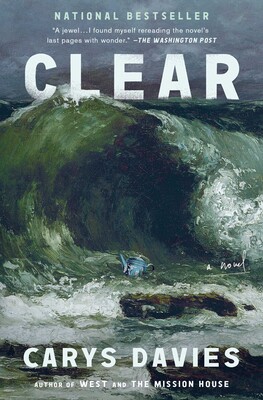
Clear (2024) by Carys Davies is a historical novel that brings a great deal of power, intelligence, and empathy into a few short pages. The story, told from three different perspectives, is set in the 19th century when two somewhat related and truly seismic events were shaking Scotland: the establishment of the Free Church of Scotland and the infamous Scottish Clearances. It is a time when around a third of the ministers in the Church of Scotland resigned because of a patronage system where landowners could nominate ministers of their choosing to congregations. That same era also saw whole communities of the rural poor driven off the land of those rich landowners in a relentless program of forced evictions, a time which gives the novel its name.
In this setting we meet John Ferguson, an impoverished Scottish Free Church minister who has accepted a job to help clear land for one of those landowners; John’s wife Mary who is apprehensive about her husband’s trip; and Ivar, the lone remaining occupant of an island north of Scotland. Shortly after his arrival on the island John falls down a cliff where he is found by Ivan, badly bruised and unconscious. A bond develops as the minister is nursed back to health by a man who has rarely interacted with another human for decades and who speaks in a local tongue that is rapidly disappearing. John works to learn Ivar’s language while Ivar begins to see himself through another’s eyes. All the while Mary’s misgivings about the trip turn to action and she sells much of what she has to book passage on a ship to find John and bring him home.
Davies tells this story in spare, beautiful prose. She says only what is necessary to bring the reader into this loving look at a vanished way of life, a magnificent but harsh landscape, and the building of human relationships against all odds. The different perspectives provided by John, Mary, and Ivar give us new and unexpected ways of looking at a story that is about finding life amidst loss.
The ending—which continues with the same sparse yet captivating style—is unexpected and will stay in the reader’s mind long after the last word is read. I found it profoundly moving, as each character makes an unexpected decision that shows how their encounters have affected them. There is a timeless quality to the ending, just as there is to the novel as a whole. The story is placed within a historical framework but there is much to consider about alienation, economic devastation, connection, empathy, and love that resonates in a contemporary context.
Davies has produced, in the end, a humane tale that is both unexpected and deeply satisfying.
A beautiful novel, a testament to the written word, reminds us that “One ought to be precious with communication. Remember: words, especially those written, are immortal.”
“Aging is such a privilege” wrote a friend I’ve known since my college days. I’m only beginning to understand Becky’s birthday sentiment but my appreciation for her comment has been helped by my recent reading of a thoughtful, intimate, well conceived and well written novel. It packs a subtle yet powerful message: we can grow and change even when change seems impossible. It is also a testament to the power of the written word. I’ve seldom been as touched by a book in recent years.
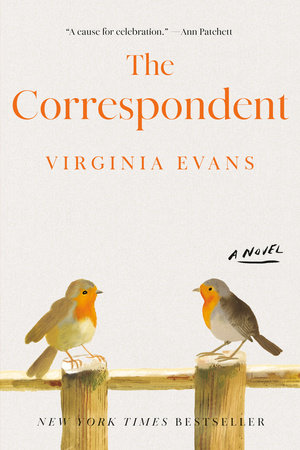
The Correspondent: A Novel (2025) by Virginia Evans revolves around a lifetime of written correspondence to and from Sybil Van Antwerp. A mother, grandmother, wife, divorcee, distinguished lawyer, retiree . . . Sybil has lived a very full life. For much of it she has used letters to make sense of that life. At about half-past ten most mornings she sits down at her desk overlooking the river, with her mug of Irish breakfast tea and milk, and writes. Letters, usually written in a clear hand, go to her brother; to her best friend; to the president of the University of Maryland who will not allow her to audit a class; to Joan Didion, Ann Patchett, and Larry McMurtry to tell them what she thinks of their latest books; to a young son of a former colleague who is brilliant but troubled. Those individuals usually respond. It is what one would call a “rich” correspondence, although some would say it chronicles a small life. And that’s the wonder of this book. In capturing one woman’s life—the joys, sorrows, births, deaths, pain experienced, pain hidden, pain finally explored—Evans has produced a vibrant work that envelops and moves the reader.
Many days Sybil also writes to one individual where the letters are never sent. But when a painful event from her past rises up—through a series of letters, of course—Sybil finally understands that she will need to examine this part of her life in ways that bring pain, sorrow, forgiveness, and ultimately growth and fulfillment.
Sybil is not afraid of dispensing advice and opinions. In writing to Judge Landy, the father of the young boy who has connected with her, she notes: “Leave it to your generation to take someone who is absolutely brilliant and turn it into a problem.” When a prospective suitor from Texas asks her to dinner and throws in a condescending line about women delivering a punch line, she declines and replies: “A good punch line is a good punch line regardless if delivered by a man or a woman. You sound like an old fool with comments like that one.”
The oncoming loss of her eyesight leads Sybil, ironically, to see her life more clearly. She learns how to forgive both herself and others. She recognizes the treasures next door and halfway around the world. In one of her last letters, when she tells one she loves a secret she has never revealed perhaps even truly to herself, she writes:
“There is a quote from one of my friend Joan Didion’s essays. It’s from the last essay in The White Album. The quote is: ‘What I have made for myself is personal, but is not exactly peace,’ and then it goes on, and then, ‘Most of us live less theatrically, but remain the survivors of a peculiar and inward time.’ This feels like the truest thing I have ever read.”
This love has brought her to “recognize how knowing you has been like coming in from the cold, lonely road to find a warm fire and a table laid.”
When we finish The Correspondent we feel much the same way. One can change when change seems impossible. And in the end, working through the pain in our lives can lead us to living those lives more fully, peacefully, and joyfully. Writer Fran Littlewood described the journey as one that “will make you laugh, it will make you cry, it will make you reflect, as all the best novels do.”
Rules for the road of life help us see how we want to live.
As has been the case in recent years, I highlight these rules on New Years Day.
While January is when many think of resolutions, I’ve taken a different route. In 2013 I established several “rules for the road of life” focused on how I want to live day-to-day. “Life learnings” are what the essayist Maria Popova calls her list. Ryan Holiday has a similar focus, zeroing in on what’s in his control so that he concentrates his resources in the places where they matter. If you must make resolutions, consider giving up what doesn’t matter.
Annual resolutions are fleeting but we should expect anything worthwhile to take a long time. The flower doesn’t go from bud to blossom in “one spritely burst,” as Popova writes, “and yet, as a culture, we’re disinterested in the tedium of the blossoming. But that’s where all the real magic unfolds in the making of one’s character and destiny.”
IT IS ALL PRETTY SIMPLE, AND YET ALL SO DIFFICULT
Designed to help direct me during both good and troubled times, these personal guidelines are not quite principles but rather serve as reminders of how I want to live over time and in the midst of life’s mystery.
The language I used in crafting these rules tends to focus on actions: walking, eating, spending, committing, laughing, caring. In my reasoning we don’t simply think our way into being the person we are meant to be, we have to act out of our commitments. These guidelines have helped me take steps forward in my quest to be open to love and wonder. Rabbi Abraham Joshua Heschel modeled this as a commitment to “radical amazement.” In his 1965 book Who Is Man?, Hershel wrote that while we try and manipulate what’s “available on the surface of the world,”
“. . . All we have is a sense of awe and radical amazement in the face of a mystery that staggers our ability to sense it . . .
Awe is more than an emotion; it is a way of understanding, insight into a meaning greater than ourselves. The beginning of awe is wonder, and the beginning of wisdom is awe.“(my emphasis)
Awe—of things extraordinary and ordinary—enables us “to sense in small things the beginning of infinite significance, to sense the ultimate in the common and the simple.” As it takes us beyond our normal ways of thinking, awe moves us, empowers us, stretches us, and can transform us.
Our thoughts become actions.
This remarkable, mysterious life we are given is all about change. Communities evolve. Nature grows, dies, and decays before being born anew. Sunsets turn from bright orange to deep purplish blues.
When I look at my eight rules, I recognize that they are designed for change. To help me slow down and pay attention. To take time. That’s a hard thing for someone whose default position is to “get things done!” But the more I consider what I know to be the path I should be taking I see attributes that I often miss in the rush through life. Awareness. Care. Wonder. Thankfulness. Moderation. Connection. Happiness.
Embrace the awe. Allow yourself to wonder.
RULE #1. BE GRATEFUL. BE THANKFUL. BE COMPASSIONATE. EVERY DAY.
Gratefulness is a practice we can cultivate especially during times of despair. My grandmother believed in saying “please” and “thank you” and those lessons have passed down to me. We begin our evening meal with each one at the table saying what they are thankful for that day. No matter where you are in life, you can start your personal “radically grateful” practice today.
RULE #2. EXERCISE SIX DAYS A WEEK FOR THE REST OF YOUR LIFE.
“Walking takes longer, for example, than any other form of locomotion except crawling. Thus it stretches time and prolongs life. Life is already too short to waste on speed . . . Walking makes the world much bigger and therefore more interesting. You have time to observe the details.”
I’ve come to embrace that approach whether walking in the great cities of the world, when visiting amazing natural landscapes, or just around our neighborhood. Walking has all sorts of benefits. We can each walk ourselves into a state of well-being. Walk into our best thoughts. Walk to daydream, as doing nothing is key to a creative life. Walk to be transformed.
RULE #3. LISTEN MORE THAN YOU TALK.
Listening is an act of love. It takes a lot of focus and energy, and all of us have our moments. Listening is not something that we do all the time. It’s work. It’s a commitment. But we want to make room for listening.
And while you’re listening remember that you don’t have to form an opinion about everything you’re hearing. Epictetus said, “It’s not things that upset us, it’s our opinions about things.” Holiday suggests that “the fewer opinions you have, especially about other people and things outside your control, the happier you will be.” Save your judgements for what matters. In the meantime, listen.
RULE #4. SPEND LESS THAN YOU MAKE.
Living within one’s means is always good advice no matter our stage along the journey. It is a reminder to me as I age to focus not on things but on what’s important now: beauty, friends and loved ones, those less fortunate, leaving a better place for our children and grandchildren. Spending less that you make is not a reminder to be stingy. In fact, a somewhat unexpected corollary to this rule might be Popova’s reminder to be generous.
“Be generous with your time and your resources and with giving credit and, especially, with your words. It’s so much easier to be a critic than a celebrator. Always remember there is a human being on the other end of every exchange and behind every cultural artifact being critiqued. To understand and be understood, those are among life’s greatest gifts, and every interaction is an opportunity to exchange them.”
RULE #5. QUIT EATING CRAP! EAT LESS OF EVERYTHING ELSE.
This rule goes along with #2, and it focuses on staying healthy through exercise and diet, especially as I age. Eating healthy food is also better for the planet.
Sometimes, however, we need help in following our rules. Since December of 2023 I’ve been working with a wonderful nutritionist because I needed help in lowering my weight and avoiding Type 2 diabetes, which runs in my family. Our monthly sessions give me the boost that I need to stay on track for the long-term.
RULE #6. PLAY (MUSIC), READ, WRITE.
This rule could also be stated as “make time for your passions.” I’ve had “Passions” on my daily task list now for a number of years, and under that I remind myself to “play, read, write”—which is shorthand for play music, read a book, and write something useful (at least to me) every day. It is the odd day when I don’t do at least two of these three. I find it is helpful to remind yourself of what brings you joy.
RULE #7. CONNECT AND COMMIT.
Conversation and connection are at the heart of living together as humans. “To communicate with someone, we must connect with them.” But like millions of others I consistently make a mess of this basic task. “The single biggest problem with communication,” said the playwright George Bernard Shaw, “is the illusion it has taken place.”
RULE #8. DON’T BE A GRUMPY OLD MAN. DON’T POSTPONE JOY. ENJOY LIFE!
I continue my lifelong project to live into Kathryn Schulz’s admonition to treat each day as the exceptional experience it is while doing my best to bash into some joy along the way.
It is all pretty simple, and yet also difficult. Be open to love and thirst for wonder. Work for justice. Take time to dawdle and dream. Leave enough empty space to feel and experience life.
Remember that life is finite . . . love is not.
Try to be nice. Always be kind.
Best wishes for a wonder-filled and remarkable 2026. As you welcome the New Year, consider making gratefulness, thankfulness, and compassion an everyday practice. And don’t postpone joy. I can recommend the effort!