
The power of words
A word after a word after a word is power.
A word after a word after a word is power.

I recently asked my colleague Priya Chhaya to open a retreat with a reflection on changing perspectives. We were discussing a familiar theme, the future of the American city, in an unexpected place—in this particular case, under the night sky in the American west. For one of the readings, she chose the Sylvia Plath poem Stars Over Dordogne, calling out the second verse in particular: “Where I am at home, only the sparsest stars Arrive at twilight, and then after some effort. And they are wan, dulled by much travelling. The smaller and more timid never arrive at all But stay, sitting far out, in their own dust. They are orphans. I cannot see them. They are lost. But tonight they have discovered this river with no trouble, They are scrubbed and self-assured as the great planets.” Priya noted that when in a city, which is home for many of us, you often only see what is right in front of you: the buildings, the roads, the cars, the noise, the obvious density. But a …
This is my season for strategic planning. Last week I spent a full day with our colleagues at the National Trust Historic Site Filoli for their strategic planning retreat. As you read this, I’m on a plane for another retreat with 20 team members designed to scale up one of our most important organizational initiatives. When I return, I have a half-day financial planning retreat set for early August. That’s a lot of planning! There are some who say that strategic plans are useless. They generally throw around the phrase “no plan survives contact with the enemy,” which is a popular adaptation of a phrase uttered by Helmuth Karl Bernhard Graf von Moltke, also known as Moltke the Elder. He was a German Field Marshal who lived between 1800 and 1891 and is credited with creating a new approach to directing armies in the field. This entailed developing a series of options rather than simply a single plan. Note that he didn’t stop planning. He simply recognized that in changing environments, you need options and …

Earlier this month I attended a conference where speaker after speaker inspired the attendees while addressing some of the key issues of our time. My notebook was filled with thoughts and information. However, one note — a Chris Thompson quote — stood out for me above all the rest. “Collaboration moves at the speed of trust.” This simple assertion has been playing around in my mind ever since. More than two decades ago, I recall sitting in a meeting where I asked a colleague why she was not engaging others in the organization on a particular project. Her response was, “I don’t trust them to do the job to the standard I want.” It struck me as a telling remark on a number of levels, but this long-ago exchange was one of the first thoughts that came into my mind when I heard Chris Thompson’s quote. This colleague — a wonderful person who now runs a successful one-person consulting firm — was upfront in admitting her lack of trust. And that lack of trust meant that she was not going to …
There’s an old saying that goes, “The only constant in the world is change.” That may be hard for some in historic preservation to accept, but I’ve often said that our job as preservationists isn’t to block change, but instead to work to manage the type of future—and communities—we want. I was thinking recently about the concept of resilience when facing change. Author Kathleen Smith has suggested that “Many people spend a great deal of time and energy trying to avoid change, but it will inevitably catch up to them.” When building personal strategies for strengthening resilience, she begins with the Stephen Covey construct of the ”Circle of Concern/Circle of Influence”, urging us to focus on what we can control. She also encourages her readers to check their thought patterns. “In times of change, it’s easy for your mind to cut corners. You might see everything in black or white, or you assume the worst will occur. But if you take the time to examine your thought patterns and assess how rational they are, you …
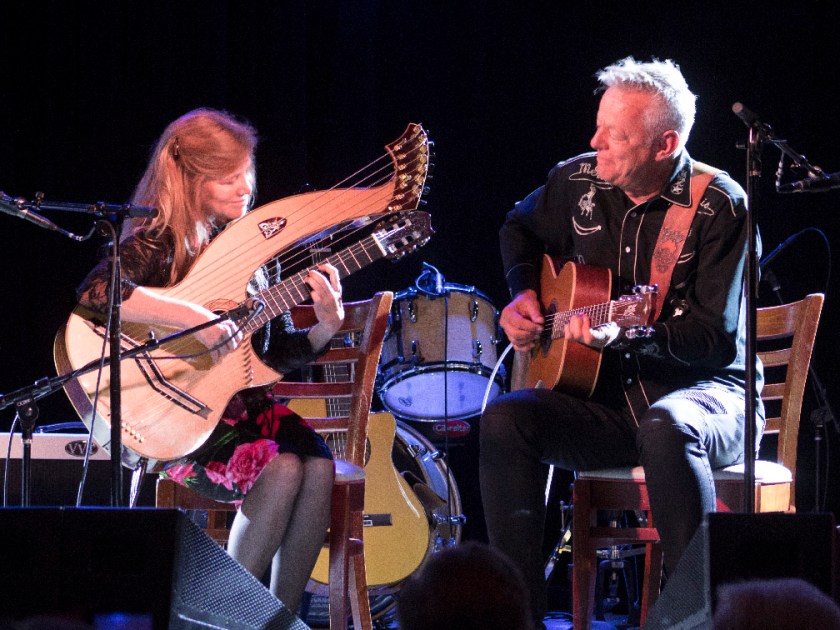
You’ll never know that one of your guitar heroes is sitting in the seat next to you if you don’t take your head out of your phone or computer.
Do you have a morning ritual? If you look at the Wikipedia entry on ritual, one might wonder why I’d ask the question. Ritual is described as inflexible, where one is governed by rules, and the term is sometimes used by psychologists in a technical sense for a repetitive behavior that is seen as a symptom of obsessive-compulsive disorders. That’s not my experience with ritual. Writing in Forbes, the author Alexandra Douwes encourages millennials to establish a morning ritual. Her reasoning is aligned with mine. “Establishing a morning ritual, preferably one that does not involve a screen, can set the tone for your entire day. Whether your morning ritual takes place at home or in the office, it’s important to ease into your day, and do it on your own terms. Before you let external factors such as screaming children, urgent emails, and smartphone notifications send you into a state of anxiety, start the day by focusing on the things you can control. A consistent morning ritual will put you in a proactive versus reactive …
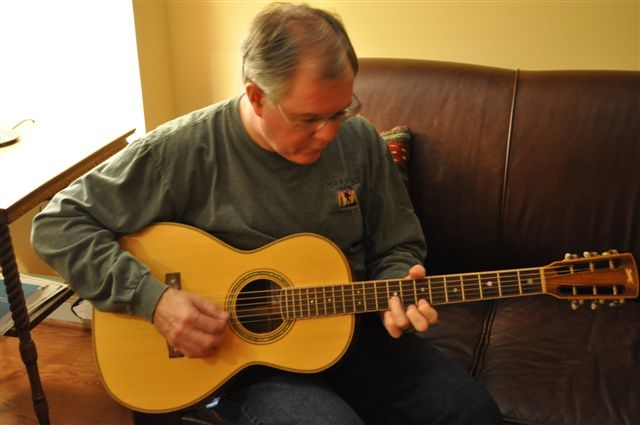
Our 15-year-old nephew — a budding musician — was in town this past weekend, so I took him to the House of Musical Traditions in Takoma Park. There he could see every type of musical instrument known to humankind (plus some) and, frankly, it gave me an excuse to play a few good guitars. Not that I don’t have good guitars at home. Later in the day my nephew had a chance to see and play my two prized Running Dog guitars made by luthier Rick Davis. Davis was profiled in Tim Brookes’ 2005 book Guitar: An American Life, where the author seeks to replace a badly damaged first guitar with a hand-crafted one “for the second half of my life.” He writes that as he nears 50 years of age, he finds an itch that can only be scratched with a new guitar. And as Brookes notes, “Guitar makers even have a word for these baby-boomers-who-always-wanted-to-be-great-guitarists-and-now-have-the-money-to-indulge-those-dreams: dentists.” “Much later, after the guitar is finished, Rick will refer to ‘the eternal and infinite capacity of …

The human brain is wired for story. We process our world in narrative, we talk in narrative and—most important for leadership—people recall and retain information more effectively when it’s presented in the form of a story, not bullet points.
In the midst of the disruption and turmoil that can be found around us, I have been reminded of the quote that began with Mark Twain and then was adapted by the great Negro League pitcher and philosopher Satchel Paige: “It’s not what you don’t know that hurts you, it’s what you know that just ain’t so.” We seem to be having an epidemic these days of “what you know that just ain’t so-itis.” There are many reasons this could be the case, but an important one is that we’re bombarded with information that requires work on our part to filter and understand. Warren Bennis has written that “adults learn best when they take charge of their own learning. Taking charge of your own learning is a part of taking charge of your life, which is the sine qua non in becoming an integrated person.” Consider where we get information today. In our interconnected yet at times isolated world, we all fall into the trap of letting others tell us how to think. It is easy …

