John McPhee wrote one of the great tennis books of all time. It is about so much more than a game.
In between the French Open and Wimbledon seems the perfect interlude to read one of the great tennis books of all time. Don’t just take my word for it. Former sports and city columnist for the New York Times Robert Lipsyte wrote that “This may be the high point of American sports journalism.” Donald Jackson, writing in Life magazine, said it is “probably the best tennis book ever written.”
Those reviews were written in 1969, when the book was published. But the recognition has lived on. Reviewing it for The Guardian in 2014, William Fiennes writes that this short book “is an adventure in form and a batch of pleasures caught on the fly.” And just last September Joe Posnanski started his series on the ten greatest sports books ever with this work. Joe describes the impact it had on him:
“Before I started, I wanted to be one kind of writer. After I finished, I wanted to be a whole different kind of writer. I pick it up a couple of times every year to remind myself of that feeling.”
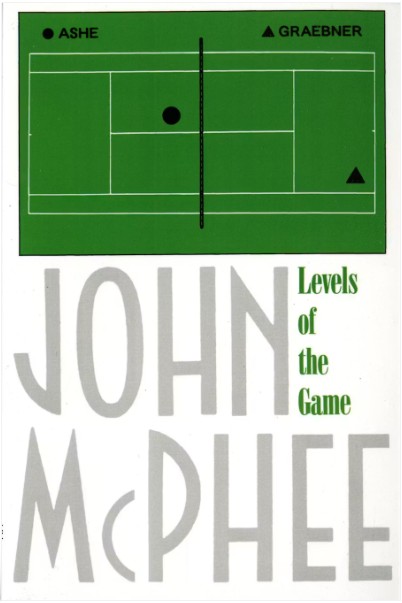
Levels of the Game (1969) by John McPhee is a masterpiece of the writing craft. “Precision is at the very heart of John McPhee’s writing.” That precision shines through in the choice of words, the form, the shifts in tense, the images he creates, the poetry in his prose. The frame of the book is the 1968 U.S. Open semifinal match between Arthur Ashe and Clark Graebner at Forest Hills in New York. There is the description of four sets of tennis, played in bright sunlight before 14,000 spectators. On one level it is sportswriting. On another it is a joint profile, complete with backstories and long flashbacks and interludes, of two players from very different backgrounds at the top of their game. On yet another it is a time capsule of an America recently torn apart by the murders of Dr. Martin Luther King, Jr., and Robert Kennedy. Finally, it is also “a highly original way of looking at human behavior.” The writing comes to life with the style and verve of a well-placed backhand return of a scorching serve. It is, as so many have said, a remarkable performance.
A mantra McPhee continues to use with his writing students is “a thousand details add up to one impression.” The implication is that “few (if any) details are individually essential, while the details collectively are absolutely essential.” What to keep and what gets taken out of a piece are equally important. As the sculptor Michelangelo said, “I’m just taking away what doesn’t belong there.” In Levels of the Game, McPhee has sculpted a classic—and timeless—tennis book that is about so much more than tennis.
Consider how the book begins.
“Arthur Ashe, his feet apart, his knees slightly bent, lifts a tennis ball into the air. The toss is high and forward. If the ball were allowed to drop, it would, in Ashe’s words, ‘make a parabola and drop to the grass three feet in front of the baseline’. He has practised tossing a tennis ball just so thousands of times. But he is going to hit this one. His feet draw together. His body straightens and tilts forward far beyond the point of balance. He is falling. The force of gravity and a muscular momentum from legs to arm compound as he whips his racquet up and over the ball. He weighs a hundred and fifty-five pounds; he is six feet tall, and right-handed. His build is barely full enough not to be describable as frail, but his coordination is so extraordinary that the ball comes off his racquet at furious speed. With a step forward that stops his fall, he moves to follow.”
The reader is barely on the second page and already engrossed.
The two players have known each other for years, are members of the U.S. Davis Cup Team, and travel together. Ashe says he knows Graebner’s game “like a favorite tune.” Ashe feels that “Graebner plays the way he does because he is a middle-class white conservative. Graebner feels that Ashe plays the way he does because he is black.” Grabner has an autographed picture of Richard Nixon on his desk. Ashe is a Democrat who, Graebner says, even plays tennis “with the lackadaisical, haphazard mannerisms of a liberal.” One of Ashe’s favorite places to visit is Spain, where he says “It’s a great feeling to get away from all this crap in the United States.”
There are gems to savor on virtually every page.
- Graebner’s wife Carole is a world-class tennis player in her own right, and when he’s playing he looks to her for clues. “I think these are the only times that Clark publicly acknowledges me as a knowing player,” she says. “Off the court, he does not acknowledge that I know much about the game,” a telling sentiment that captures so much of Graebner’s personality and worldview.
- Arthur’s father is quoted as saying that when “Arthur, Junior rushes himself, he gets into trouble. Mr. Ashe is an axiomatic man. When he says things like that, he does not seem to be making a comment so much as he seems to be promulgating a law of the universe.”
- Clark’s father is a dentist who speaks “quickly and nervously, often in an engaging monologue.” Tennis players who visit his home find him amusing because he asks them questions and, not waiting for replies, answers all the questions himself. “After thirty years of close contact with temporarily muted people, he has mastered the histrionisms of his craft.”
And then there is this section where McPhee writes about Graebner’s temper and rage on the court.
“Apparently he believes he can accurately assign blame outside himself for almost every shot he misses, every point he loses. He glowers at his wife. He mutters at other people in the crowd. Airplanes drive him crazy. Bad bounces are personal affronts. He glares at linesmen. He carps at linesmen. He intimidates ball boys. He throws his racquet from time to time, and now and then he takes hold of the fence around a court and shakes it violently, his lips curling. He seems to be caged.”
Posnanski says he has “read this section so many times. It’s utterly perfect. Every word in there, every one, you probably knew by the time you were in the sixth grade, if not earlier. And yet, the way McPhee arranges them, they turn into poetry.”
Near the end of the book, after a break between the third and fourth sets with Ashe up two sets to one, McPhee notes that Graebner “slams back Ashe’s first two serves” to go up Love-thirty.
“It is an inaccurately suspicious beginning, for Ashe now begins to hit shots as if God Himself had given them a written guarantee.”
Oh. My. God. What a sentence. “Inaccurately suspicious” is an unexpected and perfect turn of phrase. And then McPhee hits his own ace as Ashe “begins to hits shots as if God Himself had given them a written guarantee.”
Even if you don’t know how the match will end, you now know. As Ashe hits for it all one more time, McPhee closes with the final shot and image that remains with you long after you’ve put the book aside.
More to come . . .
DJB
Photo by Allison Saeng on Unsplash.


Pingback: Observations from . . . June 2026 | MORE TO COME...
Pingback: From the bookshelf: June 2026 | MORE TO COME...
Pingback: Summer reading . . . check! | MORE TO COME...