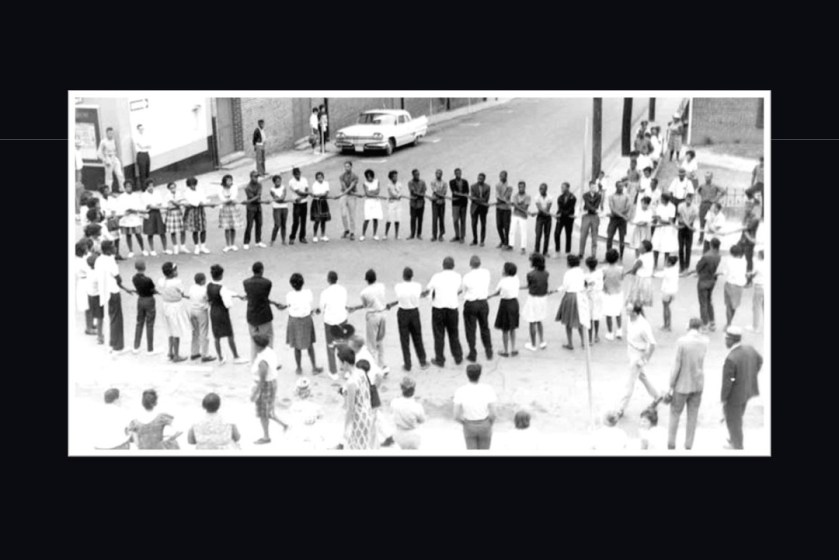
The only way to make sense of the fact that every advance in equality in America must contend with forces of reaction is to recognize that it is an eternal struggle.
In an essay for Harper’s Magazine in 1992* the writer, editor, and cultural critic Lewis Lapham examined the question of “who and what is American?” The context was the ending of the Cold War, where the “image of the Soviet Union as monolithic evil held in place the image of the United States as monolithic virtue.” With that certainty uprooted, all bets were off.
THE PLEASURES OF TELLING LIES
Here and in other essays Lapham addresses the many ways we lost our way as a country and works to highlight what he sees as our core virtues of citizenship in a democracy: mutual respect, helpfulness, forgiveness, kindliness, and, above all, tolerance.
“The American equation rests on the habit of holding our fellow citizens in thoughtful regard not because they are exceptional (or famous, or beautiful, or rich) but simply because they are our fellow citizens. If we abandon the sense of mutual respect, we abandon the premise as well as the machinery of the American enterprise.
What joins the Americans one to another is not a common nationality, language, race, or ancestry (all of which testify to the burdens of the past) but rather their complicity in a shared work of the imagination. My love of country follows from my love of its freedoms, not from my pride in its fleets or its armies or its gross national product. Construed as a means and not an end, the Constitution stands as the premise for a narrative rather than a plan for an invasion or a monument. The narrative was always plural—not one story but many stories….
If we indulge ourselves with evasions and the pleasures of telling lies, we speak to our fears and our weaknesses instead of to our courage and our strength. We can speak plainly about our differences only if we know and value what we hold in common.”
America in both presidential terms of Donald Trump has more than indulged itself with the “pleasures of telling lies.” Much like Lapham, activist and author Parker J. Palmer makes the strong case that lying to ourselves goes back well before 2016. Palmer asserts that in the quarter-century since the horrors of 9/11, we have lived in a state of denial. “Denialism has metastasized in our body politic, contributing to the way MAGA lies now have our democracy on the ropes. When denial is on the rise, democracy begins to die.”
Nancy MacLean’s 2017 National Book Award finalist Democracy in Chains: The Deep History of the Radical Right’s Stealth Plan for America takes it back even further, as she outlines the deliberate and blatant attempt, over more than 60 years, to overthrow democracy and our form of government. As it generally does in America, it comes down to power, money and race..
THE BETTER ANGELS OF OUR NATURE
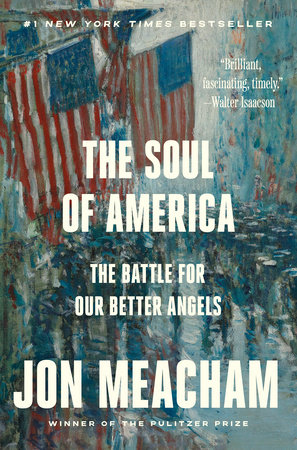
The Soul of America: The Battle for our Better Angels (2018) by Jon Meacham was written to help us navigate the current divisiveness that speaks to our fears by looking back into American history at other times of conflict and political warfare. The book was conceived and created following the alt-right march in Charlottesville in August of 2017, an event that shook the nation and exposed the ugly stain of racism that has always hovered, in the best of times, just below the surface in America. A believer in the great truth found in William Faulkner’s observation in Requiem for a Nun that “The past is never dead; it’s not even past,” Meacham asks his readers to look at the ongoing American battles over power and race and history to put today’s events in context. This history, Meacham argues, provides guidance on ways to respond to the reactionary forces that would turn back the clock on the promise of the Declaration of Independence.
Meacham looks at seven key eras in American history, from the Civil War and Reconstruction to women’s suffrage and the Red Scare to McCarthyism and the modern civil rights movement. In each he focuses on presidential leadership—noting its imperfections in every instance—and the role played by influential citizen activists.
There is much to like in Meacham’s book. But the work also raises points and perspectives that beg deeper questions. A talented writer, his faith in America comes through on every page. He sees possibility in trial. He understands that progress in America has always been slow, painful, bloody, and tragic. Much like Lapham, David McCullough, and others, Meacham sees history as the way to arm against despair. As the “antidote to folly” in Lapham’s phrasing.
I do not have a problem with the fact that many of Meacham’s illustrations of progress align with the progressive perspective of today’s Democratic party. Some will find that troubling. There is, however, a challenge of timing. The work already seems a little dated. It would be interesting to hear Meacham’s revisions to this work in light of the second Trump administration and the all-out attack on the Constitution by the Republican party and its judicial wing (aka the Supreme Court). This interview from 2026 gives us a glimpse of where such a revision would go.
ENTER THE ARENA

Meacham’s work does not come in a vacuum. Going back to Lapham’s 1992 Harper’s essay, we are reminded that when our star should be ascendent, as in the fall of the Soviet Union, we as a nation often lose sight of who and what we can be. Even with the dated references to politicians from that era, Lapham’s final paragraphs—like Meacham’s concluding calls for us to enter the arena, resist tribalism, and find a critical balance—are calls for us roll up our sleeves and work together.
“Among all the nations of the earth, America is the one that has come most triumphantly to terms with the mixtures of blood and caste, and maybe it is another of history’s ironic jokes that we should wish to repudiate our talent for assimilation at precisely the moment in time when so many other nations in the world (in Africa and Western Europe as well as the Soviet Union) took to the promise of the American example. The jumble of confused or mistaken identities that was the story of nineteenth-century America has become the story of a late-twentieth-century world defined by a vast migration of peoples across seven continents and as many oceans. Why, then, do we lose confidence in ourselves and grow fearful of our mongrel freedoms?
The politician who would lift us to a more courageous understanding of ourselves might begin by saying that we are all, each and every one of us, as much at fault as anybody else, that no matter whom we blame for our troubles (whether George Bush, or Al Sharpton, or David Duke) or how pleasant the invective (racist, sexist, imperialist pig), we still have to rebuild our cities and revise our laws. We can do the work together, or we can stand around making strong statements about each other’s clothes.”
More to come . . .
DJB
*The essay was subsequently reprinted as one of the opening chapters in Lapham’s masterful 2016 book The Age of Folly: America Abandons Its Democracy.
Image of “Wake Up, America” by Prettysleepy is from Pixabay of a poster from 1917. After two and a half years of neutrality, the United States entered World War I on April 6, 1917. James Montgomery Flagg created this poster, which was featured in “Wake Up, America” Day in New York City just 13 days later on April 19, 1917.
Photo of protest of segregation in the streets of Farmville VA 1963 from Queens College collection


Pingback: From the bookshelf: September 2026 | MORE TO COME...