
Links to stories from a few writers I follow who have important things to say. With a few musical interludes thrown in for good measure.
The Old Farmer’s Almanac tells us that the days that marked the four major divisions of the year were called quarter days; they marked the solstice (when the Sun sets at its most northern or southern point on the horizon) and equinoxes (when the Sun sets due west). This fit readily into the rhythm of the ways people farmed.
The fall equinox and the first day of autumn arrive on Tuesday, September 22, 2026, at 8:04 P.M. EDT in the Northern Hemisphere. The word “equinox” comes from the Latin aequus, meaning “equal,” and nox, “night.” On the equinox, day and night are roughly equal in length.
The Almanac has an interesting note about the Harvest Moon and its connection to Fall.
“One of our favorite pieces of trivia surrounding the autumnal equinox involves its relationship with the full Moon. Curiously, the full Moon that occurs nearest to the autumnal equinox is always called the Harvest Moon. Why is that?
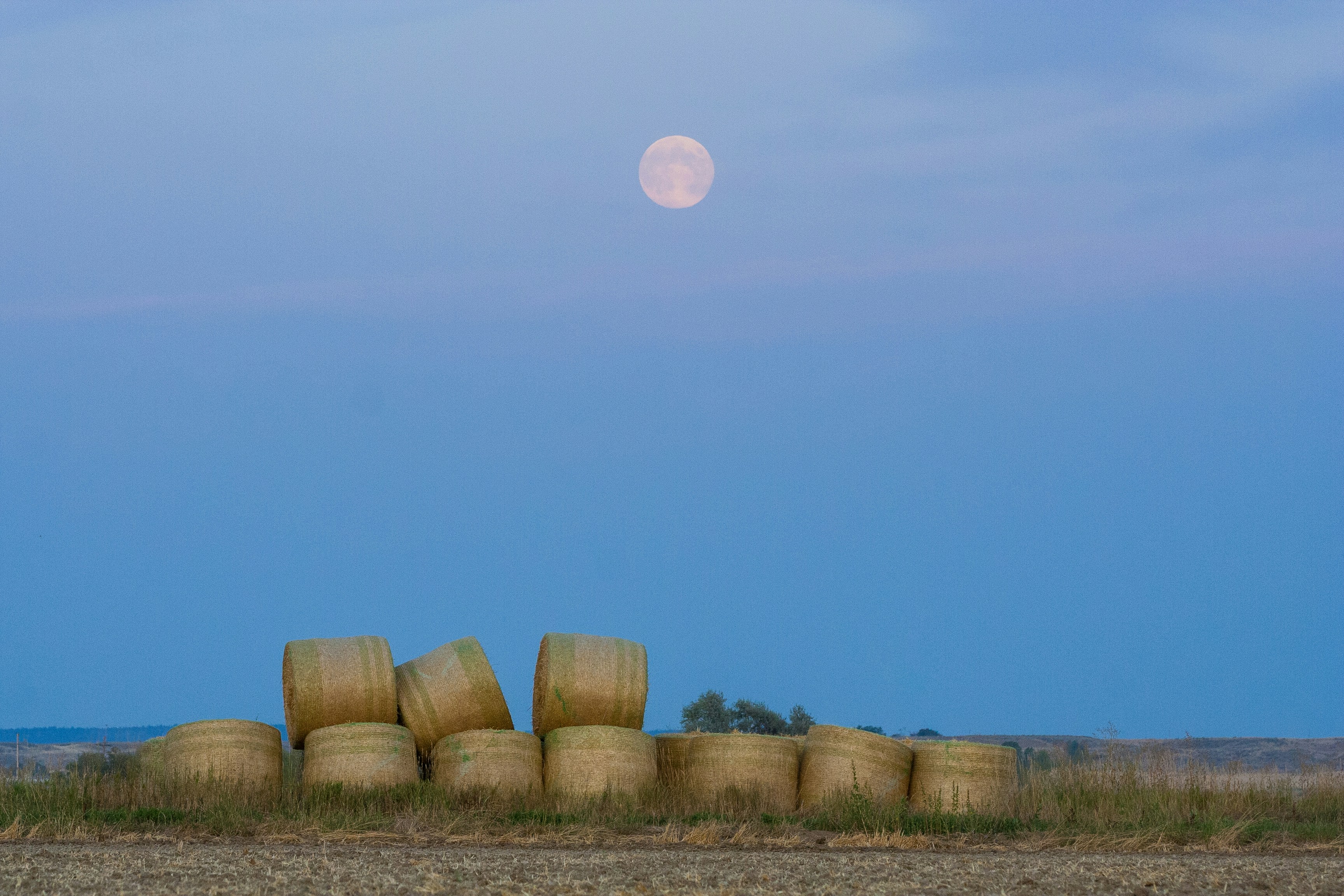
Surprise, surprise: the name has to do with farming! Around the fall equinox, the full Moon rises around sunset for several nights in a row, traditionally providing farmers with just enough light to finish their harvests before the killing hard frosts of fall set in.
Typically, the Moon rises about an hour later each night, but around the time of the fall equinox, the angle of the Moon’s orbit and the tilt of the Earth line up just right and cause the Moon to rise only about 20 to 30 minutes later each night for several nights in a row!”
In 1992 Neil Young had a hit with the beautiful love song Harvest Moon.
“Because I’m still in love with you
I want to see you dance again
Because I’m still in love with you
On this harvest moon”
Those of a certain age will remember another song about the Harvest Moon. No one does this old classic better than the late Leon Redbone.
To celebrate this day of transition, I thought I’d share offerings from writers and musicians who help me move through liminal times of change. I hope you’ll find something of interest among this eclectic mix.
MYTH IS NOT A SYNONYM FOR UNTRUTH
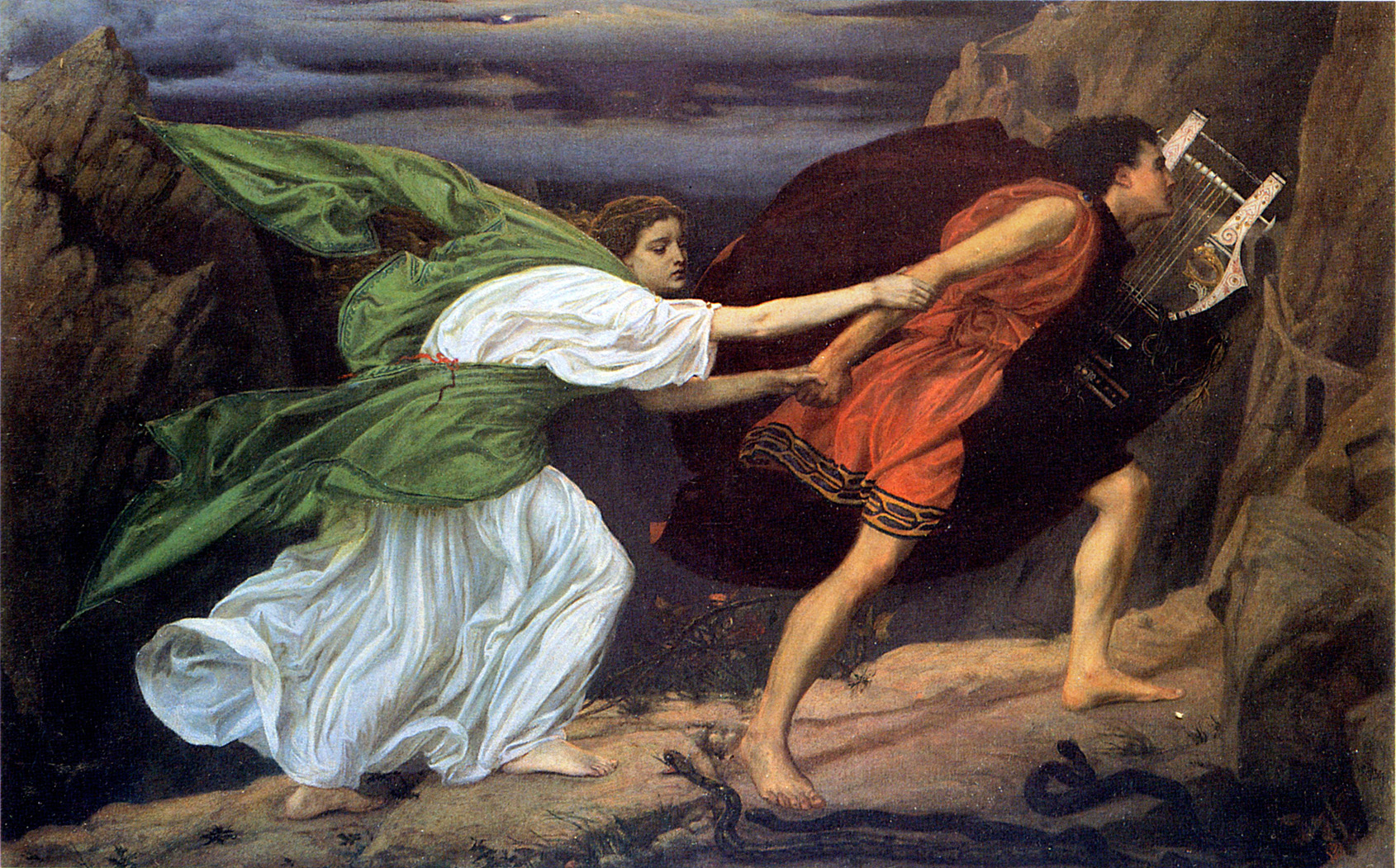
In my wrap of August MTC posts, I wrote about myths. Some can be illuminating and positive; others are powerfully destructive. Brilliant Reader Merrill sent me a link to a post by the poet and author Pádraig Ó Tuama entitled London and the underworld. In it, he recounts the story of being in a London cafe listening to a grandmother and her grandson at the next table. There was a Hadestown poster in the café. “Do you know what that is?” she asked the boy. He didn’t. So she told him the story of Orpheus and Eurydice, “the musician who ventured to Hades to find his lover, and the tragedy that unfolded as he lost her, just at the cusp of exiting the underworld.”
I love this myth, which was also central to the stunning movie Portrait of a Lady on Fire. Pádraig continues the telling of his morning encounter:
“I loved hearing the casual, fluent, loving rendition of the myth, in a café in London that was gradually filling up with lunchtime customers—the clink of knives and forks on plates, the whoosh of kettles and coffee machines, the hum of conversation, the telling of a myth that keeps on happening and rehappening. We love each other, we lose each other, we go in search of one another, love takes us into other worlds, we change, we find music for grief, we are marked and moved by love, we start again, we tell the story again.”
Myths are important, and as I wrote last month their strength is not in facts but in narratives. They help us make sense of the world and our lives. Ó Tuama notes this near the end of his post:
“I get annoyed sometimes when I hear ‘myth’ used synonymously with ‘untruth.’ A myth is something that is so true we have to construct a container of fantasy to hold it: A lover goes to hell because he cannot imagine living without a beloved; a character flies too close to the sun; a world is made and with complicated trees who import information we do not know yet know how to live with; a young person uses the only tools he has—pebbles and a harp—to stand in the face of exploitation …”
Ryan Holiday writing on 39 (or so) Lessons On The Way To 39 also points to why myths (among other stories) are important.
[M}ost people should consume less news and read more books. Less news, more books. More history. More poetry. More literature. More philosophy. More myths. Because you know what those stories are about? They’re about what’s happening now!
WILL THERE BE HISTORY IN THE FUTURE?
Two recent posts stood out among those I read focused on history. Leonard Pitts, Jr. wrote about the departure of Smithsonian Secretary Lonnie Bunch and the right wing war on memory in an article entitled Will There Be History in the Future?
“In the future they will wonder what in the hell we were thinking.
And while that’s not flattering it is also, in a sense, the best case scenario. If our progeny are able to ask that pointed question twenty, thirty or more years from now, it would at least mean they had been accurately taught about the dumpster fire in a train wreck that we are now living through. It would mean they had been told how we somehow managed to elect – not once, but twice – the most corrupt, incompetent and stupid president in history. It would mean they learned how we blew off an insurrection, welcomed back measles, tanked our own economy on a fool’s whim, started a war for the same reason, and watched as the richest man who ever lived took food and medicine from the poorest children on earth.”
Read Leonard’s entire piece. It is worth it.
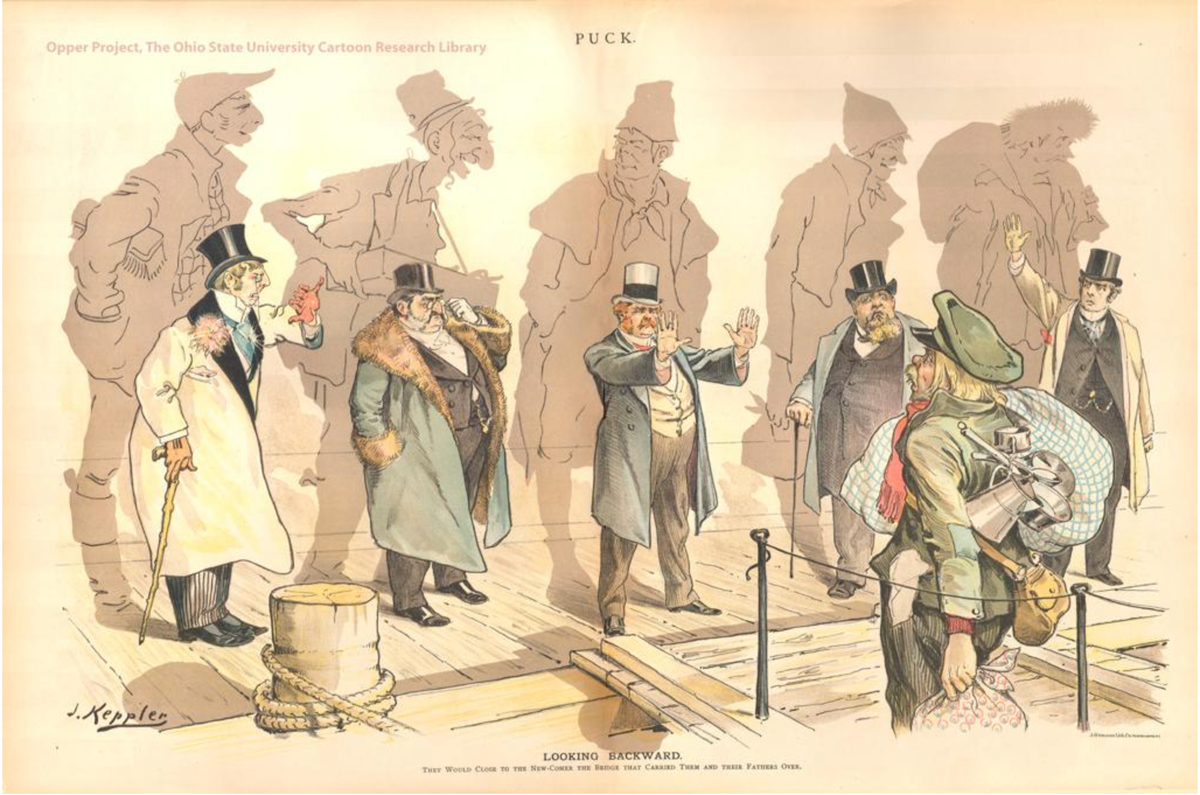
The second post I want to promote comes from historian Kevin Kruse. In Pulling Up the Ladder, Kruse writes about recent statements by Rep. Michael Rulli (R-OH) and Rep. Tom Emmer (R-MN) encouraging the deportation of Haitians and Somali immigrants.
“I’m not a genealogist by any means, but Rulli is an Italian surname and Emmer a German one. I am a historian, so I can tell you that the exact same kind of nativist nonsense was spewed by earlier generations of Americans towards people who had last names like Emmer and Rulli.”
So much of the self-inflicted damage we are doing to our country comes about from the actions of people who do not know their history or who don’t care to learn from history’s lessons. Here are a few other snippets from the past that could help us today.
- Jack Jenkins, a reporter for Religion News Service writes that Thomas Paine is the voice we need to hear in the post-250th anniversary celebration.
- A coin featuring the likeness of President Trump doesn’t have many precedents in American history. The ancient Roman opponents of Julius Caesar could explain why.
- Writing in Liberal Currents, Alan Elrod maintains that Donald Trump Wants to Bury America With Him: His speech at the GOP’s midterm convention came off like a Jim Jones sermon.
- On the 25th anniversary of 9/11, Rebecca Solnit wrote that only we can terrorize ourselves. “A quarter century ago, 2,600 people lost their lives in Manhattan, and then several million people lost their story.”
- On June 30, 2026, the Supreme Court struck down Donald Trump’s attempt to unilaterally amend the Constitution. “The true significance of this decision . . . is to be found in the principal dissent” by Justices Thomas, Alito, Gorsuch, and Kavanaugh, a dissent that marks a war on Reconstruction.
- Mother Jones weighed in on a similar issue by reporting on the Supreme Court and the “comprehensive approach to creating Jim Crow 2.0.”
- Foreign Policy in Focus has a piece worth reading on the ugly origins of America First while Thom Hartmann thinks about generational change.
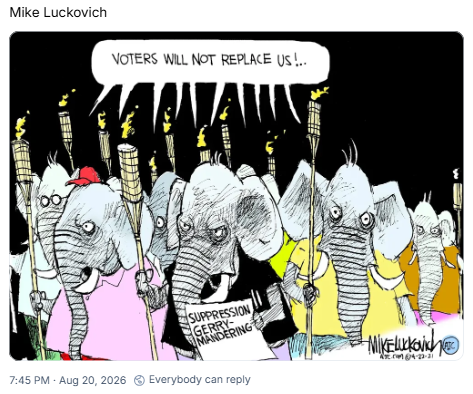
- Kevin Kruse has another good article online about denouncing extremists. One of the media’s favorite activities is demanding that Democratic politicians denounce individuals on their side who have made extreme statements. And yet they never call for Republicans to denounce Elon Musk, who is obsessed with race, is an ardent proponent of racial pseudo-science, is a promoter of the so-called Great Replacement Theory, and so much more. But the media has barely a question to Republicans who are receiving massive amounts of money and even more free publicity from their top donor Elon Musk. I wonder why.
CARTOONS TO MAKE YOU LAUGH OR WEEP
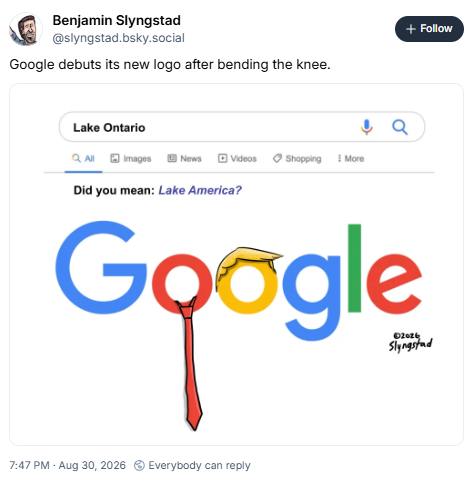
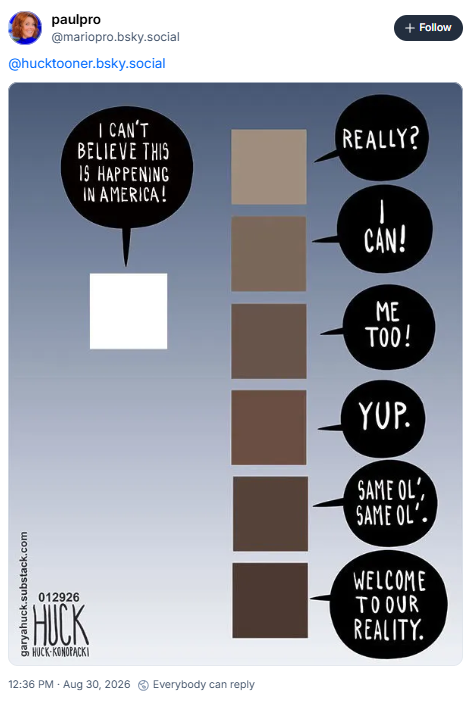
A FEW RANDOM NOTES
- Some good news via the American Library Association: Filmmaker Kim Snyder’s documentary about public and school librarians in Texas, Florida, and other states who unite to combat book banning in the United States was awarded a 2026 Emmy® for Exceptional Merit In Documentary Filmmaking at the Creative Arts Emmys, held September 5th and 6th at the Peacock Theater in downtown Los Angeles.
- Leonard Pitts, Jr. writes in They just don’t know when to quit that we increasingly find ourselves living in what has been described as an American gerontocracy. “As of last year, the average representative was about 58 years old, the average senator, 64. By way of comparison, the average American is 39. That gap matters.”
- I can only say “here, here” to the argument to leave your airplane window shades open from The Atlantic. “When the shades are drawn so quickly [so flyers can get their digital fix from the in-flight entertainment], passengers miss out on both the fascinating machinations of infrastructure—the strange vehicles, markers, and signs that make airports work—and the natural beauty of the landscape . . . as my colleague Henry Grabar wrote for Slate a couple of years ago, ‘you will see the ballet of the tarmac workers, parks and lakes you never knew existed, patterns of development and infrastructure, customs of land ownership, and finally, the lines of the earth itself.'”
THINGS I’M GLAD TO SEE
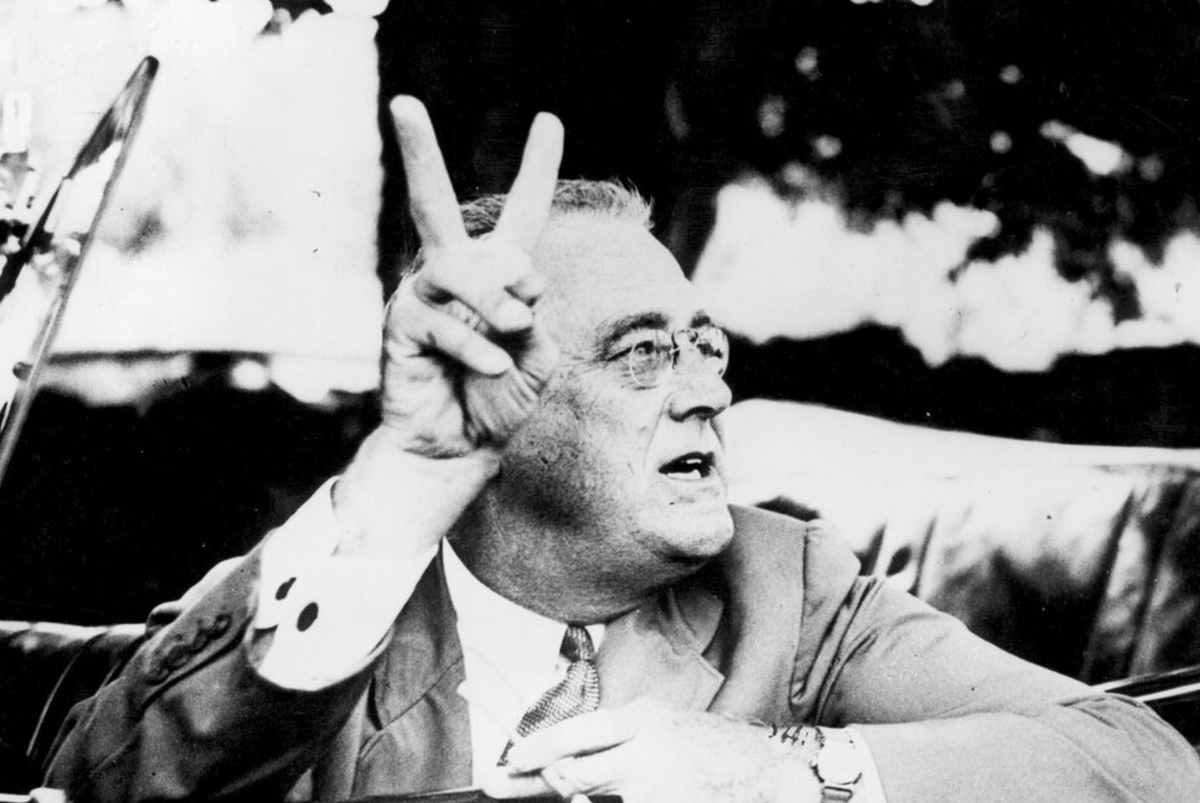
If David Brooks says it, I tend to think the exact opposite. I’m glad historian Kevin Kruse has the same outlook in a post entitled Punching Left.
A commentator had a wonderful reaction to Kruse’s column:
“I don’t think one can ever go wrong by ignoring or doing the opposite of what David Brooks recommends (which also applies to Matthew Yglesias). Brooks has tried to reinvent himself as a Wise Elder, a non-ideological chap (a word I’m sure he uses with no sense of irony) whose only interest is in saving Amurrica. It’s a disingenuous and dishonest effort that has also and unfortunately been pretty successful, as he, along with Arthur Brooks et al., attempts to make us forget that he was a conventional true believer Republican and lover of all things GWB, McCain, and Romney back in the day. He is to domestic politics what Tom Friedman is to global affairs—a tiresome hack long past relevance.”
FINALLY, TEST YOUR ASSUMPTIONS
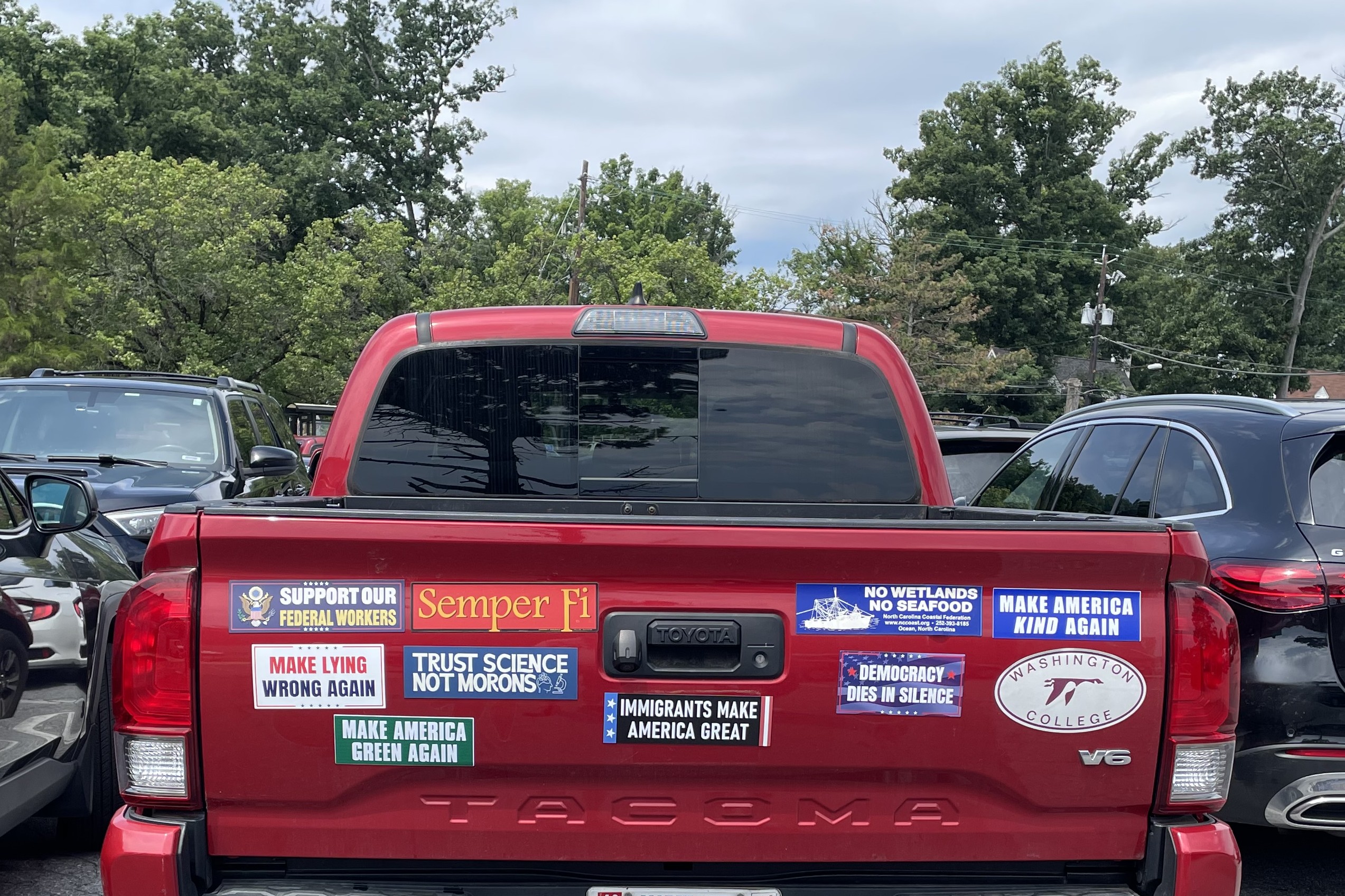
If you see a large, red pickup truck in today’s polarized political environment, you may quickly assume that some right-wing conservative is out for a spin. But as the bumper stickers on this Silver Spring-area vehicle attest, sometimes our assumptions are just plain wrong. I really liked seeing the Marine’s “Semper Fi” alongside the “No Wetlands No Seafood” sticker. Besides those two, my favorites, in no particular order, were:
- Trust Science Not Morons
- Make Lying Wrong Again
- Immigrants Make America Great
Real patriots come in all shapes and sizes. With a wide variety of interests and pickup trucks.
And just because you can never have enough Leon Redbone . . .
Enjoy the nice fall weather.
More to come . . .
DJB
NOTE: Click here to read the grab bag from the 2026 Ides of March edition and here to read the grab bag from the 2026 Summer Solstice edition.
Photo by Lukasz Szmigiel on Unsplash


Pingback: Observations from . . . September 2026 | MORE TO COME...