
Five books at a minimum. Every month. A variety of topics from different genres. Here is the list from November 2026.
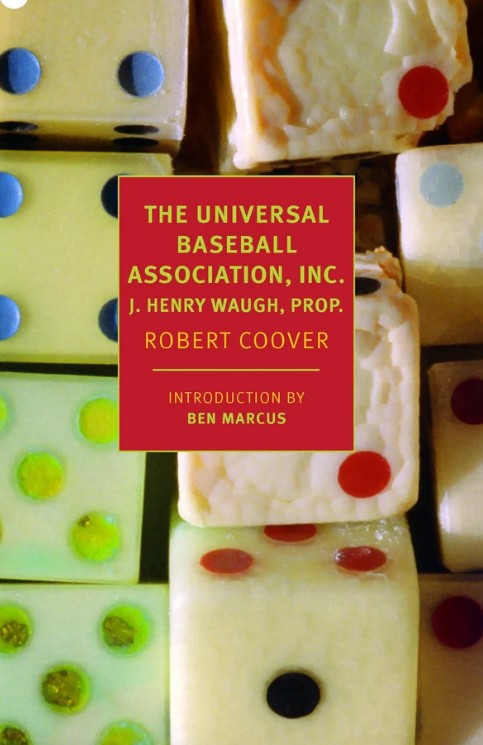
The Universal Baseball Association, Inc., J. Henry Waugh, Prop. (1968; reprinted by New York Review of Books in 2026) by Robert Coover is an original and challenging baseball novel that is about much more than the game. Henry Waugh is a “no-account accountant, barfly, and country music fan.” He hates his job and finds countless ways to avoid working. The one thing Henry loves is baseball. “Not the actual game so much—to tell the truth, real baseball bored him—but rather the records, the statistics, the peculiar balances between individual and team, offense and defense, strategy and luck, accident and pattern, power and intelligence.” So taking the names of eight historical teams from baseball’s Civil War and Reconstruction eras, he has created games played with dice and a league that exists entirely in his head, except for the extensive scorecards, league standings, ongoing seasons, stat sheets, archives, and more. Coover has produced a cautionary tale about fantasy, obsession, and control. Written in the 1960s, Coover is well ahead of his time in anticipating fantasy baseball, yes, but more importantly, he is among the vanguard in considering the dystopian nature of artificial intelligence.
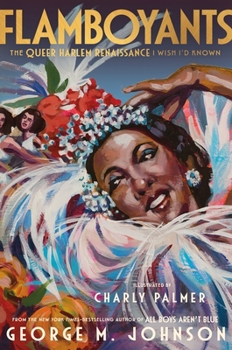
Flamboyants: The Queer Harlem Renaissance I Wish I’d Known (2024) by George M. Johnson is a very personal celebration of twelve writers, performers, and activists from 1920s Black America whose sexualities have been obscured throughout history. This Young Adult book is designed to help those growing into adulthood and their sexuality find creatives who blazed their own trail, often against great odds. Adults who only know the broadest outlines of these artists and the periods in which they lived will find the narratives of value as well. Flamboyants (I love the name) is a work that seeks to celebrate the full stories of individuals who are known today as iconic figures but who in their own time too often felt they had to hide their true natures in order to survive. I found this work to fit their description as “spiritual and ancestral work.”
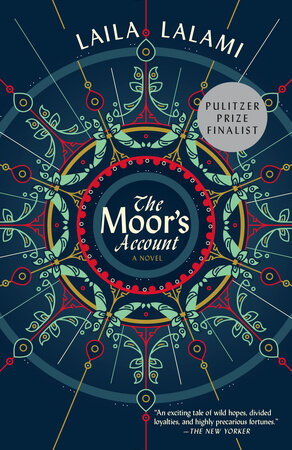
The Moor’s Account: A Novel (2014) by Laila Lalami is a fictional memoir of the Moroccan slave who survived the disastrous 1527 Narváez expedition to Florida and accompanied Cabeza de Vaca and two others as they made their way across the continent. Lalami gives the enslaved Moroccan the birth name of Mustafa ibn Muhammad ibn Abdussalam al-Zamori, but we know that he was renamed Estebanico by his Castilian master. Mustafa is widely considered to be the first African explorer of America. Little is known about his early life except for one line in Cabeza de Vaca’s chronicle of the journey: “The fourth [survivor] is Estebanico, an Arab Negro from Azamor.” Mustafa’s voice is missing from the official report of the expedition. Lalami takes the sliver of information from de Vaca’s chronicle and weaves a fascinating tale that forces us to look at history through different eyes. The enslaved and oppressed African has a very different perspective from that of his Castilian masters who came to the New World to hunt for gold and glory. Two key elements of this story differ from popular understanding of this history. First, Black men played a significant part in New World exploration. And secondly, “Native American men and women were not merely silent witnesses to it.”
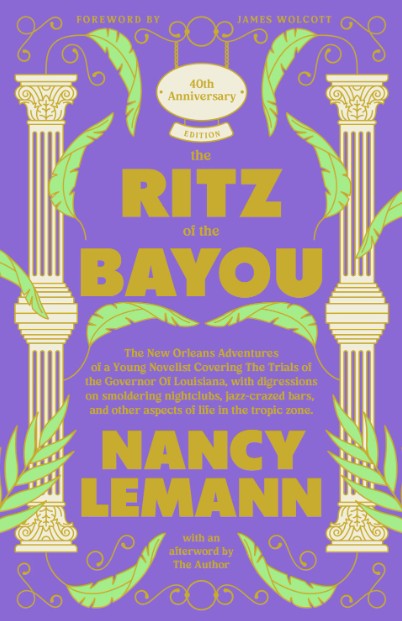
The Ritz of the Bayou: The New Orleans Adventures of a Young Novelist Covering the Trials of the Governor of Louisiana, with digressions on smoldering nightclubs, jazz-crazed bars, and other aspects of life in the tropic zone (1987; 40th anniversary edition republished in 2026) by Nancy Lemann began life as a long-form article on the 1985 corruption trial of Louisiana Governor Edwin Edwards commissioned by Vanity Fair‘s legendary editor Tina Brown. When Brown killed the piece in part because it contained little or no actual reporting on “the facts of the case,” Lemann and Knopf editor Gordon Lish saved it from oblivion by reworking the article into a book: a book that Lish knew “had no prayer of commercial success.” Yet the writing—oh that meandering, perceptive, atmospheric writing—was too good to let die. And now, forty years later, Hub City Press has re-published this work about, nominally, a trial of political corruption, and released it into our own era of politics gone much too far off the rails.
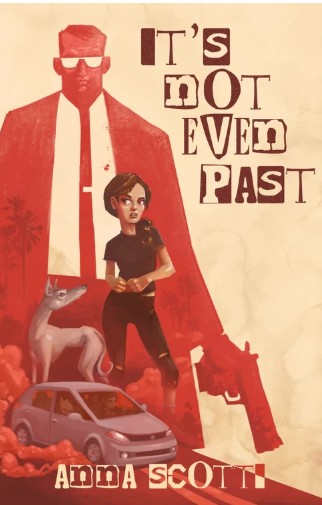
It’s Not Even Past (originally published in 2025; newly republished in 2026) by Anna Scotti is a brilliantly conceived set of murder mysteries involving the librarian originally known as Lori Yarborough. Lori moves through several aliases, multiple locations across the U.S., and a variety of rather menial jobs in order to stay a step ahead of her ruthless ex and his cartel henchmen. In each place our protagonist has an uncanny ability to find herself in the midst of trouble and murder; her ingenuity in solving those crimes inevitably forces her to move on, often to a new city with a new WITSEC-provided identity. Nine of the eleven chapters were originally published as short stories in the Ellery Queen Mystery Magazine where they received wide critical acclaim. In this wonderfully crafted work those original stories are book-ended with two new pieces, the first to help set up Lori/Cam’s saga and then the final one which adds a coda to this part of her life after the years have so fundamentally changed this once naive librarian.
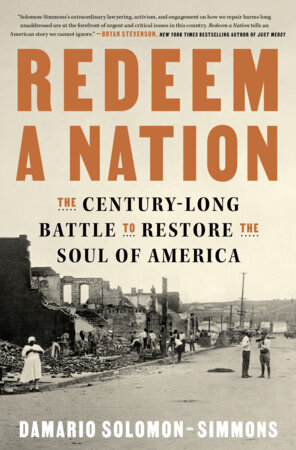
Redeem a Nation: The Century-Long Battle to Restore the Soul of America (2026) by Damario Solomon-Simmons tells the story of the Tulsa Race Massacre from a legal, community, survivors, and personal point of view. The frame is the historic legal case for reparations and the deeply moving testimony of survivors and descendants of Greenwood, a Black community unlike any other in the world. Solomon-Simmons grew up in North Tulsa, but it wasn’t until he was in college that he even heard of Greenwood or the two days when an entire neighborhood of ten thousand people, hundreds of successful businesses, $100 million in property, and generations of wealth were destroyed by an angry mob of racist whites. A mob deputized, armed, and directed by government officials and city leaders who resented the love, the success, the very idea of a thriving Black community that was known as Black Wall Street. Hundreds were killed and their bodies thrown in the river or dumped in mass graves. Thousands were left homeless. The aftermath reminded observers of the bombed out cities of Belgium in World War I. The story changed Solomon-Simmons’ life and gave him a purpose: to find justice for the survivors and descendants while holding the government accountable for what can only be described as genocide. This is his story alongside that of the fight for justice for Black Americans.
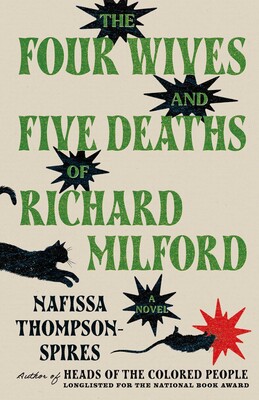
The Four Wives and Five Deaths of Richard Milford (2026) by Nafissa Thompson-Spires is a dark comedy about love, death, self determination, and survival. The story begins at the funeral of Richard Milford who is being buried but not celebrated by his four “wives.” That’s not the best description of his female companions who are the mothers of his 13 children, as he legally has only one “wife.” The town has come together in 1927 to gawk at this unusual family that seldom shows its face beyond the Milford mansion which sits high above the free-Black community of Newville, Oklahoma. Rich’s body has been pulled out of the river “swollen and stinking of gangrene, poisoned and bootmarked and missing a foot.” Over the course of this short, page-turning novel we learn how those various attempts at murder took place, the refusal of Rich Milford to die until he did, and the specter of lynching that reminds the residents of this freedom town that they really aren’t free. In 1920s Oklahoma—and especially after the Tulsa race massacre—white supremacy and bigotry are still very much the order of the day. Thompson-Spires has written an unconventional novel that examines history, human nature, joy, and pain on its own terms.
WHAT’S ON THE NIGHTSTAND FOR DECEMBER (Subject to change at the whims of the reader)
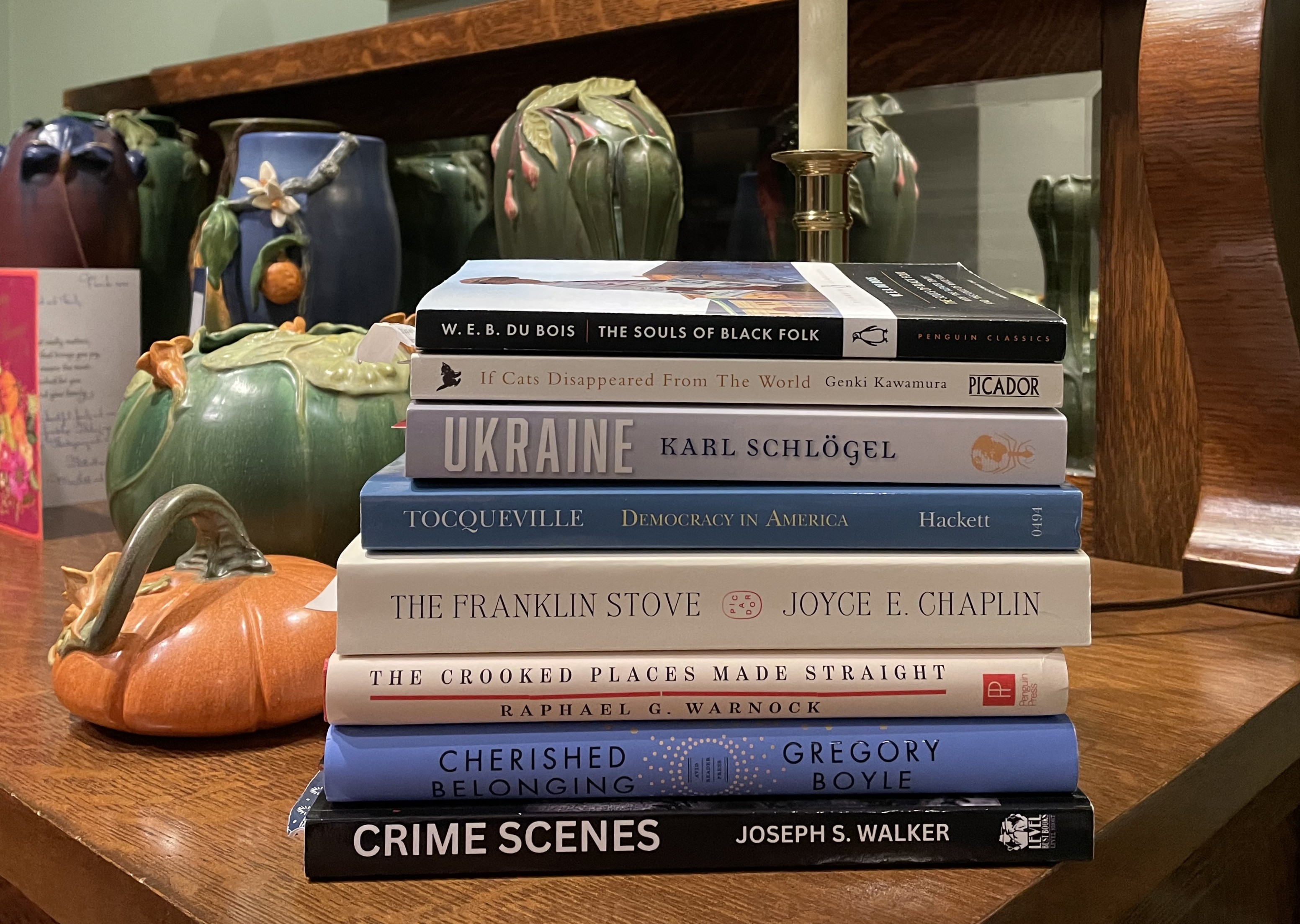
- Cherished Belonging: The Healing Power of Love in Divided Times (2024) by Gregory Boyle
- The Franklin Stove: An Unintended American Revolution (2025) by Joyce E. Chaplin
- Democracy in America (1835/1840; 2000 new abridged version) by Alexis De Tocqueville
- The Souls of Black Folk (1903) by W.E.B. Du Bois
- If Cats Disappeared from the World: A Novel (2019) by Genki Kawamura; translated by Eric Selland
- Ukraine: A Nation on the Borderland (2018) by Karl Schlögel
- Crime Scenes (2026) by Joseph S. Walker
- The Crooked Places Made Straight: Reflections on the Moral Meaning of America (2026) by Raphael G. Warnock
Keep reading!
More to come . . .
DJB
NOTE: Click to see the books I read in October of 2026 and to see the books I read in 2025.
Photo by Pavan Trikutam on Unsplash

