Latest Posts

Hiroshima 1945 / 2019

Pearl Harbor. Normandy Beach. Hiroshima. Names, places, memories, and lessons we should never forget.

A-bomb Dome
A-Bomb Dome at Hiroshima, Japan

Last week I was moved beyond words by time spent at the Hiroshima Peace Memorial Garden and Museum in Japan. In fundamental ways the experience mirrored my reactions during visits in recent years to Pearl Harbor and Normandy Beach.

The world at the time of those earlier visits seemed more stable than it does in 2019. Just a few years ago we didn’t have out-of-control individuals in positions of immense power in the United States; individuals threatening to use nuclear weapons against other nations and people just because the capability exists. Instead, we had leaders who sought, at least at some fundamental levels, to try and unite us as a people and as a world. There seemed to be adults in charge who had the memories to understand the horror to humankind of nuclear war.

As John Hersey, the author of the landmark 1946 piece on Hiroshima in The New Yorker, once wrote:

What has kept the world safe from the bomb since 1945 has not been deterrence, in the sense of fear of specific weapons, as much as it’s been memory. The memory of what happened at Hiroshima.

Hiroshima (1946) by John Hersey grew out of the only single-content edition of The New Yorker in the history of that publication. The book was the subject of a pre-tour lecture I attended by Harvard Professor Werner Sollors*. In his talk, Professor Sollors spoke to the impact of Hersey’s reporting and how it led the U.S. government to revise its narrative about why dropping the bomb was necessary. The report was serialized in some 70+ newspapers (back before all the major newspapers were owned by a small handful of conglomerates), turned into a book (never out-of-print), produced as a national radio reading, and became a touchstone for the nuclear non-proliferation movement. I bought a copy of the book at the Hiroshima Museum and finished reading it in two nights. Sollors’ lecture was a powerful preface to visiting the place where the world’s history changed.

A visit to Hiroshima begins at the A-Bomb Dome, a 19th century industrial building made of steel and brick that survived the bombing and has been left as a ruin to dramatize the scale of the destruction. On the day of our visit, the dome—and every other element of the peace garden and museum—was flooded with Japanese students. A visit to Hiroshima is a key part of education in Japan, and the message focused on the need for peace and non-proliferation is powerful.

Hiroshima is a very different testament to the destructive power of war when placed against Pearl Harbor and Normandy. Yes, both Pearl Harbor and Hiroshima were attacks carried out in surprise. But in the case of Pearl Harbor—and also at Normandy—the targets were largely military. Hiroshima was one of a handful of major Japanese cities that had been spared from large-scale bombing, and was chosen for the A-bomb attack in part for that reason. Almost 100,000 people—largely civilians—died on August 6, 1945, the day of the bombing, or shortly thereafter. The overall toll came to more than 140,000. The museum effectively shows the massive destruction, unlike any seen before during a single day of the war, and the impact on the people of the city, the country, and the world.

At Pearl Harbor, I saw the floating memorial to the individuals killed and buried in the wreckage of the U.S.S. Arizona. I walked among row after row of headstones at the American cemetery at Normandy, stones with the names of those who gave the ultimate sacrifice and some, who made the same sacrifice for country, but whose names are known only to God.

Peace Memorial Garden
Hiroshima Peace Memorial Garden

At Hiroshima, it is different. There is a simple memorial in the shape of a burial vault, with the names of the citizens of that city who died in the attack. Many lost their lives in an instant. John Hersey said the survivors described the atomic bomb as “a noiseless flash” that, unless you were several miles away from ground zero, gave you no time to react. His description of the experience of Miss Toshiko Sasaki, a clerk for the East Asia Tin Works, describes the horror felt by tens of thousands.

She thought that before she began to make entries in her lists of new employees, discharges, and departures for the Army, she would chat for a moment with the girl at her right. Just as she turned her head away from the windows, the room was filled with a blinding light. She was paralyzed by fear, fixed still in her chair for a long moment (the plant was 1,600 yards from the center).

Everything fell, and Miss Sasaki lost consciousness. The ceiling dropped suddenly and the wooden floor above collapsed in splinters and the people up there came down and the roof above them gave way; but principally and first of all, the bookcases right behind her swooped forward and the contents threw her down, with her left leg horribly twisted and breaking underneath her. There, in a tin factory, in the first moment of the atomic age, a human being was crushed by books.

Crushed by books in the first moment of the atomic age. It is a scene powerful and alive with meaning. The world changed. But Hersey’s telling of that story is given further resonance because we have come to know the place. And the place that is Hiroshima in 2019 tells of the horror not only of 1945, but of the potential horror today and in the future if the world refuses to learn the lessons from this act. The places we choose to preserve, even when they are of unspeakable tragedies, have the power to tell us about who we are as a people and what we can do differently in the future. Pearl Harbor, Normandy Beach, and Hiroshima provide individual and collective memories, connecting over a continuum of time, to create identity for individuals, communities, nations, and the world. We can choose to shape that identity because Hiroshima remains as relevant today as it was in 1945.

But we have to want to learn the lessons, else we are destined to repeat the mistakes.

More to come…
DJB

*Professor Sollors and Professor Alide Cagidemetrio are currently at work together on Face to Face with Antiquity, which examines visitors to global sites of antiquity.

Dinos on the Montana Landscape

How can I miss you if you won’t go away?

Sometimes it’s hard to say good-bye.

Last week, former Vice President Joe Biden—at 76 years of age and counting—became the twentieth announced Democratic candidate for President.  As many have noted, he’s not even the oldest aspirant in the field. That would be 77 year old Senator Bernie Sanders, running again after coming in second to Hillary Clinton in the Democratic primary in 2016.  Both white males are vying to replace another white male, 72 year old Donald Trump.

So much for the generational change with diverse candidates who look more like America that was to occur when the 47 year old Barack Obama assumed the presidency in 2009.  Not to mention the glass ceiling, which remains very much in place.

Knowing how and when to step aside for a more diverse, younger generation of leaders is very much front page news for the Democratic Party as the nation heads into another presidential election cycle. A recent Suzanna Danuta Walters op-ed in the Washington Post argues that male politicians “have a responsibility—if they really do want a more gender-equitable world—to lean out, work actively to disavow their privilege and pitch in to get a woman elected president.”  A Democratic primary focused on the women and younger, more diverse male candidates would provide choices among those who have experience in executive and legislative leadership, voting rights, criminal and social justice work, consumer protection, financial sector reform, health care, environmental protection, immigration, LGBTQ rights, Hispanic and African American empowerment, local government, the role of the military in today’s world, and international relations.  All are issues of importance to a wide range of Americans. (See my update to this post here.)

Politicians have a history of sticking around when others have long moved on to retirement (think Strom Thurmond, for goodness sake) and they certainly have motivations which differ significantly from so many of their fellow citizens.  Nonetheless, suffice it to say there is no “right” answer here.  Looking outside of politics, the preponderance of evidence has led me to believe that the privileged who are aware** of the special standing they have been given because of their gender, race, or circumstances of birth have a responsibility to think carefully about how to support those who do not have those same entitlements.  Even when we believe we have unique qualifications to lead—perhaps especially if we believe we have unique leadership qualifications—we need to consider the benefits of giving others, who bring a different perspective, their opportunity.

I considered appropriate ways to turn over my responsibilities before stepping down from a nonprofit leadership post earlier this year.  Over time, I came to believe that the baby boomers had made our mark on the historic preservation field and should find ways to pass the movement’s future to younger and more diverse generations and their points of view.  As this thought grew, the face in the mirror looked back at me with that, “Well, what are you going to do about it?” look.  Was I good at what I did?  Yes, I believed I was.  Were my perspectives, gained over decades of experience, of value to the field?  Yes, I felt so.  Was I indispensable? Ha! My grandmother’s admonition that, “The graveyard is full of folks who thought the world couldn’t get along without them” was always too fresh in my ears.

Stepping aside to encourage leadership roles for people of different generations, genders, and ethnicities doesn’t mean crawling into a retirement shell and slowly dying.  Mentoring new generations—both before and after transitions—will always be important.  Former President Jimmy Carter has had what many believe is the most successful post-presidential career in history***, all built around service to others.  His work empowers those who didn’t have the privilege that he enjoyed as a white, male Southerner growing up in the 20th century.  It is a model many of us could emulate, no matter our field of expertise.

There’s an old song that goes, “How Can I Miss You If You Won’t Go Away?”  It is a sentiment that is good to keep in mind when considering how to effectively, and gracefully, step aside before becoming a dinosaur.

Have a good week.

More to come…

DJB

*Perhaps some should say good-bye before extinction arrives (Dinosaurs on the Montana landscape* – photo by Claire Brown). One of the great things about traveling cross country is the wacky art you find along the way, such as the dinosaur sculpture garden just outside of Glasgow, Montana.

**I am very much aware that there are many individuals who do not see how their privilege has set them up for success.  They were born on third base and yet wake up and think they hit a triple.

***Others may argue for John Quincy Adams, who served 17 years in the House of Representatives after losing his presidential re-election bid to Andrew Jackson.  Adams, a fervent anti-slavery Congressman, is credited for the effort that did away with the “gag rule,” which automatically nullified anti-slavery legislation.  Adams suffered a stroke on the floor of the House in 1848 and died two days later.

Installment #2 in The Gap Year Chronicles

A crisis is a terrible thing to waste

A bad report from the doctor.  An unexpected shift downward in job prospects.  A jarring call in the middle of the night.  An unwelcomed story on the front page of the New York Times. Each is a crisis.

Crises are inevitable. How we respond says a great deal about our courage and fortitude.  It was Stanford economist Paul Romer who coined the famous soundbite, “A crisis is a terrible thing to waste.”  Others have used similar language, including former Intel CEO and Chairman Andrew Grove.  When speaking of his company’s Pentium Processor flaw in 1994, Grove said, “Bad companies are destroyed by crisis, Good companies survive them, Great companies are improved by them.”

In a recent Politics and Prose presentation, Reed Hundt—author of A Crisis Wasted* and former chairman of the Federal Communications Commission—discussed the global financial meltdown and Great Recession of 2008-2009.  While his new book studies the courage and fortitude of those addressing this financial crisis, Hundt goes further to describe key elements in responding effectively to moments of upheaval.

First, correct diagnosis of the problem at the strategic inflection point is critical.  This is easy to understand, but difficult to implement.  Often this analysis is made with the wrong people in the room.  I’ve seen nonprofit boards make decisions around crises without having people who understand their organization’s “industry” in the room.  Brilliance and the ability to frame issues in general is mistaken for wisdom in the subject at hand.  Dostoyevsky once said, “Intelligence alone is not nearly enough when it comes to acting wisely.”

Diagnosis takes time and should involve consideration of real choices. In the case of the global financial crisis, Hundt argues that the Obama team made decisions before understanding the scope of the problem. That premature leap forward ultimately hamstrung the administration in getting to appropriately sized solutions.

Once committed to a choice, one has to communicate endlessly.  “If you can’t sell it, you can’t do it” says Hundt, who adds, “How well we communicate is determined not by how well we say things but how well we are understood.”

Finally, it is important to note when the winds have shifted as a result of the crisis.  Hundt argues that Obama’s strong desire to be a post-partisan president ran into the political shifts that occurred as a result of the economic downturn.  Not recognizing those shifts until it is too late can have disastrous consequences.

Timely diagnosis.  Consideration of real choices.  Endless communication.  Recognition of the changing landscape.  In times of upheaval, consider how these four elements can help prevent looking back later on your crisis as a wasted opportunity.

Have a good week.

More to come…

DJB

*See my book review on A Crisis Wasted here.

Image: A storm rolling in by Claire Brown

Books to be read

From the bookshelf

The world’s landscape has shifted.

Two books came off my “to be read” pile this month, and both focused on a theme as current as the day’s headlines. The more substantive — A Crisis Wasted — is a deep analysis of the 2008 financial crisis and how early decisions made in the midst of the Great Recession still affect us today.  The other — A Gentleman in Moscow — is a charming novel set in a luxury hotel which takes the reader from the upheaval of the Russian Revolution through the mid-1950s.  President Barack Obama and Count Alexander Rostov, main characters in fact and fiction respectively, nonetheless face similar challenges when their world shifts underneath them.

A Crisis Wasted 2019

A Crisis Wasted:  Beginning in 2008 through at least 2009, the United States faced the most serious economic crisis since the Great Depression.  With the Bush Administration transitioning out of power, President Barack Obama and his administration took on the lion’s share of the work to address this challenge, often while battling opposing forces in both political parties.  That the United States survived without falling into national and worldwide chaos is no small achievement.

Yet many supporters of President Obama have felt that in multiple ways the response was inadequate.  Reed Hundt’s new book, A Crisis Wasted: Barack Obama’s Defining Decisions, is designed to provide perspective and details on these vague yet deep-felt concerns.

Speaking in November 2004, Stanford economist Paul Romer coined the famous soundbite, “A crisis is a terrible thing to waste.” Rahm Emanuel, President Obama’s first chief of staff, was speaking of the 2008 economic meltdown when he told an interviewer, “You never want a serious crisis to go to waste.”  It is Obama’s early decisions in addressing the financial crisis, as president-elect and then president, which are the focus of Hundt’s riveting book.

Hundt personally knows and has interviewed most of the key players involved, and he strongly suggests that the response was not up to the scope and intensity of the crisis. He weaves those interviews in with his own personal perspectives to produce an analysis of past action by Obama and his key advisors, as well as a guide for better decision-making going forward to those who believe our country needs fundamental change.

As Stephen Wiseman notes, Hundt makes a compelling case that, “The president-elect forgot how he got elected, and favored Wall Street over homeowners, deficit hawks over the middle class, and costly health care reforms over the chance to make a difference on climate change.” The outcome was an insufficient response to the crisis that favored banks over the middle class and, subsequently, led to the Tea Party revolution and the election of Donald Trump. Strong, provocative words.

A Crisis Wasted reads like a novel, which speaks to the way Hundt has pulled complex material together into a coherent tale.  His writing is clear and he makes sure to recognize perspectives other than his own.  (The only quibble I have here is that in one footnote, Hundt allows an attack on New York Times columnist Paul Krugman to take place anonymously. If you want to attack Krugman’s  work—and he does have a Nobel prize for economics to back up his assertions—have the guts to give your name.)

While the first half of the book is a page-turner, when Hundt gets into the details of housing, the environment, and the other elements of Obama’s “pillars of transformation,” the pace slows.  Yet the last two chapters are worth the price and the wait.  The first compares the Obama Inaugural Address (and his leadership style) with FDR’s in 1933, and the second is an epilogue that wraps up the main thesis of the book.  On the comparison between Obama and Roosevelt, Hundt describes the many differences between the crises they faced, but calls out Obama’s shortcomings in leadership style when contrasted with Roosevelt.  I’ve personally believed that Obama was too “nice” to his critics who had determined to block whatever he proposed (for example, Mitch McConnell of the oft-quoted goal to make him a one-term president).

In contrast, consider Roosevelt’s Madison Square Garden speech just before the 1936 election, when he famously described forces which he labeled “the old enemies of peace: business and financial monopoly, speculation, reckless banking, class antagonism, sectionalism, war profiteering.” Roosevelt claimed that these forces were united against his candidacy; that “They are unanimous in their hate for me—and I welcome their hatred.”  For many, Obama never came to understand how to use his position and masterful oratorical skills as Roosevelt had done to bring the country along to support his programs.

Hundt’s analysis is detailed and well framed, although not everyone will agree with his conclusions.  Nonetheless, it is an important and recommended work.

A Gentleman in Moscow

A Gentleman in Moscow: Amor Towles 2016 novel about a Russian Count who, during the Russian Revolution, is ordered to spend the rest of his life inside a luxury hotel is a good, if light, read. Towels is a gifted writer who can turn a phrase and tell a story.

Towles’ elegant touch comes through to me in a passage late in the book. Count Alexander Rostov is in bed with his long-time lover, Anna Urvanova, discussing the difference between Russians and Americans.  When Anna suggests that half the inhabitants of Europe would move to America just for the conveniences, the Count protests that he doesn’t understand.  Anna shows him pictures of dishwashing machines, toasters, televisions, and an automatic garage door opener.  For someone who hasn’t ventured outside the hotel in four decades, the Count is unimpressed and says, “I think if I were a garage door, I should rather miss the old days.”  He then goes further with thoughts that get to the heart of the novel’s focus:  what it means to have your life upended, yet remain a man of purpose.

“‘I’ll tell you what is convenient,’ he said after a moment. ‘To sleep until noon and have someone bring you your breakfast on a tray. To cancel an appointment at the very last minute. To keep a carriage waiting at the door of one party, so that on a moment’s notice it can whisk you away to another. To sidestep marriage in your youth and put off having children altogether. These are the greatest of conveniences, Anushka—and at one time, I had them all. But in the end, it has been the inconveniences that have mattered to me most.'”

This is a good and satisfying work.  However, early in the story it was clear that the main characters were going to avoid real tension and tragedy. Perhaps I’ve seen too many Game of Thrones episodes, but life doesn’t always work out as well for us as Towles manages for his key characters.  A Gentleman in Moscow made several best books of 2016 list, and is worth a read.  Just don’t expect War and Peace.

More to come…

DJB

Lake at Mohonk Mountain House by Claire

The Gap Year Chronicles

At some point in describing my “not quite” retirement after 42 years in preservation, I began to refer to what was next as the “gap year” I never had in my 20s.  It was said only partially in jest.

Gap years are a first world phenomenon that—as far as I was concerned—didn’t exist in my middle class/public school upbringing in Tennessee in the 1970s.  At least they didn’t exist for a young man

  • who wanted to get on with his career (the ambitious slice of my personality);
  • who, as the number two child/son, always did what was expected and “right” (the getting the job done segment of my personality); and, finally,
  • who needed a job to pay the bills (the persistent part of my personality coupled with the reality of rolling off the family payroll).

But here I am, having said “I’m taking a gap year” enough that it has become a reality, even for me, and I’m working on understanding what it all means. Will this period cover a full year? To be honest, I don’t know.  Perhaps I’ll determine that my gap year is really just a few gap months.  Or it may stretch much further into my next third of life.*

In talking with a former colleague, she told me of a friend who is unable to take a vacation this year.  In response, this young woman is posting something vacation-like on a daily basis to her social media accounts during the month of April under the hashtag “vacation every day.”  The post may show her having a mimosa with a homemade brunch or simply taking a nap.  I was inspired and began to consider ways to mark my gap year.

Since stepping away from the daily engagement with my life’s work, I’ve certainly mulled over how to use this new-found freedom to step back, reflect, stretch my mind, and more.  As with so much else, I know that by writing it out I can work through these thoughts.  Paul Graham, in a tiny essay entitled Writing, Briefly,  notes that “writing doesn’t just communicate ideas; it generates them.”

My plans for the Gap Year Chronicles—as far as they existare to write frequently about encounters with mind, body, spirit, places, or people that help me understand the journey towards who I am during this time.  I expect the posts to range from the frivolous to the serious, and everywhere on the spectrum between those polar opposites.

There will be plenty of time for the serious, so let’s begin with the frivolous:  My gap year beard.

Many who have known me only since we moved to Washington do not realize that I had a full beard for much of the 1970s and 1980s. Great facial hair is a part of the Brown family tradition, at least going back to the 19th century and Thomas Bruce Bearden, who was known as Papa Bearden in my father’s family.  Papa Bearden had a terrific moustache—so much so that it just begs for the use of the English spelling!

Pappy Bearden
Thomas Bruce Bearden – Our Andrew’s middle name is Bearden, which was my Grandmother’s family name

As soon as my mother granted her permission (which was after I graduated from high school), I joined in the family tradition and grew a beard.  The earliest version—as seen here in this parking lot jam picture with my friends John Balch and Jody Kammerud—was full and dark!

Parking Lot Picking
Parking Lot Picking circa 1975

My wife had no idea what my face looked like without a beard for the first several years of our marriage.  That changed on one wild and crazy New Year’s Eve** when I decided to become cleanshaven for the first time in over a decade.  We took a picture of the new look and—back in the pre-digital days—had a print made and mailed it home to Tennessee.  When the photo arrived, my father opened the card and laid the picture on a table while discarding the envelope.  Mother came by, picked it up, and asked, “Who is the person in this picture?”  My father laughed and said, “That’s your son!”  Of course, facial hair was such a part of my persona in those days that by the time this conversation occurred, the full beard was well on its way back to its standard look.

As I grew older, I was determined not to have facial hair with splotches of gray.  I was also not going to color my hair. In our family gene pool, my mother turned gray when she was 35 years-old, followed just five years later by a beautiful and elegant head of white hair.  Both grandmothers had full heads of hair that turned gray and white in their later years. My father and both grandfathers were bald (and clean-shaven). Given those genes, it was clear that my days of dark, black facial hair were numbered. By 1990 the beard was gone.  The moustache, however, lasted until early in the 21st century.  One day our young and perceptive daughter Claire came to the dinner table with a picture she had created, depicting me as if I was straight out of the old “Got Milk?” commercials.  I realized then that the gray-turning-white look was visible to everyone, and soon afterwards that was the end of all my facial hair for the next 15 years or more.

My family by Claire Brown
“My family” by Claire Brown. Note the gray moustache and the streaks of white running through my gray hair.

Both my brothers have long sported facial hair and for several years—since realizing that my beard was now all white—I’ve considered joining them. But—to quote the authors of Younger Next Year: A Guide to Living Like 50 Until You’re 80 and Beyond—I worried that while I might believe I looked hip and cool, in reality I’d look like Yasir Arafat!  But if you can’t take the plunge during your gap year—if you can’t use this time as your “Year of No Fear”—when will you ever try new things or return to explore once again, in more depth, elements of your past. I was flying home from a conference on March 31st—my last official day at work—so I skipped shaving that day and haven’t regretted it yet.

One week ago I had my first professional beard trim in almost three decades. Our millennial son Andrew and I have been texting back and forth to discuss beard trimmers and oil. In my head I see a closer cropped version of the older Ernest Hemingway.  If you see Yasir Arafat, please keep your comments to yourself!

DJB beard 3 weeks in
The gap year beard…three weeks and counting!

The gap year beard is emblematic of the range of opportunities facing anyone who has the time and wherewithal to step aside, slow down, and consider alternatives to his/her current way of living. Some will be lighthearted and perhaps insignificant in the long term, but might lift your spirits.  A lark, if you will. Others may prove to be life-changing. Perhaps one choice might be both. In the weeks and months ahead—if I’m lucky—I’ll have the time to consider possibilities and questions surrounding health and exercise, relationships, new educational paths, the building of solitary hours/days/weeks into my schedule to think and just be, ways to give back for the privilege I’ve been granted, my role in the fight for our democracy, music’s place in my life, support for the next generations of family and friends, new work options, widened horizons, my continuing place in preservation, and the list goes on.  Several may appear in a public way on this blog.

With number 1 in the Gap Year Chronicles series now complete and searchable in the “What’s Next…” category, I’m hopeful there will be…as I like to say…more to come…

DJB

*I subscribe to the division of a life into thirds, roughly divisible by 30 years.  Both my grandmothers lived to be close to 90 or beyond, and my father was just a month or two short of 91 when he passed away.  I realize nothing is given, but I’m trying to be intentional about my possibilities.

**I’m using my sarcastic voice here.  We were basically so bored that shaving off a beard sounded like great excitement.

Image: No Fear: Taking the plunge off the high board at the lake at Mohonk Mountain House (Credit: Claire Brown)

Books to be read

Stretch your mind

We have an “almost unlimited ability to ignore our ignorance.”

With that simple observation, the Nobel Laureate Daniel Kahneman, writing in his landmark book Thinking, Fast and Slowgets at the heart of how we create an illusion of understanding even when our knowledge is limited or based on false information.

The week after the redacted Mueller report was released to the public seems an appropriate time to explore Kahneman’s assertion.  Everywhere one turns there are those making stronger and stronger claims based on less and less factual evidence, even when those facts are clear and in the public realm.  One of the culprits is most certainly the way we now consume news. We skim or graze over news feeds from sources chosen by tech giants’ algorithms, so that we grasp only the barest of essentials run through a filter of group think.

In The Knowledge Illusion: Why We Never Think Alone, cognitive scientists Steven Sloman and Philip Fernbach argue that we vastly overestimate what we know (a point also made by Kahneman).  Quoting Sloman and Fernback in a recent New Yorker article, journalist Michael Luo suggests that “our unjustifiably strong opinions are reinforced by other people who are similarly ill-informed, creating self-reinforcing communities of misinformation.”

“When group members don’t know much but share a position, members of the group can reinforce one another’s sense of understanding, leading everyone to feel like their position is justified and their mission is clear, even when there is no real expertise to give it solid support. Everyone sees everyone else as justifying their view so that opinion rests on a mirage.”

The illusion of understanding has been around since the human race began recording history in part because tribal alliances have existed just as long.  In the 21st century we simply call them by different names—economic class, ethnicity, nations, political parties, race.  Or perhaps we call them our Facebook friends.

One way to break out of the group-think mold that leads to this illusion is to take the time to read and learn outside your comfort level.  Molly Ivins wrote a column aimed at journalists (later reprinted in her book Molly Ivins Can’t Say That, Can She? ) that fits all of us in this age of misinformation.  After calling on reporters to read at least one good newspaper a day, she then urged them to:

“Concentrate on opening your mind.  If you are 55 and straight, read Rolling Stone.  If you’re 25 and hip, Readers Digest. . . . You should be reading at least one good book a week—history, anthropology, sociology, politics, urban problems. If  you were a fine arts major, read about economics.  If you were a business major, find out about the ballet.  I’m not joking about any of this.  You have got to stretch your mind, further and further.  The alternative is letting it congeal, harden, and contract.”

While reading a great deal, I am nonetheless susceptible to being influenced by others’ opinions and adopting them without critical thinking.  In the end we are all responsible for setting our own boundaries as to what we’ll read and accept in this age when every media and tech company is using increasingly sophisticated methods to vie for our attention.  Stretching your mind does require that we gather and absorb more knowledge.  But whatever the approach to get there, we can all benefit by focusing on the pace and diversity of our diet of information.

In the next few days, consider cutting back on Facebook (or whatever your particular social media addiction) and pick up a good book on a topic you haven’t considered in a long time.  See if it doesn’t help you stretch your mind.

Have a good week.

More to come…

DJB

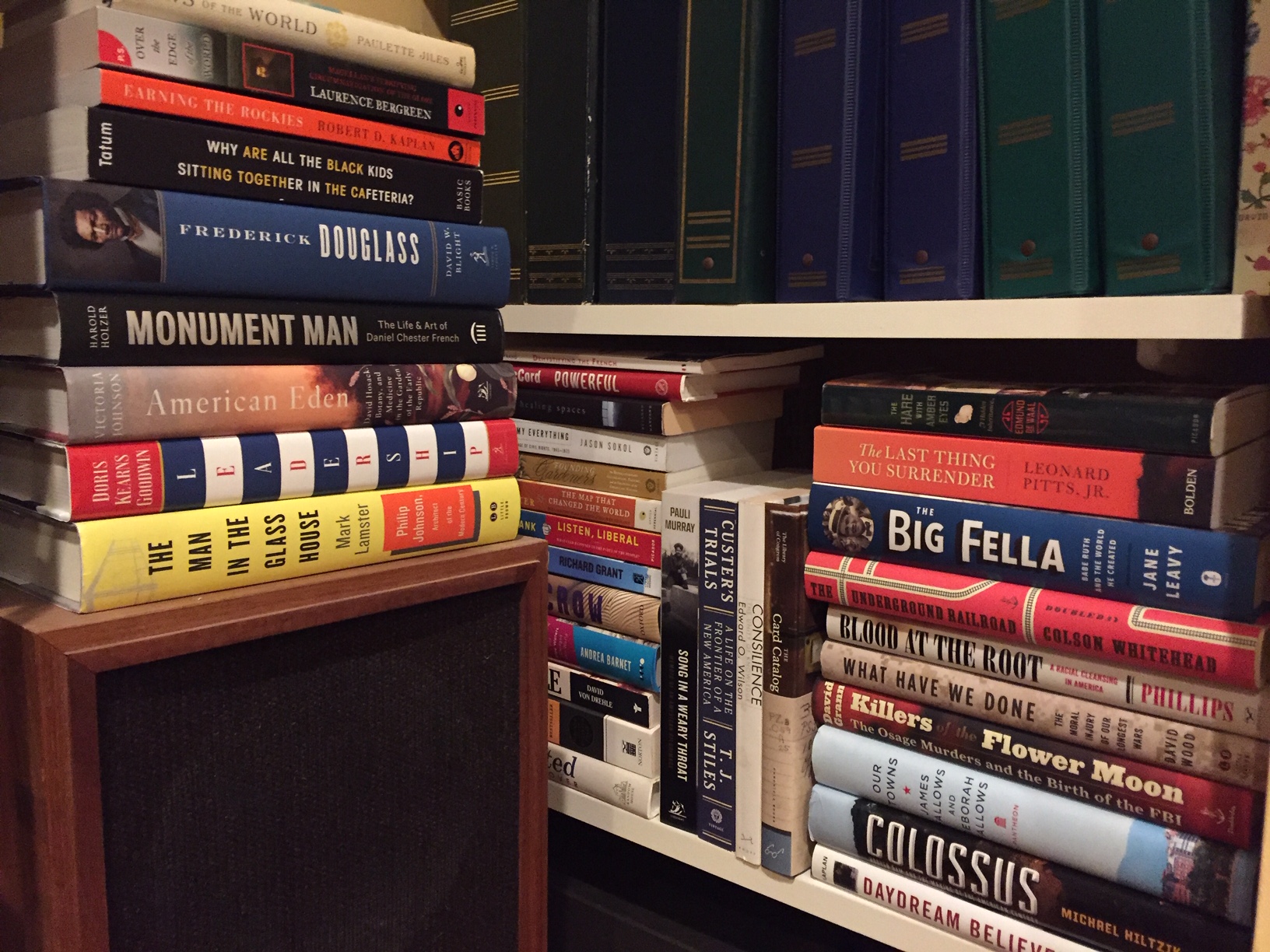
Image: A portion of the current DJB “to be read” bookshelf

Ants

Move in traffic with good sense and prudence

Who knew that Pope Francis was an urbanist?

I’m not a Catholic and only occasionally follow news out of the Vatican, but I was taken by reports that Pope Francis had commented on driving habits during his most recent New Year’s Eve homily. As reported in the press, Francis — who is also the Bishop of Rome — included the following in his remarks:

“’I feel gratitude in my soul, thinking about the people who live with open hearts in the city,’ Francis said.  As examples of that spirit, the pope began with a for-instance that will echo the frustrations of many a Roman resident – ‘those people,’ he said, ‘who move in traffic with good sense and prudence.’ By consensus, the poor state of maintenance on Rome’s roads, the lack of accessible public parking, and the city’s paralyzing traffic, are among the top complaints from locals….

The pope then went on to cite other examples of heroism from the silent majority.  He praised ‘those who respect public places, and report things that aren’t right; those who are attentive to the elderly, and people in difficulty; and so on,’ Francis said.  ‘These and a thousand other behaviors express concretely love for the city,’ the pope said, adding that they come ‘without giving speeches, without publicity, but with a style of practical civic education for daily life. In this way, they cooperate silently for the common good,’ the pope said.”

Helping to ensure that the places where we live contribute to community life has been a part of my work through the years as a preservationist.  In an earlier note commenting on the sign in a coffee shop window to “Be Civil, Be Urban,” I suggested that how we live and work together is a key to productivity, learning, growth, and happiness.  Civility is—unfortunately—in short supply in much of our national and international discourse today.  I think Pope Francis was making a similar point, but with his optimistic point of view that millions are moving together with “good sense and prudence.”

It is Holy Week on the Christian calendar, so a reference to the teachings of Pope Francis—even on how we live together in cities—isn’t that far-fetched.  However, if you are uncomfortable getting your urbanist insights from a world religious leader, you can always turn to the natural world.  Because they give each other a lot of headway, which buys them more time to react to any incidents up ahead,  “ants don’t get stuck in traffic jams.” Living and working together has its challenges, especially in these times of heated political divisions, but we can take heart in the lessons learned from the teachings of a pope or from the navigation styles of some of the smallest creatures on the planet.

Wishing you a week of civility, productivity, love for the people and places where you live and work…and no traffic jams.

More to come…

DJB

Image: Ants marching (photo credit: PSG of Mercer County)

Restored Franklin Theatre

Legacy and promise

NOTE: This post first appeared on the Preservation Leadership Forum blog.  It is adapted from remarks I made at the February 23, 2019, National Trust for Historic Preservation Board of Trustees meeting, my last Board meeting after more than two decades with the National Trust.

Over the past 22 years, I made it a practice to regularly reflect on both the legacy and the promise of the National Trust for Historic Preservation. We were founded by Congressional Charter after America’s leaders had seen the destruction that war could inflict not only on people but also on a nation’s culture and heritage. Our founding chairman, David Finley, was one of the famous Monuments Men who risked their lives to save the cultural patrimony of Europe during World War II. Bill Murtagh, an early predecessor of mine in senior management, went on to a distinguished career in preservation as the first Keeper of the National Register of Historic Places, establishing the tool to tell America’s story. Clearly, we stand on the shoulders of giants.

The National Trust led the successful fight to save the West Front of the U.S. Capitol from an expansion proposal that would have desecrated one of the sacred spaces of our democracy. Great names and families from American History—Rockefeller, Gould, Woodrow Wilson—have entrusted this organization with their property and their stories. But others—who didn’t have access to wealth and power—have also turned to the National Trust to tell their stories and protect the places that matter to them.

The places we choose to preserve tell us who we are as a people and as a nation. Every one of us has personal stories that help define us, and often those stories are rooted in place.

The Franklin Theatre and the Future of Preservation

My grandmother believed that idle hands were the devil’s workshop, and I’ll never forget the times she told me, “Make yourself useful as well as ornamental!” My father, having heard those same words, got his first job when he was still a teenager. Franklin, Tennessee—my parents’ hometown—has a lively Main Street, and that is where he went to work—selling tickets, making popcorn, and serving as the back‐up projectionist at the Franklin Theatre. I’ve heard stories of that theatre all my life. My parents went there on dates. And I saw films there in the 1960s, though the area was slowly deteriorating with the arrival of the malls.

Fortunately, a dedicated group of people loved downtown Franklin and led a Main Street comeback. This Great American Main Street award–winning community is now a cultural and economic engine in Middle Tennessee, and my father’s beloved Franklin Theatre is part of that renaissance. New music stars and current films play in the same space where his generation went to dream about a brighter future during the darkest days of the Depression.

Before he passed away two years ago, my father was able to attend the re‐lighting of the marquee and to see the restored theatre. We “bought a seat” in his honor, so that Tom Brown’s name—a name from the theatre’s past—would be connected to its future.

Individual and collective memories, connecting over a continuum of time to create community and national identity, are at the heart of why we save old places—why old places matter.

As I look to the future of preservation, two key points from my family’s story stand out to me. First, relevance is more important than ever. The Franklin Theatre remains a place where entertainment, music, and stories bind us together in the 21st century, just as it was during the Great Depression and WWII.

Second, for a movement that many assume is resistant to change, the way we save places keeps changing—and that’s a good thing. The Main Street program began as a push against both modern mall development and traditional preservation practice. Main Street buildings like the Franklin Theatre weren’t the crown jewels of American architecture—but they were places that mattered to local communities for reasons that went well beyond their architectural style.

The National Trust conceived and nurtured the Main Street movement and supported the adaptive reuse of buildings for changing needs. We initially pushed for Historic Rehabilitation Tax Credits and then, just last year, led the charge to save those credits. So much of what led to the renaissance of downtown Franklin came from the work of the Trust. We are well positioned to lead future change, but we must understand how and why change is important. Saving the past has a past—and that history is worth knowing as we look to the future.

A Look at Relevance

Former New York Times architectural critic Herbert Muschamp said that “the essential feature of a landmark is not its design, but the place it holds in a city’s memory.”

The A.G. Gaston Motel was described in 1955 as the “most lavish Negro owned hotel in the nation,” but this Birmingham, Alabama, landmark was abandoned and decaying just five decades later. Built by the state’s first African American millionaire, it became the epicenter for those campaigning to break the back of segregation in 1963. The infamous bombing and murder of four young black girls at the 16th Street Baptist Church occurred one block away.

March Birmingham cr MarkSandlin
Volunteers leading the March for the Birmingham Civil Rights National Monument (Credit: Mark Sandlin)

Well-coordinated National Trust advocacy, public affairs, and legal efforts led the city to donate a portion of the motel to the Trust in 2016. We immediately transferred it to the National Park Service, which enabled President Barack Obama to create the Birmingham Civil Rights National Monument.

This is clearly a place of memory and relevance.

Over my time in the field, I’ve seen that when many people think about historic preservation, they think only of “great architecture” or places “preserved in amber.” Unfortunately, they often don’t connect the work of saving places with helping people express meaning for the present and hope for the future. Why is that? Well, we haven’t always connected places to the lives of real people. Perhaps our tools, like the National Register of Historic Places, push us to see our cultural heritage as something rare and unique to be carefully preserved, as opposed to something ubiquitous, ordinary, and everyday to be celebrated.

In preservation, we reference the “period of significance” that is always somewhere in the past. I’ve pushed our staff to answer the question, “What if the period of significance is now?” Why is the A.G. Gaston Motel significant in 2019? President Lincoln’s Cottage, where Lincoln conceived of the Emancipation Proclamation? The President Woodrow Wilson House, another National Trust Historic Site? Why is the National Trust’s headquarters, the Watergate Building, relevant to people today? These questions give our work new relevance.

The benefits of preservation extend across many areas that we would identify as relevant today—environmental sustainability, economic growth, health, and more. But to be relevant, historic preservationists need to get comfortable with the emotional ways most people see their past. Once we can understand how most people perceive and value older places, we can then make our case through their lens, not ours.

Continuing to Change the Way We Save Our Past

Fortunately, we’ve proven ourselves good at change. Forty years ago, preservation was an outsider movement with citizens working against the grain of normal policies, plans, and development practice. Many preservation tools were created as exceptions and Band-Aids, designed to give older buildings, landscapes, and neighborhoods a chance to survive in an otherwise hostile environment. Tens of thousands of citizens across the country rose up to fight the nature and pace of change in their neighborhoods. This instinct to shape the communities we want, instead of accepting what others conceive for us, remains.

Here’s a powerful example: The residents around Memphis, Tennessee’s Crosstown Concourse recently came together to push for new zoning to preserve their neighborhood’s historic fabric. “Suddenly, the impossible has happened,” one resident said. “So let’s figure out what’s next.” What had seemed impossible? Taking a decaying 1920s former Sears distribution facility three football fields in length—filled with rats, standing water, and wild dogs—and turning it into a thriving, urban vertical village.

Crosstown Concourse
Crosstown Concourse (Credit: Aerial Innovations courtesy of Looney Ricks Kiss and Crosstown Concourse)

One of the largest LEED-certified rehabs ever completed, the Crosstown Concourse is almost fully occupied with hundreds of residents, an arts auditorium, school, YMCA, restaurants, and health-care providers. The National Trust Community Investment Corporation was a New Markets Tax Credits investor in this project. This is what preservation can do when the right tools are in place.

Crosstown Concourse credit Crosstown Concourse
Crosstown Concourse Grand Opening (Credit: Crosstown Concourse)

But while America’s cities are now magnets for the young, the challenge for the next 50 years is taking the values and proven benefits of preservation to scale while adapting our tools for today’s environment and issues. In contrast to the amazing success story of the Crosstown Concourse, let me tell you about how America’s only World Heritage City and the birthplace of our constitution—a city rich with architectural landmarks, walkable neighborhoods, and diverse ethnic communities—is currently facing a preservation crisis.

In Philadelphia, demolition rates are climbing while the percentage of buildings protected through landmark designation is far lower than the national average. City leaders turned to the National Trust for help; working with the Mayor’s Task Force, we evaluated Philadelphia’s preservation programs, gathered national best practices, and provided data-driven research. The 2018 Task Force Report is a blueprint for preservation practice in a new urban era—one we look forward to sharing with other cities nationwide. Recommendations for advancing the future of preservation in cities include:

  • We are far behind in the use of technology, and we must leverage open data and geographic information system (GIS) technology to move beyond survey exclusively focused on architectural attributes and completed by preservation professionals. Let’s find out what people value in their communities and then engage with them in accessible and compelling ways to save it.
  • We should reconsider our one-size-fits-all classification tools. We need a variety of methods and tools to effectively encourage the preservation of a diversity of buildings.
  • In a country where more than half of the structures in many communities were built before WWII, but only an average of 5 percent are protected through traditional preservation tools, we need to consider alternatives to historic district zoning. Conservation and sustainability districts are not “preservation lite”—they are preservation for the future.
  • The change from working against to working with marginalized communities in retaining their community structures—both social and spatial—is among the central challenges for preservation today.
  • Finally, we need to conceptualize cultural and environmental conservation as the same thing, but along a continuum. Our ReUrbanism principles note that historic preservation is an environmentally conscious activity, but our work should also be about the conservation of landscapes, including their living components and ecological systems. That puts preservation in the mix of the efforts to address the impacts of climate change.

Pushing the Envelope for Change

Over my two decades, the National Trust—together with a variety of partners—has saved some of the country’s most important places, connecting past to present to future. The Trust also has a record of pushing the envelope for change.

Cooper Molera Opening cr Mike Danen Photo
Cooper-Molera Gardens in Monterey, California (Credit: Mike Danen)

With a long history of fighting development that threatens historic properties, why would we partner with a shopping center developer to radically re-imagine a shuttered historic site? Because saving Cooper-Molera Adobe—a National Trust Historic Site that has been a locus of community and commerce in Monterey for longer than California has been a part of the United States—required new perspectives.

Cooper Molera Alta Bakery Opening
Alta Bakery at Cooper-Molera Adobe (Credit: Photo Courtesy of National Trust for Historic Preservation)

Today, a sign on the entrance advises visitors that “this is not your usual house museum.” At Cooper-Molera, they choose their own path through bilingual exhibits that mix historic collections with contemporary art. It is truly an astounding transformation, and—just as it did five decades ago at Drayton Hall—our work at Cooper-Molera gives other historic sites permission to try new approaches. The National Trust has been at the forefront of the effort to transform preservation through the years. Belief in, and support for, staff who are eager to test new models is necessary to stay there.

My colleagues and I have worked to share and celebrate stories from our nation’s past that opened new understandings of its history and of why we are who we are today. Together we have made the National Trust a leader in the fight to ensure that old places are part of our individual and collective memories, connecting over a continuum of time to create community and national identity. Together we have shown that there is a future for our past.

I look forward to what’s next. Thank you.

I want to extend my appreciation for the work and writings of former National Trust colleagues Tom Mayes, acting chief legal officer and general counsel, and James Lindberg, vice president of the Research and Policy Lab—as well as Jeremy C. Wells, Ph.D., assistant professor in the historic preservation program at the University of Maryland and chair of the Environmental Design Research Association.

Image: Restored Franklin Theatre (Credit: The Heritage Society of Franklin & Williamson County)

About DJB and MORE TO COME…

David J. Brown (hence the DJB) has been sharing stories and observations at More to Come since 2008. Originally created to capture photos and memories from a family vacation to the west, he continued writing as a way to send thoughts to friends, family, and others who may share the same passions. David’s mother was a prolific letter writer, sending long hand-written letters on a weekly basis to family members who lived away from home. He not only has acquired that gene but has cultivated and refined it for 21st century technology.

Fun fact #1: David said goodbye to Facebook in 2013 and has never been on Twitter, so except for LinkedIn which is used primarily for business-related posts, More to Come is his social media presence.

David is now retired and he uses More to Come to share encounters, discoveries, and observations made while traveling at the speed of life. With a professional background and personal passion in historic preservation, David writes to place today’s events in a historical context, highlight places that matter, and explore opportunities for learning through heritage travel. David’s mother and father were both prolific readers and his mother was also a librarian and talented amateur musician. Channeling his parents, David provides recommendations regarding books that have captured his attention and his regular Saturday Soundtrack feature explores roots music and musicians he enjoys.

Fun fact #2: David has lived throughout the South and, when pressed, will identify Murfreesboro as home. However, he is still working through that most Southern of all questions, “Where are you from?”

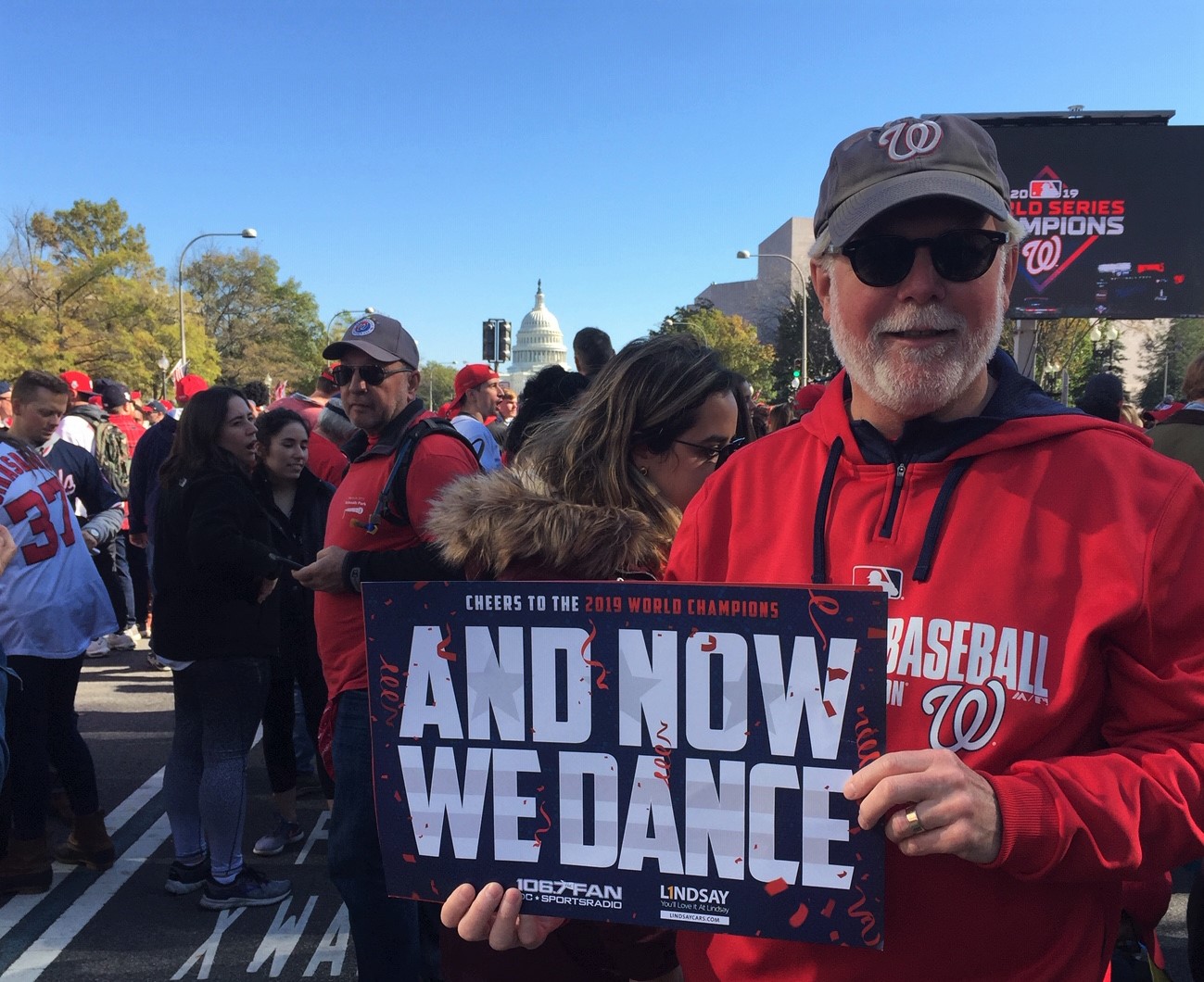
David currently lives in the Washington region, and More to Come has a section for family items — where he writes about how he would be clueless without his wife of four decades, brags on their (now adult) twins, and shares stories of his parents and siblings. One of his life-long passions has been baseball (Go Nats!) so readers will find some sports-themed posts.

Several years ago David began writing a Monday email to work colleagues about things that were on his mind. This discipline continues in a regular Monday Musings feature. When he retired from full-time work after a forty-year career, David took a gap year and added a section on “what’s next” to think about the future.

There are also a significant number of topics covered under the “Random DJB Thoughts” menu item, including posts where he reflects on the lives of people who have touched his life. The quirky “Observations From…” category began as short notes from the road, but in reality can cover just about anything. 

Professionally, David has a four-decade record of growing and strengthening organizations at local, state, and national levels. Throughout his career, David’s passion has revolved around connecting people in thriving, sustainable, and vibrant communities. His professional writings have been included in collections as diverse as: 

  • The Virginia Record
  • CRM: The Journal of Heritage Stewardship
  • Explore Rural India
  • Tennessee Historical Quarterly 
  • Forum Journal 
  • The Georgia Historical Quarterly 
  • The Journal of Architectural Education

While at Historic Staunton Foundation, he also served as the editor of Staunton, Virginia: A Pictorial History (1985). In addition to these books and articles, David has been quoted in and/or published op-eds in The New York Times, The Washington Post, The Richmond Times-Dispatch, The Nashville Tennessean, and other newspapers around the country.

You can learn more about David’s professional life through the Bearden Brown LLC website. He also serves as an educational expert for National Trust Tours. Check them out and come travel with us!

DJB in Venice (photo by Andrew Bearden Brown)

Fun Fact #3: David’s disclaimer for the politics-related posts: While I have voted for Republicans in the past (e.g., Howard Baker was one of the first votes I cast for a U.S. Senator), I’m a lifelong registered Democrat who, following in the footsteps of my late father, has become increasingly progressive as I get older. I agree with President Biden that “the government isn’t some foreign force in a distant capital. No, it’s us, all of us, we the people.”  As such, government should work to better the lives of all the people, not just those with access to wealth and power. I believe we need to stop the war ON government and begin to fight FOR government.  I won’t apologize for the fact that I have called out the authoritarianism of one of our political parties, the Republicans, in these pieces. Their leaders have made their goals abundantly clear. If any of that makes you uncomfortable, then I encourage you to skip these posts.

Everyone should have the right to vote

This personal newsletter covers a broad range of random topics, so other things have and will crop up. I love to hear from readers, so please feel free to respond to these posts and they’ll be posted, unless you are a troll. However, as a former colleague of mine says, if you want to disagree strongly, get your own newsletter!

As he often reminds his readers, keep some room in your heart for the unimaginable. Take time to dawdle and dream. Let yourself be bewildered!

Life is finite . . . love is not.

Try to be nice. Always be kind.

Thanks for reading.

More to come…

DJB

Image of DJB at Leon’s World Famous Custard in Milwaukee by Genell Scheurell.

Writer's Block

Honing your craft

Vision. Skill. Time.  All are usually required to produce something of lasting value.  All are at the heart of craftsmanship.

Traditionally linked to items made by hand, craftsmanship can be applied to a wider array of undertakings that benefit from an attention to detail through the application of a skill sharpened over time and practice.

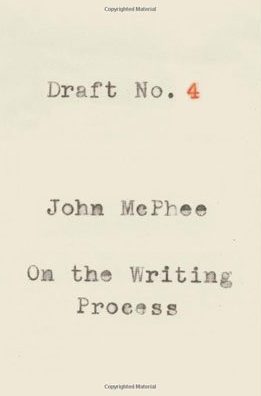
Draft No. 4
“Draft No. 4: On the Writing Process” by John McPhee

Take writing, for instance.

For several years I’ve considered how best to refine my writing skills. However, other commitments became excuses for never taking serious steps forward to actually hone that craft until a former colleague recently noted that my passion has always been best expressed in my writing. It is where I seek to tell a story or share a memory in hopes of inspiring and making a meaningful connection to colleagues and friends. One of my favorite sayings is “Let’s see how it writes.” This same colleague suggested that I may have been the best first draft writer in the organization.

I knew exactly what she meant, and it was that particular comment that led me to pick up John McPhee’s 2017 book Draft No. 4:  On the Writing Process. I wanted to consider getting from a good first draft to a great fourth draft. As a long-time staff writer at the New Yorker, McPhee has some definite thoughts on how to move in that direction.  Writing to his daughter, McPhee once explained that, “The way to do a piece of writing is three or four times over, never once.”  Three or four revisions are not always possible in a work context with tight deadlines, but I agree with his premise that the essence of the writing process—the heart of the writing craft—is reflection and revision.

In Draft No. 4, McPhee takes the reader on a delightful and well-considered journey from ways to structure a piece of writing to an ending chapter on omissions.  That last feature is just as important as the first.  A mantra McPhee continues to use with his writing students is,

“A Thousand Details Add Up to One Impression.”

He notes that this is a quote from the actor Cary Grant, with the implication that “few (if any) details are individually essential, while the details collectively are absolutely essential.”

What to keep and what gets taken out are equally important.  As the sculptor Michelangelo said, “I’m just taking away what doesn’t belong there.”

In the business context, I have been known to say, “Don’t let the perfect be the enemy of the good.” However, when working on your craft—be it a stone carving, your speaking skills, a handmade musical instrument, a painting, or a piece of writing—don’t let the merely good keep you from sharpening, refining, and honing the thing until you have created something worthy of the term craftsmanship.

Have a good week.

More to come…

DJB

Image: Writer’s Block (photo credit: Center for Documentary Studies)