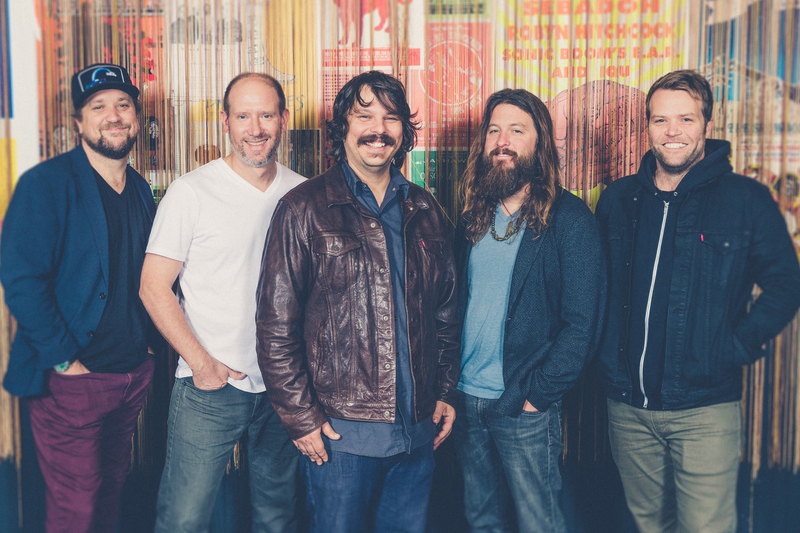
Greensky Bluegrass began playing together more than 18 years ago, and they remain road warriors today, making up to 175 tour stops a year. Based in Kalamazoo, Michigan, these five musicians play bluegrass music and much more on traditional bluegrass instruments. In fact, Greensky Bluegrass fits nicely into the progressive bluegrass and jam band category begun lo those many years ago by Sam Bush and the New Grass Revival, II Generation, and others. Today, they are often compared—and share the stage with—String Cheese Incident, the Infamous Stringdusters, and similar bands.
While they’ve played hallowed country music halls such as Nashville’s Ryman Auditorium, they also play to large audiences in venues less frequently connected to traditional bluegrass acts, such as Red Rocks Amphitheatre, Bonnaroo, and the New Orleans Jazz Festival. The band has been described as “a live force of nature renowned for bringing rock ‘n’ roll showmanship to high-energy bluegrass…. Their unpredictable performances remain the stuff of legend attracting diehard devotees who typically travel far and wide to experience multiple gigs.”
The internet has a wide variety of the band’s music for those who want to take a listen. Do It Aloneis from their most recent album, All For Money (a nice tongue-in-cheek title for any bluegrass band.) For those looking for something closer to traditional bluegrass picking (at least until about the 3 minute mark), check out Kerosene. On a different level you may want to sample Windshield, a song of pain, loneliness, and loss that fits well in any musical tradition.
“There’s a secret in the basement, I can feel it through the floor I don’t think this heart can take the weight of deception anymore Cry out in helpless agony for the broken memories In things I thought that I would never be.”
The bluegrass jam band tradition is not everyone’s cup of tea, and I tend to take it in small doses. But bands like Greensky Bluegrass attract wider audiences who often end up finding their way into the wealth of good music in the acoustic / bluegrass / Americana world. Greensky Bluegrass will be playing two shows at The Anthem (not your traditional bluegrass venue) in Washington next weekend, on Friday the 31st and Saturday, February 1st.
To a historian, the beginning of the Senate’s impeachment trial of Donald Trump seems to be an appropriate time to consider our nation’s history. Trump has been impeached for his actions to involve a foreign country in undermining the 2020 election and — by extension — undercutting the right of U.S. citizens to choose their own leaders.
We will certainly hear a great deal of fake history — both of the recent and founding fathers variety — this week. For the real deal, I turn instead to one of our country’s most prominent historians of the Civil War and Reconstruction era, Pulitzer Prize-winning author and scholar Eric Foner.
The Second Founding: How the Civil War and Reconstruction Remade the Constitutionis Foner’s most recent book, bringing together a lifetime of scholarship around this most contentious era in our nation’s history. And in spite of its look at a period some 150 years in the past, this is work with great resonance for this day, this political climate, and the major questions of how we will advance as a nation.
As Foner states in his preface, “Key issues confronting American society today are in some ways Reconstruction questions.” When we are faced with an impeachment trial that may not call any witnesses or ask for any documents, we are far removed from the country that professes to be democratic and subject to the rule of law. Foner suggests that, “most historians see Reconstruction, as W.E.B. Du Bois argued three-quarters of a century ago, as a key moment in the history of democracy and its overthrow as a setback for the democratic principle in the United States and throughout the world” (emphasis added).
Anyone who looks at our history through rose colored glasses clearly has not read Foner’s “direct and vivid prose,” as described by one reviewer. Foner writes “without a trace of specialized language, which anyone with a passing interest in the subject can read, learn from, and enjoy.” As someone whose father and uncle were victims of an early form of McCarthyism, due to their writings on African American and labor history and sympathies with communism, Foner knows first hand how so many of our advances as a nation have been half-steps and partial victories, pulled back by conservative interests.
The Second Founding is a slim volume that looks at the three Reconstruction-era amendments to the U.S. Constitution—the 13th, 14th, and 15th—which abolished slavery, guaranteed all persons due process and equal protection of the law, and equipped black men with the right to vote. Foner’s work highlights the radicalism of these amendments and how, as Georgetown professor Michael Kazin writes in a review in The Nation,
“…over the past 150 years, clever and powerful conservatives have diligently sought to undermine their egalitarian promise. As Foner reminds us, the ‘key elements of the second founding, including birthright citizenship, equal protection of the laws, and the right to vote, remain highly contested…. Rights can be gained, and rights can be taken away.’”
The battles today on the floor of the U.S. Senate, in the Supreme Court, and in state capitols across the land, remind us that while we’ve come a long way towards “fulfilling the agenda of Reconstruction,” deep inequalities remain. Foner’s work in The Second Founding points directly to Supreme Court decisions as undermining the Reconstruction amendments and the push for equality in fundamental ways, often requiring very creative reading of the historical texts.
His point is not “that the counterinterpretation” to these Supreme Court rulings is the one and only true meaning of what Congress intended when the amendments were passed in the late 1860s, but that “viable alternatives exist to actual Supreme Court jurisprudence, alternatives rooted in the historical record which would infuse the amendments with greater power.”
It will require a change in the political environment to bring forward the true meaning of those amendments. Perhaps a show trial in one of the most consequential acts a Congress is ever asked to address, is what it will take to drive such a change.
As we celebrate the life and work of The Rev. Dr. Martin Luther King, Jr. this weekend, we are reminded of how far we’ve come in terms of racial justice and equality in America.
And—this year more than most—we are also reminded of how so very far we’ve yet to go.
In honor of the work of Dr. King, I quoted author Michael Eric Dyson in 2019 from his book Tears We Cannot Stop: A Sermon to White America, where Dyson argues of Martin Luther King, Jr. that America has “washed the grit from his rhetoric” in order to get to a place where he can be seen and admired by the country at large. Yet it was King who said that the country’s race problem “grows out of the…need that some people have to feel superior. A need that some people have to feel…that their white skin ordained them to be first.”
Difficult words for many to hear, yet, “This is why King is so important to this generation, to this time, to this nation, to our people,” Dyson writes. “He spoke the truth that we have yet to fully acknowledge.”
In recent days I’ve been immersed in books, articles, and talks that speak to how we have yet to acknowledge the racism of our past and present. It was an essay by the author Michelle Alexander in the Sunday Review of the New York Times as well as an interview with Alexander in The New Yorker that pushed me to revisit her seminal work on mass incarceration. It is a book that reveals the depth of our challenge as well as any I’ve read in recent years, and confronts me personally with each new visit. The New Jim Crow: Mass Incarceration in the Age of Colorblindnessstill stands as a stinging rebuke to those who make the case that we are a post-racial society and should quickly move beyond our racist past.
In the book’s original introduction Alexander wrote,
“What has changed since the collapse of Jim Crow has less to do with the basic structure of our society than with the language we use to justify it. In the era of colorblindness, it is no longer socially permissible to use race, explicitly, as a justification for discrimination, exclusion, and social contempt. So we don’t. Rather than rely on race, we use our criminal justice system to label people of color “criminals” and then engage in all the practices we supposedly left behind…We have not ended racial caste in America; we have merely redesigned it.”
Her new essay shows how much has changed from the time when Barack Obama was elected the nation’s first black president until today. Racism is front and center of national discourse, and usually not in a good way.
“Donald Trump is president of the United States. For many, this feels like whiplash. After eight years of Barack Obama—a man who embraced the rhetoric (though not the politics) of the civil rights movement—we now have a president who embraces the rhetoric and the politics of white nationalism. This is a president who openly stokes racial animosity and even racial violence, who praises dictators (and likely aspires to be one), who behaves like a petulant toddler on Twitter, and who has a passionate, devoted following of millions of people who proudly say they want to ‘make America great again’ by taking us back to a time that we’ve left behind.
We are now living in an era not of post-racialism but of unabashed racialism, a time when many white Americans feel free to speak openly of their nostalgia for an age when their cultural, political and economic dominance could be taken for granted—no apologies required.”
Alexander’s interview, essay, and the book—just released in a 10th anniversary edition— all suggest how we must address the new era of Jim Crow by treating the problem of mass incarceration as a racial caste system and not as a system of crime control.
Most importantly, we have to care for people who don’t look like us.
“Seeing race is not the problem,” Alexander writes. “Refusing to care for the people we see is the problem” (emphasis mine). Alexander argues in her book that America should not hope for a colorblind society “but instead for a world in which we can see each other fully, learn from each other, and do what we can to respond to each other with love.”
Dr. King’s dream was just that: “a society that is capable of seeing each of us, as we are, with love.” Alexander adds, “That is a goal worth fighting for,” and then concludes her current essay with the following:
“The struggle is as old as the nation itself and the birth process has been painful, to say the least. My greatest hope and prayer is that we will serve as faithful midwives in our lifetimes and do what we can to make America, finally, what it must become.”
MLK Memorial Detail (photo credit: LuAnn Hunt from Pixabay)
That fight, as Dr. King suggested, requires moral toughness. Former First Lady Michelle Obama also suggests it requires dignity, determination and hope. In her memoir Becoming, she writes,
“What I won’t allow myself to do, though, is to become cynical. In my most worried moments, I take a breath and remind myself of the dignity and decency I’ve seen in people throughout my life, the many obstacles that have already been overcome. I hope others will do the same. We all play a role in this democracy. We all vote. I continue, too, to keep myself connected to a force that’s larger and more potent than any one election, or leader, or news story—and that’s optimism. For me, this is a form of faith, an antidote to fear.”
There is still much for us to do, especially those of us who have enjoyed the unmerited privilege of being white. We should undertake that work with gratefulness for the life—and continuing impact—of The Rev. Dr. Martin Luther King, Jr.
Her reach and impact as a once-in-a-generation artist has been astounding. Staples is a member of both the Blues Hall of Fame and the Rock and Roll Hall of Fame, a Grammy Award winner, a Kennedy Center honoree, and a recipient of the National Arts Lifetime Achievement Award. As someone who began singing during the civil rights movement and marched with Dr. King, her longevity in the spotlight is a testament to her magnificent talent. Mavis Staples performed at John F. Kennedy’s inauguration and sang at President Barack Obama’s White House.
“At a time when most artists begin to wind down, Staples ramped things up, releasing a trio of critically acclaimed albums in her 70’s with Wilco’s Jeff Tweedy that prompted Pitchfork to rave that ‘her voice has only gained texture and power over the years’ and People to proclaim that she ‘provides the comfort of a higher power.’ In between records with Tweedy, Staples teamed up with a slew of other younger artists—Bon Iver’s Justin Vernon, Nick Cave, Valerie June, tUnE-yArDs, and M. Ward among others—for ‘Livin’ On A High Note,’ an album The Boston Globe called ‘stunningly fresh and cutting edge.”
Staples was, of course, a member of the iconic Staple Singers with her siblings Yvonne, Cleotha, and Pervis, and their father, “Pops” Staples. The group’s music was key to the soundtrack of the civil rights movement of the 1950s and 1960s, and Mavis has been carrying the torch ever since. She turned 80 years old in 2019, and celebrated by releasing her twelfth studio album and first full-length collaboration with multi-Grammy Award-winner Ben Harper. The title track to We Get By, is, as Mavis says, “a song that is gonna help somebody.” She loves to sing songs that “brings somebody closer.” Now in her ninth decade, Mavis continues her life’s work for love, faith, justice, brotherhood, and joy.
There is so much great Mavis music to celebrate, that I’ll just touch the tip of the iceberg and encourage you to go down the YouTube rabbit hole on your own. O Happy Day with Mavis and Aretha Franklin brings together two of the greatest and most powerful Soul and Rhythm & Blues voices not just of their generation, but of all time. (Check out the interplay at about the 1:50 segment and then again at 4:00. Good gawd!) If you want some movement songs or gospel from the Civil Rights era, you might try Freedom Highway or Wade in the Water.
Mavis has a wide range of musical interests. She can sing the definitive cover version of Bob Dylan’s Gotta Serve Somebody, join in with some gospel soul at the Country Music Academy awards ceremony with Chris Stapleton, and then turn Stephen Foster’sHard Times Come Again No Moreinto the most aching, soulful, and beautiful interpretation imaginable.
Finally, I’ve always loved the spirit that comes through as Staples rehearses “The Weight” backstage in 2011 with Wilco and Nick Lowe. Watch her supportive love pat of Nick Lowe at about the 1:40 segment, to help him work through the tricky lyrics.
Music, as sung by Mavis Staples, brings people together. Thanks to this wonderful treasure for so much love and good music over nine decades of life.
Enjoy.
More to come…
DJB
Image: Mavis Staples from her “Live in London” album
You, dear reader, have just clicked onto my 1,000th post on More to Come. As it says in the tagline, you’ve found my observations and recollections on places that matter, books worth reading, roots music, the times we live in, and “whatever else tickles my fancy.”
That last one gives me license to touch on just about anything. But don’t worry. Contrary to the headline, this isn’t a rant about income inequality. I’ll explain in a moment.
More to Come was created in 2008 to capture photos and memories from a family vacation. After the trip was over, I simply continued writing. Originally I would send random thoughts on a few things I cared about to friends, family, and other travelers on the internet who might share the same passions.
Over the years the blog changed to have a more definite focus and look. In 2016, I began writing an email each Monday morning to my staff at the National Trust for Historic Preservation about things that were on my mind. This discipline led to a regular feature on the blog, written with the first day of the work week in mind, which is found under the heading of Monday Musings. There’s even a subcategory of stories, entitled On Leadership. Late last year I found that my writing on things musical had largely disappeared, so I begin a new feature entitled Saturday Soundtrackto push myself to engage more with old friends and new talents (at least to me). Observations from… is another regular, if occasional, series where I often bring together short comments that, as I’ve noted more than once, “may not be ready for prime time” as a longer post. And because this is my gap year where I negotiate the move from a full-time career to something different, I added a section entitled What’s Next.
For this 1,000th time I’ve put fingers to keyboard, I thought it would be fun to look at the top ten posts in terms of views since I took More to Come out for a stroll in the blogosphere lo those many years ago. Hence the top 1 percent! So while you may have thought the headline was going to lead you down the rabbit hole of income inequality, never fear.
Most of the top ten are from older postings, which makes sense given that they’ve had longer to build up views, be referenced and tagged in more recent stories, and show up on search engines. I’ll reveal them in reverse order to build up the suspense!
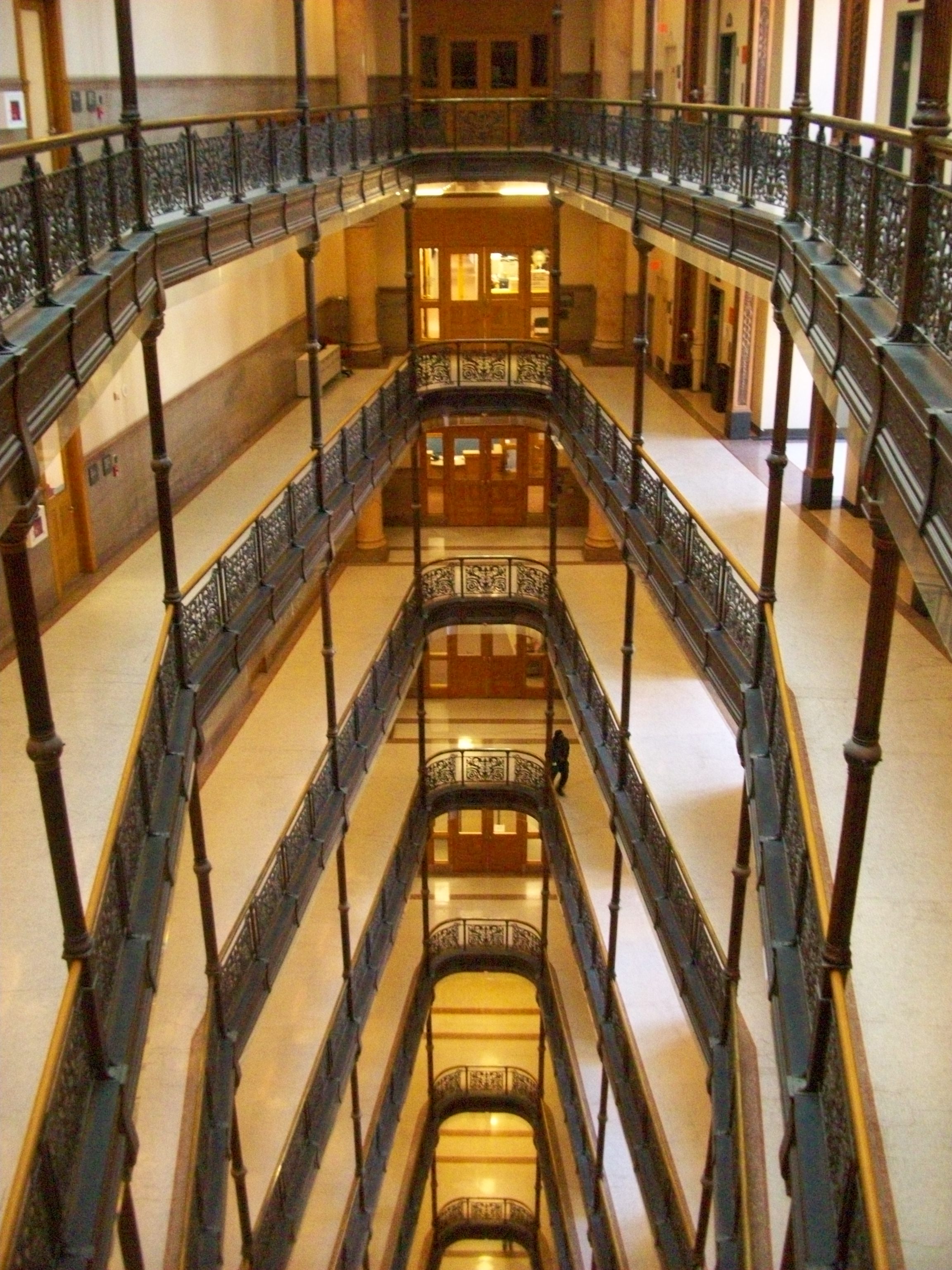
The atrium at the Milwaukee City Hall
Number 10: If Santiago Calatrava’s Milwaukee Art Museum (spoiler alert…look ahead to #5) is a symbol of the city’s optimism for the 21st century, then the Milwaukee City Hall is a fine example of the community’s spirit and optimism for the 20th. My pictures, which really do not do this building justice, nonetheless capture what a colleague described as “an atrium you don’t want to miss.” Man, was he right!
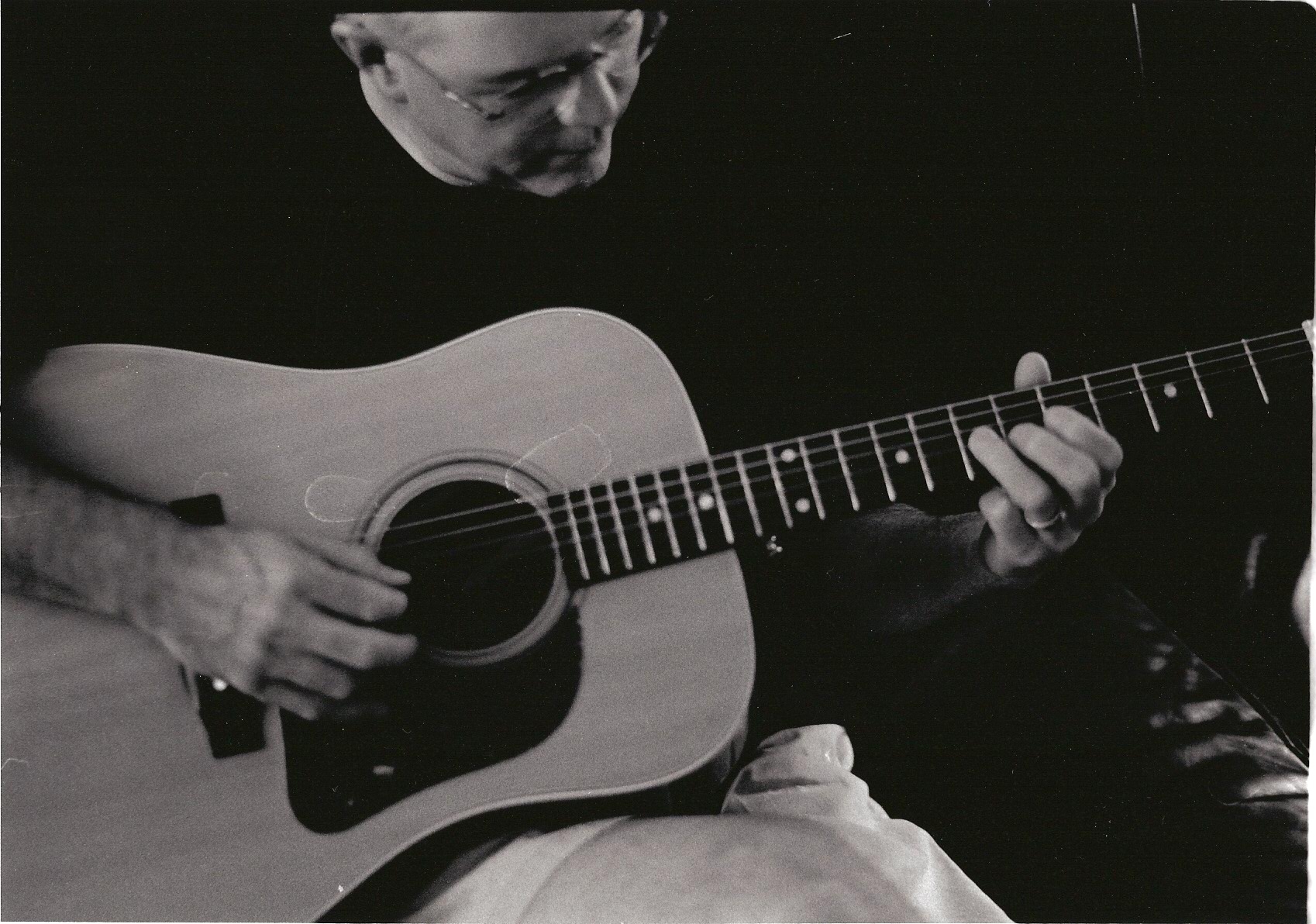
A guitar study, playing my Gallagher (photo credit: Claire Brown)
Number 9: I love the fact that readers find out about fine hand-crafted guitars on More to Come. In Praise of Gallagher Guitars was a post I wrote about my Gallagher shortly after The Fretboard Journal carried a story on Doc Watson’s favorite guitar makers. Coming in just outside the Top Ten was another instrumental post, one about Finding My New Running Dog Guitar. Yes, I am afflicted with G.A.S. (Guitar Acquisition Syndrome) and I am a lucky man.
Number 8: The post Never Underestimate the Impact One Person Can Have on the World was written by our son Andrew upon the death of his teacher and mentor, Ben Hutto. It is a heartfelt tribute to someone who not only touched our family, but tens of thousands of people all around the world. Ben had an infectious love for music and life.
Number 7: Tulsa, Oklahoma, has an incredible collection of Art Deco architecture, none better than the Boston Avenue Church, which I featured in a 2008 post.
The sleeping porch at Wingspread
Number 6: Over two days in 2009, I was with a National Trust group that toured a remarkable collection of Frank Lloyd Wright architectural gems located in Wisconsin. Along the way we saw icons and surprises. The text and photos include information and views on Herbert Fisk Johnson’s home, Wingspread, Wright’s “last” Prairie style home and a truly magnificent work with incredible light; the famous S.C. Johnson headquarters, in Racine; and then on to Milwaukee for the Frederick C. Bogk House, which is currently a private residence.
View from Calatrava’s Milwaukee Art Museum
Number 5: I’m lumping three posts into one here. I went on a Santiago Calatrava binge a few years ago, and my photos and comments have always been a reader favorite. In fact, these three separate posts have virtually the same number of views, and they show up together in the analytics chart. To see some wonderful architecture as sculpture, take a look at the Dublin bridges of Calatrava, his Milwaukee Art Museum (my personal favorite of the three posts, as I captured the “wings” in flight as per the pictures above), and then a close-up of Dublin’s Samuel Beckett bridge under construction.
Number 4: Before I started my Saturday Music series, I would occasionally write 2-3 posts with reviews from a music festival or with a focus on some other musical theme. It was one such series—the “Music Fit to a T” posts that highlighted songs with “Tennessee” in the title—that produced The Brand New Tennessee Waltzat number 4 on the list. If you are interested in what other songs were featured in this series, they were John Hiatt’s Tennessee Plates, along with Bob Dylan’s Nashville Skyline Rag. Yes, I know it doesn’t technically have the state’s name in its title, but it is my series, so who’s quibbling.
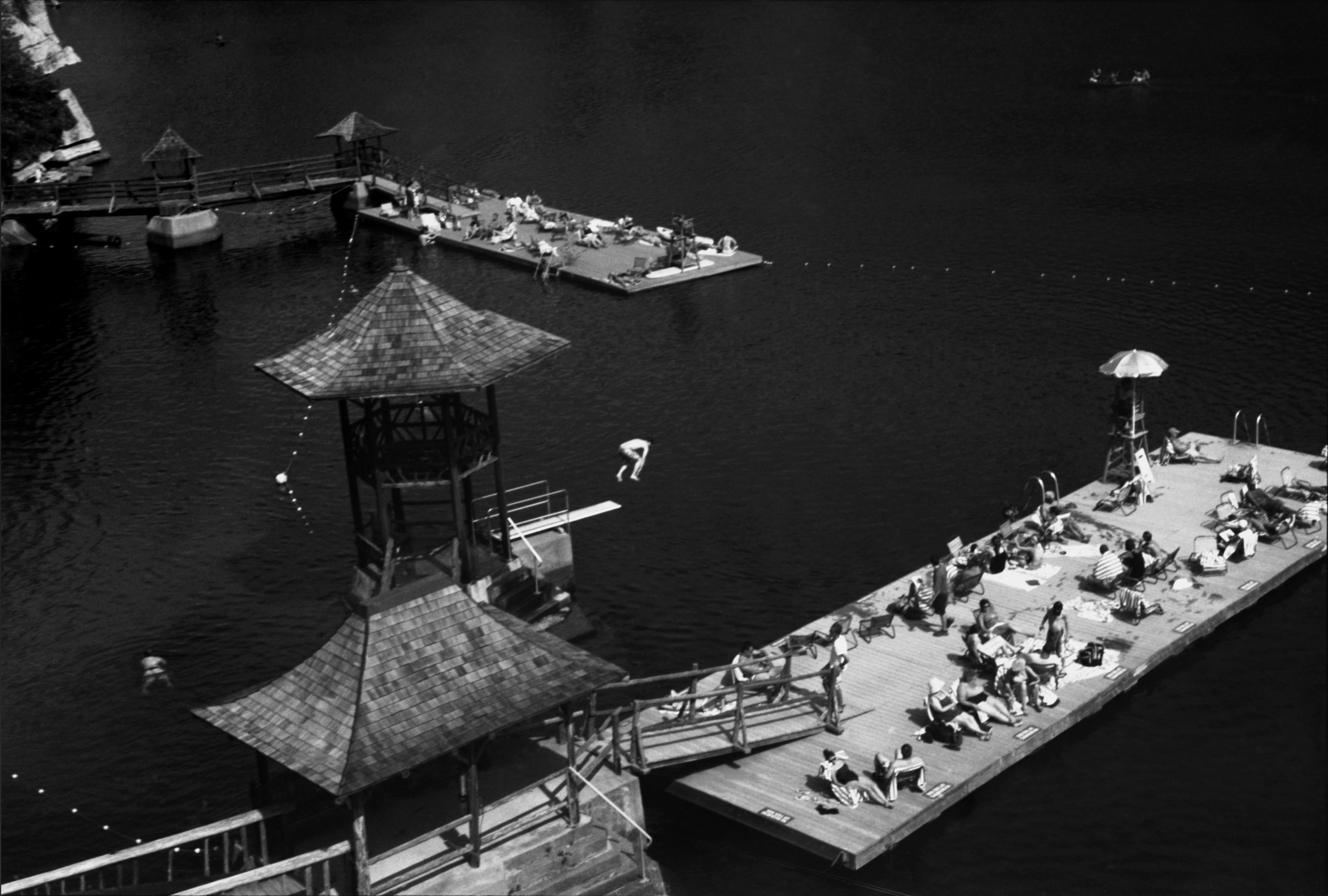
Taking the plunge off the high board at the lake at Mohonk Mountain House (photo credit: Claire Brown)
Number 3: I’ve been privileged to travel over many parts of the U.S. and the world. Few places touch me like Mohonk Mountain House. I’ve been to this historic mountain resort for business meetings, for family trips, and for an anniversary, and no matter the season it always has something to offer my soul. In this particular post, I recount how my friend Nina Smiley gave a wonderful talk, full of tales of twin Quaker brothers establishing this hotel, but naming it the Mohonk Mountain House to avoid the unsavory reputation hotels and inns held in their day. Over 141 years of ownership by the Smiley family, Mohonk has remained “the same…only better” to use Nina’s words.
Number 2: In 2010, I was on a business tour that included trips to see the work of glass artist Dale Chihuly in both Seattle and Tacoma, Washington. I tried to use the photographs to show the vibrant colors of his work in those settings, and they seem to have captured the attention of a number of visitors over the years. I was glad to be able to share my experience more widely.
And finally, coming in at Number 1 in terms of all-time views (drumroll please):
Goulding’s View at Monument Valley (photo credit: Claire Brown)
Monument Valley — It is so appropriate that the post with the most views goes back to the reason this blog was started—our western vacation in 2008. It is also clear that my beautiful prose has absolutelynothing to do with this ranking. Instead, our daughter Claire’s evocative black and white photograph from Goulding, taken on her old-fashioned 35mm camera and printed out by hand for a photography class, is the reason so many people find their way to More to Come.
There are many other posts in the top 25 which I’ve been proud to share with my readers through the years, such as stories on the Americana musical festival Merlefest; baseball quotes (the best kind) from the Philadelphia Phillies 2008 World Series win; 90 things about the wonderful life of my father, Tom Brown, on the occasion of his 90th birthday; and my 60 Lessons from 60 Years, written in 2015 on my 60th birthday. But they’ll have to wait to see if they make it into the top 10 when I get to the 2,500th post!
As always, thanks so much for reading, for your thoughtful feedback, and for your support through the years.
There are times when the personal takes on global implications. Last week was one of those times.
It began when I discovered that a former National Trust colleague, Raina Regan, has begun a fascinating self-help project for preservationists. Here is Raina’s description of this work:
“One of my goals for 2019 was to be more intentional with my free time, which resulted in a rekindled love of reading. I was really drawn to self-help books, and according to my count, I’ve read two dozen of them in 2019. As I read each one, I considered how they would apply to me and my work in historic preservation. At some point, I decided I wanted to take what I’ve learned and share it more broadly with the world—and Uplifting Preservation was born.“
Those of us in the field believe strongly in the value of our work, yet the shaming can have a toll on one’s mental health. Raina looks at the effect of shaming on the profession, and suggests ways to combat it through the insights gained by reading the works of Brené Brown.
With more than 40 years in the preservation field, I’ve seen the type of vilification that Raina describes in an up-close and personal way. Even well-meaning friends think they are being funny by describing what I do as working for the “hysterical” society.
Yep, never heard that one before.
This came home to me again when I was having a recent conversation with the developer of Downtown Silver Spring. He thought it was okay to denigrate the historic preservation professionals in Montgomery County, who were keeping him from transforming our older buildings into the garish rumpus room-look he envisions for the rest of his downtown development. (That description is, admittedly, my take. He would have a different perspective.)
Downtown is something of the living room for our community, and, as an area with a history, it contains excellent historic buildings like the 1930s Art Deco-style AFI Silver Theatre and one of the country’s earliest shopping plazas with a street-facing parking lot. Nearby Woodside Park is the area’s first automobile-oriented suburb and is considered one of the region’s best examples of 1920s-30s residential development. The theatre and shopping plaza are protected by the county preservation ordinance, and all bring both good design and beauty to our community, in addition to generations of personal stories from those who live here. Those protected structures won’t change, thank goodness, and will instead remain authentic and unique to Silver Spring.
At the global level, I was reminded of the value of what preservationists do amidst the fragility of cultural resources when our president threatened to target centuries-old cultural resources for destruction in Iran. Preservationists and conservationists across the globe stepped up to call this out for what it was—a war crime—and to note that attacks against the cultural heritage of one country are attacks against culture and humanity worldwide. Thankfully, in spite of calls by some Trump supporters to follow-through on the president’s warning, the wider immediate backlash seemed to have put a pause on those plans. But the threat remains real, and our work remains vital.
While I think I’ve become immune to the denigration of preservation by the media, public officials, and some in related professions, Raina’s new project reminded me of how much it can still sting to hear your life’s work disparaged, often simply because you are asking the community (or the world) to think about how the past connects to the present and future in ways that can be uplifting and inspiring.
Thanks for the good work Raina! I didn’t realize how much I would appreciate this project until you conceived of it.
One of the all-time great lyrics. And the inspiration for Red Molly, a talented Americana/folk group that features smart songs, tight 3-part harmonies, and an infectious spirit.
I’ve always appreciated how this band moves easily between country, blues, folk, and bluegrass, incorporating and weaving pieces from all those various strains—and more—into their music. Red Molly’s website notes that their “innovative instrumentation is suited for roots-rock and heartful ballads alike,” and “the alchemy of their personalities onstage draws even back row listeners into a sense of intimacy.”
I can vouch for that last description, as their onstage alchemy also draws in viewers on the internet. With a little bit of luck, I had the good fortune last evening to catch their live-streamed show from the famous Caffe Lena in Saratoga Springs. The band’s bio page provides the basics about these talented musicians. Dobro player Abbie Gardner’s songs and performance “have the punch of rhythm and blues.” On guitar and tambourine, Laurie MacAllister “draws inspiration from classic folk and singer-songwriters. Her voice stretches octaves, warm and romantic one moment, playful and subversive the next.” The newest member of the group, Molly Venter, “has a smoky voice that is unforgettable,” and brings “a moody approach to song-smithing.” Originally formed in 2004, the band was reinvented in 2017 with the addition of upright bassist Craig Akin and percussionist and electric guitarist Eben Pariser.
Now, back to that lyric. Red Molly’s name comes from the classic Richard Thompson song, 1952 Vincent Black Lightning, which they performed on 2014’s The Red Album as well as on last evening’s live stream.
There are several memorable versions of Thompson’s tale of a biker and his loves, and it is appropriate that Red Molly actually waited ten years before putting their personal version on an album. Good things come to those who wait.
Clinch River Blues is a darker tune for the band that is “instantly addictive. Being bad never felt so good” reads the liner notes.
Finally, Sing to Me is a beautiful lullaby written by Molly Venter that speaks to the feelings of being away from the ones we love. The song showcases the tight harmonies that make Red Molly so appealing.
New York-based readers should not worry if you didn’t make it to Saratoga Springs last evening. The band plays at The Bowery Ballroom in New York City on Sunday evening. Their tour continues in the spring, with dates in Chattanooga; Decatur Georgia; and New England, before moving south to Philly and Virginia.
Catch Red Molly at a venue near you…or on a live stream…and enjoy.
“For all who love great old-time fiddle tunes, here’s a little luncheon treat.
One of my favorites among the old-time tunes is the Eighth of January, which many will remember from the old Johnny Horton country hit The Battle of New Orleans. (The date of the battle was January 8, 1815, and Jimmy Driftwood, an Arkansas school principal who wrote the words to the song to interest children in history, used the fiddle tune for the music.) The Eighth of January is a sweet little melody that’s relatively easy to play but has lots of possibilities for variations.
So, on January 8, 2010, enjoy the Eighth of January in a more timeless mode.”
UPDATE: I was reminded of the post here in 2020 because a friend’s birthday falls on this auspicious day. In wishing her a happy birthday, I told her that it was great to have your birthday align with the anniversary of a historical event. (January 8th is also Elvis’ birthday…but we won’t go there.) For instance, my birthday was, until 1937, inauguration day in the U.S.
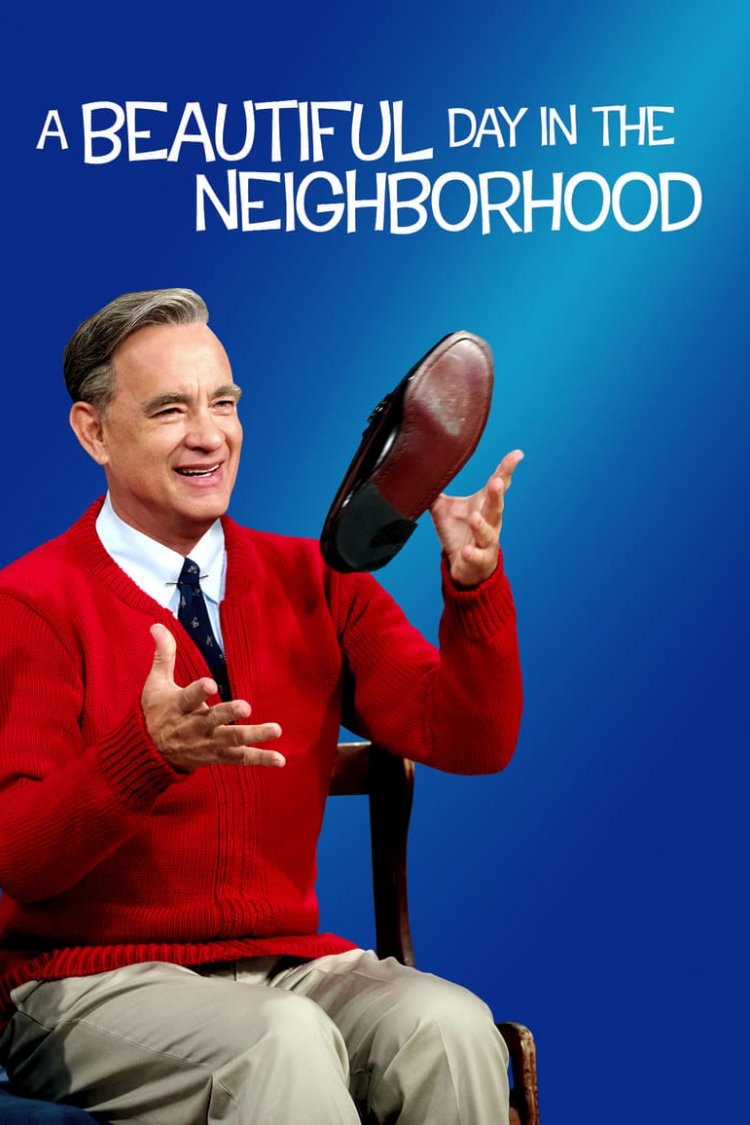
On New Year’s Day, I finally saw the delightful movie, A Beautiful Day in the Neighborhood, starring Tom Hanks as the beloved children’s television star Fred Rogers. I waited until the last day this critically acclaimed film was showing at our local theatre because we wanted to go as an entire family and needed to align multiple schedules in our short window of opportunity over the holidays. Like millions of Americans, Mister Rogers’ Neighborhood was a part of our children’s childhood, and it just seemed right to sit down together to take it in as if watching around the television set.
There is much to like about this film, from the cast to the skillful direction of Marielle Heller, from the smart screenplay to the transitional shifts taking place between the toy set and the real life scenes of Rogers and journalist Lloyd Vogel (played expertly by Matthew Rhys). Vogel is, as one reviewer notes, “a magazine writer who actually may be the one person on the planet who doesn’t love Mr. Rogers.” Rhys’ character is based on real-life journalist Tom Junod, who wrote a profile of Rogers for Esquire in 1998. If you saw the film and are at all cynical about the use of some of the scenes (such as with the children on the subway), I recommend you read the original piece, to see how much it impacts the story and script.
As we came home from the showing and sat around the dining room table over a late lunch, all agreed that we were especially taken by the pauses in Fred Rogers’ style. The most famous, of course, is the scene in the Chinese restaurant, which was based upon a real life example from Rogers’ acceptance speech upon receiving a lifetime achievement award at the 1997 Emmys. Beyond that particular instance, however, we all commented on the thoughtful—and sometimes awkward—pauses that Rogers used in everyday conversation. He would ask a question and then stop. And wait. And let you think. And then wait some more.
It just so happened that I had recently completed my New Year’s Day post, and was reminded of my Life Rule #3: Listen more than you talk. In our luncheon conversation, we discussed listening and talking as well as the value of space between the two. Our daughter mentioned that in therapy circles, there is an acronym that has proven helpful to her in thinking about when to talk and when to listen.
The acronym is W.A.I.T. It stands for: Why Am ITalking?
Why am I talking indeed? That’s a great question for therapists to ask themselves when in conversation with clients and those they are trying to help. I use to remind fundraisers who worked with me that they should stop talking after making an ask for support, and let the potential donor think and talk it through. While talking is a critical part of communication, when I find myself going on too much, it is often because I am uncomfortable or want to fill up awkward spaces. I’ve also talked when I shouldn’t because I think I may be protecting the other person in the conversation. I know someone who talks a great deal because he is hurt and is missing the regular support of someone to step in and ask questions to help him work through his pain. There are so many reasons we talk without thinking. There are many good reasons to stop and listen. Listening is, after all, an act of love.
How we talk and how we listen are both important. The next time you find yourself dominating a conversation, think about Mr. Rogers and then stop to ask yourself the question behind the acronym: W.A.I.T.
Amythyst Kiah has burst on the roots music scene in recent years with her powerful vocals and insightful songwriting. The native Tennessean is a self-described “Southern Gothic” singer of “alt-country blues” who has been receiving rave reviews and is nominated for a 2020 Grammy in the Best American Roots Song category for her spell-binding “Black Myself.”
Our Native Daughters is the name of Kiah’s recent collaboration with 2017 MacArthur Fellow Rhiannon Giddens, Leyla McCalla, and Allison Russell (from Birds of Chicago). Early last year the supergroup delivered a full-length album, Songs of Our Native Daughters, produced by Giddens and Dirk Powell. “Polly Ann’s Hammer” is a Kiah/Allison Russell song that reimagines the old John Henry tune from the point of view of his wife, and it certainly is one of the album’s standouts. “Black Myself,” the opening track, grabs the listener right from the beginning and is described by NPR as “the simmering defiance of self-respect in the face of racism.”
In the liner notes to the album, Kiah writes about “Black Myself” in saying,
“This song was inspired by a line from north Mississippi hill country musician Sid Hemphill’s ‘John Henry:’
‘I don’t like no red-black woman Black myself, black myself’
This sentiment is linked to the history of intraracial discrimination, the idea that being a lighter shade of black is more desirable because it means that you look closer to being white than black. And from that I thought about how this negative connotation of blackness was integral to slavery, segregation, and then the “white flight” to suburban neighborhoods after desegregation. I thought of my experience as a black girl in a white suburban neighborhood in the 1990s, and how, once puberty hit, the doors of my neighbors would soon be suddenly closed to me. And thus the refrain and title of this song are intended to be an anthem for those who have been alienated and othered because of the color of their skin.”
Kiah’s solo projects have been turning heads now for several years. In addition to her own songs, such as 2019’s “Firewater,” Kiah presents powerful interpretations of traditional tunes, as in “Darling Corey” from the album Dig.
Rolling Stone noted that Kiah and Our Native Daughters arrived
“…as a crucial pronouncement in folk music. It’s the culmination of a movement of 21st-century singers, artists, songwriters and instrumentalists of color who have been reclaiming the racially heterogeneous lineages of folk, country and American roots music.
‘In the past 10 or 15 years, there’s been this real sense of need to bring forth this cultural history,’ says Kiah. ‘You’ve got people now who are interested and invested in bringing attention to the history of folk music, who really bring things full circle and show that this is America’s music. This isn’t something that only black people or only white people do.'”