When it came to the existential challenge facing our democracy, there was no debate at the debate.
Every candidate for the Democratic nomination for president agreed that the corrupt and criminal enterprise in charge of the executive branch—now being called out day-after-day by the testimony of real patriots—needs to be removed.
However, as you might expect, that wasn’t the surprise of last evening’s Democratic presidential debate, held in Atlanta.
I watched the entire 2 1/2 hours and was generally captivated from beginning to end. I say that knowing that the debate wasn’t perfect. Where was former HUD Secretary Julián Castro, for instance? He has a much better chance of being first or second on the Democratic ticket than does billionaire Tom Steyer or Congresswoman Tulsi Gabbard. But even with its missteps, the debate was highly engaging on several fronts. Certainly, some credit for the night’s conversation with American voters goes to the smart group of candidates, even those who aren’t going to win. (I’m looking at Andrew Yang.)
But I think a good deal of credit for the evening’s lively and informative conversation goes to the moderators. The all-womenpanel of moderators.
Here’s why it matters: The moderators asked smart questions on things people care about. We heard discussions on housing, paid family leave, child care, climate change, foreign affairs, equal pay, voting suppression, racism, abortion rights and social justice. And yes, there were also discussions around the impeachment inquiry and the criminal conduct taking place in our government at the moment. Health care had its time in the sun as well, but as part of an array of issues. As more than one candidate pointed out, many of the remedies discussed for a range of across-the-board issues are favored by two-thirds or more of the American public, yet these common sense solutions remain bottled up in the Senate, hostage to extreme ideology and power grabs.
Here’s what we didn’t see: a push to have the candidates fight with each other just to generate news clips and gotcha moments for cable TV and opposition political ads. We didn’t see a one-hour food fight around health care. There were some sharp exchanges, especially generated by Rep. Tulsi Gabbard (Hawaii) who seems to want to run in the Republican primary or audition for FOX News rather than be a serious candidate for the Democratic ticket. But overall the tone was respectful, serious, thoughtful.
And, at times, funny. Senator Amy Klobuchar (Minnesota) had the best line of the night: “If you think a woman can’t beat Trump, Nancy Pelosi does it every day.”
I couldn’t agree more with Christina Reynolds, who tweeted during the debate: “Elect more women. Have more women as moderators. Make sure more women are at the table…wherever the table is.”
Here’s a shout out to the panel of moderators. Well done…and thank you!
Doris Kearns Goodwin’s Leadership in Turbulent Times, is, as one would expect from the Pulitzer Prize-winning historian, a thoughtful analysis that deserves to be taken seriously. At a time when the country has entered the public phase of Donald Trump’s impeachment inquiry and as the fight for the Democratic presidential nomination—and perhaps the soul of the country—escalates during the twelve months before the 2020 election, there are lessons to be learned from the past.
“Leadership in Turbulent Times” by Doris Kearns Goodwin
This 2018 work is a study of the life of four presidents and the ways in which they addressed major issues in fractured times: Abraham Lincoln (winning the war, ending slavery and saving the union); Theodore Roosevelt (responding to the sharp inequities and unfairness of the industrial revolution); Franklin D. Roosevelt (rebuilding a country out of the Great Depression); and Lyndon B. Johnson (the fight to ensure civil rights for all Americans).
Kearns Goodwin observes that we have come through difficult periods before. In a more troubling sense, she also makes it clear that we have always had scoundrels in positions of power in our government, individuals who are only interested in self-gratification and enrichment.
In looking for the lessons to take from the profiles in her book, Kearns Goodwin calls out similarities and differences between the four presidents. Their resilience in the face of serious personal hardships — in these cases poverty, depression, polio, and the death of a young spouse — is a shared trait that rises to the forefront when considering their life’s work. All four of the national crises they faced called for a strong sense of moral purpose — a quality I see missing from too many in positions of power when facing our existential crisis in democracy. Lincoln, both Roosevelts, and Johnson were each ambitious, but that’s hardly exceptional among men and women who believe they can lead the United States. More importantly, in these four presidents, ambition did not get in the way of their moral compass. In each instance outlined in Leadership, crucial decisions were made to enlarge opportunities for others.
There’s one other shared characteristic of these four leaders: boldness.
Today, we have timid politicians and a smug pundit class, each supported by political consultants and a corporate-sponsored media culture, who push against big, bold ideas. The former Republican speech writer David Frum, in a recent article in The Atlantic, sums up the Washington Beltway conventional wisdom when he lays out all the reasons why we’re in trouble, no matter if Trump leaves office through impeachment, a close loss, or a blowout win for the Democrats. In Frum’s telling, the resources don’t exist for the bold ideas being proposed to respond to financial inequities, a broken health care system, and environmental disaster; proposals put forward to reshape society to support the public at the expense of the rich and ruling classes. And, in any event, he asserts that the one-third of the country that supports Trump’s backwards-looking agenda, won’t let anything happen that affects their place of privilege.
Doris Kearns Goodwin notes that Lincoln, Theodore Roosevelt, Franklin D. Roosevelt, and Johnson all faced strong opposition and limited resources (at least on the face of things) for transformational change. Guess what? They all led, instead of listening to the conventional wisdom of the day.
Surprisingly, a current counterpoint to Frum comes from John F. Harris at Politico, who, as the founding managing editor at that online site, built a news and commentary platform that is famous for focusing on the game of politics at the exclusion of substance. But in stepping back from that role, he has shown some surprising self-awareness in noting that the bias of much of the pundit class is a centrist bias. He admits to having that bias himself, but then notes that it is usually the radicals who write history.
Harris quotes historian Arthur Schlesinger Jr.’s skepticism about Bill Clinton’s middle-of-the-road path to uniting the country in the 1990s.
“Great presidents,” he told me, “are unifiers mostly in retrospect.”
In their own times, he noted, they divide the country over large questions — slavery, civil rights, the proper role of government versus the private sector — and only later “unite the country at a new level of understanding.”
That observation is right in line with Kearns Goodwin’s assessment of leadership.
I appreciate all that Frum, who writes regularly for The Atlantic; Jennifer Rubin (who is spot on in her commentary) and Max Boot at the Washington Post; Nicolle Wallace (who I watch daily) and Steve Schmidt at MSNBC; and even George Will and the other former Republicans and Never-Trumpers have done to call out the damage and hypocrisy of the Republican Party and the Trump administration over the past three years. However, in my estimation they should not be given, or expect, a role — small or outsized — in helping Democrats choose their next nominee to lead the party and hopefully the country forward. All of them worked in the recent past for a party whose core beliefs align with the corporate and wealthy classes and against a broad, inclusive view of America. And as Harris suggests, as much as he might want to be proven wrong, real change comes from those who think boldly and listen to the people who are burning for change.
In last Monday’s Washington Post, Daniel W. Drezner—a professor of international politics at the Fletcher School of Law and Diplomacy at Tufts University — calls out the beltway pundits for their myopic and cocooned way-of-life. Whenever he talks to D.C.-based folks,
“…the despair runs deep. I was in the District last week, and less than two weeks after the Washington Nationals shocked the baseball world the city is in a serious funk, fearing another five years of Donald Trump. Elizabeth Warren’s rise has triggered an allergic reaction among the Beltway’s centrist tribe. Last week’s New York Times/Siena battleground poll showed Warren losing to Trump across a swath of key states. That one poll caused an awful lot of panic in D.C. and, I suspect, played a significant role in Michael Bloomberg’s gold-plated trial balloon.”
Leadership, whether in politics or the media, involves — duh — leading. Yet so much of what we see these days is based on incremental moves, following polls, scoring points on Twitter, and covering one’s behind. Drezner points out that “premature pessimism is a lousy way to go through life.”
We are at one of the most turbulent times in national history. We have politicians who are having difficulty upholding their oath to protect and defend the Constitution against all enemies, foreign and domestic. We have a corporate pundit class that controls much of what we hear. We have a large and influential right-wing corporate infotainment network funded by many of the industries that are at the heart of our country’s problems. We have billionaires who are up in arms that they may get taxed at a higher rate than their personal assistants and other members of the working class. We have a Supreme Court increasingly dominated by political hacks put into power by outright lies and blatant disregard of the Constitution.
Kearns Goodwin ends her book with a chapter entitled “On Death and Remembrance” and she rightly chooses Lincoln — our greatest president and leader — to close this section. As she notes, “The master story Lincoln told grew deeper and simpler throughout his life. It was the narrative of our country, the birth of our democracy, and the development of freedom within our Union.” She notes that, beginning with the Lincoln-Douglas debates, the future president “invited his audiences on a communal storytelling journey so they might collectively understand the dilemma of slavery in a free country and, together, fashion a solution.”
She continues with,
“At Gettysburg, he challenged the living to finish ‘the unfinished work’ for which so many soldiers had given their lives — that ‘government of the people, by the people, for the people shall not perish from the earth.’ At the Second Inaugural, Lincoln asked his countrymen ‘to strive on to finish the work we are in, to bind up the nation’s wounds.’ These same words nourished Franklin Roosevelt. He drew upon them, he said, because Abraham Lincoln had set goals for the future ‘ in terms of which the human mind cannot improve.'”
Lincoln, in Kearns Goodwin’s telling, “continued to grow into a leader who became so powerfully fused with the problems tearing his country apart that his desire to lead and his need to serve coalesced into a single indomitable force. That force has not only enriched subsequent leaders but has provided our people with a moral compass to guide us.”
Let’s find and support the leaders who will point toward regaining our nation’s moral compass and — working with all Americans — do the hard, bold work required over the months, years, and decades ahead with “humanity, purpose, and wisdom.”
Amy White and Al Petteway (photo credit: Al Petteway)
Acoustic duo Al Petteway and Amy White will celebrate 25 years of music together at a special Institute of Musical Traditions (IMT) concert on Saturday evening, November 23rd. Favorites of the IMT crowd (and former Washington, DC-area residents before a move to the mountains of Asheville, North Carolina), these are musicians sure to fill the room at St. Marks in Rockville, the main IMT concert venue where I’ve heard them live through the years.
Al and Amy’s music is eclectic yet uniformly lovely on the ears. Petteway is an award-winning fingerstyle guitarist (voted one of the Top 50 Guitarists of all time by the readers of Acoustic Guitar Magazine) while Amy is a composer and singer who is no slouch on the instrumental chops as well. Their repertoire has been described as “original, traditional, contemporary Celtic- and Appalachian-influenced music with occasional nods to Blues, New Age, and Jazz.” That about sums it up.
Al and Amy have provided music for the soundtrack for several Ken Burns documentaries, most notably The National Parks: America’s Best Idea. Both are award-winning photographers, and Winter in the Blue Ridge Mountainsshowcases their music and photography. I also recommend a UNC-TV piece on the duo, which gives the background on their life and work, how they met, the range of their interests, and includes a lovely vignette about how Al brought the adult Amy and her father—an oboist with the Nashville Symphony—together after having never played music with each other in over three decades.
This is lovely music for the heart. Recommended.
More to come…
DJB
UPDATE: The IMT concert on Saturday evening was beautiful, with Al and Amy playing to a full house; yet, it had the feeling as if they were in a living room with a group of friends. One of the most beautiful new tunes for me was Amy’s Never Got to Say Goodbye. Thanks to these two talented musicians, and to IMT, as always, for their wonderful concert series.
The Mainstream Media (MSM) is largely taking it on the chin for their coverage of the first day of the Donald Trump impeachment inquiry.
They earned the ridicule, from my perspective. Here are two quick examples.
First, NBC News and Reuters both complained about a lack of pizzazz in the hearings. They were rightly taken to the woodshed by thoughtful commentators and by late night comics (who, come to think of it, are now among our most reliable branch of thoughtful commentators.) That “If it doesn’t involve sex or drugs, it is dull” type of coverage isn’t just lazy, it is irresponsible journalism, and the MSM should be better than this. As is often the case, Alexandra Petri in the Washington Post had one of the best satirical responses to this nonsense in her, “Hey, I got your first draft of the Impeachment Hearings. Here’s what it needs!”
My thought was, who died and left Eric Trump—with his “horribly boring” and “Snoozefest” tweet—to set the ground rules for how to cover the impeachment inquiry of his father?
Second, comparing this inquiry and the times to Watergate is also lazy and worse, it sets up a narrative that’s bound to fail. Peter Baker wrote in the New York Timesthat the country wasn’t “riveted” by the testimony on Day 1 of the Trump inquiry, as he suggests it was during the Watergate hearings. Well, I’m a bit older than Peter Baker and was in college in 1974 during the summer of the hearings. If Wikipedia can be believed, Peter Baker was seven years old at the time. I recall a country 45 years ago that had three major television networks, not 500 cable channels and countless internet, social media, and blog sites to choose from. FOX News and the right-wing infotainment network didn’t exist. As Joan Walsh writes in The Nation, we’re not riveted by anything anymore—except maybe the Super Bowl, and some of us haven’t watched that in years.
The two Senators who led the Watergate hearings—Sam Ervin and Howard Baker (my senator at the time)—were not anyone’s idea of riveting television. What they were, even with all their faults, were Members of Congress who cared more about the future of their country than they cared for their next race for office or their jump to a lucrative K Street lobbying job or a spot on cable news. They took their responsibilities seriously and they worked hard, through a lot of dull hearings and background work, to get to the truth.
As Walsh writes in her compelling take on the subject, we fetishize Watergate today because we know how it ended. Nixon resigned. She notes that many of us are craving “some type of playbook” and some obvious force of “moral authority” when, in fact, we have neither. “We have to create it.” I would add that just because we create a story that sounds insightful doesn’t mean that the story is necessarily true. If you are going to cite something like Watergate, at least understand the full context and history, and then try and understand how the times today are different.
Jennifer Weiner ends her commentary in the Times excoriating news outlets looking for pizzazz with the following:
“Here’s a thought: The next time we see a partisan or a politician or, worse, a reporter complain that the hearings are boring, we push back. We point out that our political process is one thing and professional wrestling is another, and shame on anyone who faults the first for not resembling the second. We remind people that just because something is shown on TV, that does not mean it’s a TV show.
Because, if we keep insisting that impeachment has to entertain us, we’re going to channel-surf our way right out of our democracy.”
Former Charleston, South Carolina, mayor Joe Riley has spoken eloquently about beauty and civic design. In an Architect magazine article on the occasion of the mayor’s retirement after 40 years in office, author Wayne Curtis quoted Riley as saying, “Often architecture is thought elitist, that you’ve got to be schooled or have a special interest. But not long after I was elected, I’d see visitors in town. They looked like they were retired blue-collar workers, and you’d see them admiring buildings.”
Riley ends with one of his core beliefs. “Beauty has no economic litmus test. It’s a basic human need and instinct.”
I’ve been thinking of Joe Riley’s belief in the ability of beauty and good civic design to uplift our communities* as I have walked through our downtown in recent weeks. There is a great deal of construction activity underway in Silver Spring, but I am hard-pressed to find too many examples of fine urban design. One challenge is that much of the future of downtown Silver Spring was turned over to a development company some twenty years ago, which resulted in the successful completion of the Downtown Silver Spring commercial core, but rather pedestrian design decisions that are actually being made worse by a 2019 “refresh.” At a recent public hearing on the project which I attended, the head of the development firm made the comment that the new, bright (some might say garish) paint scheme was “fun—not something you’d use in your house, but fun.” He also made the point that in a new art installation, he instructed his staff that he didn’t want to see anything “silver” or with a “spring” in it. In other words, he didn’t want this installation to reference the place.
My initial thought was, “Well, the developer actually lives in Potomac (an expensive and well-heeled nearby town). This isn’t his home, and they wouldn’t allow this design in Potomac in any event. But Silver Spring is my home.”
Downtown is something of the living room for our community, and, as an area with a history, it contains excellent historic buildings like the 1930s Art Deco-style AFI Silver Theatre, a WPA-era old post office building, and one of the country’s earliest shopping plazas with a street-facing parking lot. Nearby Woodside Park is the area’s first automobile-oriented suburb and is considered one of the region’s best examples of 1920s-1930s residential development. Downtown also contains other supporting buildings from the 20th century (a few of which are threatened with demolition). The theatre and 1940s shopping plaza are protected by county ordinance, and all bring both good design and beauty to our community. Those protected structures won’t change, and will instead remain authentic and unique to Silver Spring.
However, with the clashing paint schemes, artificial turf, and other “amenities” of the refresh chosen by the developer’s architect, the downtown of the future looks more like the rumpus room or perhaps like the television and game rooms in my son’s fraternity house in college, places where they wouldn’t let the parents through the door.
There is no beauty at play here. But beauty isn’t the goal of the development company. It should, however, be the goal of our government and our citizens.
Our other challenge is, as I’ve written earlier, that even where we have made good design decisions, a lack of coordination between project managers, developers, utility companies, and county government leads to constant patches on what were once well-conceived and executed projects. As I walk through downtown today, there are multiple instances of brick and stone pavers that have been removed and filled in with asphalt following a utility company intervention. The bicycle track which was the subject of my earlier post, and which was just completed last month, now has two ugly utility patches that cut across the newly paved road, with more to come.
No one argues that we should stop all utility company upgrades. I understand the impacts of aging infrastructure very well. However, I do think the quality of their restoration work is very sub-standard. In fact, shoddy is the best descriptor I have of this work by the utility companies, and — because design matters in communities — that’s what I’d like to see change.
In that same Architect article, Wayne Curtis notes, “Three years after taking office, Riley was invited to travel to Europe on a study trip sponsored by the German Marshall Fund of the United States. His group toured eight cities in Germany and England, studying what worked and what didn’t in the civic landscape. ‘I didn’t know what I was looking for until the end of the trip,’ Riley says, ‘and then I realized I was seeing cities where the public realm was accorded the highest priority, and that the citizens revered that.'”
In my conversations with Joe through the years, it was clear that what he looked for most was quality.
Curtis continues by suggesting that Riley’s legacy will include that insistence on quality, in “top-notch materials and techniques” in public structures. Joe is famous for saying, “When people complain about cost, I ask, ‘How many people know what the Spanish Steps in Rome cost?’”
It isn’t the Spanish Steps, but on my walk through downtown this frigid fall morning, I did catch a glimpse of how beauty can contribute to our built environment. A well-designed and landscaped pocket park at the heart of our community, ringed by a small grove of trees, was covered with beautiful yellow leaves that had taken flight for the season. Since it was early, the scene was undisturbed by foot traffic. I stopped and admired the park for several minutes. I slowed down. I thought about the space and the people around me. I was grateful.
That’s an example of what beauty and good design can bring to a community.
More to come…
DJB
*Riley’s beliefs led him, among many other things, to found the Mayor’s Institute on City Design, where I was a panelist in 2017.
UPDATE: The image at the top is of the pocket park I reference near the end of the post on a beautiful fall morning in downtown Silver Spring. Unfortunately, the developer who is mentioned in this post got the county to approve the demolition of this wonderful park for an ugly new plaza…complete with fake grass. It is an abomination.
Old habits can be very hard to break. Case in point: my difficulty in breaking out of the mold of being a stereotypical male.
I’m reminded of this far too often and in many different ways. However, one of the more consistent occurrences involves listening. Or, to be more accurate, not listening.
The stereotype is that men are encouraged, and even trained, to be the center of attention. It is a stereotype, in this case, because it is usually true. Studies show that boys are called on more in school, that boys grow up to become men who talk more in meetings, and that we interrupt women more than we interrupt men.
Most of the time I fall into this pattern of interruption because I’m not thinking. But a few times I do it knowingly and with the best of intentions. That was the case earlier this year when I found myself talking over a friend to “help her” explain something that I thought might be difficult to articulate. Not because she isn’t a smart, articulate person, but because I perceived it could be an emotionally difficult subject.
Bad decision.
I interrupted her attempt to talk to me. Later, when I was home and reflecting on the conversation, I realized that I didn’t really know how she felt, because I had spoken over her and inserted my perceptions over hers. The next time we spoke I apologized. And then I asked if she would talk while I promised to be quiet and listen. But the moment had passed and she couldn’t remember, or didn’t want to return, to the topic.
So both my friend and I lost out by my decision to talk instead of listen.
Listening is an act of love. However, as much as I try to act out of love for others, this is obviously a part of my practice in life that needs more work. Recognition is only part of the solution. Active, intentional listening requires more.
In Rebecca Solnit’s insightful new book Whose Story is This? Old Conflicts, New Chapters, the author quotes the actor Chris Evans, in the context of the #MeToo movement, as saying of well-meaning men, “The hardest thing to reconcile is that just because you have good intentions doesn’t mean it’s your time to have a voice.”
Men who are privileged (virtually all white males) and who have power often complain or push back about being made to feel uncomfortable. Solnit makes the point that, “Comfort is often a code word for the right to be unaware, the right to have no twinges of one’s conscience, no reminders of suffering, the right to be a ‘we’ whose benefits are not limited by the needs and rights of any of ‘them.'”
Solnit suggests that, “The world is an uneven surface, with plenty to trip on and room to reinvent.” Her opening essay ends with this equal parts hopeful and challenging observation:
“This country has room for everybody who believes that there’s room for everybody. For those who don’t—well, that’s why there’s a battle about whose story it is to tell.”
In thinking back, and then looking forward, to my conversations, I’m trying to listen with love. To push myself out of the need to feel comfortable. And, even, to reinvent my world to be a more inclusive place.
In other words, to be open to the fact that it isn’t always my story to tell.
Few people—much less entertainers and celebrities—can bring together blue and red Americans, straight and gay communities, grandmothers and granddaughters, rich and poor.
Dolly Parton — who we highlight in this Saturday Soundtrack — bridges those divides, and more.
At a time when the marginalization of women in country music is being called out more and more forcefully, it is important to realize that Dolly’s been in that fight for half a century. And often winning it, always very much on her own terms.
Growing up near Nashville in the 1960s, I was first introduced to Dolly and her exceptional gifts through the Porter Wagoner TV show where she was featured as the “girl singer.” But she had higher aspirations, and over the course of 50 years has earned the affection so many bestow upon her. She is well known as an entertainer, but her songwriting talent is now recognized as among the best in popular music.
Writer Mary Elizabeth Williams has a recent article in Salon on why Dolly is such a force of nature. Williams writes,
“Dolly Parton is, quantifiably, one of the most loved personalities in the world. She’s also a deceptively complex American figure. On a superficial level, she’s a twangy blonde with a wig collection to rival RuPaul, a body that defies the laws of physics and a proudly gaudy sartorial aesthetic. ‘It costs a lot of money to look this cheap,’ she’s famously explained. But you don’t have to look very far under the rhinestones to see that she’s one our greatest American songwriters, a virtuoso musician, an actress, an entrepreneur, a philanthropist and what your mom used to refer to as just plain good people. Her larger-than-life persona makes her a great entertainer. Her intelligence and authenticity make her an icon.”
There’s so much of Dolly’s musical catalog to explore, and I definitely recommend what Parton self-describes as her “sad ass songs” from the early years. Here she was often taking traditional murder ballads like Knoxville Girl and recasting them from the woman’s (i.e., the victim’s) point of view. She also has written great songs of empowerment, such as Coat of Many Colors, a fantastic song about not letting poverty, and others’ point of view, change your self perception.
“But they didn’t understand it, and I tried to make them see One is only poor, only if they choose to be Now I know we had no money, but I was rich as I could be In my coat of many colors my momma made for me”
Dolly has penned some of the best lines in country music, like, “In my Tennessee mountain home, life is as peaceful as a baby’s sigh.” One of my favorites is, “You don’t know love from Shinola.”
“Your attitude stinks and I hate it You’re arrogant, cocky and rude You’re selfish, conceited and jaded Everything’s all about you You think that I’m lucky to have you You think you’re so handsome, so what I’m callin’ you out cause I don’t need this crap I’m gettin’ myself outta Dodge Cause you don’t know love from Shinola”
But being a bluegrass fan from way back, I was thrilled when Dolly turned her attention to her roots in that music with 1999’s The Grass is Blue. Her next two albums, Little Sparrow in 2001 and 2002’s Halos & Horns, carried on a similar vein. The latter included the wonderful “I’m Gone”—one of my favorite Parton tunes because it so clearly captures the “I’m in charge of me” part of Parton’s persona in the humorous way that endears her to so many.
“You can tell the truth or you can lie You can say I left you or I died Say I’m in the Himalayas on some spiritual quest And could spend years lookin’ for the light Say I’m in the witness program with the F.B.I., Say a U.F.O. abducted me from home You can say what you chose, but I tell you the truth You can say for sure I’m gone, ’cause I’m gone”
Williams’ article also covers Dolly’s ability to connect with so many, her status as “a full blown hero” cemented by her “supreme grace.”
“When an embittered Porter Wagoner sued his star protégé for breach of contract, she simply settled out of court. When he fell on hard times later, she bought his songwriting catalogue and then gave it back to him, because, as she recalls on Dolly Parton’s America, ‘I wanted his kids to have it. That was one of my gifts thanking him.’
When the scientists behind the world’s first cloned sheep named her Dolly — because she sprang from a mammary gland cell, GET IT? — Parton laughed it off by inviting her woolly namesake to visit Dollywood. And when she wanted to honor her father, who had to quit school to support his family and never learned to read, she started her Imagination Library. Since 1995, it’s given away over 100 million books to children around the world. Those are the actions of a person whose seat of power comes from a place of profound compassion.”
(Note: Slightly revised versions of this appreciation ran in the National Trust’s Forum newsletter, on LinkedIn, and on social media pages for Preservation Virginia and other preservation organization.)
Former Virginia Governor Gerald L. Baliles, who passed away on October 29th at age 79, has been appropriately recognized as a quiet but effective leader. His “boldly cautious” style was credited for gains in increasing the number of women and minorities in statewide leadership positions, as well as for increased support for transportation and the environment.
But the Jerry Baliles I remember was also one of the most effective advocates for historic preservation at a time when development pressures in Virginia were pushing forward at the expense of its past. His leadership led to much needed changes at the state level that played an important role in all that has happened to save the best of Virginia’s past in the almost three decades since the end of his term as governor in 1990.
During his campaign for governor, Jerry met with representatives of the state’s preservation community. He listened intently to the challenges we put before him and promised, if elected, to be a friend of historic preservation.
He was true to his word, and soon he could be found at historic sites, Main Streets, and in older neighborhoods around the Commonwealth, promoting the benefits of preservation. Jerry had a special place in his heart for Thomas Jefferson’s Bedford, Virginia, retreat—Poplar Forest—which had just been purchased by a group of citizens who fought to save it from inappropriate use and encroaching development. Jerry helped promote the rescue and restoration effort, serving as Chairman of the Governor’s Campaign to help fund the restoration. Because of his personal interest, he became the first governor since Thomas Jefferson to sleep overnight in the retreat, which was still in its pre-restoration condition.
While Virginia had world-class historic resources, its public sector program had not received the financial and political support required of a state with such a rich legacy. A broad cross-section of preservation, conservation, and Main Street organizations put forth a proposal for a gubernatorial commission to recommend a path forward. Jerry liked the idea, and on April 10, 1987, he created the Governor’s Commission to Study Historic Preservation. It was a highlight of my professional career when Jerry asked me to chair this blue-ribbon panel.
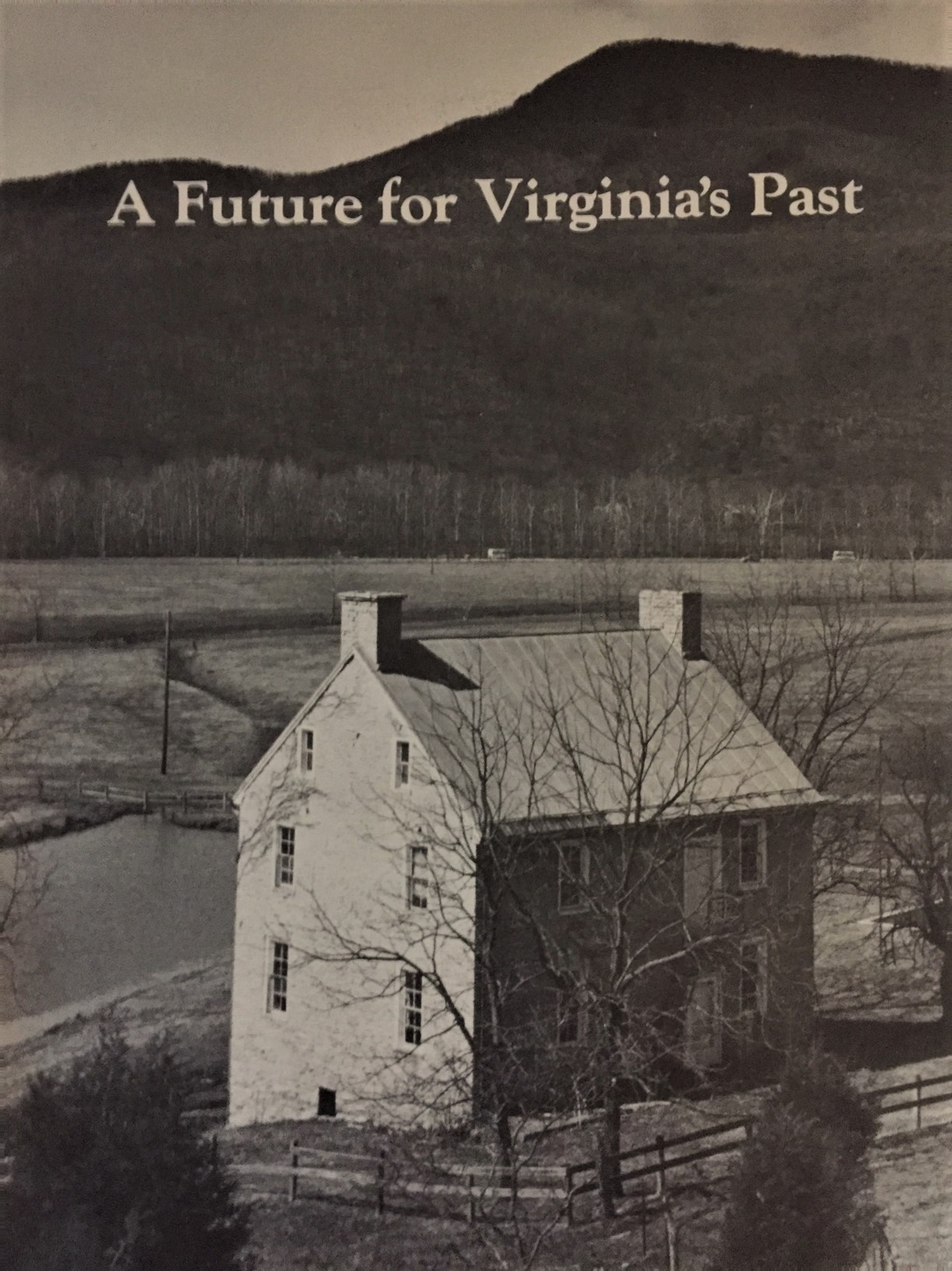
A Future for Virginia’s Past: The Final Report of the Governor’s Commission to Study Historic Preservation (1988)
The 23 men and women who made up the commission came from diverse backgrounds, including preservation, law, business, development, housing, government, and education. Over the course of 18 months, the commission held hearings across the state to listen to citizens about the importance of preserving the past, worked with experts from across the country, and prepared a comprehensive report submitted to the governor on November 3, 1988.
The report included 32 specific recommendations which ranged from calls to increase the clout and visibility of the state program and better review of state actions that affected historic resources, to suggestions for strengthening local government programs and providing financial support and incentives for preservation.
It is a testament to Jerry’s skill that the majority of the recommendations were included in a successful bill put before the General Assembly by Delegate Whittington W. Clement in 1989. Chief among the law’s provisions was the establishment of the Virginia Department of Historic Resources and the establishment of a statewide preservation revolving fund, the latter operated since 1999 by Preservation Virginia. Those changes established a new level of support for preservation in state government and helped a statewide coalition of more than 160 organizations learn how to advocate effectively on preservation issues with the administration and state legislature. Both were critical in ensuring passage in the following decade of the state’s transformational historic rehabilitation tax credits. Virginia’s Historic Rehabilitation Tax Credit program has played an essential role in the preservation of thousands of historic properties since its inception, stimulating $4.5 billion in private investment since 1997.
Jerry’s work in historic preservation didn’t end with the Governor’s Commission, as his administration also led the effort to restore the historic Executive Mansion on Capitol Square in Richmond. Designed by Alexander Parris in 1813, it is the oldest occupied governor’s mansion in the United States. And while he was known as the “transportation” governor, he understood that building and improving infrastructure depended upon sound cultural and natural resource data. He took personal interest as governor in ensuring that state projects would not adversely affect Virginia’s landscape.
Jerry spoke to the importance of preservation, when he addressed the commission in July of 1987.
“With so much history within our Commonwealth, we have an especially pressing responsibility to keep our rapid growth balanced with a respect for the past…But preservation is not reverence. Preservation is, rather, a tool to manage change.”
After he left the governor’s office and I moved to the Washington area, Jerry and I would connect every couple of years. The last time was in early August, at the funeral of our mutual friend Anne Worrell. Jerry spoke at that funeral, and I had the chance to catch up with him and wish him well. He spoke eloquently of Anne’s work in preservation, but was obviously frail from the cancer that would take his life less than three months later.
Jerry Baliles was an important public sector advocate for historic preservation at a critical point in the history of the movement. All who care about the future of our past — and not just Virginians — owe him a debt of gratitude.
Rest in peace.
More to come…
DJB
Image at top: Presentation of the Governor’s Commission on Historic Preservation report to Gerald L. Baliles, November 3, 1988
Saturday’s rally to celebrate the Washington Nationals World Series Championship was—intended or not—a masters class in leadership and team building.
The lessons were outlined by speaker after speaker from the stage, and they began with a facing of reality.
Before he passed away in 2017, Max DePree was the retired CEO of the furniture and design pacesetter Herman Miller. Through the years I’ve come to appreciate his definition of leadership, and especially his thoughts on the responsibilities of leaders. DePree said that the first duty of a leader is to define reality.
On May 24th, with almost a third of their season over, the Nationals record stood at 19-31. Twelve games under .500. Their chance of winning the World Series on that date was a miniscule 1.5%. From the outside, it appeared that the reality wasn’t good.
But there were reasons—primarily but not exclusively a rash of injuries to key players—that led to the bad start, and the reality was that those injured players were beginning to return. It was also clear that some elements of the team—for example the relief pitching—were not working as planned and changes were needed to fix those particular problems. The team’s management, understanding this reality, didn’t panic, although the fan base and most pundits were writing them off. Those injured players returned, changes were made to the pitching staff, and the level of play immediately improved.
The second lesson we heard on Saturday was to address the things you can address, and don’t get caught up in the overwhelming nature of the task ahead.
Manager Dave Martinez began telling his players, “Let’s go 1-0 today.” That was the thing over which they had some measure of control: they could work hard to win that day’s game. If the team had focused on what they had to overcome to win the World Series, there would have been no rally on Saturday. Instead, as Martinez explained, they focused on winning the day. And he made the point to the crowd that we should all wake up tomorrow with the same thought: Let’s go win the day.
The third lesson came from General Manager Mike Rizzo, who noted that everyone was on the same page.
While others were shoveling dirt on their figurative graves and counting them out, the team itself was focused. “Not one person pointed a finger, no anonymous quotes, no clubhouse lawyers, no backbiting,” Rizzo told the crowd. The longest-tenured National and face-of-the-franchise player Ryan Zimmerman put Rizzo’s role this way: “He’s huge on chemistry and clubhouse stuff, not bringing in bad teammates, not bringing in bad guys. Before he makes, really, any sorts of moves, he will reach out to us and ask if we’ve heard anything about this player or that player.”
In an age awash in data, the Nationals cared about chemistry as much as what’s quantifiable. It was never about one person, but it was about the team. Max DePree was famous for his support of inclusive corporations, and that’s what the Nationals were building.
The fourth lesson was simple. Have some fun. This isn’t brain surgery.
When Gerardo “Baby Shark“ Parra was added to the team in May, coming off the baseball scrap heap, he looked around and asked, “Why’s everyone so tight?” So he proceeded to choose a silly children’s song that his 2-year-old likes as the walk-up tune to be played when he came to bat, leading to an entire stadium making shark-like chomping motions with their hands and a huge boost in sales of shark costumes in the Washington region. He found some funny looking rose-colored sunglasses while the team was in Detroit and began wearing them every day and every night in the dugout. With other Nationals, Parra instituted a dugout dance party, where every player who hit a home run had to come into the dugout and dance while his teammates clapped hands and beat the water coolers like a drum. He even instituted a group hug for famous pitcher—and famous introvert—Stephen Strasburg after an especially meaningful Game 3 outing in the League Championship Series.
Some things are very serious. But for much of work and life, adults who feel the need to always be “mature” take away the joy that is there just below the surface.
Championship buttons – including a Baby Shark pin
The final lesson: not every destination will be reached by traveling the superhighways of life.
When the Nationals won the League Championship round to gain their first World Series berth in franchise history, Manager Dave Martinez was asked about the journey from 19-31 to the game’s top showcase. He said he was reminded of something his mother told him.
“Bumpy roads often lead to beautiful places.”
Simple, but true.
Baseball is loved by so many people because of how it uses a game to showcase life lessons. At a rally attracting tens of thousands of people on Saturday, we learned several lessons on leadership and team-building:
Understand your reality.
Go and win the day.
Build an inclusive team chemistry.
Have fun, this isn’t brain surgery.
And remember, bumpy roads do lead to beautiful places.
More to come…
DJB
Image: Fans gather along Pennsylvania Avenue to cheer on their World Series Champion Washington Nationals by DJB
Scenes from today’s Washington Nationals World Series Championship Parade through downtown DC. N-A-T-S Nats! Nats! Nats! Woo!
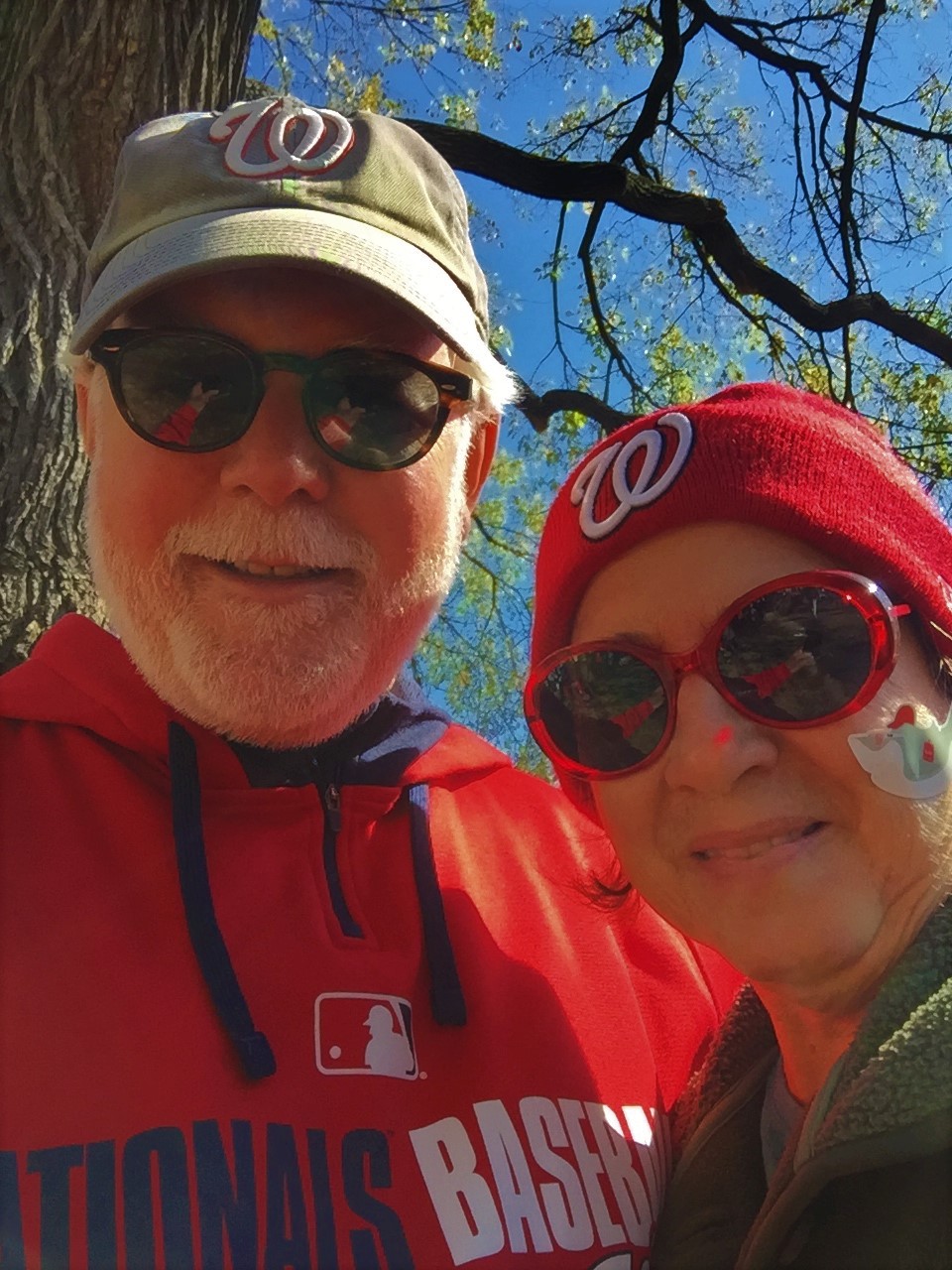
DJB with Candice and her Baby Shark decal
We ended up watching the parade from some steps along 6th Street, N.W., where it intersects Constitution Avenue at the National Gallery of Art.
Our view of the parade route (with help from the Jumbotron)
Mad Max Scherzer (arms raised in the middle of the bus) – who started Game 7 of the World Series – gets great reaction from the crowd
The souvenir vendors were out in force, including with the Baby Shark pin.
Championship buttons – including a Baby Shark pin
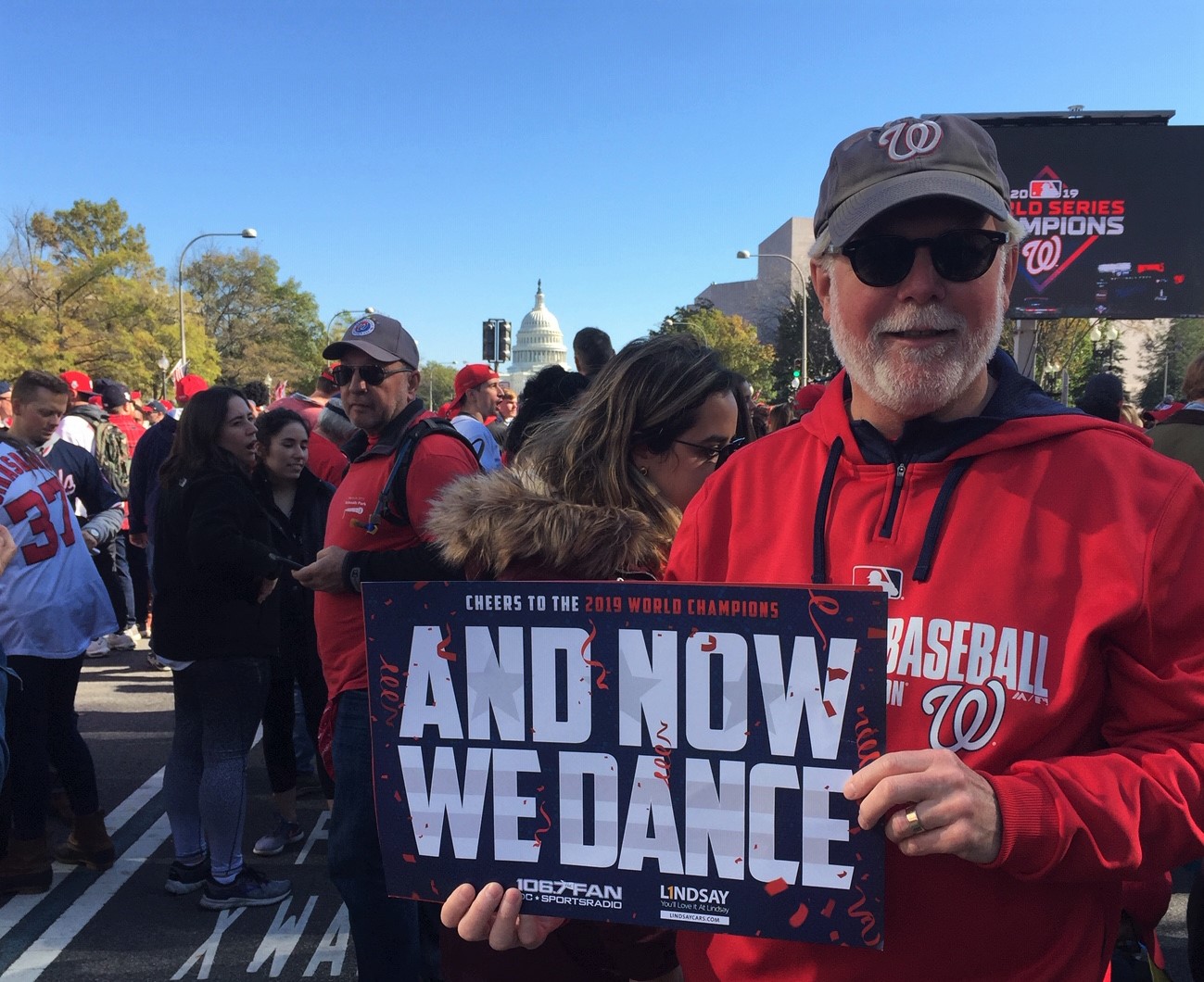
After every Nationals home run from about June 1st on, the team would gather around the batter who hit the dinger and they would have a dugout dance party. Invariably, announcer F.P. Santangelo would say, “And now we dance!” Today was a home run to beat all home runs…and we all danced!
And Now We Dance
A great way to end the most exciting year, and the most amazing month, of baseball in Washington, D.C.
Congratulations to the World Series Champion Washington Nationals!