In the summer of 2018, I had the chance to hear alt-country singer Courtney Marie Andrews live at a small venue in Washington, DC. Andrews was touring to showcase her just released album May Your Kindness Remain, and I was impressed by the honesty of the lyrics, the soulful power of her vocals, and—perhaps most importantly—the defiance in the songs. It was a defiance that pushed back against melancholy. Against the struggles we all face.
The acoustic version of Took You Up is a good example of her work.
And the lyrics of May Your Kindness Remain speak to the connectivity she finds with people while living the life of the road musician.
You’re a good woman, and a good friend You’ve got a good heart, even when it’s busted and bent Lipstick and perfume, underground queen Wearing loneliness like a costume, for the whole world to see And if your money runs out, and your good looks fade May your kindness remain
. . .
The richest of people aren’t rich with houses, cars, or fame No, they’re not rich with something that can be bought, or arranged No, it’s kindness that makes them beautiful And a kind heart don’t cost a dime It’s a gift that keeps giving, for the rest of your life And if your money runs out, and your good looks fade May your kindness remain
I love the thought of kindness being the thing that remains. After money, looks, fame are all gone—especially in this day and age—there’s a lot to be said for just being kind.
Kindness came back to Andrews recently, in a wonderful fashion. Brandi Carlile, one of Americana and country music’s most popular female performers—and a member of the super-group the Highwomen—is taking a stand on her stated intention to “open the door and hold it open for other female artists.” How is she doing that?
And a kind heart don’t cost a dime It’s a gift that keeps giving, for the rest of your life And if your money runs out, and your good looks fade May your kindness remain
What a wonderful gift.
More to come…
DJB
Image: “May Your Kindness Remain” album cover: Courtney Marie Andrews
What an incredible run through the entire playoffs, ending with four road wins in Houston against the mighty Astros.
I’m so happy for the only original National, Ryan Zimmerman. Stephen Strasburg as the World Series MVP is so deserving. Love all the “Los Viejos” (the Old Men)! And love all the kids as well!
What a season.
If you had asked me on Memorial Day…
I could not have imagined that the Washington Nationals would make the playoffs, much less the World Series.
I could not have imagined that the Washington Nationals would be described by one columnist as the only “likeable” team of the four left in the hunt during the League Championship Series. Does he know he’s talking about Washington, D.C., the city the country loves to hate?
I could not have imagined manager Dave Martinez holding on to his job through September, much less out-managing such well-respected skippers as Dave Roberts of the Dodgers, Mike Shildt of the St. Louis Cardinals, or A.J. Hinch of the Houston Astros in October. Speaking of Martinez, I could not have imagined that his “Let’s go 1-0 today” and “Bumpy roads often lead to beautiful places” quotes would be so damn inspirational.
I could not have imagined the Nationals fan base being so, well, spectacular during three home losses in the World Series. In years past, the fans who turned up for the playoffs were often there to party and seemed to think the Nats — who often did have the better team — could just show up and win. This year, the team’s playing for the joy of the game rubbed off on the fan base. I know that I’ve seldom had such a good time at the ballpark when my team lost as I did at Game 3. It was a knowledgeable baseball crowd. And it is a crowd that knows how to catch a home run ball without spilling the beer!
And because it is Washington, D.C., it was also a crowd that was knowledgeable about politics and the current dangers to our democracy. It was a crowd that cheered celebrity chef and humanitarian José Andrés, who further endeared himself to the town when he noted that he was proud to be an immigrant throwing out the first pitch for a team full of immigrants. But I digress…
I could not have imagined the Nationals going into Houston and winning the first two games of the World Series on the road against the mighty Astros, and then bouncing back in a wacky and ultimately marvelous Game 6 after being held to one run in each of the three games at Nationals Park.
I could not have imagined being behind in five elimination games during the playoffs, and coming back to win each one.
I could not have imagined such a satisfying Game 7.
Frankly, I could not have imagined having this much fun watching a baseball team.
In my five decades of being enthralled by baseball — beginning as a nine-year-old with a 1964 family vacation to Wrigley Field where I saw the Chicago Cubs play Bob Gibson and the St. Louis Cardinals — nothing compares to the joy of watching this year’s Nationals. This is one time when I haven’t let my expectations drive my happiness, and it has paid off in spades.
In years past, after the end of the season I’ve been fond of quoting A. Bartlett Giamatti. The Ph.D. professor of English Renaissance literature, former president of Yale, and the great commissioner of baseball who banned Pete Rose for life and then died of a heart attack 8 days later, said of baseball:
“It breaks your heart. It is designed to break your heart. The game begins in the spring, when everything else begins again, and it blossoms in the summer, filling the afternoons and evenings, and then as soon as the chill rains come, it stops and leaves you to face the fall alone.”
But this year, I don’t feel heartbroken!
This may have been the last game in a Nationals uniform for Anthony (Tony Two-Bags) Rendon and Stephen Strasburg. I hope that’s not the case, but whatever happens, I want to thank them, and thank all the Nats, for a magical year.
Go World Series Champion Nats!
More to come…
DJB
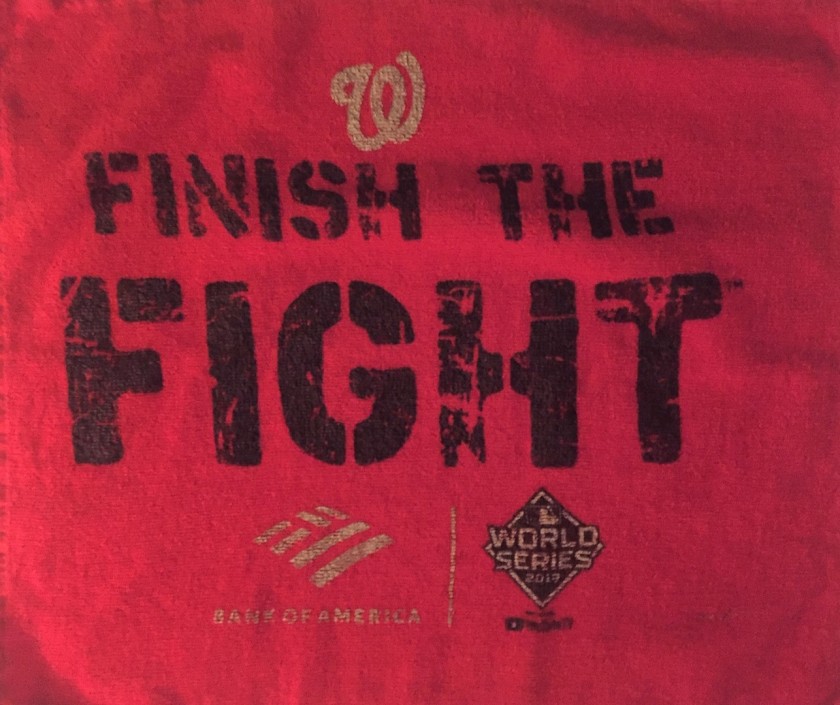
Image of my lucky World Series FINISH THE FIGHT rally towel!
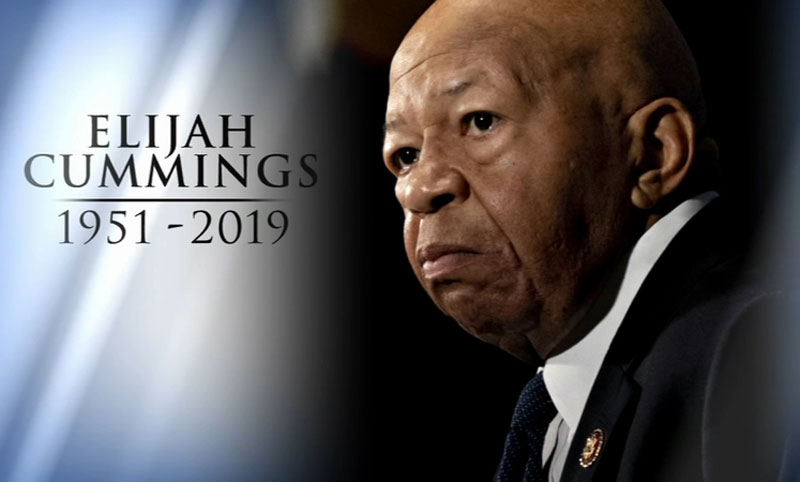
The Honorable Elijah E. Cummings, who represented Maryland’s 7th Congressional District which included his beloved city of Baltimore, passed away on October 17th. His was an especially difficult death for many of us to process, because he regularly and effectively spoke truth to power at a time when that trait is sorely lacking in our civic conversation.
The Honorable Elijah Cummings
Yesterday’s Washington Post had a Cummings op-ed written in July entitled We Are in a Fight for the Soul of Our Democracy. It began,
“As I pen these words, we are living through a time in our nation’s history when powerful forces are seeking to divide us one from another; when the legitimacy of our constitutional institutions is under attack; and when factually supported truth itself has come under relentless challenge.
I am among those who have not lost confidence in our ability to right the ship of American democratic life, but I also realize that we are in a fight — a fight for the soul of our democracy.
As an American of color, I have been able to receive an excellent public education, become an attorney, and serve my community and country in both the Maryland General Assembly and Congress because of one very important fact: Americans of conscience from every political vantage point took our Constitution seriously and fought for my right to be all that I could become.”
Even though he fought those in and out of government who put party, personal profit, and power above the nation’s values, concern for all citizens, and our very Constitution, Cummings was beloved across the aisle. From the tributes that have poured out following his death, it is clear that first and foremost he had a moral clarity about his work and treated everyone with respect. As Colbert I. King wrote in one such tribute in the Post, the phrases people were using, such as “‘a common touch,” “a sense of duty and steady strength,” and a “commanding presence in a man with such a gentle spirit” were all accurate.
“But the Elijah Cummings I got to know,” said King, “was more than a dedicated and skilled public servant. He was, for me, the keeper of the nation’s conscience.”
I was reflecting on Cummings’ life and work last week when I opened the mail and saw a thank you card. It was from the widow of another man who, although not as public a personality as Cummings, was nonetheless a man of integrity. The outpouring of affection following Cummings death, along with the thank you card from a grieving widow that came from another place in my life, led me to think about what we gain when we look beyond ourselves.
Bert Smiley was a great-grandnephew of two Quaker brothers. Beginning in 1869, these two brothers “transformed a rowdy 10-room tavern into an idiosyncratic hilltop hotel with more than 260 guest rooms.” That hilltop hotel is Mohonk Mountain House, one of my favorite places on earth.
Bert Smiley, who led the transformation of Mohonk into the 21st century, had passed away a year and a day before Cummings, on October 16, 2018.
Mohonk Mountain House
Mohonk was designed, and remains, as a place to nurture the soul. With its miles of wooded hiking trails, crystal clear mountain lake, and rambling Victorian-era hotel, it couldn’t be farther away from the gritty streets of Baltimore. And yet, both Elijah Cummings and Bert Smiley looked beyond themselves in ways that touched and blessed others. Albert Smiley, Mohonk’s founder along with his brother Alfred, was a humanitarian and conservationist, concerned about the condition of Native Americans and devoted to fostering world peace. His descendants, including Bert, followed in his footsteps.
Smiley’s widow Nina is a long-time friend, and as the first anniversary of Bert’s death from leukemia was approaching, she was thanking, with personal notes, what must have been the thousands who reached out to her and the family with support. Included with the note was a smaller card that had a photo of a rainbow at Mohonk on one side and the following on the other side:
“Setting a Mindful Intention
A Gift from Bert and Nina
Bert began each day with Nina by setting a daily intention. Before getting out of bed, they would close their eyes, take several full gentle breaths, and say: ‘May we live with compassion, with grace, with insight, with integrity, with love.’ They saw this as a moment of connection to their best selves and to the world, and a way to begin each day with an infusion of positive energy.
Nina hopes that you might embrace this idea in your own life.”
Compassion. Grace. Insight. Integrity. Love. Connecting to our best selves is what Bert and Nina sought each day, and what the work of Elijah Cummings calls us to do, even though his physical body has left this world.
With gratitude for the transformational work of Elijah Cummings and for the example of those—like Bert Smiley—whose lives call us to a connection to our better selves.
This morning, an interesting question popped up on my wife’s Facebook feed.
“Now that the Nationals 8-game winning streak has ended, should I wash my Curly W socks that I’ve worn throughout the streak?”
Baseball fever has swept Washington, even if the Nationals will not sweep the Astros in the World Series after last night’s 4-1 loss in Game 3. Superstition is a big part of the game, so the question was a serious one.
My answer? Yes! Once a streak is ended, you need to shift to new gear so that the momentum can swing back your way. Luckily, I have enough Nats caps, t-shirts, hoodies, and jackets (at least two of each and more in some instances) to make the change easily.
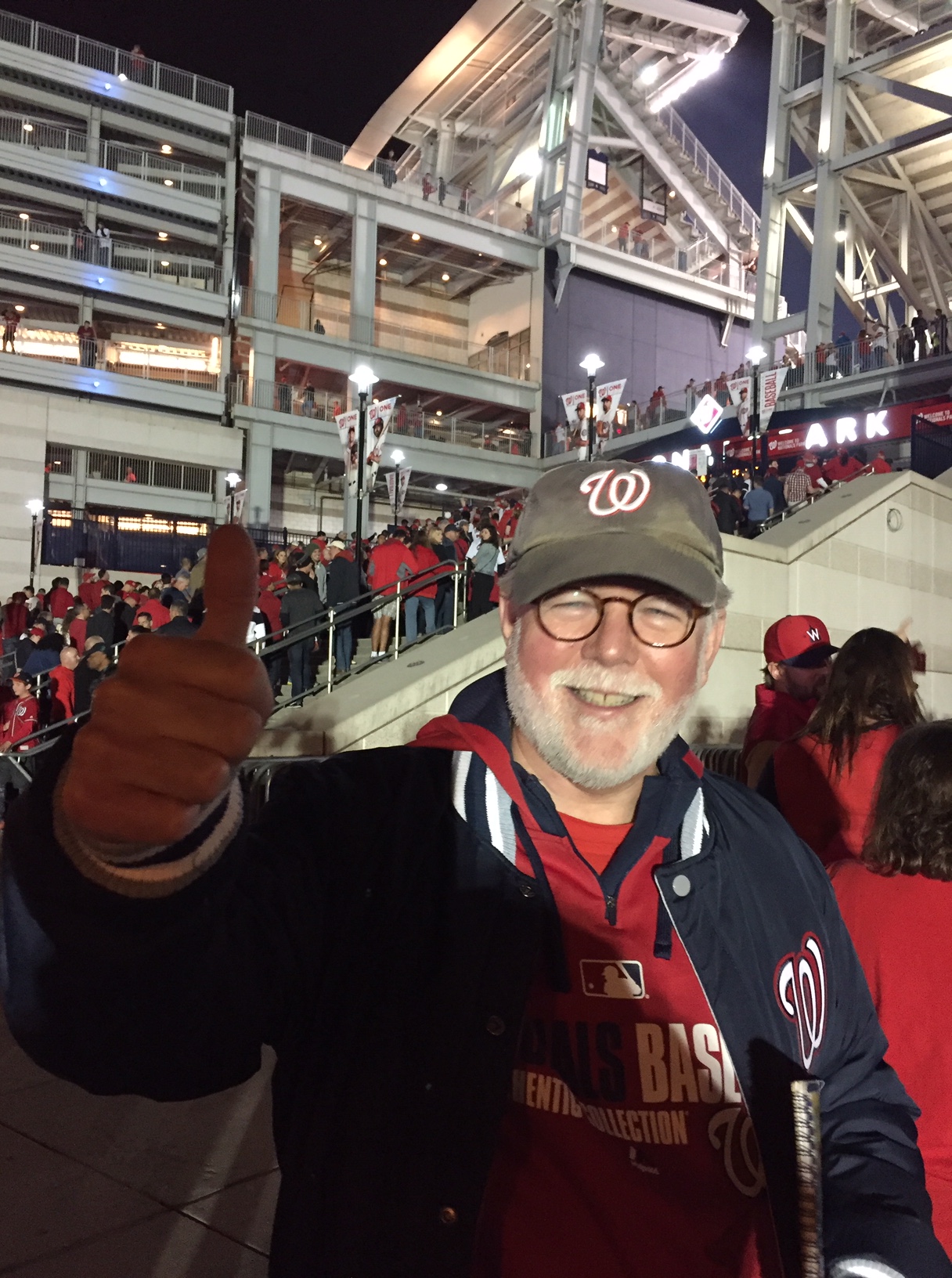
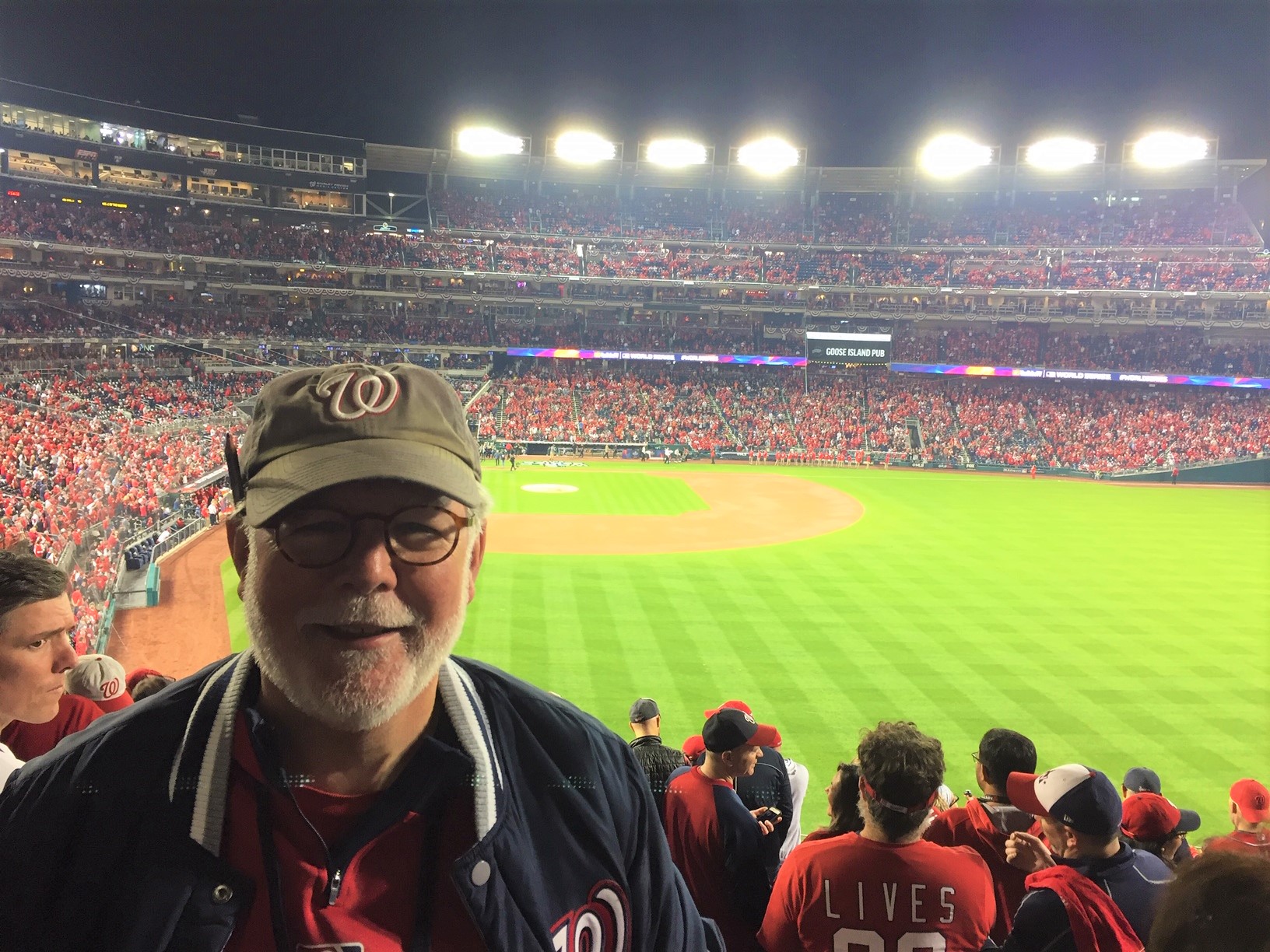
Entering Nationals Park for Game 3 of the 2019 World Series
For all things streak related, I first turn to the best baseball movie ever, Bull Durham. There’s a famous scene about “respecting the streak” where Kevin Costner’s Crash Davis makes the point to Susan Sarandon’s Annie Savoy that players have to respect a streak…and should not change whatever they think is causing their run of good fortune. (Note: the scene is as much about sex as it is about baseball, so the link is for mature audiences only.)
One of our home-team announcers for the Nationals, former player F.P. Santangelo, likes to admonish the viewers to stay in the “same seats” when hits are flying off the Nationals’ bats, or to encourage everyone to move to a different seat when the team needs to break out of a slump.
View from my seat at Game 3 of the 2019 World Series
I’ll confess that I went to last night’s Game 3 at Nationals Park with some bit of trepidation. My on-site record for playoff games for the Nationals was 1-2, and the two losses were horrific. (Game 5 of 2012 NLDS and the famous 18-inning game of the 2014 NLDS, for those who care.) But I’ve never been to a World Series game in person, and so I threw caution to the win and forked over the money to get a seat.
My biggest tactical mistake was not wearing the same pants I wore for the Nats’ wins in Games 1 and 2. I feared they were a little thin for the October evening temperature, and frankly they looked a little worse for the wear after I wore them stretched out on the couch for two games.
So I’ll take the blame for the Game 3 loss. It’s on me.
But I had a blast, all the same.
As I’ve said, I have no expectations for this series (or the two that went before) but I just want to enjoy the ride. Last night was no exception. The crowd was terrific. As opposed to some other playoff crowds I’ve been around in Washington, which were heavy on those who wanted to party, the folks in our section were knowledgeable, enthusiastic, but also respectful of the Astros as a talented group of players. It was an exciting game all the way through the last pitch in the bottom of the 9th.
My take on the loss was that the Nationals players were as amped up as the fans, and had trouble controlling their emotions. Any time you leave 10 men on in scoring position without getting them home, you’re not relaxed in a moment of great tension (which is the only way to play the game.) I hope that getting over that first “World Series game at home” hump, and the reality of the loss, will bring them back to the “terrific players having fun” persona that has led them this far.
So, for those who are superstitious, I’ll be home and back in my “winning” seat on the couch (or the “winning” seat at the Silver Branch Brewing Company bar) for the rest of the series.
Go Nats!
More to come…
DJB
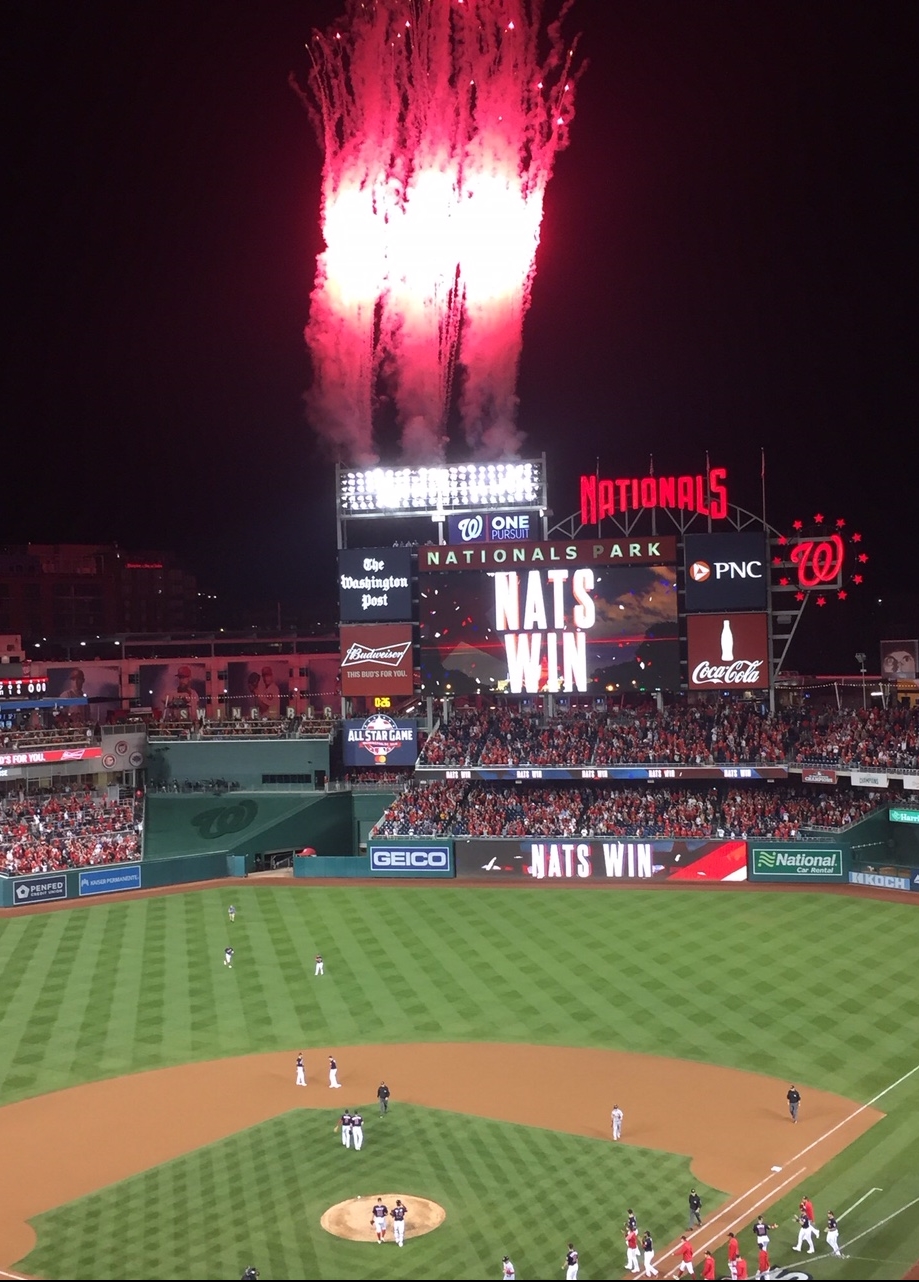
Image: Nationals Park before the start of the first MLB World Series Game in Washington since 1933. To set the record straight, yesterday’s Washington Post noted correctly that Washington’s last World Series team was the 1948 Homestead Grays of the Negro League, “who defeated the Birmingham Black Barons, four games to one, to cap perhaps the most dominant stretch of baseball in American history.”
This is the 20th year Fraser and Haas have played together, and the anniversary gave the duo the excuse to return to their back catalog. And it is a masterful body of work, beginning with the album where I first heard them—their inaugural CD Fire & Grace, a project that turned heads worldwide with its exquisite musicianship and clear sense of joy.
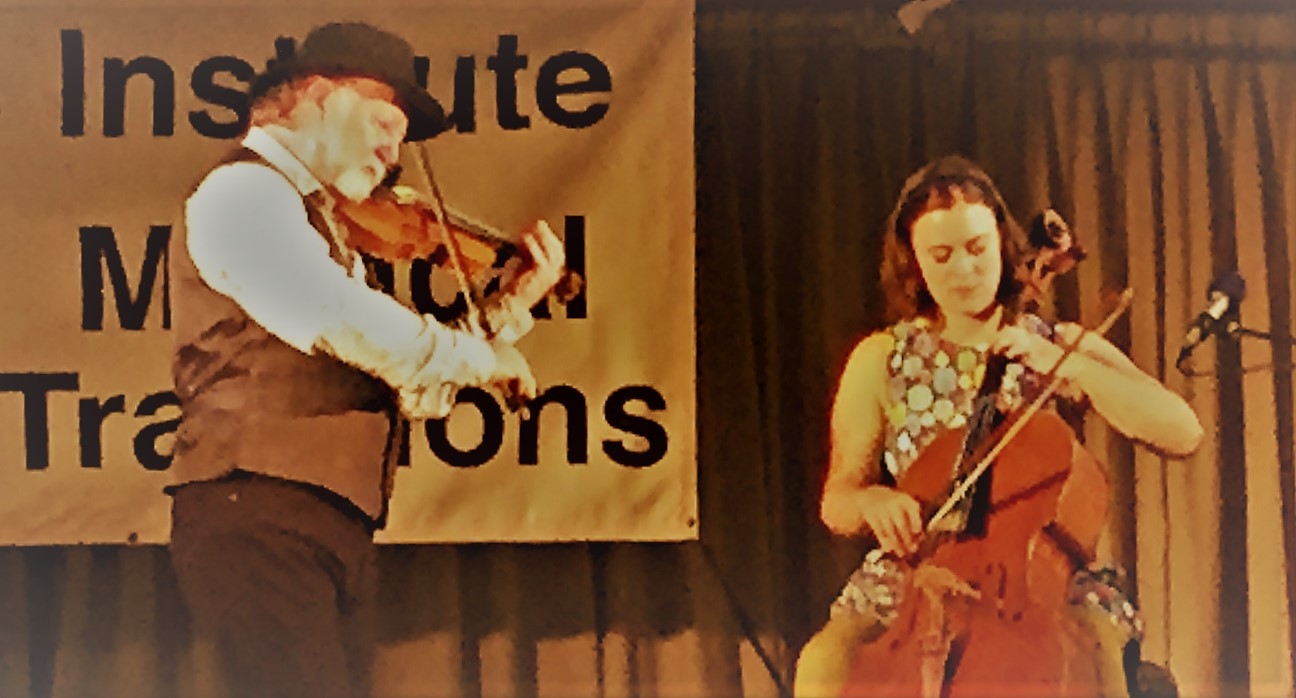
Steeped in different backgrounds— Alasdair from the roots world of Scottish fiddle and Natalie from the classical halls of Julliard—these amazing musicians responded to each other and to each intricate twist and turn of the music for a delightful two hours. It was art as a life-giving force. And they clearly had fun, recognizing the unique nature of the evening’s setting when they played the “appropriate for Washington” reel Little Donald in the Pigpen. Haas’s percussive use of the cello underpinned the magnificent tones that Fraser coaxed from his fiddle. No matter the tune, their music soared as they traded lead and rhythm roles, then came together in unison so as to take your breath away.
It was an exceptional evening of music making.
Alasdair Fraser and Natalie Haas (photo credit: Fran Bernardino)
Included among the many fiddle tunes they played on Monday was the medley of two traditional pieces, Neil Gow’s Wife and The Old Reel. There were contemporary tunes in the set as well, such as Megan and Jared’s Waltz followed by Mike Vass’ Cavers of Kirkcudbright. Give them all a listen from their Strings Sessionsvideo.
Alasdair Fraser and Natalie Haas are touring this fall in support of their new album and in celebration of their two decades of a wonderful musical partnership. Check them out, and enjoy.
Tunnel vision is defined as the tendency to focus exclusively on a single or limited goal or point of view.
And that’s not always bad. There are certainly instances where a laser-like focus is required to get the job done. But more times than not, getting locked in on a single goal without considering the context, other points of view, or the broader consequences brings trouble.
In leading teams both large and small, I often say that one of my key roles is “connecting the dots.” I’m trying to ensure that team members consider the context. It is critical for leaders to ensure that someone is thinking about broader consequences and the big picture.
I saw an unfortunate example of tunnel vision play out over the past two weeks. The leaders and their teams did not connect the dots that were right in front of them.
This real life lesson began when my wife and I walked the short distance from our house to a nearby intersection on a beautiful Monday morning. There we joined with other neighbors, bicycling and pedestrian activists, members of the media, and county officials for the official opening of the new dedicated bike lane in our hometown of Silver Spring.
This has been a major project, with night-time road reconstruction, the addition of new bus stops, construction of floating traffic islands, and the installation of special bicycle traffic lights. The county had worked hard to keep the residents along Second Avenue informed of the progress. Over the course of approximately eight weeks signs were everywhere and, once the work began, the evidence of the change was all around us.
Ribbon cutting on October 7th for the new Silver Spring bike path
In the course of watching the construction, I met the project manager. In our conversation, I shared our family’s excitement for the changes and our appreciation for the strong communications coming from the county and from the contractor. I also mentioned—almost as an aside—my concern with the way that area utility companies were active in nearby neighborhoods, tearing up the streets to replace underground lines and then undertaking shoddy road repairs to cover up their work. I could not see what consideration the utilities gave for other neighborhood projects and efforts at design improvement.
According to the project manager for the bike lane extension, the utility companies are supposed to wait at least two years before tearing up a newly paved street, with an exception made for emergencies. But he also mentioned that utility companies have a mind of their own.
The “wait two years” comment stuck in my mind.
And it came rushing back when, only TWO DAYS after the official county dedication of the just-completed bike path, I walked up to see a utility crew in our neighborhood.
Digging a hole in the fresh pavement of Second Avenue.
Smack in the middle of the new bike path.
They were doing this work because there was a major construction project also in progress—the Elizabeth Square aquatic and recreational center—with extensive work near Second Avenue. Everyone working on the Elizabeth Square project hadto cross Second Avenue when the bike lane was under construction just to reach their building site. The contractors and project managers for the Elizabeth Square project worked side-by-side with the ongoing bike-lane extension on Second Avenue. They saw the work underway in August and September.
Utility crews dig up the new and freshly paved Silver Spring Bike Path, just TWO DAYS after the official dedication
And yet, the only charitable conclusion is that they were too focused on their project and didn’t think about the context.
For they never thought to call the county Department of Transportation and say, “Hey, we’re going to need to do some utility work on Second Avenue. Let’s finish that before you put a fresh coat of pavement down and construct a new bike lane.”
And somehow in the county’s permitting services office, no one saw two projects requiring permits on Second Avenue and put two-and-two together.
As a result, residents, pedestrians, and bicyclists in Silver Spring got to enjoy two whole days of a freshly paved Second Avenue bike lane and street before it was torn apart.
It appears that tunnel vision strikes again.
Our Councilmember and the bike lane project manager are responsive and working at the appropriate levels of county government to attempt to fix the process and ensure that the remediation in this instance exceeds the utility company’s normal shoddy (my term) patching jobs. I’m staying on the case.
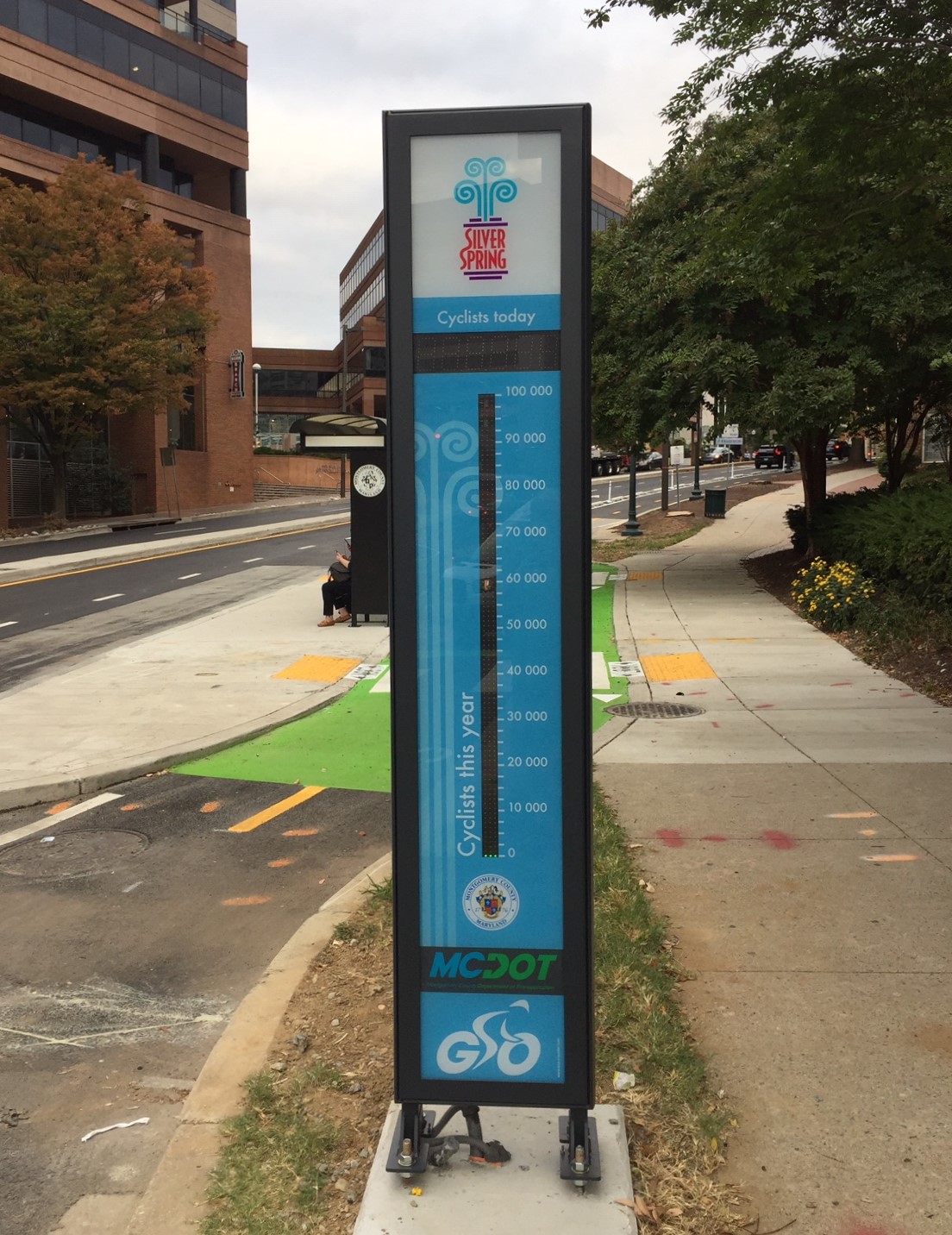
The electronic bike counter along our new bike path in downtown Silver Spring
If you want to be a leader, look around. Figure out what else is going on. Get the bigger picture. Understand the context. Find a way to involve others, even if they aren’t part of your team or office or organization.
In other words, connect the dots.
Have a good week.
More to come…
DJB
UPDATE: After reading my blog, the Silver Spring Urban District Specialist asked me for a meeting, which took place on the morning of October 28th. I learned a number of things about the process the county has in place to guard against this type of tunnel vision…and how that process wasn’t used effectively on Second Avenue. But I also learned that there are good public servants who listen to constituents and work hard to set things right. The Urban District Specialist is working towards a restoration of the road in short order, alerted me to some other challenges with upcoming construction in our neighborhood, had answers to my questions, and was very responsive. She is a “connect the dots” type of person.
On a picture perfect fall day, I feature Swingologyin today’s Saturday Soundtrack as they were cutting loose with some fine gypsy and traditional jazz this morning at the corner Busk Stop at the Silver Spring Farmers Market. The band is a great new addition to our lineup of regular buskers, and we’ll look forward to seeing them back at the market in about a month.
Then, in light of earning the franchise’s first trip to the World Series, he added, “And this is a beautiful place.”
Oh, is it ever!
NLCS Most Valuable Player Howie Kendrick—one of 18 resident “Los Viejos” (the Old Men) on the Nats playoff roster over the age of 30—said, “I can truly say this is the best time of my career, the best moment of my career this year.”
I can add that in my 55 years of being enthralled by baseball—beginning as a nine-year-old with a 1964 trip to Wrigley Field on a family vacation to see the Cubs play Bob Gibson and the St. Louis Cardinals; to following Willie Mays and the San Francisco Giants from afar, as a kid growing up in Middle Tennessee; to the Atlanta Braves teams of the 1970s, and 1980s, and 1990s; to the Nationals arrival in DC in 2005; to my bucket list quest to visit all 30 MLB ballparks; to the Division-winning teams of 2012, 2014, 2016 and 2017—nothing compares to the joy of watching this year’s Nationals.
I may not have any expectations for this team, but, as I said following this club’s improbable Wild Card game win and again after they crushed the mighty Dodgers in five games of the NLDS with Howie’s 10th inning grand slam, I sure am having fun.
Last evening was no exception.
As a one television family, we had a “discussion” in our household about whether we were going to watch the Democratic Presidential Debate or Game 4 of the NLCS. I volunteered to go on the road, so I headed across the street to our terrific and lively local brewery, the Silver Branch Brewing Company. There I settled in at the bar with a group of other red-clad Nats fans, ordered up an October brew, and watched the game while chatting with new friends and bartenders. The seven-run first inning had us all in a state of euphoria, but I recalled to my bar mate that we had a 6-0 lead in 2012’s elimination game against these same Cardinals. Nothing was assured. When the Cardinals clawed back to 7-4, it was time to order a second beer.
And yet, the Nats hung in there and fought through all the challenges thrown at them.
One of the great lines in the many column inches in today’s Washington Post about the Nationals win came from that long-time baseball scribe Thomas Boswell, who wrote about that May day when, “The team landed a Baby Shark named Gerardo Parra on a one-ounce test line — picked up free, with the San Francisco Giants still paying his salary.”
When Parra came in late in Game 4 and got a hit, somehow I knew that the Nats would win. Parra brought joy back to Washington baseball after too many seasons of pinning our hopes on the talented but moody and aloof Bryce Harper. Heck, Parra even got that old head case Stephen Strasburg to dance and laugh in delight when enveloped in a group hug he couldn’t have escaped even if he wanted to.
As columnist Christopher Powers noted, “Of the four teams left in the MLB Playoffs, there was really only one that could be characterized as ‘likeable,’ that team being the Washington Nationals.” Powers looks at the other teams that were in the two league championship series and finds them all lacking in likeability.
“The New York Yankees? Evil Empire. The St. Louis Cardinals? Most insufferable fanbase ever. The Houston Astros? Cocky players and even cockier fans, which is funny considering they just discovered the franchise existed in 2017.”
Every one of those characterizations is spot on. And speaking of insufferable, who died and left Yadier Molina as the king of baseball’s unwritten rules? He’s a terrific, Hall of Fame-bound catcher, but give me a break with all the grousing about how to play the game. Let the young kids and “Los Viejos” have some fun! Break out the Parra rose-colored glasses!
“As for the Nats,” Powers continues, “now that Bryce Harper is in Philly, there’s really nothing hate-able about them.”
Not only is there nothing hate-able, there’s a lot there to just sit back and enjoy. And now we get to do it for at least four more games in 2019.
So we’ve celebrated, danced, and now we wait for six long days before the start of the World Series, against either the formidable Houston Astros or New York Yankees. A World Series where I’ll have no expectations…except for the expectation to have a great deal of fun.
Go Nats! No, wait. Go, National League Champion Nats!
In her 2018 study Leadership in Turbulent Times, historian Doris Kearns Goodwin tackles a subject that could not be more relevant. Drawing on the life and lessons of four U.S. presidents, Goodwin holds up the achievements, foibles, and resilience of Abraham Lincoln, Theodore Roosevelt, Franklin Delano Roosevelt, and Lyndon Johnson. She examines how each came to be known for leadership as they dealt with civil war, the inequalities of the Industrial Age, the twin crises of global economic depression and war, and, finally, the struggle for civil rights.
Leadership, in other words, in times of crisis and transformation. Something like the times we are in at the moment.
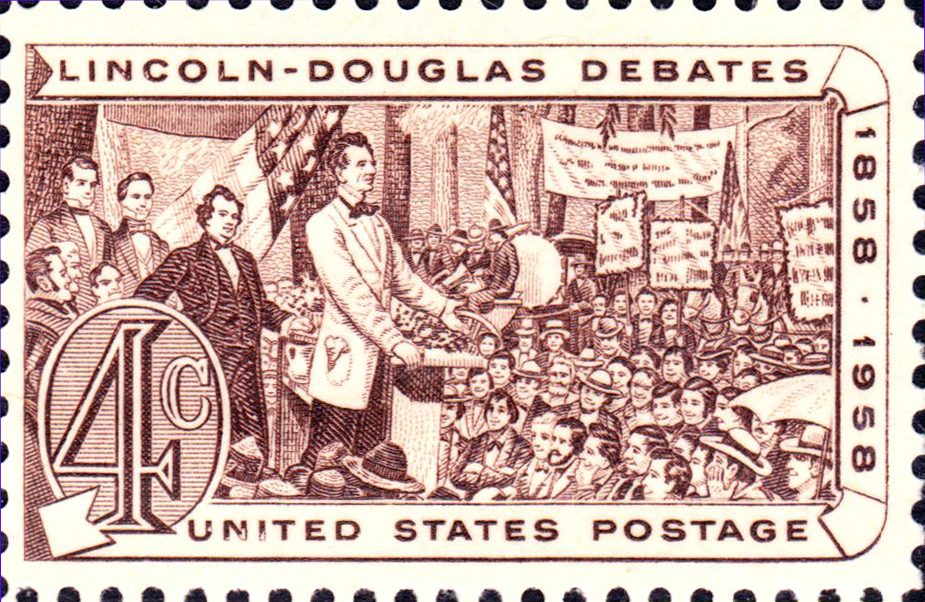
In contrast to the powerful having a sense that they can bully and hurt the vulnerable for their own political profit, Goodwin notes that the young Lincoln “possessed a profound sense of empathy (emphasis added).” He was able to put himself in the place of others. In doing so, he could “imagine their situations and identify their feelings.”
Lincoln Douglas Debates commemorative stamp from 1958 (Credit: U.S. Government, Post Office Department – U.S. Post Office Hi-res scan of postage stamp by Gwillhickers., Public Domain)
We are currently grappling with what happens to our nation when all sense of empathy leaves those at the height of power, if it was ever present in the first place. We are seeing what happens when humor is used not to uplift spirits, but to degrade our fellow human travelers.
Goodwin tells us that the young Lincoln’s humor could run amok, “his light mockery turning vindictive, even cruel.” She gives an example when Lincoln—in response to a rival’s light-hearted political jousting at his expense—resorted to mimicry and “scathing ridicule.” Lincoln, apparently, was a master at this type of humor and his rival, sitting in the audience, broke down in tears. In the vernacular of today, Lincoln’s performance “went viral.”
But what he does next is just one example from many of why he became a great leader. Lincoln realized he had overstepped. He went and found his rival and gave a heartfelt apology. The memory of the event stayed with him for years and led Lincoln to “rein in his impulse to throw a hurtful counterpunch.”
We live in a day and age when an hour-long presidential “address” is nothing but a grievance-filled counterpunch, intended to hurt, tear-down, and destroy political rivals.
Why was Lincoln able to rein in his impulses? “He was after,” Goodwin asserts, “something more significant than the gratification of an artfully delivered humiliation (emphasis added).”
In real leaders, the proper aspirations and vision can lead to a place where empathy and humor are used to build up rather than divide and destroy.
I suspect I wasn’t the only person having a private dance party in my television room at precisely 12:23 a.m. this morning. Or once again at precisely 12:41 a.m.
No, indeed! The Washington Nationals faithful—after enduring crushing defeats in the 2012, 2014, 2016, and 2017 National League Division Series (NLDS)—were ready to celebrate in that crazy 2019 Nationals way: the dugout home run dance party.
Thank God the Nats don’t play in the NFL (also known as the No Fun League). They would be penalized for exuberant celebrations.
There is a lot to be said for disregarding goals and barriers that others set for you in order to allow yourself to simply focus on enjoying the ride. That’s one thing this group has clearly done since the darkest days of May, when they stood at 19-31 on the 23rd of the month and everyone (myself included) was ready to write off the season.
That’s about the time Gerardo Parra arrived, a former Gold Glove winner picked up cheap off the MLB scrap heap, to which he replied, “That’s baseball.” He looked around at his new surroundings and said, “Why’s everyone so tight.” Parra got them to loosen up, and since his arrival the Nats have had fun. They’ve turned Nationals Park into the capital of Baby Shark. They focused on “Go 1-0 today.” They bring a cast of characters, none more important than “Tony Two Bags.” They began wearing orange and pink-colored Gerardo Parra sunglasses. They tied with the Dodgers for the best record in baseball from May 23rd until the end of the season. And, oh yeah, they dance in the dugout after home runs.
I could write about so much here: Stephen Strasburg’s gritty effort that kept the Nats in the hunt after he settled down from a rocky start. Patrick Corbin’s gutty relief appearance after a meltdown earlier in the series. The bullpen as a whole, which kept the Dodgers at bay after they scored three runs in the first two innings. The absolutely horrible managerial decisions made by Dodgers manager Dave Roberts. (Yes, he could win the Matt Williams Award for boneheaded calls under pressure.)
But I won’t.
There are great accounts in the Washington Post by columnists Thomas Boswell and Barry Svrluga. Scott Allen has a wonderful piece on the reactions at the late-night watch party at Nationals Park, from the Washington Capitols (tuning in from Nashville where they are in town to play the Predators tonight), and around the country. Go read the professionals.
Ready for October baseball! Go Nats!!
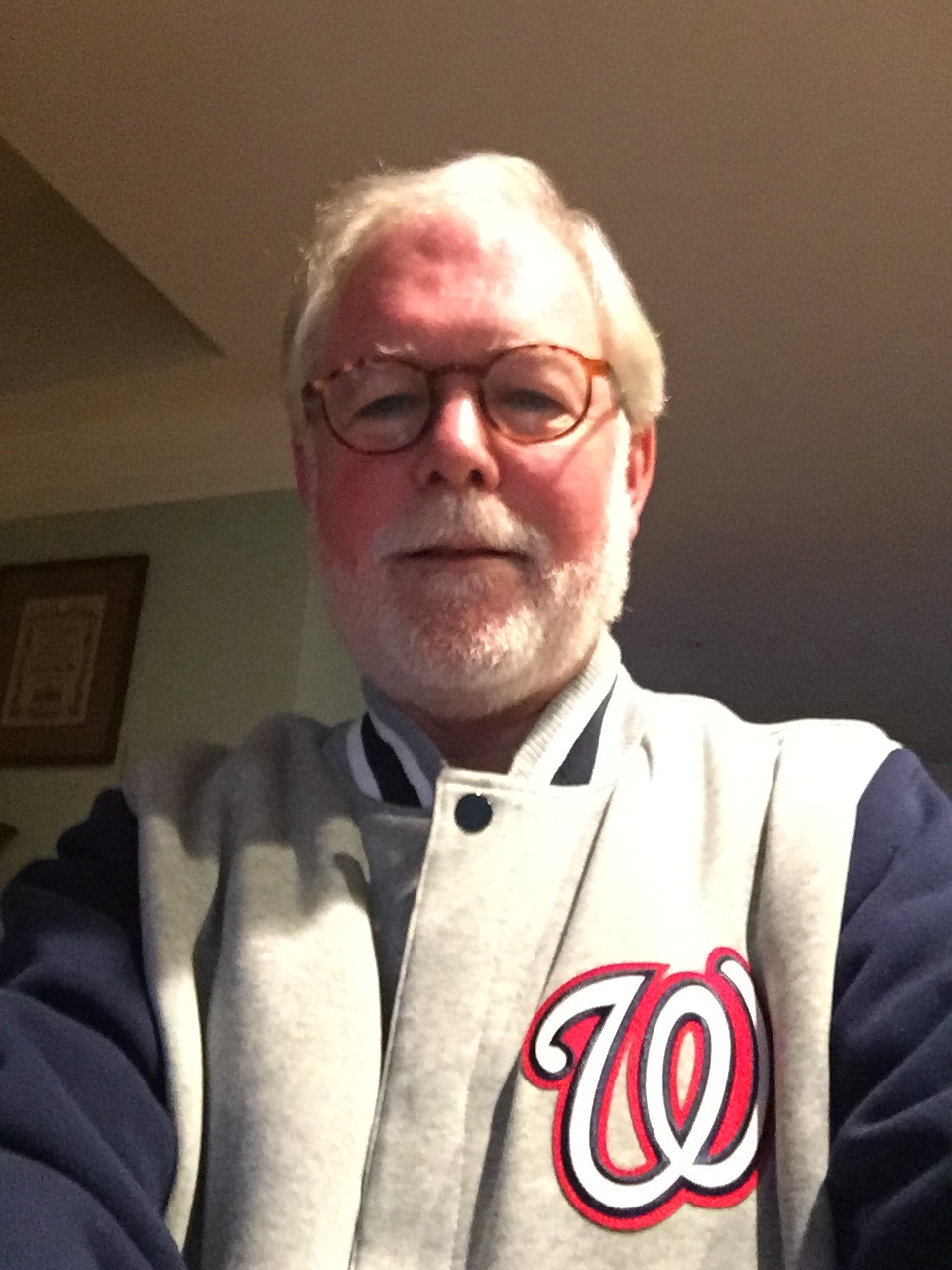
And on my morning walk through Silver Spring today, my new Nats jacket—one that’s especially warm for October baseball in the District—brought approving comments and “Go Nats” calls from fellow travelers.








 I suspect I wasn’t the only person having a private dance party in my television room at precisely 12:23 a.m. this morning. Or once again at precisely 12:41 a.m.