Latest Posts

Moments of resonance

Washington is blessed with an abundant tree canopy which encloses 37% of the city. The nation’s capital is fourth among U.S. communities with the most tree coverage per capita. This fall we’ve seen those trees in all their glory. Well past the peak days of late October the region was ablaze with magnificent color.

Views along a Washington street taken on Veterans Day weekend.

Yet I noticed a tendency among some residents to hurry past this amazing display. Even Rock Creek Park, a veritable cathedral of nature, is not immune to our mental disappearance. Drivers rush through, barely noticing their surroundings. Elsewhere heads are buried in smartphones in the midst of some of the area’s most stunning displays, like the blanket the ginkgo tree lays upon the ground in the fall.

Fall in downtown Silver Spring
A view from an earlier fall morning in Silver Spring

Essayist Maria Popova reminds us that “to live wonder-smitten with reality is the gladdest way to live.” But we have to take the time to recognize the wonder, the joyful, the fulfilling that sparks awe in humans. We find that wonder not just in nature but in leisurely lunches at a sidewalk cafe, in talks with a child as they explore the world around them, in simply finding a bench on which to sit and think.

Too few of us choose to order our hours and days this way. The ability to live wonder-smitten lives is often crushed by a culture that demands that we always hustle, striving to achieve more. It is the race that never ends. And as Brian Klaas writes, we are too often perplexed when we meet those who have stepped off the treadmill.

Racing to keep up, we tend to find it exotic and eccentric when people linger without a purpose, when one wanders aimlessly, or when we see a stranger sitting and thinking in public without a smartphone as a distraction. The solo diner without a book or phone is seen as a weirdo; the person who wanders alone for hours in nature deemed a loner. Constant hyper-activity hasn’t just defeated patient stillness and slow reflection — what Hannah Arendt called the vita contemplativa. Instead, the modern rat race has massacred it so much that many of us can’t even handle being forced to be alone, with nothing but our minds as company.

We have discovered modernity and, unfortunately, latched on to the parts that are unfulfilling for too many of us. We can fly, but at what cost? E.B. White once wrote, “The curse of flight is speed. Or, rather, the curse of flight is that no opportunity exists for dawdling.”

The difficulty of finding work/life balance in a fast-paced world is an oft-heard complaint. But the consequences of not finding the appropriate balance can be devastating. As I wrote on the occasion of our twins’ birthday, thirty years goes by in the blink of an eye. We have to slow down and learn to savor each moment that we can. Doing so is a recognition of the freedom that comes, as described by Franciscan Sister Ilia Delio, from spiritual maturation and a growth in consciousness.

“The first half of our lives is spent building an identity, establishing our security, defining our boundaries, creating a zone of safety, and having controllable order,” she writes. We are operating on lower levels of consciousness.

What creates a breakthrough in consciousness, whereby authentic growth shifts from attention to authority outside ourselves to the inner law of the heart, is not simply growing old but, rather, it is growing inward in freedom . . . Freedom requires a breakthrough into unitive consciousness, a radical surrender and complete letting go, trusting the spiritual impulses of life . . .

“Humanity is the only phenomenon in the known universe that contemplates its own existence,” Klaas writes. “It is one of the reasons, perhaps, why Aristotle and Plato emphasized the role of contemplation in an ideal life — and why the philosopher and guru Alan Watts remarked that ‘through our eyes, the universe is perceiving itself.’”

Hartmut Rosa writes about focusing on “moments of resonance.” I love that phrase, because when things really touch us they resonate within us. To Rosa, resonance refers to a relationship “between subject and world characterized by reciprocity and mutual transformation: the subject’s experience of some other calling upon it which requires understanding or answering, but that also has the ability to change the subject.”

We’ve all had these moments, whether walking in nature, viewing a work of art, in a deep conversation, or simply in thinking alone on a bench. But we have to be present in the experience.

“There is a creative purpose to wandering, daydreaming, even to boredom” writes Michael Corballis. Klaas agrees. “The good life has more aimless wandering, less frantic racing, more spontaneity, less scurrying. It comes with a slower pace that allows us to catch our breath, to soak up wonderful moments, to savor what we have. It gives us the space to do one of the most important things a human can do: to notice and relish the joyful, the fulfilling, or even the merely pleasant bits of life.” He then shared this gem of wisdom from the great writer Kurt Vonnegut:

One of the things [Uncle Alex] found objectionable about human beings was that they so rarely noticed it when they were happy. He himself did his best to acknowledge it when times were sweet. We could be drinking lemonade in the shade of an apple tree in the summertime, and Uncle Alex would interrupt the conversation to say, “If this isn’t nice, what is?”

So I hope that you will do the same for the rest of your lives. When things are going sweetly and peacefully, please pause a moment, and then say out loud, “If this isn’t nice, what is?”

Take your head out of your smartphone or computer screen. Look around. See if you don’t find yourself agreeing with Uncle Alex.

If this isn’t nice, what is?

More to come . . .

DJB

Photo of Rock Creek Park (credit NPS)

Sittin’ on Top of the World

One of the pleasures of music is how different musicians from a variety of genres can take a simple song and make it their own.

I’ve always loved the old chestnut Sittin’ on Top of the World in part because even a musician at my level can play it in different styles. For my retirement party at the National Trust, I joined the By-and-By Band for a spirited bluegrass rendition of the tune. After a kick-off by the banjo player, I jumped in to sing that great first verse, which has so much to say about heartbreak and promise.

Twas in the spring, one sunny day
My sweetheart left me, Lord, she went away
And now she’s gone and I don’t worry
Lord, I’m sittin’ on top of the world

For each successive verse, the first two lines differ, while the last two repeat that paradox of life: The person I love is gone yet I don’t worry, because I’m on top of the world.

If I remember the words (he says with a knowing smile), the following is usually my second verse, which comes before the first instrumental break.

Mississippi River, is deep and wide
My good gal left me on the other side
And now she’s gone . . .

By-and-By Band
Playing Bluegrass with the By-and-By Band. DJB is the one in the jacket!

Perhaps the first version I heard of the song was the fingerpicked rendition of my guitar hero, Doc Watson. Sittin’ on Top of the World was on Doc’s self-titled debut album, which was a revelation to fans and musicians alike.

Music critic Jim Smith wrote that Doc’s debut album was . . .

incredibly varied, from the stark, banjo-driven “Country Blues” to the humorous “Intoxicated Rat,” and many of these songs became Watson standards, especially his signature song “Black Mountain Rag.” His incredible flat-picking skills may have been what initially wowed his audiences, but it was Watson’s complete mastery of the folk idiom that assured his lasting popularity.

Doc — unlike other musicians who skipped over the tune’s writers — gave the credit to two members of the Mississippi Sheiks: Sam Chatmon and Walter Vinson.

The Shieks composed and performed the original of Sittin’ on Top of the World in the 1930s, taking the tune at a somewhat more languid pace compared to the faster bluegrass versions of later years.

And the early bluesmen got into the act as well, as with Howlin’ Wolf’s take.

As you can hear in just three different versions of the songs, there are a great many verses and performers sing them in all different orders.

Jimmy Martin

Jimmy Martin may have been the bluegrass performer most associated with the song, recording it on Volume 2 of the Nitty Gritty Dirt Band’s Will the Circle Be Unbroken as well as on other albums. Besides Martin’s signature vocals, this version contains killer breaks by Vassar Clements on fiddle, Jerry Douglas on dobro, and Mark O’Connor on mandolin.

The next generation has taken on the song as well. Here’s a great live version from the Grey Fox Festival of Billy Strings and Molly Tuttle ripping through the tune with some incredible flatpicking along the way.

In many versions, including mine, these two verses are sung together. They both have a “well, you should have known what you were missing before you ran off” vibe that blends into a statement about why “I don’t worry.”

Don’t like my peaches, then don’t you shake my tree
Get out of my orchard, let my peaches be
And now she’s gone . . .

Don’t you come here runnin’, holdin’ out your hand
I’m gonna get me a woman like you got your man
And now she’s gone . . .

The Flatlanders — Jimmie Dale Gilmore, Joe Ely, and Butch Hancock — play a spirited Texas country-rock version of Sittin’ on Top of the World for their Austin City Limits performance. I’ve loved the Zen Cowboy and his compatriots ever since hearing them live in a 2009 performance with my long-time colleague Anthea in a New York City nightclub.

I like to end the song with these two verses. The first has the wandering lover calling up from El Paso with a wailing cry for redemption, followed by a repeat of the first verse that tidies it all up.

She called me up from down in El Paso
Said “Come back, daddy, ooh, I need you so”
And now she’s gone . .

Twas in the spring, one sunny day
My sweetheart left me, Lord, she went away
And now she’s gone and I don’t worry
Lord, I’m sittin’ on top of the world

Several years ago I heard Chris Smither sing his bluesy version of Sittin’ on Top of the World at the Red Wing roots music festival and it immediately became my favorite.

As one commentator noted, there is great fluidity in his fingers so that “it looks like he may not even be touching the strings.” Another hit the nail on the head as to why the Smither performance has such an impact. “Creativity, artistry: take an old standard, run it through your own interpretive filters and, voila! a great performance for us all, in the style of the old school.”

Chris Smither
Chris Smither

All of these artists are running this great tune through their own musical filters, and it just keeps working its magic.

Whatever has you down this Thanksgiving weekend, don’t worry . . . just go sit on top of the world.

More to come . . .

DJB

Photo of Claire Brown “on top of the world” in Thun, Switzerland.

Most things that are important lack a certain neatness

Few writers capture gratitude for what is around us with the grace of Mary Oliver. As we approach Thanksgiving, I turn to Oliver’s poems and essays to remind myself that, like the violets in her poem Spring, it is okay to use up your time in happiness.

Violets have many leaves, each one so earnestly
heart-shaped that you could not imagine the plants have
thought of anything else to do. But they have: they make
blossoms, which rise yellow or violet, in multitudes, the
violet ones with violet-colored spurs. They like
dampness, they like hillsides and are comfortable also
in the shady woods. They like to be alone, or congregated
together in the grass, looking up as you pass by, saying
Hello, Hello. And what else do you imagine

they might do? Sing? I don’t think so, I suspect
they know when any further ambition would be
unseemly. So all their time is used up in happiness―
in becoming the best they can be
for the greater glory of _.
In fact, they know it’s okay to rest for the rest of
your life just saying: Thank you. Oh cast of thousands,
as are the stars of heaven. Thank you.

Blue Iris: Poems and Essays (2004) by Mary Oliver is a collection of ten new poems at the time of publication, two dozen of her poems written over the prior two decades, and two previously unpublished essays on the beauty and wonder of plants. Nature is full of mystery and miracle. Oliver believes our response, if we are paying attention, should be one of astonishment and gratitude. In The Bleeding-Heart she writes of a plant that has “thrived for sixty years if not more,” and has “never missed a spring without rising and spreading itself into a glossy bush, with many small red hearts dangling.” And she asks, “Don’t you think that deserves a little thought?”

And the way she thinks shows Oliver’s wonderful eye for detail and ear for expression. The woman who planted the bush is long gone, as are those who lived there at that time.

…and so, like so many stories, this one can’t get finished properly. Most things that are important, have you noticed, lack a certain neatness. More delicious, anyway, is to remember my grandmother’s pleasure when the dissolve of winter was over and the green knobs appeared and began to rise, and to create their many hearts. One would say she was a simple woman, made happy by simple things. I think this was true. And more than once, in my long life, I have wished to be her.

At Thanksgiving, especially, it is important to remember that while life is hard, because mystery is hard, life is also joyful and full of wonder. It is easy to give thanks when everything is going well. It is in the most challenging of times, however, when it is so very important to be open to gratefulness and to remember to be thankful. Thanksgiving itself came from a time of violence. Abraham Lincoln’s famous Thanksgiving proclamation was issued in the midst of some of the worst times of the Civil War. An attitude of gratitude — a deliberate choice of love over fear, a desire to be positive instead of negative — can help us be thankful in difficult times.

Mary Oliver understood the true enchantment and mysterious spell of nature and she found ways — as in her poem Freshen the Flowers, She Said — to hear music in her world and convey that to her readers, even when there was nothing playing.

Freshen the Flowers, She Said

So I put them in the sink, for the cool porcelain
was tender,
and took out the tattered and cut each stem
on a slant,
trimmed the black and raggy leaves, and set them all–
roses, delphiniums, daisies, iris, lilies,
and more whose names I don’t know, in bright new water–
gave them

a bounce upward at the end to let them take
their own choice of position, the wheels, the spurs,
the little sheds of the buds.  It took, to do this,
perhaps fifteen minutes,
Fifteen minutes of music
with nothing playing.

Be grateful in the wild joy of belonging amidst the wonder around us. Be thankful for the opportunity to take in this music. Be generous in sharing and exchanging kindness with the world.

Happy Thanksgiving.

More to come . . .

DJB


The Weekly Reader links to the works of other writers I’ve enjoyed. I hope you find something that makes you laugh, think, or cry. 


Photo by Timothy Eberly on Unsplash

Our year in photos — 2023

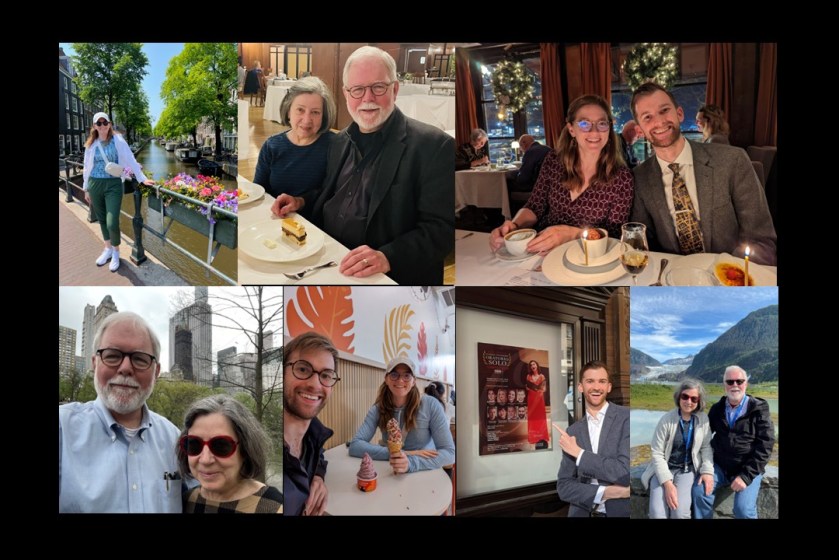
During this season when so many are thinking of the love of family and friends, I continue my annual tradition of posting family photographs on More to Come. This practice first began in 2008* but has grown through the years so that the entire family participates in the curation of this particular entry.

As is often the case, we begin with our Thanksgiving dinner in Staunton at the home of dear friends Margaret and Oakley Pearson. At this past year’s celebration, we captured a great picture of Andrew with his “honorary godmother” Bizzy Lane.

Bizzy Lane with Andrew

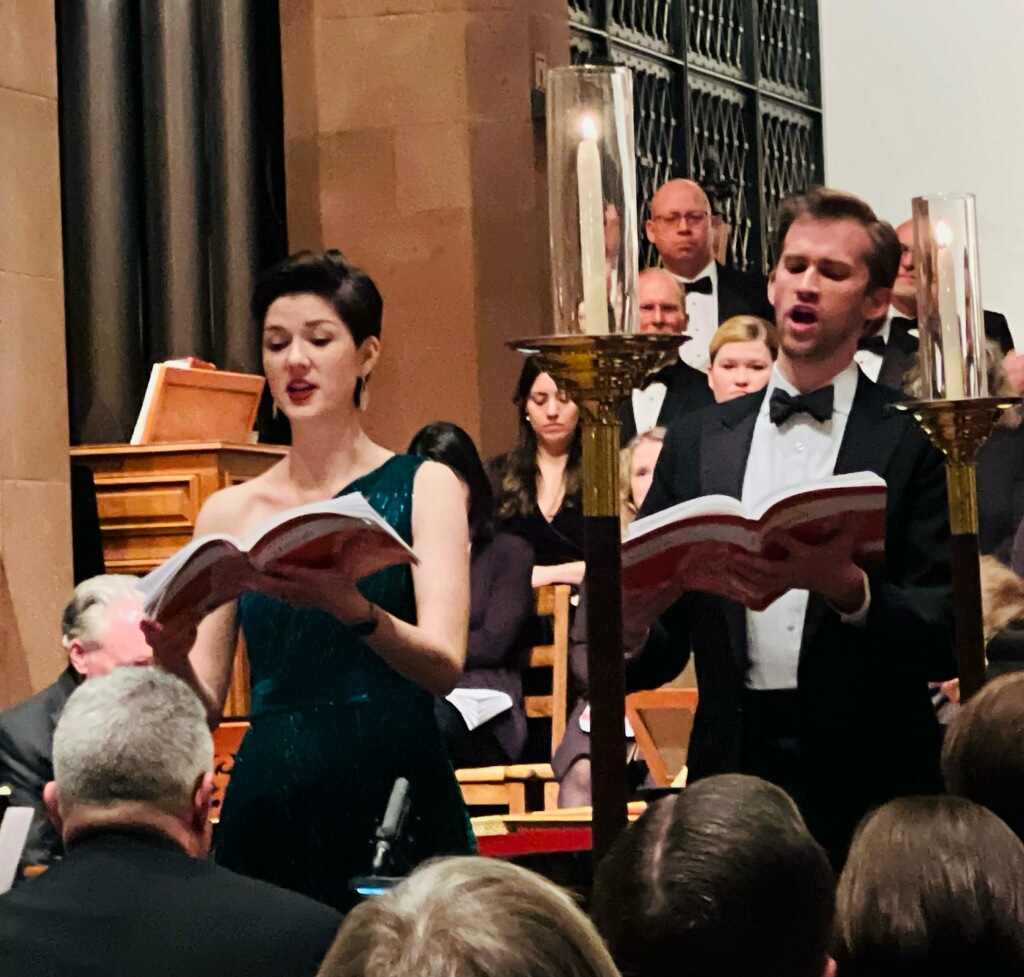
On December 18th, Candice and David traveled to beautiful Christ Church Christiana Hundred in Wilmington, Delaware to hear Andrew perform as the tenor soloist in Handel’s Messiah with members of Philadelphia’s Tempesta di Mare; the professional Christ Church Choir; and other nationally acclaimed Baroque vocalists.

Andrew duets with Sylvia Leith
Andrew with soloists Sylvia Leith, Edmund Milly, and Nacole Palmer (right), along with conductor Bruce Barber (center), for Handel’s Messiah at Christ Church, Christiana Hundred in Wilmington, DE.

In 2022 Claire and Andrew took their 30th trip around the sun. As their December birthdays approached, some of Claire’s wonderful friends from Pomona College celebrated the occasion over a scrumptious tea in Alameda, California.

Ali, Claire, Kyra, and Susan (left-to-right) celebrate the big 3-0!
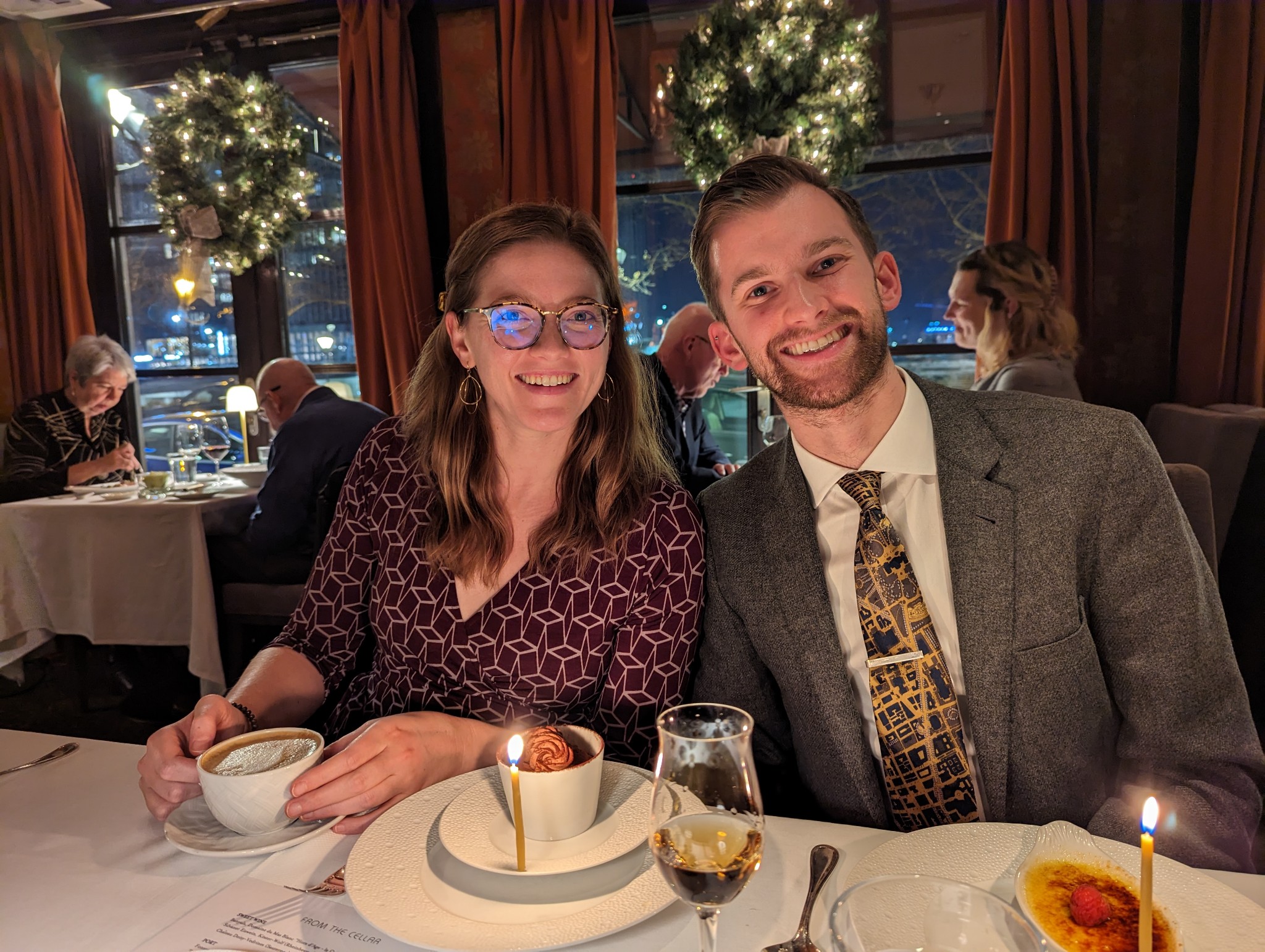
Claire and Andrew celebrate their 30th at Charleston, one of our family’s favorite restaurants (located not in South Carolina, but in Baltimore)

Because Andrew always sings on Christmas Eve/Christmas morning (last year and this at The Church of the Advent in Boston), we postponed our celebration of Christmas until Boxing Day — the 26th of December. Here Claire, Andrew, and Candice prepare our breakfast biscuits, a family tradition.


Living on opposite coasts, Andrew and Claire experience different types of winter weather.

Andrew outside his Brookline home after an early snow

Of course, the Bay Area can get chilly, so Claire and her good Pomona College friend Jackie Tran took off for some days in Cabo, Mexico in February, just to ensure they could soak up the sunshine.


We celebrated our 41st wedding anniversary in 2023, traveling once again to the magical Mohonk Mountain House for some restful and celebratory time together.


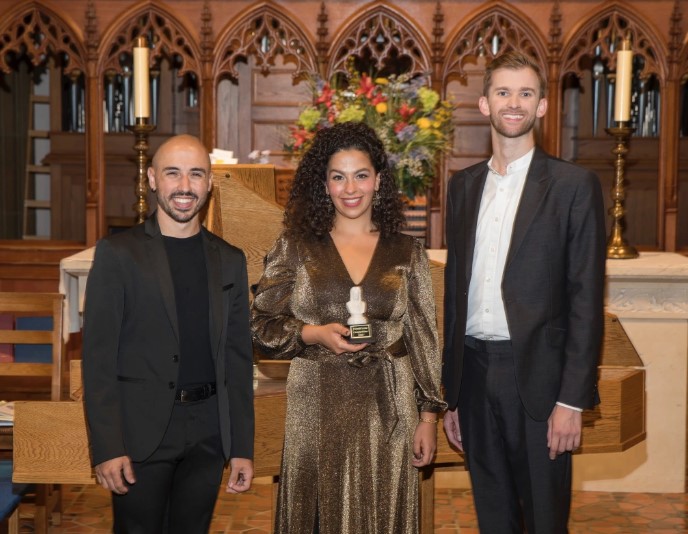
In 2023, Andrew sang in three vocal competitions, receiving Second Prize at the Handel Aria Competition, the William Grogan Award at the Oratorio Society of New York’s Lyndon Woodside Oratorio Solo Competition, and first prize at the Rhode Island Civic Chorale & Orchestra Collegiate Vocal Competition.

For the New York competition, Andrew joined six other aspiring soloists to perform major arias with piano accompaniment in the competition finals on April 15th at Carnegie Hall. We were in New York to support him as he gave a very moving and well-received performance.

Look who’s on the poster for an upcoming performance at Carnegie Hall!

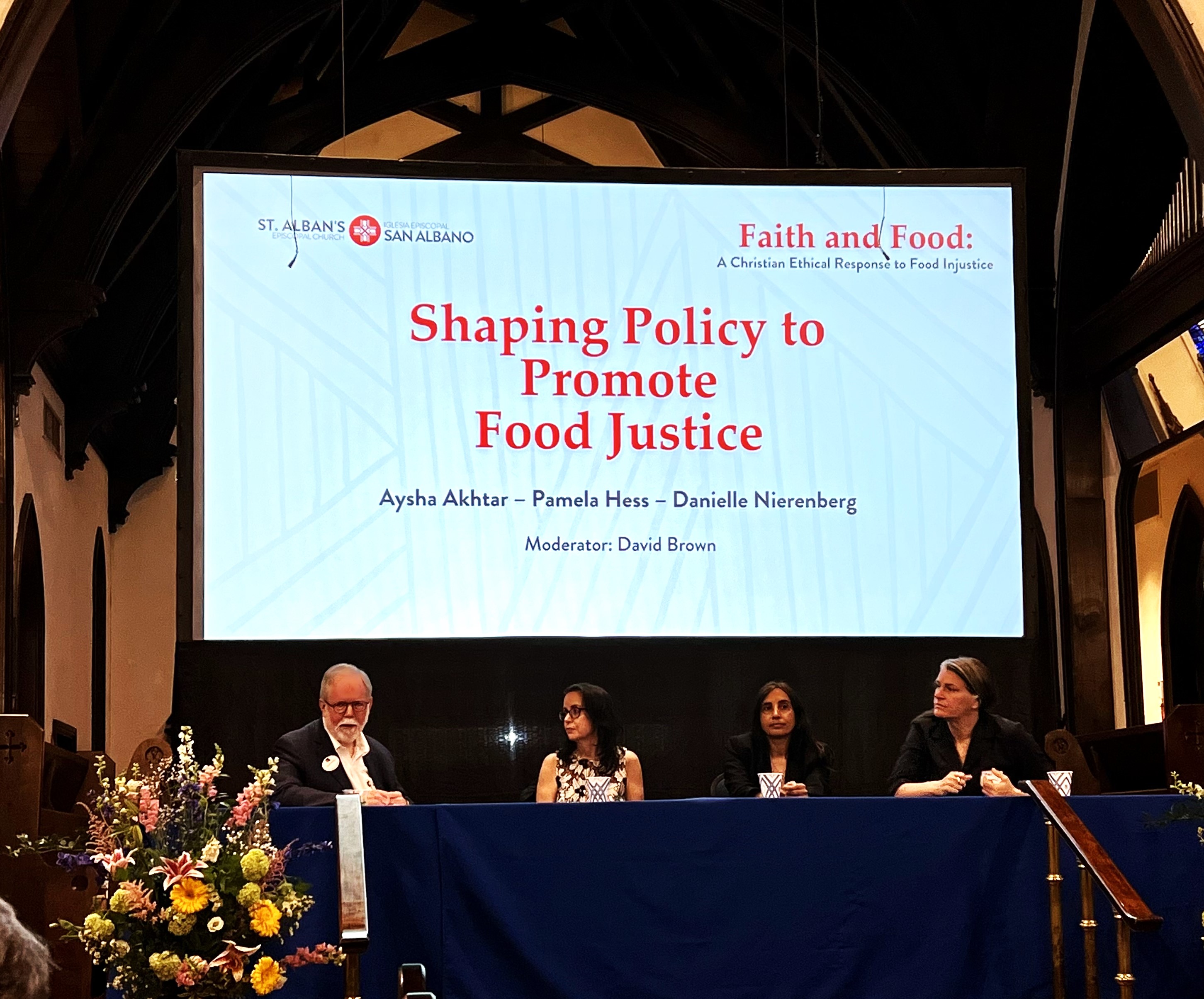
April also found us back in Washington, where David moderated a panel on Shaping Policy to Promote Food Justice for St. Alban’s 2023 Memorial Lecture Series focused on Faith and Food: A Christian Ethical Response to Food Injustice.


April was a busy month, as we also took the train to Boston to see Andrew perform as Oronte in the Handel opera Alcina. As is our custom, we took in a few other sites along the way.

Candice with Andrew in the courtyard of the beautiful Isabella Stewart Gardner Museum
Nothing could be better than to watch a game at Fenway with my long-time friend Ed Quattlebaum

May is a month of celebration — for Mother’s Day and Candice’s birthday.

Candice brings out her hand-crafted necklace, specially designed and lovingly created by much a younger Andrew and Claire
Celebrating Candice’s birthday

Claire and her friend Susan Nussbaum spent a delightful May weekend in Southern California celebrating the wedding of Vicky Gyorffy, a classmate at Pomona College.

Claire and Susan on a chilly night in Southern California

After months of intensive online and in-person study, Claire stepped forward in 2023 to launch The Sky Speaks to You, a unique coaching model that blends together astrology with psychology to support women on their journey of self-discovery.

Claire with her teacher Debra Silverman

Claire snuggles with Chai, our family’s favorite cat, in their home in Alameda.

Claire also worked in a wonderful two-week early summer European adventure in 2023, first stopping in Boston to catch up with Andrew before heading to see The Netherlands, Germany and Switzerland.

Andrew and Claire enjoy a summer cone together in Boston — just the latest in a long string of photograph of the two of them eating copious amounts of ice cream!
Claire meets up with Elsa, her Franklin Knolls swim team friend, at her home in Amsterdam.
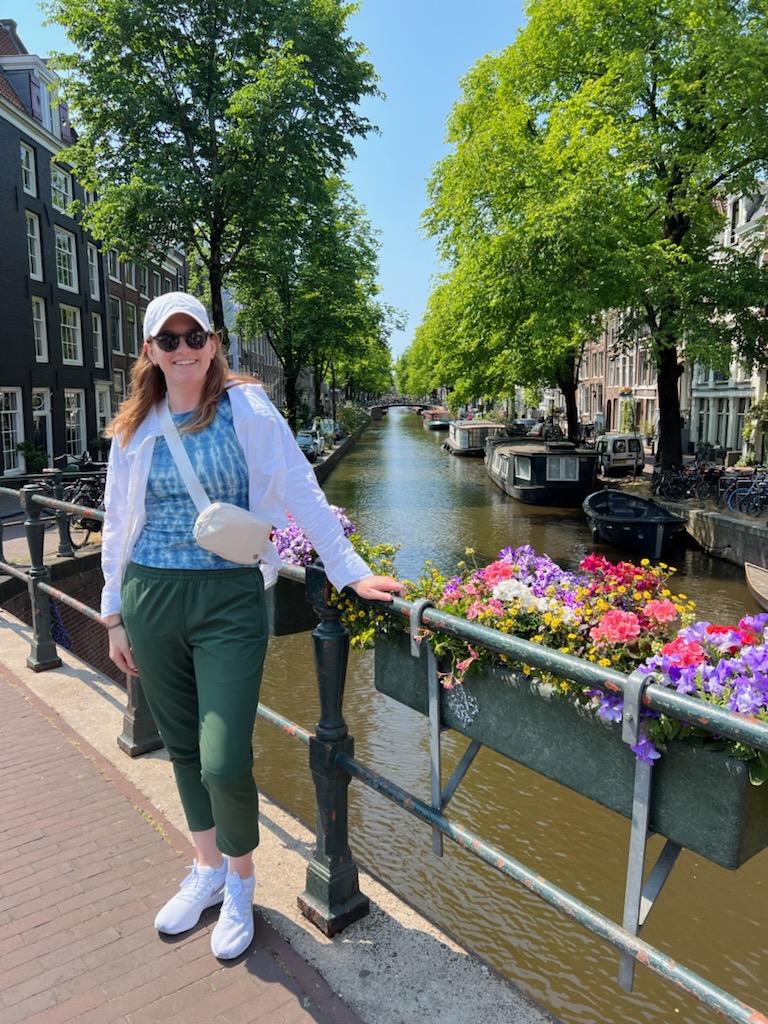
Claire along one of Amsterdam’s canals

Claire and her study-abroad friend Sylvie Abookire had a great time visiting sites across the continent.

Claire and Sylvie at the Nymphenburg Palace in Munich
Claire in Zurich
Claire and Sylvie enjoy dinner at a Swiss castle
Claire on the mountain top in Thun, Switzerland

This summer also found Andrew in Europe for a wedding, visits with friends from his Royal College of Music days, and more.

Andrew in Oxford, July 2023

In July, Candice and David made a stop for a few days in Alameda to visit with Claire, before heading north to Alaska.

Mother/daughter tea time
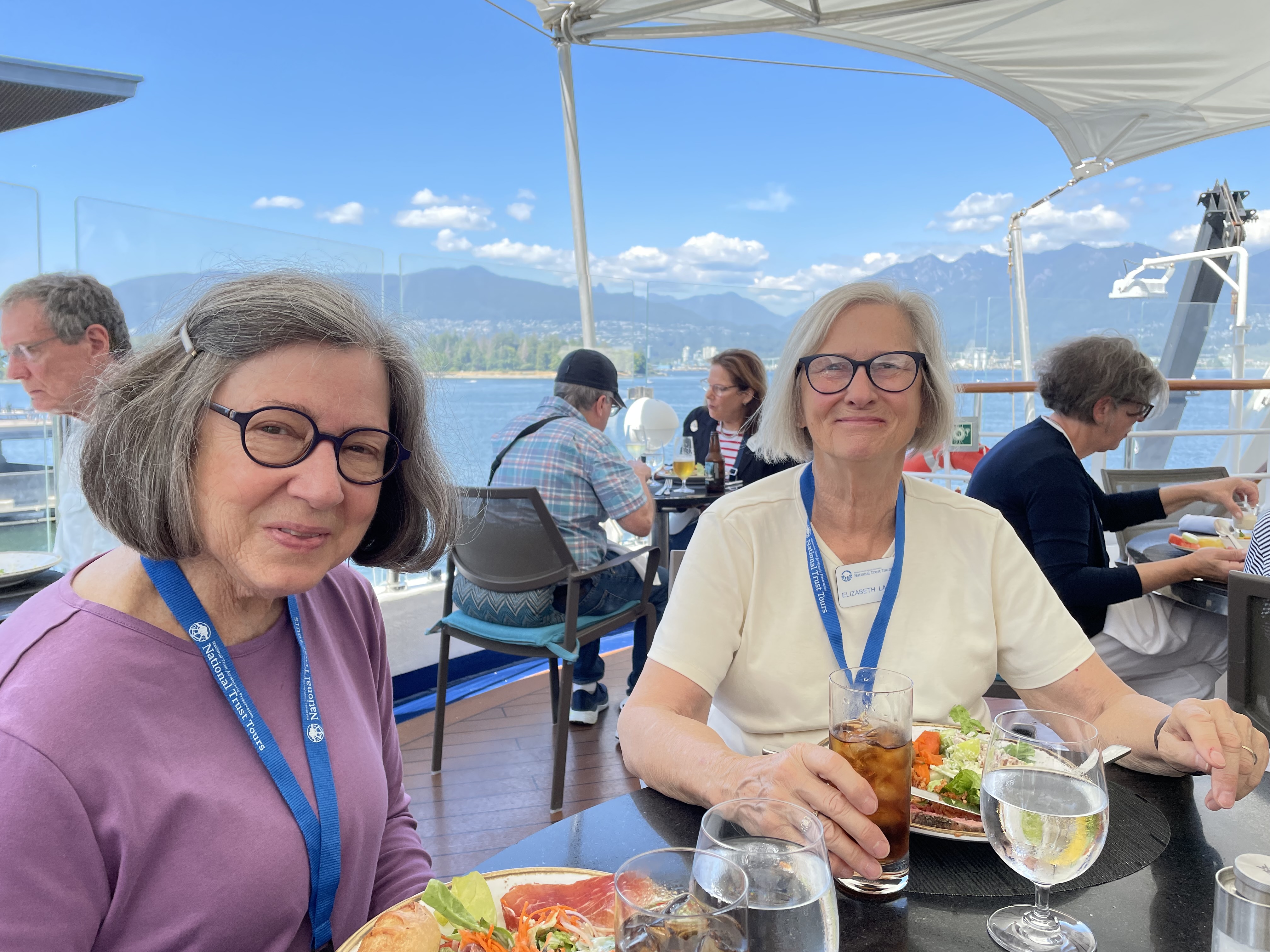
With a group of our National Trust Travelers
Our good friend Bizzy Lane joined us on the Alaska tour. Bizzy and Candice enjoy a lunch as we sail the Inside Passage.
On a Zodiac exploring Dawes Glacier
David during one of his lectures on our Alaska National Trust Tours trip
Visiting the tiny town of Elfin Cove: wintertime population about six on a good day.
At Mendenhall Glacier
We were so fortunate to have clear skies for our visit to Denali. Only 30% of the travelers who come to see North America’s highest peak actually get to see it in all its glory.

Also in July, Claire flew to San Diego to visit Andrew and to see him as Marzio in the Opera Neo production of Mozart’s Mitridate.

July and August were times for David and Candice to get together with friends over a meal. Bill and Sara Overby have recently moved to the DC area from North Carolina, and we’ve enjoyed catching up with them. David and Sara were childhood friends in Murfreesboro, and this summer we introduced them to a Maryland crab feast on our back porch.

Our Staunton friends Margaret and Oakley Pearson stopped by in August during a long east coast trip for a couple of days of rest, good food, and conversation.

Oakley and Margaret Pearson
David sporting his new hat

August and September were months for David to catch some baseball with friends . . . and to travel to Cincinnati to knock another ballpark off his bucket list.

With long-time friend and former colleague John Hildreth at a Nats vs. Brewers game in August. Nats win in a walk-off!
David with “Two-Dollar Tom” Cassidy, a friend, former colleague from work, and follow fan of baseball. Tom tips the staff at the beer stand with two-dollar bills. They are the ones who gave him the nickname.
David and his friend and former colleague Lisa Thompson catch a game together at Cincinnati’s Great American Ballpark.
David outside the ballpark with one of the many pigs in the town once known as Porkopolis.

In mid-August, Andrew traveled to Madison, Wisconsin, to sing in the 2023 Handel Aria Competition. Claire and David had spent a few delightful hours in Madison on a 2014 cross-country trip, so they encouraged a visit to the Chocolate Shoppe Ice Cream Company. You can see Andrew took our advice . . . and perhaps he even found the Serious $&@! — yes, that’s the name of one of their flavors! As I noted in the earlier post, they have a sign up that says, “If you want nutrition, eat carrots!”

Andrew enjoys some ice cream, made with the milk of those Wisconsin cows.

Oh, and he did a fabulous job in the competition, taking second prize.

Winners of the 2023 Handel Aria Competiton: Emily Donatosoprano, first prize; Andrew Bearden Brown (right) tenor, second prize; and Fran Daniel Laucericatenor, third prize (credit: Handel Aria Competiton.)

Claire and Andrew have also been hitting the road this fall to see some stars. Claire was able to catch the year’s most anticipated event: The Eras Tour!

Claire and her Pomona friends at the Eras Tour Taylor Swift Concert in LA
And with the whole crew (including the amazing Vicki Nussbaum on the right)

Andrew came to visit us in Silver Spring in October . . . but only so he could see one of his favorite divas of the moment, Jessie Ware.

Andrew was THIS CLOSE to Jessie Ware during her performance at DC’s Lincoln Theatre.

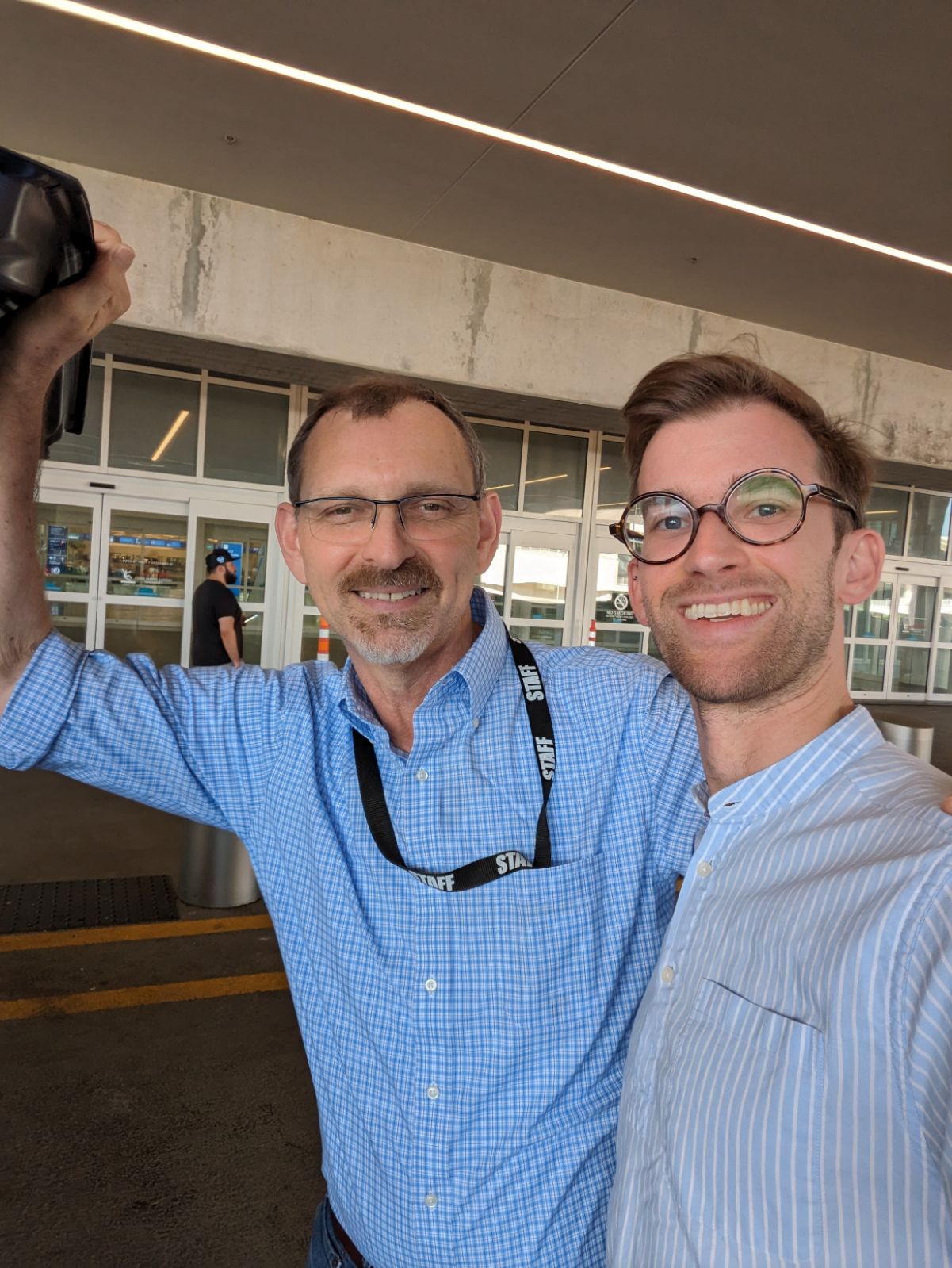
Andrew and Claire also made visits to Florida in 2023 to see their grandmother — Candice’s mom, Irene Colando — who celebrated her 92nd birthday in September. During his visit, Andrew caught up with Mark Duvall, brother of our late sister-in-law Kerry Brown (Joe’s wife). Mark was a former singing colleague of David’s back in his Canticum Novum days.

Mark Duvall and Andrew catch up outside Orlando

Candice and David took a fall trip to Durham to hear Andrew perform as the tenor soloist in the Duke University Chapel’s performance of Handel’s Cantatas BWV 60 and 95.

David outside the Pauli Murray House in Durham. The saving and restoration of the home of this 20th century civil rights, women’s rights, and LGBTQ rights activist, ground-breaking lawyer, and Episcopal priest (and saint) was a project supported by the National Trust when he was the organization’s Chief Preservation Officer.
Andrew sings in the beautiful Duke University Chapel

In 2023, the entire family explored more of this amazing world — a snow-covered mountain in Alaska, Swiss mountain tops, an iconic performance venue in New York City, and so many other places that brought joy and wonder.

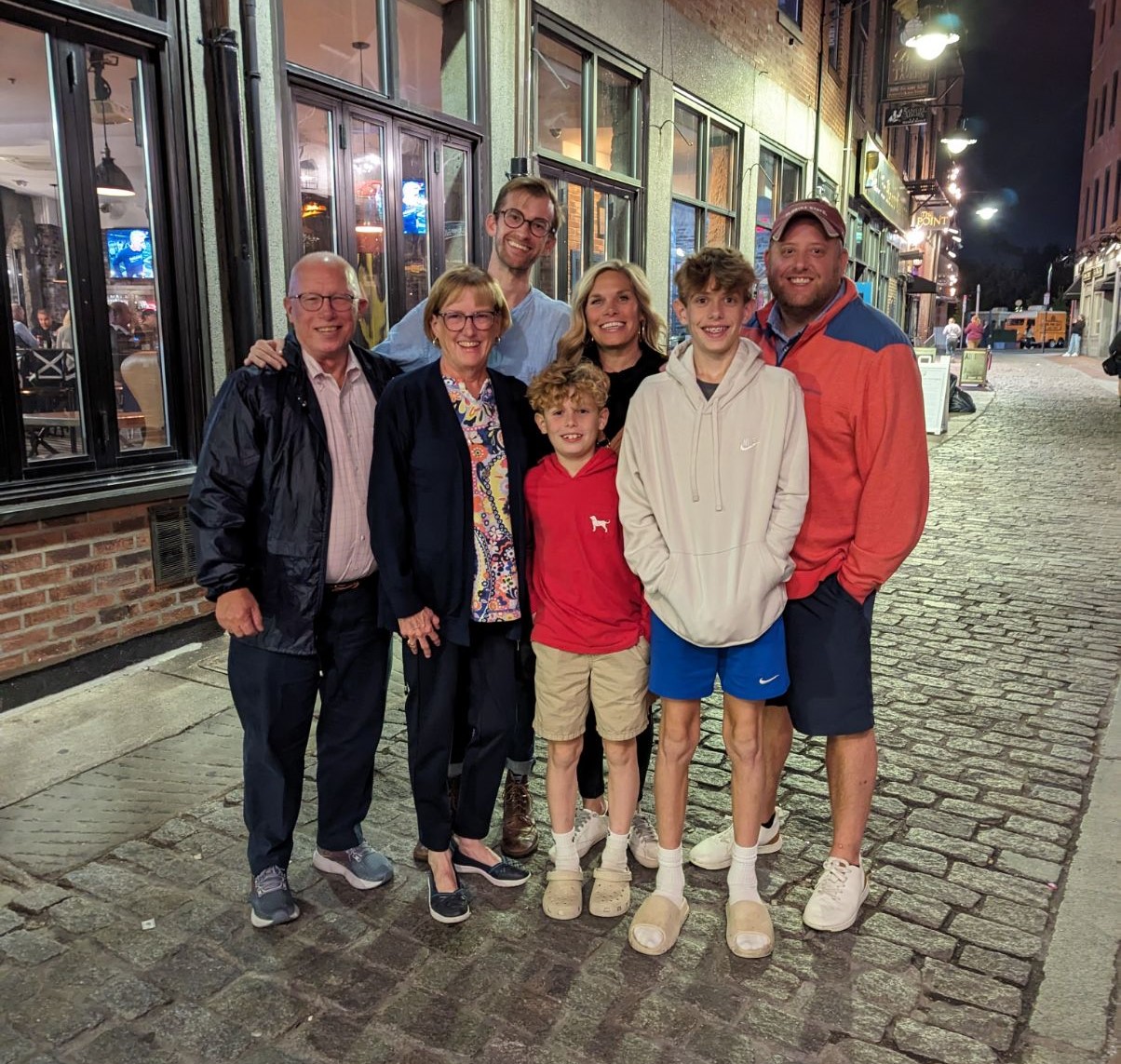
Andrew in Boston with his Aunt Debbie and Uncle Mark, his cousin Rachel Pepper, her husband Brad, and two of their children for a night out on the town

Claire, November 2023
We found time on an April trip to NYC for a stroll through Central Park

We remain grateful for each of you and the friendships we share. Happy Thanksgiving to all!

More to come…

DJB

*For previous year’s posts, click here for:

Bringing old songs into the present

Windborne has been called “The most exciting vocal group in a generation.” Their captivating show, which I saw for the first time last December, “draws on the singers’ deep roots in traditions of vocal harmony, while the absolute uniqueness of their artistic approach brings old songs into the present. Known for the innovation of their arrangements, their harmonies are bold and anything but predictable.”

Credit: Matthew Muise

When I wrote about Windborne last year — singers Lauren BreunigJeremy Carter-GordonLynn Rowan, and Will Rowan from Vermont and Massachusetts — I was just being introduced to their music. Then Candice and I heard them live and I wrote the following as a comment to my original post at the intermission:

We’re at intermission of the Windborne concert and the group is terrific. The program is built around songs of the season and the group brings innovative arrangements even to traditional carols. Here’s hoping their following continues to grow!

Windborne on stage (credit: Windbornesingers.com)

Windborne is returning again this year to the Institute of Musical Traditions concert series and their Music for Midwinter program is set for Thursday, December 14th, at 7:30 p.m. at St. Mark Presbyterian Church in Rockville, Maryland. We have already convinced our friends Sara and Bill to go with us, and I hope more people turn out to hear this terrific group.

Their website describes the group’s newest album:

Their latest project, Of Hard Times & Harmony, explores themes of social consciousness, singing in four languages and showcasing the depth of emotion their voices can evoke, as well as moments of true hilarity and wit 

The group is committed to bringing vocal traditions to a younger audience and over the past year has found surprisingly viral success on TikTok for such unlikely genres as Corsican polyphony or early 20th century labor anthems.

Here are two examples of their work: the short video of E Muntagne d’Orezza sung in Durham Cathedral, followed by their arrangement of the Phil Ochs song When I’m Gone.

In 2018, Windborne was part of a Christmas Celtic Sojourn on PBS. The description from the video describes the evening this way:

One of our Overtures assembled by Seamus Egan and Maeve Gilchrist . . . Windborne sing Personent Hodie (beginning at 1:35), Hannah Rarity is incorporated with the Wexford Carol, and of course spectacular dancing from Liam Harney’s Academy of Irish Dance in Walpole.

In How We Do It, you can get a sense of the playfulness of the group in live performance.

Windborne sings a powerful traditional setting of the Stabat Mater in this video from the village of Nebbiu in southern Corsica. Listen to the bells ringing at the 3:00 mark at the end, as if building is adding an appropriate coda.

As I did in last year’s post, with the approach of winter’s solstice I’ll end with Windborne’s arrangement of John Renbourn’s Traveller’s Prayer.

Praise to the moon, bright queen of the skies, | Jewel of the black night, the light of our eyes, | Brighter than starlight, whiter than snow, | Look down on us in the darkness below.

Enjoy, and catch the group at the IMT concert here in the DC area or at an upcoming performance near your hometown.

More to come . . .

DJB

Windborne Red and Black photo by Michelle Frehsee

The girl with the troubled eyes

In my year of reading dangerously™, I’ve become immersed in the world of crime stories. For the 11th in this series, I returned to where I began: with the best-selling novelist of all time.

The Murder on the Links (1923) by Agatha Christie begins with the famous Belgian detective Hercule Poirot rushing off to northern France. He has received an urgent request from a client, Paul Renauld, who fears his life may be in danger. Unfortunately, by the time Poirot arrives the local police have found Renauld stabbed to death, lying in a shallow grave on a golf course, wearing only an overcoat and his underwear. His wife, Eloise Renauld, claims masked men broke into the villa, tied her up, and took her husband away with them. This is a curious turn of events, made even stranger when a short while later another well-dressed man is found on the estate murdered in an identical way.

A mother and daughter — the younger being a “girl with troubled eyes” — live next door, and Poirot’s investigations uncover the fact that the mother has received several large payments into her bank account from Renauld in recent months. Strange as it all seems, Poirot cannot shake the thought that he’s heard of a similar crime before. As he works to unravel the mystery, he also has to contend with Monsieur Giraud of the Paris Sûreté. The “famous Giraud” — at least in his own mind — leads the police investigation and resents Poirot’s involvement.

As is true with many of Christie’s novels, characters in The Murder on the Links are not always who they seem to be. In the midst of the investigation, Poirot takes a quick visit home to London to answer the question about his nagging suspicion that he’s seen this before. There he finds his answer, although it takes some trickery by Eloise Renauld to uncover the identity of the real murderer.

The story is narrated by Captain Arthur Hastings, Poirot’s assistant. Hastings is quick to jump to conclusions, which gives Poirot many opportunities for teaching moments with his young protege. The book also has an interesting subplot, in that Hastings falls in love, apparently a development “greatly desired on Agatha’s part . . . parceling off Hastings to wedded bliss in the Argentine.”

During this year of reading crime novels, I’ve also taken to watching the British television adaptation of the Poirot stories: Agatha Christie’s Poirot. After finishing this book, I went back to rewatch The Murder on the Links episode to get a sense for how much changed in the adaptation. While the basic plot of the novel was retained, the setting in France was different and a number of characters were either dropped or had their stories revised. The television version tidies it all up, while Christie’s original made for a more complex story where not all of those in on the murder plot receive their justice. Christie has created just the right mixture of intrigue to allow Hercule Poirot to “put together the strange pieces of a puzzle that stretched halfway around the globe and into the most secret and sinister places of the human mind.”

More to come . . .

DJB


To see reviews of the other books in my year of reading dangerously (i.e., mystery novels and true-life crime stories), click here for 


The Weekly Reader links to the works of other writers I’ve enjoyed. I hope you find something that makes you laugh, think, or cry. 


Photo of French golf course by Vikor Kiryanov on Unsplash.

A gospel of grit

On a recent visit, my dermatologist pointed to a few spots she needed to freeze before those “confused cells” had the opportunity to grow into something harmful. Then she pointed to other spots on my body and said these were simply “the barnacles of life.”*

I told her I was going to steal that line!

My doctor’s comment came back as I was thinking about the things that happen along life’s highways. We experience ecstatic joy and shocking tragedies. We face times where we are confused and uncertain. We are dealt hands by fate. We also accumulate barnacles.

Are there secrets to navigating life to help us understand what matters and what are just barnacles? Can those secrets help us live longer?

Well, yes and no.

The secret to living a long life? Pure luck. If our genes and the fates all align we may be one of those who outlives the average human. Or we may work at our diet and exercise but then be hit by an inattentive driver the next time we cross a street.

But . . . the secret to living a happy and useful life is entirely within our control. How we respond is important. That’s the core of response-ability: the ability to respond.

And that’s the message of a new book about the life of Dr. Charles White.

The Book of Charlie: Wisdom from the Remarkable American Life of a 109-year-old Man (2023) by David Von Drehle is the story of Charlie White, a man born before radio who lived to use a smartphone. Upon moving to Kansas City, Von Drehle meets White — at the time his 102-year-old neighbor — and strikes up a friendship. Over seven years he learns that Charlie lost his father at an early age, the victim of a freak accident. But it was in his response to that tragedy that Charlie learned how to live. This parable of persistence and durability points the way toward a happy and useful life.

Charlie’s life is remarkable in part because of all the changes and upheaval of the 20th century. Charlie worked to help his single mother, yet he kept up with his studies. At the age of seventeen he graduated from high school and leaves with two friends for an audacious cross-country adventure, traveling first in a Model T Ford then by hopping freight trains.

This first adventure wasn’t Charlie’s last, for he had a remarkable ability to learn and grow. He taught himself to play the saxophone, swinging with the sounds of the Jazz Age while saving money for medical school. When his application to Northwestern was turned down, he hopped a train to Evanston to meet — unannounced — with the dean and talked his way in. Charlie learned medicine at a time when it was primarily a profession for helping ease nature’s cures or the suffering of the dying. That training found him racing aboard ambulances through Depression-era gangster wars and later — after a stint as a military doctor in World War II changed his practice —improvising techniques for early open-heart surgery.

Throughout this story, Von Drehle returns to make the point that Charlie chose how to respond. “Do the right thing” Charlie explained to an interviewer late in life. Whatever the challenge “this will pass, and you’ve got to work through it, and hold the line. There’s no future in negativism.”

A single sheet of notepaper found among Charlie’s belongings shows that the interviewer’s question had stayed with him. Charlie “sat with the notepad and distilled his philosophy of life.” And he began boldly.

Think freely.

Practice patience.

Smile often.

Make and keep friends.

Tell loved ones how you feel.

Forgive and seek forgiveness.

Observe miracles.

Make them happen.

The page was filled “as though the operating system of a happy and productive life could be written in thirty or forty lines of code.”

Cry when you need to.

Make some mistakes.

Learn from them.

Voh Drehle sees the life well lived as consisting of two parts. First, we take the simple world of childhood and discover its complications. But what Charlie had discovered and was outlining on this piece of notepaper is that “if we live long enough, we might soften into the second stage, and become simplifiers.”

What we face might be complicated, but what we do about it is simple . . . Charlie lived so long that the veil of complexity fell away entirely and he saw that life is not so hard as we tend to make it.

The essentials are familiar, Von Drehle suggests, “not because they are trite, but because they are true.”

Work hard.

Spread joy.

Take a chance.

Enjoy wonder.

This lovely little book is not perfect. Charlie’s life was remarkable, but he faced it from a place of privilege as a white male in 20th century America. There are few people of color in Charlie’s world — or at least the part that Von Drehle shares with us. It is too narrow to be, as a jacket blurb suggests, a serious history of the last 100 years.

Also, on several occasions Charlie works as a scab — or union buster — on the railroads. Von Drehle wrote a book about the Triangle Shirtwaist Fire, so he understands better than most the dangers of corporate greed built on the broken bodies of exploited workers. Yet he apparently never asks Charlie why he made the choice to cross the picket lines of workers trying to make a living in a notoriously anti-union industry. It is an odd omission.

Finally, on the day that Von Drehle meets his new 102-year-old neighbor, Charlie is washing his girlfriend’s car, the car that had sat in the driveway overnight. “The Saturday night date with the glamorous driver,” Von Drehle deduces, “had developed into the sort of sleepover that makes a man feel like being especially nice the next morning.” Von Drehle repeatedly returns to this introduction. I don’t mind the story, but its repetitiveness suggests a bothersome mindset — macho, western, conservative-individualism — that doesn’t strengthen the book.

Notwithstanding these issues, grace notes abound in The Book of Charlie. It is a worthwhile read.

More to come . . .

DJB

*Skin barnacles, medically known as “seborrheic keratoses” are harmless, noncancerous growths that usually appear during adulthood.

Remembrance for D-Day

November 11th

November 11th is celebrated as Veterans Day in the U.S., but it used to be called Armistice Day. On this day in 1918, the major fighting of World War I ended. It was when, Kurt Vonnegut has written, “millions upon millions of human beings stopped butchering one another.”

On Veterans Day we honor those who have served and continue to serve in our armed forces. In my immediate family that includes my father, a World War II Navy veteran; my brother Joe, who served in the Navy on a helicopter carrier during the 1980s; as well as a number of aunts and uncles who also served in World War II. I am proud of each of them for their service.

While we did not lose a family member in military service, many families have lost loved ones fighting for our nation. No words can fill the void that’s been left.  As President Obama said to family members in a Veterans Day tribute in 2009, “We knew these men and women as soldiers and caregivers.  You knew them as mothers and fathers; sons and daughters; sisters and brothers.”

But here is what you must also know:  Your loved ones endure through the life of our nation. Their memory will be honored in the places they lived and by the people they touched. Their life’s work is our security, and the freedom that we all too often take for granted. Every evening that the sun sets on a tranquil town; every dawn that a flag is unfurled; every moment that an American enjoys life, liberty and the pursuit of happiness — that is their legacy.

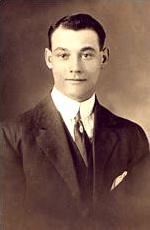
George Lawrence Price

Veterans Day is not a time to glorify war or military might, especially as the world is involved in so much conflict. It is a good time to recall the pointless slaughter of so much war. And it is a good day to reclaim the remembrance that the reason for war is peace. Holy peace. In 1938, Congress made November 11 a legal holiday to be dedicated to world peace.  Armistice Day was sacred, and that should not be forgotten.

On this day in 2021, Heather Cox Richardson remembered George Lawrence Price, a private serving with Company A of the 28th Battalion of the Canadian Expeditionary Force in Belgium during World War I.

As the moment of the armistice approached, a few soldiers continued to skirmish, and Price’s company set out to take control of the small town of Havre. As they crossed a canal to their target, a German gunner hidden in a row of houses tried to stop them. Once safely across, just ten minutes before the armistice, the Canadian patrol began to look for the German soldier who had harassed them. They found no one but civilians in the first two homes they searched. And then, as they stepped back into the street, a single shot hit Price in the chest. He fell into the arms of his comrade, who pulled him back into the house they had just left. As Price died, German soldiers cleared their guns in a last burst of machine-gun fire that greeted the armistice.

Price’s life ended just two minutes before the Great War was over.

Even at the time, Price’s death seemed to symbolize the pointless slaughter of WWI. When an irony of history put Price in the same cemetery as the first Allied soldier to die in the conflict, disgusted observers commented that the war had apparently been fought over a half-mile of land. In the years after the war ended, much was made of George Price, the last soldier to die in the Great War.

But Richardson also wanted us to remember the man who pulled the trigger, who decided — knowing that peace was only two minutes away — to take another life and deny him a future. It was legal. It was also surely, she writes, immoral.

He went back to civilian life and blended into postwar society, although the publicity given to Price’s death meant that he must have known he was the one who had taken that last, famous life in the international conflagration. The shooter never acknowledged what he had done, or why.

Price became for the world a heartbreaking symbol of hatred’s sheer waste. But the shooter? He simply faded into anonymity, becoming the evil that men do.

Political theorist Hannah Arendt coined the phrase “the banality of evil” after watching the 1961 trial of Nazi SS officer Adolf Eichmann. “Good can be radical; evil can never be radical, it can only be extreme, for it possesses neither depth nor any demonic dimension yet — and this is its horror — it can spread like a fungus over the surface of the earth and lay waste the entire world. Evil comes from a failure to think.”


Kurt Vonnegut famously wrote of Armistice Day in the preface to Breakfast of Champions.

I will come to a time in my backwards trip when November eleventh, accidentally my birthday, was a sacred day called Armistice Day. When I was a boy, and when Dwayne Hoover was a boy, all the people of all the nations which had fought in the First World War were silent during the eleventh minute of the eleventh hour of Armistice Day, which was the eleventh day of the eleventh month.

It was during that minute in nineteen hundred and eighteen, that millions upon millions of human beings stopped butchering one another. I have talked to old men who were on battlefields during that minute. They have told me in one way or another that the sudden silence was the Voice of God. So we still have among us some men who can remember when God spoke clearly to mankind.

Rest in peace, George Lawrence Price, and all the men and women who have sacrificed their lives for good over evil. And let’s do all we can to remember the message God gave to mankind, a message that was never clearer than on this day.

More to come . . .

DJB

Image: Remembrances for D-Day 2019 in the British village of Chipping Campden (photo by DJB)

Simple but not easy

A Book of Questions is a song on the new album A Great Wild Mercy by Carrie Newcomer. It is also the title of a recent posting on her A Gathering of Spirits Substack newsletter.

Carrie Newcomer

It was an early paragraph in that newsletter that really caught my attention:

I’ve often said that I don’t write songs because I have an answer, I write songs because I’m writing myself into my next becoming. I’m writing because I have a question.

I love the idea of using questions to “write myself into my next becoming.” Then I looked at the lyrics as she sang the song and thought of how several of her questions could prompt serious reflection — and perhaps writings that lead to a next becoming — for me.

Do you put honey in your tea? | Do you let it cool gradually? | Do you feel the strange wash of time and memory? | Have you made peace with your worst day, | Ever kissed in a busy café? | Are there things you feel, but you still don’t know how to say?

In fact, Newcomer speaks to the power of questions in her post.

An open-hearted question is a beautiful way to get to know another person. When I’m at a gathering and meeting new people I often like to ask opening questions that go beyond the usual “what do you do”. I often ask questions like “what gave you life this year” or “What were you grateful for this week”. People will sometimes look at me like I have seven heads, but then they will launch into the most wonderful stories. I always feel grateful for the story and feel I got to know the person much better than if I had asked the usual fare.

Some questions are simple but personal . . . But other questions ask for a deeper, even more vulnerable response, “Did you make peace with your worst day” “Did you ever love a place, that you still had to leave”.

Questions, it seems, prompt a number of artists, including the poet Mary Oliver.

Some Questions You Might Ask

Is the soul solid, like iron?
Or is it tender and breakable, like
the wings of a moth in the beak of an owl?
Who has it, and who doesn’t?
I keep looking around me.
The face of the moose is as sad
as the face of Jesus.
The swan opens her white wings slowly.
In the fall, the black bear carries leaves into the darkness.
One question leads to another.
Does it have a shape? Like an iceberg?
Like the eye of a hummingbird?
Does it have one lung, like the snake and the scallop?
Why should I have it, and not the anteater
who loves her children?
Why should I have it, and not the camel?
Come to think of it, what about maple trees?
What about the blue iris?
What about all the little stones, sitting alone in the moonlight?
What about roses, and lemons, and their shining leaves?
What about the grass?


A Gathering of Spirits arrived in my email inbox around the same time that I received a recent sermon from my friend and mentor Frank Wade.

Frank begins with the passage from Matthew 22 where the Pharisees were trying to trip Jesus up by asking a trick question: Was it lawful to pay taxes to Caesar?

Everybody hated the Roman occupation and resented paying taxes to support it. If you were for it, the people resented you. If you were against it, the Romans saw you as a rebel.  It was a trap.  Jesus held up a coin and said, “Give to the Emperor the things that are the emperor’s, and to God the things that are God’s.” That was really clever, the kind of response I usually think of an hour after a conversation is over. 

Tax codes and accountants tell us what things are due the government. Frank asks, “But what are God’s things? What does God require of us?”

Scripture practically boils over with responses to that question. They all point in the same direction, but one of my favorites is from the prophet Micah who gave his answer about 700 years before Jesus’ time. Micah scoffed at our pretending not to know what God expects of us.  You know, he says, what the Lord requires of you.  What is it but to do justice and love mercy and walk humbly with your God?

But what exactly does that mean? Frank makes it personal and relatable.

When we read or speak about justice and mercy we are usually talking about societal issues. Social justice on a large scale. Merciful responses to world events and continuous crises. Those things definitely are part of what Micah is talking about.  But justice and mercy have a micro reality, as well.  Justice is about fairness. Mercy is about generosity. The world needs those things and so do our families. Listening to one another without judgment is an act of fairness.  Admitting our own faults and errors is fairness. Doing one’s part to make the household function is fairness. They are justice issues on the family level. Generosity can determine how we spend time with those we love, how we encourage one another, and how we let the people closest to us know they are special to us. Justice and mercy, fairness and generosity, are part of God’s expectation for the world at large and for the world at hand.

. . . we are to give to God the things that are God’s — justice and mercy, fairness and generosity, extended to the far reaches of our world and to our closest companions.  

As Frank says, this is “simple but not easy.”

And the questions Carrie Newcomer asks us to consider are sometimes simple but may not be so easy to face.

Did you say yes, did you say no? | Was it true or just wasn’t so? | Did it land hard or gracefully, | Was it not what you planned, | But right where you needed to be?

Are there questions you need to consider, leading you to your next becoming?

More to come . . .

DJB

Photo by David Wirzba on Unsplash.

From the bookshelf: October 2023

Each month my goal is to read a minimum of five books on a variety of topics and from different genres. Here are the books I read in October 2023. If you click on the title, you’ll go to the longer post on More to Come. Enjoy.


Why We Love Baseball: A History in 50 Moments (2023) by Joe Posnanski may not be the most important book you’ll read this year, but if you care at all about the game this will be the book you’ll cherish. This is a love letter of the best kind, bringing together the long history of the game with the uniqueness of the moment, all told with Posnanski’s “trademark wit, encyclopedic knowledge, and acute observations.” These forever moments are magical: “beautiful or delightful in such a way as to seem removed from everyday life.” Unlike basketball and football, baseball is a game of perspective. It moves at a leisurely pace. Players, umpires, and fans have time to talk, get to know each other, and tell stories. Nobody tells a better baseball story than Joe Posnanski.


Your City is Sick (2023) by Jeff Siegler is a deep dive into how the various causes of community malaise — poor planning decisions, neglect, disregard for current residents, and more — have led to the dysfunction we see today. Cities are like people, Siegler argues, and when humans forget all we’ve learned about health care, skip the vegetables that sustain us, eat a diet of attractive desserts, and stop exercising we get sick. Cities face the same challenges. But like a blunt yet perceptive doctor, Siegler first helps us understand the disease and then — in straightforward, no-holds-barred language — he prescribes treatments to push his readers to transform their cities through relentless, incremental improvements.


How to Resist Amazon and Why (2022) by Danny Caine makes the case for resisting what at times seems to be the takeover of the world by this corporate behemoth. Caine — who co-owns the Raven Book Store in Lawrence, Kansas — has provided a wealth of strongly sourced information about how “big tech monopolies, especially Amazon, are bad for communities, small businesses, the planet, consumers, and workers.” In seven detailed chapters, Caine gives example after example of Amazon’s devastating impact on the book industry, small business in general, the labor force and workers’ rights, competition, privacy, the environment, and every level of government. He then explores ten things you can do to resist Amazon. The loss of personal connections and community-oriented support is at the heart of Amazon’s destruction of America, but there are ways you can fight back.


The Young Man (2022) by Annie Ernaux (translated by Alison L. Strayer) is the account of her love affair with A., a man some 30 years younger, when she was in her fifties. This is not a salacious memoir; rather, Ernaux uses the backdrop of this brief romance to explore themes of the movement back and forth between youth and age, of memory and time, of misogyny and class, of life’s pitfalls and pleasures. Though trim and stark, The Young Man — in the hands the 2022 winner of the Nobel Prize for Literature — turns into an unexpected study of life.


Killers of the Flower Moon: The Osage Murders and the Birth of the FBI (2017) by David Grann is a well-known and highly praised work, a finalist for the 2017 National Book Awards for Nonfiction. In the 1920s, the richest people per capita in the world were members of the Osage Indian nation in Oklahoma, whose land sat above some of the largest oil deposits in the United States. “To obtain that oil, prospectors had to pay the Osage for leases and royalties . . . In 1923 alone, the tribe took in more than $30 million, the equivalent today of more than $400 million.” And in 1921, one of the Osage, Anna Brown, was brutally murdered. Grann’s story begins with that killing and in a tightly woven tale he takes the reader through an evil crime spree arising from white settlers’ attempted dispossession of an Osage family’s Oklahoma lands, exposing once again the dark and odious underbelly of race in America.


What’s on the nightstand for November (subject to change at the whims of the reader):

Keep reading!

More to come…

DJB


NOTE: Click to see the books I read in September of 2023 and to see the books I read in 2022. Also check out Ten tips for reading five books a month.


This special Friday edition of the Weekly Reader links to the works of other writers I’ve enjoyed. I hope you find something that makes you laugh, think, or cry. 


Photograph of the Carnegie Library in Stillwater, MN, from the Carol M. Highsmith Archive, Library of Congress, Prints and Photographs Division.