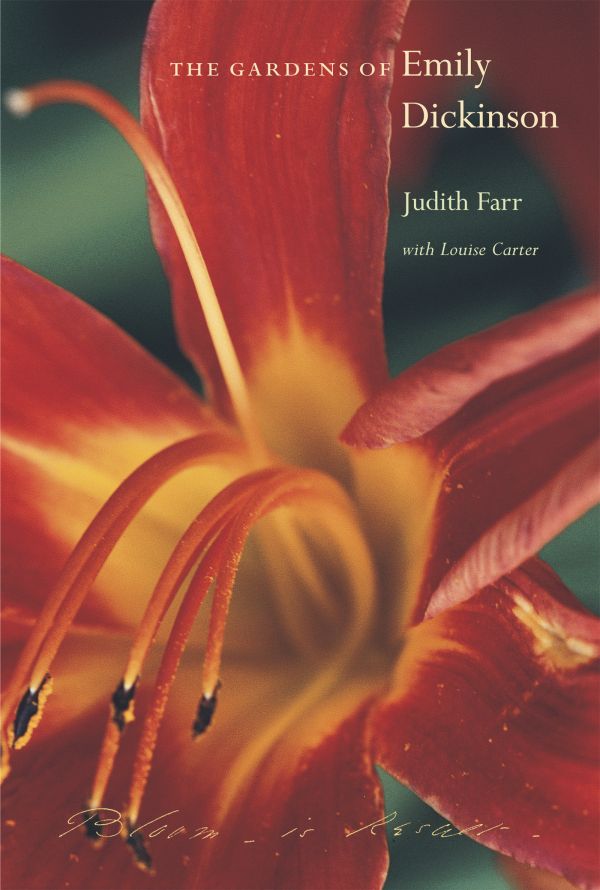
Judith Farr’s intimate study of Emily Dickinson as poet and gardener is a delight for scholars, admirers of Dickinson’s poetry, and garden lovers everywhere.
When Emily Dickinson died in 1886 at the age of 55, some of those who attended her funeral knew she had been a poet. All of them knew she had been a gardener. Her sister-in-law listed “love of flowers” as Emily’s first attribute in an unfulfilled plan for a memoir. During her lifetime her almost two thousand poems were privately published, often enclosed in letters pinned together by flowers or in bouquets that concealed the poem at the flowers’ center.
Emily Dickinson declared that “the only Commandment [she] ever obeyed was ‘Consider the lilies.'”
“Her witty allusion was to that passage in Matthew 6: 28-29 wherein a vehement Christ eloquently scorns worldliness and urges men and women to trust in God for material sustenance . . . Dickinson’s fondness for lilies was intense, and her adherence to this passage was probably won not by its promise of divine support but by its choice of botanical image.”
The fact that the lilies “neither toiled nor spun” was also endearing to the prolific nineteenth century poet whose original and enigmatic verses are now considered canonical. While she shared the household work, Dickinson “preferred the more aesthetic to the grosser task.” In a letter where she mentions that the house is being cleaned, the poet confides that “I prefer pestilence. That is more classic and less fell.”
It was at another funeral—this one in 2021—that I began to truly appreciate the depth of scholarship into Dickinson’s life and literary canon by the author, teacher, and poet Judith Farr. Admiration for the insights provided by her lifelong work and passion was clearly evident in the service’s eulogies and remembrances. The realization set me on a path to build what has become a life-enriching friendship with Judith’s beloved husband George and to return to a poet I had not considered in any seriousness since my high school English class.
It is yet another example of the incredible amount those who are flexible in mind and spirit can learn “between our birthday and our last day.” I asked George if he had one of Judith’s books I could read, and with his typical generosity he gifted me three. Since it was springtime, I quickly chose the one with a brilliant cover reminding me of the flowers that I was seeing on my daily walks.
The Gardens of Emily Dickinson (2004) by Judith Farr joins “both poet and gardener in one creative personality.” Dickinson’s passion for gardening was intrinsic “both to her personality and to a much larger movement in American culture,” especially in nineteenth century literature and painting. In this deftly written and beautifully illustrated work, Farr takes the reader into the various “gardens” of Dickinson’s life: the wildflowers in the nearby woods, the blossoms from the cultivated plot at her father’s home, the exotic species from the conservatory that allowed her year round pleasure, and finally the gardens in her mind which served as “a summary synonym of life itself.” Dickinson said that her garden was her church. It was the place where she came to believe in eternal life and to “hazard belief” in the existence of God.
The poet called her poems “Blossoms of the Brain” and she regularly associated various flowers with friends, family, and lovers. Although Dickinson was famously reclusive—known in her time as the “Myth of Amherst”—she was also surprisingly sensual. Farr shows through various poems and letters that sexuality as a theme is frequently represented by the “sweet” intercourse between the bee and flower. A garden—especially in summer—is abloom with sexuality. Dickinson was a poet of the country as well as the mind and “she contemplated the sexual area of her garden daily” through the “careers” of the flowers and “the bee as their lover/propagator.” Farr also discusses Dickinson’s own loves, although that’s not the main focus of this work.
A thoughtful epilogue ties the book together as Judith examines “the gardener in her seasons.” In the nineteenth century she writes that these periods of the year classically describe the development of human life as well as nature’s. Winter is a time of replenishment of mind, soul, and soil. Spring reawakens the gardens she has tended, but she does worry in some poems that it might someday fail to arrive. “Her garden in spring made God manifest to her.”
“In one of Dickinson’s most pictorial poems about summer, she describes ‘a Butterfly / As Lady from her Door’ emerging from a cocoon to carry itself like a colorful parasol above a hay field until sundown.”
Summer is different from the other seasons for Dickinson, in that it can mean “sensuous fulfillment, a release from the stern requirements of reason and analysis.”
“And yet it was not for summer’s ‘Consummated Bloom’ but for ‘the happy Sorrow of Autumn’ that Dickinson reserved her most wistful yet impassioned descriptions. . . It was perhaps the season most fascinating to her as a person and as an American artist.”
Farr concludes this loving and insightful book by noting that in medieval symbology, the garden was a metaphor of the soul. So it was for Emily Dickinson. In writing of the seasons, Dickinson “demonstrated both the complexity of her mind and its unique temper.” Her gardening—like writing poetry—was “the manifestation of profound and even occasionally rebellious desire.” As Susan Salter Reynolds wrote in a review in the Los Angeles Times, “So intertwined are Dickinson’s verses with her life in flowers that they seem to be the lens through which she saw the world.”
Judith Farr, with impressive scholarship but even greater love and affection, opens this world to those of us fortunate enough to discover this timeless work.
An interview with historian John Garrison Marks on understanding George Washington’s legacy of slavery.
When the hand-written will of the most famous person in America became public it was big news. Already mourning the loss of the one person many thought indispensable to the success of the new country, Americans quickly discovered that George Washington’s will freed the people he enslaved. As one of the largest slave holders in the new republic that decision had enormous consequences.
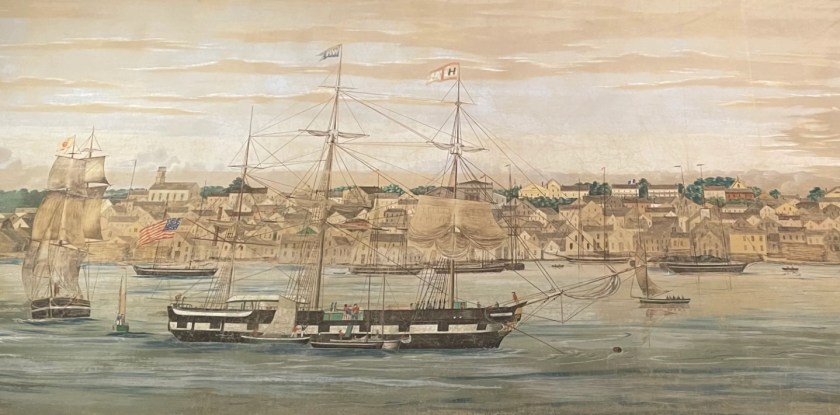
Set in the context of a country that had already begun shaping an emerging mythology about his life and significance, Washington’s will forced decisions about what to remember and what to forget that have lasted to our present day. After Maj. Gen. Henry Lee famously declared that he would forever be “first in war, first in peace, and first in the hearts of his countrymen,” how does one seriously grapple with a legacy of slavery?
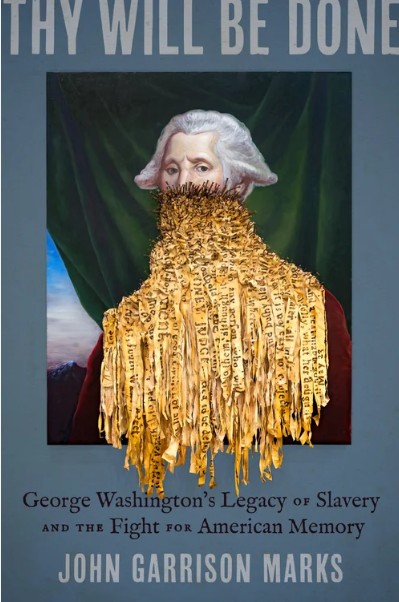
Thy Will Be Done: George Washington’s Legacy of Slavery and the Fight for American Memory (2026) by John Garrison Marks takes a deep and insightful look into how we as a country have wrestled with Washington’s conflicted status as one of the nation’s most prolific enslavers and the architect of one of its largest private emancipations. It is a debate that began days after his death in 1799 and continues to 2026. In the first two decades following his passing the American public created a myth of an infallible father and erased slavery’s centrality to Washington’s life. Marks takes us into the time leading up to the Civil War as the fight over slavery intensified, each side shaping Washington’s legacy to fit their broader worldview. Those individuals freed by Washington also grappled with their freedom in a country where slavery was still legal and growing.
The 1932 Washington Bicentennial—celebrated during an era of rapid and often unsettling change—was another milestone that brought the issue to a head. White and Black Americans engaged in this conversation from entirely different perspectives. Marks brings this thoughtful and revelatory work to a close by studying the way Washington and slavery were taught in the American classrooms of the 20th century and how the stewards of his home at Mount Vernon have moved, albeit slowly, to an effort to tell the story of slavery to the millions who are still called to visit this landmark of American history. In his conclusion, Marks writes that “commentary about Washington and slavery—denouncing his slave owning, praising his emancipation, or silencing the issue altogether—is always about much more” than a simple debate or conversation.
John Garrison Marks has given the nation an important gift on our 250th anniversary. He urges us to use this as an opportunity to ask “different questions” about Washington’s legacy and, more importantly, “to engage in deeper, more meaningful conversations about history, memory, and the values we wish to carry forward.” In doing so, we might come to understand what historian Edward L. Ayers calls the “messy complexity of our past.” And we may, as Marks asserts, “come to better understand ourselves.”
John graciously agreed to chat with me about Thy Will Be Done, his most recent book.
DJB: George Washington, as you make clear, was one of the nation’s most prolific enslavers and the architect of one of its largest private emancipations. What are the key elements that made―and continue to make―George Washington’s legacy of slavery such a contentious topic for Americans?
JGM: More than any other historical figure, Americans have always struggled to see George Washington as a human being. Instead, people have always lifted him up as something more, often treating him as a symbol of the nation itself. Because so many people have attached this symbolic importance to Washington, Americans have often used him over the past two and a half centuries to make broader points about the nature of American society, both for good and for ill. Washington’s enslavement of other people is always brought to bear on those conversations. For those who want to deny our history of slavery or the effect of racial oppression on contemporary injustices, writing slavery out of Washington’s history—and thus the nation’s—is essential. For others who want to emphasize the central nature of racism in American society, Washington’s involvement with slavery serves as a convenient way to highlight it. But among those for whom “American” is an important part of their identities, criticizing Washington’s slaveholding feels like criticizing America itself, and thus feels like it’s critizing themspecifically. His symbolic power is also the reason it has long been a contentious subject.
Your chapter on Washington’s will is fascinating. We find out, for instance, that Americans wanted not only to read his will but to own a copy. Yet commentators from the period rarely mentioned slavery or emancipation. How do you interpret Washington’s intentions in drafting a will that freed his slaves (but not those owned by his wife), and how did whatever hope he had for a broader emancipation play out in real life in early 19th century America?
When Washington wrote his will, I think he clearly understood it would be read far beyond just the local courthouse. He didn’t begin the will stating he was a “resident of Fairfax County.” Instead, he began “I, George Washington, citizen of the United States.” Also, after decades of declining to speak publicly on the issue of slavery, the directions for how enslaved people should be dealt with constitutes the longest and most detailed portion of his will. It seems naive now, but I think Washington may have genuinely thought this example could influence others to do the same.
But that’s not what happened. When Washington died, many Americans worried it would doom the entire American project not long after it began. Recognizing that slavery was already a lightning rod in American politics, most white Americans declined to call much attention to the emancipation provisions of his will. By the 1820s and 1830s, the reticence and concern among revolutionary-era enslavers had mostly disappeared, and white southerners began justifying slavery as a “positive good,” both for American society and for enslaved people themselves.
What did you discover as you sought to determine what happened to each of the 123 formerly enslaved individuals Washington freed through his will?
First, I discovered how difficult it is to track these people in historical records. While there is basically a never-ending amount of information on Washington himself, finding information about specific people he enslaved and then emancipated required piecing together scraps from various sources—census lists, freedom registrations, tax records—to try to put together some kind of meaningful picture.
More to the point though, this research revealed both how challenging life was for many of these individuals, especially the decision to remain at Mount Vernon in the only life many of them had ever known, or to strike out on their own in a society still very much committed to slavery. Many of those who left founded churches, found work, built community, and crafted lives for themselves in freedom profound enough that evidence of it was still available for me to find two centuries later. Often, the lives in freedom established by this first generation allowed them to pass on the benefits of freedom to their children, who continued to build stable, meaningful lives.
While the historical interpretations at Mount Vernon began formally acknowledging slavery as early as the 1920s, why do you believe the stewards of Washington’s home took so long to fully explore the centrality of slavery in Washington’s life, and what led to that change? From your perspective, what work remains to be done?
Like most Americans, Mount Vernon has, historically, struggled to balance the desire to lift up Washington as an inspiring symbol and to reveal him for visitors with all of his faults. Trying to figure out whether we can have both at the same time has been a challenge for Americans for a very long time, and Mount Vernon has not been immune to those tensions. Several forces have moved Mount Vernon to address Washington’s history of slavery more forthrightly. Their own historical and archaeological research, along with that of decades of recent scholarship, has allowed them to tell the story with greater accuracy and specificity than was possible in earlier eras. The public also began expressing an expectation of a fuller story of history at historic sites generally and Mount Vernon specifically, which created more space for them to tell the story there. Perhaps most importantly, Mount Vernon has worked closely with descendants of those once enslaved at Mount Vernon, who have pushed the site to continue to do more.
The subtitle of the book speaks to the “fight for American memory.” Why is memory so important to the study of the past and what key points about how Americans approach, remember, and relate to history would you like for readers to take away from your work?
There’s often a wide gulf between how we remember things and what a closer inspection of the evidence reveals. This is particularly true for George Washington, a person to whom so many people feel such a deep connection. I hope the book helps people recognize that today’s debates about our history and how it should be presented have been a subject of contention for nearly our entire history as a nation. As people try to emphasize particular views in whatever cultural and political context they’re operating in, they often call history into the fray to make their points. But most of the time, history is messy, complicated, and ambiguous. It rarely offers clear answers. So I hope the book can help people grow more comfortable with ambiguity, more comfortable with the gaps between history and memory, and better able to engage in thoughtful conversation about difficult topics.
Thank you, John.
Thanks for the invitation.
More to come . . .
DJB
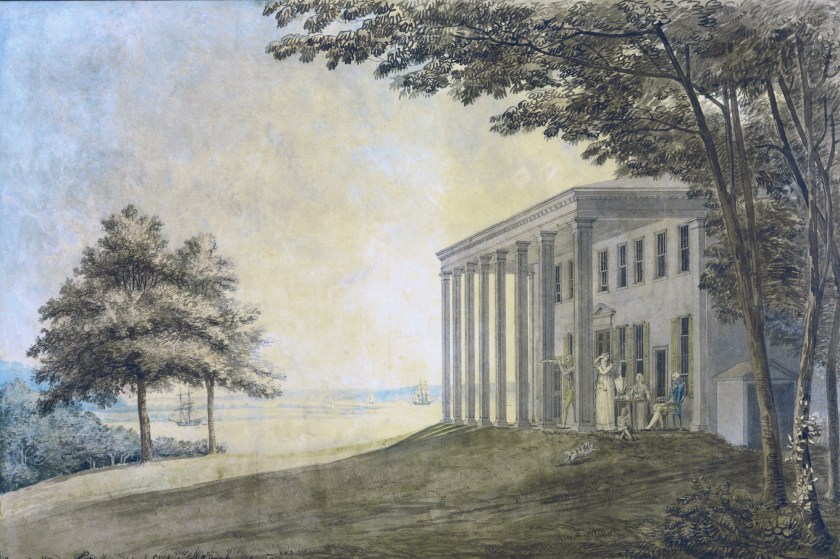
Top image: Mount Vernon with the Washington family on the terrace, a 1796 portrait by Benjamin Henry Latrobe from Wikimedia
Links to stories from a few writers I follow who have important things to say. With a few musical interludes thrown in for good measure.
Summer solstice arrives tomorrow. While most meteorologists divide the year into four seasons based on the months and the temperature cycle—with summer in their season beginning on June 1 and ending on August 31—Sunday, June 21st marks the astronomical first day of summer here in the Northern Hemisphere.
To celebrate this day with the longest period of sunlight, I thought I’d share offerings from writers and musicians who brighten my days and enlighten my life. I hope you’ll find something of interest among this eclectic mix.
A BASKETBALL CONTEST THAT TOOK ON GREATER MEANING
Jalen Brunson credit Wikimedia
Who knew that a NBA finals could excite an entire country (including this reader, who rarely watches professional basketball) and make us think differently about sports, cities, and life in America today? Several writers took different approaches to the wonder that was the 2026 New York Knicks.
Sportswriter Joe Posnanski writes in a short column entitled Knicks in Five that “as the Knicks took the city higher and higher, the longest-suffering fans felt healed, and more recent fans felt seen, and the newest fans felt something they probably didn’t expect: They felt a bigger part of New York City.”
Notable quote:
“They’ll tell you again and again—so many times that it becomes inescapable—how different we are, how divided we are, how we just don’t see the world the same way and don’t feel the same things.
Then a second-generation Knick named Jalen Brunson scores 45 to lift a lovable bunch to the NBA title, and all around him is mayhem, and the reporter asks him how he feels and he can’t say anything because there are no words, but he also doesn’t have to say anything because his face is covered in tears and you KNOW how he feels, it doesn’t matter where you live, it doesn’t matter what team you cheer, it doesn’t matter.
You know because you know.”
Non-fan fan Anand Giridharadas has a wonderful piece entitled Trump vilifies cities. The Knicks redeemed them. It is a beautiful essay from “perhaps the most recent Knicks fan of all. I am so recent a Knicks fan that I was surprised to learn about the silent ‘K.’ I am so recent a Knicks fan that I thought Timothée Chalamet was the point guard.” As the title suggests, this essay pushes back eloquently against the notion that cities are terrible places. “There is something incandescent,” Giridharadas asserts, “about living around so many people who didn’t take the advice to do the easier, safer, known thing, who said no to the family occupation, said no to Iowa, said no to conversion therapy, said no to accounting as a backup.” There’s too much to quote here, so after reading this one example go read the entire piece.
Notable quote:
“So where do we fit in this frenzied fandom, we the non-fan fans, the fannies-come-lately? Why are we so moved? What are we cheering for, those of us who think a ‘pick and roll’ is a kind of sandwich, a ‘lay-up’ is a short nap, and an ‘alley-oop’ is a sex act more commonly undertaken in Europe?
Here is one theory. In cheering for New York’s Knicks, we were also cheering for the Knicks’ New York. Rooting for a team that staged jaw-dropping comebacks is also rooting for a city whose raison d’etre is comebacks — second chances in a new nation, reinventions of the self, overcomings of odds. In relishing a team whose superpower is instinctual mutual knowledge, who know each other like kin even though they are not, we saw a reflection of the chosen families so many of us forge in New York. And in celebrating a team built not on the superstar model but that of the orchestra, we were standing up for the power of what emerges spontaneously from diverse groups, no matter what the autocrats will tell you.”
Finally, even my non-fan wife realized that the only game that the Knicks lost in the playoffs was the one attended by Donald “It’s all about me” Trump. The wonderful Candace Buckner—a refugee from the late, lamented Washington Post Sports Section who now writes for The Athletic—had a commentary entitled Donald Trump, James Dolan tried to ruin NBA Finals vibe. The Knicks’ loss killed it. In the end, the Knicks were strong enough to overcome the hubris of two billionaires, but it wasn’t for lack of trying.
Notable quote:
“Dolan had to have known how the price of admission—one couple interviewed spent the actual cost of a used luxury car—would be a financial burden for the people who love this team. He should’ve understood that inviting such an unpopular president would hijack attention away from the real focus of the night, and unnecessarily complicate logistics for the league. Still, Dolan didn’t care. Not about his fans, nor his players. Dolan saw this night, this big New York moment, and strangled the fun out of it. Whatever joy was left after fans trickled in through the police-state setup outside the building reached its expiration date when the Garden witnessed the Knicks lose 115-111 to the San Antonio Spurs.
The vibe—placed in a headlock, dragged out back, judo-hip tossed by Trump and beaten to an inch of its life—is gone. All thanks to Dolan.”
It took the Knicks setting an NBA Finals record by coming from 29 points down in the second half to win Game 4 with the OG Anunoby tip heard ’round the world to restore the vibe.
We’re glad they did.
Musical interlude:
There’s no other choice for traditionalists . . .
. . . but for a younger generation.
TRANSITIONS
The next two posts blend Knicks stories with other events in the news, making for a good transition.
In her Letters from an American on June 18th, Heather Cox Richardson noted that while the current administration, trying to dictate a new global order, seems brittle and breaking, “the crowds jamming the streets in New York City in a ticker tape parade for the NBA Championship winners, the New York Knicks,” as well as the crowds at the opening of the Obama Presidential Library in Chicago, suggested “the momentum has shifted back to the American people.” At City Hall in New York, Mayor Zohran Mamdani blended the victory of the Knicks with the rising political power of the people.
Notable quote:
“So often when this city comes together, it is because we are forced to by a moment of tragedy, or adversity. What a gift it is to be brought together by pure, unfiltered joy. For as long as we live, we will remember this feeling of a city together. A city alive, a city overcome by happiness.
But,he said, let’s not pretend that this was inevitable. If you will allow me, I want to travel back in time eight days. Game four. Nine minutes and 33 seconds left in the fourth quarter. The Knicks are down 20. The analytics guys, the sports betting companies, the pundits who watch from far away, they do what they do. They run the numbers. They calculate the odds. They write the Knicks off. They give the Spurs a 99.6% chance of winning the game. A 99.6% chance of tying up the Series 2–2, of reclaiming the momentum with the next game in San Antonio. A 99.6% chance of silencing the Garden, of another year of watching and waiting . . .
But there is one thing that the pundits just don’t get about this team, that they just don’t get about this city. It is in that .4% that we go to work. It is in that .4% that Jalen Brunson, the same guy that so many said was too small, proves that not only is he good enough, he is the new standard for greatness. It is in that .4% that OG Anunoby watches the ball float from the top of the arc and start running toward the basket, fingers reaching towards the heavens. It is in that .4% that Karl-Anthony Towns finds the strength to mourn his mother and still pull in rebound after rebound, make block after block . . .”
Oh, the speech is so good, just listen to the whole thing.
This next piece—historian Kevin Kruse‘s A Tale of Two Cities—blends a story about the Knicks with one on a different type of sporting event, making this another good transition to what follows.
Kruse writes that he has been “repeatedly struck by the sharp contrasts we’ve seen unfolding across two of America’s greatest cities—Washington, D.C., and New York City.” Both of those spectacles have been refracted through the most prominent political figures in town, President Donald Trump and Mayor Zohran Mamdani. And both, in turn, showcase stark differences between their visions for their cities and for the nation as well.”
Notable quote:
“While no one really wanted the Washington UFC stunt, the Knicks playoff run has been incredibly popular, bringing out a diverse set of fans for watch parties and celebrations across the city. . .
The nation’s capital is lovely when it’s not being misruled and mangled as it is now, but make no mistake—New York City is the most thoroughly ‘American’ spot in the entire country. For centuries now, wave after wave of new arrivals, coming from other parts of America and every corner of the planet, have come to the city to make their fortune, to find their freedom, to forge their future. They’re remade themselves in the process, and thereby remade the city and the country that takes so much direction from it. They’ve made us better.
And that’s why Republicans in general and MAGA in particular spend so much time trash-talking Mamdani’s New York City. Not because it’s a failure, but because it’s a success. It’s a success that flatly disproves every sweaty lie they’ve pushed about how ‘real America’ is essentially white, male, straight, and cis.
Diversity is, in fact, our strength.”
CALIGULA ON THE POTOMAC*
The real thing credit Unsplash
Michelle Goldberg writes about A Garish Spectacle of American Decline in The New York Times by stating that “only the hackiest screenwriter imaginable would script America’s decline this way.”
Notable quote:
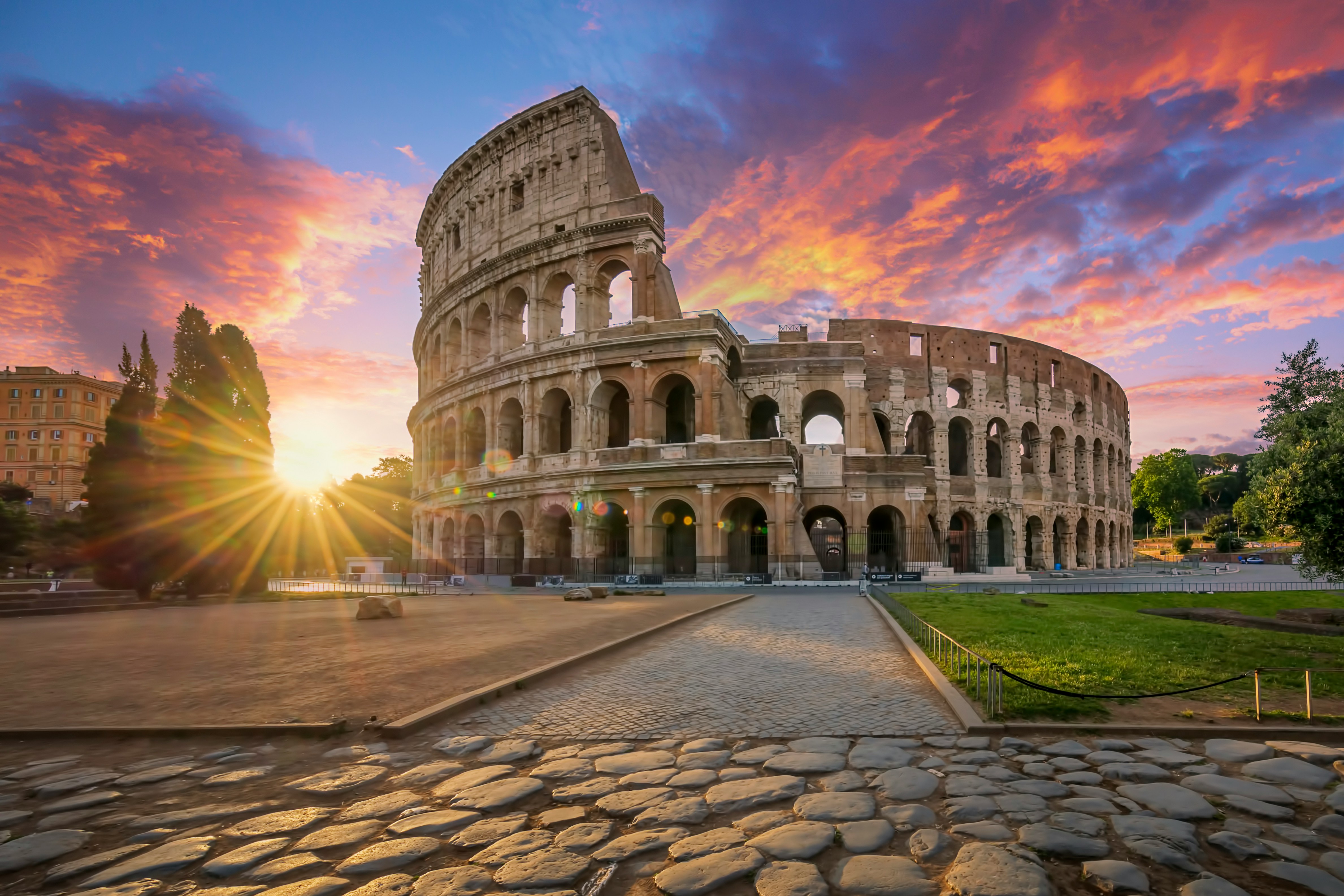
“The Wall Street Journal reported on one excited fan who drove seven hours in the hope of seeing Trump’s pageant and said, ‘It’s like the Colosseum in real life.’ To America’s founders, the fall of the Roman Republic and the rise of the Roman Empire was a cautionary tale. To parts of MAGA, it’s apparently aspirational.
But to everyone else, the confluence of America’s failure in Iran and Trump’s Temu colosseum should paint a clear picture of decadence, rot and weakness trying to conceal itself behind macho kitsch. This is an administration capable of immense, epic destruction, but unable to create much besides spectacle.”
Parker J. Palmer—in Tacky Birthday, Dear America! Tacky Birthday to You!—shows pictures of what visitors who come to D.C. this summer to celebrate America’s birthday will see: numerous examples of the MAGA aesthetic in addition to cage fights.
Notable quote:
“When people around the world look at the U.S. these days, they don’t see a ‘city set on a hill.’ They see Ugly Americans, full of contempt for all that does not conform to “the American way.” They see Rich Americans full of greed, despite the fact that they have more than they need. They see Arrogant Americans, full of a sense of entitlement to drop bombs, shoot bullets and let sick and starving people die wherever it suits their fancy. On June 14, when the MMA fighters duke it out in front of the White House, the world will see MAGA’s commitment to the survival of the fittest and the doctrine of might makes right. They will see an America to be feared, not celebrated, led by some of the tackiest men and women in U.S. history.
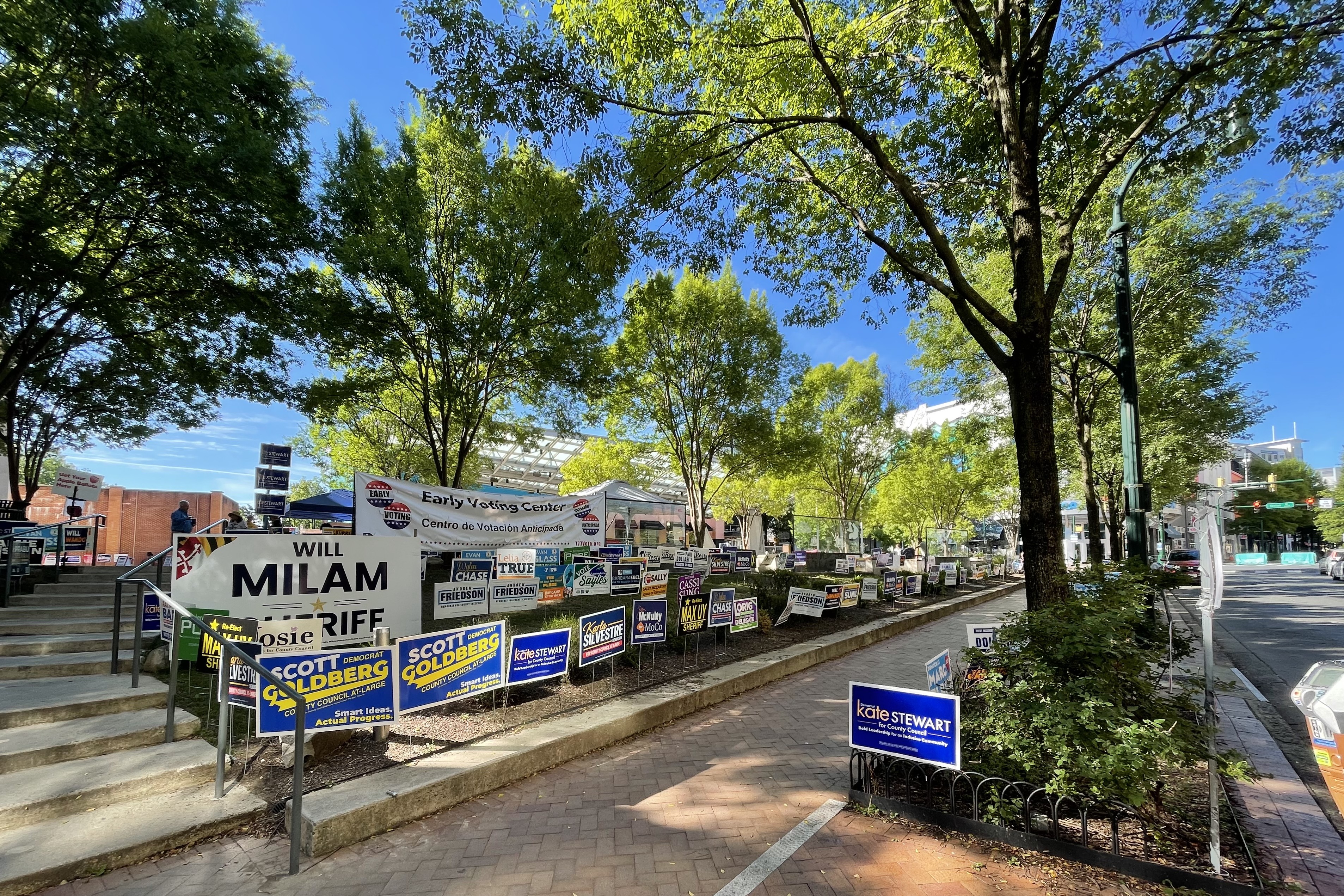
If I’m going to have things strewn all around the yard, I’d prefer this scene to what we just saw at the White House. This is what democracy looks like.
Early voting in downtown Silver Spring as seen on my morning walk
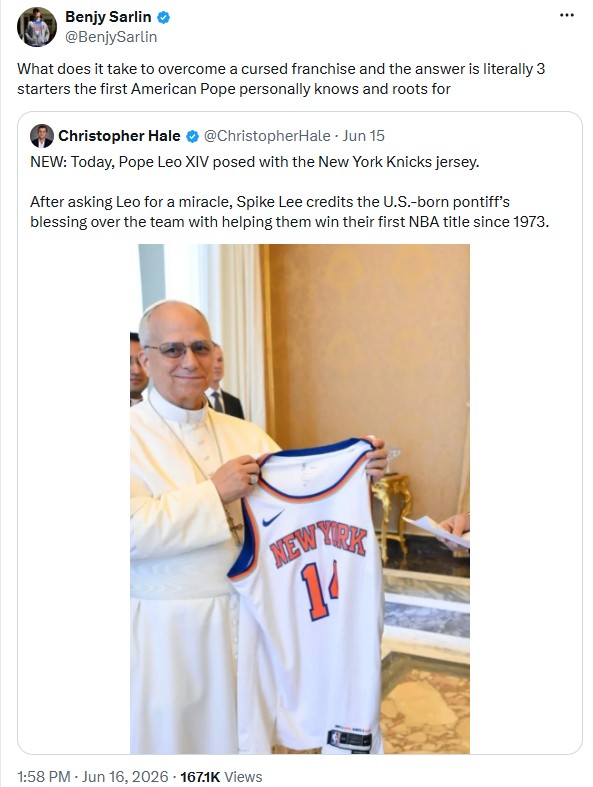
“John Prevost, the pope’s older brother, rang from Chicago with a computer problem—because Bob, as the family still calls him, has always been the one who fixes these things.
‘John, I’m the pope,’ Leo reminded him.
The reply came without a pause: ‘Oh, sorry pope. My computer is broken.'”
“I grew up Catholic in Murfreesboro, Tennessee—St. Rose of Lima parish, the kind of Southern Catholic upbringing where you learn early that your faith puts you at odds with polite company. My grandfather Jolly Hayden was Irish; my grandmother Mary Michael Fiorella was Italian. The faith I inherited from them is stubborn, sacramental, and unapologetically concerned with the world.”
He had me with that line about Southern Catholic upbringing. I’ve reminded more than one family member who was raised Catholic that they need to be careful about prejudice . . . because where “I come from” Catholics were not exactly the most popular people in the Bible Belt. I had lots of Catholic friends who went to St. Rose of Lima parish, and we played them in church league basketball, which reminds me of this great cartoon:
The Rev. Will B. Dunn as featured in Kudzu by Doug Marlette
Oh, and then there is this from Christopher Hale (to jump back to the earlier stories):
THE TIME IN-BETWEEN THE UNCHANGEABLE PAST AND THE UNKNOWABLE FUTURE
Singer, songwriter, and poet Carrie Newcomer shared the poem In the Hayfield on her A Gathering of Spirits newsletter. She is celebrating the “time of day when the day and night overlap. It is a liminal time between the cerulean blue of daytime and the indigo blue of night.”
Notable quote:
“I am in love with the untamed things, The cloud, the doe, Water, air and light. I am filled with such tenderness For ordinary things: The practical mule, the pasture, A perfect spiral of gathered hay.”
Musical interlude:
Newcomer also includes this song called Unless by Hawktail “There is something about this particular song that always feels a bit like that hayfield experience—haunting and heart achingly beautiful.”
Finally, you can depend on the Old Farmers Almanac to give you plenty of facts about the solstice. In Summer Solstice 2026: When Is the First Day of Summer?, Catherine Boeckmann welcomes the solstice with some interesting facts and folklore.
Notable quote:
“Did you know that the Sun actually sets more slowly around the time of a solstice, in that it takes longer to set below the horizon? This is related to the angle of the setting Sun. The farther the Sun sets from due west along the horizon, the shallower the angle of the setting Sun. (Conversely, it’s faster at or near the equinoxes.) Bottom line, enjoy those long, romantic summertime sunsets at or near the solstice!”
Musical interlude:
Is there any better summer song than Summertime from Porgy and Bess? Does anyone sing it better than Ella? For my money, no.
Have a wonderful summer!
More to come . . .
DJB
*I didn’t come up with this title, but it really fits. Full credit goes to Sabrina Haake.
NOTE: Click here to read the grab bag from the 2026 Ides of March edition. Hmmm, I may be developing a pattern here.
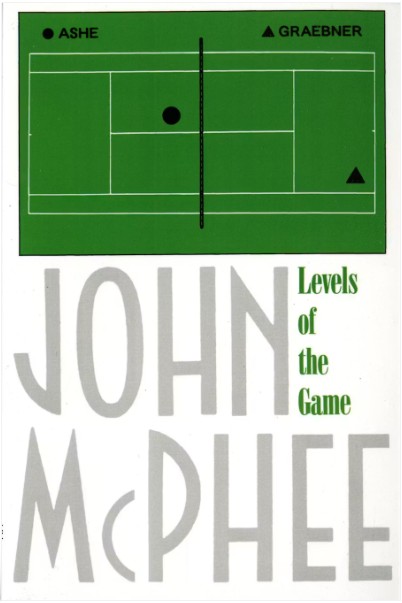
John McPhee wrote one of the great tennis books of all time. It is about so much more than a game.
In between the French Open and Wimbledon seems the perfect interlude to read one of the great tennis books of all time. Don’t just take my word for it. Former sports and city columnist for the New York TimesRobert Lipsyte wrote that “This may be the high point of American sports journalism.” Donald Jackson, writing in Life magazine, said it is “probably the best tennis book ever written.”
Those reviews were written in 1969, when the book was published. But the recognition has lived on. Reviewing it for The Guardian in 2014, William Fiennes writes that this short book “is an adventure in form and a batch of pleasures caught on the fly.” And just last September Joe Posnanski started his series on the ten greatest sports books ever with this work. Joe describes the impact it had on him:
“Before I started, I wanted to be one kind of writer.After I finished, I wanted to be a whole different kind of writer.I pick it up a couple of times every year to remind myself of that feeling.”
Levels of the Game (1969) by John McPhee is a masterpiece of the writing craft. “Precision is at the very heart of John McPhee’s writing.” That precision shines through in the choice of words, the form, the shifts in tense, the images he creates, the poetry in his prose. The frame of the book is the 1968 U.S. Open semifinal match between Arthur Ashe and Clark Graebner at Forest Hills in New York. There is the description of four sets of tennis, played in bright sunlight before 14,000 spectators. On one level it is sportswriting. On another it is a joint profile, complete with backstories and long flashbacks and interludes, of two players from very different backgrounds at the top of their game. On yet another it is a time capsule of an America recently torn apart by the murders of Dr. Martin Luther King, Jr., and Robert Kennedy. Finally, it is also “a highly original way of looking at human behavior.” The writing comes to life with the style and verve of a well-placed backhand return of a scorching serve. It is, as so many have said, a remarkable performance.
A mantra McPhee continues to use with his writing students is “a thousand details add up to one impression.” The implication is that “few (if any) details are individually essential, while the details collectively are absolutely essential.” What to keep and what gets taken out of a piece are equally important. As the sculptor Michelangelo said, “I’m just taking away what doesn’t belong there.” In Levels of the Game, McPhee has sculpted a classic—and timeless—tennis book that is about so much more than tennis.
Consider how the book begins.
“Arthur Ashe, his feet apart, his knees slightly bent, lifts a tennis ball into the air. The toss is high and forward. If the ball were allowed to drop, it would, in Ashe’s words, ‘make a parabola and drop to the grass three feet in front of the baseline’. He has practised tossing a tennis ball just so thousands of times. But he is going to hit this one. His feet draw together. His body straightens and tilts forward far beyond the point of balance. He is falling. The force of gravity and a muscular momentum from legs to arm compound as he whips his racquet up and over the ball. He weighs a hundred and fifty-five pounds; he is six feet tall, and right-handed. His build is barely full enough not to be describable as frail, but his coordination is so extraordinary that the ball comes off his racquet at furious speed. With a step forward that stops his fall, he moves to follow.”
The reader is barely on the second page and already engrossed.
The two players have known each other for years, are members of the U.S. Davis Cup Team, and travel together. Ashe says he knows Graebner’s game “like a favorite tune.” Ashe feels that “Graebner plays the way he does because he is a middle-class white conservative. Graebner feels that Ashe plays the way he does because he is black.” Grabner has an autographed picture of Richard Nixon on his desk. Ashe is a Democrat who, Graebner says, even plays tennis “with the lackadaisical, haphazard mannerisms of a liberal.” One of Ashe’s favorite places to visit is Spain, where he says “It’s a great feeling to get away from all this crap in the United States.”
There are gems to savor on virtually every page.
Graebner’s wife Carole is a world-class tennis player in her own right, and when he’s playing he looks to her for clues. “I think these are the only times that Clark publicly acknowledges me as a knowing player,” she says. “Off the court, he does not acknowledge that I know much about the game,” a telling sentiment that captures so much of Graebner’s personality and worldview.
Arthur’s father is quoted as saying that when “Arthur, Junior rushes himself, he gets into trouble. Mr. Ashe is an axiomatic man. When he says things like that, he does not seem to be making a comment so much as he seems to be promulgating a law of the universe.”
Clark’s father is a dentist who speaks “quickly and nervously, often in an engaging monologue.” Tennis players who visit his home find him amusing because he asks them questions and, not waiting for replies, answers all the questions himself. “After thirty years of close contact with temporarily muted people, he has mastered the histrionisms of his craft.”
And then there is this section where McPhee writes about Graebner’s temper and rage on the court.
“Apparently he believes he can accurately assign blame outside himself for almost every shot he misses, every point he loses. He glowers at his wife. He mutters at other people in the crowd. Airplanes drive him crazy. Bad bounces are personal affronts. He glares at linesmen. He carps at linesmen. He intimidates ball boys. He throws his racquet from time to time, and now and then he takes hold of the fence around a court and shakes it violently, his lips curling. He seems to be caged.”
Posnanski says he has “read this section so many times. It’s utterly perfect. Every word in there, every one, you probably knew by the time you were in the sixth grade, if not earlier. And yet, the way McPhee arranges them, they turn into poetry.”
Near the end of the book, after a break between the third and fourth sets with Ashe up two sets to one, McPhee notes that Graebner “slams back Ashe’s first two serves” to go up Love-thirty.
“It is an inaccurately suspicious beginning, for Ashe now begins to hit shots as if God Himself had given them a written guarantee.”
Oh. My. God. What a sentence. “Inaccurately suspicious” is an unexpected and perfect turn of phrase. And then McPhee hits his own ace as Ashe “begins to hits shots as if God Himself had given them a written guarantee.”
Even if you don’t know how the match will end, you now know. As Ashe hits for it all one more time, McPhee closes with the final shot and image that remains with you long after you’ve put the book aside.
Historian Edward L. Ayers looks at the six critical decades leading to the Civil War to find contested visions, but also hope for our future.
It is tempting to look at a period of history—especially one with well tilled soil—and decide that the main stories and themes are settled. That we understand not only what happened, but why. I have certainly been guilty of wanting my history wrapped and tied up with a neat bow.
Fortunately or unfortunately, depending on your point of view, history is seldom so simple. It is complex, multi-layered, surprising. What happened has not changed, but what we know about what happened and the context into which we can place that new understanding always seems to be expanding. Pulitzer prize winner Viet Thanh Nguyen, made this important point in connection with the Vietnam War when he wrote, “All wars are fought twice, the first time on the battlefield, the second time in memory.”
As we learn more, the way we tell the stories of our history and the way we preserve the physical reminders of the past changes. History is under construction.
Through compelling storytelling mixed with solid scholarship, gifted historians have a way of opening our eyes to the “messy complexity of our past.” We may think that the United States was on an inevitable path of collision in the years prior to the Civil War. Perhaps. But many different Americans—probably more than we traditionally recognize—were involved in contesting the possibilities and promises of our young country in the the first half of the 19th century.
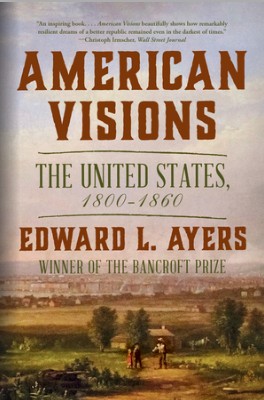
American Visions: The United States, 1800 – 1860 (2023) by Edward L. Ayers is an illuminating synthesis of the six decades leading to the Civil War. Ayers shows us how a broad cast of characters came together to shape the volatile new nation. There were famous writers and those who only won veneration after their deaths. People on the margins who ruptured history. Faith leaders and con men. Naturalists. Musicians, artists, and poets. Indigenous leaders, female activists, Black speakers, and abolitionists. “Individuals dismissed for their skin, sex, or peculiarity spoke for an America of freedom and connection, of possibility and responsibility. They did so from the traditions of the Declaration of Independence and the New Testament, from the individuality of art and literature, from traditions of African and Indigenous cultures, and from a recognition of the mutual dependence of the human and the natural world.” Their visions were articulated after confronting the moral failings of the nation.
They lived and worked in an era when the young United States “veered in unexpected directions.” A time when American slavery went from something seen as a backward and failing institution to the point where it “would spread over an area the size of continental Europe and lead the United States into a war against another republic.” Older historians have termed this period the “age of Jackson” or “the rise of the common man”; the era of “manifest destiny” or the “ante-bellum” years. Ayers wants us to think of this time as “the era of the new nation, the story of government, economy, culture, and identity invented on the spot, of progress and wrong weaving together in ways that defined America’s understanding of itself.”
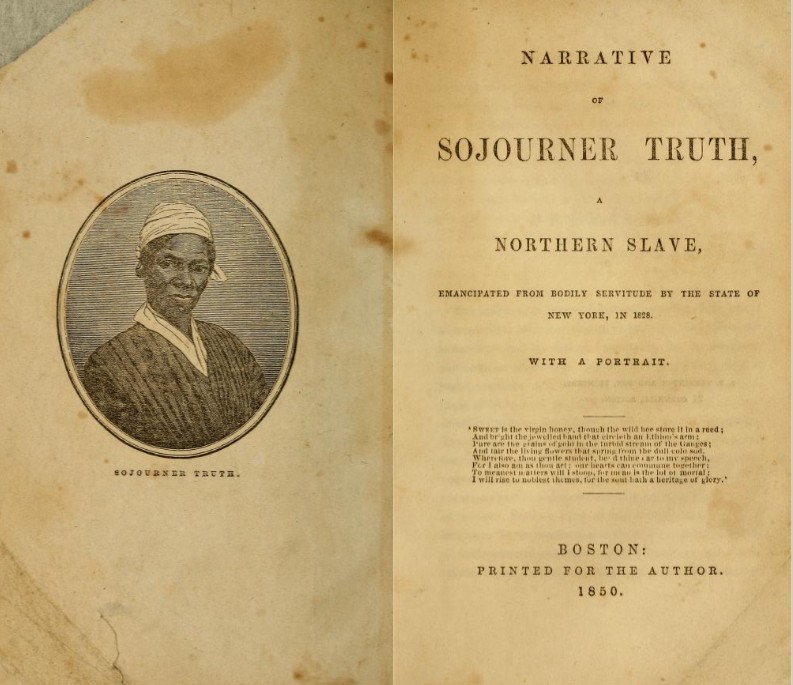
Ayers takes the reader through nine chapters and an epilogue full of unexpected twists, thoughtful explorations, and vivid, lively prose. As a helpful story map on the New American History website shows, we find voices we expect—Tecumseh, Frederick Douglass, Ralph Waldo Emerson, Joseph Smith, James Fenimore Cooper, William Lloyd Garrison, Elizabeth Cady Stanton, Sojourner Truth, John Brown—and many more we do not. Men and women such as Hiram Powers, whose marble statue of a white woman enslaved by Turkish captors seized the imagination of white Americans across the nation while some noted that millions of enslaved Black women found no sculptor. William Gilmore Simms who found a large and admiring audience with his stories of the South during the era of the American Revolution—and of enslaved people contented with their lot. Elias Boudinot, born of Cherokee and white parents, who used his education to defend the rights of Native people to their lands.
Because these are people setting out visions for the new country, we read more than one might expect about writers, artists, lecturers, poets, activists. “Walt Whitman published Leaves of Grassat his own expense and set some of the type. The poetry scandalized many readers at the time but later became recognized as the most important American poetry of the century.” Lilly Spencer, painting pictures from her own experience pushed beyond sentimental images of married life. Sarah Grimké wrote Letters on the Equality of the Sexesafter abandoning her wealthy slaveowning family in South Carolina for a Quaker community in Philadelphia, where she became an abolitionist.
Ayers interests and scholarship are so wide—with subjects including “authors, reformers, pseudoscientists, mystics, showmen, and more”—that any listing of the people and voices found in this work will be inadequate. But one never loses the thread and readers are brought along by Ayers skill at weaving these many pieces into one fascinating, mind-expanding, and enlightening fabric.
These are complex visions of progress and possibility that are full of contradictions. The issues of this era remain important today. Historian and Harvard president emerita Drew Gilpin Faust said that Ayers is “a son of the South who knows how to honor the past by facing it squarely.” Ayers describes himself as “an optimistic person who has written and taught about the worst wrongs in American history,” doing so because he believes that “by addressing these evils we can perceive and counter their insidious legacies.” That can seem difficult in our present age, especially when nativists, racists, and those who politicize religious faith claim the sanction of history.
“But we can choose to remember a fuller American history, one that is more truly patriotic, one that evokes the nation’s highest ideals of equality and mutual respect in the face of the nation’s failings.”
As Ed Ayers shows in this sweeping synthesis of our period of growth as a nation, “bold men and women in the new United States spoke without permission and often in defiance of those who held power . . . Their visions remain powerful—and necessary—generations later.”
Classics scholar Elizabeth Bobrick posted “the essay that made us friends” on her Substack newsletter today. I’m sharing the link so you’ll see how wonderful it is.Trust me: you will want to read this.
I became friends with Elizabeth Bobrick after reading this post when it first appeared more than 20 years ago. I wrote at the time about how wonderful it was (the best entry in a book of baseball essays, to my way of thinking) and Elizabeth found my commentary online. We connected, stayed friends, met in person when Andrew and Claire were on the college search, and continue to connect online on a semi-regular basis. When Elizabeth posted this earlier today on her wonderfully named Substack newsletter This Won’t End Well: On Loving Greek Tragedy, I knew I had to share it with you. I’ll provide the set up and two short examples of why you should drop what you are doing, click the link above, and read this wonderful piece. Trust me. You’ll love it.
Elizabeth provides a setup that I’ll quote in full.
“The story I’m going to tell you now is about my brief life as a sports fan, when I was in graduate school, struggling to get my doctorate in Classics. Even if you’re not interested in sports, or are horrified by the ridiculous sums that top athletes are paid, or a fan of the San Antonio Spurs, stay with me. As you can see by the title of this post, there’s a connection to ancient Greek literature, and not a tenuous one.
I haven’t thought about this story in a while, but we were in New York City yesterday, where seemingly everyone was in orange and bright blue, having pledged allegiance to the Knicks. Every game has been a nail-biter, won by small numbers. We got home in time to watch them play game 5 against the San Antonio Spurs.
To the amazement of everybody, possibly to the team itself, the Knicks won. They are now the National Basketball Association champions. On the OMG/WTF scale, their victory falls somewhere between Sleeping Beauty and Lazarus. The last time they won it was in 1973, when Richard Nixon was president and nobody wore sunscreen.
The unifying feeling of exhilaration in NYC reminded me of my years as the most unlikely of sports fans. In the late 70s and early 80s, the Baltimore Orioles were my heroes when I was struggling against some tough odds. Indeed, I was trying hard not to lose what was most important to me. I wrote an essay about those days, published 20 years ago in Creative Nonfiction. Here it is.”
Oriole Magic
NOTE: Elizabeth at the time of this story is a twenty-three-year-old graduate student who fell for the Baltimore Orioles in the summer of 1979. As she notes in the beginning of the essay, much of graduate school felt very bad. Although she loved Sophocles, Plato, Homer, Virgil, the philosophers, and the historians, she did not love the endless hours of largely solitary work. Plus she was married at the time to “a brilliant and charismatic but only sporadically employed academic who treated me as if I were a freshman in his first-year philosophy seminar.”
In her first ever foray into the Sports section of the Baltimore Evening Sun (to avoid studying), Bobrick stumbles across two articles by a writer named Terry Pluto and immediately thinks of the Greek god of wealth and the underworld. Pluto had two articles in the Evening Sun that day. In the first:
Pluto had devoted this column to somebody named Jim Palmer, pitcher from the former dynasty, and the only member of the team who was nationally recognized as a star. Palmer, I read, had a chronic problem. He felt unappreciated by his manager, a dyspeptic little man named Earl Weaver. Palmer was given to sulking and saying his arm hurt, when in fact it was his ego that was sore, because Weaver didn’t let him pitch as often as he wanted to. As Pluto reported, Palmer was threatening to aggravate management until they got so sick of him that they traded him.
She writes of his second article:
“A rainstorm had forced the game (in Cleveland) to be called, and a melee ensued, during which the home fans tore up the stadium while being chased through mud by the police. Both constabulary and quarry slipped and fell a good deal. Pluto said the scene, one ‘worthy of the Keystone Kops,’ played out against a dramatic backdrop: ‘The sky was filled with lightning. The rain came down in torrents and Noah could be heard in the background pounding the last few nails into his ark.’
I had never seen reporting like this: a description of the weather apparently lifted from a Gothic novel followed by an allusion to the Book of Genesis, all in order to take a swipe at the Cleveland fans’ wild behavior and their police force’s ineptitude. I admired the boldness of the mix, and the broad brushstroke delivery.”
Later in the essay, she quotes Tom Callahan of the Washington Star, whose “sentence structure reminded me of Cicero’s.” With the O’s one game away from winning the series, Bobrick quotes Callahan and then adds her take on the sentence:
“‘Earl Weaver loudly says HE is to be the star of the Baltimore Orioles, a plain fact that amuses the players at the brink of the World Championship; which annoys them occasionally; which hurts their feelings frequently; which helped them to the brink of the championship undeniably.’ Behold, a one-sentence illustration of what adverbs can do when a professional strikes the keys.”
Now, go back and read the entire piece as Elizabeth wrote it. I’ve left out so much. Then follow Elizabeth on Substack if you want to know more about Greek tragedy.
And, oh yes, you’re welcome.
More to come . . .
DJB
Photo by Tim Gouw on Unsplash. Elizabeth used this photo as the lead to her Substack piece, so I’m following her example. “The Toronto Blue Jays Stadium reminds me of an ancient Greek amphitheater, so it illustrates this post nicely,” she wrote.
The former Archbishop of Canterbury looks at the essential elements of the Christian life. It is a useful reminder on the day we say goodbye to my mother-in-law.
Our family and the families of Candice’s two brothers have gathered today to say goodbye to my wife’s mother, my mother-in-law, and Andrew and Claire’s grandmother. Irene Ann Holsey Colando lived to be 93 years of age. When we bury her ashes in the columbarium at St. Patrick’s Catholic Church in Mt. Dora, Florida, her Christian faith will be the framework for all we do and say. A lifelong Catholic, Mrs. Colando loved the church and participated fully in every aspect of its ministry. I heard her say on more than one occasion, “God is taking care of me.” She fully accepted me into the family and often mentioned—especially after Candice joined me in the Episcopal Church—that her father had been an Episcopalian. I called her my favorite mother-in-law and she would respond that I was her favorite son-in-law. We will all miss her dearly.
“I wait for the Lord, my soul waits, and in his word I hope; my soul waits for the Lord more than watchmen for the morning, more than watchmen for the morning.”
Psalm 130: 5-6
A former Archbishop of Canterbury prepared a little book designed to help us think about the essential elements of the Christian life. It seems an appropriate topic to consider on this special day in the life of our family.
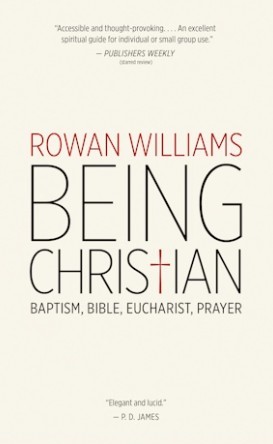
Being Christian: Baptism, Bible, Eucharist, Prayer (2014) by Rowan Williams is a clear, accessible, and thought-provoking work; simple to read and yet profound in its approach to what it means to be a Christian in today’s world. As the title suggests, Williams looks at four elements that cut across almost every part of Christendom, beginning with the act that brings us into full membership in the church. Christians read the Bible and gather to share bread and wine in memory of the death and resurrection of Jesus of Nazareth. Finally, Christians pray, with many incorporating the prayer passed along by Jesus into their worship service. Some traditions of the church have other elements that are important to them to varying degrees (e.g., speaking in tongues, healing, confession, celibacy for priests, foot-washing, worship on Saturdays), but Williams wants to focus on what brings us together, not what divides. As one reviewer notes, Williams entices us all to go deeper by reviewing the basics. “It takes a theologian of depth to write a simple book about complex concerns.”
Each chapter includes insights and perspectives that expand one’s understanding of the historic arc of Christianity and the role of each element in today’s church. Baptism, Williams writes, is a restoration of what it is to be truly human. The humanity that God first intended. What is that intention? It is, Williams suggests, a letting go of our personal identity. This new creation is “not a humanity that is always going to be successful and in control of things, but a humanity that can reach out its hand from the depths of chaos, to be touched by the hand of God.” That leads Williams to suggest that if one wants to know where we might expect to find the baptized, one answer is, “In the neighborhood of chaos.”
We are expected, as Christians, to not be afraid of looking with honesty at the chaos inside ourselves, “as well as being where humanity is at risk, outside.”
The chapter on reading the Bible was especially useful to me. Williams points out that Christian people characteristically have the Bible read to them. “Christian life is a listening life.” It is not an easy book to understand. “As soon as you think you know what the Bible is, you turn the page and it turns into something different.”
Williams makes the point, which resonated strongly with me, that God wants you to hear all parts of the Bible.
“He wants you to hear law and poetry and history. He wants you to hear the polemic and the visions. He wants you to listen to the letters and to think about the chronicles.”
The Bible can be contradictory and the stories confusing. So Williams suggests that an important question to ask yourself if why exactly is it important to God that you hear it. Know it.
Here and elsewhere, Williams wants us to see that we are still in the middle of the story. There is constant movement into an endless mystery. Jumping to conclusions while the story is still being told it not helpful. He encourages us to think about how some people responded, but recognize that this story isn’t always easy to hear.
Williams speaks of the Eucharist as exemplary of the life Jesus lived on earth. It confused those who were with him then.
“The indiscriminate generosity and the willingness to mix with unsuitable people were already, in the first Christian generation, just difficult enough for the Gospel writers to scratch their heads and cough just a little bit about it. But they could not deny it or suppress it. It was too vividly remembered. Jesus sought out company, and the effect of his presence was to create a celebration, to bind people together.”
The Roman Catholic priest James Allison summarizes much of the Gospel message as “Let’s party!” In Holy Communion, Williams asserts, Jesus tells us that he wants our company. Yes, there is remembrance of death and suffering in the Eucharist, but there is also very much a celebration.
Prayer is how we grow in Christian humanity. He quotes Gregory of Nyssa in suggesting that prayer “is in significant part about resolving conflict and rivalry. If people prayed seriously they would be reconciled.” God shows us how to forgive and then steps back and says, “now, show me” how you forgive others.
In reflecting on this book, Sister Wendy Beckett of the Carmelite Monastery, Quidenham, wrote:
“Christianity is both simple and profound. Rowan Williams understands these two levels, and how we come to the depth of what Jesus is by the simplicities of informed Christian practice. This is a handbook for Christian living.”
That sums it up pretty well.
In The Leaving by Jan Richardson
in the leaving, in the letting go, let there be this to hold onto at the last:
the enduring of love the persisting of hope, the remembering of joy,
the offering of gratitude, the receiving of grace, the blessing of peace.
A final post from our recent tour of Morocco, Portugal, and Andalusia.
In late April we boarded a plane to begin our most recent journey with National Trust Tours, this one a two-week trip to visit four countries and two continents. We opened with a week in Morocco, a fascinating, captivating, and altogether welcoming part of the world distinguished by its Berber, Arabian and European cultural influences. In two earlier posts I focused first on highlights from our explorations around Marrakech and then turned to the other Moroccan cities we toured.
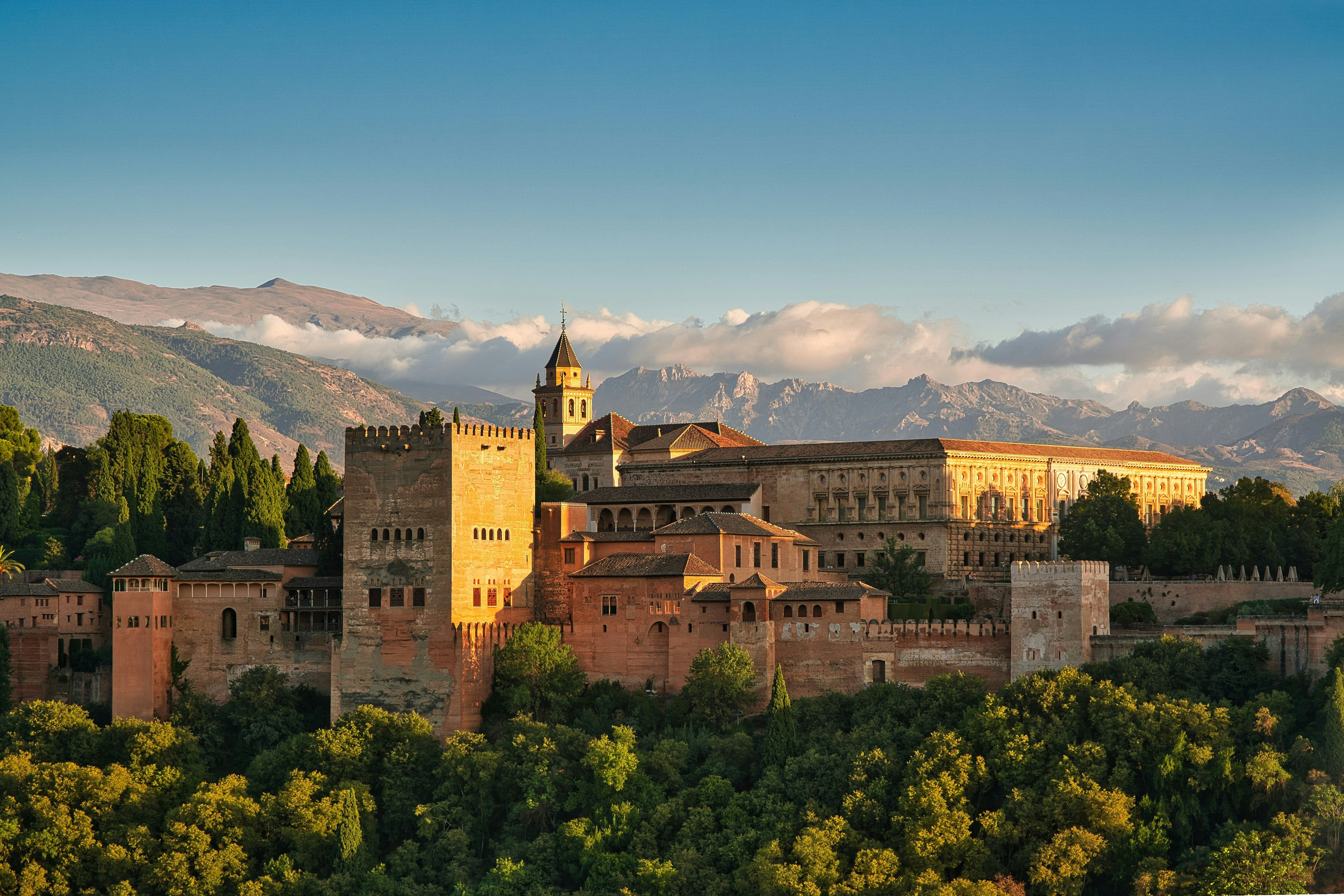
I also wrote about one of the world’s great heritage treasures, The Alhambra in Granada, Spain, showing how it unveils overlapping lives and histories which breathe life into an intercultural dialogue.
Alhambra panorama by Alexander Psiuk from Unsplash
In this final installment from the trip, I will move through our time in Gibraltar, Seville, and Lagos, highlighting the history, architecture, and landscape of this part of the world where Africa meets Europe.
GIBRALTAR
We spent a morning in Gibraltar, that small but strategic piece of rock on the southern tip of Europe where the Atlantic Ocean joins the Mediterranean Sea. Tina Fey famously spoofed former Alaska governor Sarah Palin with the line, “I can see Russia from my house,” but in Gibraltar one sees the reality of two continents and three countries in such close proximity. You can, actually, see Morocco from Gibraltar. Quite easily, in fact.
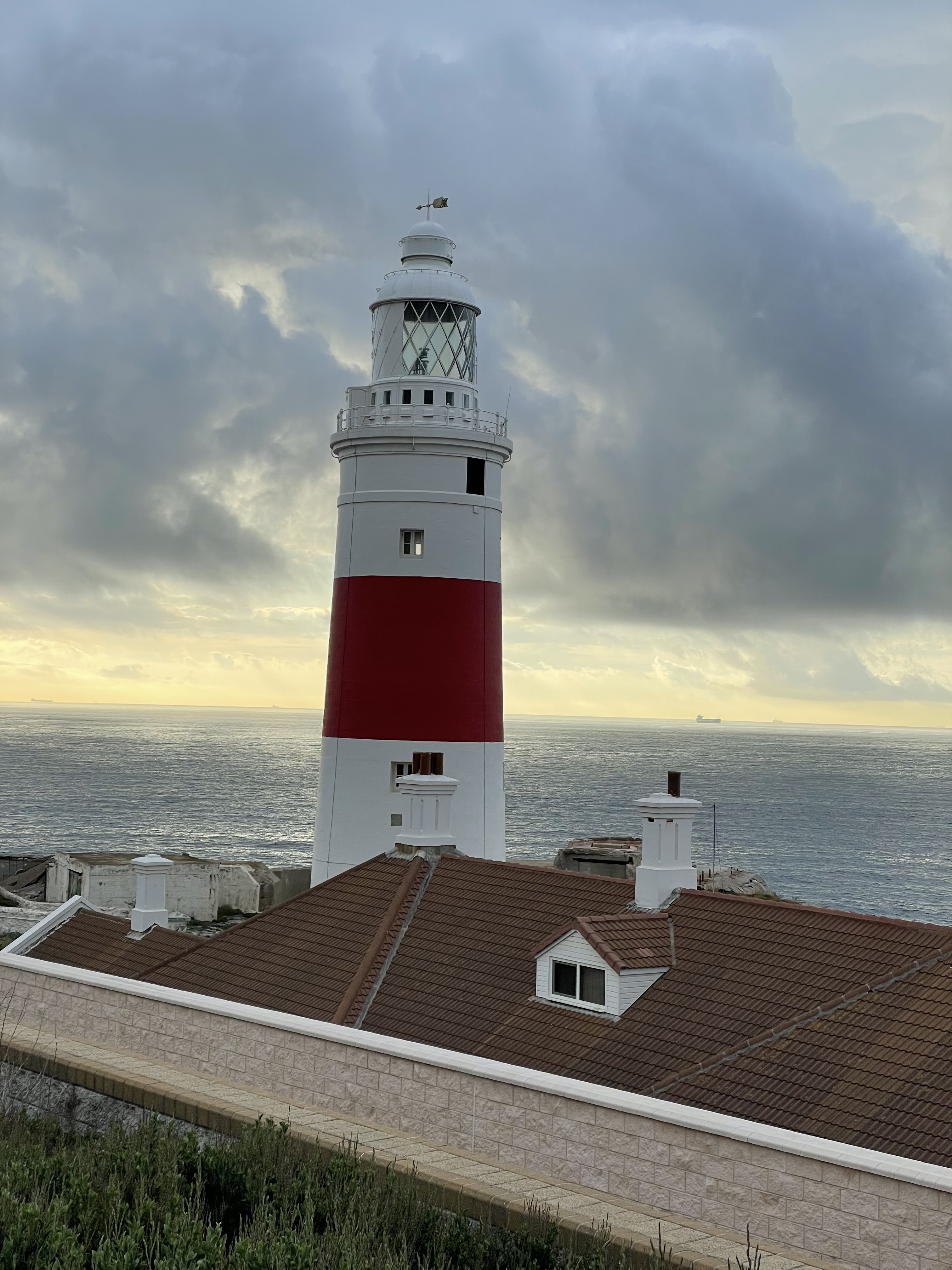
View of Morocco from Gibraltar
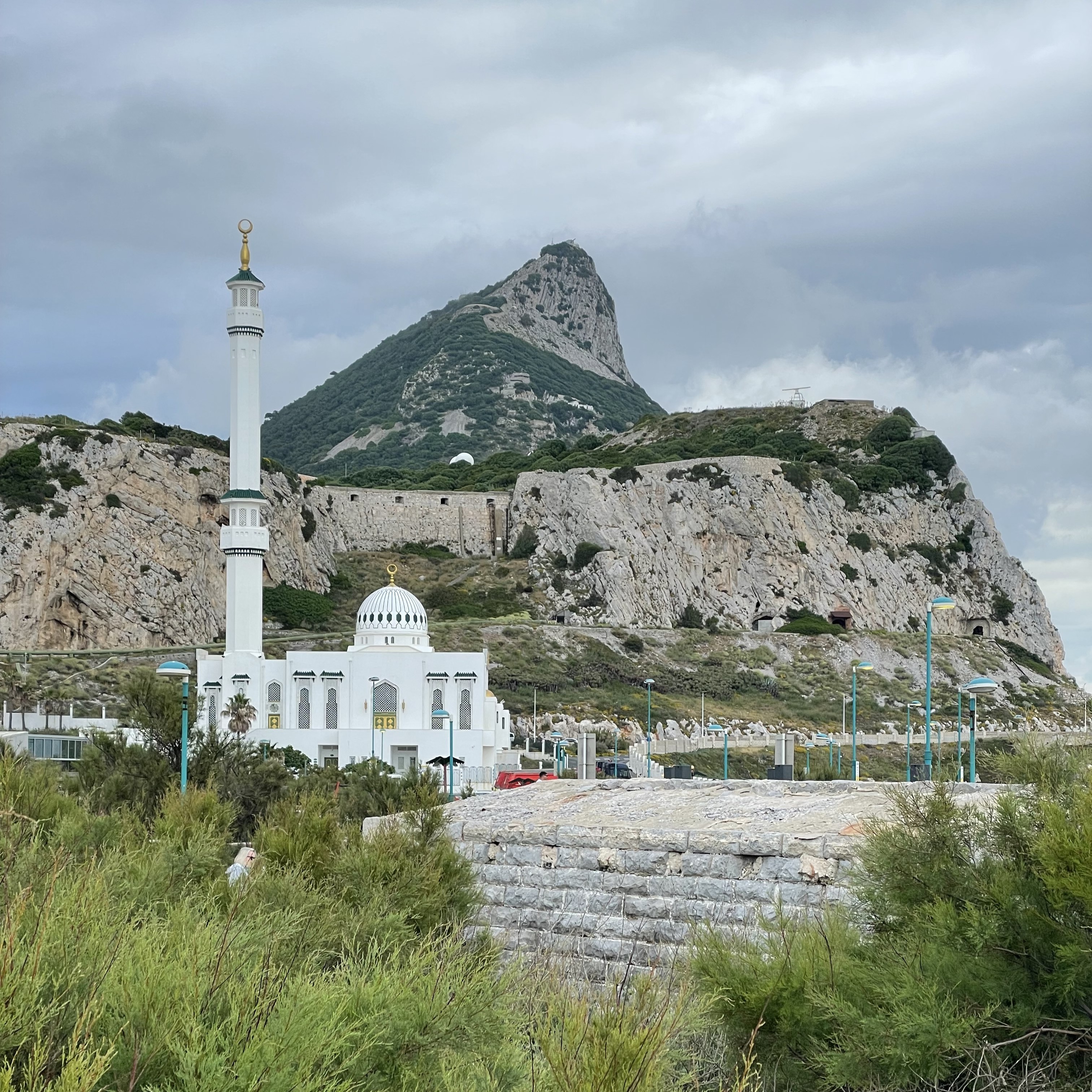
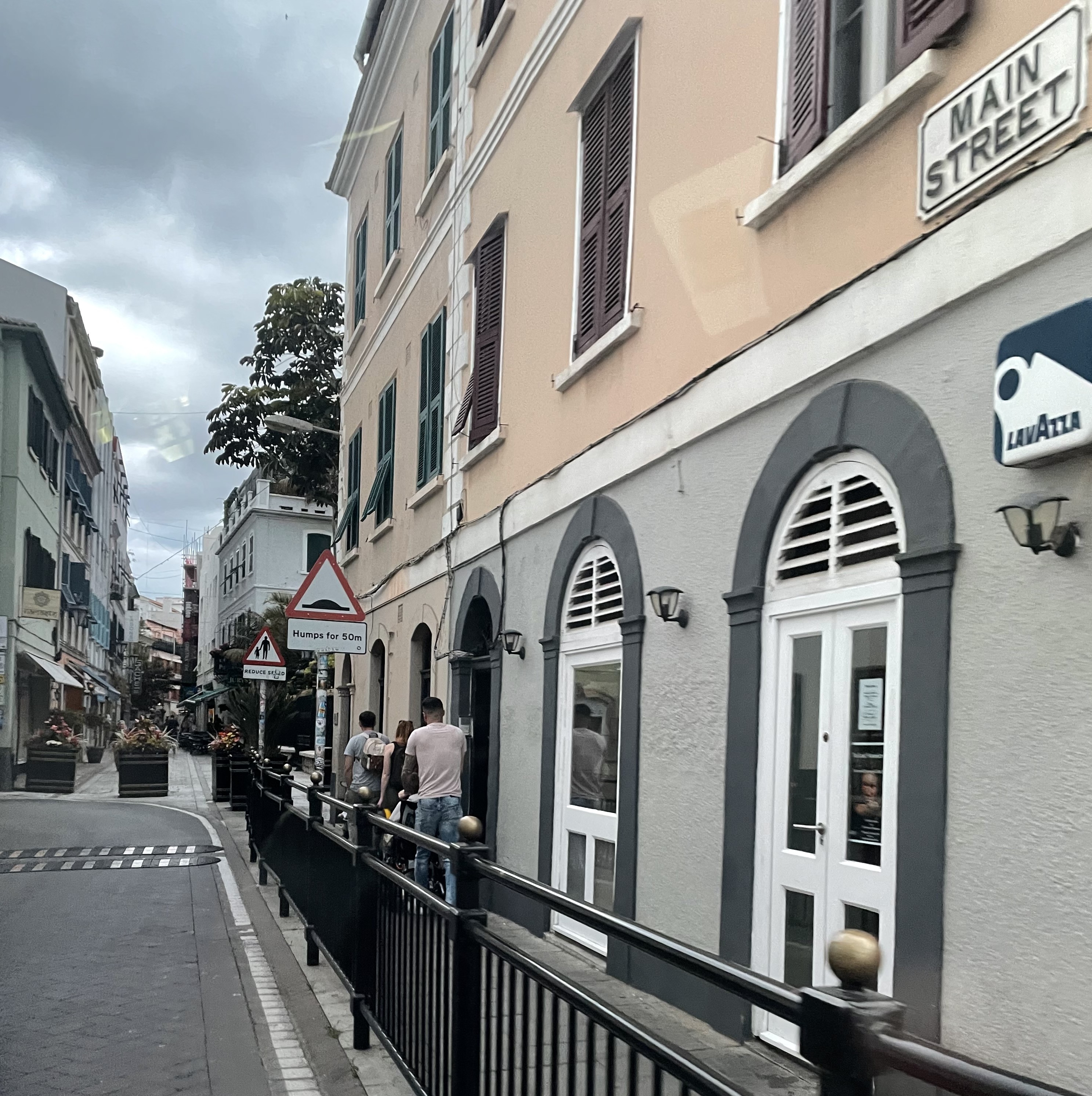
Gibraltar is part of the United Kingdom. There is some juxtaposition of cultures here, such as with the mosque on the African side of the territory, but the feeling one gets when driving through the small, densely populated city is that there’s bound to be a fish and chips shop just around the corner. It was a bit jarring after ten days immersed in Moroccan and Spanish culture.
Monkeys and The Rock
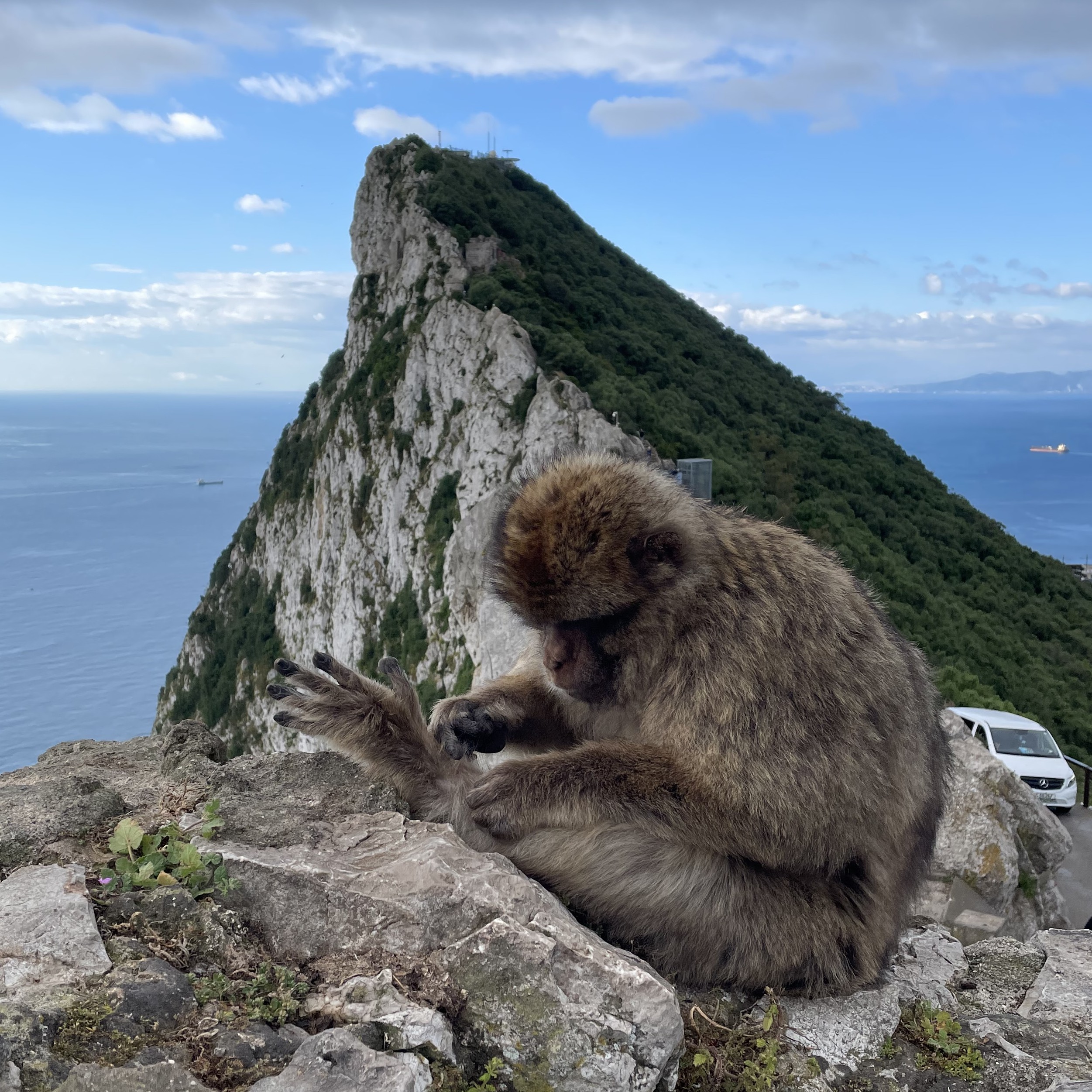
Most tours of Gibraltar focus on two things: Monkeys and The Rock.
The Wikipedia entry for the Barbary monkeys is as good as any:
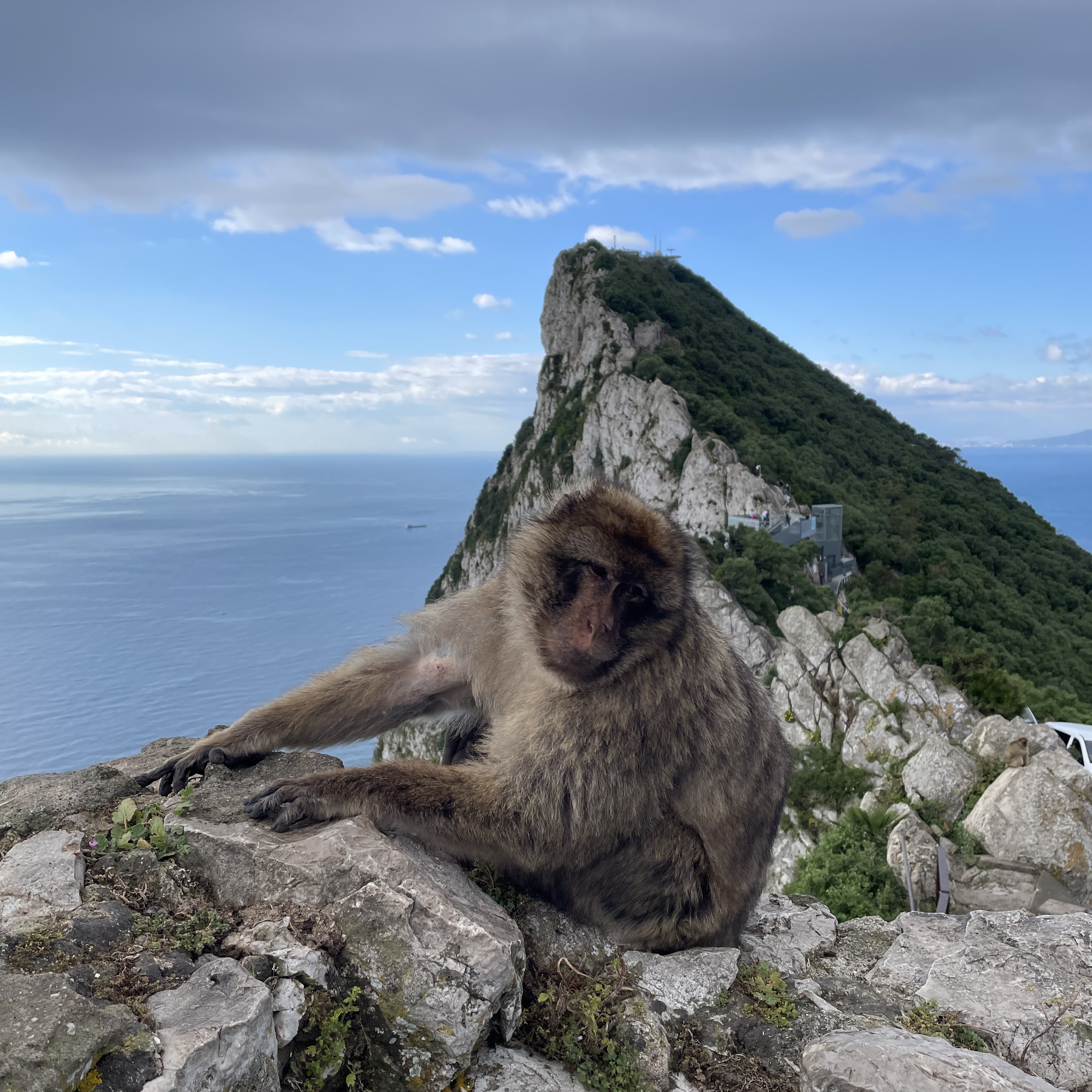
“Originally from the Atlas Mountains and the Rif of Morocco, the Barbary macaque population in Gibraltar is the only wild monkey population on the European continent. Although most Barbary monkey populations in the African continent (specifically Algeria, Tunisia and Morocco) are experiencing decline due to hunting and deforestation, the Gibraltar population is increasing. As of 2020, some 300 animals in five troops occupy the Upper Rock area of the Gibraltar Nature Reserve, though they make occasional forays into the town.”
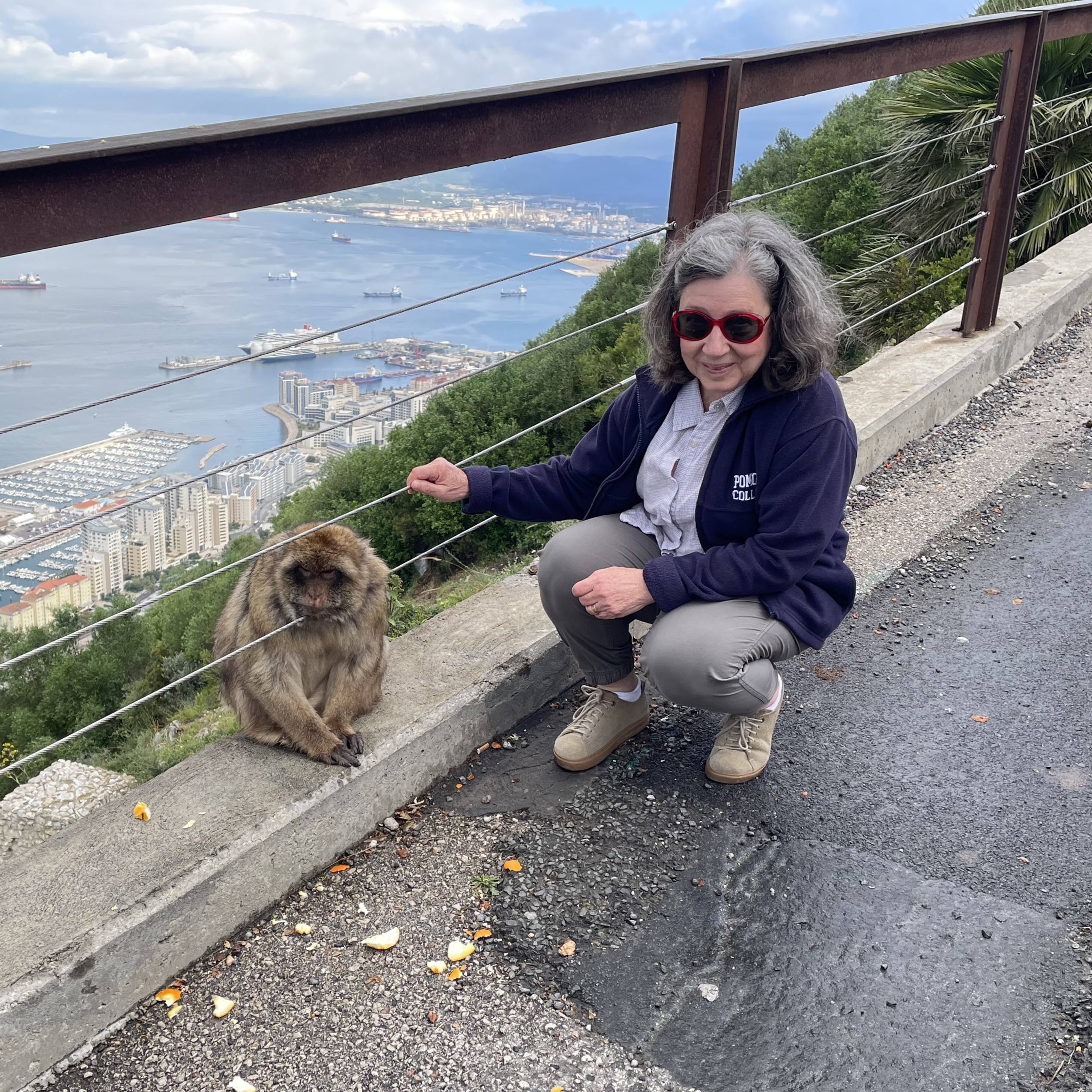
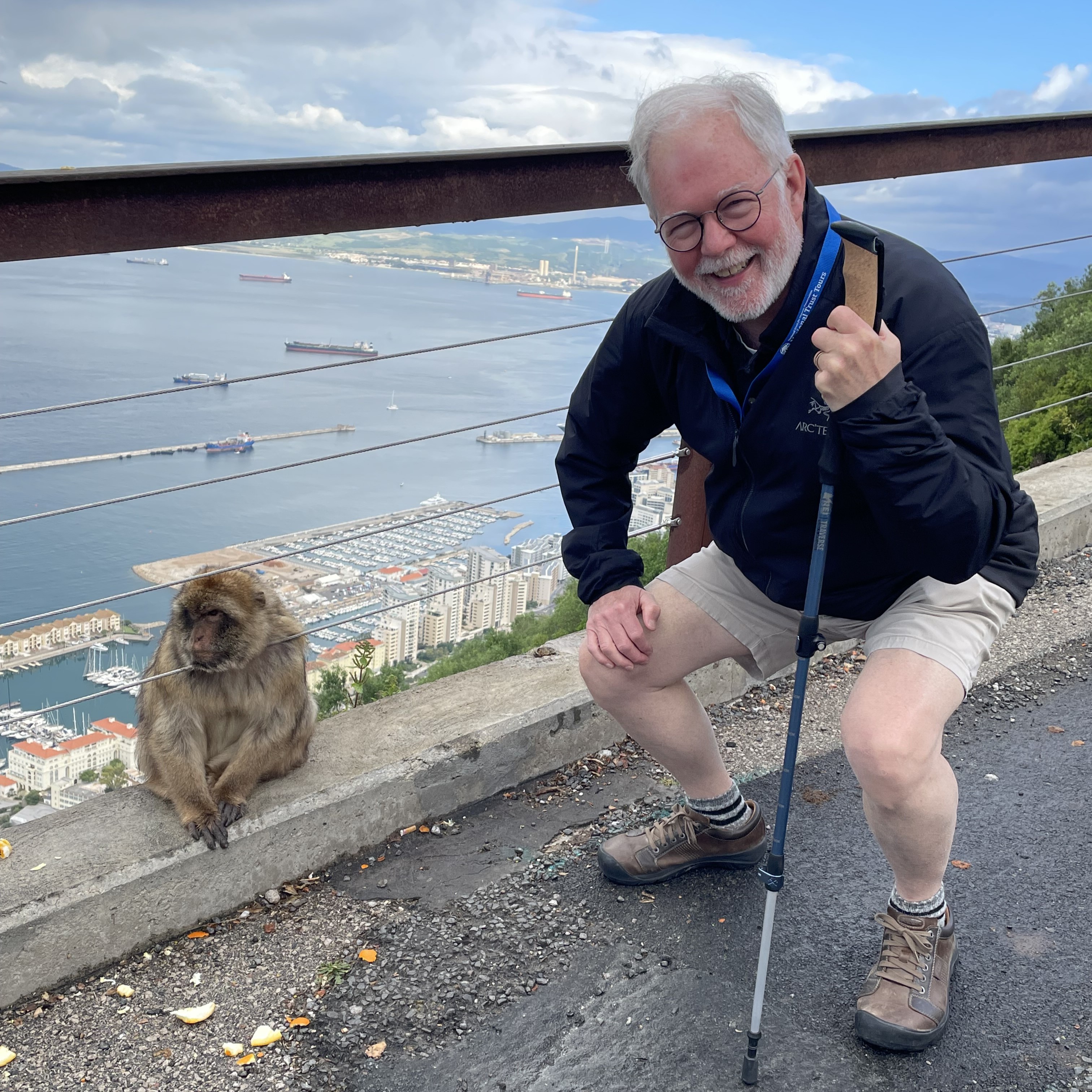
Our guides made sure we saw them up close and personal!
These wild animals are clearly comfortable with people. I captured one Barbary macaque who looked as if they were focused on their morning hygiene when I climbed the observation deck to get a better look at the top of the rock.
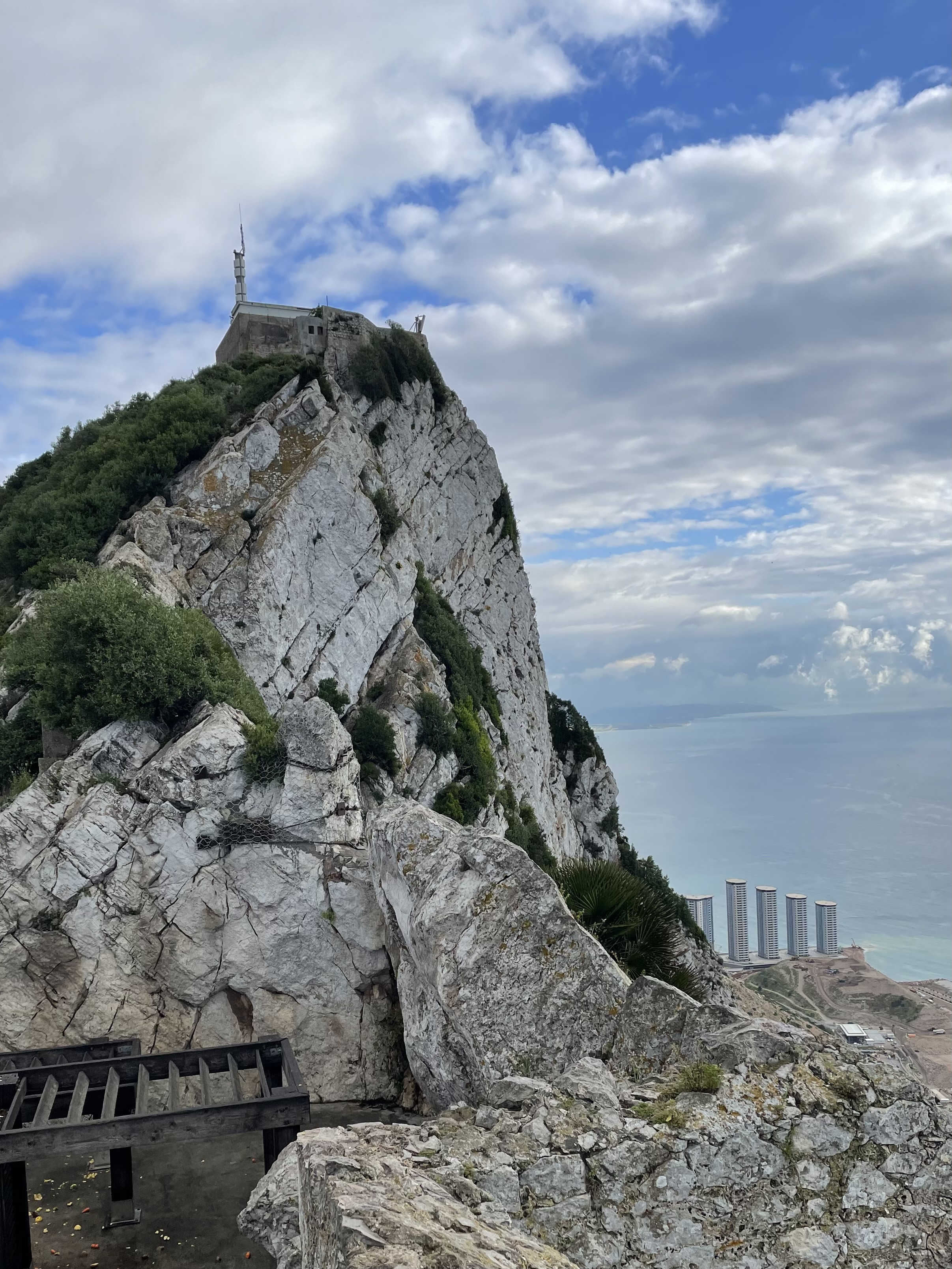
The Rock of Gibraltar, as one might expect, dominates this British territory. It is easy to see the strategic importance as well as the beauty—exemplified by St. Michael’s cave and the extensive nature reserve—of this small piece of land jutting out into the oceans.
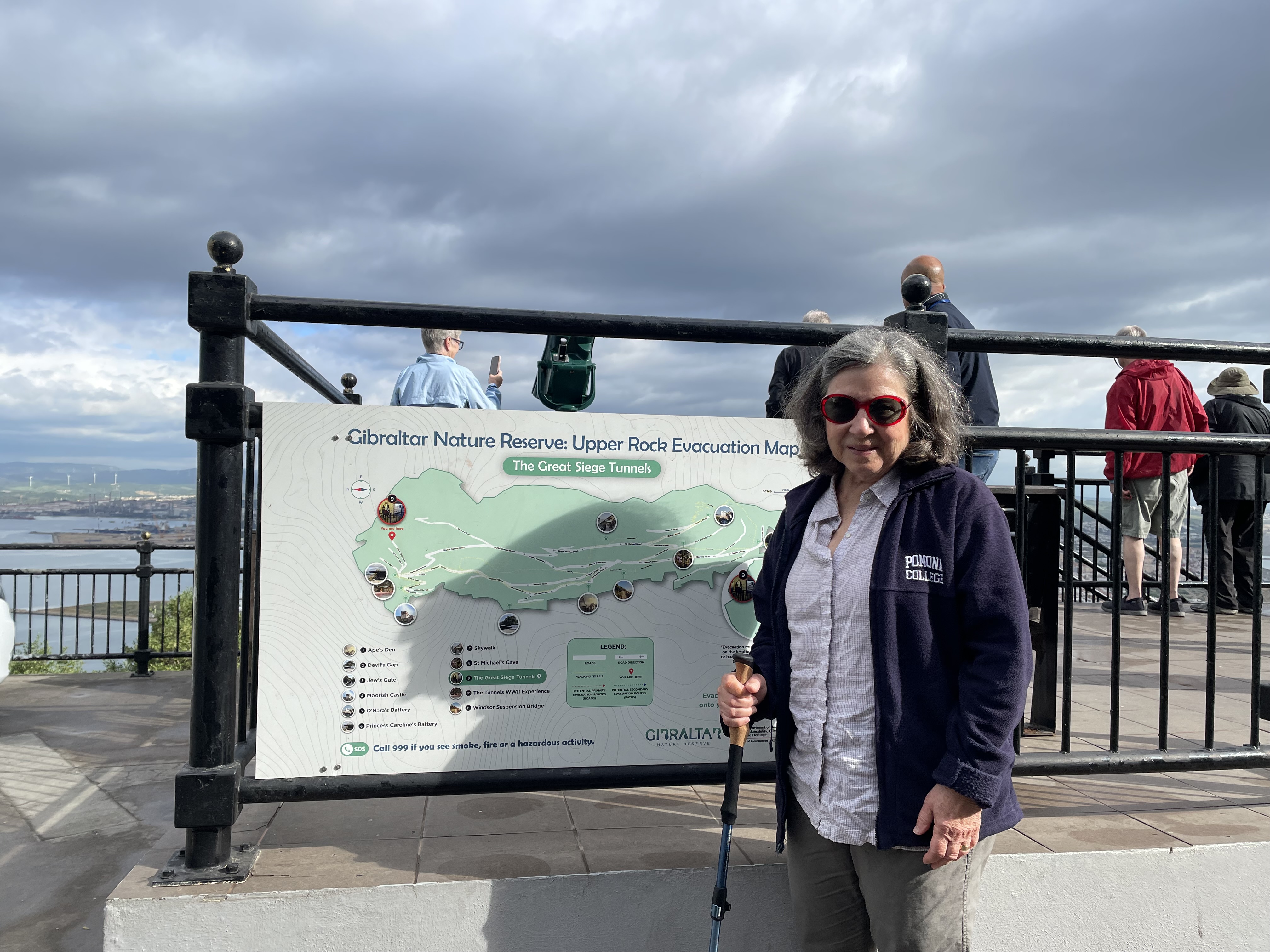
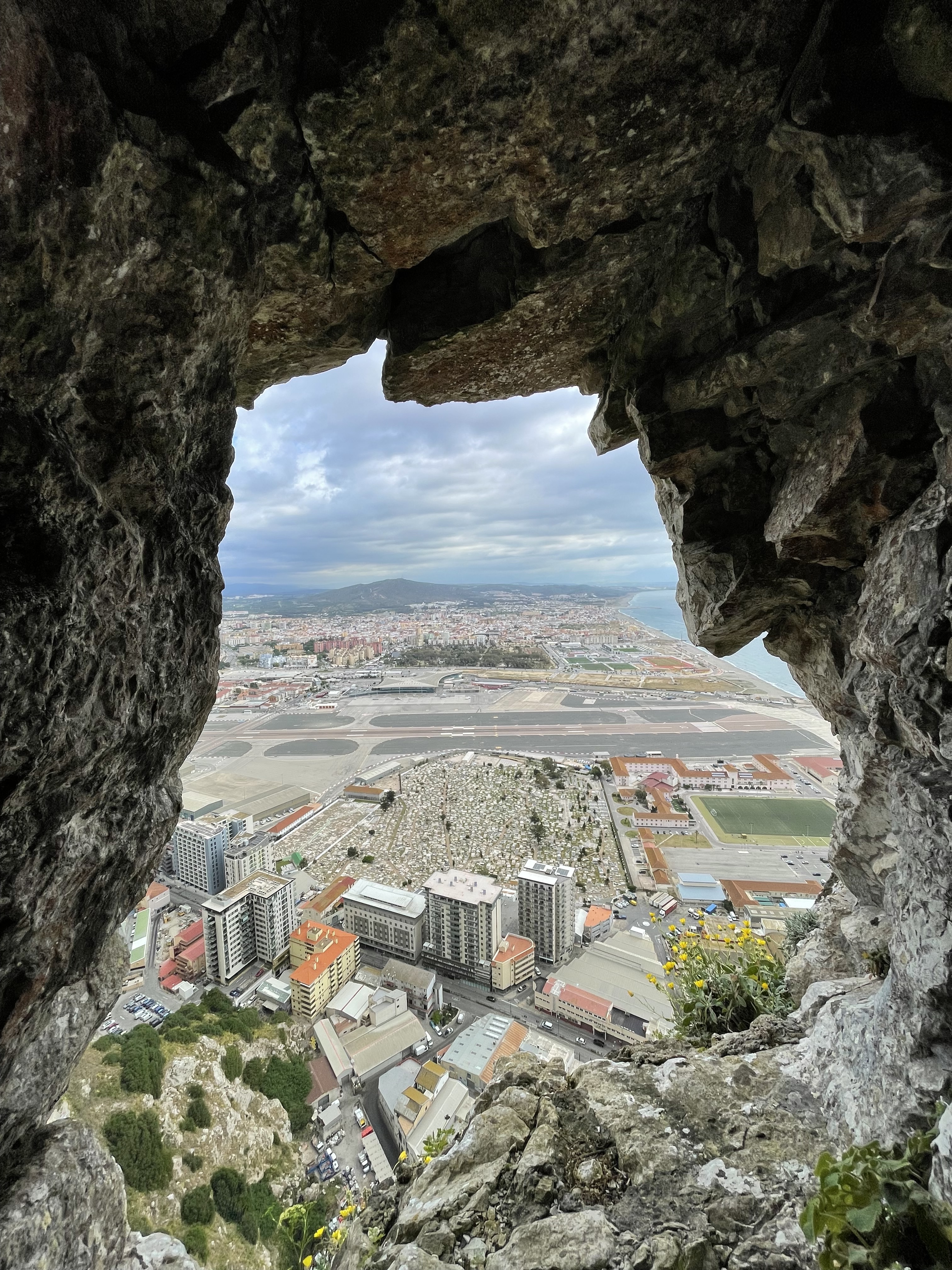
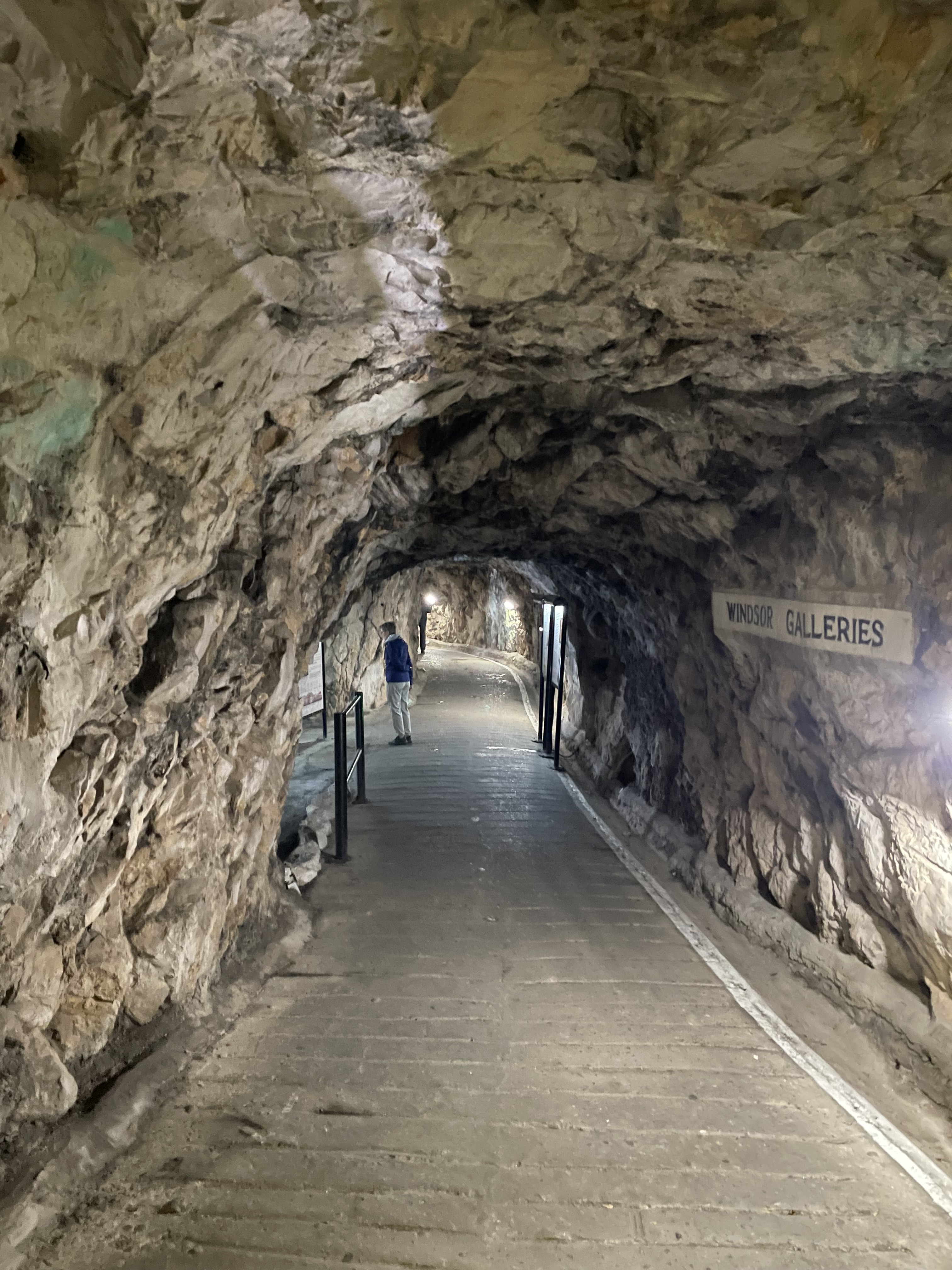
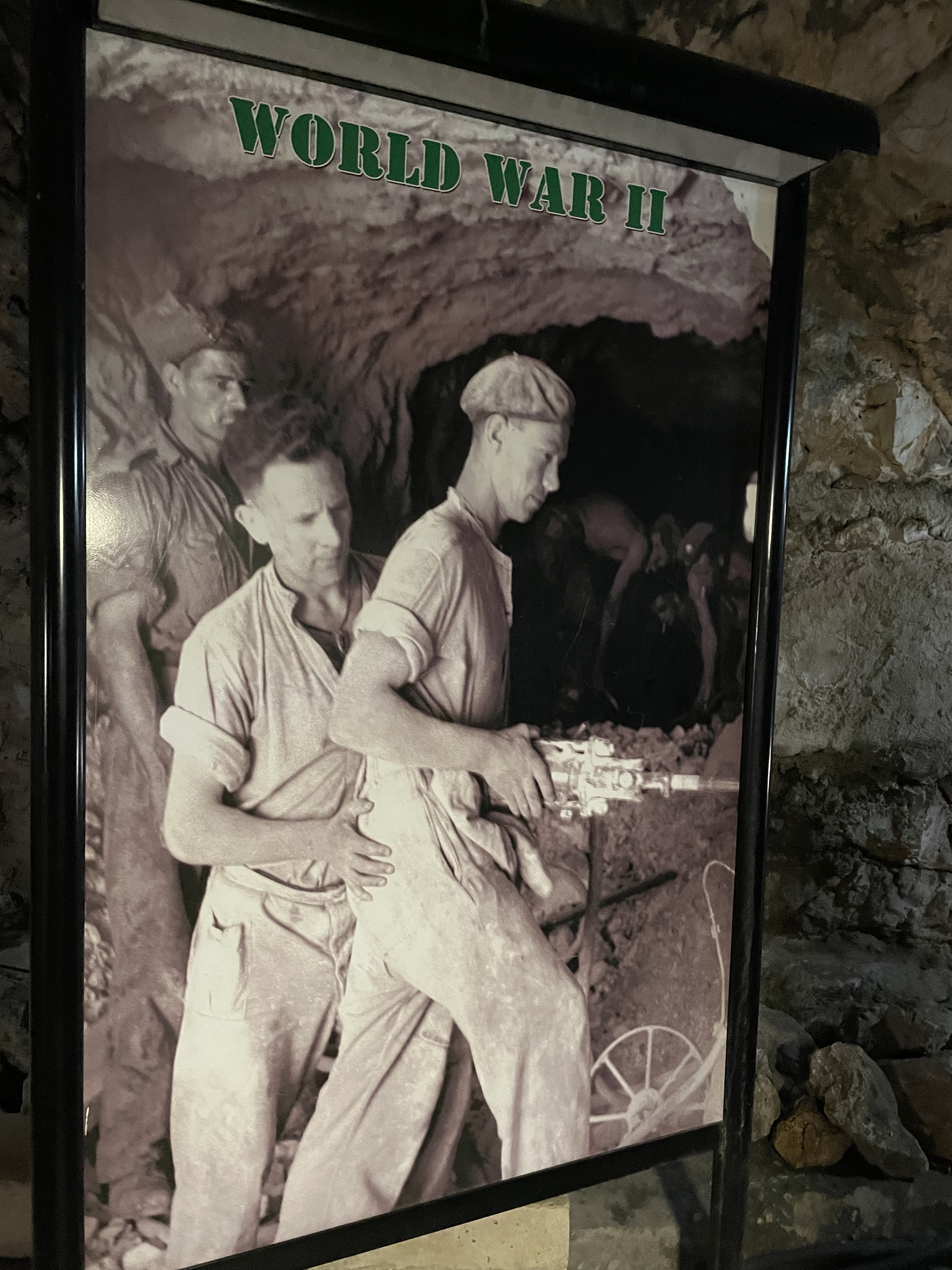
The defensive tunnels of Gibraltar, built primarily by the British over 200 years, were the other main attraction. As Wikipedia notes, within a land area of only 2.6 square miles Gibraltar has around 34 miles of tunnels, nearly twice the length of its entire road network. The first tunnels, excavated in the late 18th century, served as communication passages between artillery positions. More tunnels were constructed in the 19th century to accommodate stores and reservoirs to deliver the water supply of Gibraltar.
“The 20th century saw by far the greatest extent of tunnelling when the Rock was turned into a huge underground fortress capable of accommodating 16,000 men along with all the supplies, ammunition and equipment needed to withstand a prolonged siege.”
SEVILLE
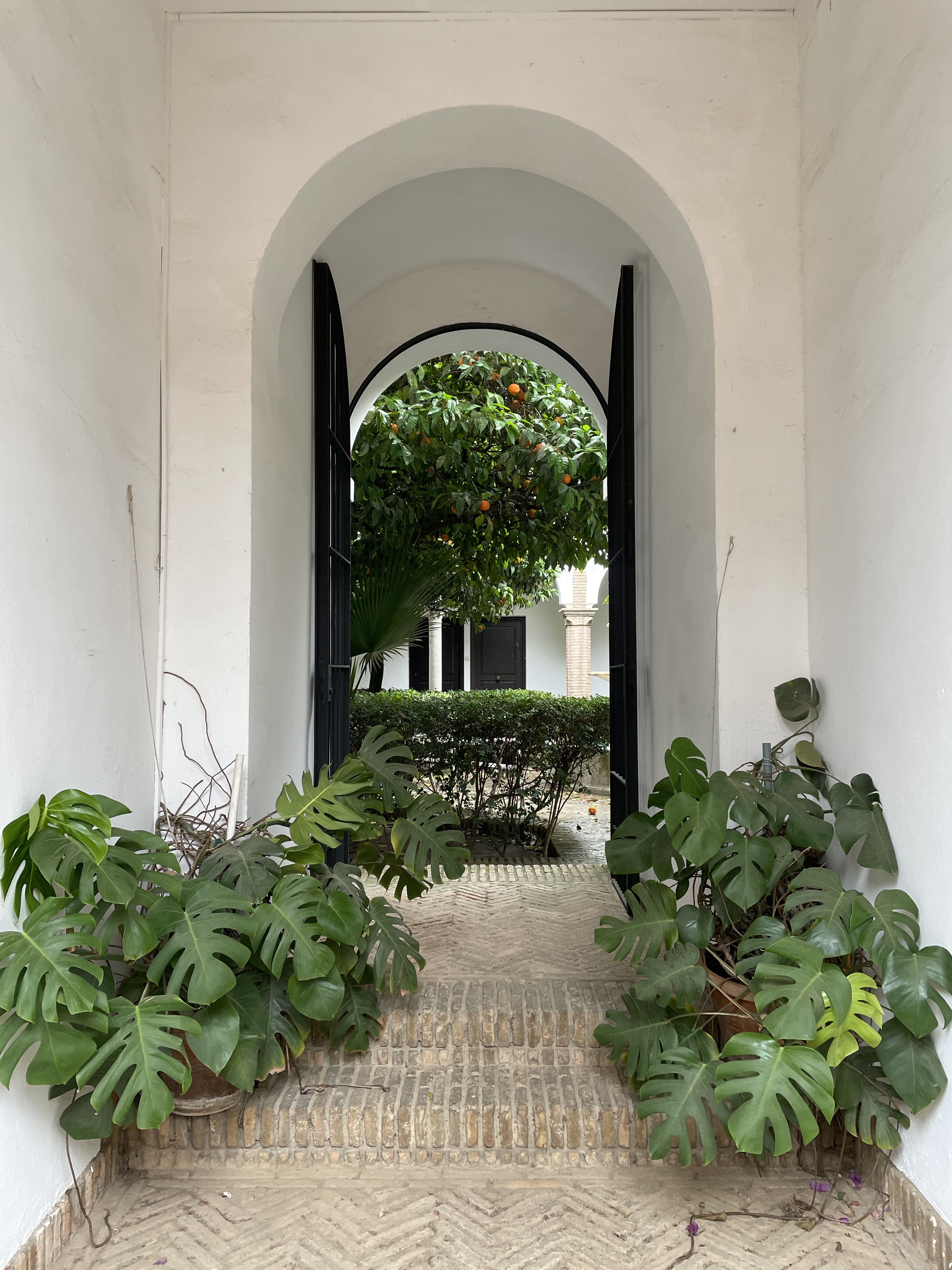
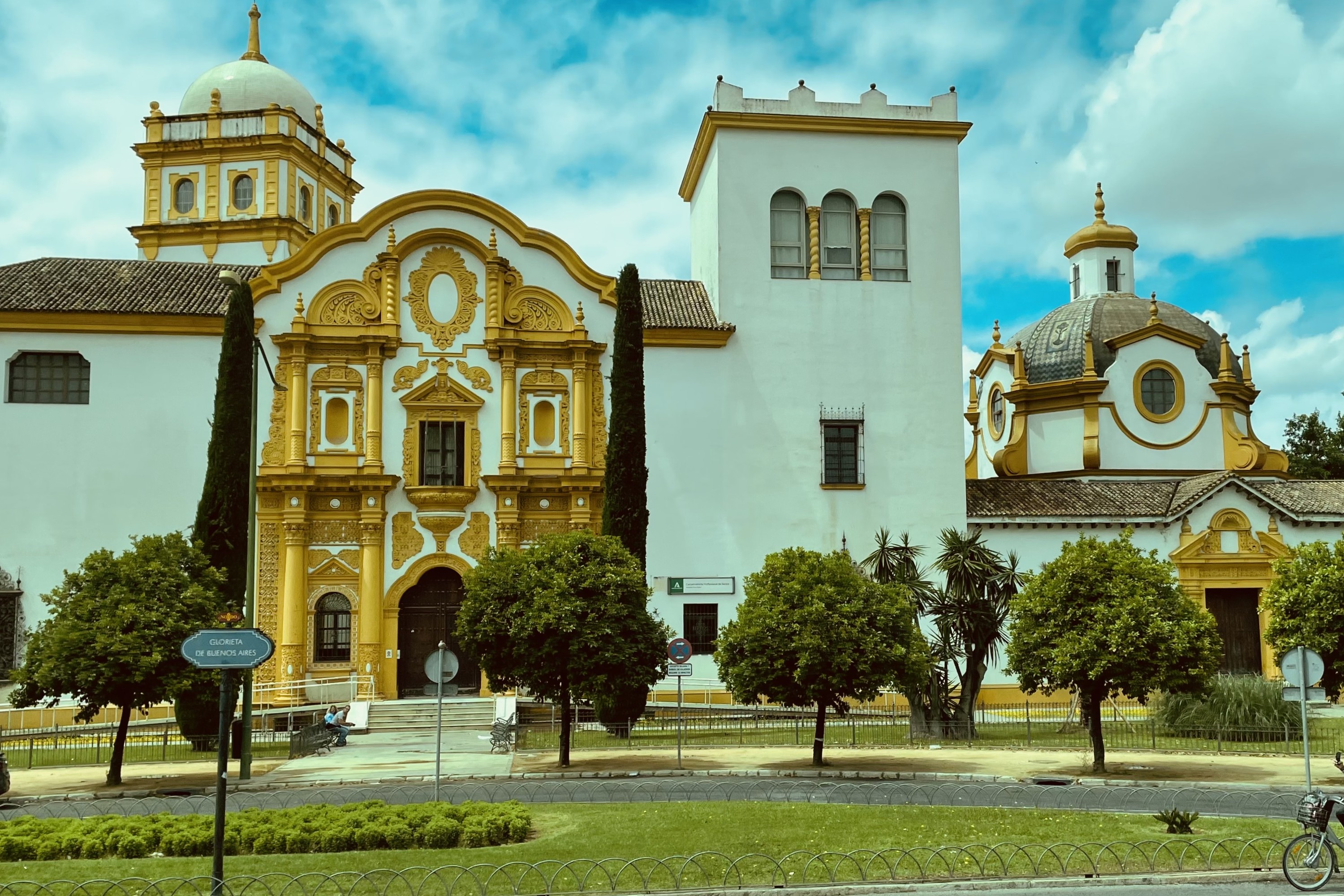
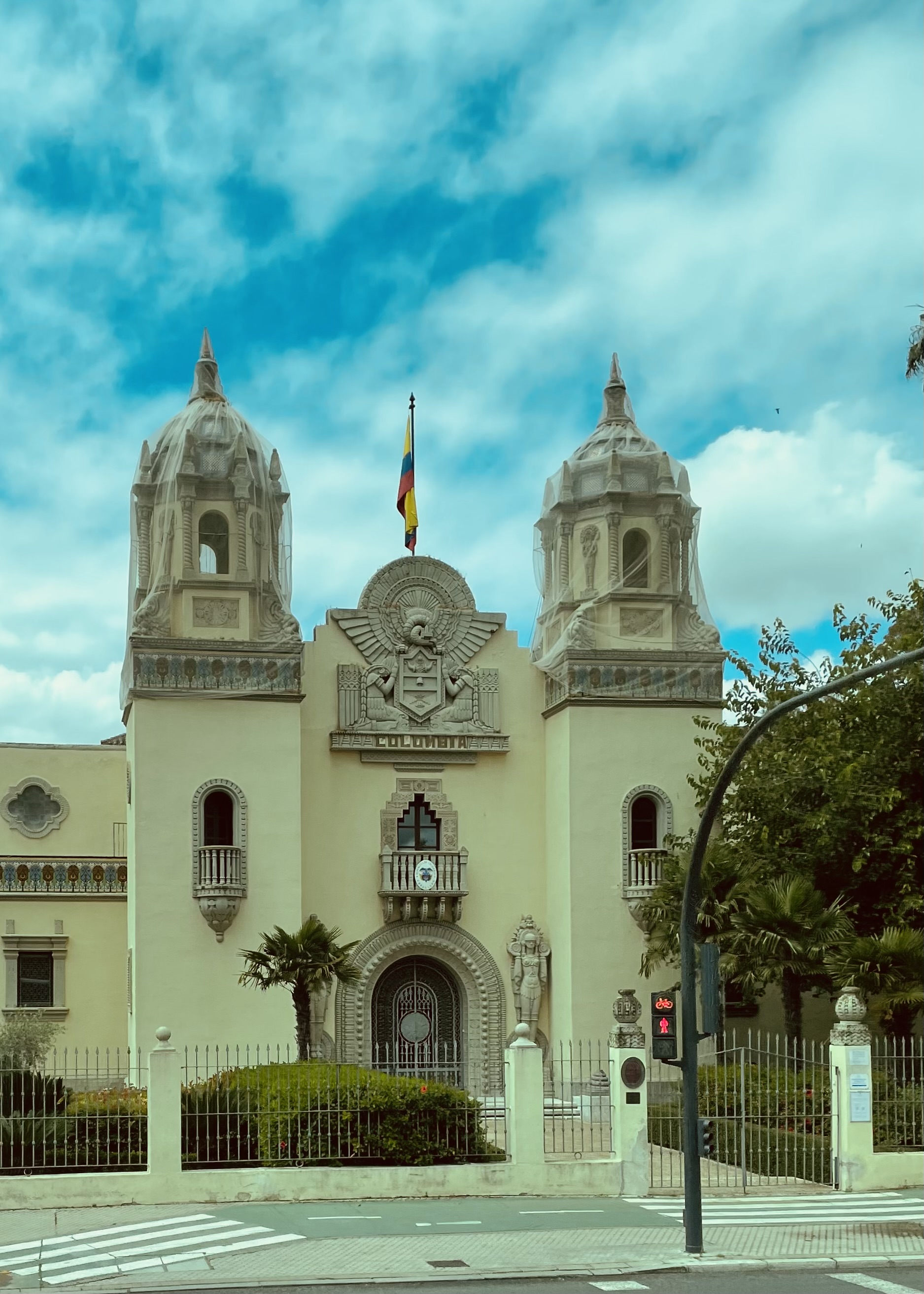
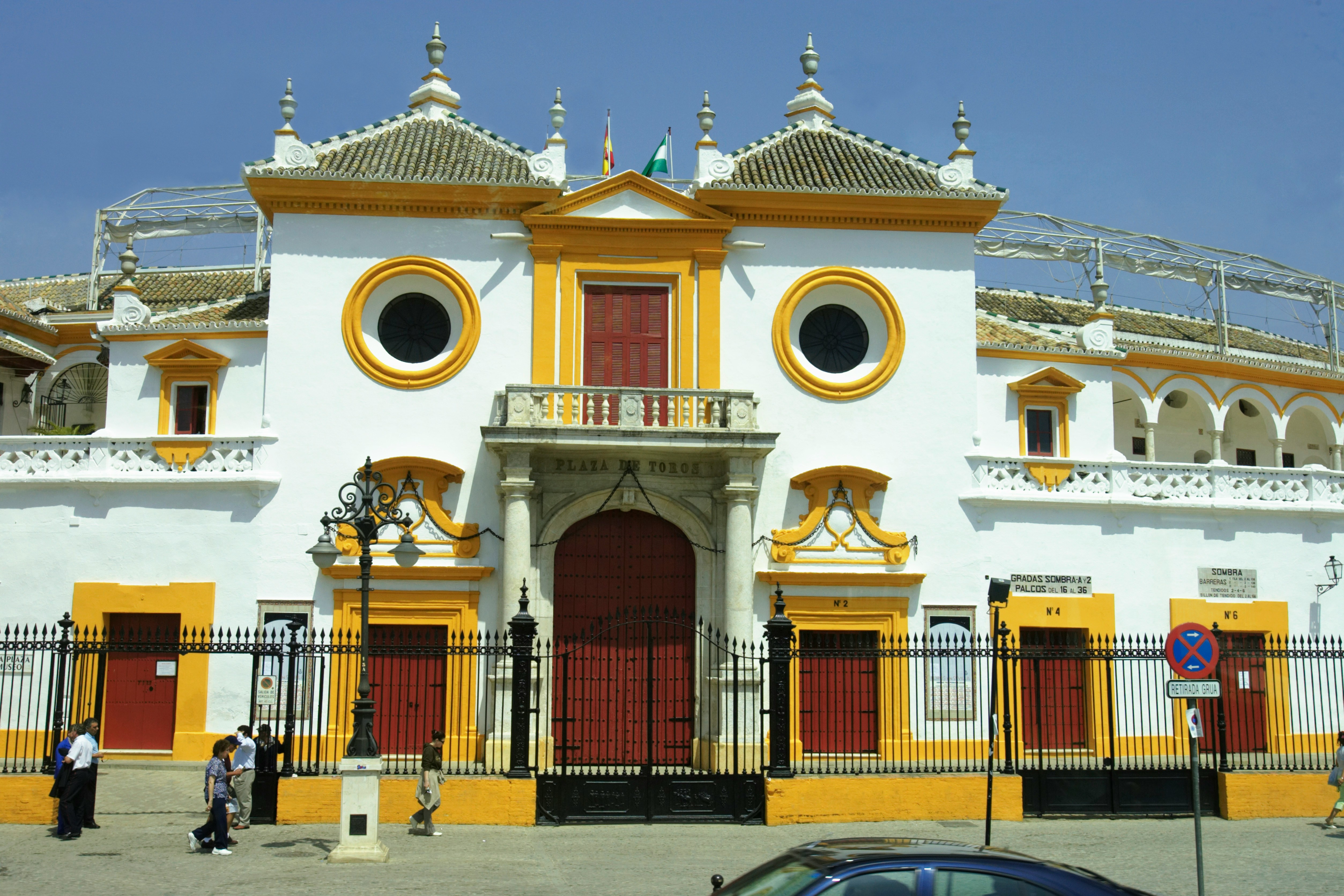
Seville, our next stop, is known for the beauty of its architecture, both historic and modern, including works such as Santiago Calatrava’s well-known Alamillo Bridge, designed for the 1992 World Expo. When leaving the port to enter Seville, one is immediately captivated by the breadth and depth of the city’s built heritage.
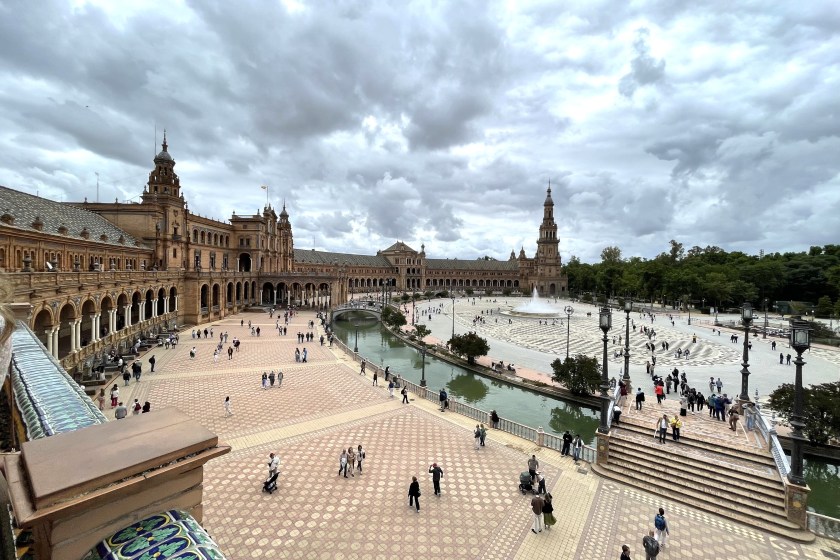
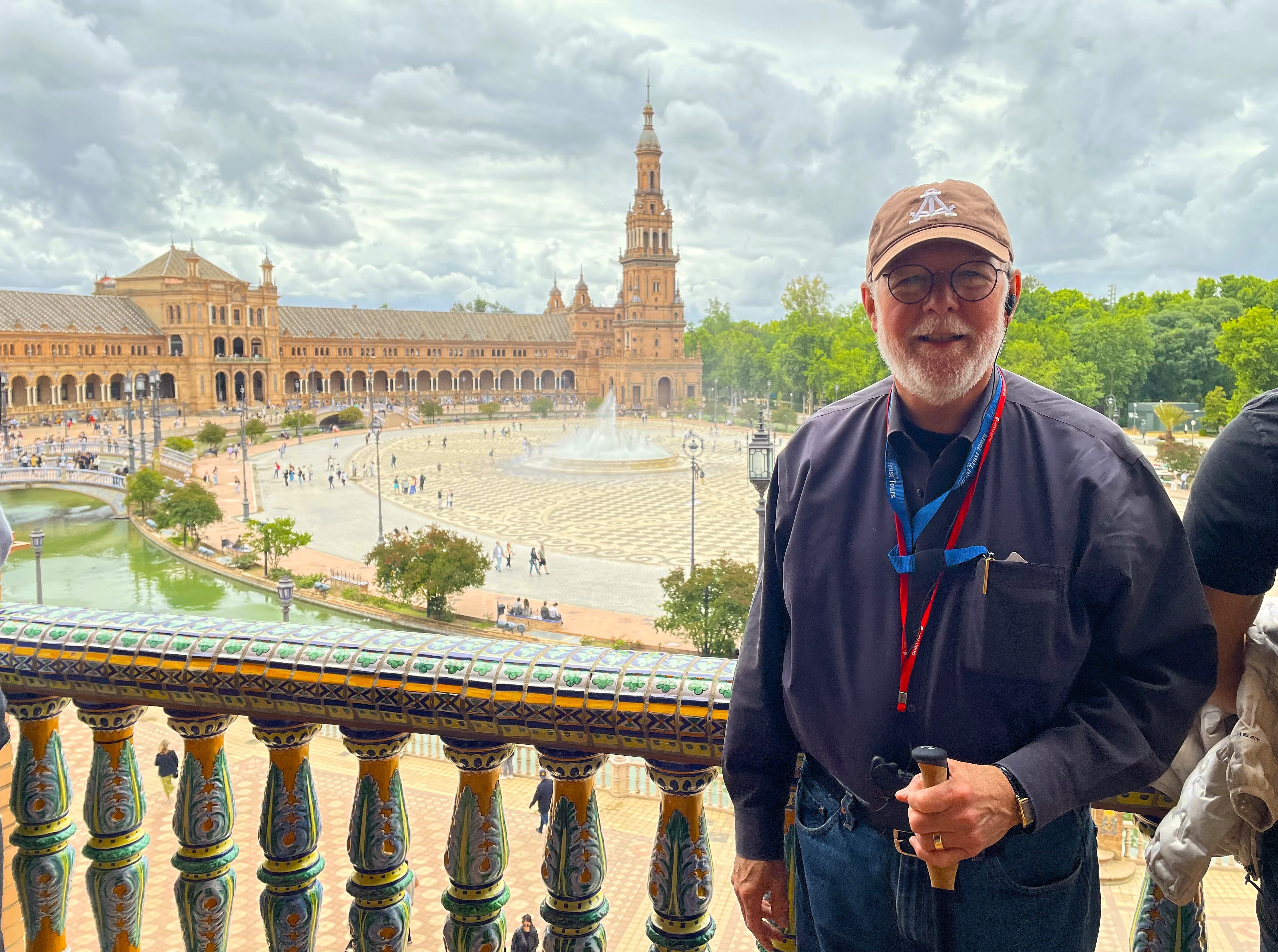
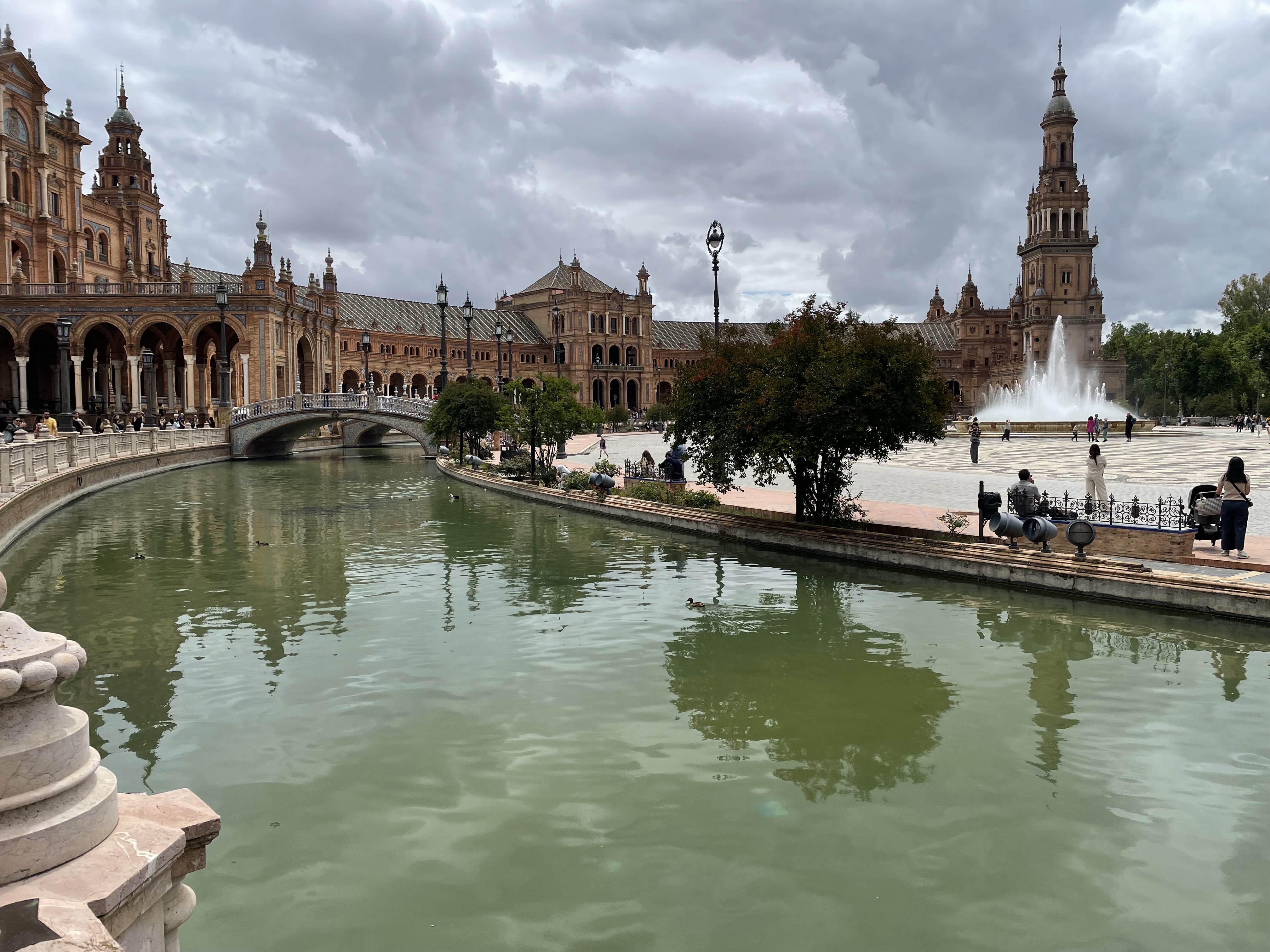
Plaza de España
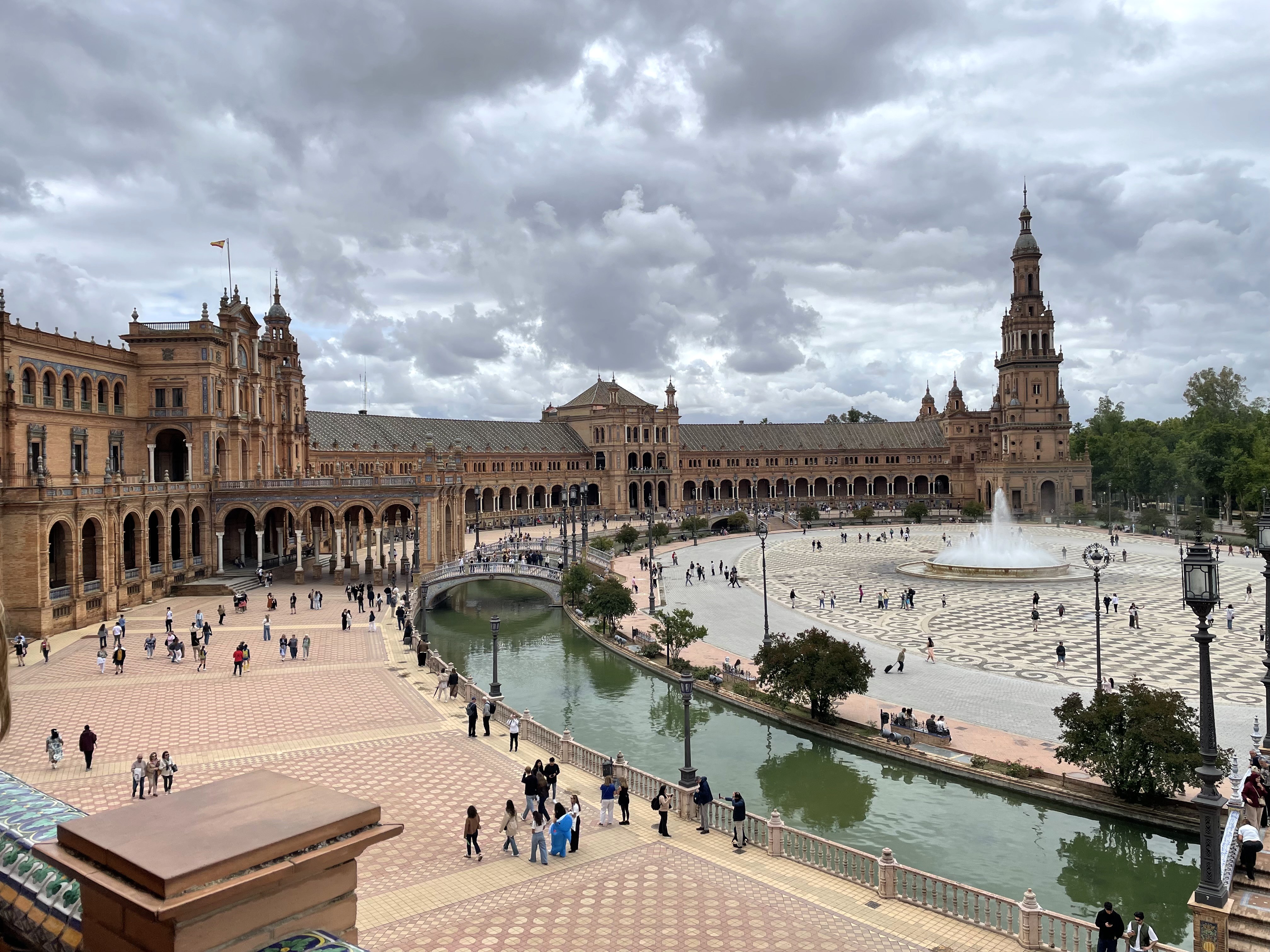
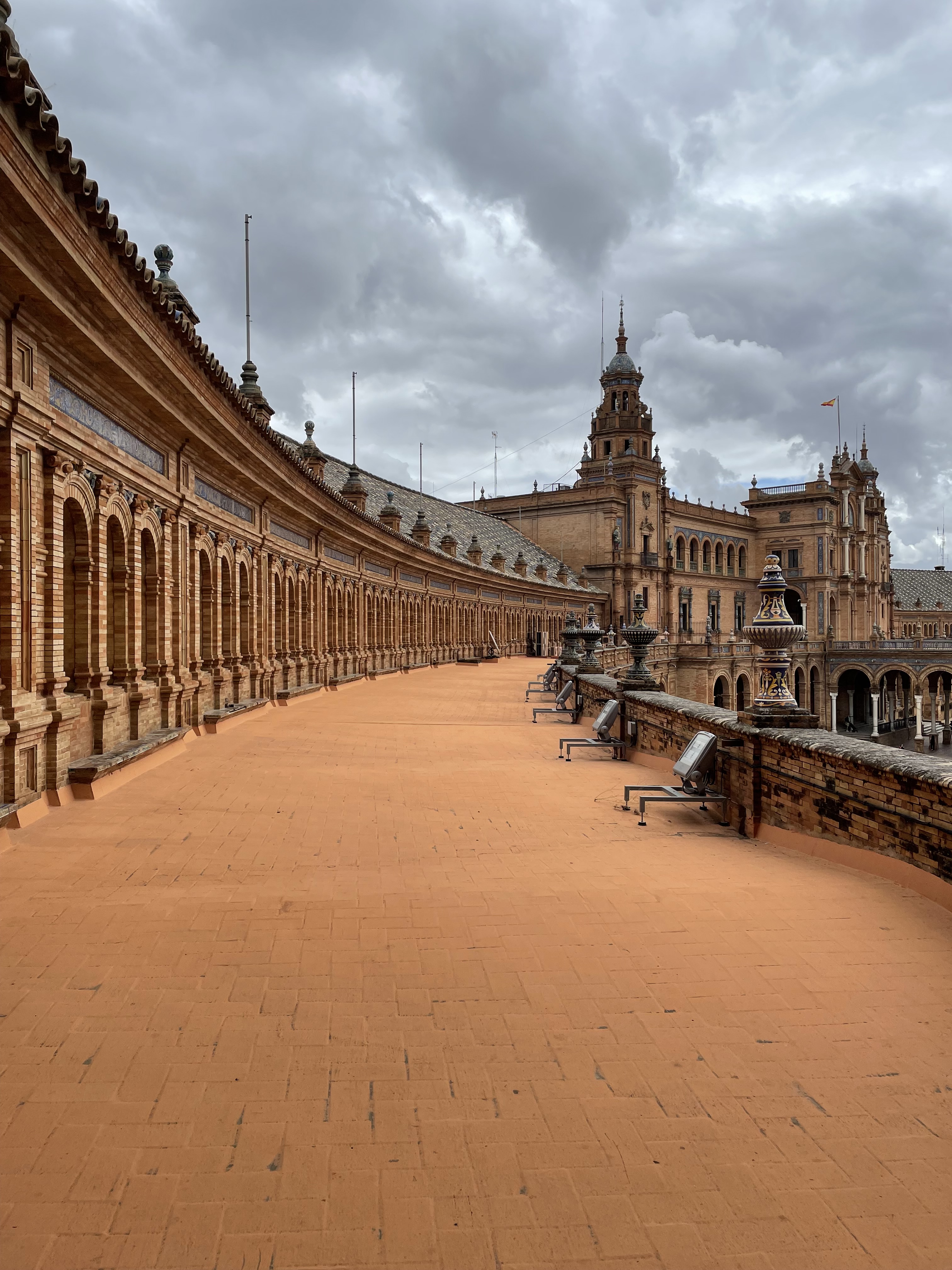
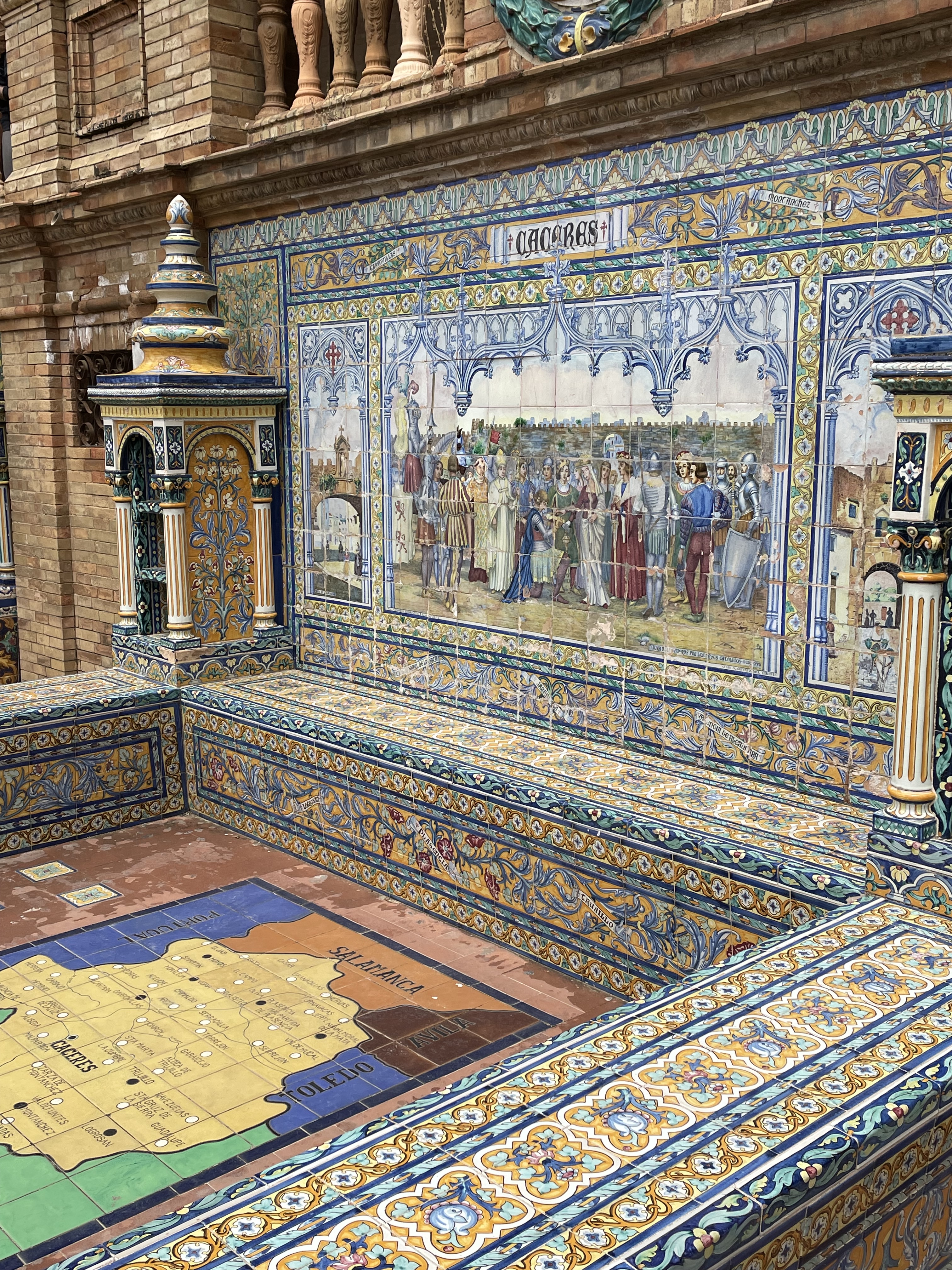
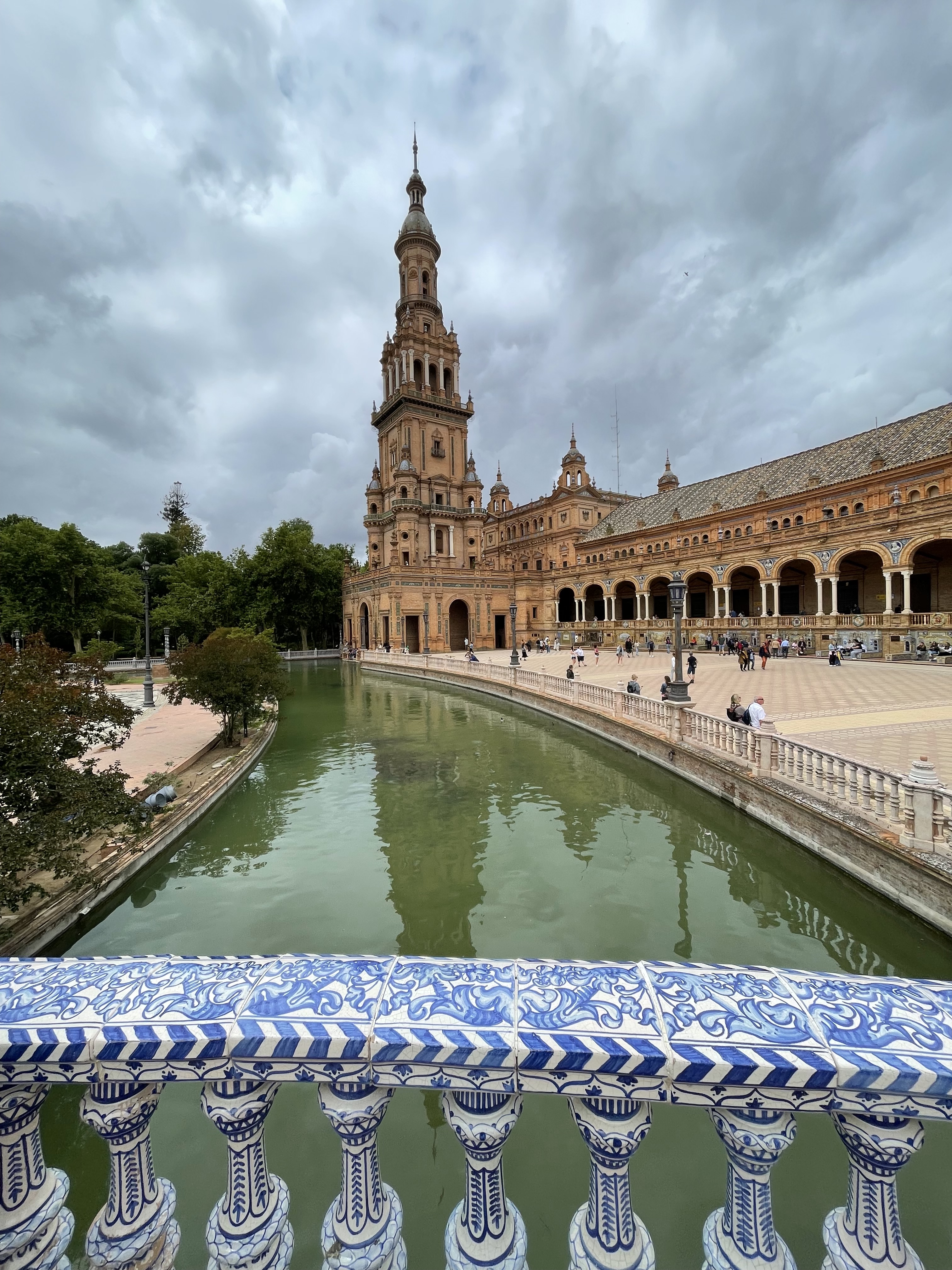
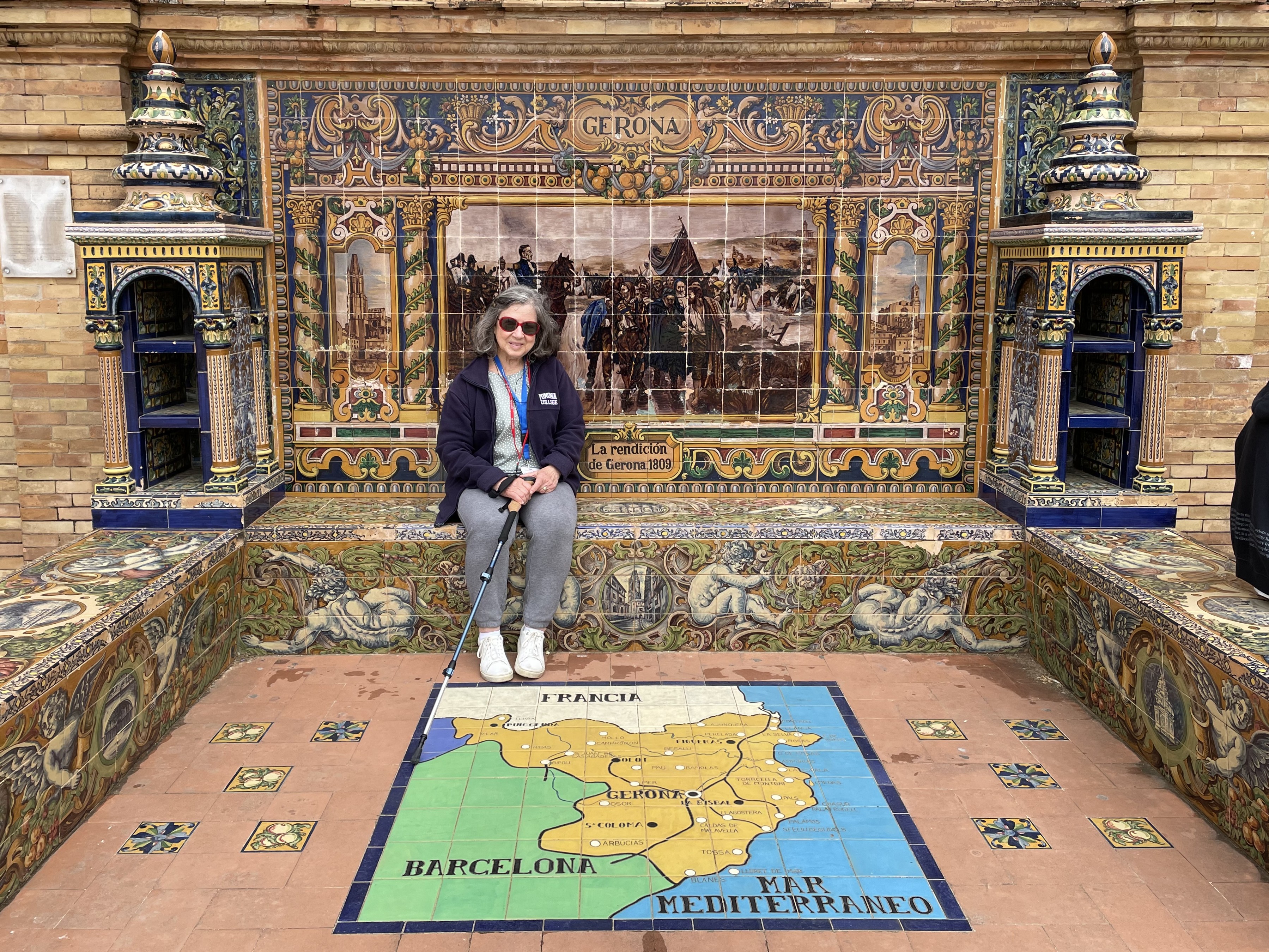
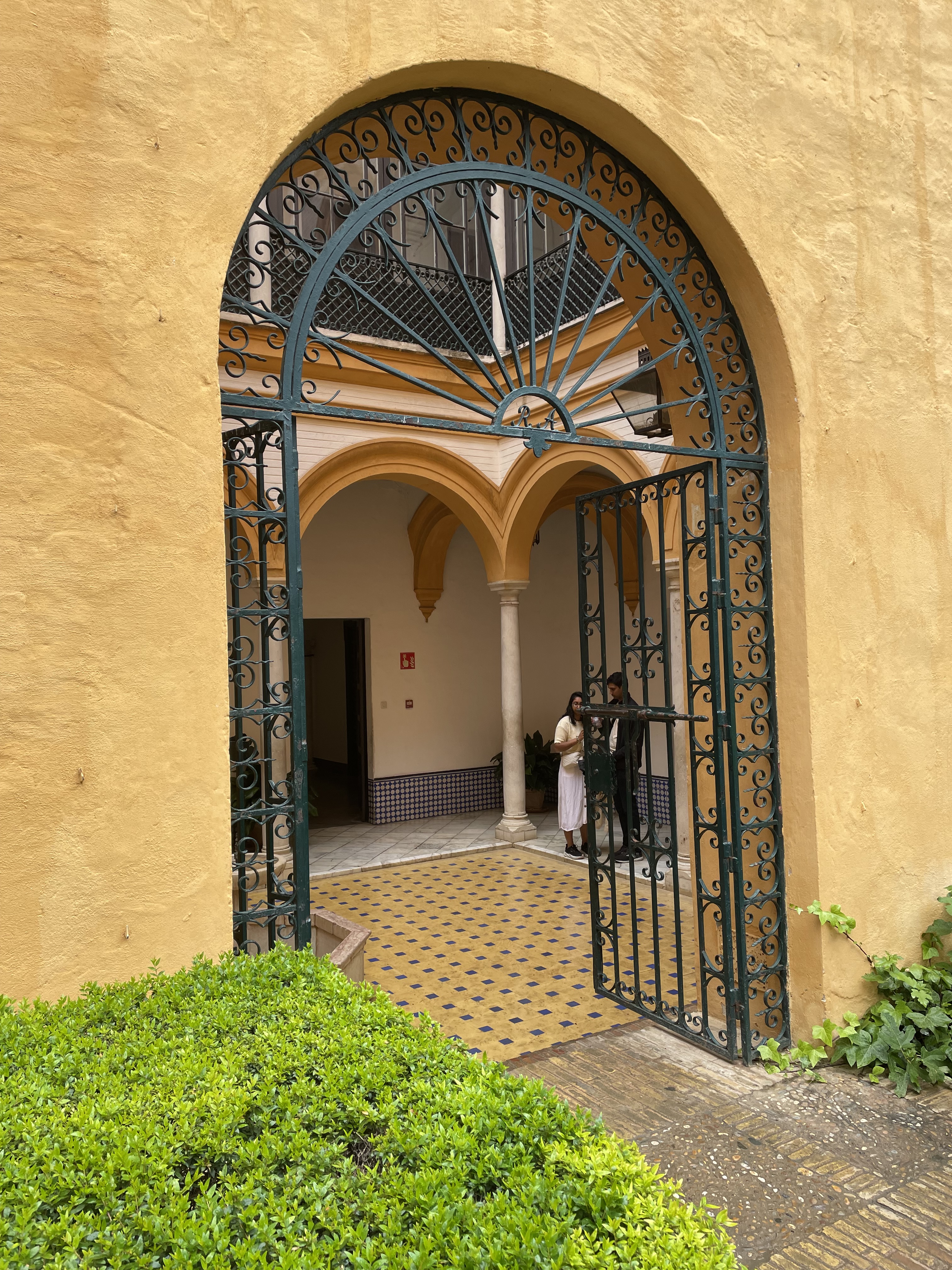
Our tour group visited the remarkable Plaza de España, located in the Maria Luisa Park.
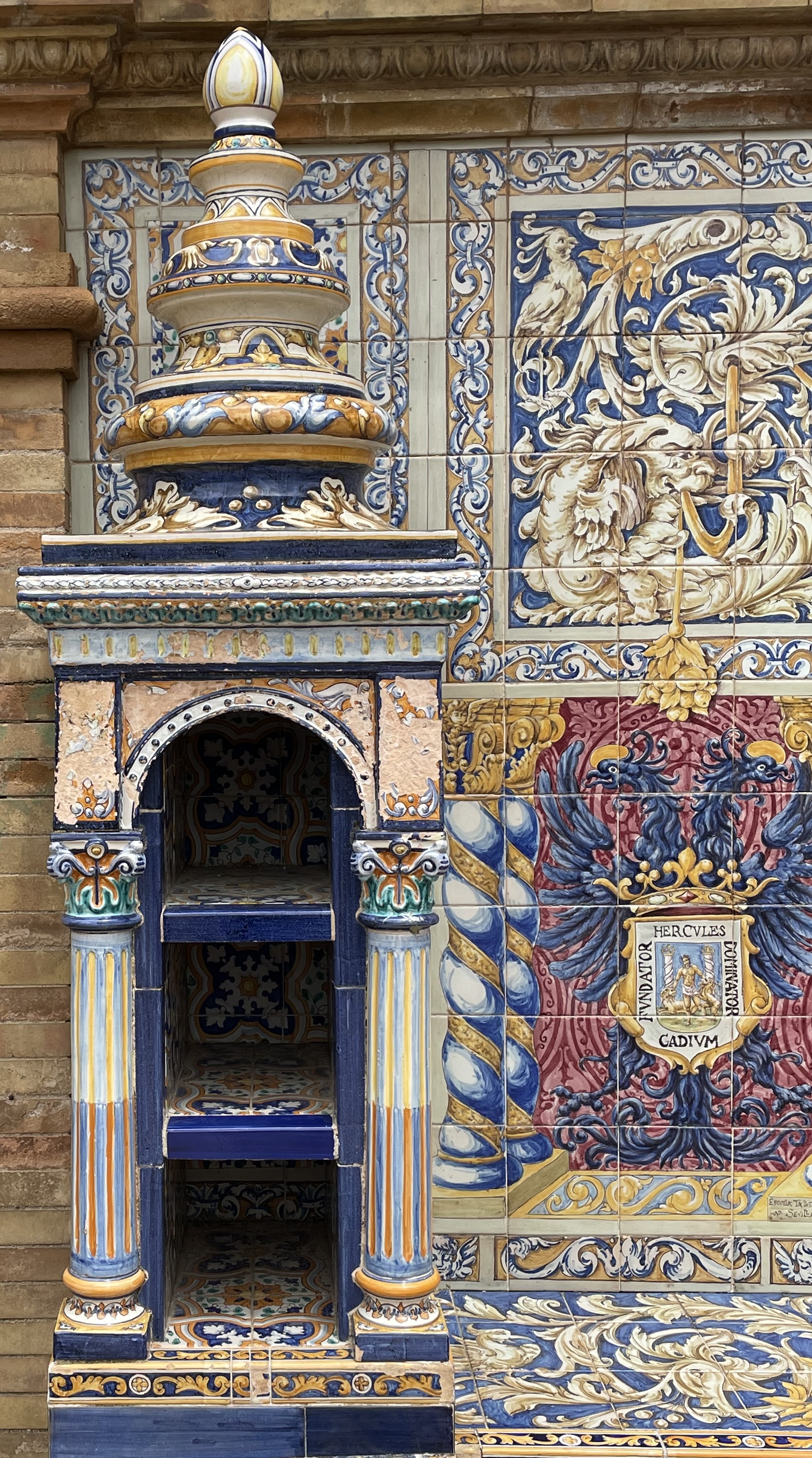
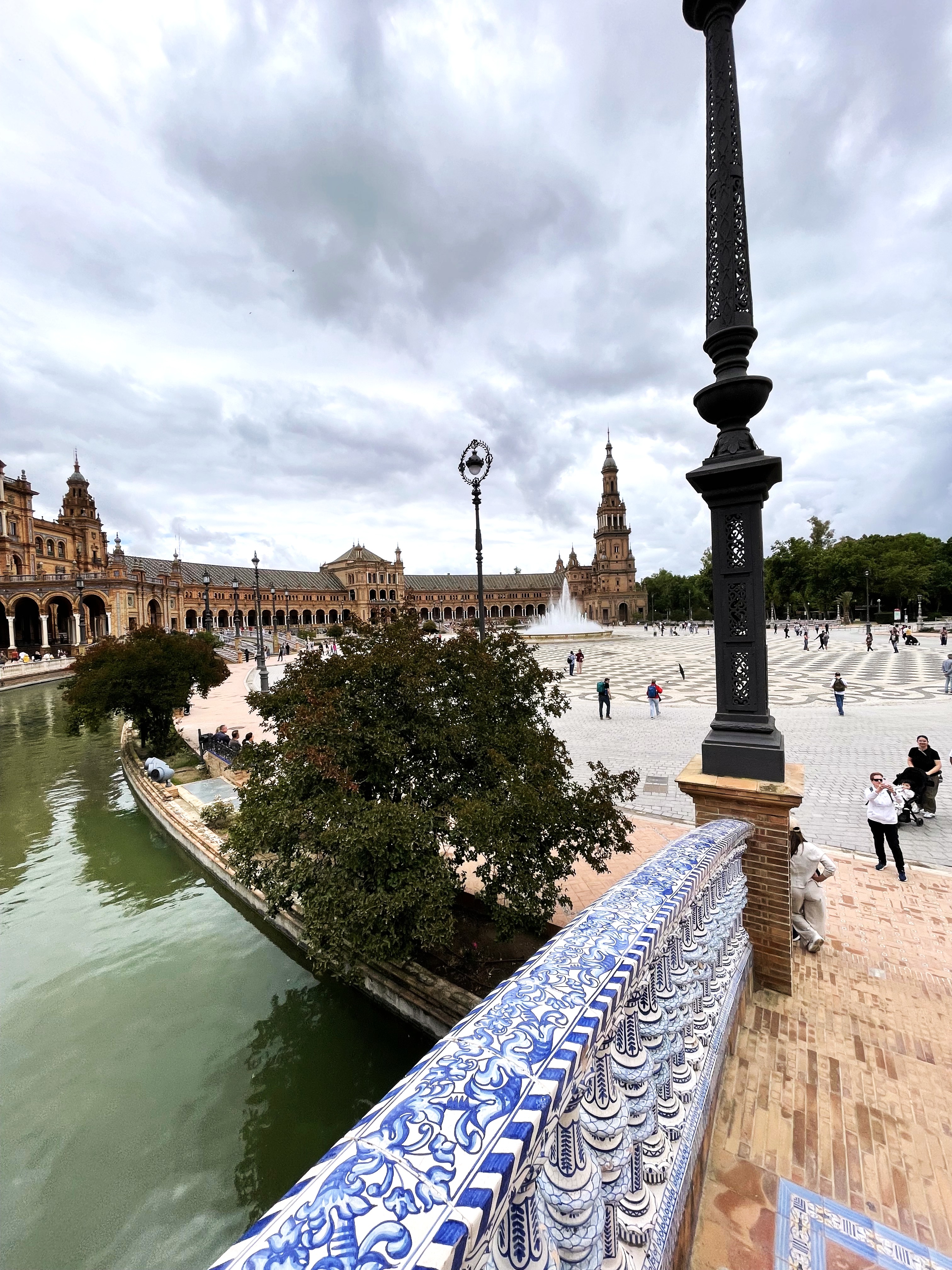
The plaza was built in 1928 for the Ibero-American Exposition of 1929 and mixes elements of the Baroque Revival, Renaissance Revival, and Moorish Revival styles of Spanish architecture in what is a landmark example of Regionalism Architecture. It was teeming with people drawn to the architecture, water, wide plaza, and beautiful details.
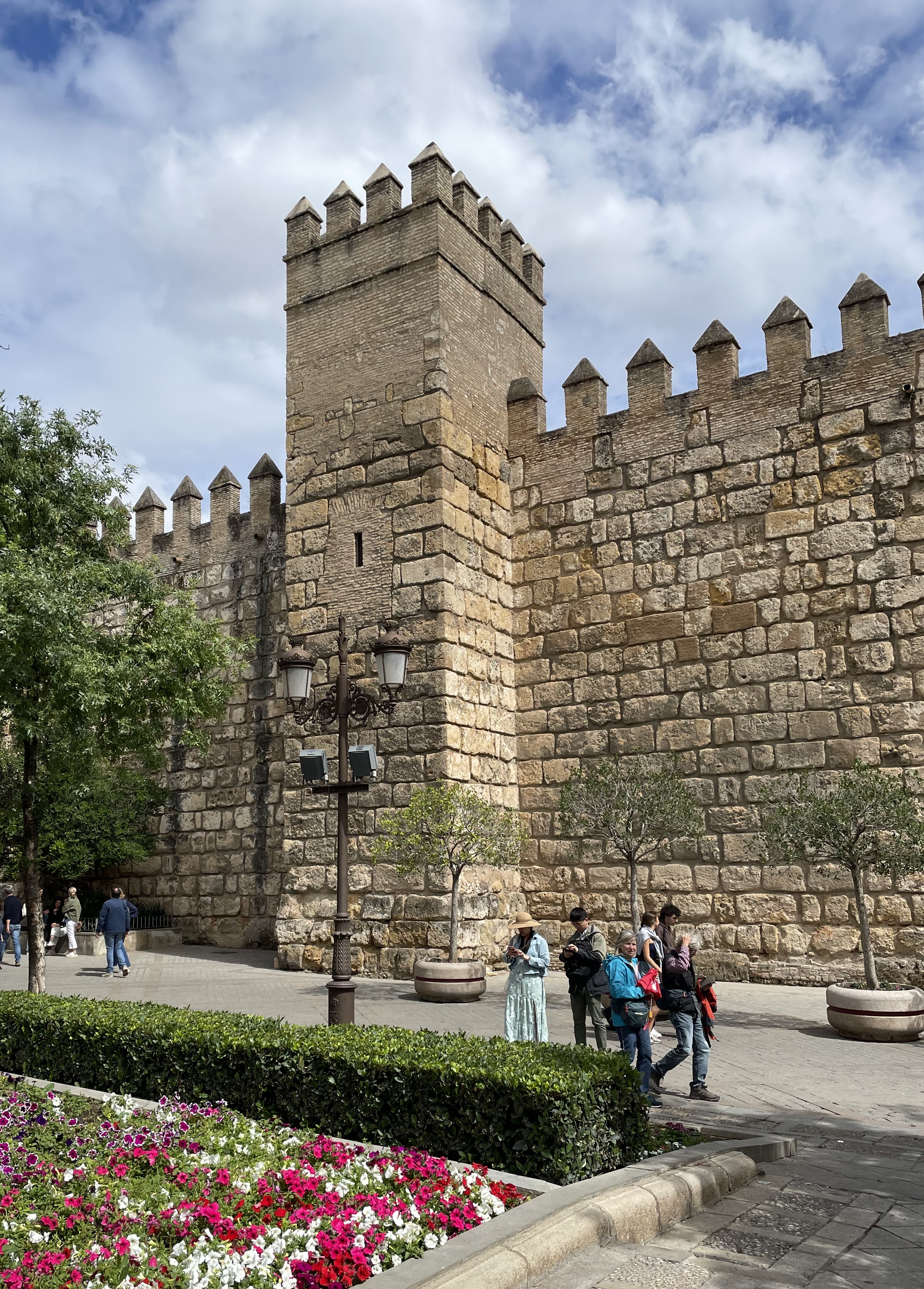
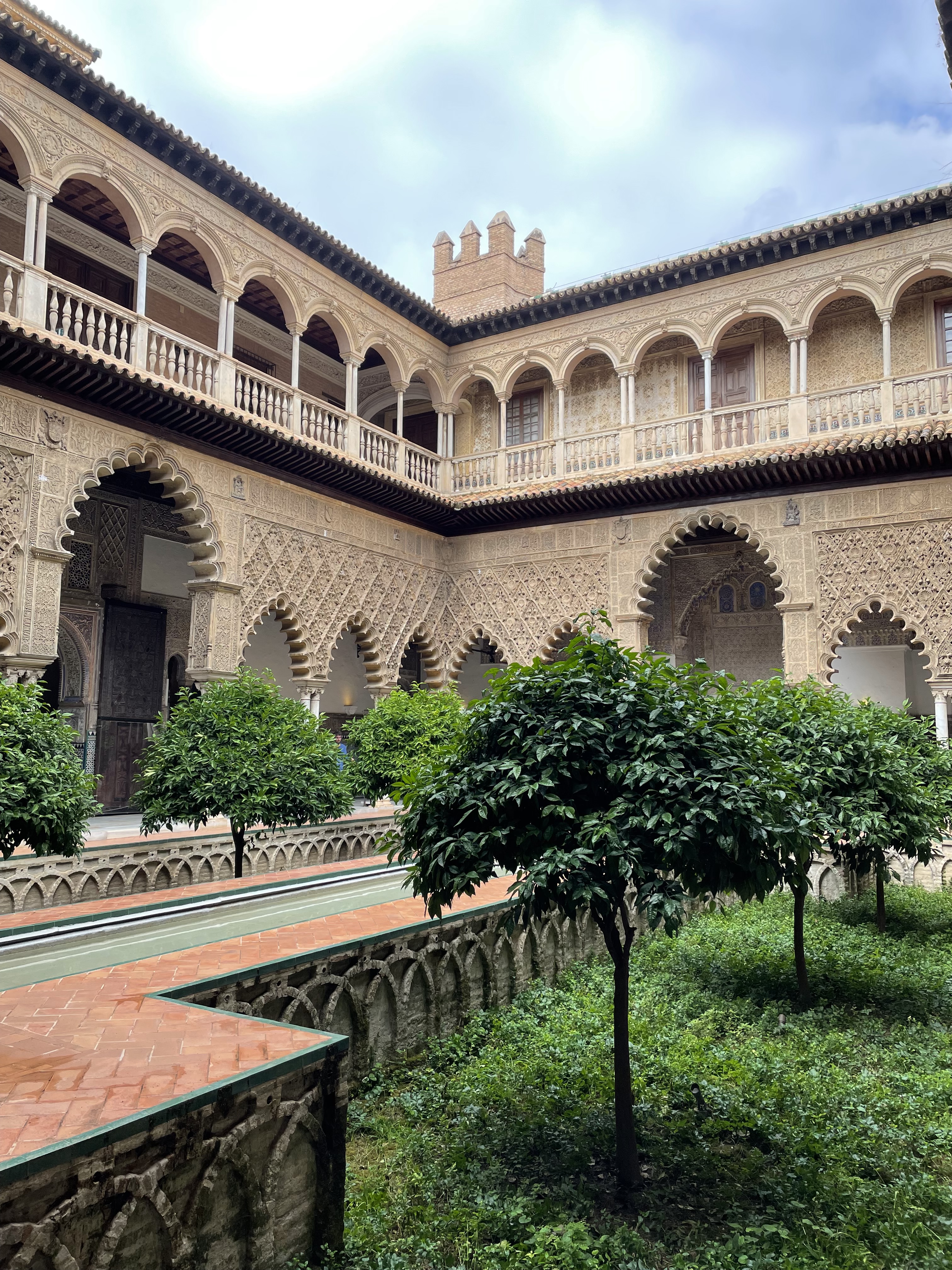
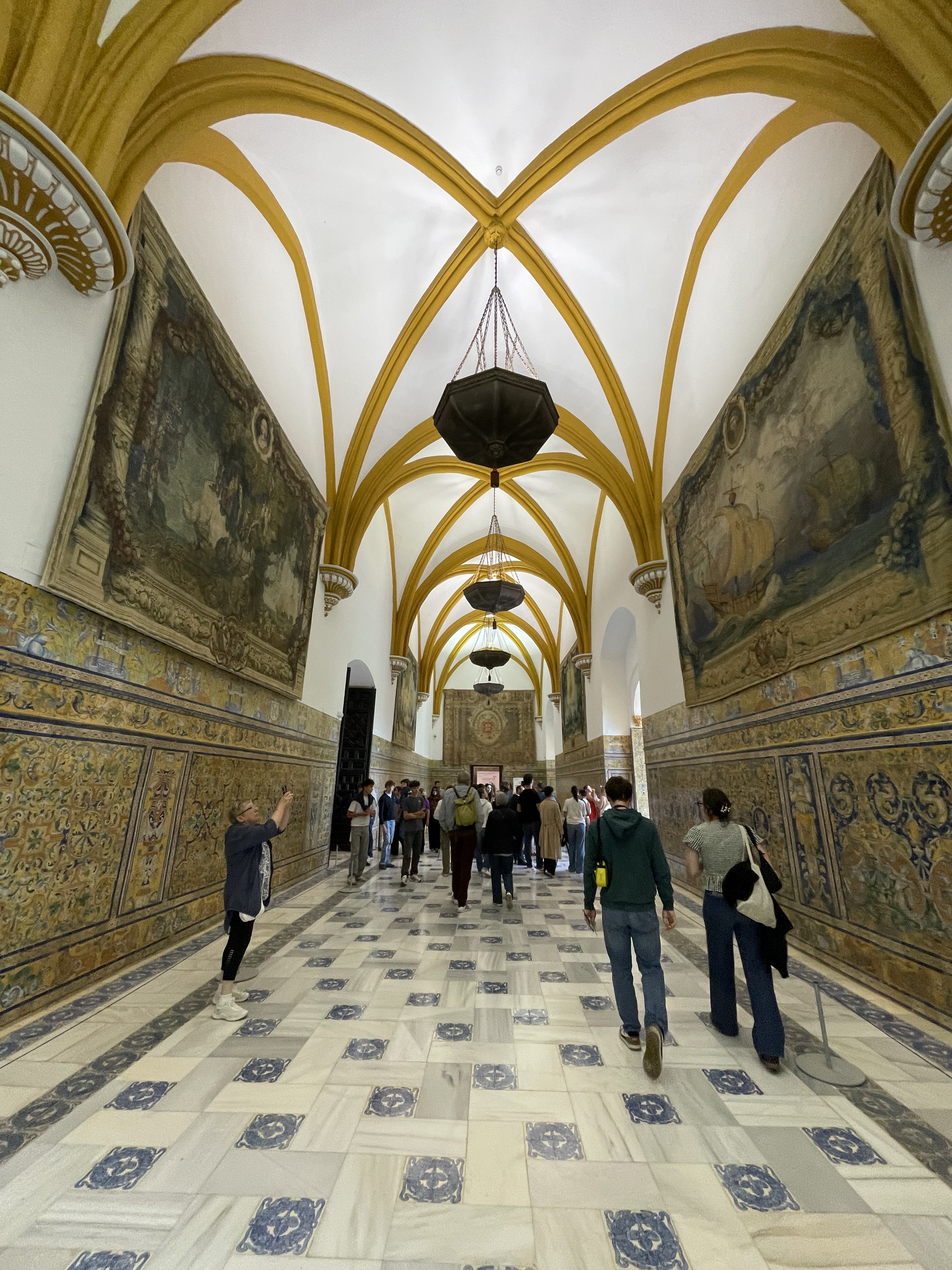
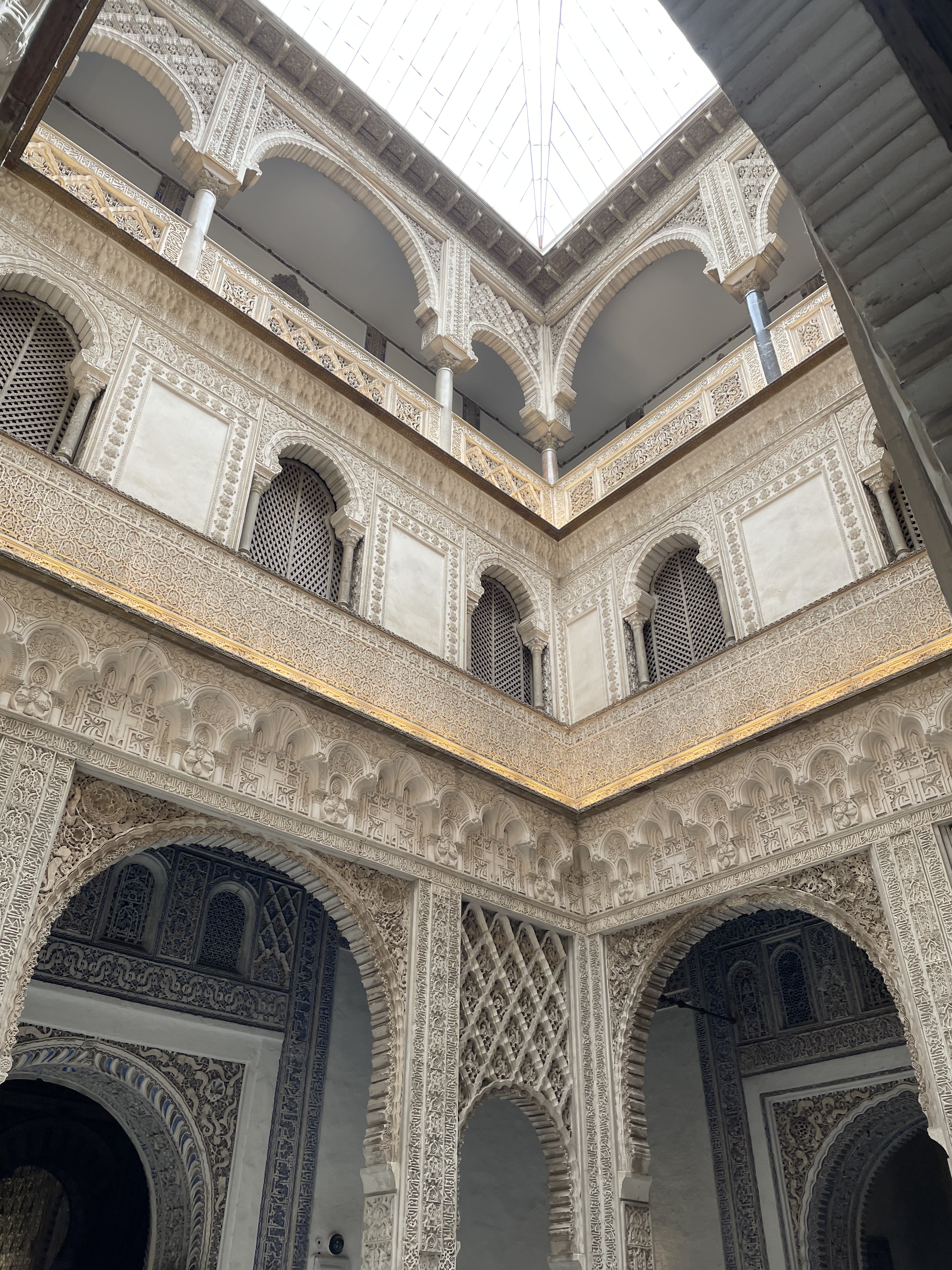
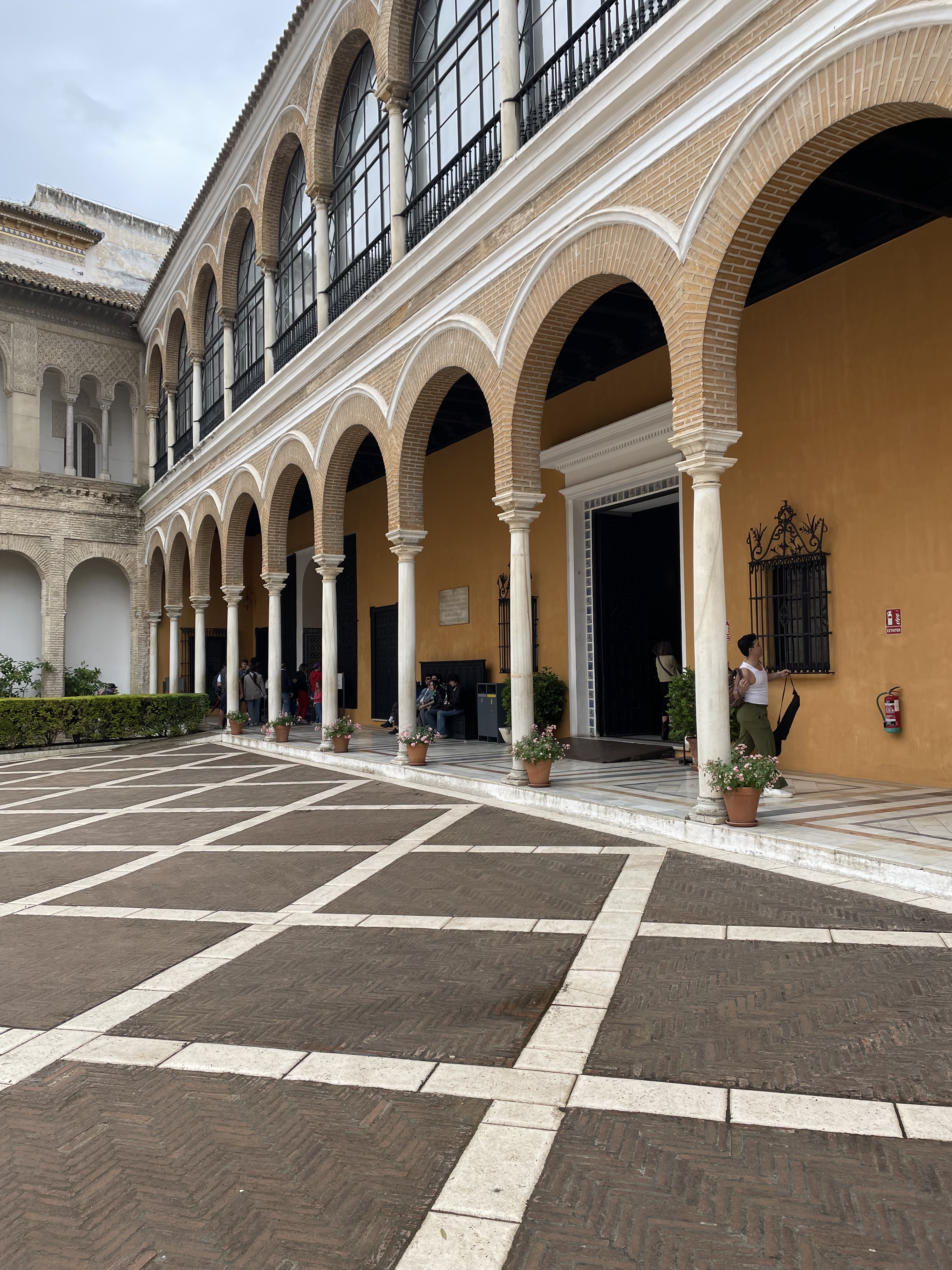
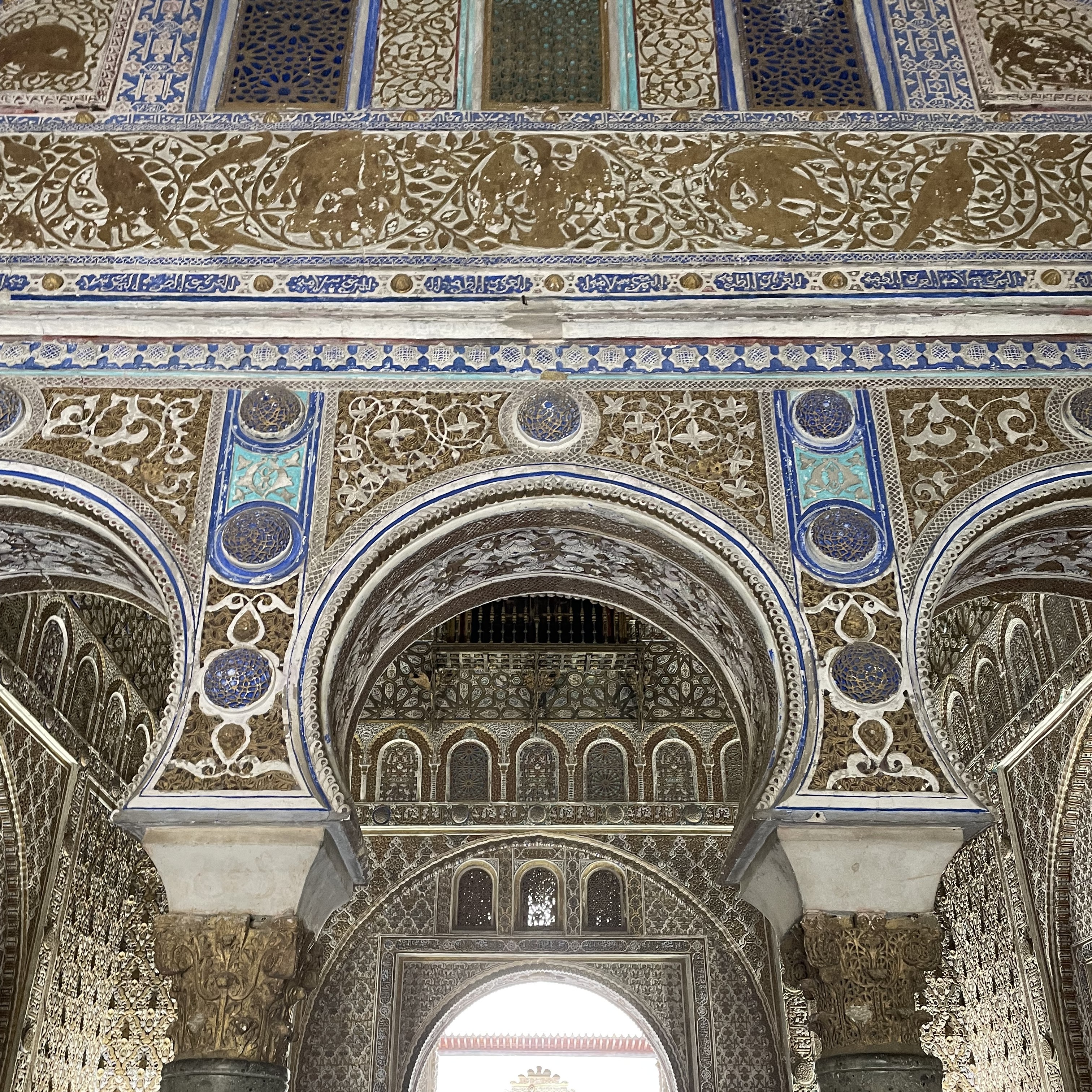
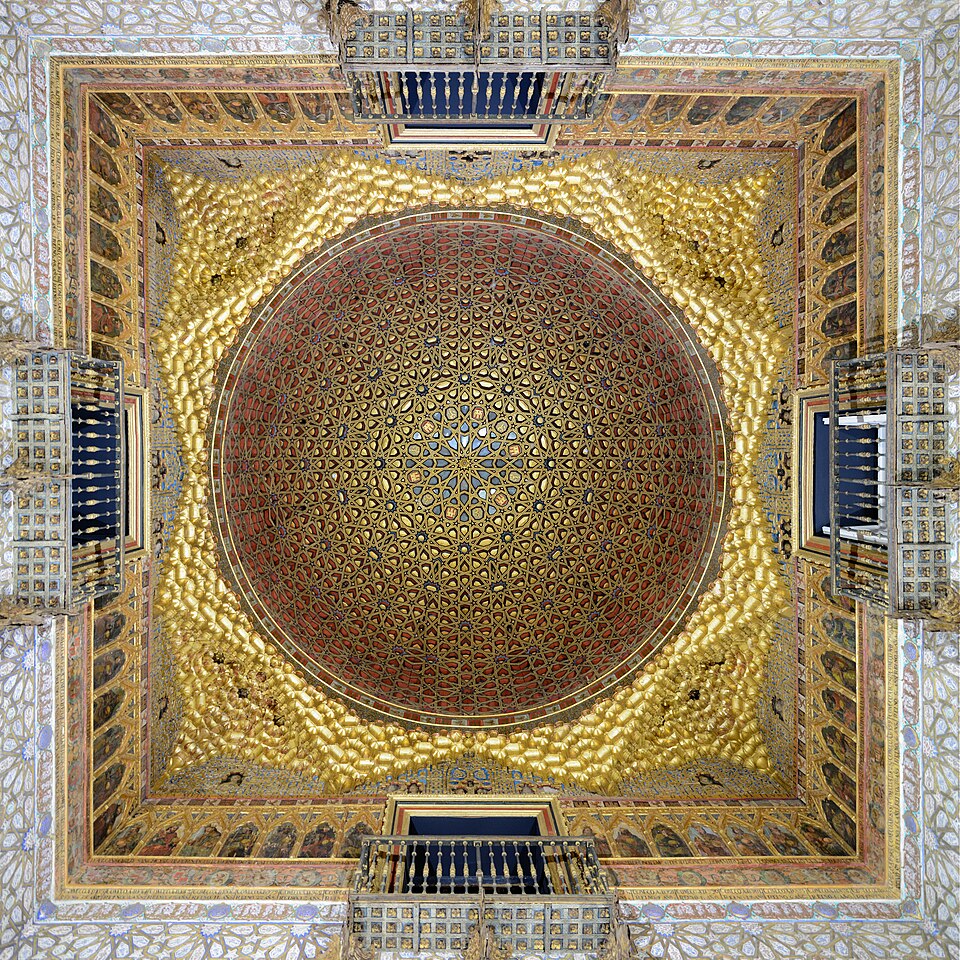
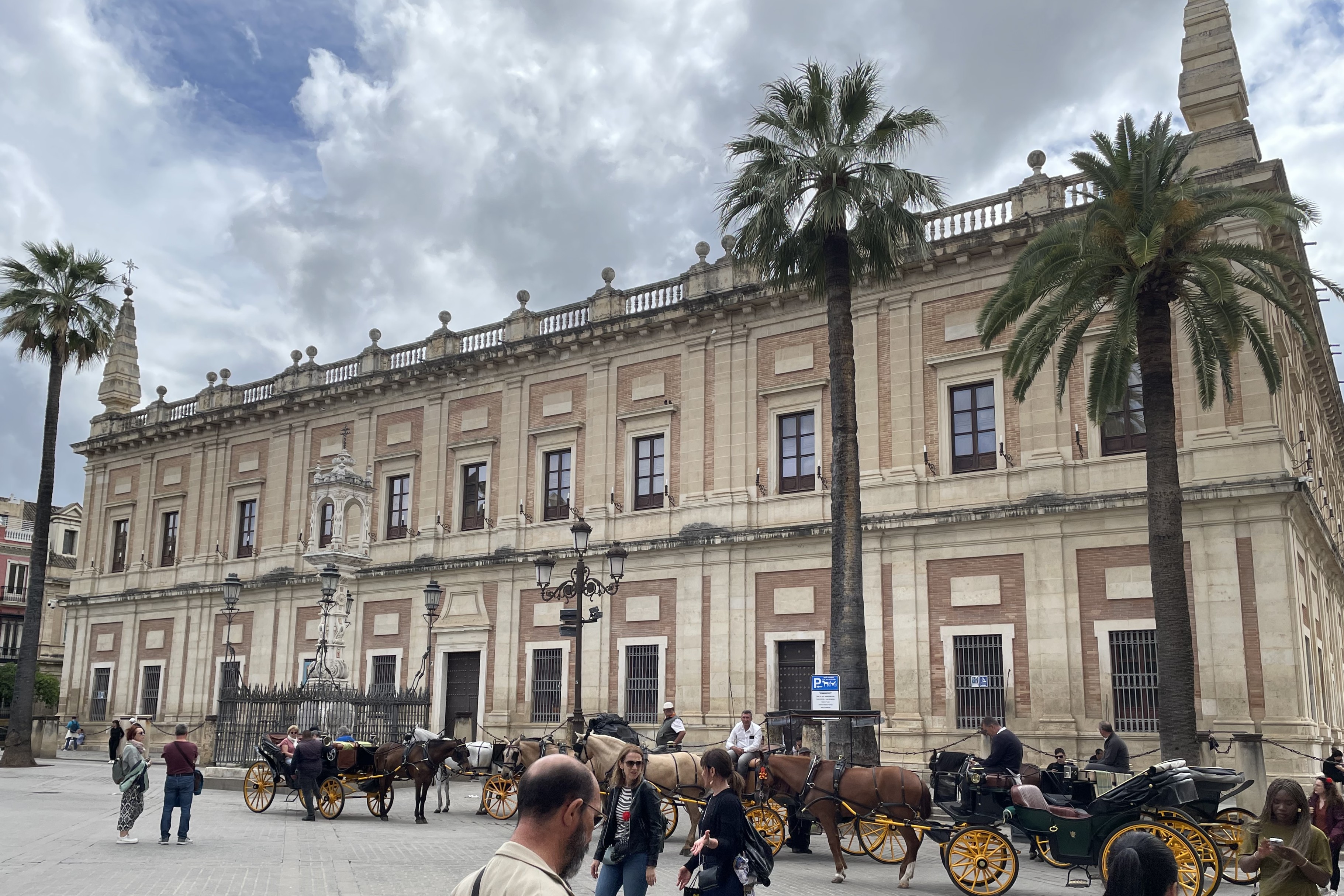
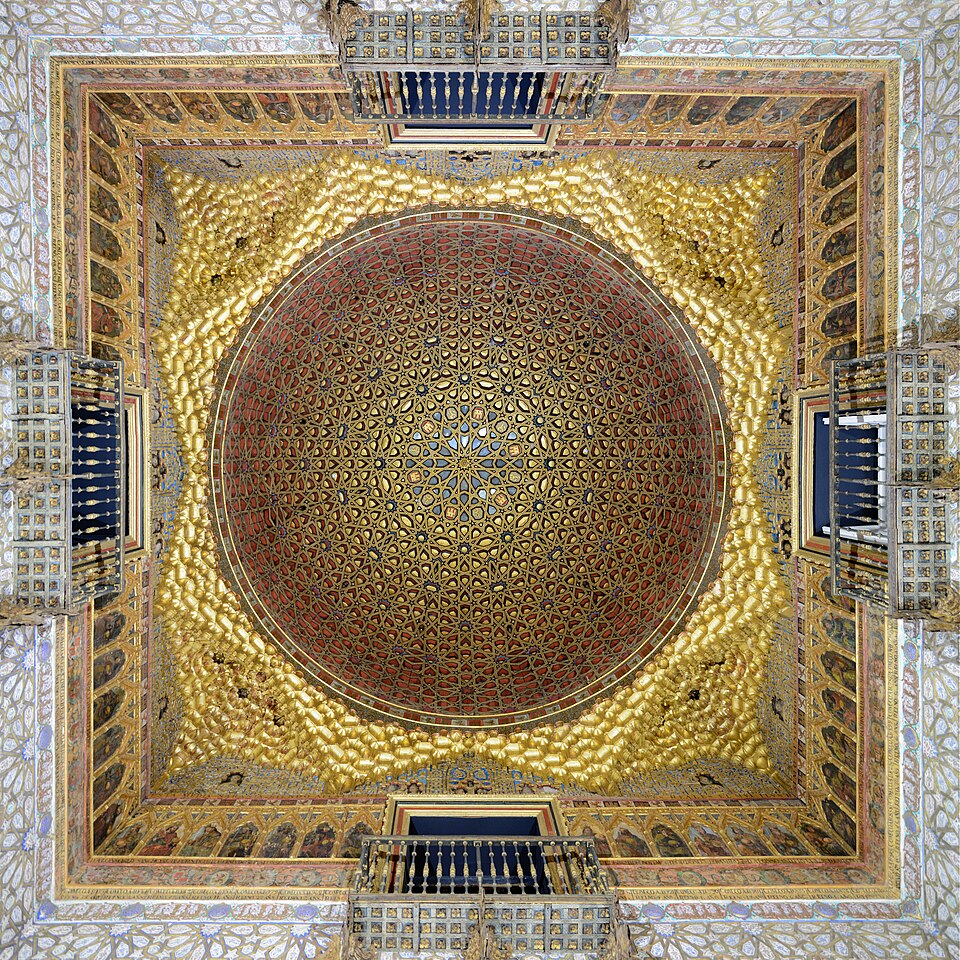
There are three historic buildings in Seville on the World Heritage List―the Alcázar or palace, the Archives of the Indies, and the Cathedral―which together form a remarkable monumental complex in the heart of the city. They perfectly epitomize the Spanish “Golden Age”, incorporating vestiges of Islamic culture, centuries of ecclesiastical power, royal sovereignty and the trading power that Spain acquired through its colonies in the New World.
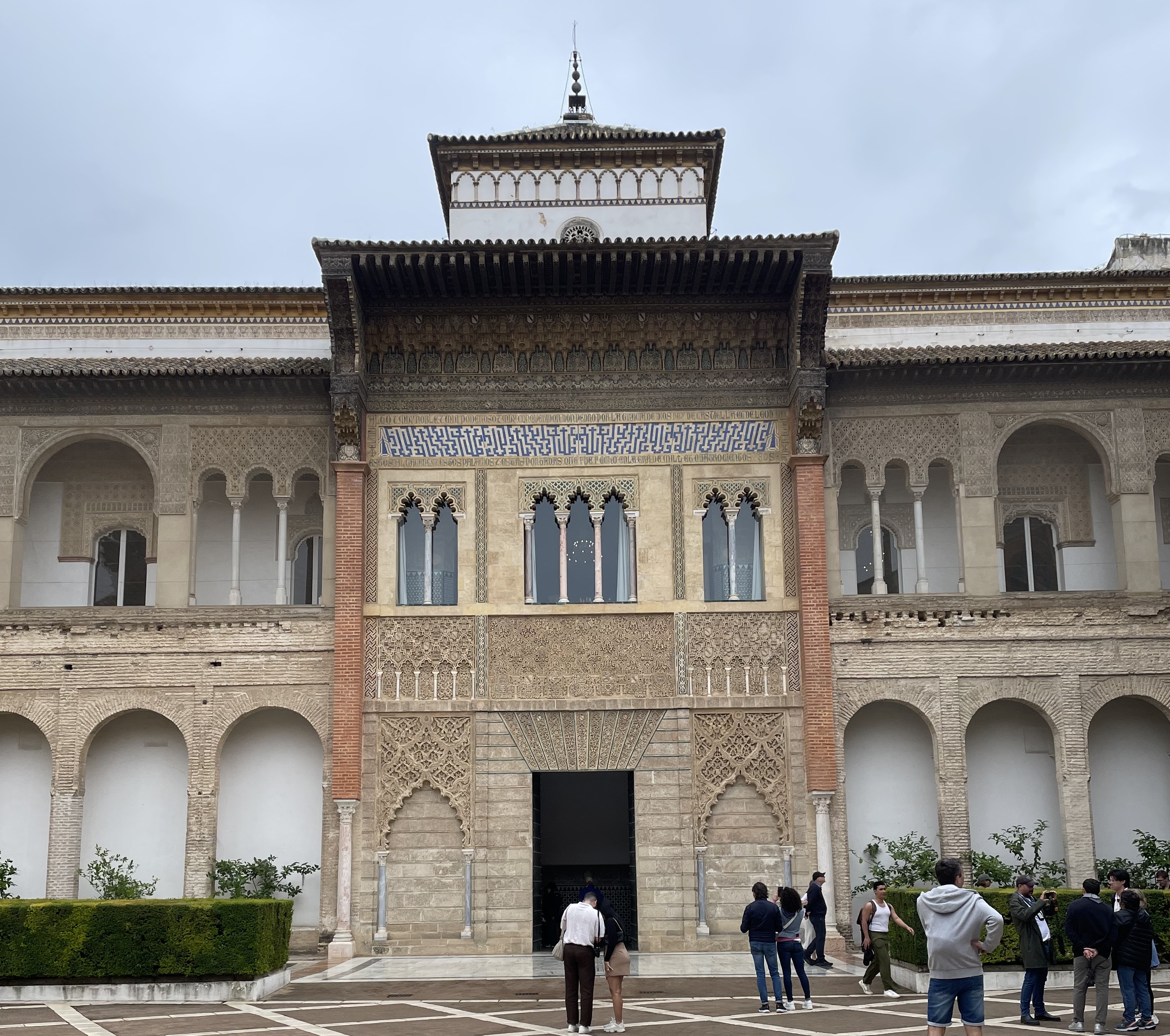
Alcázar
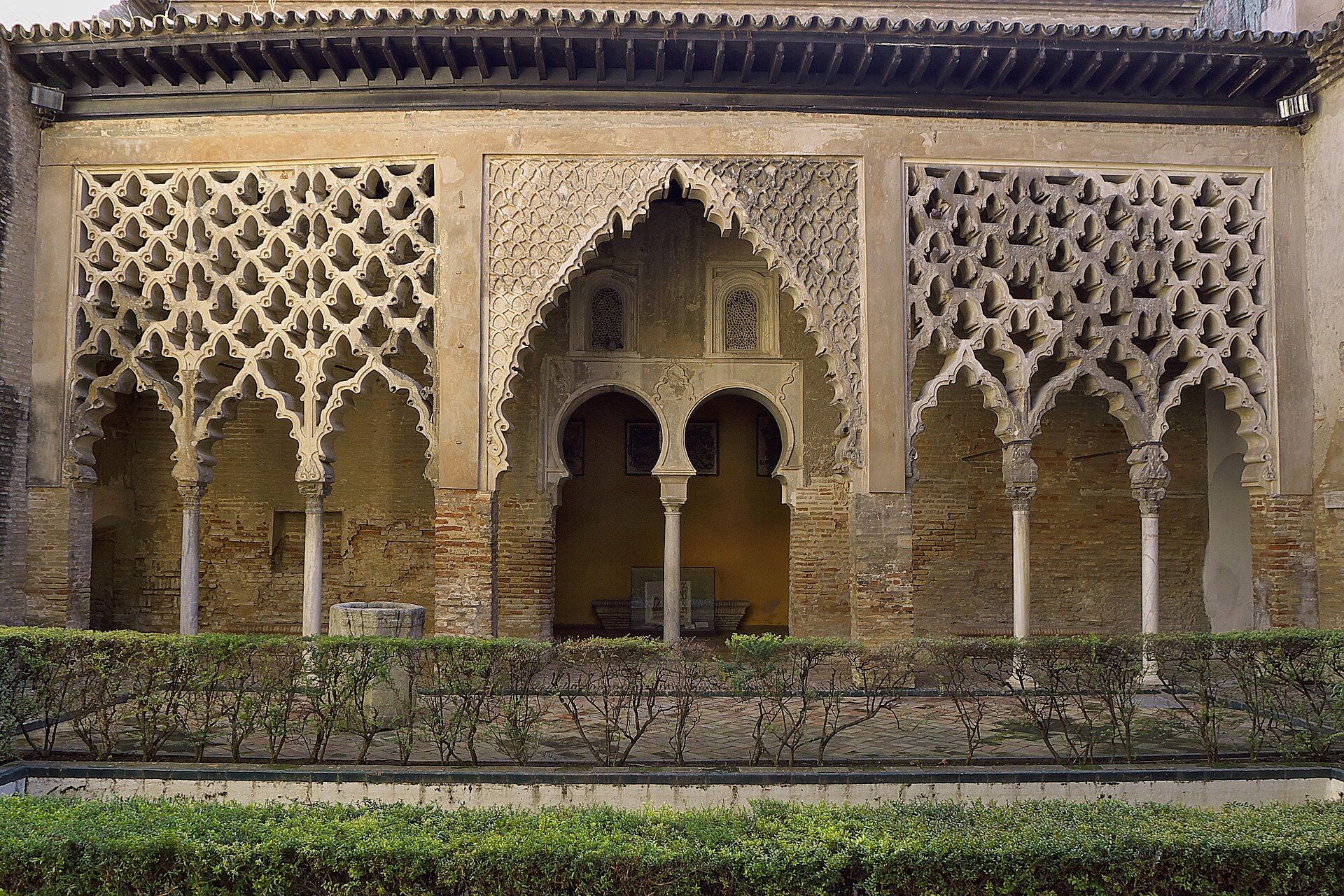
The original nucleus of the Alcázar was constructed in the 10th century as the palace of the Moslem governor and is used even today as the Spanish royal family’s residence in this city, thereby retaining the same purpose for which it was originally intended: as a residence of monarchs and heads of state.
Built and rebuilt from the early Middle Ages right up to our times, the Alcázar embraces a rare compendium of cultures where areas of the original Almohad palace coexist with the later Spanish cultures. Here one sees every style from the Renaissance to the Neoclassical.
Archives of the Indies
The Archives of the Indies building was constructed in 1585 to house the Consulate of the merchants of Seville. It became an archives in 1785, and since then it has become home to the greatest collection of documentation concerning the Spanish explorations and relations with the New World.
Seville owes its importance during the 16th and 17th centuries to its designation as the capital of the Spanish trading monopoly with Latin America. It was the “Gateway to the Indies” and the only trading port with the Indies from 1503 until 1718. The Archives building—symbolizing the link between the Old and New Worlds—is “one of the clearest examples of Spanish Renaissance architecture and was an enormous influence on Baroque Andalusian architecture and on Spanish neoclassicism.”
Cathedral of Seville
Seville Cathedral by Henrique Ferreira on Unsplash
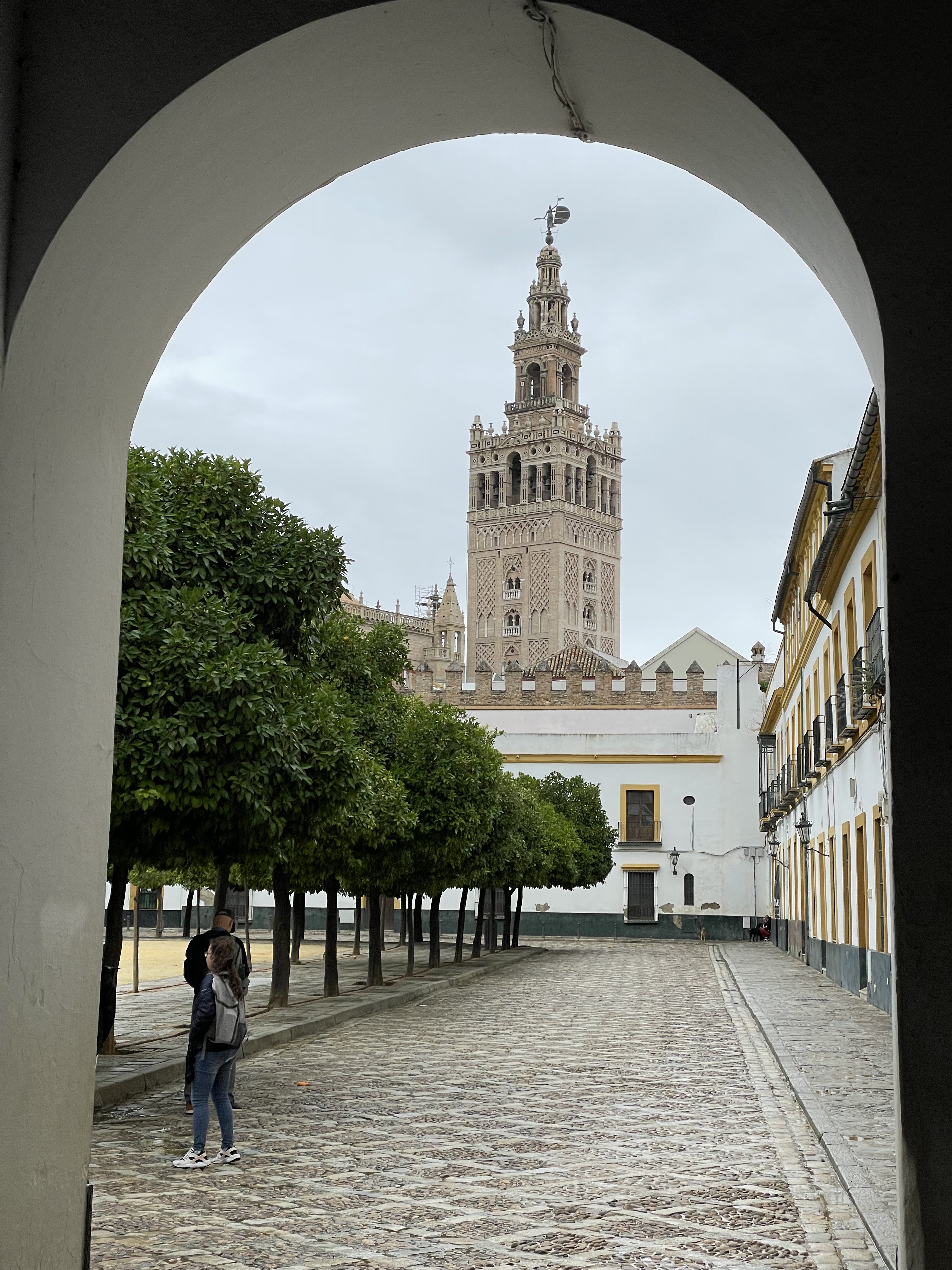
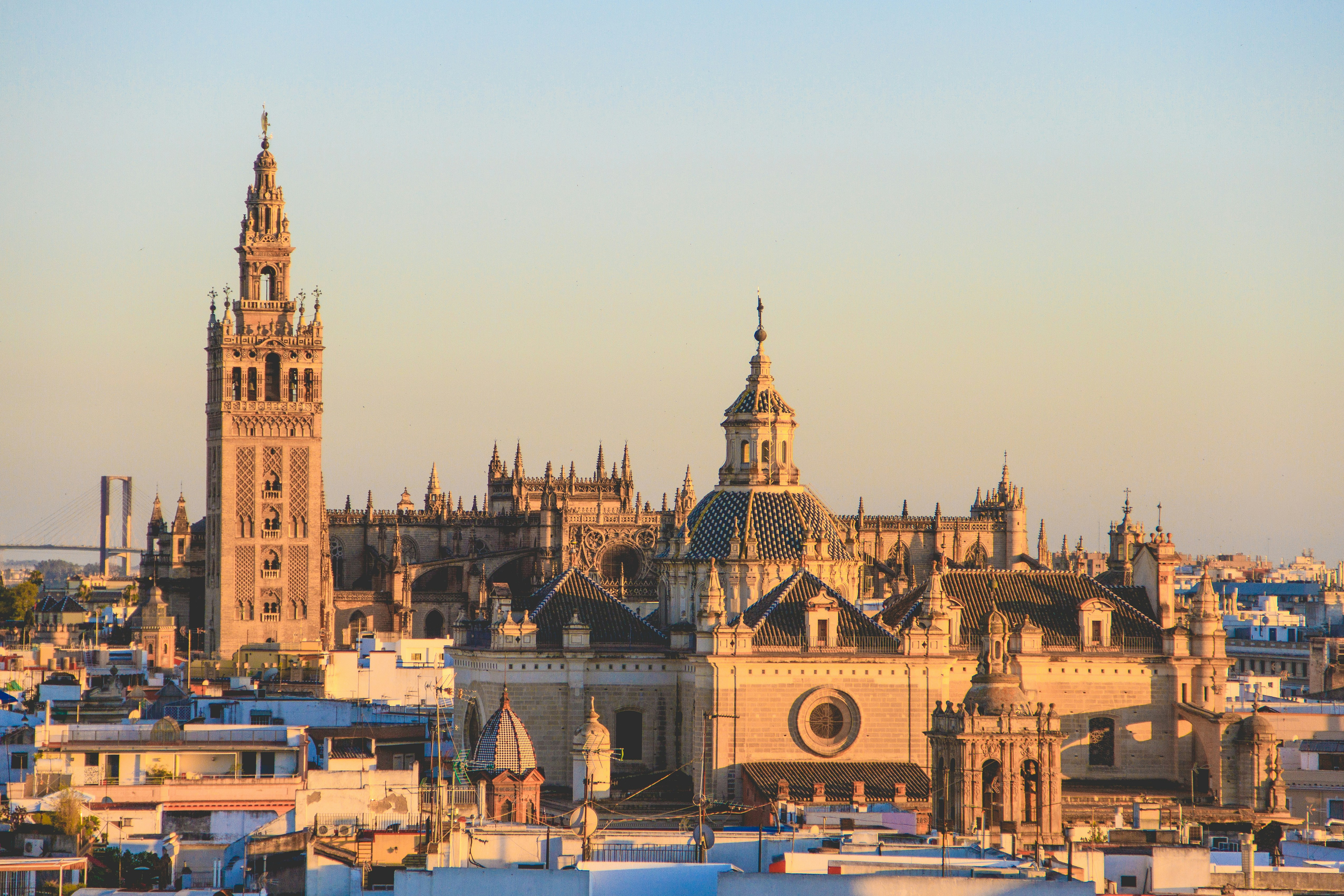
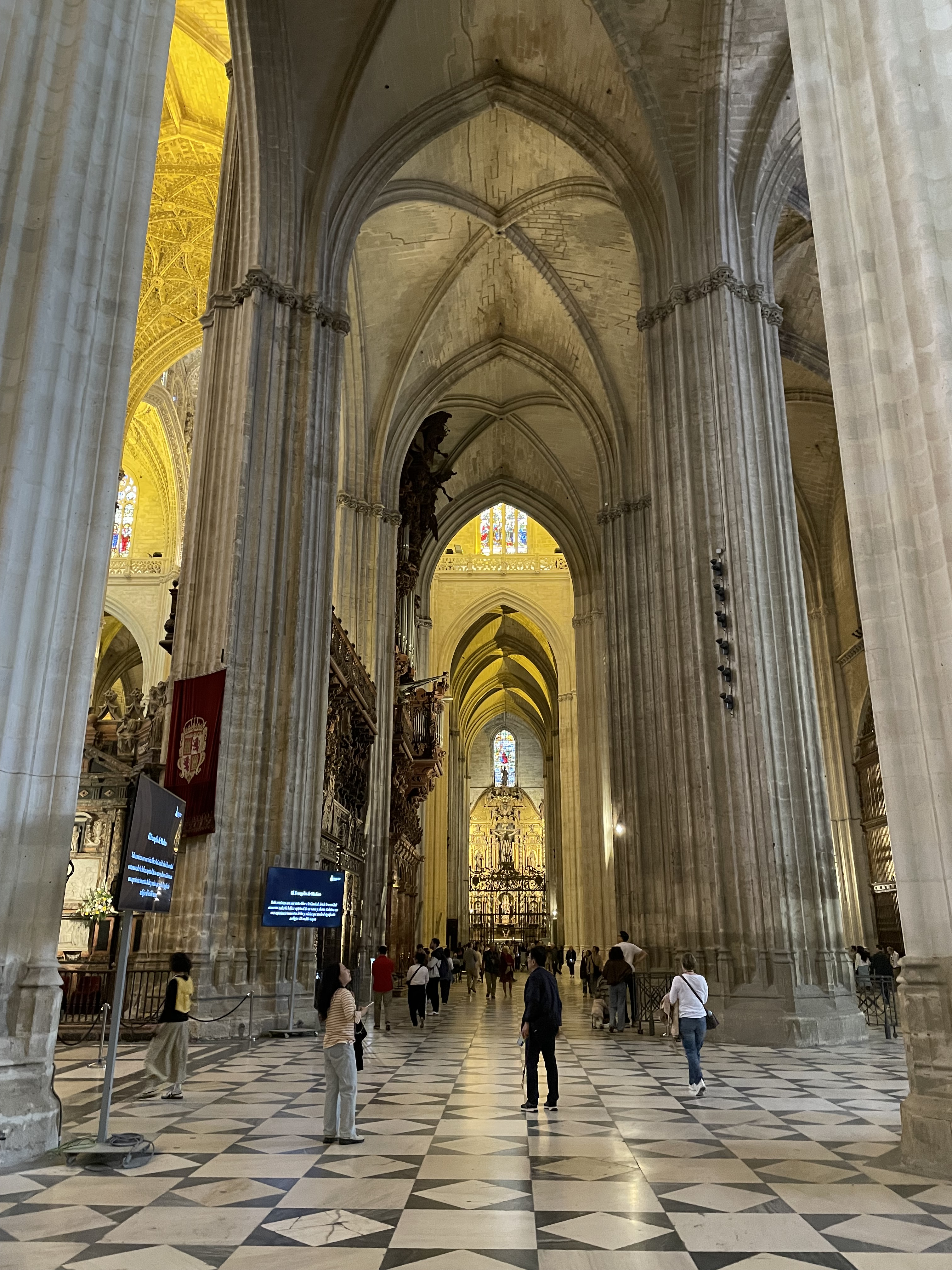
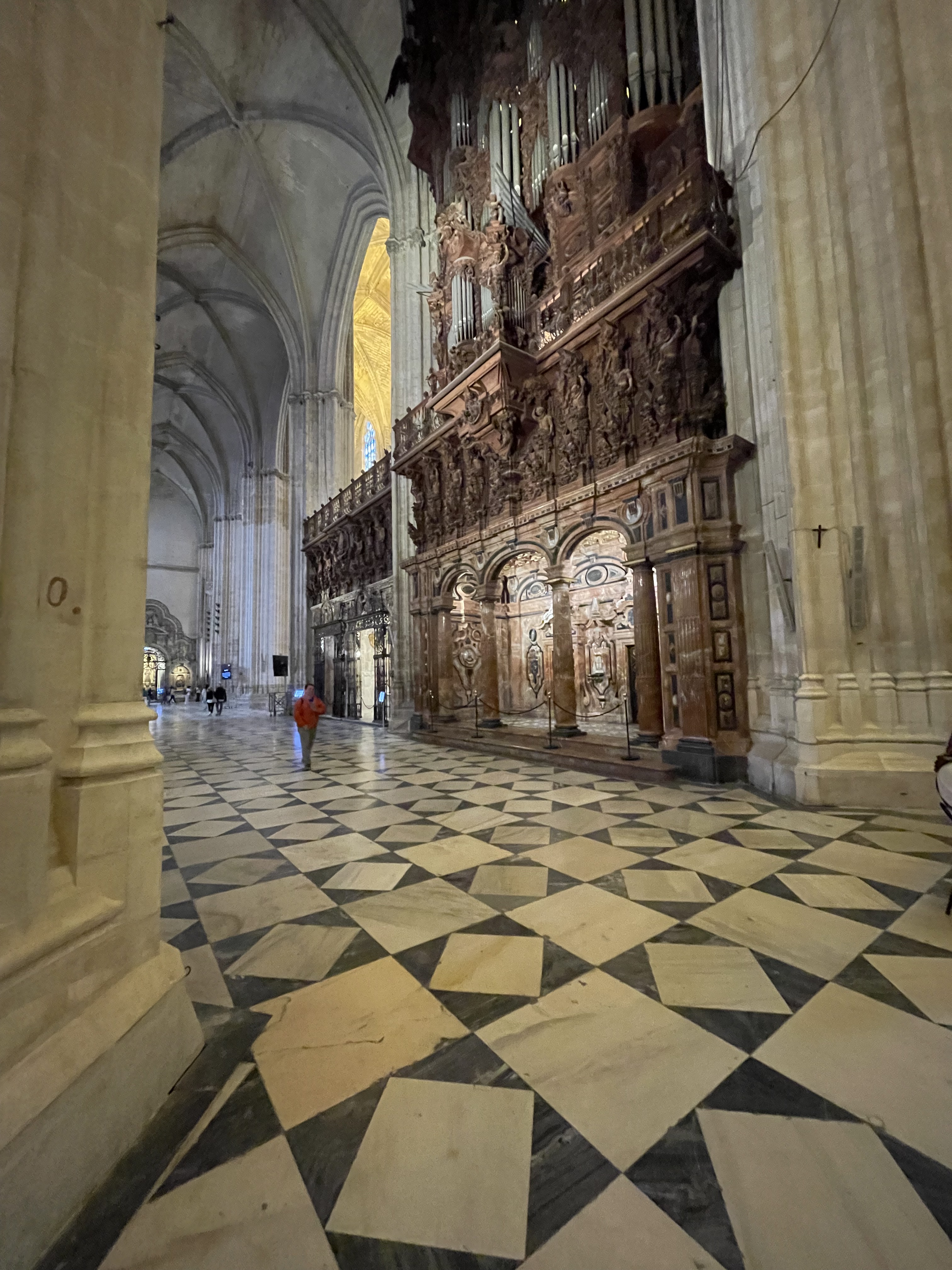
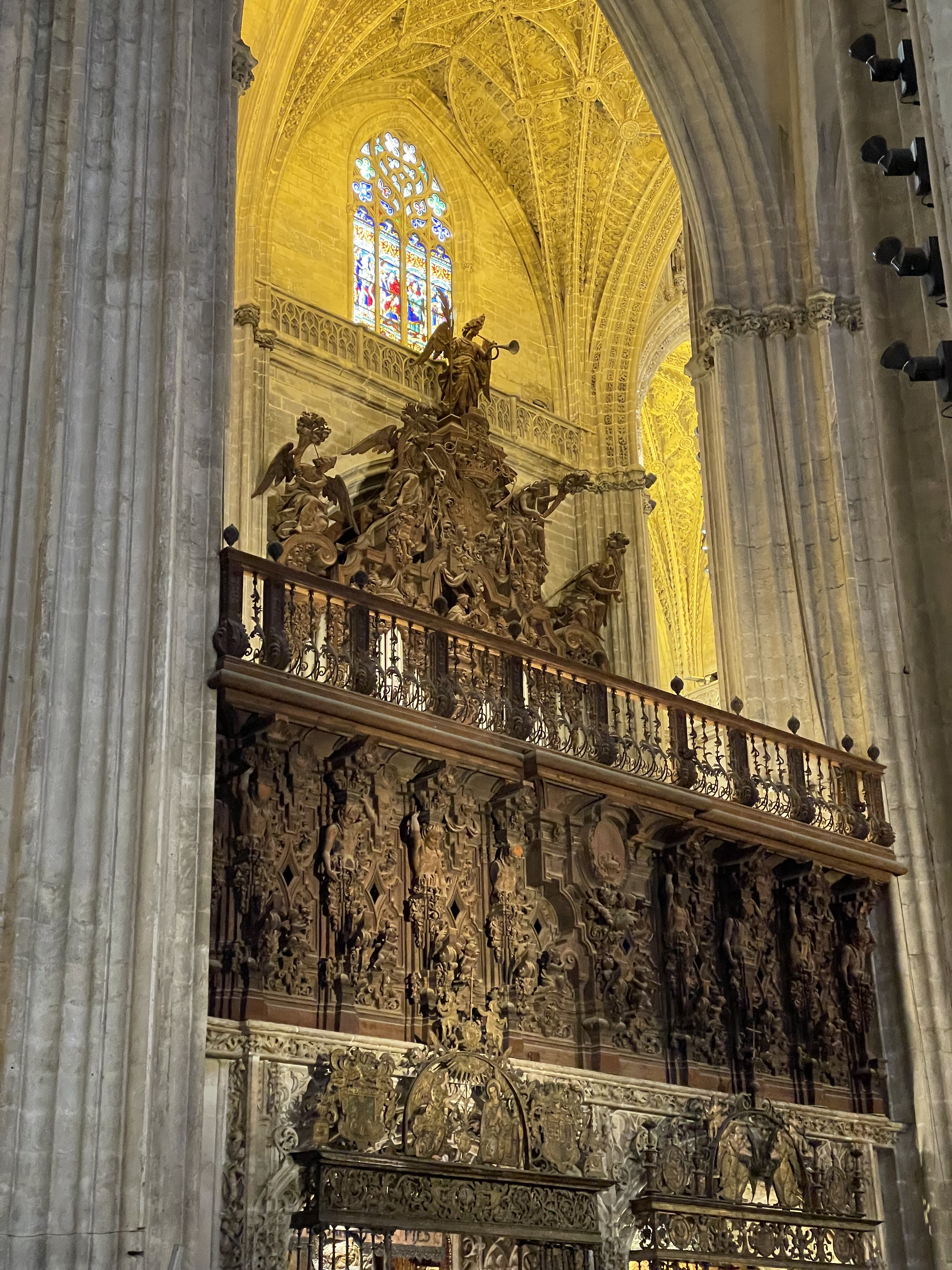
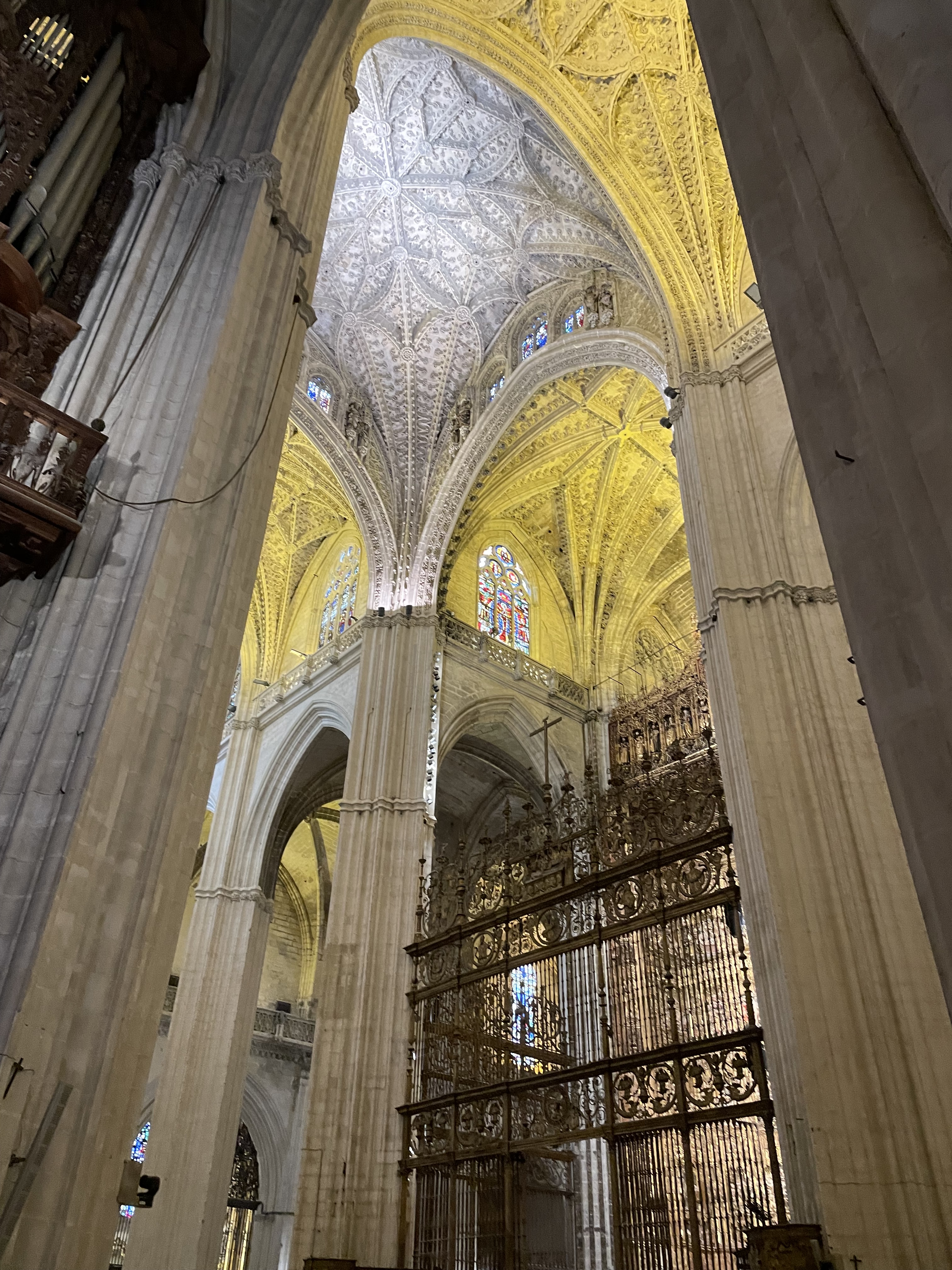
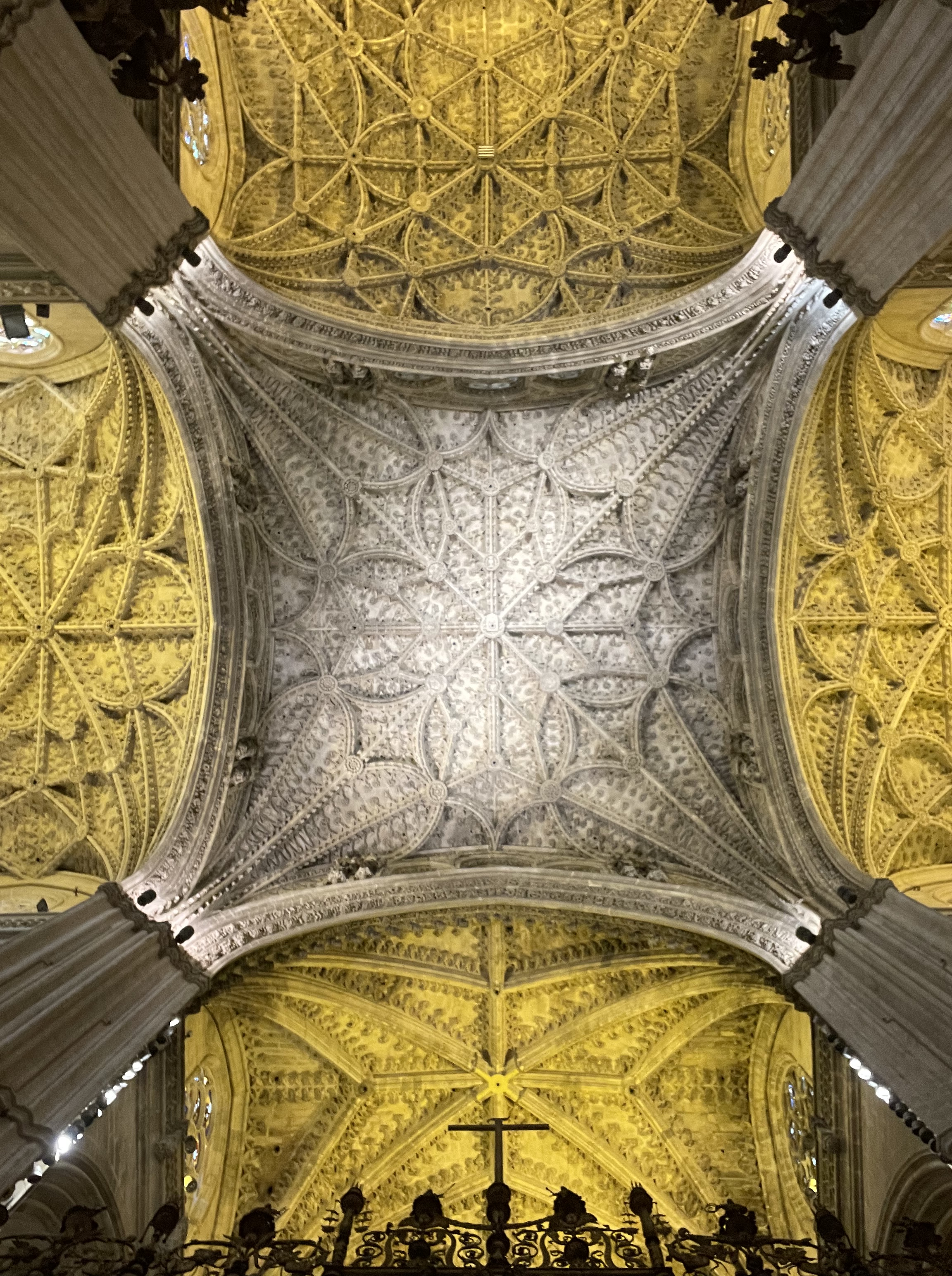
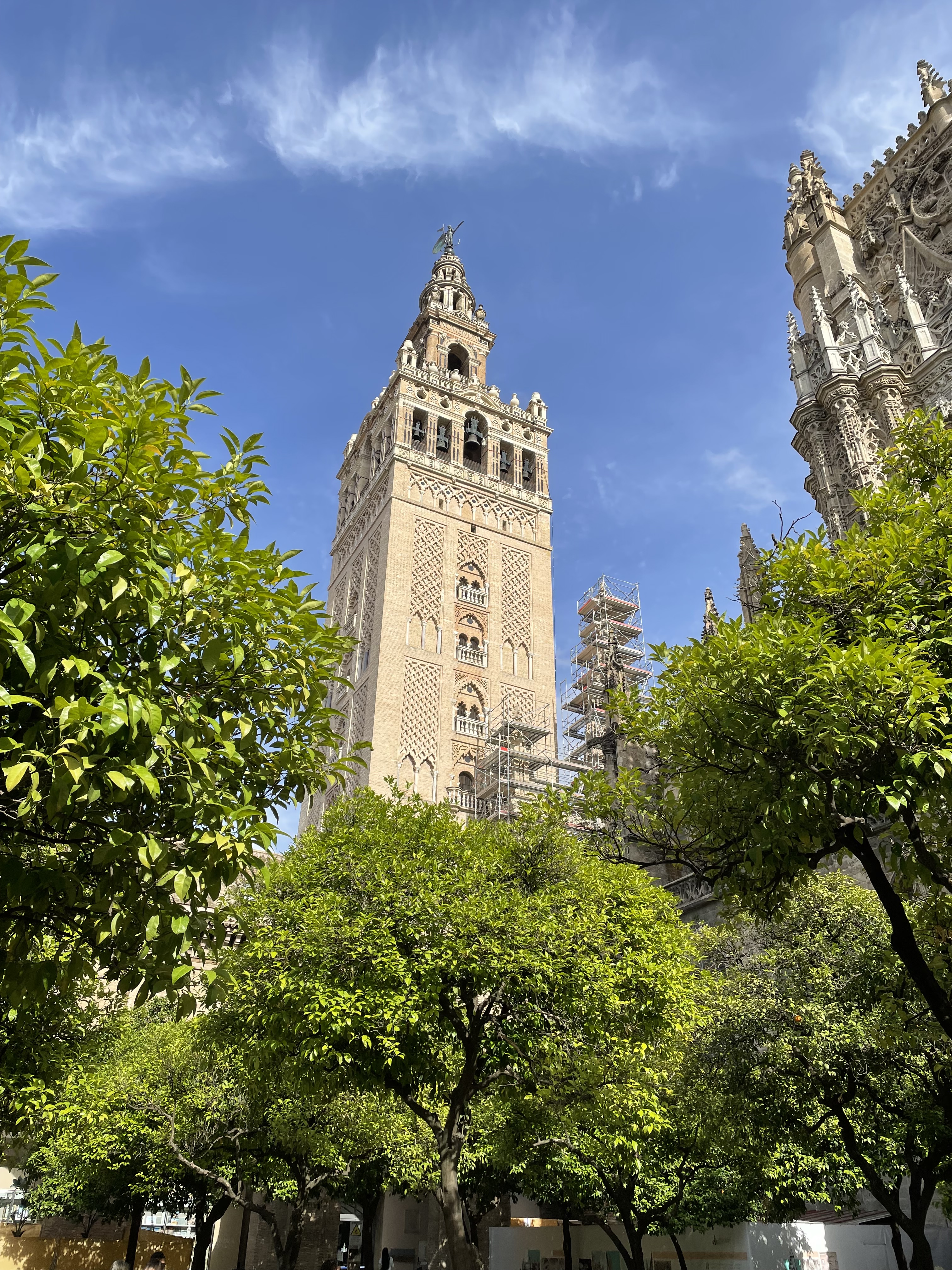
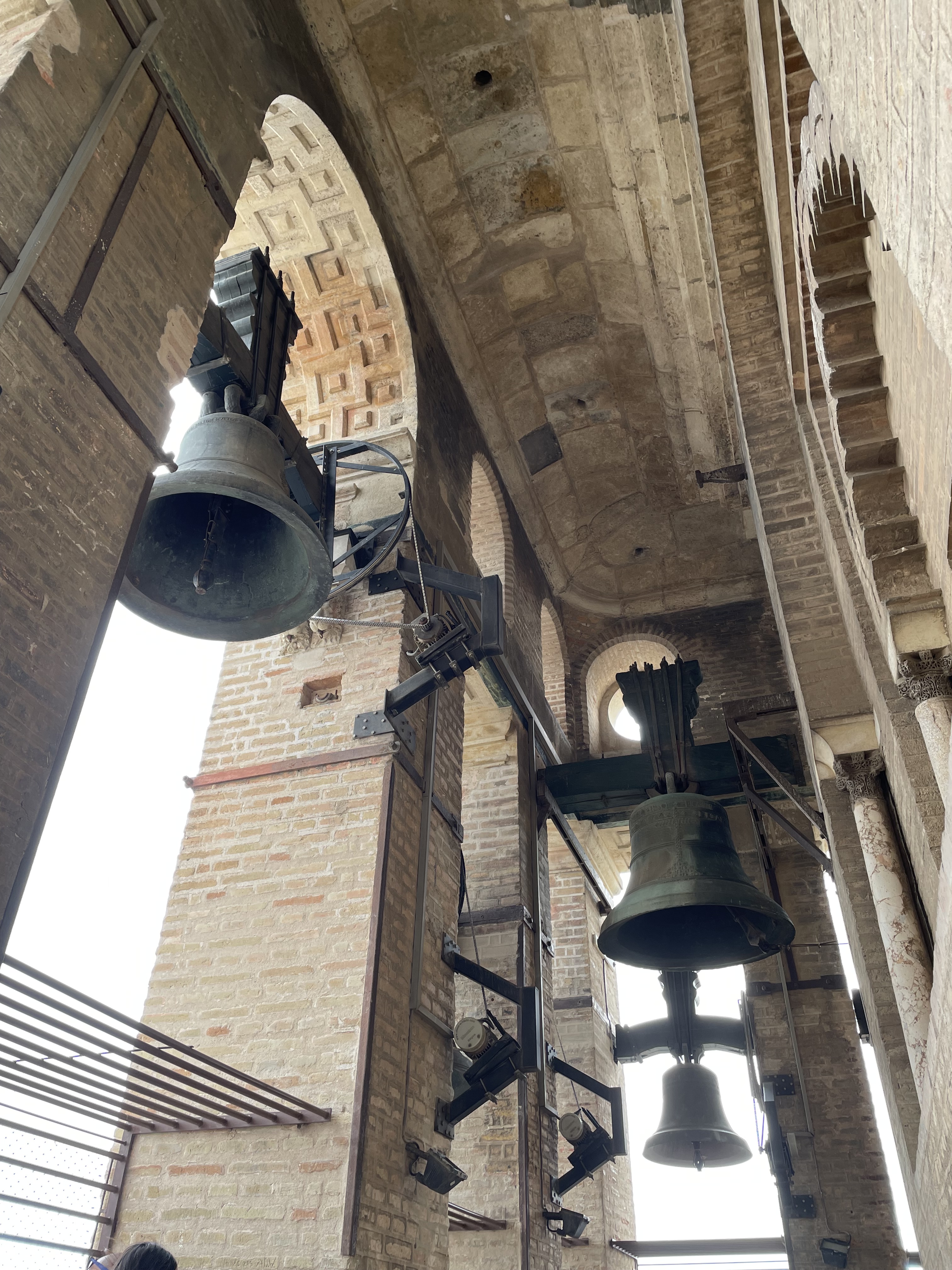
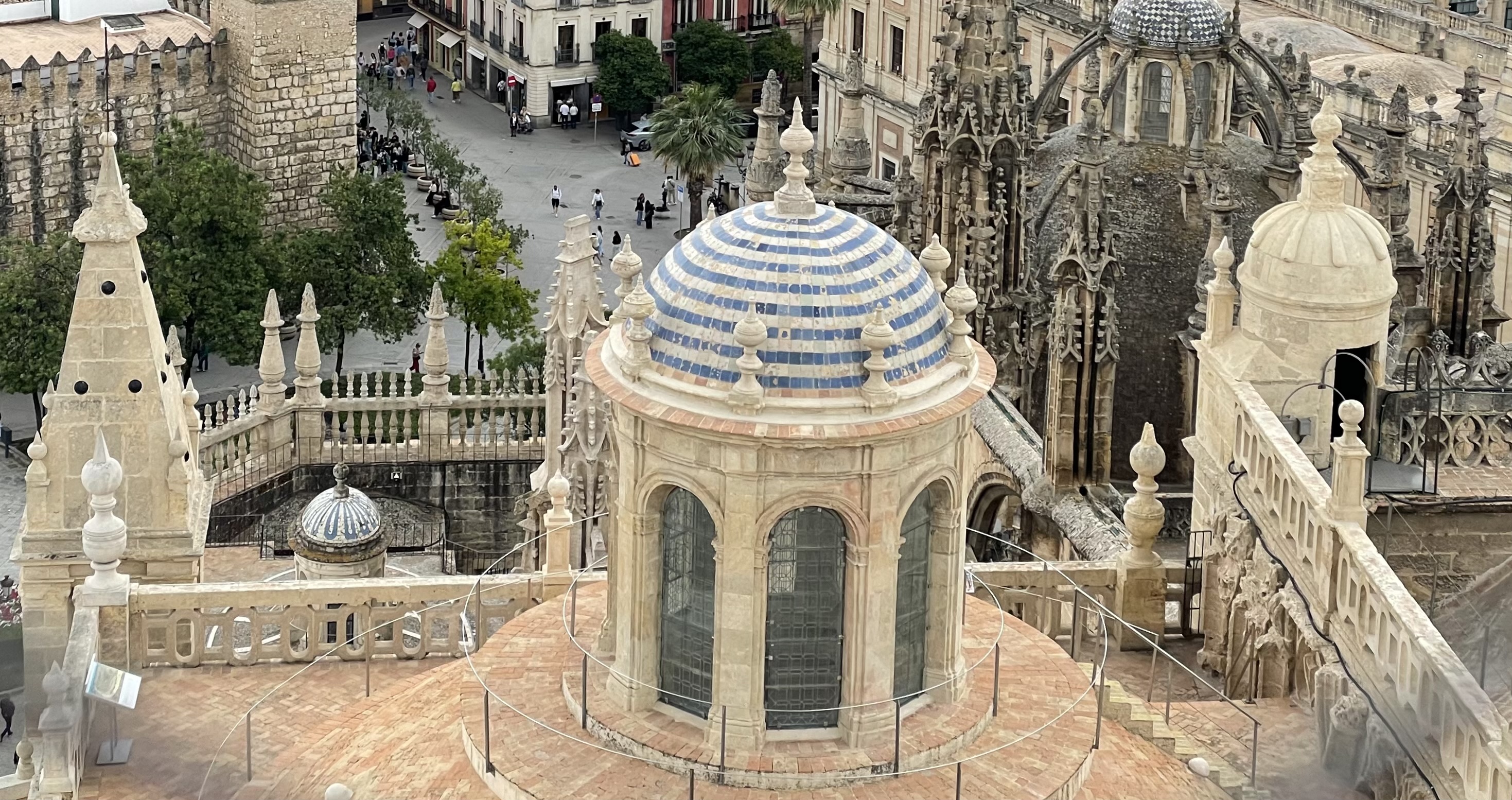
The Cathedral, built in Gothic and Renaissance style, covers seven centuries of history. With its five naves it is the largest Gothic building in Europe; its bell tower was the former minaret of a mosque; and its “chapter house” is the first known example of the use of the elliptical floor plan in the western world.
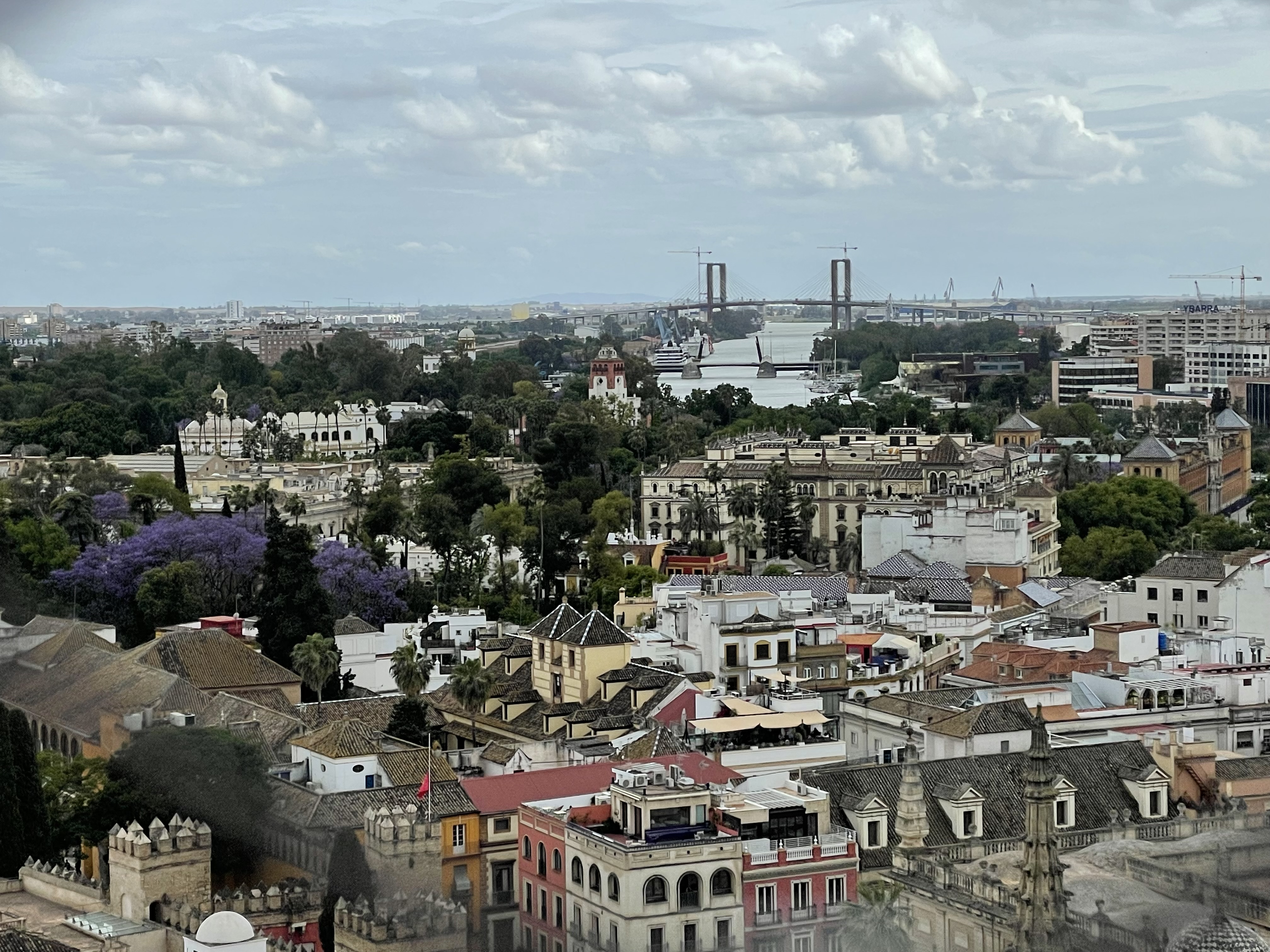
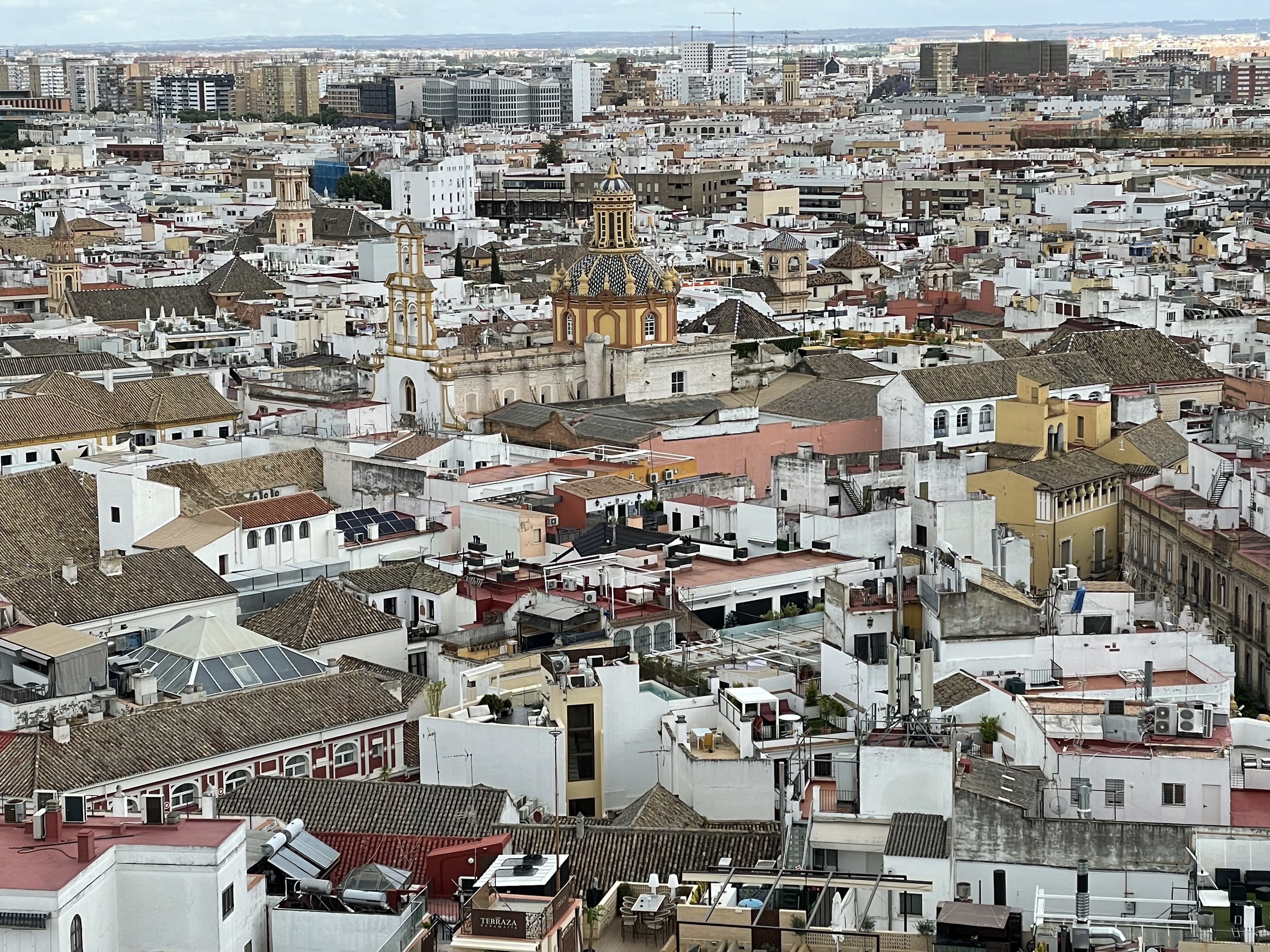
In that bell tower we see a history with the cathedral that reflects the disputed territories of the region and mirrors that seen in many colonies. Founded in 1403, the Cathedral was built on the site of a former mosque, known as a masterpiece of Moorish architecture. I accessed the top of the tower by a series of some 37 ramps. Once there, one has stunning views of the entire city.
Lagos
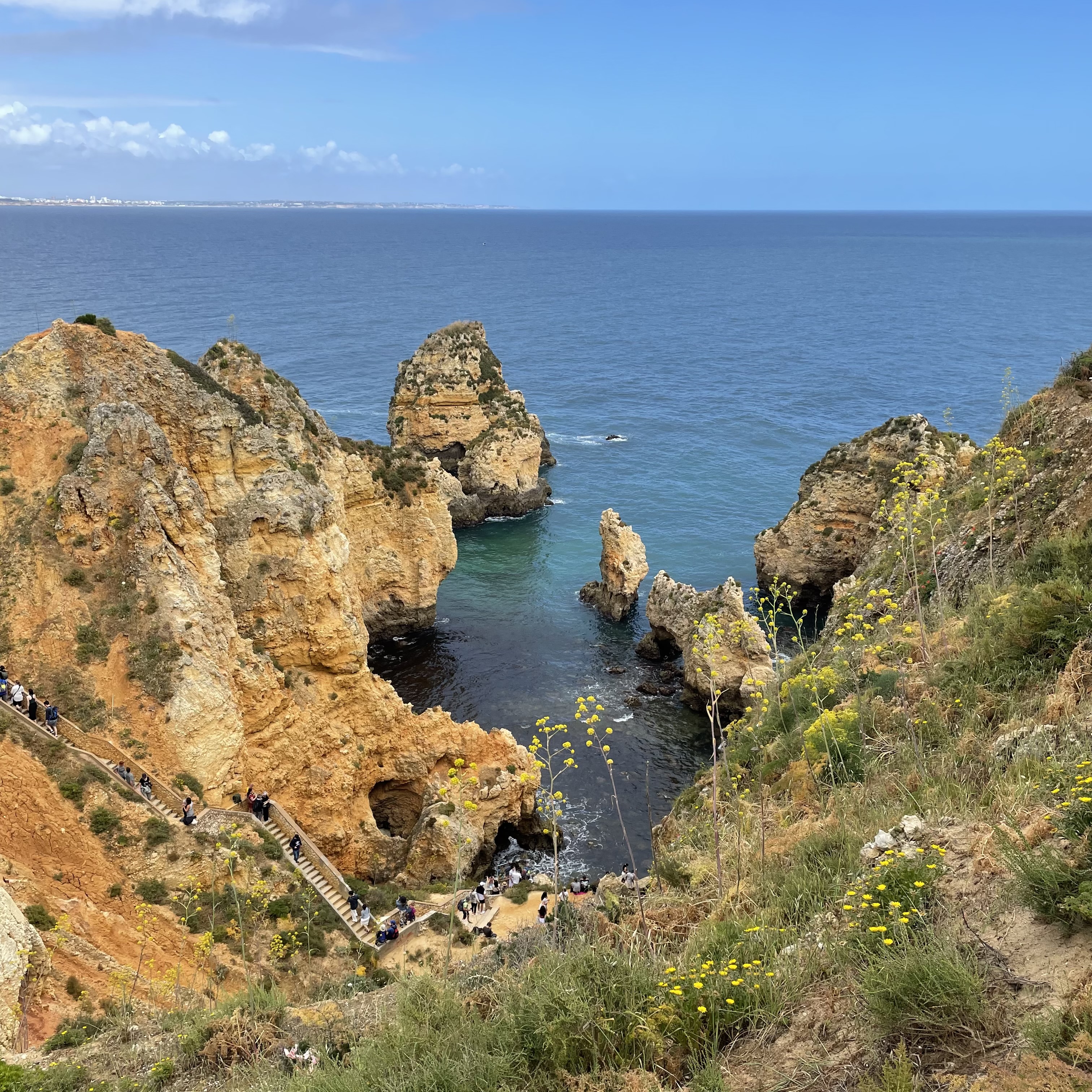
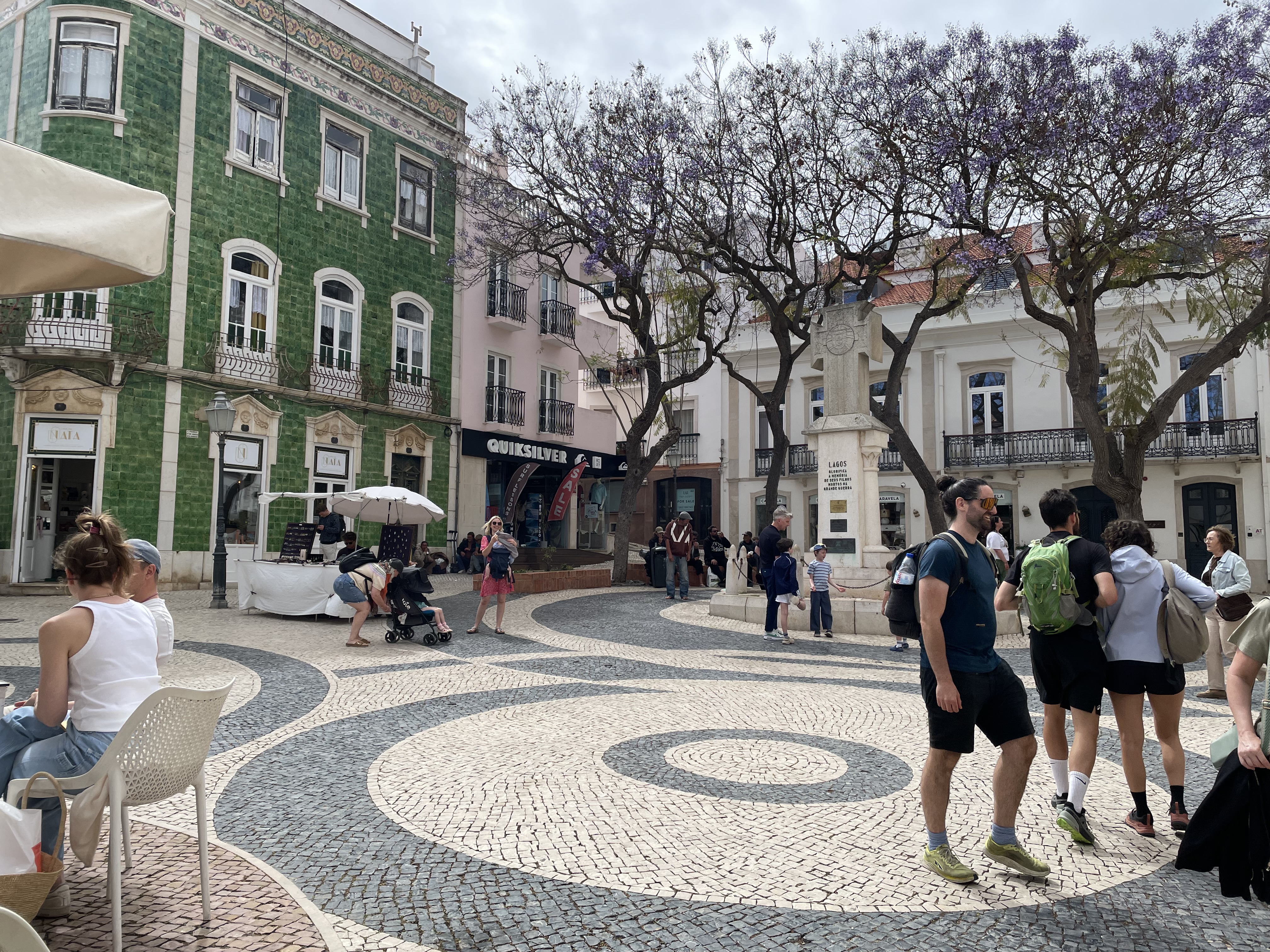
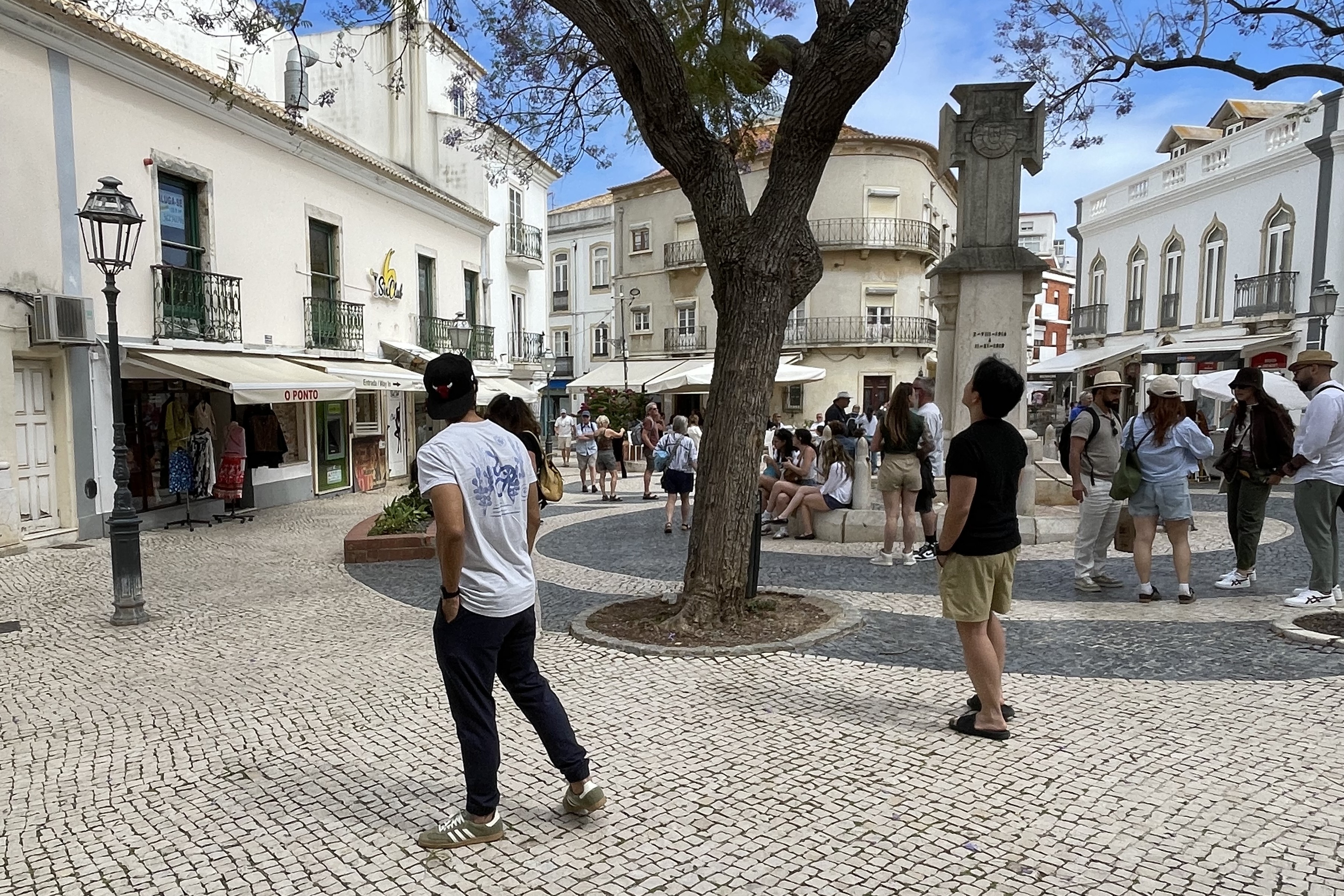
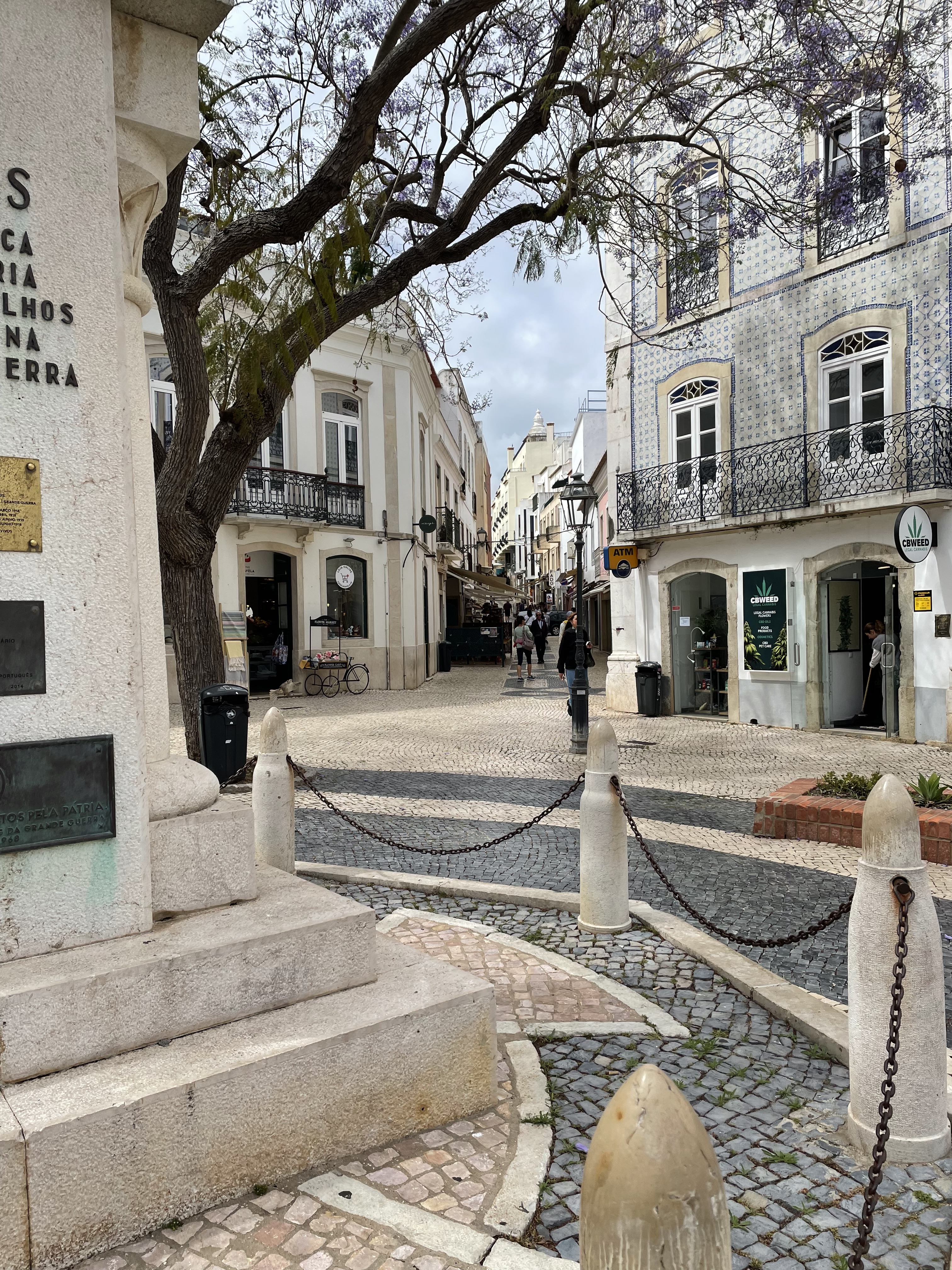
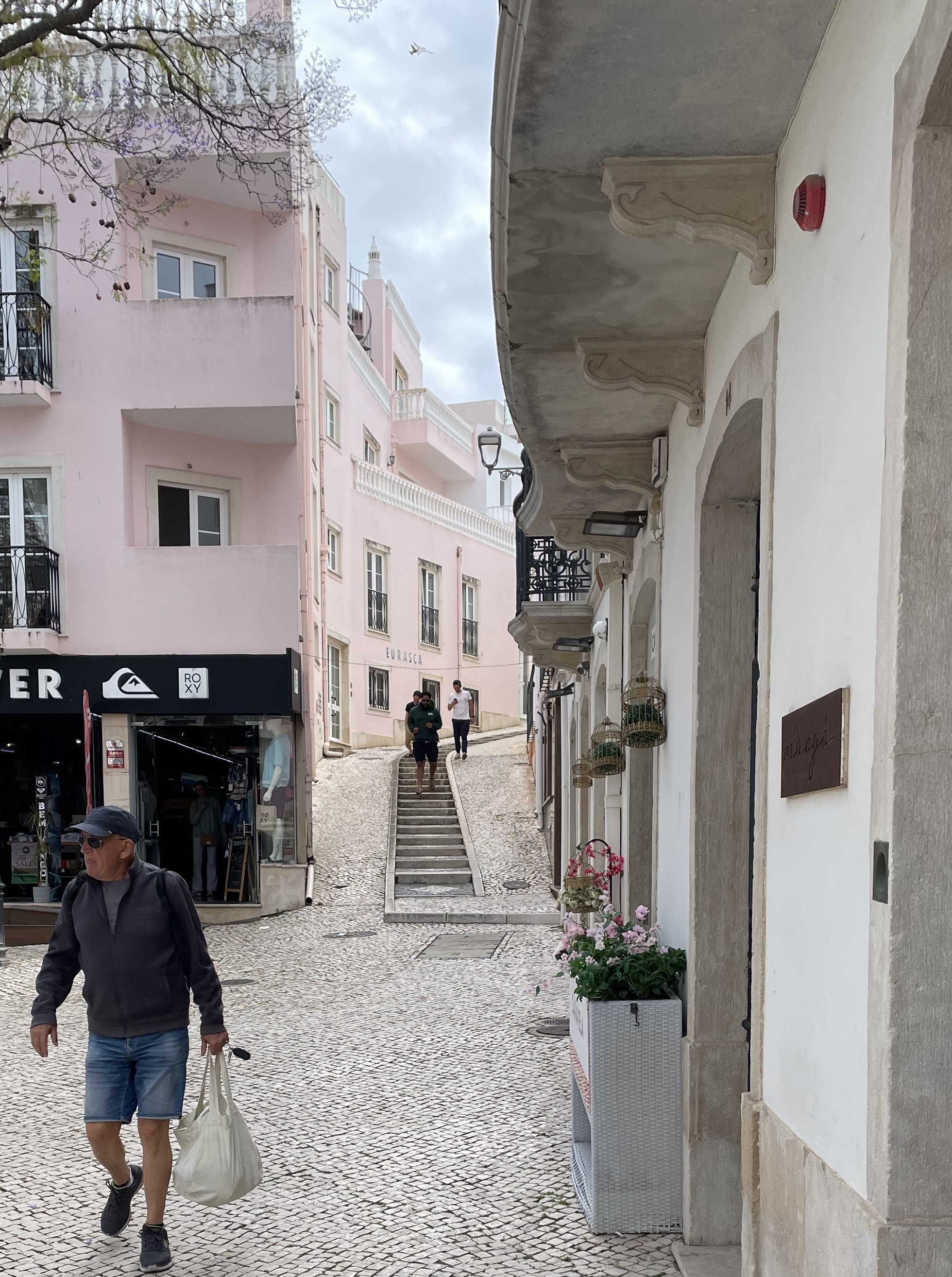
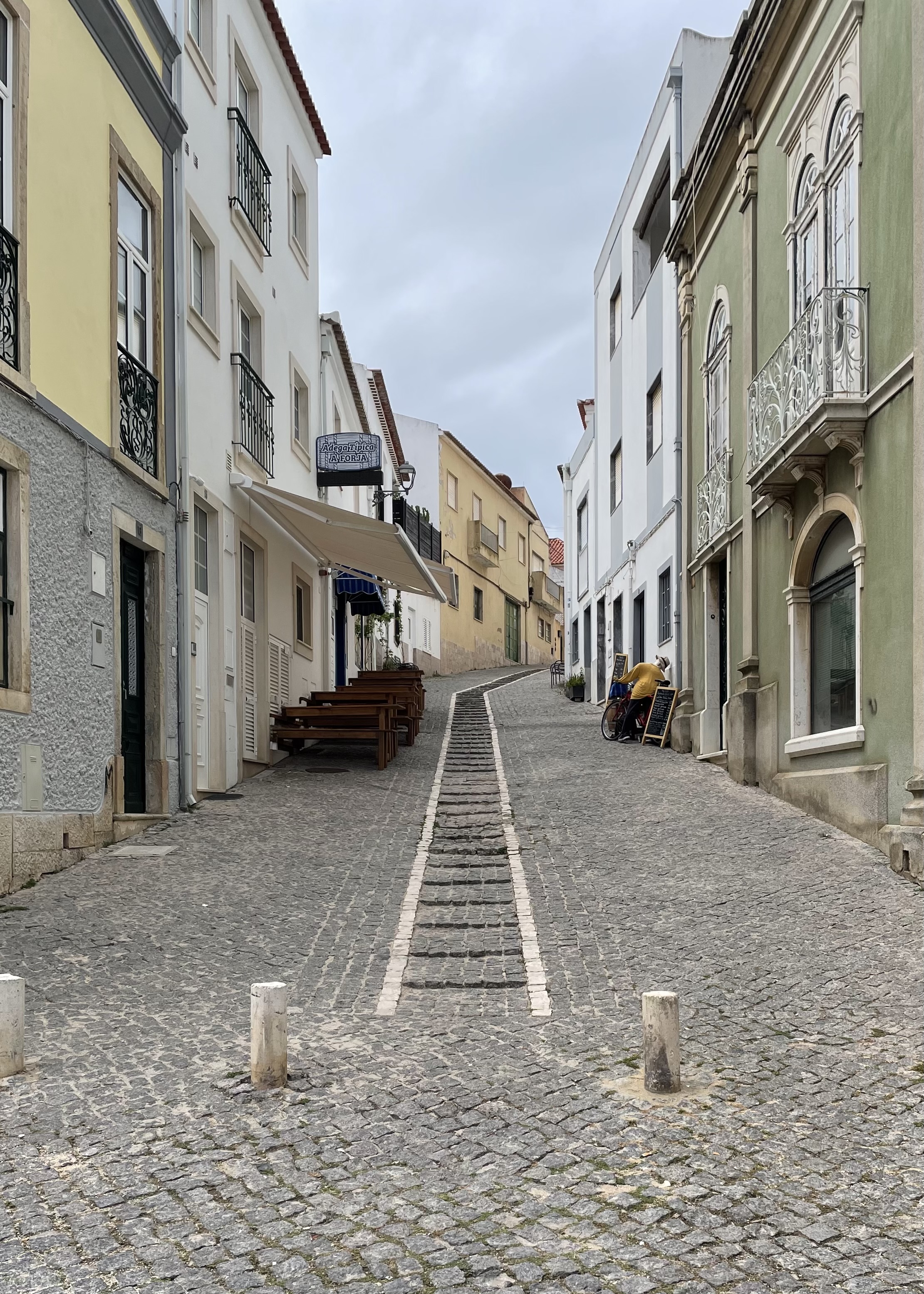
Our final day of travel included a stop in the Atlantic seaside town of Lagos in southern Portugal. Lagos is one of the most visited cities in the Algarve and Portugal, due to the tourist-friendly beaches, bars and restaurants. The attractions and the tourists were very much in evidence. Lagos, as Wikipedia reminds us, “is also a historic center of the Portuguese Age of Discovery, frequent home of Henry the Navigator, historical shipyard and, at one time, center of the European slave trade.”
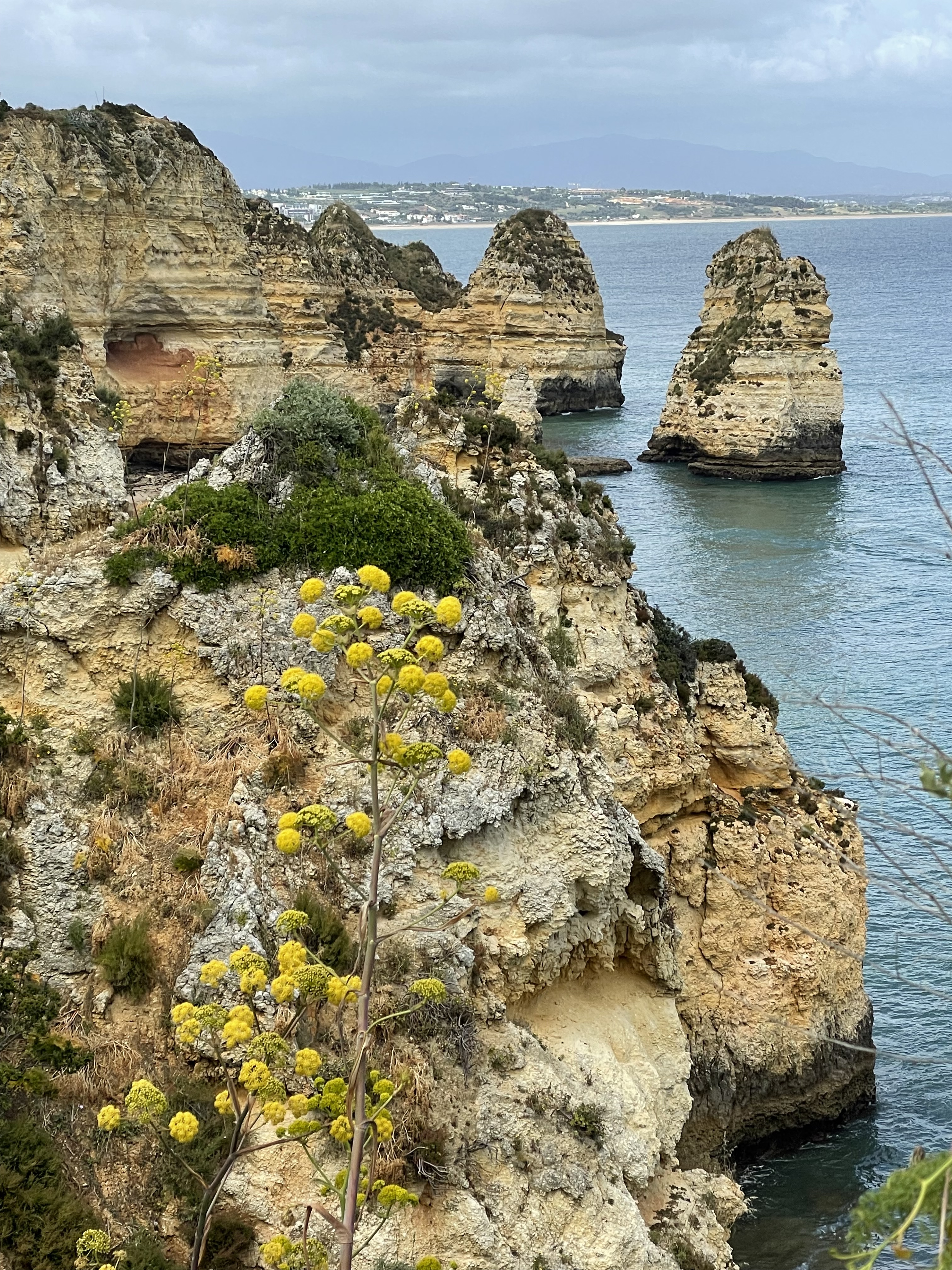
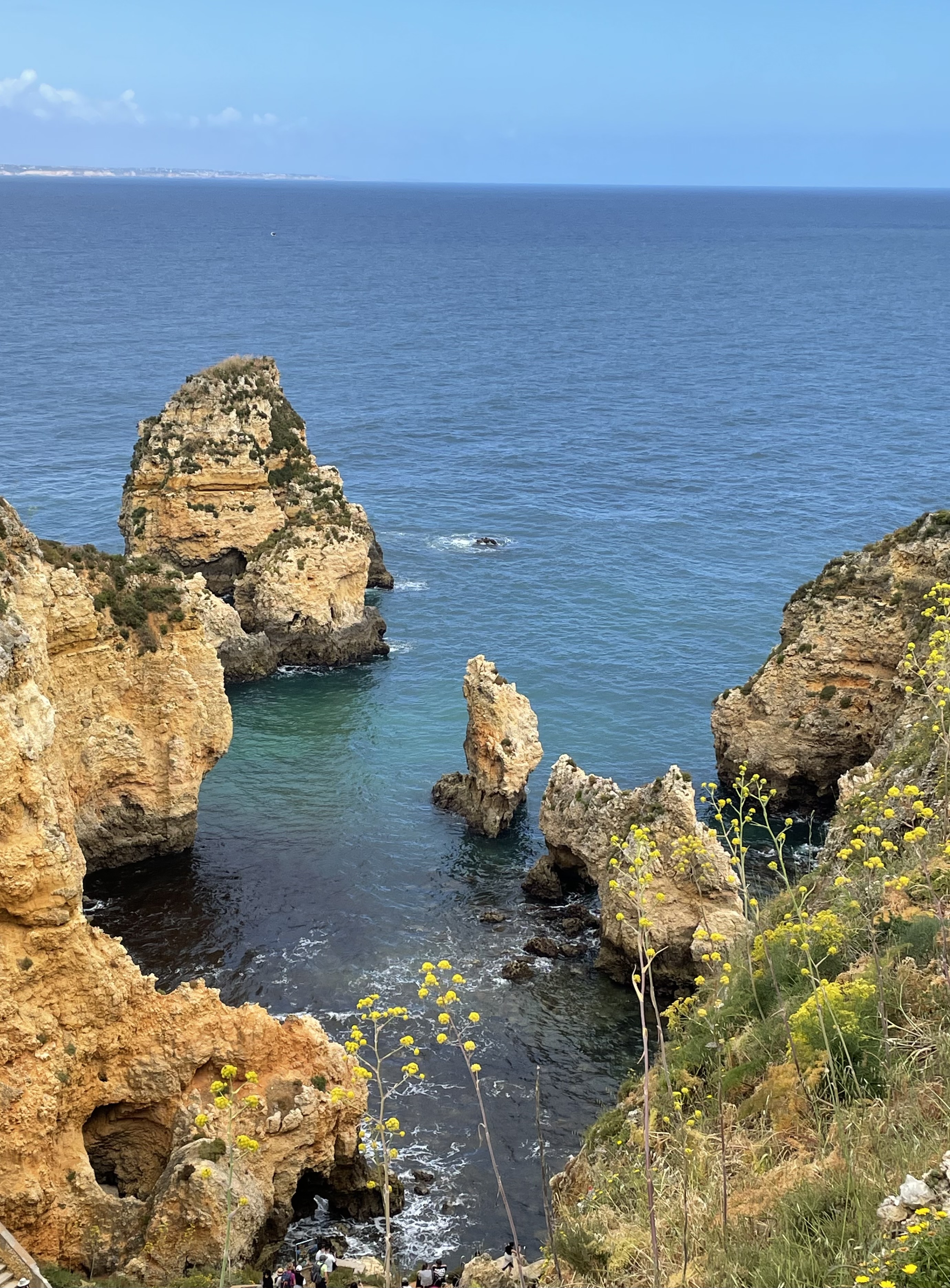
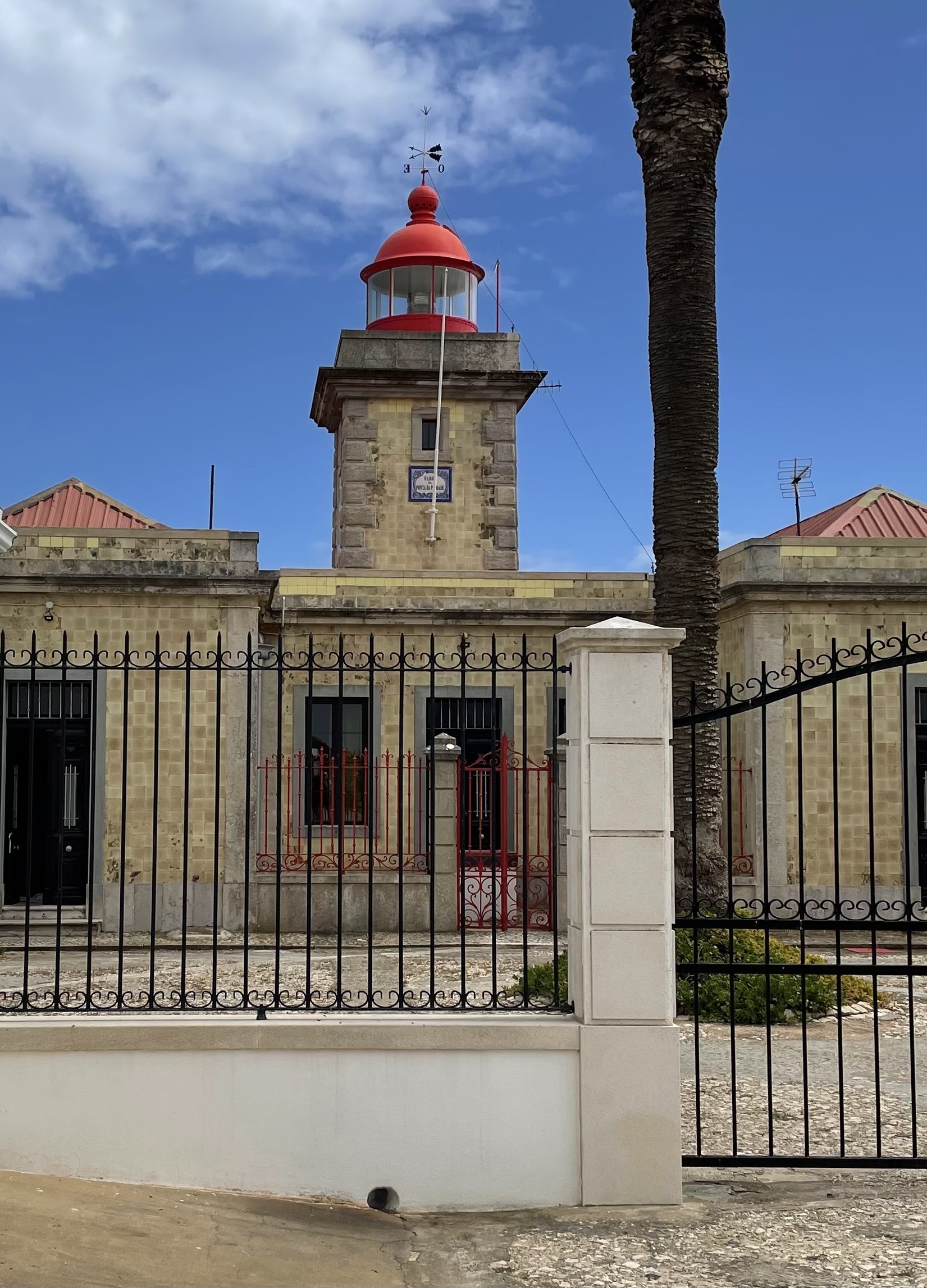
We spent most of our visit at Ponta da Piedade (Portuguese for “point of mercy”), a headland with a group of rock formations along the coastline. There one sees beautiful yellow-golden cliff-like rocks, stations of the cross for the faithful, and an early twentieth-century lighthouse.
WHAT’S ON THE HORIZON
As you can see, these life-enriching trips to special places around the globe open our eyes, minds, and hearts. Among our travelers, tour directors, local guides, and residents one meets the most interesting people, some of whom become life-long friends. I’m scheduled to lecture on three upcoming trips with National Trust Tours over the next few months . . .
. . . and we’d love to see you on one of these trips, or on a future National Trust Tour!
More to come . . .
DJB
Photo of Calatrava Alamillo Bridge, ceiling in Alcazar, and interior shots of the Archives from Wikimedia. Picture of Plaza de España at the top of the post and all other photos except where noted by DJB.
Rebecca Solnit looks at how the next era comes after the end of the last one. In between comes a lot of falling apart.
We forget our past—good and bad—at our own peril.
“If knowledge is power, memory and perspective are among its most important aspects,” writes one of our more thoughtful chroniclers of this time of turmoil. “Only in the long view can you see the patterns emerging, the way the present builds on the past, the way past surprises guarantee more surprises are coming.”
Change is all around us. “If you don’t see time on the scale of change,” however, “you don’t see change; if you don’t remember how things use to be, you don’t know they’re different than they were and how that unfolded.”
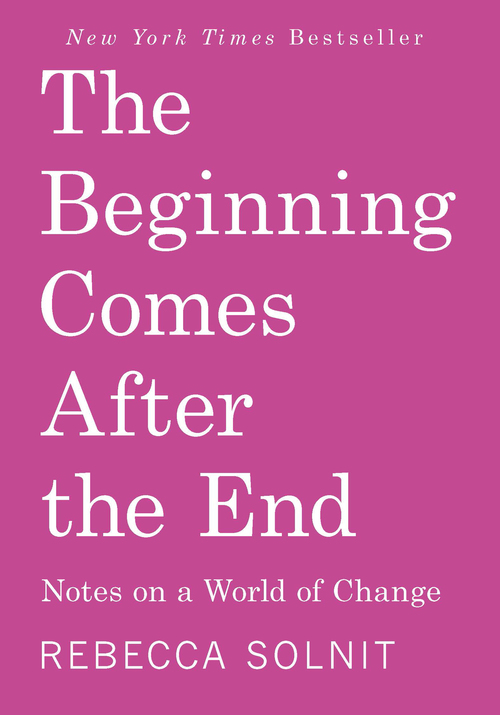
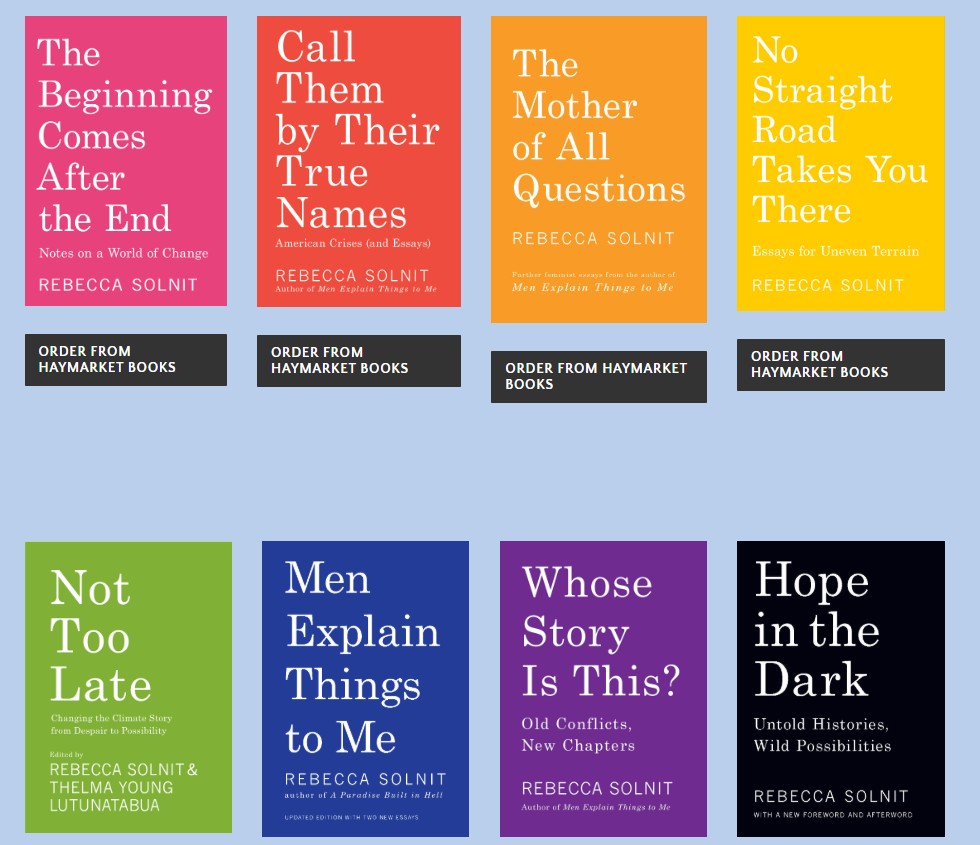
The Beginning Comes After the End: Notes on a World of Change (2026) by Rebecca Solnit is the eighth in a series of Haymarket Books by the longtime climate and human rights activist, historian, and writer. Like the others in this collection it looks back to remind us of how far we have come. It is full of insightful perspectives and clear, compelling writing. Unlike some of the others, however, this newest work reads more as a whole piece rather than a series of essays. That seems appropriate given the topic. Solnit takes the reader back to times when those pushing for change appeared to be swimming upstream. We discover how seeds are planted and nourished even in dark, difficult times. The fierce backlash that comes against the future is made by enemies who “believe in us even when we don’t believe in ourselves,” bringing confirmation that “they believe we’ve changed the world in consequential ways, and with a coherent vision.” Those who believe in an interconnected, mutually supportive, and more open world have been far more successful than we believe. And, she asserts, “people who have long been consigned to the past were charting a viable future for all of us. ‘We’re the ancestors of tomorrow,’ said Madonna Thunder Hawk . . . so we behave accordingly.'”
Early in this hope-filled and forward-facing work, Solnit uses a well-known metamorphosis from nature as a metaphor for the transformation of society.
“The beginning comes after the end. A chrysalis is the beginning of a butterfly, but in that chrysalis is no elegant transition. The caterpillar falls apart—it turns to goo, and something profoundly different reconstitutes from it, guided by the hitherto dormant imaginal cells. In that slurry, the dissolving caterpillar’s immune system perceives the imaginal cells as alien and attacks them. But they survive, multiply, and set in motion the instructions to become a butterfly. A many-legged crawler becomes a six-legged winged creature, an animal that devours leaves becomes one that sips nectar from flowers . . . A butterfly is the end of a caterpillar. The beginning—the next era—comes after the end of the last one, and in between comes a lot of falling apart.”
We are in the middle of that time of falling apart. But nature—as well as our history—tells us a new era awaits.
We forget what it takes to go from genocide of indigenous peoples to a time of rights and recognition. That transition over decades seems simple and straightforward, “but heaven and earth, law and culture, had to be moved, shaken, reimagined, dismantled, and rebuilt in order to arrive at that day.” It isn’t a straight path. Those fighting against the future can take away rights, as we’ve seen with the current Supreme Court, but they cannot take away belief in those rights. Solnit asserts that if we look at history, we will see that those beliefs will prevail.
“Ideas have power, and while those who support them often dismiss that power, those who fear them recognize they can change the world.”
For those who take the time to stop and consider where we’ve come from, we see the old orders that have fallen apart, the systems that no longer work, the assumptions that no longer fit. “Cruelty, greed, and division are not new, but when the old order that institutionalized them is threatened, its beneficiaries come out fighting to hold onto advantages that use to go unquestioned.”
It is easier to see the old world dying than the new world being born. Solnit wants us to not only see that new world, but to work together to hasten its coming.
In many of her works, Solnit writes about how memory and history pose threats to authoritarian regimes. That’s why they work so hard to control it. “Amnesia,” she writes here, “can normalize the present while erasing the changes that led to it or the possibility of changing it.” Context gives us coherence, showing the patterns into which change fits.
Both Silent Spring author Rachel Carson and civil rights leader The Rev. Dr. Martin Luther King, Jr. spoke often about how everything is connected. Solnit devotes a full chapter to that concept, with the title taken from a quote by Dr. King from Letter from a Birmingham Jail: “We are caught in an inescapable network of mutuality, tied in a single garment of destiny. Whatever affects one directly, affects all indirectly.” King, Solnit notes, “called that principle of connection and care love.”
In a recent newsletter, Solnit noted that she’s occasionally argued that the real divide in this country and beyond is better described as connectors and disconnectors, the relational and the isolated, than left and right. She builds on that distinction here. There are many who want to disconnect us from one another and from the world. The brutal politics we are experiencing is a backlash against the vision of interconnection. Solnit makes the case that the right sees “many elements—environmentalism, feminism, queer rights, equality, racial justice, and inclusion, even kindness—as related, as part of the same cosmology. The backlash seeks a return to hierarchy and segregation. To a world where some people matter more than others. Solnit wonders if this backlash is not, in fact, a supernova.
Solnit, whose first book in the Haymarket series is entitled Hope in the Dark, brings this work around to the hopeful possibilities that lay before us. As she wraps up this impressive book, she writes that “you can cut down the flowers, but you can’t stop the spring.” And because of that, we “don’t need to know the future to act in the present.”
Which is just as well since we are creating a world we’ve never seen.
More to come . . .
DJB
For my other reviews of Rebecca Solnit’s Haymarket Books, see the links below:
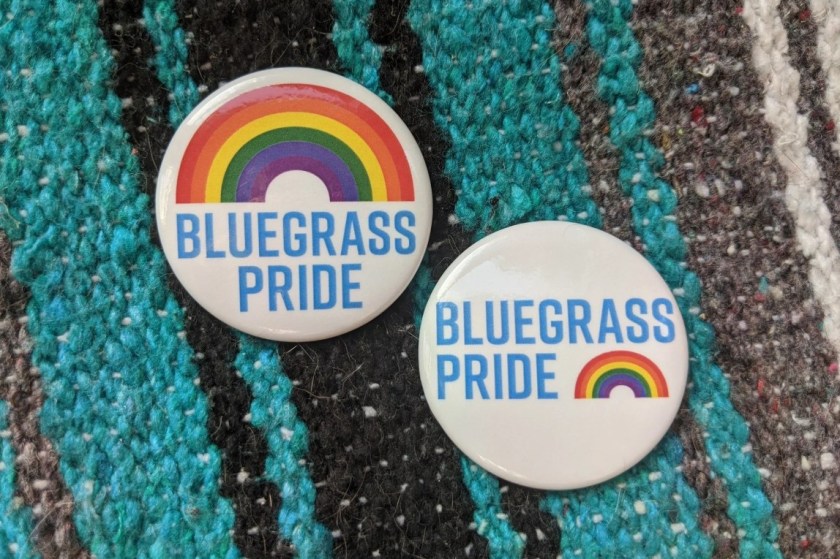
Bluegrass Pride: Working to make sure that if you love bluegrass, then bluegrass loves you right back.
In 2021 I wrote about cultural movements and histories that may surprise you. One of those was about the LGBTQ+ presence in traditional music. I was guessing at the time that you didn’t know that there was a Bluegrass Pride organization. Well, I’m here to tell you—here in Pride Month 2026—that it not only exists but that their members play great music. And they are not afraid to widen the boundaries of what has traditionally been a fairly conservative music community.
Bluegrass Pride began as a side project of the California Bluegrass Association. The original goal was relatively modest: bring bluegrass music to a new audience via a float at the 2017 San Francisco Pride Parade. The group quickly realized they had struck a chord (no pun intended). Here’s how the group’s website describes that initial foray into the Pride scene.
“In that first year, we celebrated Pride with hundreds of marchers and three float bands, representing the best of the local traditional American music scene: one youth band, one old-time band, and one traditional bluegrass band. Our picket fence float, live music, and enthusiastic marchers made a big impression, within the bluegrass scene and on Pride. We were named the Best of the Best at SF Pride 2017—bringing home the top prize out of 270 marching contingents. It was the first time that a first-time entrant to Pride had won the accolade.”
Fast forward to this year, and the group is now operating as its own organization, “pursuing new avenues through which to provide more opportunities for the musical and professional development of LGBTQ+ bluegrassers, and for community development within the bluegrass scene.”
The group’s message is simple, yet clear:
“We want current bluegrassers to know that they are loved and treasured for who they are and the music they make. We want future bluegrassers to know that they are welcome to come as they are without fear of retribution or exclusion. We want the world to know that bluegrass and old-time music are for everybody, regardless of age, race, gender, orientation, nationality, upbringing, or politics.
We want to make sure that if you love bluegrass, then bluegrass loves you right back.”
One way they will do that is with the first Camp Bluegrass Pride 2026 in beautiful Astoria, Oregon.* I thought it would be fun to hear some of the music of the instructors from the camp as well as from some of the artists who have been carrying this torch for some time.
NOA EVE AND FOG HOLLOW
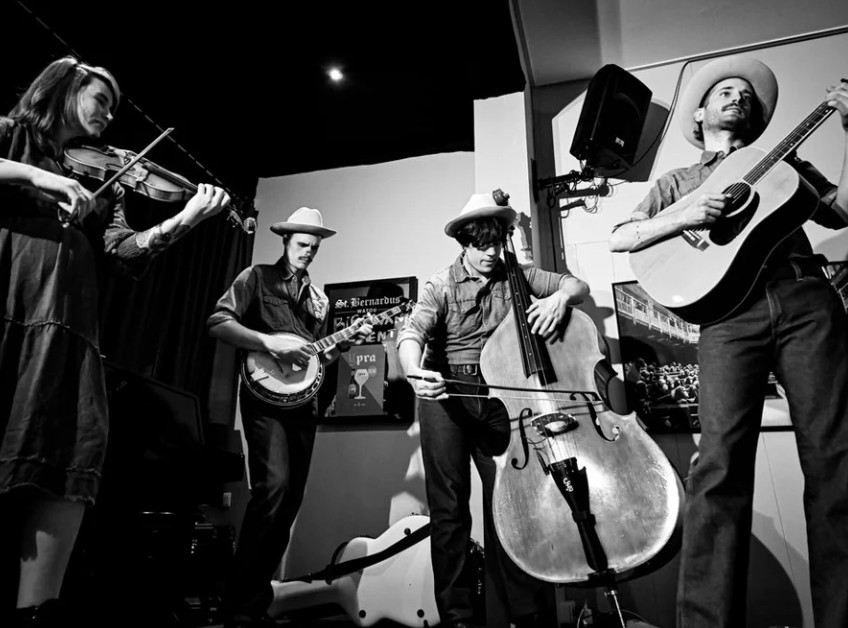
Noa Eve will be one of the bass instructors at Camp Bluegrass Pride this year. A bassist and composer, Noa grew up in Buffalo, New York, graduated from SUNY University at Buffalo with a BA in music performance, and furthered their studies at UCLA, where they received their master’s, also in music performance. “Noa had their first experiences playing folk music at UCLA, and since then has worked to marry their virtuosic, classical style of bowing with the rhythmic needs of bluegrass and old time.”
They play with the band Fog Hollow and can be heard here in the tune Burning Down and Bodega Rock. The latter features some nice fiddle/bass interplay.
CJ LEWANDOWSKI AND THE PO’ RAMBLIN’ BOYS
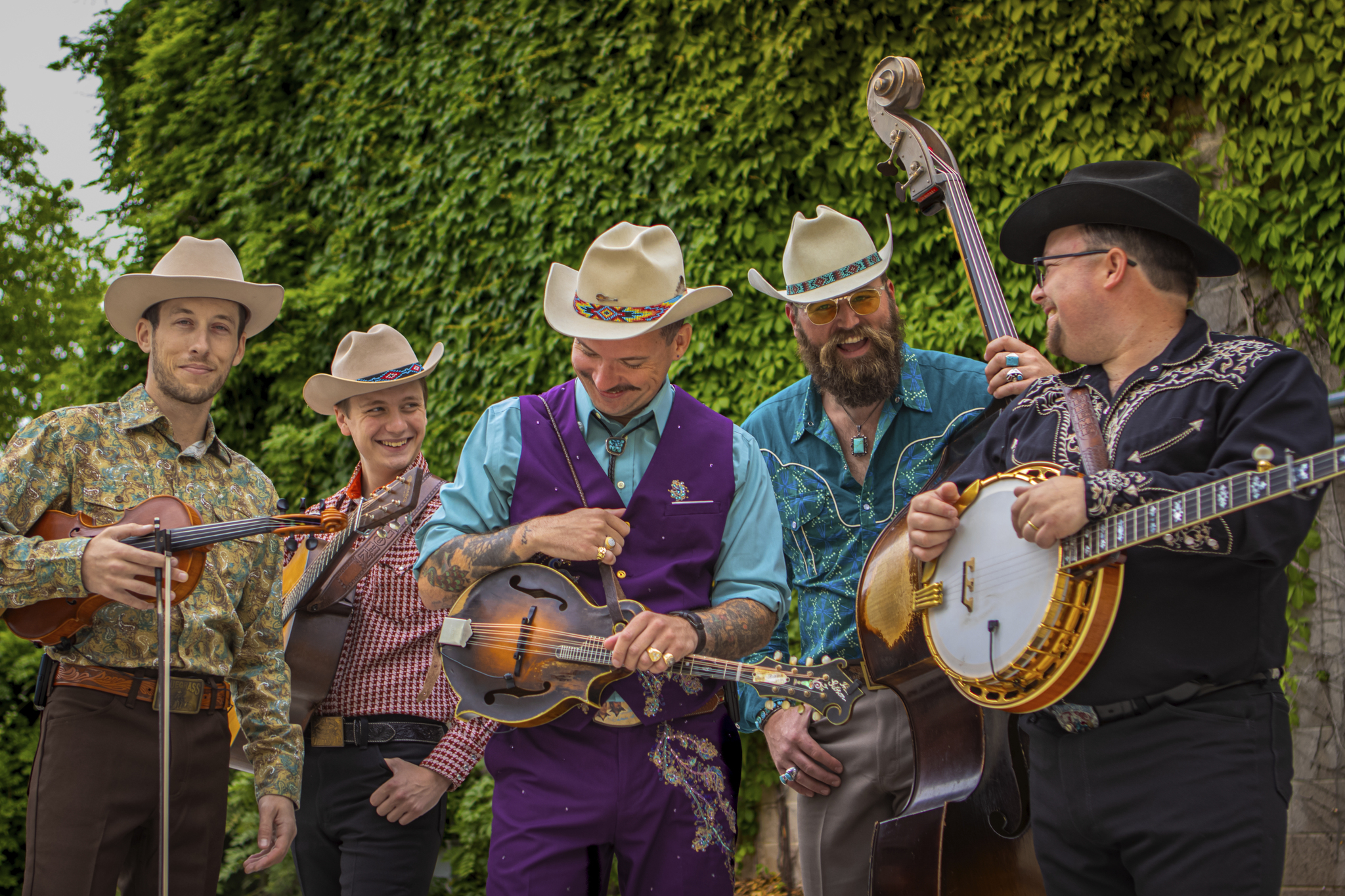
CJ Lewandowski is the mandolin instructor for Camp Bluegrass Pride 2026. In his regular life, CJ is best known as the mandolinist and co-founder of the Grammy-nominated Po’ Ramblin’ Boys. His powerful mandolin builds on the traditional, Monroe-style drive.
Po’ Ramblin’ Boys (credit Laci Mack)
“With the Po’ Ramblin’ Boys, CJ has helped lead one of the most exciting modern bluegrass bands on the scene, earning international acclaim, IBMA honors, and a Grammy nomination for Best Bluegrass Album. His playing is precise, soulful, and fearless. His love for teaching and community shines just as brightly as his musicianship.”
NELSON WILLIAMS AND NEW DANGERFIELD
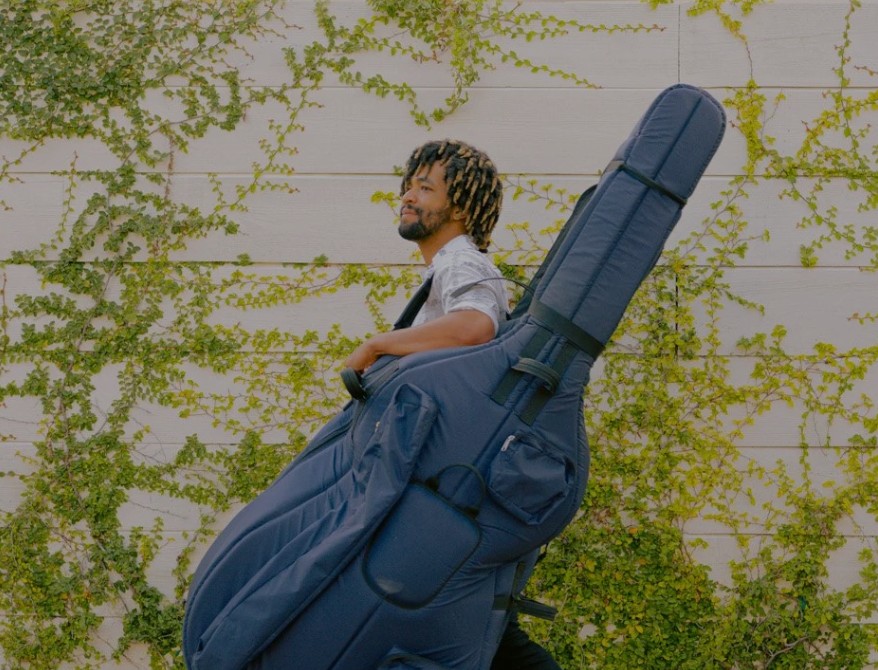
Another bass instructor at Camp Bluegrass Pride 2026 is Nelson Williams.
An upright and electric bass player based in New Orleans, Williams was born and raised in South Louisiana, a “child of the diverse and influential music culture that permeates throughout the region.” He has performed across the nation and abroad, is a founding member of the Black string-band, New Dangerfield, and a member of the acclaimed bluegrass band, Chris Jones and the Nightdrivers.
New Dangerfield “brings together Afrofuturist fiddler Jake Blount (see below) with composer, songwriter, and old-time banjo player Kaia Kater, bluegrass banjo iconoclast Tray Wellington,” and Williams. “Embodying the innovative aspects of the Black string band tradition, Wellington, Kater, Williams and Blount are well-acquainted with the contemporary, the experimental, and the speculative.”
Put No Walls Around Your Garden is a reminder that the only way we’ll get through is together. Rather than walling ourselves off, “now is the time to throw open our garden gates and welcome each other in. Share our abundance, work through our scarcity and lack, and care for each other’s needs—big or small.”
The group takes their name from Dangerfield Newby, one of five recorded Black abolitionists among John Brown’s raiders who died while taking part in Brown’s infamous raid on a federal armory in Harpers Ferry, Virginia in 1859. By taking traditional instrumental tunes and turning them on their ear, “the band demonstrates the unique prism through which they make music and synthesize these age-old folkways. Each of these four powerful artists has risen to carry the torch for the ancestors who first built this music, but have been forgotten and erased today.”
CARRYING THE TORCH: JAKE BLOUNT
Several well-known musicians in the field have been standing with the community’s LGBTQ+ musicians for some time. Jake Blount, a member of New Dangerfield and a former board member of Bluegrass Pride, is both an advocate for the the Queer community and someone who is well known for stretching boundaries.
“Blount specializes in the music of Black communities in the southeastern United States, and in the regional style of the Finger Lakes. A versatile performer, Blount interpolates blues, bluegrass and spirituals into the old-time string band tradition he belongs to. He foregrounds the experiences of queer people and people of color in his work.”
In 2020, Blount’s first full-length solo album, Spider Tales, was released on Free Dirt Records & Service Co. The album debuted at #2 on the Billboard Bluegrass Chart. Rolling Stone wrote of one of the songs on the album:
A queer and black performer working in Appalachian music, Blount gives an eerie, gender-flipped rendition of Leadbelly’s “Where Did You Sleep Last Night” — famously covered by Nirvana — that’s heavy on mournful fiddle and every bit as unsettling as the original.
That’s followed here by a 2022 rendition of Death Have Mercy played, I suspect, as you’ve never heard it before.
DELLA MAE
Della Mae (or the Dellas as they call themselves) are “women, writing from women’s perspectives, taking their cues from bluegrass and old time music.” As they say on their website, “We are 50% queer, and 100% supportive. We believe that representation, queer voices, and allyship are important in music. We’re not necessarily typical of traditional music, and we love representing our identities and values in new spaces.”
While unafraid to get political, the most topical songs early in their career were based in history, such as Boston Town.
As the writer of the Bluegrass Pride blog wrote about a recent performance by the group,
“Magic Accident brings us more of what we’ve come to love from Della Mae: tight harmonies, brilliant songwriting, and—practically oozing out of the seams—a sense that someone else gets it. It’s a sonic group hug.”
“In 2020, Della Mae reset and came out swinging with Headlight—a record tackling sexual assault, infertility, and the strength needed to carry on in no uncertain terms. They followed it with Family Reunion, centered on “The Way It Was Before”, their clearest statement yet that we are in the present, talking about today’s issues.”
But that didn’t mean that the band lost sight of “the joy needed to sustain the revolution.” Just give a listen to Dry Town and try not to smile.
“‘Cause it’s dry town | No beer, no liquor for miles around | I’d give a nickel for a sip or two | To wash me down | Outta this dry town”
MOLLY TUTTLE
Molly Tuttle is another musician who has been featured on Saturday Soundtrack multiple times—see here, here, here, and herefor instance—and who has spoken up for Bluegrass Pride. For today’s post she sings a bluegrass (sort of) version of the Rolling Stones song She’s A Rainbow. It includes powerful statements about gender and equality. As I wrote in the original post in 2021, getting all parts of the bluegrass world to support rights for the LGBTQ+ community may be the definition of hard work, but it is work worth doing.
If you’d like to dig deeper, here’s a soundtrack provided by the Bluegrass Pride website.
Enjoy, and Happy Pride month everyone!
More to come . . .
DJB
*Claire and I visited Astoria on our cross-country drive in 2015. It really is a special place. If you click on the link, you’ll get a hint of what we discovered.
Photo of Bluegrass Pride pins from the Bluegrass Pride website. Photos of the musicians from their various websites.