Election Day 2022 was a good day for democracy. The worst of those who want to deny Americans the ability to choose our own leaders lost. There was little or no violence and no credible calls of fraud. From my perspective, the American people voted pretty emphatically that they were not going to tolerate a party that tried to fix all the elections so that only Republicans can win.
President Joe Biden spoke to the nation yesterday and noted that the Democrats had the best midterm elections for governors since 1986 and lost fewer House seats than they have in any Democratic president’s first midterm in 40 years. Once again, I suspect, that remarkable performance against the historical standard will go underreported. Pundits and political reporters had a really bad day on Tuesday, but I have lost what faith I had in their ability at introspection. They still get paid when they are wrong, and they will continue to write out of their biases, facts be damned.*
There is still a great deal of work to be done. Florida, for example, is a mess, and Marco Rubio’s 17%-point victory over the very competent Representative Val Demings stands as exhibit number one. Rubio is not a serious person. I suspect there is a combination of a flood of new MAGA residents, voting restrictions and intimidations, DeSantis denying the Justice Department access to the polling stations, a flawed state Democratic party, and more at play.
There is also work to be done around illegal gerrymandering. After years of the state legislature drawing maps that favored Republicans, the people of Michigan rose up to amend the state constitution, requiring an independent, nonpartisan panel of 13 citizens to redraw the maps. Guess what? Political competitiveness broke out all over! Michigan Republicans challenged the new map, but yesterday the Supreme Court dismissed their appeal. However, not every state is as fortunate. Four states controlled by Republicans — who control 10% of the seats in the House of Representatives — have simply refused to follow the orders of their state supreme courts to change blatantly partisan maps. In Alabama, Georgia, Louisiana, and Ohio, heavily gerrymandered maps stayed in place despite state court decisions that they were unconstitutional. Work to change the maps, and demand consequences when lawmakers openly flout the law, is needed.
History tells us there is always work to be done.
As the elections neared, I read of two periods in our past in which democracy hung in the balance. Neither one is as well-known as the Joe McCarthy fiasco of the 1950s. In both cases, people chose to fight. That fight took years and sometimes decades, but in the end, America emerged a stronger democracy.
In that year the Republican Party had become so extremist that many of its members, disparagingly called “Mugwumps” by party loyalists, jumped ship to vote for a reformer, Democrat Grover Cleveland. It was a chaotic and consequential election, for it showed those Republicans who stayed with the party that they must moderate their stances or become a permanent minority.
Younger Republicans like Henry Cabot Lodge of Massachusetts, Robert La Follette of Wisconsin, and Theodore Roosevelt of New York took notice and turned their party back toward its roots, protecting the rights of individuals rather than of corporations. By the end of the century, they had captured the imagination of the nation. Once in office, they ushered in the Progressive Era.
But on Election Day, 1884, all anyone could know was that there were currents and crosscurrents. What would come from any of them would not be clear for another decade or more. In that tense election the main point was that there was voting at all, for the right to choose our lawmakers was what made America, America.
This was “the Trumpiest time in our history.” It was defined by extraordinary repression, persecution, racist violence, and surveillance.
In Lincoln, Nebraska, a mafia boss named Tom Dennison orchestrated attacks on white women by white men in blackface to unseat a progressive mayor. Black World War I veterans were beaten and lynched. So were German Americans and those suspected of being Communists. Newspapers and magazines were censored and shut down by the postmaster general. Zealous military officials built a surveillance network to spy on resisters in the Philippines, then deployed them against dissenting Americans.
If you were on the receiving end of that vengeful repression, it would have been easy to conclude that the fight for democracy and human rights was lost forever.
But within a few short years, women would gain the right to vote. Within decades segregation would become illegal. That device in your pocket now permits you to spread information without worrying about the postmaster general.
Every generation has its challenges, because the oligarchs and their politicians don’t want democracy. They want to choose their own voters rather than the other way around. They have deep pockets and they never stop in their stealth bid to reverse-engineer all of America, at both the state and the national levels, back to the political economy and oligarchic governance of midcentury Virginia, minus the segregation.
But as women and young people showed on Tuesday, once people have rights, they don’t like for some oligarch, judge, or politician to try and rip them away.
The fight continues.
More to come…
DJB
*Markos Moulitsas, the founder of The Daily Kos, summed up the media approach pretty well.
When my daughter was a toddler, she’d drop a glass of water or juice and say “Uh oh, the glass fell!” The passive voice implying she had no responsibility in the accident.That’s what the @nytimes is doing here, pretending that they weren’t a major driver of The Narrative.
Each month my goal is to read five books on a variety of topics and from different genres. I read in order to learn and to start conversations with readers and others I encounter along the way. Here are the books I read in October 2022. If you click on the title, you’ll go to the longer post on More to Come. Enjoy!
The Architecture of Suspense: The built world in the films of Alfred Hitchcock(2022) by Christine Madrid French is the rare book from an academic publisher (the University of Virginia Press) that is academically sound in its field (architectural history), insightful in its conclusions, instructive in its suggestions as to how her findings can be applied in the real world (through historic preservation), and — perhaps best-of-all — a page-turner that a reader simply cannot put down. Chris looks at how Alfred Hitchcock made buildings characters in his films, including the mid-century modernist house as the new villain’s lair, the urban honeycombs of apartments and skyscrapers, and, of course, the famous dilapidated mansion and roadside motel. A spooky good read!
Lemon (2021) is the first novel translated into English by the Korean writer Kwon Yeo-sun. The story revolves around the murder years earlier of a beautiful 18-year-old woman and how the case turns cold when the two prime suspects cannot be convicted. Yet the murdered woman’s sister begins her own journey to find the truth, a journey that intersects with the lives and fears of two other women also haunted by the incident. The whodunnit style is merely a device to have the reader consider issues of fear, guilt, grief, and trauma. It is also, as more than one review has noted, a “shrewd diagnosis of a culture that disempowers women — commodifying and consuming them, one after another, until their appeal wears out.” Yeo-sun’s writing is taut, pulling the reader along page-after-page to follow the unfolding, complicated, and contradictory paths each of the women take.
The Baseball 100 (2021) by Joe Posnanski — the self-described “writer of sports and other nonsense” — is characterized by the publisher as “a magnum opus…an audacious, singular, and masterly book that took a lifetime to write.” This is Joe’s intimate and very personal look at baseball history through the lives of the 100 greatest players of all time. The rankings are important, and Posnanski explains how his rankings came to take the form they have in this book. There is a fairly intricate formula he uses to set the rankings, and then some of his personal quirks intrude that set the players in certain places (e.g., #56 for Joe DiMaggio for his historic 56-game hitting streak; #42 for Jackie Robinson for his uniform number, the most famous in baseball). But mostly he wants these rankings to “give this book shape and spark a few feelings.” And they do. I happen to strongly agree with his number 1 ranking, but I know others who would disagree. The Baseball 100 is pure baseball bliss.
Survivor: The triumph of an ordinary man in the Khmer Rouge Genocide (2012), is by Chum Mey, one of seven survivors of the S-21 Khmer Rouge prison. As Mey tells in his captivating book, he was fortunate. His life was spared because, as a mechanic, he was able to fix a broken typewriter for his captors, who then kept him alive in order to work on other machinery at the site. The book, told in the first person, is a raw and moving story of a poor Cambodian peasant whose parents died when he was young. His dream to be a car mechanic led him to learn the trade, and then to go to Phnom Penh after the Khmer Rouge takeover because that was where the buses and cars were located. Like many in Cambodia, he was arrested under false pretenses and sent to Tuol Sleng, the name for the S-21 prison and torture center. The story of his resilience and impact is inspiring.
1368: China and the Making of the Modern World(2022) by Ali Humayun Akhtar makes a compelling case that China’s “first modern global age” began in 1368 with the establishment of the Ming dynasty and lasted until the abdication of the last Qing emperor in 1912. In Akhtar’s capable hands, we learn of the series of diplomatic missions that went out from the Ming rulers to various parts of the world. Though it may come as a surprise to many, Portuguese, Spanish, Dutch and English traders maintained an unusually peaceful relationship with China until the 19th century. “Finished textiles flowed from Safavid Persia and South Asia to Japan; silver bullion from Japan to China; and tea, ceramics and silk from China to Europe.” The Opium Wars, where Britain and later France brutally defended their right to import opium into China, signaled the ending of China’s first great global era. Both China and Japan were humbled by Western military superiority of the 19th century, and reformers in both countries pushed for a western-style industrialized empire. That they succeeded has generated a new set of problems along with enduring questions for the west, questions where history can be a guide to China’s current global aspirations.
This Weekly Reader features links to recent articles, blog posts, or books that grabbed my interest or tickled my fancy. I hope you find something that makes you laugh, think, or cry.
Photo of Thomas Hughes Memorial Library in Rugby, Tennessee, by DJB
Standing on the bank of the Siem Reap River near the Terrace of the Leper King in Angkor Thom, Cambodia, the young man cast his fishing net much as his ancestors had done over the centuries. My camera froze that moment, but it was the timelessness I wanted to capture.
The practice of heritage conservation works within a world touched by the passage of hours, days, years, decades, and centuries. Landmarks, you see, are not created by architects and builders alone. What really makes a site a landmark is the place it holds in a community’s memory. Memories are created over time. Memories are poets, not historians. Memories can be deeply spiritual.
The spirit of place comes alive not just in the ways a site is conserved and presented and not just through memories, but in the way it is usedand valuedby people, the way a community animates the space today. How a place is animated by its community gives it meaning. Part of what gives that temple at Angkor meaning is the casting of that fishing net. The placing of flowers in veneration. The thousands of little actions by the people who live near what are still sacred places — taken time and time again — over the centuries.
There were many occasions during the past two weeks in Vietnam and Cambodia to confront the fact that the cyclical understanding of time, found in civilizations that are much older than ours in the West, is ever present in this most fascinating of places. Each day the sun rises and sets, the seasons follow one another, the heavenly bodies revolve around us, people grow old and die, but their children reconstitute the process. Cyclical time is not a scarce commodity. There seems to always be an unlimited supply of it just around the next bend.
And scholars who work in heritage conservation in Southeast Asia suggest that the cyclical nature of time contributes to the authenticity of these places. Authenticity comes not only from the physical structure, but from the history, traditions, memories, myths, associations, and continuity of meaning connected with people and use over time; what’s known as the intangible heritage of a site.
The past two weeks were an extraordinary journey into the intangible heritage of Southeast Asia.
Exploring the traditions and cultures of the world
Angkor Wat, Siem Reap, Cambodia
One of the joys of this time in my life is to serve as a study tour leader/educational expert for National Trust Tours. * For over 50 years, National Trust Tours has been offering life enriching programs that explore the traditions and cultures of the world, placing a special emphasis on the roles of art and architecture. It was because of National Trust Tours that I was in Vietnam and Cambodia along with Candice and some 21 other travelers, cruising the Mekong River, from October 17th – 30th.
This was such an extraordinary experience that I have already placed six posts on More to Come examining different aspects of what we encountered and highlighting specific regions of these two countries. Throughout this wrap-up of the trip, I’ll reference those posts and provide links. This overview is filled with pictures and is organized using my traditional Observations from…format, which entails pulling together a series of random observations into one post.
Feel free to jump around to find the headlines and sections that interest you the most.
First, the logistics of getting from HCMC to Seim Reap
Our group gathered in Ho Chi Minh City (which is often abbreviated HCMC and was formerly known as Saigon). For two days we explored sites within the city as well as nearby landmarks, such as the Cu Chi Tunnels. In the post Body and Soul, one can see more images from those days as well as read excerpts from my first talk on the differences between conservation practice in East and West.
Old Post Office interior in Ho Chi Minh City
On Thursday the 20th, we embarked on the Mekong Princess for a seven-day cruise up the Mekong River.
The Mekong at morning outside Phnom Penh in Cambodia
Life never seems to stop along the Mekong River. It is beautiful. It is polluted. It is the lifeblood of the traditional communities that still line its banks. It is being choked at one end by the massive dams being built by the Chinese as part of their Belt and Road Initiative and it is being killed at the other when those dams result in hydrological changes that push brackish water back up the river. It supports a wide range of boats day and night, from traditional fishing vessels to weekend party boats around the major cities. It hosts floating markets.
It is endlessly mesmerizing.
Ferries are everywhere along the Mekong, although we saw a number of new bridges — usually built by other countries as reparations for war — along the route as well. This ferry seemed to specialize in motorbikes.
A traditional wooden boat for transporting fish. The eyes on the front of the boat are also a traditional touch.
Vietnam has built this dam and catchment area to stop brackish water from traveling further upstream and killing the fish and wildlife along the river.
One of literally hundreds of barges and boats we saw carrying goods along the river.
Speaking of transportation
This Vietnamese woman riding a bicycle on one of the island roads along the river was something of an anomaly.
The traditional bicycle which so many of us associate with Southeast Asia is being replaced by the motorcycle. Traffic in Ho Chi Minh City and Phnom Penh reminded me of the controlled chaos that is Delhi. Seim Reap — as befits its tourist-oriented focus near the Angkor temples — was more subdued.
A very typical street scene, full of motorcycles, in Ho Chi Minh City
It was difficult to find a place in HCMC that was not served by motorcycles
Motorcycles were everywhere, even in the most remote of villages
Candice and I (and our fellow travelers) took just about every mode of transportation imaginable over these two weeks.
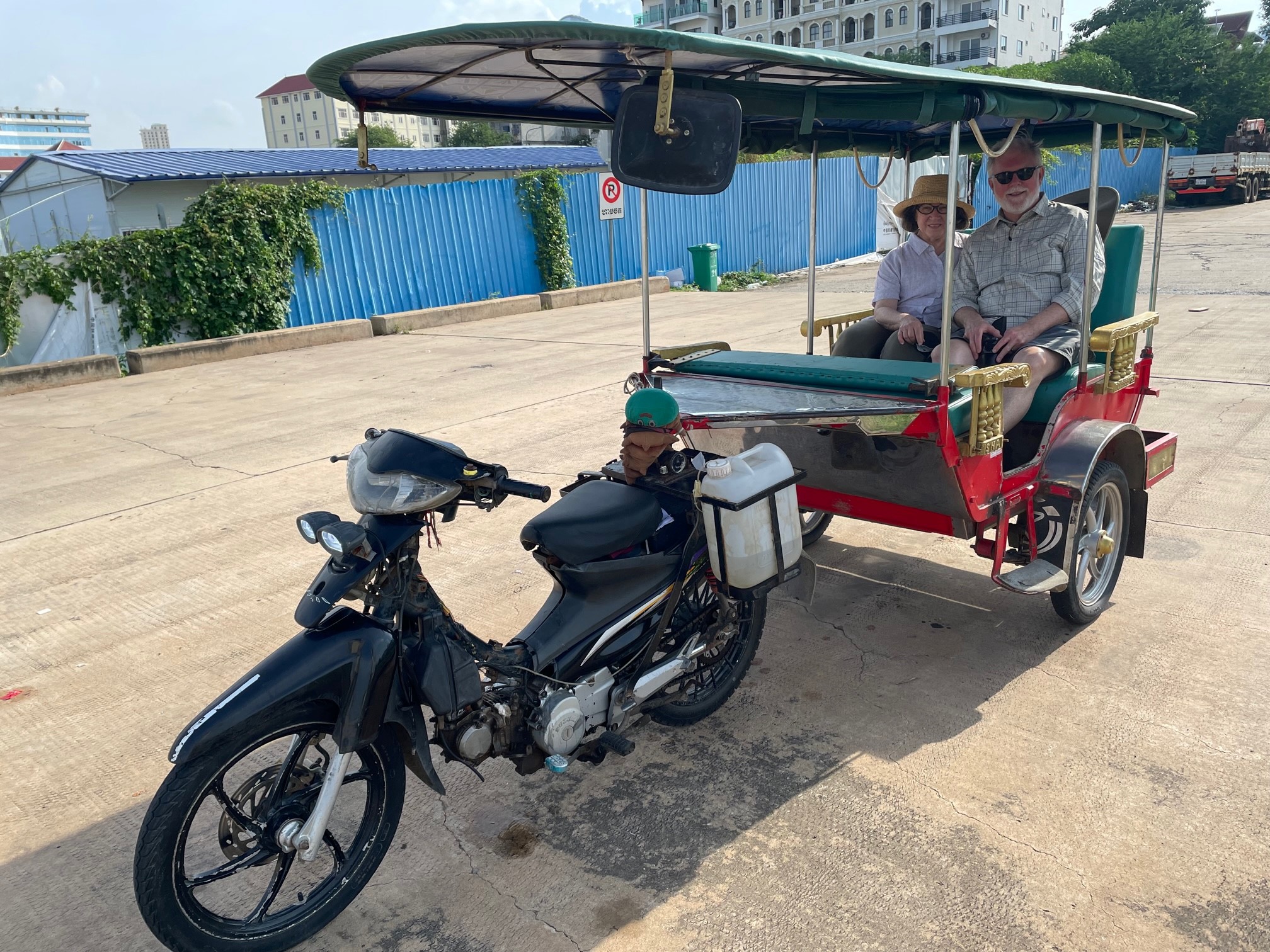
Our Tuk-Tuk in Phnom Penh (credit to our Tuk Tuk driver)
Rider’s view from the Tuk-Tuk
Traveling around the moat at Angkor Thom via gondola (credit Sylvia Griffin)
A typical traditional boat to move off the ship and travel up the small waterways around the islands.
The launch point for our ship-to-island ferry.
Traveling by sampan in Ben Tre
And this historic mode of transportation was the way to our rooms in Seim Reip
These markets are not your typical Whole Foods
Part of the wet market in Phnom Penh’s Central Market
I included a number of pictures of the famous floating markets in an earlier post. But we saw markets everywhere, selling anything and everything.
Our group visits the floating Cai Rang market in Vietnam
Saigon’s Central Market (above) seemed crowded and chaotic…until we saw the Central Market in Phnom Penh. After that experience, this seemed rather orderly.
The Phnom Penh market had endless rows of clothing, including many brand-name outfits! (Including clothes where two well-known brand names were prominently featured, just to let you know it was quality!)
The central hall of the market in Phnom Penh. If you need a watch, you can get it here!
Flowers for sale beside the Buddhist temple in Siem Reap
Flower detail in Seim Reap
The museums were not always up to western standards, but they more than delivered in terms of educational enlightenment and emotional impact
Skulls from those who lost their lives at the Killing Fields in Phnom Penh
As I wrote in Understanding and honoring difficult history, our tour did not shy away from visiting the places and hearing the stories of horror and inhumanity. You are invited to click on the link to see more photos of places like the S-21 torture center and the Killing Fields. Throughout our visit, we were challenged again and again to look at the region’s history from fresh perspectives.
The photo exhibition at the War Remnants Museum in Ho Chi Minh City was especially powerful
Stark reminders of inhumanity at the War Remnants Museum
Cambodia’s national museum
Part of the collection at the national museum
Interior courtyard at the national museum
Detailing on the national museum
Khmer classical dance theatre in Seim Rep
The many islands held endless fascination
River scene on a Vietnamese island
We visited a number of small villages and islands throughout the trip. There was something new to see and experience around every bend.
Traditional house at Angkor Ban
Some traditional scenes — such as the pens for these roosters, kept separated to help train them for cock fighting — challenged our sensibilities
We saw numerous instances of single craftspeople working to create traditional and handmade pieces of clothing or items for use in the home
Family-owned coconut candy factory in Vietnam
Given our personal interests, we encountered local food and heard traditional music everywhere we turned
Our Cambodian meal one evening in Siem Reap
Candice and I both enjoy exploring the food of the countries we visit, and we had some excellent meals in both Vietnam and Cambodia. There was also a great deal of street food that looked exotic, but that would not have settled in well on our western digestive systems. We chose to simply capture those parts of the culinary experience via pictures.
Meat skewers — sometimes with feet and head attached — were very popular with the locals
The food in this small Vietnamese market was typical of what we saw on the street
This view of a family taking food from the floating market to use and/or resell is one of my favorite images of food from the entire trip
Flattening rice using traditional tools (but with an electric generator to supply the energy for the pounding mechanism)
Countless markets such as this one lined the roads in Vietnam and Cambodia
One of the street foods that our Cambodian guide swore tasted great…but did not entice us given our western sensibilities…was the 21-day-old egg. Yes, you can guess what emerges when one is cracked open.
Street vender selling the 21-day-old egg
Tek, our Cambodian guide, eats one of the eggs as we all declined his offer to join in
Fruit was everywhere we looked
Many of our travelers joined Candice in enjoying a Three Elephants drink at the Grand Hotel Angkor
Gathering for the trip’s final dinner together before we head home
Traditional music, also a deep interest of mine, could be found everywhere, but especially in the temples and on the streets. We heard a great deal of Khmer music once we reached Cambodia.
Traditional musicians playing in a Phnom Penh temple
Traditional dancing was always accompanied by a small group of musicians playing Khmer music on traditional instruments
Greater Angkor lives up to its reputation as a bucket list heritage site
The temples in the Greater Angkor area near Siem Reap, a UNESCO World Heritage Area and the largest religious monuments in the world, are not to be missed. We spent two days there and could have spent two weeks.
Angkor Wat
Hallway and carvings at Angkor Wat
Lotus flower in the moat around Angkor Thom
Our approach to Bayon Temple
Bayon Temple…note the faces in the towers
The carvings at Bayon Temple are simply extraordinary.
Marker for the Terrace of the Leper King
Terrace of the Leper King
Both Vietnam and Cambodia are one-party countries ruled by authoritarian leaders, and the wealth inequality is staggering
Presidential Palace in Phnom Penh
Everywhere we turned on this trip, we could see disparities of wealth. The amount of outside investment, especially from the Chinese, Japanese, Koreans, and some Middle Eastern oil countries, was huge and unrelenting.
Old and new architecture juxtaposed in Phnom Penh
New construction was everywhere in Phnom Penh
Unfortunately, along with the shiny new buildings, the sustenance living of so many of those we saw on the streets and in the villages was also extensive and unforgettable. Western style investment and development has not been the tide that lifts all boats…a fact that we see in our country as well.
This Vietnamese woman cooking with rudimentary utensils in an open-air kitchen was an all-too-typical scene on the islands along the Mekong
Farm animals live side-by-side with families in Angkor Ban
Children in Angkor Ban were enthusiastic learners, even though they had to use sub-standard reading materials in their English classes
Children in Angkor Ban wish us well at the end of the school day
Residents at a Phnom Penh orphanage that is supported by the owners of the Mekong Princess entertained us with traditional music and dancing. The impacts of war, poverty, and policies to encourage Western-style development can be hard on the country’s youngest citizens.
All of the cities had their special charms and attractions
The entrance to the Old Post Office in Ho Chi Minh City, bringing to mind the French colonial past
The presidential palace in Ho Chi Minh City as seen from our bus. Unfortunately, the building was off limits for parts of our stay, due to a state visit by the President of Singapore
One of the networks of parks in Ho Chi Minh City, as seen as we drove past on our bus
The independence monument in Phnom Penh
Cambodia has a history associated with drumming. This drum is part of one of the main temples in Phnom Penh
View in the heart of Phnom Penh
Siem Reap had the best bridges.
And who even knew that a fish pedicure even existed!?
With thanks to the young lady who gave me permission to photograph her feet swimming with the fishes
I’ll end where I began…
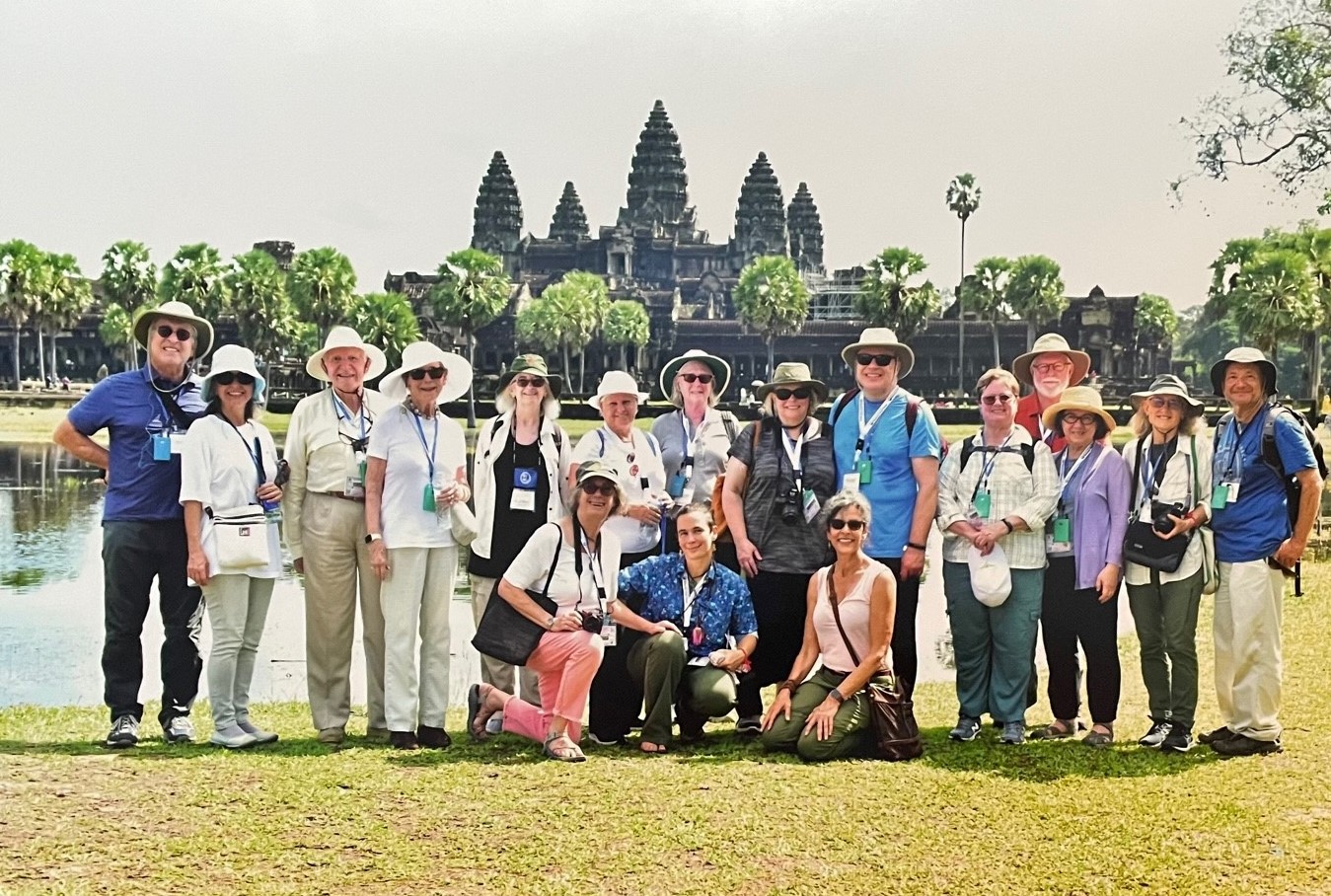
Our group of travelers in front of Angkor Wat
National Trust Tours can be a life enriching experience. Come and join us.
More to come…
DJB
*As a staff member serving as a representative for the National Trust for Historic Preservation, I took my first NTT trip in 1998 to Northern Ireland. Over my more than two-decade career with the Trust, I joined tours stretching from the Black Sea to the Gardens of the Caribbean, from the coastal civilizations of Europe and the beaches at Normandy to Japan.
Presenting one of my lectures aboard the Mekong Princess (credit Candice Brown)
After my retirement from full-time service at the Trust in 2019, the NTT staff asked me to join them in this role of study tour leader, sharing my expertise and experience in historic preservation and international heritage conservation through lectures and other presentations on several trips each year. While the pandemic scuttled the first couple of tours, we were finally able to begin this new journey in 2021 with a tour to explore the architecture, art, and craft of Asheville. That was followed earlier this year with our tour of Glasgow, the Scottish Highlands and islands, and the fiords of Norway.
UPDATE: I realized that I missed the lede when I posted this yesterday. Here’s what I should have highlighted much earlier in the post:
(T)he speed and ferocity of the disinformation surrounding the attack (on House Speaker Nancy Pelosi’s 82-year-old husband Paul) was remarkable. Within hours, there were wild conspiracies being shared on fringe sites. After a few more hours, those conspiracies had gone mainstream via GOP lawmakers like Ted Cruz and figures like Donald Trump Jr., and ultimately, Donald Trump himself. It just shows how willing Republicans and all the people in that orbit are to dismiss reality and accept something that is obviously and easily debunked, but helps push their own narrative, demonizing their opposition.
What was so shocking was the conspiracies were almost immediately matched with jokes. Donald Trump Jr. and others were posting pictures of a Halloween costume with a hammer and a pair of underwear. At a campaign event this week, Kari Lakemade a joke about the attack and it got the biggest laugh of the night. The callousness of that is quite terrifying. It’s startling to see mainstream politicians being so callous and inhumane when an 82-year-old man is attacked in his home with a hammer and almost dies.
This obfuscation (around what clearly happened to Paul Pelosi) serves two purposes. First, it avoids a disruption in the right’s meta-narrative of victimization. The story told by conservative media is one in which innocent conservatives are relentlessly persecuted by an all-powerful progressive cabal. This persecution justifies the right’s increasingly illiberal methods, which they present as a necessary defensive response to stave off political annihilation. If they were to acknowledge even one episode of a violent maniac attacking their enemy, it would mean contemplating a reality in which evil and blame are more complex.
Second, deflecting this reality allows them to avoid having to confront a faction within their own coalition. If they conceded DePape was on the political right, they would concede that ideas like Trump’s stolen-election lie or QAnon contained at least the potential to inspire violence and criminality. Their denial grew out of an impulse to close ranks. They might be able to afford cutting DePape loose, but they could not afford to alienate those who shared his most important beliefs.
That’s the big lede going into the elections. We have a party — and party leaders — that, in order to maintain the pretense that they are relentlessly persecuted by progressives, will lie and then laugh about an attack on an 82-year-old grandfather that almost killed him.
That’s where we are today. So put that up against all that the Democrats are doing to help all Americans…not just members of their own party.
We are just a few short days away from the 2022 mid-term elections and apparently the Republican candidate for the U.S. Senate in Georgia, Herschel Walker, suggested that voters in that state should compare his resume with that of former president Barack Obama. Stephen Colbert was glad to oblige.
Herschel Walker challenged Obama by saying we should compare their resumes. We took the liberty to do that: pic.twitter.com/W8PGucjHHq
John Stoehr at the Editorial Board has written an excellent summary of everything the Democrats have done over the past two years. I include the high points but suggest you read the full article for yourself. As he says, no smoke and mirrors are required, just an overflow of facts.
Here’s the reality as Stoehr lays it out:
Jobs: Achieved the greatest single year of job creation in American history, more than 6 million in 2021, a decrease of 16 million receiving unemployment benefits, and the biggest drop in the unemployment rate in history.
Manufacturing jobs: The biggest yearly increase in US manufacturing jobs in nearly 30 years. Democrats’ new incentives for key industries have already led to announcements of thousands of new manufacturing jobs.
Healthcare: Democrats’ new tax credits drove a record 14.5 million Americans signing up through the ACA, including 5.8 million new people getting coverage. They forced drug companies to negotiate prices for the elderly and capped costs at $2,000 per year. This will save elders thousands annually.
Poverty: The Dems’ child tax credit created the largest-ever one-year decrease in childhood poverty in American history, about 3 million kids. Households saying they didn’t have enough to eat dropped by a third.
Safety: Passed the biggest anti-violence measure in decades, including the Gun Safety bill and strengthening the Violence Against Women Act.…
Covid: Biden executed the most successful American vaccination program in history – from under 1 percent of adults fully vaccinated to over 75 percent, with over 500 million shots administered – and from less than half of schools open to almost all of them.
Roads, bridges, energy: the bipartisan infrastructure bill will finally fix America’s infrastructure. In 2022 alone, repairs are starting on 65,000 miles of roads and 1,500 bridges, with thousands of jobs created.
Protecting America and our allies: Biden kept the NATO alliance together in support of Ukraine following the Russian invasion, brought in two new countries and took out the world’s number one terrorist, Ayman al-Zawahri.…
Climate: The Inflation Reduction Act includes the largest investment in history to address global warming. Biden rejoined the Paris Climate Accords and the EPA established strong new fuel economy standards.
Diversity, equality: Democrats made lynching a federal hate crime, made Juneteenth a federal holiday and Biden appointed more Black women to the US Court of Appeals in one year than any president in history.
Budget: The Inflation Reduction Act reduces the deficit by $300 billion.
But of course you won’t hear this in the fear-mongering ads from the party which has been taken over by a far right-wing element. It has become a party that seems perfectly fine looking the other way when an 82-year-old grandfather has his skull fractured with a hammer wielded by an intruder who has spent months soaking in the lies of the right-wing media.
— Editorial & Political Cartoons (@EandPCartoons) November 3, 2022
Today’s Republicans like to play make-believe, so they scream about…
Inflation (without noting that Democrats did not cause this and Republican plans, such as they are, will make it worse.)
They want us to be scared of rising crime (when, in fact, major crimes, including murders and shootings, are down across America, and crime rates are higher in Republican-run states).
And they play the race-based immigration card (although immigration is up because of the rising number of jobs we have, many of which only immigrants will take).
The critical political story of our time is that one of our political parties backed an unsuccessful coup d’etat in 2020 and is working hard at all levels now to wrest power in 2022 and 2024 from legitimately elected officials. I don’t expect the national media to back one political party over another. I do expect national media to be pro-democracy. Unfortunately, as media critic Margaret Sullivan has noted in her recent book, much of mainstream journalism is not up to the task.
Which, unfortunately, is as it has often been.
I have no idea how next Tuesday’s elections will turn out, and I doubt many people making confident predictions do either. I do know that whatever happens, our country will not collapse.
There are steps forward and backward in this process. Powerful forces in the U.S. and around the world don’t want us to be a democracy for all. Sometimes those forces win, and sometimes those looking out for the broader public good are successful. No matter what happens on Tuesday, we have to continue to push for a world that is better for all.
We succeed as a country only when we all thrive. There are wise observers who know all too well where we are headed without a major change in direction, one that recognizes that our left-behind citizens deserve better in part because we will all do better — we will all build hope together — if we recognize that life is a team sport.
NOTE: For more than three years, I’ve been sending an email to several hundred friends and readers to summarize the posts on More to Come. These usually go out on the last day of the month and as I craft these messages I work to pull these posts together into a story. It struck me after sending out the October update that I could easily post this to the blog as well, in case someone who isn’t on the email list comes by for a visit and wants to check out what’s going on. So I’m trying it out to see how it goes. If you receive the email, you can skip this. Nothing’s changed. If absolutely no one opens it after a month or two, I’ll probably drop the experiment. But perhaps someone will find it of use.
Between trips to Scotland, California, Vietnam, and Cambodia, I spent a grand total of five days at home during October. * Taking advantage of the privilege of travel, I posted observations from around the world on More to Come… As I’ve been challenged by travel to, in Pico Iyer’s words, “think about moods or intimations or places inside yourself that you never ordinarily see,” I’ve come to better understand the wisdom in the Richard Rohr quote that “life is about discovering the right questions more than having the right answers.” Seeing different perspectives helps us discover those questions.
One of the amazing houses in the Gold Coast neighborhood of Alameda, California. Note the cool water tank in the rear of the house.
In praise of the local walking tour ― the favorite October post in terms of reader views ― is typical of many from this month. While focusing on a specific place, it uses what I’m seeing as a jumping off point to make observations around a variety of subjects that I hope you’ll find interesting. The architectural walking tour in question is for one of the historic neighborhoods of Alameda, a veritable gold mine of architectural styles. The homes are gems that point to the creativity of the architects in California in the late 19th and early 20th centuries. The tour itself is also first rate, which points to the care for community of those residents who have become stewards of the past for the benefit of future generations.
This month the blog showcases the breadth of my tag line: Observations, recollections, and occasional bursts of radical common sense about places that matter, books worth reading, roots music to nourish the soul, the times we live in, and whatever else tickles my fancy. You’ll find some of each this month. In a break from my regular monthly update, I’m grouping these posts by location, providing a bit of a travelogue feel. I’ll catch up on all the “whatever else tickles my fancy” posts at the end. This update is longer than most, but I hope you’ll find several things to tickle your fancy as well.
So let’s go to the place that may not have invented orange marmalade, but certainly made it commercially available
I traveled to Scotland the first week of the month in order to attend INTO Dundee 2022, the conference of the International National Trusts Organisation (INTO). I’ve been attending INTO conferences for two decades, first as a representative of the National Trust for Historic Preservation and an INTO board member, and more recently as a consultant for INTO. It was my second trip to Scotland this year, but the first to Dundee, which is northeast of Edinburgh. Dundee was a revelation on so many fronts, including the inventiveness of the local residents that came up with the formulas for making commercially-available orange marmalade and the adhesive postage stamp, among other things.
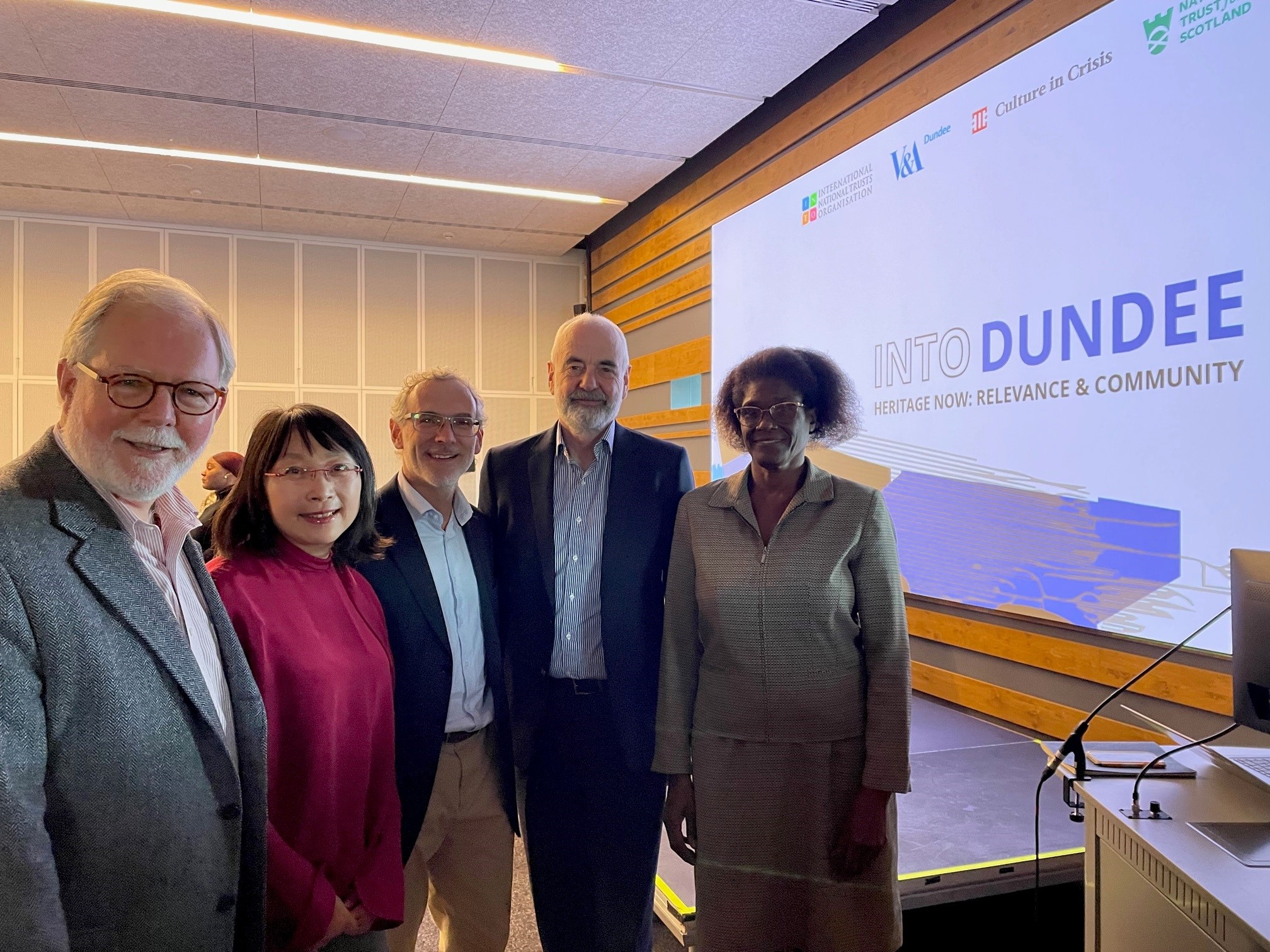
Working for a better futureis a recap of the week, with notes about the city, some highlights of the conference, thoughts on seeing dear friends again for the first time since before the pandemic, and a tasty morsal of Scottish music from the Battlefield Band. The panel I moderated ― to highlight the work of colleagues from China, Spain, Scotland, and Jamacia ― gives a sense of the diversity of participants and perspectives.
While on this trip, I also made stops in Edinburgh, where I attended my first INTO conference in 2003. The city is a marvel that was teeming with residents and visitors alike, a fact I discovered as I walked the neighborhoods around my hotel. On one of these walks I saw a good example of how Scotland has chosen to recognize the difficult history behind one of its early leaders. This caught my eye as I am often asked in my work to comment on the issue of disputed history and how we recognize and honor those who are often marginalized. History and heritageis a post I wrote after visiting St. Andrew’s Square and seeing the new plaque being prepared for the massive Melville monument. This is a plaque to 1) explain Henry Dundas, 1st Viscount, Lord Melville’s history; 2) acknowledge his significant role in delaying the abolition of the trans-Atlantic slave trade; and 3) rededicate the square to the memory of more than 500,000 Africans who were enslaved as a direct result of Henry Dundas’s actions. Photos from around Edinburgh are included here as well, as I came to realize I was running out of time to prepare another post before moving along to my next trip.
Finally, the world did not stop during my time in Scotland, so I included a short piece about Ukraine, Russia, and the threat of nuclear war entitled Observations from abroad: It’s not all about us. Timothy Snyder is one of the top historians of authoritarianism and the Holocaust, and while I was in Dundee he posted a piece on his Thinking About newsletter on how the Russo-Ukrainian war might plausibly end. He also made the strong point that those of us in the US need to get past the notion that the war, and the threat of nuclear weapons, is all about us. As I worked my way around the world this month, I came to see time and time again that we would benefit in the U.S. by getting over the notion that it is all about us. Travel and getting out of the country can do that for you.
Go west, young man!
Coming home just long enough so I could wash clothes and repack, we then headed out to Alameda, California, for a visit with our daughter Claire. A bit of family bragging is in order: successfully completing her work and exams, Claire was recently certified as a Licensed Clinical Social Worker (LCSW) in California. We are so proud of her and the important work she does, and we celebrated Claire’s licensure together over dinner and drinks. We also took the time to see some of the wonders of the Bay Area before heading to Southeast Asia. As you saw above, our Saturday afternoon was spent on a walking tour of Claire’s neighborhood. But there were a few other things we took in as well.
Alameda has a great independent bookstore downtown that was within walking distance of our Vrbo rental, so we visited on Friday morning. Naturally, I bought a couple of books. One was a short crime novel Lemon, the first translated into English by the Korean writer Kwon Yeo-sun, and I had finished it before dinner that evening. Living with life’s wrongs is my short review of a book where the whodunnit style is merely a device to have the reader consider issues of fear, guilt, and grief. It is, in the end, a work to consider how we cope and eventually go on after trauma. It is a good read.
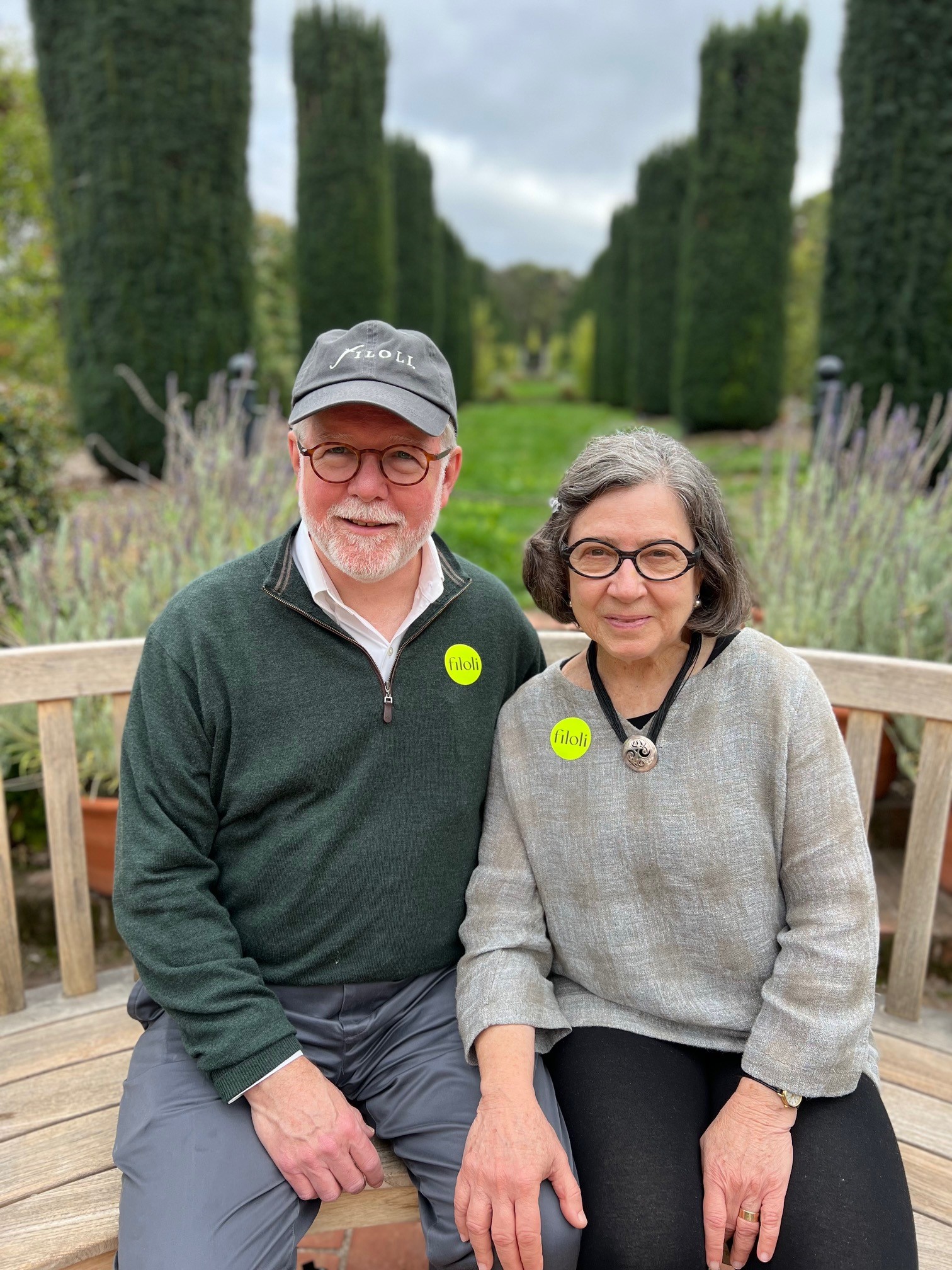
Blue Gold at Filoliis the post I wrote after spending Sunday afternoon with Claire and Candice at the National Trust Historic Site Filoli in Woodside, California. Filoli’s new interpretive exhibit looking at the power and privilege of water helps set the context for the site, and I applaud my friend and colleague Kara Newport’s leadership in working with staff, board, and stakeholders in putting this exhibit together.
A collaboration for the agesis a quick Saturday Soundtrack post I wrote while in Alameda featuring the musical collaboration of two beloved area musicians: David Grisman and the late Jerry Garcia. A little peace, love, and bluegrass from the Bay Area.
Finally, Alameda REALLY likes to decorate for Halloween. So while we were there, I filled up my camera with pictures and posted some of the best of the decorations last Saturday as Celebrating ghosts, goblins, and other things that go bump in the night. Check out the skeleton doing the cannonball dive into the swimming pool, the Haunted Broadway extravaganza, and the clever 2022 Baseball Playoffs graveyard. That last one was clearly the work of a displaced Phillies fan.
Cruising the Mekong River
Fishing in Cambodia
When I return home and allow my brain and body to catch up with the time zone there will be more to come from the terrific National Trust Tours trip to Vietnam and Cambodia. But here’s what I was able to post in October:
Body and soulwas the title of my first lecture on the tour. In addition to some excerpts from that talk, I include images from the first few days in Vietnam on our Mekong River tour. Scenes along the Mekongis a post primarily of pictures from rural Vietnam and the first day in Phnom Penh.
Understanding and honoring difficult historywas written after our group had visited the Cu Chi tunnels in Vietnam as well as the infamous S-21 torture center and the nearby Killing Fields in Phnom Penh. In my second lecture, I spoke about how history is always under construction and why seeking to confront difficult history is important in building just and ethical memories. This post delves into those questions and includes a review of a book by a survivor of S-21, who we were privileged to meet at the prison site. These were very emotional days which I expect to take a lifetime to fully process.
Exploring the traditions of Angkor Banis a look at a small, traditional Khmer village that was one of the few not destroyed by the Khmer Rouge in the 1970s. Our visit was full of surprises, including a tour of a traditional Mekong River home set high on stilts and time with a group of children at the village’s English language school.
Sunrise over Greater Angkor shows the photographs I took on a beautiful Cambodian morning as the sun rose over the landscape surrounding the famous Angkor Wat temple. It was awe inspiring. In a similar vein, The appealing mysteries of Ta Prohmcaptures the atmospheric look of Ta Prohm, among the most famous of Angkor temples due to the intertwined large trees and temple ruins. Very compelling.
Many of you know that I’ve been reading Vietnamese-American writers in preparation for the trip. One of the most celebrated is Ocean Vuong, and I reviewed two of his most recent works in Listening to new voices. The always popular The books I read in September 2022 looked at the five books I read and reviewed that month, which included the Vuong books, two others by Vietnamese-American writers, and one on debunking myths around history.
Everything else that tickled my fancy
I did keep up my reading habits this month, and two of the books I read that were not about Southeast Asia were, in a word, terrific.
Knowing that I was going to miss most of the baseball playoffs due to travel, I took along Joe Posnanski‘s magnum opus, The Baseball 100. It is “an audacious, singular, and masterly book that took a lifetime to write” and my fawning review (**) can be found in An intimate tour of baseball history.
My former National Trust colleague, Christine Madrid French, has written a new book on the built world in the films of Alfred Hitchcock that is spooky good! Just in time for Halloweenhelps the reader understand why the lairs of villains switched from haunted castles to sleek modernist masterpieces under Hitchcock’s eye. The reader also learns why our minds immediately go to a famous bathtub murder scene in the movies when a picture of an old Victorian mansion with a 1930s motel in the front yard is shown. Chris explains how this setting came to carry such a potent and disturbing message for a mid-century movie-going audience. Hitchcock understood the moment and set up the scene so that moviegoers just knew that Janet Leigh was making the wrong decision when she pulled into that motel parking lot. Hey, it’s a horror movie. Making poor decisions is what you do. (***)
As noted above, the world did not stop spinning just because I was out of town. So two posts were focused on the times we live in.
In case you needed a reminder, I provided this helpful Monday morning rant entitled Capitalism is not democracy. Wall Street is not the economy. Care for the common good is not socialism. If you can remember those three things while watching the horrible commercials during this election season, you’ll be better informed than 45% of the American public. This post begins with a story told by the late John Bogle, founder of the Vanguard Group, to the MBA graduates at Georgetown one year. “At a party given by a billionaire on Shelter Island,” Bogle noted, “the late Kurt Vonnegut informs his pal, the author Joseph Heller, that their host, a hedge fund manager, had made more money in a single day than Heller had earned from his wildly popular novel Catch 22 over its whole history. Heller responds, ‘Yes, but I have something he will never have . . . Enough.’” You can probably guess where this is going.
Most of my Saturday Soundtracks this month are included in various parts of the notes above. But the good folks at the Tenement Museum (a National Trust Historic Site) in New York City hosted a live-streamed wake for Irish musician Mick Moloney that I was delighted to include. You’ll find it at Mind Yourself: A musical wake for Mick Moloney.
In these especially difficult and unsettling times, remember to treat others with kindness, undertake some mindful walking every day, and recognize the incredible privilege that most of us have and think about how to put that to use for good. Women, people of color, LGBTQ individuals, immigrants, and others can feel especially vulnerable…because they are. Finally, work hard for justice and democracy by voting this month as if your life depends on it…because it does.
You can follow More to Come by going to the small “Follow” box that is on the right hand column of the site (on the desktop version) or at the bottom right on your mobile device. It is great to hear from readers, and if you like them feel free to share these posts on your own social media platforms.
This is a history story that has resonance in today’s climate of fear, paranoia, and conspiracy theories.
Friends of Friendless Churches is a U.K.-based charity (i.e., nonprofit) that rescues and repairs redundant places of worship in England and Wales. They care for and celebrate their rich architectural legacy and history and support their local communities. I follow the group on their LinkedIn page, which is where I first saw this story. I reposted it on LinkedIn, and I want to do the same on More to Come. Here’s the information they provided:
Wood Walton church floats on a green island amid acres of churned dun fields and murmuring fenland. No one is around for miles. And in the 19th century, a lone bell rattling in the emptiness was the only way of alerting the living that you’d been buried alive.
Fear of being buried alive permeates through centuries, but perhaps achieved its tightest grip in the 18th and 19th centuries. This was aided by stories about the presumed-dead fighting their way out of airless coffins or grave-robbers waking up would-be corpses.
From the late 1700s methods of alerting the living that you were alive too began to be developed, with many devices patented. Some such devices were safety coffins – coffins with air and feeding tubes, bells and flags, and glass panels show up any condensation from breath.
One of the earliest recorded safety coffins was for Duke Ferdinand of Brunswick (d.1792). His coffin included an oxygen tube, a set of keys to unlock the coffin, and a glazed panel to let light in.
At the end of the 18th century, Dr Johann Gottfried Taberger’s safety coffin really took off. It involved bell(s) arranged above ground. The bells were connected to the deceased by a series of strings. If the buried woke up, they would pull the string and alert those above ground to dig them out.
The bell system was popular but there is no record of it saving anyone.
Now, back to Wood Walton in Cambridgeshire. Around the northside, there is an iron arch with a deep hook tightly bolted to it. It is solid and firmly embedded. It’s believed that this is the remnant of a bell house for a safety coffin. The bell, with its strings connected to the body of the deceased, would have hung from the hook, so they could call for help from 6ft under.
Note the line in the penultimate paragraph: there is no record of it saving anyone.
We are currently awash in conspiracy theories. Many are fed and spread by politicians and media outlets that are working overtime to take your mind off the fact that their policies (such as they are) are destructive and designed solely to put power in their hands and money in their pockets.
Liars, con artists, and grifters have taken over the party of Lincoln and they are feeding stories and conspiracies that are easily disproven, if one actually resides in the reality-based world. (*) Unfortunately, many do not want to deal with reality, because the lies and conspiracies actually feed deep-seated grievances.
If you worry about being buried alive, you may be too paranoid for your own good. If you believe that someone can hear a bell ringing when there’s no one around for miles to save you, then you may also believe the hucksters who are peddling conspiracy theories — and their remedies — to today’s Republican voters.
The safety coffin story is amusing when we read it today, and we can chuckle and realize that the main harm done was to lighten the pocketbooks of those who worried about being buried alive. But many of those peddling paranoia in our current political climate are driving hatred, division and destruction. For far too many Americans, it is time to join the reality-based world.
More to come…
DJB
NOTES to the Friends posting:
1. Drone image by Hestia Architects Ltd 2. Sketches are from Dr Johann Gottfried Taberger’s patent. 3. You can read more about St Andrew’s, Wood Walton, Cambrigeshire here: https://bit.ly/3TFyN5x 4. Some believe this is where the ‘saved by the bell’ phrase came from, others believe it is something to do with boxing.
*After the recent break-in at Speaker Pelosi’s home and the vicious attack on her husband — the second attempt in two years to assassinate the Speaker of the House by crazed right-wing conspiracy theorists — Donald Trump spread defamatory falsehoods, saying that the glass was broken from the inside and that “weird things were going on in that household.” He said this after the assailant admittedtopolice that he broke into the house through a glass door and after a surveillance camera caught a man with a hammer, breaking a glass panel and entering the speaker’s home. So literally nothing Trump said about this was true. Call me not surprised. Virtually nothing this man has said his entire life is based in reality. He is the modern-day version of the huckster selling the “safety coffin” to the paranoid.
This Weekly Reader features links to recent articles, blog posts, or books that grabbed my interest or tickled my fancy. I hope you find something that makes you laugh, think, or cry.
As a high school student enthralled with history, I chose to focus on America’s past. It wasn’t that world history didn’t interest me. It was simply that I was more intrigued by what I could see (there’s that preservationist focus on place), and our family didn’t travel overseas when I was young. That changed as I grew older, as I came to travel more widely and at the same time grow in my appreciation of the scholarship that is opening doors for understanding the broader world, especially in these uncertain times.
Take China, for instance. In my younger days, China was a mystery to me. That fit with some of the prevailing scholarship at the time, coupled with narratives around Chinese insularity. The Great Wall only seemed to drive that point home.
But in a new book entitled 1368: China and the Making of the Modern World (2022), global historian and Professor of Asian Studies at Bates College Ali Humayun Akhtar sets out to prove that narrative of insularity false. Akhtar makes a compelling case that China’s “first modern global age” began in 1368 with the establishment of the Ming dynasty and lasted until the abdication of the last Qing emperor in 1912. That history has much to tell us about China’s current global aspirations.
In Akhtar’s capable hands, we learn of the series of diplomatic missions that went out from the Ming rulers to various parts of the world. These expeditions, undertaken by the Muslim admiral Zheng He to ports in Asia, Africa, and the Middle East, established contact and economic links with the rulers of Melaka, Brunei, Pasai and others located around the Spice Islands. Ashtar writes that, “It was in this Sinocentric world that the Iberian powers built their first global commodities portfolios in the 1500s.” And perhaps surprisingly, Portuguese, Spanish, Dutch and English traders maintained an unusually peaceful relationship with China until the 19th century. There was good reason for this: money could be made. “Finished textiles flowed from Safavid Persia and South Asia to Japan; silver bullion from Japan to China; and tea, ceramics and silk from China to Europe.”
The Chinese were strong militarily, but Akhtar notes that they did not bully their neighbors. Instead, they invited cultural and commercial connections.
There are fascinating chapters on the ways that Jesuit scientist-theologians were instrumental — often defying Rome in the process — in the westward transfer of objects and innovations. And then there is tea. Oh my, did I ever learn a great deal about tea from 1368!
From the 1550s, in Mr. Akhtar’s words, tea evolved “from Portuguese oddity to British monopoly.” European consumers prized Chinese black tea and blue-and-white porcelain, the attraction of the latter owing to its specialized manufacturing process — imitated, with mixed results, in the Middle East and Delft — and restrictions on its export. Late 18th-century industrialization, chiefly Josiah Wedgwood’s division of labor and advanced modes of transportation, created efficiencies in porcelain-making in Staffordshire, Meissen, Sevres and Chelsea. The English East India Co. would, in parallel, co-opt China’s tea trade through mass cultivation in Darjeeling and other South Asian outposts, and by dismantling the Canton System in the Treaty of Nanjing, which marked the end of the First Opium War. The upshot was the Company’s market supremacy, lowered prices and the emergence of England as “Europe’s premier tea-drinking nation.”
The Opium Wars, where Britain and later France brutally defended their right to import opium into China, signaled the ending of China’s first great global era. Both China and Japan were humbled by Western military superiority of the 19th century, and reformers in both countries, beginning in Japan, pushed for a western-style industrialized empire. That they succeeded has generated a new set of problems, but enduring questions for the west. As Professor Akhtar teaches us, Americans can seek to follow the Portuguese model from the 17th century and “through careful diplomacy, profit from economic partnerships with a productive China as it has since the 1970s.” Or it could choose to embrace the British empire’s zero-sum assumptions, as some on the right have suggested, that brought on military conflict and clear winners and losers.
Those are important questions for the 21st century, but questions that have a context that stretches back centuries.
Our tour group arrived early one morning to the late 12th-century Ta Prohm temple, one of the best known of the Angkor sites in Cambodia, thanks to the overgrowth of trees hundreds of years old that have come to coexist with the temple ruins.
Unlike most Angkorian temples, Ta Prohm is in much the same condition in which it was found: the photogenic and atmospheric combination of trees growing out of the ruins and the jungle surroundings have made it one of Angkor’s most popular temples with visitors.
UNESCO inscribed Ta Prohm on the World Heritage List in 1992. It is a photographer’s paradise, and we were fortunate to be at this very popular site with only a few additional visitors, including a small group of Buddhist monks.
Without any further commentary (except for a short note about the trees), enjoy these images I took on another beautiful Cambodian morning.
Our first view of the temple
An interior wall, leading to the center court of the temple
Trees and ruins coexist
The trees growing out of the ruins are perhaps the most distinctive feature of Ta Prohm, and “have prompted more writers to descriptive excess than any other feature of Angkor.” Two species predominate, but sources disagree on their identification: the larger is either the silk-cotton tree (Ceiba pentandra) or thitpok Tetrameles nudiflora, and the smaller is either the strangler fig (Ficus gibbosa) or gold apple (Diospyros decandra). Angkor scholar Maurice Glaize observed, “On every side, in fantastic over-scale, the trunks of the silk-cotton trees soar skywards under a shadowy green canopy, their long spreading skirts trailing the ground and their endless roots coiling more like reptiles than plants.”
Wikipedia
Three young Buddhist boys at the temple, attesting to the spiritual power of the ruins
View down a temple hallway
A temple tower sits amidst the jungle
Looking heavenward from inside a small room in the temple
Detail of a temple tower
But the eye always seems to return to the trees
How wonderful to experience the atmospheric combination of trees, ruins, and jungle in a way that invites one to stop and ponder — in a unique and powerful setting — the relationship of humankind with nature.
A true treasure, and an opportunity not to be missed in the fascinating landscape of Southeast Asia.
Over the last two years, first in 2020 and then again in 2021, the SaturdaySoundtrack before Halloween has featured roots music to celebrate the season. This year I’m traveling out of the country, but I have visited one town which goes all in for seasonal decorations: Alameda, California.
So, I’m going to post pictures from the creative folks in Alameda and intersperse them with a few of my favorite roots music songs for ghost, goblins, and other things that go bump in the night!
Hanging around in Alameda
I love this Alameda creation, with the skeleton doing the cannonball dive into the pool
The blues and jazz cats have a great number of songs for the season. Nina Simone does her usual masterful job with the Screamin’ Jay Hawkins hit I Put a Spell on You. That is followed by Elise LeGrow breaking the Bo Diddley classic Who Do You Love “down to a new set of bare bones. Watch her rasping howl bring ‘a tombstone hand and a graveyard mind’ to life.”
An ABBA-themed Halloween home in Alameda
These Alameda homeowners went all-in to welcome trick-or-treaters
Next, let’s turn to Rhiannon Giddens with a version of O Death from her recent album, They’re Calling Me Home. Giddens, with partner Francesco Turrisi, base this version on singing by Bessie Jones of the Georgia Sea Island Singers. As the Bluegrass Situation (BGS) site notes, it is a good reminder of “just how much of American music and culture are entirely thanks to the contributions of Black folks.”
There was one house in Alameda that went all in with a Haunted Broadway theme. Here are a number of their creations.
A sidewalk view, capturing perhaps one-third to one-half of the creations by this Alameda family. Well done!
Although I’m not a Phillies fan, I thought this clever take on the 2022 baseball playoffs was too good to pass up!
A Phillies fan in Alameda having fun with this year’s baseball playoffs (photo by Claire Holsey Brown)
Since I’ve been posting a lot of cartoons this season, it seemed appropriate to include one for Halloween.
The song that originally took me down this spooky path is the Del McCoury Band’s title track from the album It’s Just the Night, with backing vocals by the classic gospel group Fairfield Four.
Happy Hallowe’en, everyone!
More to come…
DJB
Image of werewolf from Pixabay. Playoffs graveyard by Claire Holsey Brown. All other images by DJB.
National Trust Tours can take you to places that are on everyone’s bucket list…even the “educational experts.” Take, for example, my experience on the Mekong River Cruise tour where I’m currently serving as one of the study tour leaders.
We rose at 4 a.m. this morning in Siem Reap. Our goal was simple: to view the sunrise over greater Angkor on a picture-perfect Cambodian day.
One of our first views from the top of the temple in the first light of morning
Mission accomplished!
Taking a 20-minute Tuk-Tuk ride to the point where we could begin hiking in the dark to reach the high temple mount of the late 9th century Phnom Bakheng Temple was an experience in itself. It was also inspiring to see places where long-time colleagues at American Express and the World Monuments Fund (WMF) have had such a profound impact on the stabilization, preservation, and restoration of these World Heritage Sites. While there I couldn’t help but think of the times I’d discussed global heritage conservation with my good friend Tim McClimon, the former president of the American Express Foundation, as well as the opportunities I’d had through the years to talk with Bonnie Burnam, the long-time CEO of WMF, about their work in this part of the world. Both have been colleagues I’ve long admired. Both remain an inspiration to me and many others.
Some things are better seen than explained, however, so I’ll stop writing and begin posting photographs taken today from Phnom Bakheng Temple. Enjoy!
After hiking up the mountain, we still had these stairs to climb before reaching the top of the temple
One of our first views of the temple, as the light began shining from the east
Early morning view looking back towards Angkor Wat
Angkor Wat in the morning mist
Panorama from Phnom Bakheng Temple
Views through the temple
I feel the need to tell you a bit more about what you’re seeing in these photographs, so here’s a great description from the WMF project page:
Phnom Bakheng, the state temple of the first Khmer capital in the Angkor region, survives as one of the world’s greatest architectural treasures. The Temple of Phnom Bakheng was constructed between the late ninth and the early tenth century by Yasovarman I as the centerpiece of his new capital, known as Yasodharapura. It was abandoned only a few decades after its construction, but its privileged hilltop location makes it unique among the temples of Angkor. Its stepped pyramid construction is a built representation of Mount Meru, the center of the physical and metaphysical universes in dharmic religions. Shrines and guardian lions adorn the seven levels of terraces that make up the pyramid; decreasing in size towards the top of the temple, these enhance the impression of the temple’s height. Five shrines on the top platform, arranged in a quincunx formation, represent the five peaks of Mount Meru. In the sixteenth century, an attempt was made to construct a large seated Buddha around the central shrine, which has since been dismantled. The central temple was surrounded by multiple brick towers, which only survive as ruins. Today, Phnom Bakheng is a popular spot for panoramic views of the Angkorean landscape, often enjoyed by visitors at sunset.
Views from atop the temple
View through temple looking east
Towers
Temple detail
Detail, looking through the central temple
Small plots of flowers on the temple floor
Towers along the edges of the temple
Looking west from the temple
Guardians of the temple
Candice and DJB at Phnom Bakheng Temple
Our final view of the temple before our hike back down the mountain
We spent the rest of the day exploring Angkor Thom and Angkor Wat…which I’ll cover in a later post. In the meantime, check another one off the bucket list!
More to come…
DJB
All images by DJB except for the one of flowers which is by Candice and the one of Candice and DJB, which was taken by Tek, our local guide.