Latest Posts

Thinking about narratives

Last week’s prime time hearing of the House Select Committee to Investigate the January 6th Attack on the U.S. Capitol has me thinking about narratives.

Those watching have identified multiple narratives at play in the presentations of the committee as well as in the testimony of the witnesses. A majority of Americans believe that the members of the committee have succeeded in setting a narrative that clearly lays the responsibility for the attempted coup d’état at the feet of the former president and his enablers. Likewise, many of the witnesses have told effective stories about the events of that day, none more so than former Mark Meadows aide Cassidy Hutchinson.

But as Michelle Goldberg wrote in Friday’s New York Times, there is a difference between “a smart narrative and an accurate one.” Like many narratives in today’s political culture, the ones we heard last week are crafted with a specific audience and a specific purpose in mind. In addition to making the case for former President Trump’s leadership of the insurrection, many of the stories, as Goldberg notes, are also designed to pave a path for Republican redemption.

This raises several questions. To save democracy, how important is it that our political narratives be both smart and accurate? And what’s the difference?

Nesrine Malik, who wrote about narratives and myths in We Need New Stories, seems to think both are very important. As to the difference, she argues that while we need new stories to overcome the harmful myths that subvert freedom, facts alone only go so far. The strength of myths is not in facts, but in the narratives. That makes it impossible to fight fake facts solely with other facts. We need the compelling narrative to go along with those facts. Smart and accurate, in other words.

Myths that divide and create a sense of superiority over others “work hard to prevent change from happening. They are powerful. But they are not all-powerful.” Much of the Republican redemption narrative we are hearing in the January 6th hearings is an attempt to prevent real change from happening.


The right questions

Goldberg and others are asking the right questions. In going after Donald Trump’s culpability in the attempted overthrow of our democracy, have the narratives given too much room for others who enabled him for almost four years to evade their responsibility? There is no doubt that Trump is an existential threat to the United States, someone who would destroy our government of the people, by the people, for the people in order to get his way. But he could not have made it as far as he did without the support of the Republican Party and their divisive narratives. For example, when Trump needed Russia to uphold his narrative denying the reality of Russian interference in the 2016 election, the Republican Party was there to support that lie.*

We need to look at Donald Trump’s culpability. But we also need to go beyond that narrow focus to think about the narratives that keep driving political divisions and press coverage in the real world, often to the detriment of our democracy.

What is needed are new stories that are not just the correction of old stories but are visions that assert that “for societies to evolve, an old order must change.”

So much of what passes for political narrative now is far from the truth and focused on issues that are not critical to our future. They are undermining our democracy. Let me give you an example. In the midst of a full-blown constitutional crisis, the press is simply pushing Republican talking points that Joe Biden is a failed president. They are saying this of a president who has righted the ship after taking over from his predecessor who spent four years destroying democratic norms and gathering power into his own hands. Biden presided over an 86% drop in Covid deaths, the creation of almost 10 million new jobs and an unemployment rate of 3.6%, Medicare bulk purchasing to help lower drug costs, passage of the nation’s largest-ever infrastructure bill … and the list goes on.

The press may be beyond hope at the moment, but commentators like John Stoehr at The Editorial Board says he does expect better narratives from progressives who say they are trying to save democracy. I would go a step further and say that I expect more from all clear-thinking politicians — Democrats and whatever is left of the “Rational Republicans” alike who are fighting the fascists trying to destroy our democracy and our way of life. They need to tell a different story. As it is, the majority of their narratives are more about them than it is about democracy.


So, what do we do?

Franklin Roosevelt may have been the master at setting a compelling, forward-looking narrative. He wasn’t afraid to take on the challenges of his day, asking Americans “to judge me by the enemies I have made.”

But he also found the courage to look boldly ahead. “Courage is not the absence of fear,” FDR said, “but rather the assessment that something else is more important than fear.” And that something?

The test of our progress is not whether we add more to the abundance of those who have much; it is whether we provide enough for those who have too little.

There is a moral purpose to FDR’s vision, just as there was to Abraham Lincoln’s.

Congressman Jamie Raskin at the 2022 Takoma Park July 4th Parade

My Congressman, Jamie Raskin, sent out an email recently that does a great job of framing a forward-looking message. He wrote:

The most important political epiphany I ever had was on the day I announced my first campaign for public office, when I was running for the Maryland State Senate many years ago.

I made a speech setting forth everything I wanted to accomplish: abolish the death penalty in our state, increase the minimum wage, decriminalize marijuana, ban the sale of military-style assault weapons, launch the National Popular Vote interstate compact, and pass marriage equality for our LGBTQ community.

A woman came up to me and said, “Great speech, but one thing — take out everything you have in there about gay marriage. It’s not going to happen, and even gay candidates don’t talk about it. It makes you sound really extreme, like you’re not in the political center.”

I paused because I didn’t want to offend her, but my kids were with me watching, and so I said this:

“Thank you so much for saying that to me, because it makes me realize that it is not my ambition to be in the political center, which blows around with the wind. It is my ambition to be in the moral center. That is why I’m a Democrat and that is why I’m a progressive.”

Historian Heather Cox Richardson in her Letter from an American, says that when people write to her feeling hopeless about the future,

I always answer that we change the future by changing the way people think, and that we change the way people think by changing the way we talk about things. To that end, I have encouraged people to speak up about what they think is important, to take up oxygen that otherwise feeds the hatred and division that have had far too much influence in our country of late. (emphasis added)

Better stories, based on facts and reality, that have a compelling, moral, inclusive vision for the future. We can all contribute to those stories. We can do this.

More to come…

DJB

NOTE 1: The narratives around the January 6th hearings are not the only ones that need to be examined. I’ll go into more detail on narratives by the press, the Republicans, and the Democrats in Wednesday’s Weekly Reader.

*NOTE 2: From Greg Miller’s book The Apprentice, as recounted in What Were We Thinking by Carlos Lozado.

Image of sunrise by franz roos from Pixabay

Molly and Flux play Bluegrass like the founders intended

There is so much wonderful interplay these days between the established legends of progressive bluegrass and its young practitioners who are setting amazing new standards of musical excellence. Banjo master Bela Fleck, to give just one example, continues to tour with his Bluegrass Heart project that features a host of graybeards like Sam Bush and Jerry Douglas playing incredible music along with young titans of the genre like Billy Strings and Sierra Hull. (*)

In that same spirit, it has been a thrill to hear the recent music of Molly Tuttle & Golden Highway as the band has spent this year releasing new music and touring the country. Tuttle’s newest album, Crooked Tree, was recorded live at Nashville’s Oceanway Studios. The album “simultaneously honors the bluegrass tradition and pushes the genre into new directions, particularly in its lyrical content.”

I’ve featured the inventive guitarist Molly Tuttle and dobro king Jerry “Flux” Douglas individually in previous Soundtracks, but today I’m bringing them together because of a wonderful Paste Studio video of their three-song set this past May at Del McCoury’s Cumberland, Maryland music festival DelFest.

Here’s how The Bluegrass Situation described this gem:

In May, (Tuttle & Golden Highway) were joined at DelFest by none other than Dobro hero Jerry Douglas, who is also the co-producer of their new album. Douglas, Tuttle, and company give not only rip-roaring renditions of Golden Highway’s new songs in this performance for Paste Studio on the Road, but also an interesting and enlightening interview with a Paste host. The songs are presented as the founders of bluegrass intended: the band surrounding one microphone, weaving in and out of one another’s space to be heard. In between the interview portions, the band plays three songs from Golden Highway’s new album, Crooked Tree. For those of us who couldn’t get to DelFest this year, this video is a great way to feel like you didn’t completely miss out.

Yep, just like the founders of bluegrass intended…if they could have envisioned a 29-year-old female guitar phenom leading a band of top-notch pickers with the best dobro player on the planet.

Enjoy!

More to come…

DJB

*Just to be clear, all the graybeards are about my age, plus-or-minus five years. The younger set can be anywhere from teenagers to those musicians in their 40s.

Image: Jerry Douglas, Molly Tuttle, and Shelby Means (l to r) playing for Paste Studio on the Road at DelFest

Working your way out of the holes in life

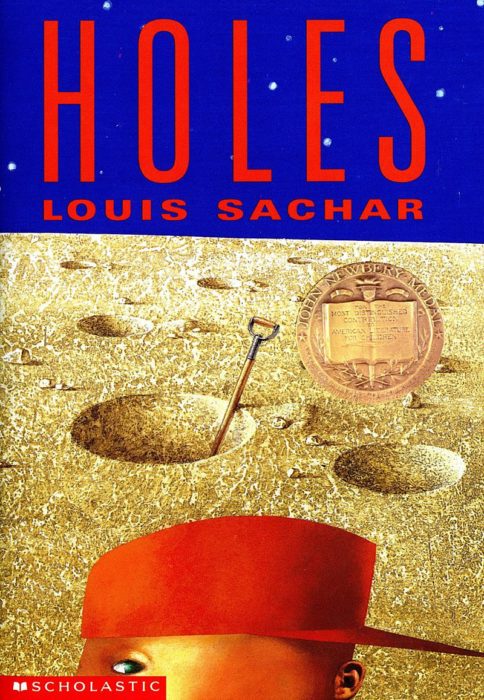
Because of a curse put on his no-good-dirty-rotten-pig-stealing great-great-grandfather, Stanley Yelnats always finds himself in the wrong place at the wrong time. Which is how he ends up at Camp Green Lake digging very large holes, because the adults have told him it will build character and teach him how to be a good citizen.

Oh, and Camp Green Lake is not a camp. It is not green. It doesn’t have a lake. And the holes Stanley digs are not always literal. After he finds something significant in one particular spot, Stanley also digs that hole into his memory. 

We learn the backstory at the beginning of Holes, a 1998 novel by Louis Sachar which takes the reader on a darkly humorous trip as Stanley reckons with his cursed past and his misplaced present. Wrongly accused of stealing the sneakers of Clyde “Sweet Feet” Livingston, a famous baseball player who got his name from having a foot fungus that made his feet smell bad, the overweight and bullied Stanley is sent to a juvenile detention center in the middle of the Texas desert. There he meets the other boys in his group — X-Ray, Squid, Armpit, Magnet, Zigzag, and Zero. Stanley is quickly given the nickname Caveman. And then there are the adults — Mr. Pendanski, a helping type who the boys call Mom, the perpetually grumpy Mr. Sir, and the Warden. Mr. Pendanski helpfully tells Stanley there is really only one rule at Camp Green Lake.

That rule? “Don’t upset the Warden.”

Written with pre-teens in mind, Holes has won the prestigious Newbery Medal, among more than 30 worldwide awards. It was made into a movie starring Sigourney Weaver as the Warden, Jon Voight as Mr. Sir, and Tim Blake Nelson as Mr. Pendanski. The book was banned by at least one school district, which only increases its cred among young readers. And more than twenty years after its publication, the book continues to delight pre-teens, teenagers, and adults. Family members had read Holes and recommended it as a good selection for my 2022 summer reading list.

Sachar’s story shifts between past and present, and the two are clearly intertwined. It becomes obvious early in the book that the Warden has the boys digging holes for reasons other than building character. She is desperate to find something — desperate enough to have her charges dig five-by-five-by-five-foot holes across a dry desert lake. Stanley decides he wants to know the secret as well. The edgy mystery unfolds in a way that is full of plot twists and danger.

We learn about racist violence in the past and the revenge of outlaw Kissin’ Kate Barlow. There is also cruelty and violence in the present, adding to the suspense. Coincidences between family history and current events keep popping up. A young boy named Zero, who everyone but Stanley dismisses as dumb, is key to unlocking the twisted tale. There’s nail polish made with rattlesnake venom; yellow-spotted lizards that can leap from the bottom of five-foot holes to devour a tarantula; stolen treasure; enough delightfully devilish nicknames to fill up a Barf Bag (yes, that’s the nickname of the boy who left just before Stanley arrives); and stinky feet.

What else could a young reader ask for!

Sachar’s way with words and his inventive storytelling skills captivated me right from the start. In the opening paragraphs he tells the reader that it is ninety-five degrees in the shade at Camp Green Lake. The only shade, however, comes from two old oak trees on the eastern edge of the “lake” that have a hammock stretched between them. The shade and the hammock are owned by the Warden and campers are forbidden to lie in the hammock. We can only imagine what might happen if a camper took that risk.

Rattlesnakes and scorpions are abundant, but “usually” you won’t die if one bites you. No, the worst thing that can happen to you at Camp Green Lake is to be bitten by a yellow-spotted lizard.

That’s the worst thing that can happen to you. You will die a slow and painful death.

Always.

If you get bitten by a yellow-spotted lizard, you might as well go into the shade of the oak trees and lie in the hammock.

There is nothing anyone can do to you anymore.

I stayed up late reading this book, laughed out loud when Zero makes an observation that leaves even the Warden speechless, and appreciated the lessons about perseverance, companionship, and overcoming both cruelty and personal history that shine through in Holes. The treasure chest of justice doesn’t always reveal itself easily, but Stanley finds it in the end.

A delightful read … for any age!

More to come…

DJB

Image by Marion from Pixabay

The consequences of complicity in an “I don’t take responsibility” world

When a president who routinely claimed absolute authority over, well, everything, famously washed his hands of the mismanagement of the coronavirus pandemic in March 2020, he said, “I don’t take responsibility at all.” Writer David Frum concluded that those words “are likely to be history’s epitaph on his presidency.”

“And an epitaph for those who nodded in assent”, adds Carlos Lozada.

Lozada’s 2020 book What Were We Thinking: A Brief Intellectual History of the Trump Era (2020) is the Trump book you didn’t know you needed to read. As the nonfiction book critic of the Washington Post since 2015, Lozada read upwards of 150 works on “the Trump era” — a period “suffused with conflict, crudeness, and mistrust” — and then created this wide-ranging, sobering, at times funny, and always insightful work focused not so much on Donald J. Trump, but on how we see ourselves in this moment.

Yes, it is ironic that a man who never reads and who speaks at the level of a fourth grader has generated so many words and so many volumes that try to define, understand, and address the state in which we now find ourselves. Ironic, weird, and — to use a favorite word of the former president — sad.

Lozado first read the ghost-written Trump: The Art of the Deal (1987), which he calls the “foundational text” of Trump Studies. This and other “Trump-authored” books (fake news if ever there was such a thing) offered a preview of “a world where bragging is breathing and insulting is talking, where repetition and contradiction come standard, where vengefulness and insecurity erupt at random.” But Lozado is primarily interested in the works of journalists, government officials, authors, and scholars who take on the task of figuring out how we got here, and what thinking (or not) went into that journey.

He leads us on his literary journey through ten chapters, with titles such as Heartlandia, Resistible, True Enough, See Some I.D., The Chaos Chronicles, and Russian Lit. In each he considers 10-15 books that address a common theme. A couple of the works are silly; others come very early in, or even predate, the Trump era; most identify the challenges of our times without much thought on solutions. Lozado helpfully identifies books that “challenge entrenched assumptions and shift our vantage points, the books that best help us make sense of this era.”

The most important, often written by historians and scholars, “enable and ennoble a national reexamination … They are the books that show how our current conflicts fit into the nation’s story, that hold fast to the American tradition of always seeing ourselves anew.”

They are the volumes on democracy that identify today’s battles as part of that endless fight to live up to our self-professed, self-evident truths, and that show that striving, while failing, to reach them is not just a feature of our system but its definition.

Lozado tackles each of the key issues of the Trump era with care and thoughtfulness. It isn’t a perfect book, as he sometimes exhibits flashes of the cynicism of the Washington insider. He also tends to read a lot of books by establishment types (e.g., David Frum), although he does introduce us to less-well-known authors as well. Corporations, oligarchs, and their impact in destroying democracy are generally missing in his review (perhaps because Lozado felt the need to thank Jeff Bezos in the acknowledgements for “keeping the lights on” at the Post). Nonetheless, it is book that moves beyond the soul-crushing daily headlines to take a longer look. With its publication coming just before the 2020 election, I quickly found myself hoping that Lozado is already at work on the second edition.


Understanding immigration and gender wars

There are several chapters that, to me, stood out above the others, beginning with Beyond the Wall on immigration. As an immigrant from Lima, Peru, Lozado brings personal insights into the discussion that strike this reader as especially useful. America for Americans: A History of Xenophobia in the United States by award-winning historian Erika Lee comes in for special praise in showing us how primed the country is for Trump’s message. (It is included among the “twelve books he’ll return to” that Lozado cites at the end of What Were We Thinking.) He also speaks as to how family separation, recounted in countless memoirs, is “already intrinsic to the immigrant experience, occurring long before anyone reaches America’s borders.”

Him, Too — Lozado’s chapter on gender and the Me, Too, movement — begins with the laughable account, told in one of the many sequels to The Art of the Deal, of the time Donald Trump was groped at a dinner party. “(W)omen accosting him with pulp-fiction come-ons are a recurring problem. That’s just life as The Donald.” But the chapter quickly turns serious, and Lozado handles it with appropriate care, in part because he is not a woman and is surprised by what he reads. There is a passage from Soraya Chemaly‘s Rage Becomes Her: The Power of Women’s Anger that clearly hit Lozado as hard as it hit me in reading it. “I hadn’t fathomed quite how much time, money, and mental energy women spend avoiding and fearing rape,” Lozado notes. But Chemaly lays it out in a chilling two sentences.

Ask a man what his greatest fear is about serving jail time, and he will almost inevitably say he fears being raped. What can we deduce from the fact that jail is to men what life is to so many women?


Chaos becomes him

In the chapter entitled The Chaos Chronicles Lozado blames Michael Wolff and his early 2018 bestseller Fire and Fury for setting the tone that the chaos in the White House is the true story. As Lozado writes, the trouble with writing about the Trump White House, and reading about it, too, is that “the lunacy is appalling yet unsurprising, wholly unpresidential yet entirely on-brand.”

The larger story, which often gets missed, is what the chaos means and why it matters. I’ve written about The Fifth Risk by Michael Lewis, which comes in for special praise here (another of his 12 books), as a work that describes the true American carnage wrought by Trump and his White House, including “the decline of America’s preparedness for truly complex crises.” Lewis wrote his book prior to the pandemic but was prescient in foreshadowing its consequences.


Consequences of complicity

The Chaos Chronicles is the first of several chapters that demonstrate the tragedy and consequences that arise when the “adults in the room” are complicit with Trump’s inappropriate and illegal actions. As Lozado notes, “so much is happening in this administration that gets lost in the Trump glare.” In Russian Lit, he reviews Greg Miller‘s The Apprentice: Trump, Russia and the Subversion of American Democracy. Miller notes that because Trump appears “beyond shame” when it comes to sex or money, Putin’s leverage on Trump is probably not found in the infamous Steele dossier, but in the simple fact that Trump needs Russia to deny the reality of Russian interference in the 2016 election order to keep his “last hold on that lie. Trump, obsessed with safeguarding the legitimacy of his election and his office, needs that story to persist.” Lozado adds: “As always, the scandal with Trump happens out in the open.”

And the Republican Party is complicit in supporting that lie.

The press comes in for harsh criticism as well for — among many other things — their handling of the Clinton email hack by Russia. In her book Cyberwar: How Russian Hackers and Trolls Helped Elect a President, journalism expert and scholar Kathleen Hall Jamieson makes the forceful case that foreign interference was indeed a major factor during the 2016 election. “Too often,” she notes, “the press served as a conveyor belt of stolen content instead of a gatekeeper.”

In the chapter In Plain View, Lozado writes,

(T)he authors of the democracy volumes focus on a different group that could have reconsidered Trump long before his name appeared on a ballot. It is a group whose leaders, initially alarmed by a populist and nativist candidate, opted to collude with him rather than shun or restrain him.

That is the Republican Party.

The consequences of complicity are wide-ranging and potentially long-lasting, and they show up with regularity in our daily news reports.

  • When the press is complicit in dancing around the truth, we end up seeing that Trump’s lies were intentional, but we lack reporters who will press him to explain why he was lying.
  • When the country’s so-called leaders are complicit in the never-ending calls for violence, we end up with the cautionary tale of Ray Epps, targeted by the very hate cult he joined.
  • Complicity in not calling out uncivil discourse, the attacking of women, and climate denial can have international implications, as is the case with an acquaintance of mine — a farmer and a smart, passionate, effective environmental activist from Australia who posted a note about how a simple tweet she sent out last week had led to extensive online bullying, harassment, trolling, and cyber stalking. (Strong trigger warning: these images and words are disturbing.)
  • Finally, one reason for the complicity by the wealthy is to avoid paying taxes to support our government. The tale of billionaire Ken Griffin, owner of the hedge fund Citadel, is instructive. He is donating tens of millions of dollars for the midterms in 2022 to avoid taxes and regulations. But in 2008, when his fund had lost 55% of its value and was in danger of going under in the AIG scandal/collapse, Griffin was all too willing to take his part of the $182 billion taxpayer bailout. Corporate bailouts for the “worthy” but with no help for the truly needy are part of our lives, both before and during the Trump era.

Lozado turns to The Soul of America by historian Jon Meacham to make the point that what we are seeing is normal for America. We feel a daily and constant tension between the pull of “all men are created equal” and the push to restrict life and liberty from others who are deemed undeserving, untrustworthy, and unequal.

Slavery. The Klan. Jim Crow. The Klan again. The internment of Japanese Americans and the expulsion of Mexians and Mexican Americans. Gender discrimination and scientific racism. The Southern Strategy. Mass incarceration. All this leads to a president whom Meacham considers “an heir to the white populist tradition,” a president whose only abnormality is that he manages to embody so many recurring maladies of American public life (emphasis added).


Books to help make sense of our times

Of the 150 books Lozado read in five years, he chooses twelve for his final chapter that have helped him make sense of this time. I’ll provide you with five…and encourage you to buy the book and read the whole thing!

We’re Still Here: Pain and Politics in the Heart of America, by Jennifer Silva. “This book expands my notion of who belongs to the heartland, and of the obstacles to belonging in our national politics.”

On Tyranny: Twenty Lessons from the Twentieth Century, by Timothy Snyder. “It draws on the author’s scholarship to warn of post-truth, heedless conformity, and institutional abdication.”

When They Call You a Terrorist: A Black Lives Matter Memoir, by Patrisse Khan-Cullors and asha bandele. “(This book) beautifully captures the tensions between individual and group identities, the power of marrying personal turmoil to collective struggle.”

Know My Name: A Memoir, by Chanel Miller. “Miller’s account of pain, law, and daily survival after a sexual assault outside a college dorm party in 2015 stands with the most unforgettable memoirs of trauma and loss.”

One Person, No Vote: How Voter Suppression is Destroying Our Democracy, by Carol Anderson. “Anderson underscores the ‘feigned legal innocence’ that always accompanies voter suppression, as its architects cloak their designs in benign-sounding justifications, especially the always popular crusade to prevent alleged (and largely nonexistent) voter fraud.”


Leaving an abusive relationship

I’ll close with this incredibly prescient section from the end of the chapter entitled Him, Too:

“Nearly everything strange and disquieting about Trump — his punitive response to even mild criticism, his viscerally personal insults disguised as ‘jokes,’ his willingness to spread wild rumors about his targets in order to discredit or shame them, his inability to stop lashing out or degrading certain women years after they’d left his life — was also a commonly reported behavior of domestic abusers,” Sady Doyle writes in Nasty Women. The only difference, she explains, is that Trump deploys those tactics not to wield power over one single person but to manipulate the entire nation.

That’s worth remembering on the eve of the 2020 election. As (Brittney) Cooper writes in Eloquent Rage, “the deadliest time for a woman in an abusive relationship is when she decides to leave.”

I cannot image a better, or more chilling description of what we’ve been through over the past six years, and the challenges we face in 2022. In light of that, we do well to remember the words of the late Archbishop Desmond Tutu: “If you are neutral in situations of injustice, you have chosen the side of the oppressor.”

More to come…

DJB

Image of Pilate washing his hands by Hendrick ter Brugghen (credit Shipley Art Gallery via Wikimedia Commons). Politicians have “washed their hands” and blamed others since Jesus’s crucifixion.

I love the pithy proverb – Volume 6

My love for the short and to-the-point adage comes from my grandmother. Known to favor sayings such as “Make yourself useful as well as ornamental,” Grandmother Brown had a big influence on my life as well as my love for words.

Late in 2019, a series of pithy proverbs — those bursts of truth in 20 words or so — debuted on the blog and were brought together in a post entitled More to Consider. * Four years later I’m still at it, so let’s look at I love the pithy proverb — Volume 6 to see what made it to the More to Consider segment over the past six months.


Stand for the hard right against the easy wrong

Grandmother was a believer in standing for the “hard right” against the “easy wrong.” She understood that doing what is right comes from what we repeatedly do, so she would have approved of this timeless quote from the ancient Greek philosopher.

“We are what we repeatedly do, therefore excellence is not an act but a habit.”

Aristotle

The world lost one of its moral leaders when Archbishop Desmond Tutu passed away on the day after Christmas in 2021. His quote about taking a stand seems appropriate in these times.

“If you are neutral in situations of injustice, you have chosen the side of the oppressor.”

Desmond Tutu

Madeleine K. Albright, whose parents were Czech refugees from the Nazis and the Communists, passed away on March 23rd at the age of 84. Albright served the United States as a diplomat and then as Secretary of State under President Bill Clinton, the first woman to hold that position. In honor of Dr. Albright’s career, I posted some of her words, which are a great reminder of how to proceed in the midst of darkness and fear.

“The act of striving is in itself the only way to keep faith with life.”

Madeleine K. Albright

Our congressman, Jamie Raskin, has been in the news over the past year, showing courageous leadership even in the face of deep personal loss. Like many of us, he learned lessons from his elders, in this case his father, Marcus Raskin.

“When a situation seems hopeless, then you are the hope.  When everything looks dark, you must be the light.”

Marcus Raskin, as quoted by his son, Rep. Jamie Raskin

Even if doing right is hard, we have one, precious chance to be kind, as the poet Mary Oliver reminds us.

“Tell me, what is it you plan to do with your one wild and precious life?”

Mary Oliver

Manage your expectations

I have a friend who likes to say that “low expectations are the key to happiness.” Author Anne Lamott has a slightly different take to remind us that it is much too easy to assume that what we want is what is going to happen.

“Expectations are resentments under construction.”

Anne Lamott

I always appreciated this reminder from Dr. Paul Kalanithi about the interrelatedness of human life and knowledge, especially in the face of uncertainty.

“Human knowledge is never contained in one person.  It grows from the relationships we create between each other and the world, and still it is never complete.”

Paul Kalanithi

Ben Dolnick, in his blog One Sentence, shows his fondness for William James as someone “who belongs to a narrow class of philosophers who refuse to stay put in the philosophy building; he accompanies you to the bar, to the supermarket, to the gym. He writes not for his fellow professors and not for posterity but for you. You know those notes you write to the dog-sitter before you race off to the airport — hurried, candid, useful, brimming with emendations in the margins and multiple postscripts … That’s how William James writes about everything. He’s leaving you in charge of a human body — a human life — and he needs to be sure, before he goes, that you know how this stuff works. … And that final clause ( — or slender!), with its confessionally candid exclamation point, reads like a helpless and live realization. I am not exempt!, James seems always to be reminding us. He gave up recently on being slender, and, after years of unhappy sucking in, it brought him joy.”

“How pleasant is the day when we give up striving to be young, — or slender!”

William James

Get a grip on our real problems

The country has been facing a rash of calls to ban books. Author and bookstore owner Ryan Holiday nails the correct response.

“America has many problems. Reading too many books is not one of them.”

Ryan Holiday

Too many commentators spout off on the “problems” facing the country without providing any context. Amy-Jill Levine, a self-described “Yankee Jewish feminist who teaches in a predominantly Christian divinity school in the buckle of the Bible Belt,” spoke to the all-important role of context in a variety of settings when she quoted scholar Ben Witherington, III. Hmmm…I wonder if our Supreme Court could use this bit of advice?

“A text without a context is just a pretext for making it say anything one wants.”

Ben Witherington III

This reminder from the Stoic philosopher Seneca (via Ryan Holiday) helps me think about real problems and real priorities.

“We’re tight-fisted with property and money, yet think too little of wasting time, the one thing about which we should all be the toughest misers.”

Seneca

On my morning walk, I usually see two gentlemen — about my age — who have found themselves in tough circumstances, yet still keep a bright outlook on life and the things that matter. Gilbert America Carter (who goes by Carter) and Barrington Harold Fair (who goes by Barry), often have quips to share with those around them. One day Carter and I were talking about the “shoe being on the other foot” in some situation, and Carter came out with a saying that speaks volumes. Remember that you won’t always be on top!

“Ain’t no fun when the rabbit’s got the gun.”

Gilbert America Carter

Memories and love

I am fond of Marie Howe‘s saying that memory is a poet, not a historian. Author Clint Smith has a similar take.

“Memory, for me, is often a home where the furniture has been rearranged one too many times.”

Clint Smith
Celebrating birthdays and anniversaries with Candice and the twins in Paris

Finally, Candice and I celebrated our 40th wedding anniversary earlier this year. In honor of that occasion, I posted this quote from Conrad Aiken as recounted by author Madeleine L’Engle.

“Music I heard with you was more than music, and bread I broke with you was more than bread.”

Conrad Aiken

More to come…

DJB

*To capture some of my favorite sayings without having to write an entire blog post, I created a feature on More to Come that I labeled “More to Consider.” I update these quick bursts of truth every couple of weeks. After the initial More to Consider post pulling together the first ones I highlight, I brought out Volume 2: A plethora of pithy proverbs followed with Volume 3: A profusion of pithy proverbs and Volume 4: A plentitude of pithy proverbs. I finally turned to the Super Bowl system (minus the pretentious Roman numerals) with I love the pithy proverb — Volume 5.

Image of Proverbs from Pixabay

Expertise, curiosity, mistakes … and teamwork

I am gobsmacked by all the NASA scientists are showing us with the first set of pictures from the James Webb Space Telescope. Mind-blowing is not an overstatement.

The initial JWST Deep Field Image

As the news has rippled through our consciousness, I’ve also read the reactions of others on social media, blogs, and mass media sites. I watched last evening’s extraordinary NOVA documentary on PBS, Ultimate Space Telescope, which took the story of the telescope, nicknamed JWST, from inception up until the first release of images earlier this week on Tuesday, July 12th.

While the NOVA documentary featured NASA engineers who could explain complicated scientific concepts for the layperson, many of the descriptions and stories I read are more technical than my brain can handle at the moment. But my friend — innovation consultant and author Alan Gregerman — hit the nail on the head for me with his short LinkedIn post on what struck him as extraordinary about JWST. Rather than reinvent the wheel, I thought I’d just share Alan’s thoughts.

Like many of you I am in awe of the pictures coming from the James Webb telescope. The development of the telescope itself is a lesson in the importance of expertise, curiosity, open-mindedness, learning from tests and mistakes, and teamwork. And the new discoveries are already providing a remarkable source of data for improving our understanding of the universe, its history, and our place in it. As an innovation consultant it also reinforces the importance of exploring worlds near and far as a key to learning and creating breakthroughs in the things that matter most. Let’s hope that this positive and inspiring news can energize all of us, and especially young people, in these challenging times to stretch our thinking about what is possible and to never stop exploring.

Alan’s thoughts on teamwork reminded me of the 2018 Michael Lewis book The Fifth Risk, and the comment in that work that has stuck with me to this day:

The only thing any of us can do completely on our own is to have the start of a good idea.

Simple on its face yet it captures so much of the spirit that is needed today in America, from our leaders and from us, as citizens. Kathryn Sullivan, the first American woman to walk in space and later the administrator of the National Oceanic and Atmospheric Administration (NOAA), heard the “start of a good idea” line once and it stayed with her. The message she took from it was that exchanges of information from “odd groups, outsiders to the program under study,” were how people learn, adapt, and build exciting new tools and programs to serve humankind. Individuals seldom add value when they come into those conversations with strong agendas built on furthering their professional practice, a rigid ideology, or personal greed.

JWST was the result, in many ways, of a compact underpinned by strong bipartisan support in government that worked for the good of the community. The absolute necessity of our need to nurture and maintain the social compact for a country built on ideas and ideals is among my core beliefs.

Stephan’s Quintet captured by the James Webb Space Telescope and released on Tuesday.

Alan’s thoughts on the possibilities that come from wonder and exploration are very much in line with those expressed by Kathryn Sullivan. In these challenging times, I celebrate Alan’s optimism and look for the energy that results from this innovation. Expertise, curiosity, open-mindedness, learning from tests and mistakes, and teamwork among friends and strangers really does lead to brilliance and genius.

More to come…

DJB

All images from the James Webb Space Telescope (credit: NASA, ESA, CSA, and STScI.) The landscape of “mountains” and “valleys” speckled with glittering stars in the top image is actually the edge of a nearby, young, star-forming region called NGC 3324 in the Carina Nebula. Captured in infrared light by NASA’s new James Webb Space Telescope, this image reveals for the first time previously invisible areas of star birth.

When the dog catches the car

In some tellings, the old phrase “when the dog catches the car” refers to situations where people work so hard to achieve a goal that they don’t know what to do next once they’ve acquired their trophy. But as a young child growing up on the fringes of rural America, I heard people end that phrase with, “the car always wins.” Early in my life we had a few dogs that chased cars. That latter interpretation is, sadly, accurate.

There is another old saying, this one made popular by American actor and social commentator Will Rogers: “I am not a member of any organized political party. I am a Democrat.”

Both of those short bursts of truth have been on my mind as I have considered our turbulent life in America in 2022.


First, some background

As I’ve written before, a minority of Americans have sought for decades to turn back the clock, frustrated that their traditional vision for the country was slipping further into the rearview mirror as the rising immigration supporting the Industrial Revolution of the late 19th century, the New Deal of the 1930s, and the Civil Rights advances of the 1950s, 60s, and 70s shaped a nation headed in a new direction. Historians have written of how the oligarchs in America, beginning with John C. Calhoun and working forward to Charles Koch, Elon Musk, Peter Thiel, and others, have made the case throughout history that they should be the ones with the power to decide where the government spends what little money they agree to provide in taxes for the maintenance of order and the public defense. And as Anthea Butler has so powerfully written, for a number of reasons they found a willing partner in their efforts in America’s evangelical tradition.

Those supporting a modern vision sought, with some success, to build an America that was more economically and socially equitable and just. New opportunities for those traditionally on the margins of American life meant that women, people of color, LGBTQ individuals, and immigrants could contribute more substantially to our common life.


The power of myths

Yet that minority which benefits from a centuries-old hierarchy that is paying dividends for fewer and fewer people has looked for ways to divide the majority of Americans. As journalist Nesrine Malik wrote in the 2021 U.S. edition of her powerful first book We Need New Stories: The Myths that Subvert Freedom, this minority used a malignant thread of myths to achieve its purpose.

These are not myths that animate believers into a shared sense of camaraderie and direction. They are myths that divide and instill a sense of superiority over others.

Those myths were put to use in support of an ideological “stealth bid to reverse-engineer all of America, at both the state and the national levels, back to the political economy and oligarchic governance of midcentury Virginia, minus the segregation,” as documented by historian Nancy MacLean.


Working to divide, not unite

Race always plays a factor in American history, but these oligarchs also worked hard to find wedge issues where they could use their myths to divide Americans. Three issues where they have been the most effective revolve around:

  • Who gets to control those who have long been on the margins of society — A rouge Supreme Court, using bad history and worse logic, took away a constitutional right for American women, stripping them of their bodily autonomy. Forgoing precedent, that same court is going after other rights of women and marginalized communities in America, using the same fact-free analysis to reach a pre-determined conclusion.

Those oligarchs, along with many who have led corporations over the past half century (*), have paid to enlist and support the foot soldiers in their efforts, small minorities that have been single-minded in pursuing their own goals: enshrining white Christian male rule in a country that is growing in diversity, outlawing abortion while making the actions of those who support it illegal, and equating gun ownership with freedom at the expense of all other freedoms, including life itself.


Now that the dog has caught the car, is there a way forward?

This is where those two old sayings become relevant. In an insightful article in The Atlantic entitled Roe is the New Prohibition David Frum suggests that the minority that has focused on outlawing abortion so fervently should be careful of what they wish for. Looking at the history of prohibition during the Industrial Revolution, he sees parallels with our times. In this analysis, Frum envisions a hopeful outcome as people across the political spectrum realize what they have lost through minority rule and come together to reassert their rights. Frum even uses the language of the dog catching the car when he compares our time to the tumult of the 1880s through the 1930s.

So welcome to the Roaring Twenties. The pro-life dog has at last caught up with the Roe v. Wade car. Now it has to chew on its prey. And it’s about to discover that the prey in its jaws is a lot bigger and stronger than it looked when the dog started its chase.

Frum makes the point that while those focused on turning back democracy through fights over abortion, or voter suppression, or gun rights have been singularly focused, the opposition — largely today’s Democratic Party — has been much less organized. Which is where Will Rogers’ insight comes into play. Democrats aren’t generally as organized as Republicans because they represent a much wider ideological swath of the American population.

“Democrats in disarray” is a cheap, easy catchphrase often used by the media, even when the story isn’t true. And when the media writes about Biden’s leadership weakness, they seldom compare it to the alternative. It may help to recall that only one Republican president has won the popular vote in the last 30 years, yet Republican presidents have appointed six of the nine justices on the Supreme Court. (Thank you, Electoral College, for that bit of minority rule, as well as Mitch McConnell’s willingness to lie to achieve and maintain power.)

But when the majority is aroused and sees their rights disappearing because a minority wants to control how we live, watch out. Frum shows how swiftly things changed after national prohibition. FDR through his New Deal showed how significant change can come quickly when people are pushed to the edge economically. We forget about the large, bipartisan majorities in Congress who came to support voting rights until Chief Justice John Roberts achieved his life-long goal of eviscerating the Voting Rights Act with a dishonest grab at power as an unelected jurist with lifetime tenure.

When the minority over-reaches, as they are doing now, the majority will push back. It takes work. It won’t be easy. The oligarchs, the racists, the authoritarians, the Christian nationalists, the politicians who benefit from minority rule (**) will all cling to power in any way possible. As historians have been writing throughout the Trump era, we’ve seen this all before. But we have also seen that democracy can prevail.

In his short but vital book On Tyranny, historian of the Holocaust Timothy Snyder has given us twenty lessons as to how to fight back against authoritarianism. There are lessons dealing with the need to defend institutions, think for ourselves, and take responsibility for our actions in the civic sphere. Other lessons and suggestions are focused more on the individual choices we make to stay active and alive in a civil society, such as joining and supporting causes; reading more books and spending less time on the internet; making eye contact and small talk. He ends with the critical need to study history. He notes that “the habit of dwelling on victimhood,” the province of the nationalist, “dulls the impulse of self-correction.” History, on the other hand, “gives us the company of those who have done and suffered more than we have.”


Muscular hope

Krista Tippett, of the On Being project, spoke about the muscular hope we will need in the coming years during a recent New York Times interview.

Part of my role is drawing out voices that deserve to be heard and shedding light on generative possibilities and robust goodness. Not goodness on a pedestal but the messy drama of goodness that makes it riveting and also means it’s not just for saints. I talk about hope being a muscle. It’s not wishful thinking, and it’s not idealism. It’s not even a belief that everything will turn out OK. It’s an imaginative leap, which is what I’ve seen in people like John Lewis and Jane Goodall. These are people who said: “I refuse to accept that the world has to be this way. I am going to throw my life and my pragmatism and my intelligence at this insistence that it could be different and put that into practice.” That’s a muscular hope. 

Early voting center in Silver Spring. Elections remain an important way for the majority to combat the tyranny of the minority.

Now that the dog has caught the car, we need to demonstrate how organized and powerful the majority can be in America through hard work, voting in every election, focus on what really matters, and muscular hope that says, “I refuse to accept that the world has to be this way.

More to come…

DJB

This Weekly Reader features links to recent articles, blog posts, or books that grabbed my interest or tickled my fancy. I hope you find something that makes you laugh, think, or cry. To read the other More to Come posts cited here, click on:

*Judd Legum at Popular Information has an interesting interview with the New York Times business reporter David Gelles on his new book The Man Who Broke Capitalism, about Jack Welch. It is worth a read.

**Also, if you can get past the paywall, please read Mark Lebovitch’s article in The Atlantic entitled The Most Pathetic Men in America, which is an excerpt from his new book Thank You for Your Servitude. If you cannot get through, Diane Ravitch has a good summary on her blog.

Image of dog running by Audrius Vizbaras from Pixabay

The lessons of the road

Stories about road trips are found throughout history. Many book sites highlight more recent autobiographical examples of the genre, such as On the Road by Jack Kerouac, Blue Highways by William Least Heat-Moon, Wild: A Journey from Lost to Found by Cheryl Strayed, and Zen and the Art of Motorcycle Maintenance by Robert Pirsig. However, the most recent novel by Amor Towles brings not only those works to mind, but also more historical examples, classics like Mark Twain’s The Adventures of Huckleberry Finn and, yes, perhaps even Homer’s Odyssey, which has a role in a subplot in this new work.

Road trip books are not solely American in nature, but they have been part of our culture for a long time, probably beginning with the stories of wagon trains heading west. The typical road trip narrative is built around a character or characters trying to figure themselves out, on a personal quest, or seeking to discover something about the country. Those aims are all relevant in the third decade of the twenty-first century, which may have led me to pull this book out of the TBR pile for some summer reading. (*)

The Lincoln Highway (2021), the most recent book by Amor Towles, has many features of the American road trip novel, but it doesn’t become mired in the expectations of the genre. Set in ten days in 1954, it begins when eighteen-year-old Emmett Watson is driven home to Nebraska by the warden of the juvenile work farm in Salina, Kansas, where he has just served fifteen months for involuntary manslaughter. Emmett and his precocious eight-year-old brother Billy are the two characters who set out on the road, with the intention of going to California to begin their lives over after their mother deserted her husband and children, their father’s recent death, and the bank’s foreclosure on the family farm. But other characters quickly insert themselves into the trip, each providing a different perspective as to its purpose and its effect on those involved.

Unbeknownst to the warden, two of Emmett’s friends from the work farm have tagged along in the trunk, “the wily, charismatic Duchess and earnest, offbeat Woolly.” They have a different destination in mind for their road trip and “enlist” Emmett and Billy in their plans…by “borrowing” Emmett’s car while he steps away for a few minutes. Duchess and Woolly head to New York in Emmett’s light blue Studebaker that he had planned to take west, and so he and Billy hop a freight train to New York to reclaim their car, the money that his father left in the trunk as a token inheritance, and their trip. We also meet the Watson’s hard-working neighbor Sally, who has cared for Billy in his brother’s absence and who has a fondness for Emmett; Pastor John, a con man riding the rails who attempts to steal Billy’s silver coin collection; a former veteran, Ulysses, who is wandering the country like his Greek namesake looking for home; and more.

Towles is a superb writer who fills in the characters with style and wisdom. Early on Sally recounts the Biblical story of Martha (the worker) and Mary (the dreamer) when Jesus says, “Mary has chosen the better way.” Sally states simply that “if you ever needed proof that the Bible was written by a man, there you have it.” All of a sudden, you understand who Sally is and what she is seeking to leave. Towles also knows how to bring the reader forward. No one writes a better last sentence in a chapter than Amor Towles.

You simply have to turn the page.

The Lincoln Highway, Towles’ third novel, is a self-described “multilayered tale of misadventure and self-discovery.” The characters end up going in the opposite direction from Emmett’s original intentions, finding themselves in New York City and the Adirondacks. Towles’ much-beloved second novel, A Gentleman in Moscow, demonstrated his writing and storytelling skills, but I was disappointed in his avoidance of real tension and tragedy in that book. That is not a problem with this newest work. The tension is real, and the story takes something of a dark turn near the end.

Even at a hefty 600 pages, I found The Lincoln Highway to be a very satisfying read. Multiple reviewers have noted that Towles once again explores how “evil can be offset by decency and kindness on any rung of the socio-economic ladder.” We learn how a single wrong turn on the highway of life can set you off course for years, but that this misdirection doesn’t have to be forever. We also learn that balancing accounts can be a messy business.

One favorable reviewer makes the following observation:

“How easily we forget — we in the business of storytelling — that life was the point all along,” Towles’ oldest character comments as he heads off on an unexpected adventure. It’s something Towles never forgets.

All of the main characters discover truths about themselves and the world that ring true. What more can you ask of an American road trip novel.

A terrific summer reading choice!

More to come…

DJB

Check out these More to Come blog posts on other road trips.

*TBR = To be read

Image by Joshua Woroniecki from Pixabay.

Drinking in the music of the Stillhouse Junkies

“Born in a distillery in Durango, Colorado,” is the opening line of the band bio for the Stillhouse Junkies, providing a sense of what’s to come. Alissa Wolf (fiddle and vocals), Cody Tinnan (bass and vocals), and Fred Kosak (mandolin, guitar, and vocals) mix a heady brew of roots, blues, funk, swing, and bluegrass music into an original sound that has won the band numerous awards and attracted a growing number of fans.

My first introduction came through the Bluegrass Situation newsletter when they featured this video of the “rip-roaring old-timey instrumental, Jonny Mac.” All three members were smoking on their solos, leading me to sit up and take notice.

As winners of the 2021 IBMA Momentum Band of the Year award, this is clearly a young group of musicians on the rise. Now in 2022 they have a new album on the way and are currently touring up and down the east coast. Staying true to their roots, some of the band’s videos — such as for the tunes Whiskey Prison and (Mancos Kind of) Saturday Night — are filmed in Colorado bars and distilleries. Both songs provide a glimpse into the string-band style roots music the band has played together since their inception.

Heat of the Moment gives the Junkies a chance to shine with some music that’s a bit further away from the bluegrass-infused tunes in the first few videos. This is also a group which clearly enjoys a good laugh, from their music to the website invitation to sign up for some “Junkie Mail.”

As the name would suggest, Two-Steppin’ on My Heart (Again) gives the band a chance to scratch their swing itch. Music like this may have helped make Ray Benson of Asleep at the Wheel a fan.

Colorado Bound is the first single from the upcoming Stillhouse Junkies album Small Town. The octave mandolin played by Fred Kosak adds a lower timbre to their music.

This is a band that is having a good time sharing their music with their fans. They are currently playing in the Maryland, DC, and Virginia areas, as well as New York, Delaware, Georgia and beyond in July and August. Consider taking a drink of the music of the Stillhouse Junkies at a venue near you.

Enjoy!

More to come…

DJB

Image of Stillhouse Junkies (credit: StillhouseJunkies.com)

The books I read in June 2022

Each month I have a goal to read five books on a variety of topics and from different genres in order to learn and to start conversations with readers and others I encounter along the way. Here are the books I read in June 2022. If you click on the title, you’ll go to the longer post on More to Come. Enjoy!

Between Meals: An Appetite for Paris (1959), a memoir by the well-known New Yorker writer A.J. Liebling, captures his love for Paris, food, “and for pleasure itself” in this last book before his death in 1963. While definitely a piece of its time, Liebling’s writing remains juicy and irresistible even today. He first came to Paris as a student in the 1920s and, as James Salter writes in the introduction, “the frankness and sexuality of the city were dazzling, especially to Americans who had known only the Puritanism of their own country, its materialism, indifference to art, and ignorance of history.” Liebling joined those who “came to France to breathe new air” and he breathed it deeper than most. As one reviewer of his body of work put it, “Every sentence he wrote contains a kick, a bounce, and a leap.”


Nobody Knows My Name: More Notes of a Native Son (1961), James Baldwin’s powerful collection of thirteen essays written during the 1950s, bears “witness to the unhappy consequences of American racial strife” as one observer stated. Baldwin writes of “blacks’ aspirations, disappointments, and coping strategies in a hostile society,” all in a very personal way that convicts the reader. In the introduction he writes that “Nothing is more desirable than to be released from an affliction, but nothing is more frightening than to be divested of a crutch.” He knows we, as Americans, both seek that release and hang on to the crutch.


Portable Magic: A History of Books and their Readers (2022) is Professor Emma Smith‘s delightfully written and thought-provoking work on the history of books as books. Smith wants us to consider the “bookhood” of books — a “nineteenth century coinage on the model of more familiar forms such as ‘childhood’ or ‘brotherhood’ … Bookhood includes the impact of touch, smell, and hearing on the experience of books.” There are fascinating chapters on the “Editions of the Armed Services” from World War II, the making of Rachel Carson’s Silent Spring into a classic, digital books, and the way that a 1955 photo of Marilyn Monroe reading James Joyce’s Ulysses changed thoughts about the actress and the novel. Book-burnings, censoring, a full chapter on Mein Kampf, and bookbinding all come in for study as well in this engaging look at some of our most treasured personal possessions.


Biblical Fracking: Midrash for the Modern Christian (2019) by Francis H. Wade encourages the reader to explore meaning beyond the literal text and traditional interpretations of the Bible, building off the Jewish idea of midrash (to “inquire” or “expound”). As Frank writes in the introduction, “Biblical fracking, in the spirit of its historical roots and its geological namesake, means reaching into the cracks and crevices of the biblical narrative to extract the richness that lurks there.” In 20 short chapters, Frank explores questions that lie on the edges of the literal texts, encouraging us to wonder about things that have no authoritative answer in a way that leads to a faith-based reflection on the human experience.


FJ50, the 50th edition of the Fretboard Journal, may not count as a book in your mind, but this high-quality quarterly — which is “chock full of the wild, weird and wonderful from the world of fretted instruments” — gets special consideration. To have reached the 50th issue is something to be celebrated in a world where care and craftsmanship for one’s profession is often abandoned in the pursuit of fame, money, and power. The Fretboard Journal survives and thrives, content to bore in and focus on “the varied talents found in our little universe.” This issue has articles on Bela Fleck, Yasmin Williams, the instrument company that was Leo Fender’s first venture before he became a household name, luthier Michael Lewis, Sonic Youth guitarist Lee Ranaldo and so much more. Give it a “listen.”

More to come…

DJB

NOTE: To see which books I read in January, FebruaryMarch, April, and May click on the links. You can also read my Ten tips for reading five books a month online.

Image of library from Pixabay.