While I’m on a winter break, we’ll revisit some of my favorite stories and book reviews from More to Come. Hopefully you’ll find something that you may have missed in the earlier iteration. This wonderful story on a serendipitous encounter that I almost missed was originally shared here on July 8, 2018, as Be present when serendipity strikes.
It was a flight like dozens of others I’d taken in the summertime: delayed due to thunderstorms, with the prospect of climbing into bed much later than planned.
Harp Guitar
When I finally boarded the flight from Nashville after a day’s work on our campaign to save Music Row, it barely registered that my two seatmates had stashed guitars in the luggage bin. This was Nashville, after all. I mumbled a couple of hellos, and promptly fell into my customary power nap. Waking up thirty minutes later, my laptop was opened as I started work on a project that was overdue.
Only after returning to my seat later in the flight did I exchange real conversation with the woman seated in the middle seat, between her boyfriend and me. I asked what type of guitar she played. She replied, “One’s a harp guitar and the other is a flamenco guitar.” Bing! I suddenly woke up. Harp guitars are pretty esoteric instruments, and those who play them approach their music with religious zeal. They also tend to be very good musicians.
I mentioned the music of Stephen Bennett, a harp guitar devotee, whose music I happened to be listening to at that moment on my iPad. She replied that she knew Stephen, and then seeing that the terrific guitarist and composerAlex De Grassi was next in my musical queue, she said “I’m playing with Alex next week.” She followed that by asking if I knew Tommy Emmanuel, another stellar guitarist. I replied that I knew his music, but didn’t know him personally, upon which she handed me her headphones and played a video from a recent concert where he joined her for an impromptu—and beautiful—duet on one of her compositions.
At this point I stuck out my hand and said, “Hi, I’m David Brown.” She replied, “I’m Muriel Anderson.”
Oh my goodness. I was sitting next to the woman whom I’d proclaimed my love for to God and the internet, after hearing her version of the Beatles tune Day Tripper. And I had wandered all over BWI airport several years ago trying to find where she was going to play in a gig promoted as BWI Live.
Muriel Anderson
Over the last half hour of the flight we talked guitar makers (her harp guitar was built by Mike Doolin and I showed her pictures of my two Running Dog guitars by luthier Rick Davis), harp guitar festivals, historic preservation and the importance of saving Music Row, and her newest album Nightlight Daylight, which is a two-CD set with music for the morning and music for the evening. She was pleased that Guitar Player magazine named Nightlight Daylight among the top 10 CDs of the decade but even more pleased, I think, to show me the interactive fiber-optic lighted CD cover. (Push on the moon and the night stars come out. Very cool!)
This is a musician who has collaborated with some of the best: the late guitarists Chet Atkins and Les Paul, for example. Yet she was as engaging, lively, down-to-earth, and interesting in person as she came across on stage and in her music. When I mentioned the National Trust had a hand in saving RCA Studio A in Nashville, she immediately said, “And you saved Chet’s office!” I told Muriel that I’d had the privilege of sitting in that very office, fingerpicking on a beautiful guitar owned by the man who bought the building at the 11th hour. As we were leaving I said, “I have a Gallagher guitar at home, and I bet you can guess why.” After thinking a bit she said, “You’re a Doc Watson fan, and that was Doc’s guitar.” Then she added, “He was my first guitar hero.” I knew that having read it online at some point. He was mine as well.
This experience reminded me—once again—of how much we need to wake up and focus on life. Not all encounters are so serendipitous or pleasurable, and yours—when they happen—will be different. Perhaps you’ll get to meet the writer you’ve always admired, or gain an insight for work you’ve long sought but needed a serendipitous moment to find. When it happens it can be wonderful. Trouble is, you won’t have the chance if you don’t take your head away from the screen or out of the conversation in your head, and talk with real people.
Have a good week, and when a bit of serendipity comes your way, may you be present to receive it.
More to come…
DJB
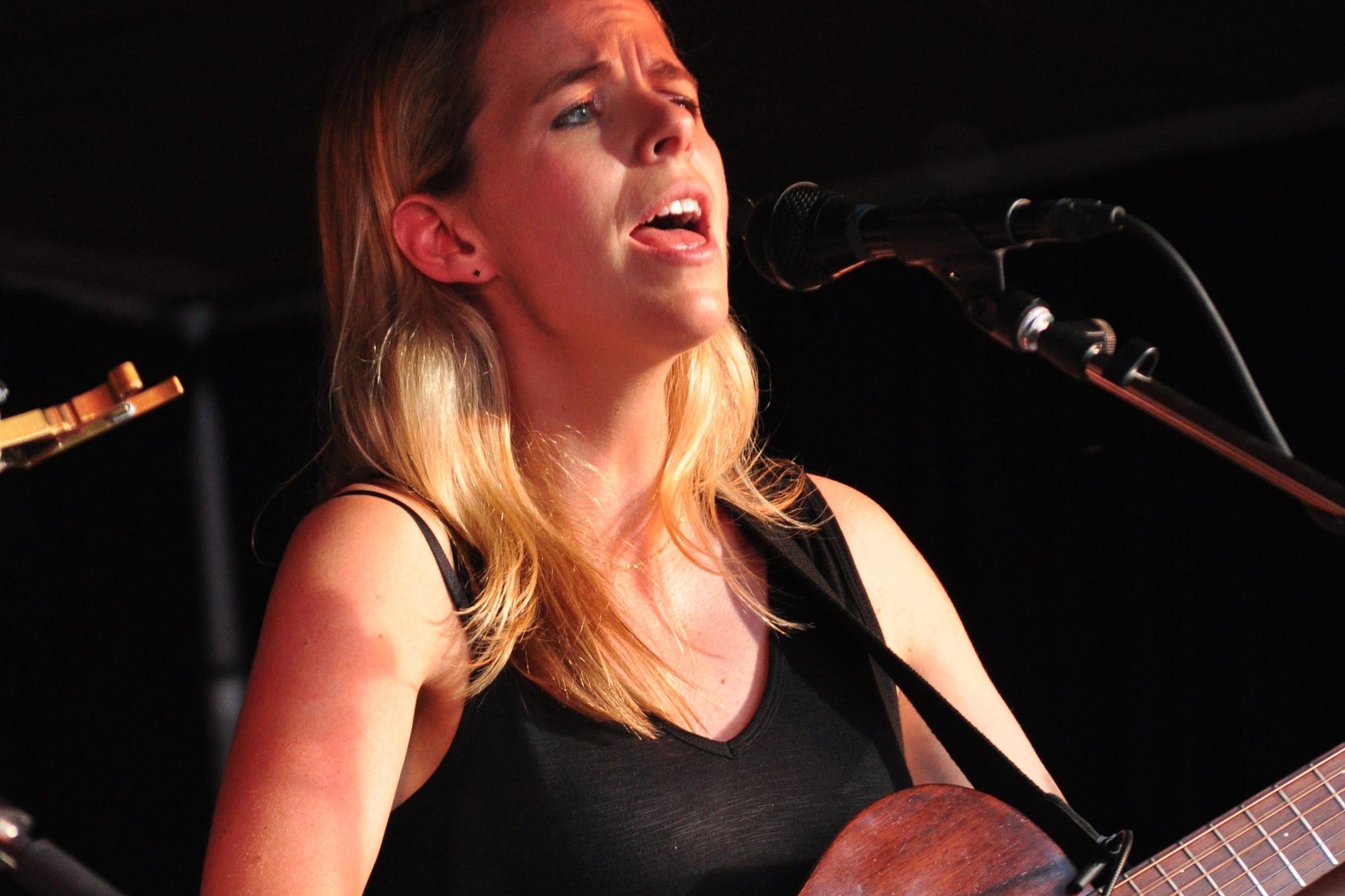
Image: Muriel Anderson and Tommy Emmanuel — playing together at All Star Guitar Night 2018 as she showed me on my fateful airplane ride.
Each month I have a goal to read five books on a variety of topics and from different genres. Here are the books I read in January 2022. If you click on the title, you’ll go to the longer post on More to Come. Because I have begun a winter break, the posts for February and perhaps March may not be up until April, but I continue to read and will eventually get around to them. Enjoy!
Entangled Life: How fungi make our worlds, change our minds & shape our futures(2020), is a vibrant and vision-changing work. As his name suggests, Merlin Sheldrake can conjure up delightful prose and mind-blowing connections that educate, charm, enlighten, and broaden the reader’s understanding of fungi — that indispensable part of life on earth. Sheldrake’s first book reads like a page-turning adventure story right from the beginning. He has managed to inject a sense of wonder — and more importantly, a wonder-filled joy — into his study. We are all the richer for it.
How the South Won the Civil War: Oligarchy, democracy and the continuing fight for the soul of America (2020) is Heather Cox Richardson’s searing, provocative, and masterful history of how America’s competing claims of equality and subordination have been used by oligarchs to tap into the extraordinary strength of the ideology of American freedom to undermine freedom and liberty for anyone who is not white and male. After their defeat in the Civil War, they regrouped and aligned with business and extraction interests in the West to create a new political power based on hierarchies and exemplified by Goldwater, Nixon, and Reagan that changed our country’s trajectory toward equality. How the South Won the Civil War is full of surprises, wisdom, and insight.
Historic Houses of Worship in Peril: Conserving Their Place in American Life(2020) is Thomas Edward Frank’s look at the meaning of these community landmarks and the implications of the rapid change that is reshaping the physical and cultural landscape around them. This is not a “how to” book of preservation but is written with the intention of helping the reader reconsider assumptions, learn more about the meaning for those who experience these places, and perceive more clearly their place in society. It led me to think of the historic houses of worship that have shaped my life, thoughts I share in the post.
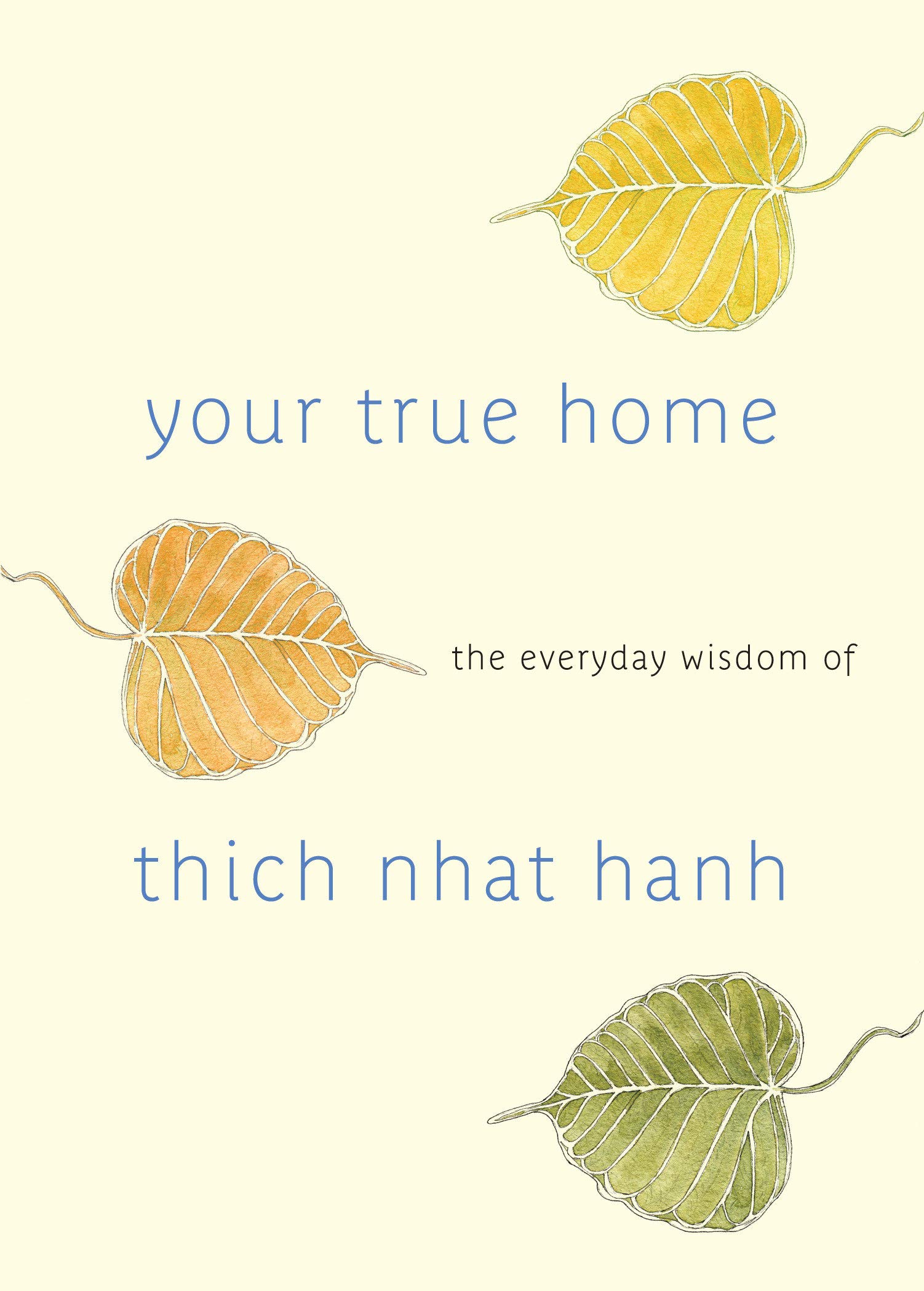
Your True Home: The everyday wisdom of Thich Nhat Hanh (2011 — compiled and edited by Melvin McLeod) has been part of my daily reading, so when the news came this month of the passing of this wise man, his work was very much on my mind. The 365 meditations in Your True Home are focused on the monk’s embrace of mindfulness. Each meditation is only a few sentences in length, but the brevity is part of what contributes to their power. Meditation #22, which coincides with the day of Thich Nhat Hanh’s passing, is entitled The Lamp of Mindfulness.
We have a lamp inside us, the lamp of mindfulness, which we can light anytime. The oil of that lamp is our breathing, our steps, and our peaceful smile. We have to light up that lamp of mindfulness so the light will shine out and the darkness will dissipate and cease. Our practice is to light the lamp.
What if everybody squeezed the cat!
If Everybody Did(1960) by Jo Ann Stover is the first book I remember reading as a child. It had been on my mind recently, so I reread it this month and found that the quirky children’s book with the funky illustrations is a primer on how to live together. We are all a mess of contradictions so living in community is difficult enough in normal times. These are not normal times, in part because too many people in public life today clearly never internalized the lessons found in this classic.
Enjoy reading!
More to come…
DJB
The Weekly Reader series features links to recent books and articles that grabbed my interest or tickled my fancy.
Phew! That’s the pithy observation the Wordle puzzle uses when I struggle before getting the correct answer with my sixth and final guess. It is as if the phone is telling me, “Barely made it there, pal.”
Too often I catch myself thinking and talking as if barely making it describes life as we reach the end of this January. When that happens, I look to find a different perspective and more hopeful words to describe the times we are in. Yes, there’s a lot going on in the world and we often feel swamped. However, taking the opportunity to step back can not only refresh our mind, soul, and body, but it offers us the chance to see that there is still much that is good in our lives and in the world.
February can easily seem like the longest month, so good news is especially welcomed this time of year. Although we dodged the blizzard that hit the northeast this weekend, the Washington region has had more than our share of snow, ice, freezing temperatures, and brisk winds. More of the same is expected in the coming weeks. We all have to work hard fighting off the winter blues.
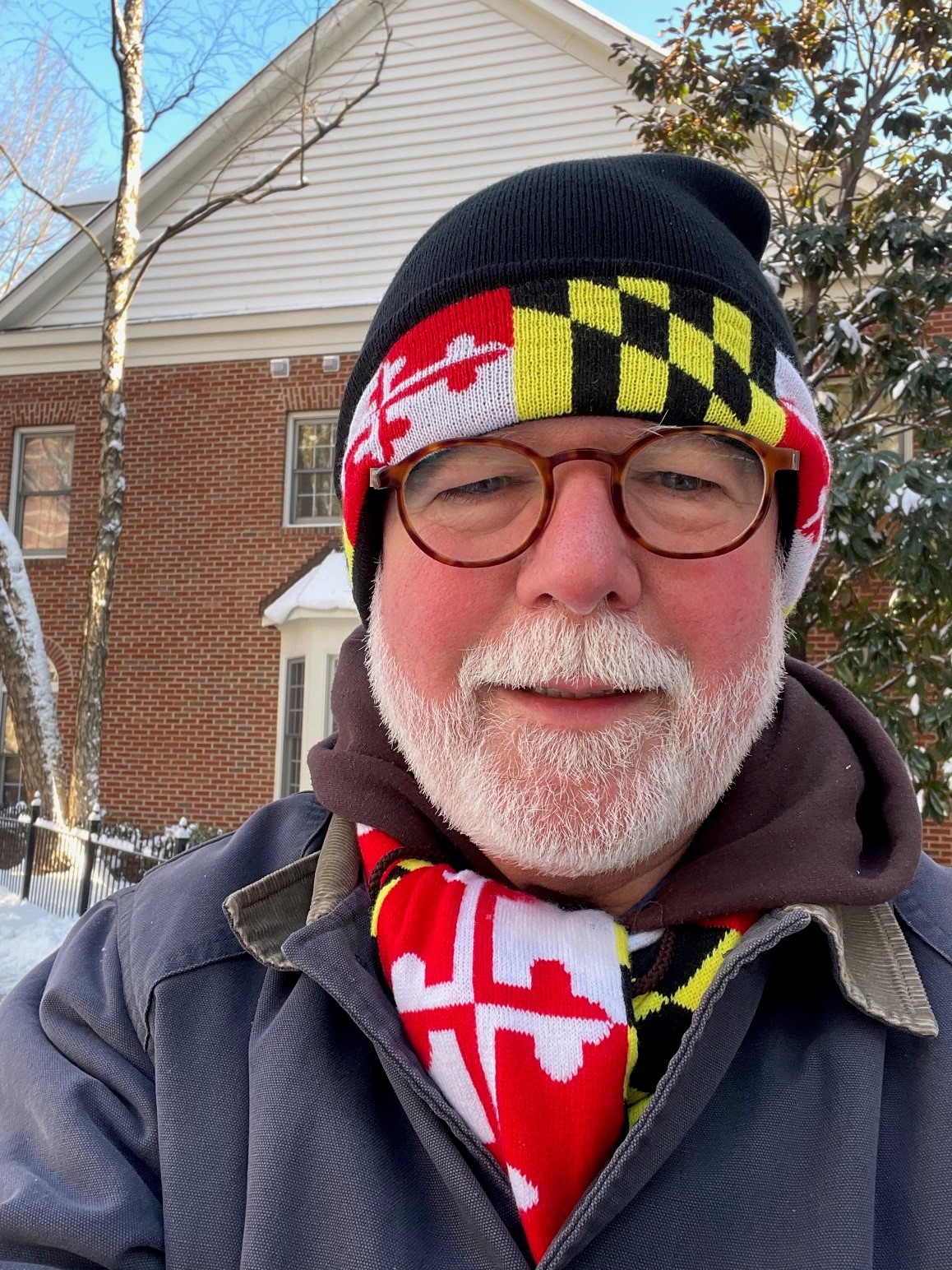
Bundled up against the winter cold with my dapper new Maryland flag-themed scarf and hat.*
If flying to Cancún isn’t in your immediate future, perhaps you can join me in choosing to focus on the good news that’s around us.
I’m not being naive. But dwelling on the negative does not do anything constructive to address problems while looking to the positive gives us a way forward, supports others who are also looking to build community, and helps us understand and focus on the things that we can control (which defines effectiveness).
I always try and begin with the good news in my personal life.
When I look for good news, I don’t have to cast my gaze too far. My siblings are all well and my youngest sister just welcomed her first grandchild, a beautiful baby girl, into the family. Our children are enjoying their life and work. Candice and I are looking forward to hearing some great music in the coming months, including Bach’sSt. John Passion in Providence and Mendelssohn’s Elijah at the Washington National Cathedral. We also have travel on the horizon with a National Trust tour to Scotland and the fjords of Norway. **
And yes, there are many good things that happened in the U.S. this past year.
We also hear a great deal about what’s wrong in the country, but there is good news if you care to look.
Sign-ups for the Affordable Care Act marketplaces reached a record 14.5 million, meaning health care is more affordable and more accessible than ever.
The Bipartisan Infrastructure Law is delivering the largest investment in tackling legacy pollution in American history — $21 billion to clean up Superfund and brownfield sites — while also bringing thousands of aging bridges up to par, with the help of $27.5 billion in new federal aid that was released this month.
For much of our history a Black woman didn’t even own her body. Now, the country will get its first ever Black female Supreme Court justice this year. After 95% of all previous appointments were white men (107 white men appointed among the first 113 justices), it is way past time to broaden the perspective on the highest court.
The rule of law is working to hold all those responsible for the attempted coup and insurrection in 2020/2021 accountable. Justice takes time.
As of today, the US has shipped 400 million Covid-19 vaccine doses for free to 112 countries around the world. The best news and biggest story by far for this year is the COVID-19 vaccines, where “ten billion doses were administered across 184 countries, and almost 60% of the planet has received at least one dose (in four months it’ll be 75%)”, making this, by far, the most successful global health initiative ever undertaken.
I understand the challenges ahead. And we are making progress.
Challenges and progress are not mutually exclusive. As Teri Kanefield writes:
Yes, democracy is fragile. That is not new. It’s always been fragile, it’s just that a lot of people didn’t realize it before.
In fact, America really didn’t start becoming a true liberal democracy until after the modern civil rights and women’s rights movement. For most of our history, we were ruled by a small group of white Christian men. That wasn’t democracy. What is happening now (a move toward a true multi-racial democracy) is creating a powerful backlash.
We can all gripe about the media and the authoritarians who have taken over a once great political party. Or we can do positive things. Here’s a great list.
Time for a rest.
Taking a mental health break is #16 on that list. I recently heard a wise person say that if we don’t take a rest from time-to-time, a crisis will find us and force us to rest.
That’s the second part of this post.
I’m taking a break from the blog to focus on completing a manuscript. I’ve been working on this book since last summer, but progress has been slow. Winter seems like a great time to set aside all extraneous writing and get this project completed and to the editor. I’m also going through another digital declutter, to remove the temptation to fall down rabbit holes.
I’ve also decided that while I’m away, I’m going to repost some of my favorite stories from More to Come that focus on good news and community. They won’t require any new writing, but hopefully you’ll find something that you may have missed in its earlier iteration.
Whatever you do, be kind to others, stay sane, and stay safe this winter. I hope to see you back here again soon.
More to come…
DJB
*Yes, I do have earmuffs on underneath the cap. I’m not typically a belt-and-suspenders type of guy, but it was cold the day I took this selfie.
**If I was being too subtle, Andrew is singing the part of The Evangelist in the Bach St. John Passion and is one of the tenor soloists in Elijah.
The pandemic has had a significant impact on musicians, especially those in the roots and folk categories that essentially need to tour to make money. Bluegrass singer Rhonda Vincent caught the angst of the music community with her clever play on Johnny Cash’s famous hit I’ve Been Everywhere with the parody I Ain’t Been Nowhere (with a guest appearance in the music video by none other than Dolly Parton).
But musicians have been resilient, playing empty halls to live-streaming audiences, recording new music from their living rooms, and now…finally, hitting the road to make live music again. For this Saturday Soundtrack, I want to feature a few of my favorite musicians who are on the road this winter and early spring.
Aoife O’Donovan at Red Wing Music Festival (photo by DJB)
The gifted singer and songwriter Aoife O’Donovan begins her tour next month. It includes a February 25th date at the Kennedy Center in Washington along with the talented Yasmin Williams. O’Donovan’s new record, Age of Apathy, will also be released at that time, and a great New York Times review by music critic Jon Pareles captures where her music is at this moment two years into a pandemic.
O’Donovan’s songs are rooted in folk tradition but full of musical surprises: daring melodic leaps, unexpected chord progressions, subtle rhythmic shifts. “I’ve always just been drawn to melodies and chordal structures that were unexpected,” she said. “They’re just more fun. When you have the whole arsenal of the tone row in your head, you can just have a lot more freedom to mess around with it.”
A number of the tunes from the new album are out on You Tube. I especially like Phoenix, as the lyrics seem to fit the moment.
Everybody’s looking for somebody to blame The stages of sadness how many can you name I stopped at anger, never felt the same
They say it’ll fade my scars my tears will dry And I’ll lie under the stars again Not wondering where you are
Fever’s got me shaking it rises up like a road to meet me Fever’s got me quaking like San Andreas fault
Just put a cloth to my brow I’ll soar like a phoenix from the ashes Put a pretty blanket down I’m ready now
Here’s a very nice live version of the tune from a couple of months ago at FreshGrass 2021 at Mass MOCA.
Watchhouse (credit: Shervin Lainez)
Watchhouse (fka Mandolin Orange) is touring February through April beginning on the west coast then coming east. The folk duo plays at the 9:30 Club in Washington on April 15th and the Beacon Theatrein New York City the following evening. Here is New Star from their 2021 album, Watchhouse.
Punch Brothers (credit: Josh Goldman)
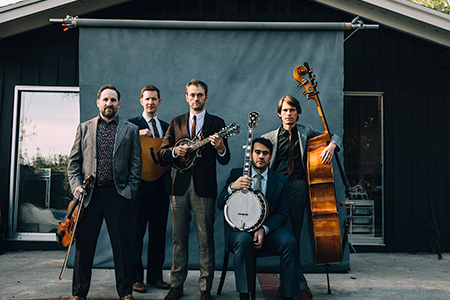
Punch Brothers began touring in January to support their new Hell on Church Street tribute album to Tony Rice. On February 26th the band will play the Lincoln Theatre in Washington. Here’s Hamilton Camp’s Pride of Man from the album.
Turn around go back down Back the way you came Babylon is laid to waste Egypt’s buried in her shame Their mighty men are all beaten down Their kings are all fallin’ in the ways
Oh God, pride of man Broken in the dust again
Molly Tuttle – Cover of “When You’re Ready”
Molly Tuttle also has a new album on the way, and she is hitting the road to promote it. Tuttle is a multi-instrumentalist and singer/songwriter with a lifelong love of bluegrass.
On her new album Crooked Tree, Tuttle joyfully explores that rich history with bluegrass, bringing her imagination to tales of free spirits and outlaws, weed farmers and cowgirls resulting in a record that is both forward-thinking and steeped in bluegrass heritage.
The album was co-produced by Tuttle and Jerry Douglas, who also plays dobro on the recording. Other standouts in her studio band include Ron Block, Mike Bub, Jason Carter, and Dominick Leslie. Gillian Welch, Margo Price, Billy Strings, Old Crow Medicine Show, Dan Tyminski, and Sierra Hull all perform on Crooked Tree. The new album “marks a departure from the eclecticism of Tuttle’s critically lauded 2019 full-length debut When You’re Ready.”
Molly Tuttle & Golden Highway perform the title track in the video below. Their tour began last week on the west coast and will work its way east in the coming months.
The Infamous Stringdusters have a new album Into the Fray coming out in February, when they’ll take it on tour. The band is at The Anthem in Washington D.C. on February 4th and 5th.
The title track is a strong call for standing on the side of freedom, something we really need at this time.
Death unfolds before my eyes / A frightened man’s unheeded cries / People, oh people / Trapped beneath the knee / Of the law gone wrong / And the force of history
Another too soon laid to rest / Some folks weep, some beat their chests / People, oh people (Let us) stand on freedom’s side / For there can be no peace / Wherever justice is denied
As cities burn in summer heat / Temptation bids us to retreat / But people, my people / There’s is no other way / To love, except to turn / Our timid souls toward the fray.
25 trips around the sun / Is long enough to make a fool out of anyone / I’ve tried to keep my head on straight / To navigate the fate I’ve done my best to wait
But the clock is back up on the wall And even if I choose to look away / The hand will fall / And the time will just keep tickin’
Here’s the title tune from the album. Hull opens for Cory and the Wongnotes at the 9:30 Club in DC on February 5th and plays Charlottesville on the 7th.
Low Lily
And as is appropriate for winter and these times, Low Lily — which tours in Rhode Island and New Jersey beginning in March — reminds us that we can bring the light in times of darkness.
We bring the light in the dark / In the dark when all is cold / When all is cold and the earth is still / In the dark we bring the light
See the light, be the light, and enjoy the light of some live music this winter.
“When there’s only one, that’s just somebody. … But when there’s one… and one… and one… and one… and more……that’s EVERYBODY.
Did you ever think of what would happen if EVERYBODY did things like ……..”
Those three sentences open the first book I remember from childhood. If Everybody Did, written in 1960 by the late Jo Ann Stover, is a book that has been on my mind in recent days.
The book’s premise is very easy to understand, and the illustration above encapsulates it perfectly. On the left page is a cute drawing of one kid doing something that probably — to him or her — looks perfectly harmless. Such as squeezing the cat. Or making a splash in the sink. Or dropping tacks on the floor (a personal favorite when I was five). Then, on the opposite page is an illustration that shows what would happen if everybody did that particular thing.
The book had a renaissance in the 1980s as my generation began having children. I read it again just this week. Most describe Stover’s work as focused on proper etiquette, and that’s certainly a part of its perspective. But I return to those first three sentences and see thoughts that go beyond simple etiquette. I see the beginnings of a primer on how we should live in community.
When we do something alone, we’re the only ones with tacks stuck in our feet or getting sick from eating too much fudge. But no one really lives alone. There’s always one… and one… and one… and one… and more… and suddenly everybody is together in a community. And as soon as we live in community, our words and actions have consequences beyond our personal feelings, desires, or health.
Those who understand that we live in community think of how their behavior affects others before they act. Those who place their personal freedom — as they define it — above all others usually take a different approach.
In his book Civility: Manners, Morals, and the Etiquette of Democracy, author Stephen Carter identifies our loss of civility as coming from a focus on self, an over-reliance on markets, a forgetfulness of the obligations we owe each other, and the lack of a moral compass in decision-making.
“…the language of the marketplace, the language of wanting, of winning, of simply taking — the language of self — is supplanting the language of community, of sharing, of fairness, of riding politely alongside our fellow citizens…”
Prioritizing our own desires leads us to slam the door and never think of what would happen if everybody did. Or jump in the mud. Or always cry. Or eat all the fudge.
We are, in fact, seeing what happens when a large number of individuals act as if telling outrageous lies is perfectly fine. We are seeing what happens when politicians in positions of power — figuratively stomping around like five-year-olds — pass laws saying we cannot teach things which make them feel uncomfortable and that explicitly require teachers to lie to children.
Too many among us want to set their own reality and tell lies without suffering any consequences. They seek to retain protectionfrom the law but without being bound by the law. They want those they disagree with or who are different from them to be boundby the law but not be protectedby the law. They want special privileges to act without consequences, just like the child who wants to eat all the fudge.
We are all a great big mess of contradictions and living together in community is difficult enough in normal times. Today we are seeing what happens when large numbers of people speak in ways that harm others, refuse to consider the broader impact of their actions, and seek to carve out special privileges for those considered at the top of the hierarchy.
Perhaps Stephen Carter could add one other reason for our loss of civility: Too many of those in positions of power never internalized the lessons of If Everybody Did.
More to come…
DJB
The Weekly Reader series features links to recent books and articles that grabbed my interest or tickled my fancy.
Thich Nhat Hanh, a Buddhist monk who was one of the world’s most influential Zen masters, passed at the age of 95 on Saturday at his home in the Tu Hieu Temple in Hue, Vietnam.
I have been reading Your True Home: The everyday wisdom of Thich Nhat Hanh this month, so this wise man and his work were very much on my mind when the news came. The 365 meditations in Your True Home are focused on the monk’s embrace of mindfulness. * Each meditation is only a few sentences in length, but the brevity is part of what contributes to their power.
If one reads these works on an annual calendar basis, Meditation #22 coincides with the day of Thich Nhat Hanh’s passing. It is entitled The Lamp of Mindfulness.
We have a lamp inside us, the lamp of mindfulness, which we can light anytime. The oil of that lamp is our breathing, our steps, and our peaceful smile. We have to light up that lamp of mindfulness so the light will shine out and the darkness will dissipate and cease. Our practice is to light the lamp.
Breathing and walking come through these readings again and again. Being aware of our breath brings us into a mindfulness of the things we can control, even — and maybe especially — when we are faced with a challenge. With mindful walking our steps are no longer a means to arrive at an end. We don’t walk mindfully to reach a goal. Each step, rather, is an end to itself if we are truly present. “There is no way to happiness; happiness is the way.”
In a post from last October, I took another of the meditations from Your True Home to think about that practice of walking. Moving at the speed of life as we walk, we touch the earth, transforming and healing ourselves.
Walking is a form of touching the earth. We touch the earth with our feet, and we heal the earth, we heal ourselves, and we heal humankind. Whenever you have an extra five, ten, or fifteen minutes, enjoy walking. With every step it’s possible to bring healing and nourishment to our body and our mind. Every step taken in mindfulness and freedom can help us heal and transform, and the world will be healed and transformed together with us.
As a result of that posting, one of my readers used the comments section to send a link to a video called Godspeed: The Pace of Being Known that takes Thich Nhat Hanh’s words and applies them to a modern life in a powerful way. Early in the video, the subject of the video notes that, “When I was running it was easy to stay hidden. To avoid being known.” Walking at the speed of life helps us know ourselves, know others, and be known by others.
There is a lifetime of learning to be found in Your True Home. “In Buddhism, it is said that love and compassion are made out of one substance, which is called ‘understanding.’ … If understanding is not there, it is impossible for you to accept and love someone.” It is with understanding that we stop blaming and criticizing. “Your compassion is born of your understanding of the situation.”
The New York Times obituary captures the essentials of Thich Nhat Hanh’s life, including his work with The Rev. Dr. Martin Luther King, Jr. in the 1960s.
A prolific author, poet, teacher and peace activist, Thich Nhat Hanh was exiled from Vietnam after opposing the war in the 1960s and became a leading voice in a movement he called “engaged Buddhism,” the application of Buddhist principles to political and social reform.
The obituary writer also notes that Thich Nhat Hanh dismissed the idea of death.
“Birth and death are only notions,” he wrote in his book “No Death, No Fear.” “They are not real.”
Thich Nhat Hanh helped change this world for the better. More importantly, he showed millions how to do the same.
More to come…
DJB
* The link on mindfulness takes one to an interview with Thich Nhat Hanh by Oprah Winfrey.
The most recent edition (#49) of The Fretboard Journal showed up in my mailbox earlier this month, and among other gems it contained a delightful little piece on how the tune Salt Spring had become a bluegrass jam favorite. I immediately checked out versions on You Tube, and this Saturday Soundtrack was born.
The tune was written by John Reischman, shown playing a delicious duet of Salt Spring in the 2019 video above with mandolinist Sierra Hull. Beyond a connection to a previously unknown tune that is clearly known to half the (bluegrass) world, the article was a re-introduction to Reischman and his music.
John Reischman first came to my attention as the mandolinist in the original configuration of the Tony Rice Unit on 1981’s Still Inside (later released as part of the compilation Devlin). Reischman’s original tune Birdland Breakdown was featured on both albums, as was the joyful Rice composition Devlin, with Reischman’s mandolin solo beginning at the 2:17 mark.
Also from that era, I came upon a rather rare audio of that band live at the iconic McCabe’s guitar shop in Santa Monica. The funny thing is that the picture is of the 1990s version on the TRU. Among those pictured, only Tony is playing on this recording. It is an amazing forty-five minutes of music, beginning with Reischman’s My Waltz. I especially enjoy the band’s version of the famous Wes Montgomery tune Four on Six beginning at 34:44.
To many ears, 1982’s sublime Backwaters album was the best of the Tony Rice Unit’s offerings from that era. On Green Dolphin Street, written by Bronisław Kaper and Ned Washington, is a personal favorite.
After leaving the Tony Rice Unit, Reischman moved north of the border to Vancouver, British Columbia in the 1990s and formed John Reischman & the Jaybirds, where he recruited the best acoustic musicians on each side of the border to realize his broad musical vision. John also explored more intimate musical styles playing mandolin on several duet records with fingerstyle guitarist John Miller.
Here is Reischman and The Jaybirds playing Hop High. Reischman’s mandolin solo on this bluegrass work, following a tasty acoustic guitar lead, begins around the 2:15 mark of the video. At 3:37 he doubles with the banjo to take the tune out.
Building on those milestones, Reischman has released a series of acclaimed solo recordings — North of the Border, Up In The Woods, and Walk Along John — that showcase his gifts as a composer and instrumentalist. Many of John’s signature “melodic mandolin” tunes such as “Salt Spring,” “Little Pine Siskin,” and “Birdland Breakdown,” also have been adopted as bluegrass standards and can be heard at jam sessions across the continent until the wee hours of the dawn.
Filmed on August 26th, 2016, at the NimbleFingers Bluegrass and Old-Time Music Workshop and Festival in Sorrento, BC, this a showcase of John with the inventive guitarist Molly Tuttle and The Taterbugs playing the aforementioned Little Pine Siskin from his album Walk Along John.
Reischman’s newest album is New Time & Old Acoustic featuring 12 new Reischman originals and a reinterpretation of his classic Salt Spring. The Punch Brothers’ Chris Eldridge and long-time Rice bassist Todd Phillips join Reischman on the mesmerizing Old Road to Kingham. Horses of Dorrigo from the same album features Nick Hornbuckle and Trent Freeman on banjo and fiddle.
And let’s end where we began — with John’s melodic Salt Spring — this time performed by the Jaybirds while waves crash against the shore in the background. Lovely.
Enjoy!
More to come…
DJB
Image of John Reischman | JohnReishman.com by Trent Freeman
It was one year ago today that millions of Americans looked to the future. As Amanda Gorman told us, “The new dawn blooms as we free it for there is always light if only we’re brave enough to see it, if only we’re brave enough to be it.”
The youngest inaugural poet in U.S. history also reminded the country that “history has its eyes on us.”
Joe Biden was inaugurated president of the United States on January 20, 2021, after a failed coup was followed by the most difficult transition of power in our history. It is fair to consider that context when asking what the administration has accomplished in its first year.
From my perspective, Biden has done reasonably well in a number of areas, spectacularly well in a few, and fallen short in several others. The political pundits, on the other hand, have largely followed Republican talking points describing the year as a disaster. Let’s consider the facts.
In response to a global pandemic, we saw the largest vaccine rollout in history.
When Biden came into office, the “plan” for federal delivery of covid vaccines was to simply give them to the cash-strapped states to figure out how to get the vaccines into our bodies. Biden immediately invoked the Defense Production Act, bought more vaccines, worked with states to establish vaccine sites, and established vaccine centers in pharmacies across the country. 75% of Americans are now fully vaccinated and 63% have had at least one dose. This rate is in spite of the fact that a Republican party focused on tribalism pushed people bereft of empathy and compassion to refuse the vaccine, contributing significantly to the second year of pandemic disruption. With the omicron surge, the unvaccinated make up a large percentage of those hospitalized and dying from the disease.
Unemployment was reduced to historically low levels and millions of jobs have been created.
The unemployment rate in 2017 as Donald Trump came into office was 4.7% and as he left office it stood at 6.4% for a net jobs gain of -2.8 million during his term. Unemployment when Biden came into office on January 20th was 6.4% It now stands at 3.9% for a net jobs gain of +6.2 million in just the first year. Both the low unemployment rate and the number of jobs created are historic in nature. The stock market has been at an all-time high under Biden.
Without a single Republican vote, the Administration and Congressional Democrats passed the $1.9 trillion American Rescue Plan in March to jump-start the economy. This put money into the pockets of ordinary Americans, and it worked. The new law significantly cut child poverty by putting $66 billion into 36 million households. It expanded access to the Affordable Care Act. More than 4.6 million Americans who were not previously insured were able to get healthcare coverage; the total covered is a record 13.6 million. And the economic impact of the pandemic has been less than feared. While the costs of the Great Recession in 2008 were huge and lingered, the costs of the coronavirus slump were far smaller.
The Administration oversaw the passage of a $1.2 trillion infrastructure bill and rolled out $27.5 billion in new aid last Friday to help repair the nation’s bridges.
Getting the bipartisan infrastructure bill through this Congress was a BFD. It is designed to help build and rebuild roads and bridges, address aging water and sewer systems, and expand broadband access. This past Friday — just sixty days after signing the historic act — the Biden administration urged states to get to work bringing thousands of aging bridges up to par, while improving safety and uncorking bottlenecks, with the help of $27.5 billion in new federal aid.
Biden got us out of a very unpopular 20-year war.
Joe Biden inherited the previous president’s February 2020 deal with the Taliban to withdraw U.S. forces from Afghanistan by May 1, 2021, so long as the Taliban did not kill any more Americans. On January 20th, the U.S. had withdrawn all but 2,500 troops from the country.
In April, Biden said he would honor the agreement he had inherited and promised to evacuate the country “responsibly, deliberately, and safely.” The Afghan army that the U.S. had supported over three previous administrations crumbled as the U.S began to pull its remaining troops out in July. By mid-August, the leaders of the Afghan government fled, abandoning the country to chaos.
There were some casualties, but in the largest human airlift in U.S. history the U.S. military peacefully evacuated more than 100,000 people. Evacuations have continued on planes chartered by other countries.
By any sane measure, Biden has had a reasonably good first year. But these aren’t normal times, and the fight continues.
There are many other success stories to highlight. Reducing taxes, making America respectable again in diplomatic circles and foreign countries, reducing hate crimes, and fighting gun violence are some of the ways the administration is making progress.
And there are missteps to call out. Commentators have rightly highlighted the administration’s missing that the Afghan government would collapse, underplaying Covid testing, and prioritizing infrastructure over voting rights.
But until recently, Biden’s “biggest miscalculation might well be refusing to address the disinformation of the Republicans directly in order to promote bipartisanship and move the country forward together.” He thought he could work with a party that is fundamentally not interested in governing, only in amassing power.
Biden’s amazingly good record is in spite of the fact that the people who attempted to corruptly — and, on January 6, violently — overthrow the 2020 presidential election are still controlling the Republican Party, attempting to block every measure the administration puts forward and engineering crises to blame on Biden. Last evening’s ruling by the Supreme Court, releasing Trump records to the January 6th committee, should be useful in public hearings to help illuminate the breadth and depth of the Trump administration’s support for a coup d’état.
The Biden administration’s amazingly good record has also come in spite of the fact that the news media seems bent on portraying everything in the worst possible light for the new administration. Examples include the economy, attendance at funerals, and whining about “I want my life back” just for starters.
Yamiche Alcindor, anchor of Washington Week in Review on PBS, noted after President Biden’s two-hour news conference yesterday,
Pres Biden, in the longest news conference in presidential history, made news, pushed back on critics, called out lies, took responsibility for mistakes he believes he made, expressed surprise at GOP, talked foreign policy and didn’t lash out on reporters. Quite the change.
Quite the change, indeed. Millions of Americans are thankful we are looking to the future.
Yes, there will always be detractors. We always have to ask, as President Biden did yesterday about the Senate Minority Leader, “What’s Mitch for?”
Yes, there is still much work to do to save our democracy. The Senate voted tonight against changing the filibuster to protect voting rights, based on some very faulty history from Senator Joe Manchin and total Republican obstruction.
UPDATE #1: Matt Robison covers politics for The Editorial Board. He goes much farther than I do in my piece when he posted a members-only article on January 20th with the title, Reality Check: President Joe Biden’s year-one grade? A+ that adds, “Any other answer is insane.” After a laundry list of disasters we faced the second half of 2020, he writes that we can imagine what a second Trump term would look like with faster global warming, endless vendettas, the jailing of dissidents, reductions in LGBT rights, nuclear standoffs…and the list goes on right up to the end of democracy.
So he encourages the media and pundits to stop kdding with the “Biden is limping” nonsense. We should not accept the premise of the underlying question here.
A year ago we were all trapped in a flaming car that was speeding to the edge of the cliff. Joe Biden sprayed us with a fire extinguisher and slammed on the brakes.
The next question is not “isn’t his driving a little slow today?” … We’re not on fire and we’re still on the top of the cliff.
I am in full agreement with Robison’s point of view.
Right, because unified GOP opposition on confirmations and the overwhelming majority of items on the substantive agenda, along with McConnell saying directly that he’s 100% behind blocking the entire Biden agenda, means nothing in comparison to two Democrats in the Senate. Oy
Images: U.S. Capitol. Health care worker. Construction worker image by Nickbar. George Washington Bridge image by David Mark. All from Pixabay.
Few places in America stand as such readily recognized community anchors and touchstones of neighborhood character as historic houses of worship. Unfortunately, many of these landmarks are clearly at risk.
Historic Houses of Worship in Peril: Conserving Their Place in American Lifeis Thomas Edward Frank’s 2020 look at the meaning of these buildings and the implications of the rapid change that is reshaping the physical and cultural landscape around them. Tom is a passionate lover of historic houses of worship, but in this short book he doesn’t take the time to wallow in nostalgia. Instead, he focuses on the various ways in which these places imbue our communities with meaning — as places of personal and collective memory, as sites of cultural identity, and, yes, as contested and conflicted places. He challenges the reader to think about what is changed and what is lost when these buildings are abandoned, repurposed for new use, or demolished.
St. Louis, Missouri, and North Adams, Massachusetts serve as both case studies and cautionary tales in his overview. The New England town is referenced throughout, given its high-profile association with houses of worship — the community is known as the “City of Steeples” — and the challenges that resulted from various immigrant groups building impressive places in which to worship and serve their neighborhoods, only to leave those edifices behind as living and working patterns changed.
In his prelude, Tom Frank makes the case for why these places matter.
Historic houses of worship tell stories of human aspirations and values, of cultural persistence and change, of aesthetic expression and elevation of the human spirit. They are focal points of community narrative, landmarks in neighborhood sense of place. What happens to them is not only — or, for the empty ones, even primarily — a matter of faith or religious practice, whatever form that may take. What becomes of them is inseparable from our sense of awe at how the past is always present: who were the people who built them? To what did they aspire? For what kind of society did they hope? How did they shape what this community has become?
In the course of thinking through these issues, Frank asks tough questions about who gets to decide the future of these places. North Adams, again, is useful in part because of the challenges inherent in its processes to bring the community into conversations with church leadership about their town and the future they want for these landmarks.
This is not a “how to” book of preservation. * Frank has written this book with the intention of helping the reader reconsider assumptions, learn more about the meaning for those who experience these places, and perceive more clearly their place in society.
Tom and I connected most recently during the National Trust tour of Asheville, leading me to think about the historic houses of worship that are a part of my life and how they have shaped me.
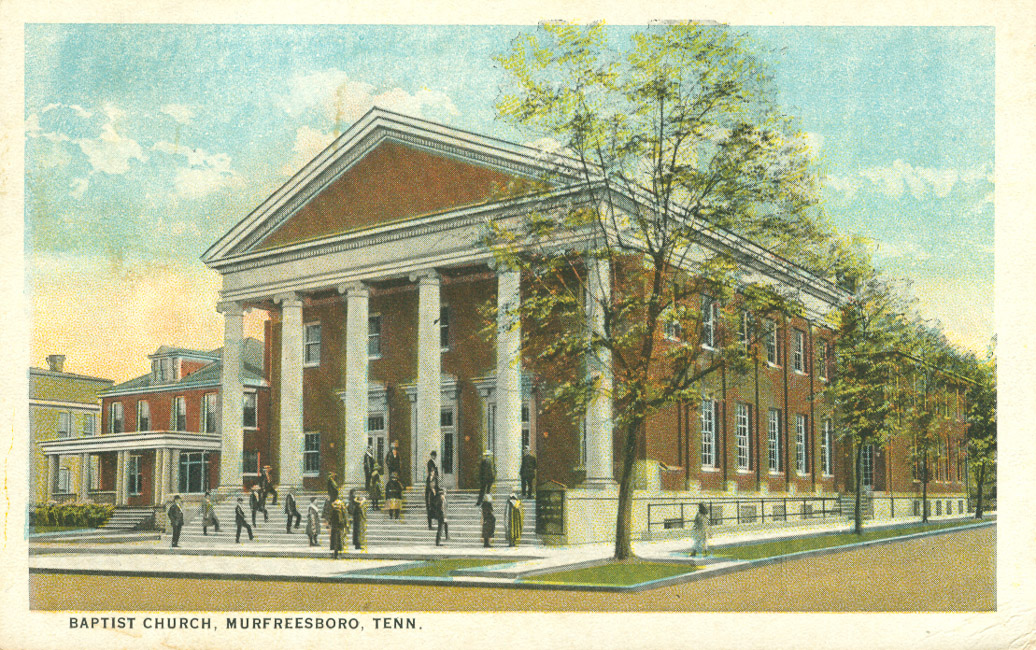
The church of my childhood is First Baptist, located on East Main Street one block from the square in Murfreesboro. It has a presence that one expects from the oldest (1843) and largest (at one time) Baptist church in a Southern community.
First Baptist Church in Murfreesboro, TN (postcard ca. 1915; credit FL Baptist Historical Society)
I began to attend First Baptist with my family in 1966, but the personal memory that comes most readily to mind is from January 1998, at mother’s funeral. Dr. Eugene Cotey — the church’s retired pastor and longtime spiritual leader — stepped into the pulpit, let out a sorrowful sigh about hoping this day would never come, and proceeded to tell the overflow crowd of what Helen Brown meant to that community. His empathy, understanding, deep faith, intellectual curiosity, and love of a good laugh were all things I came to recognize and appreciate from my religious upbringing. Mother shared those traits, and the connection lives in new generations. Our family established and continues to fund the Helen Brown Memorial Scholarship at First Baptist, providing financial help to young women seeking to attend college.
The church engages with the world in a variety of ways, housing the homeless in the church building while also hosting a counseling center, a Fine Arts Academy, and a Benevolence ministry. First Baptist partners with churches of other denominations and cultures. Many family members continue to worship there, and it remains a welcoming hub in the heart of Murfreesboro.
Calvary Episcopal Church, Americus, GA (credit: GA Trust for Historic Preservation)
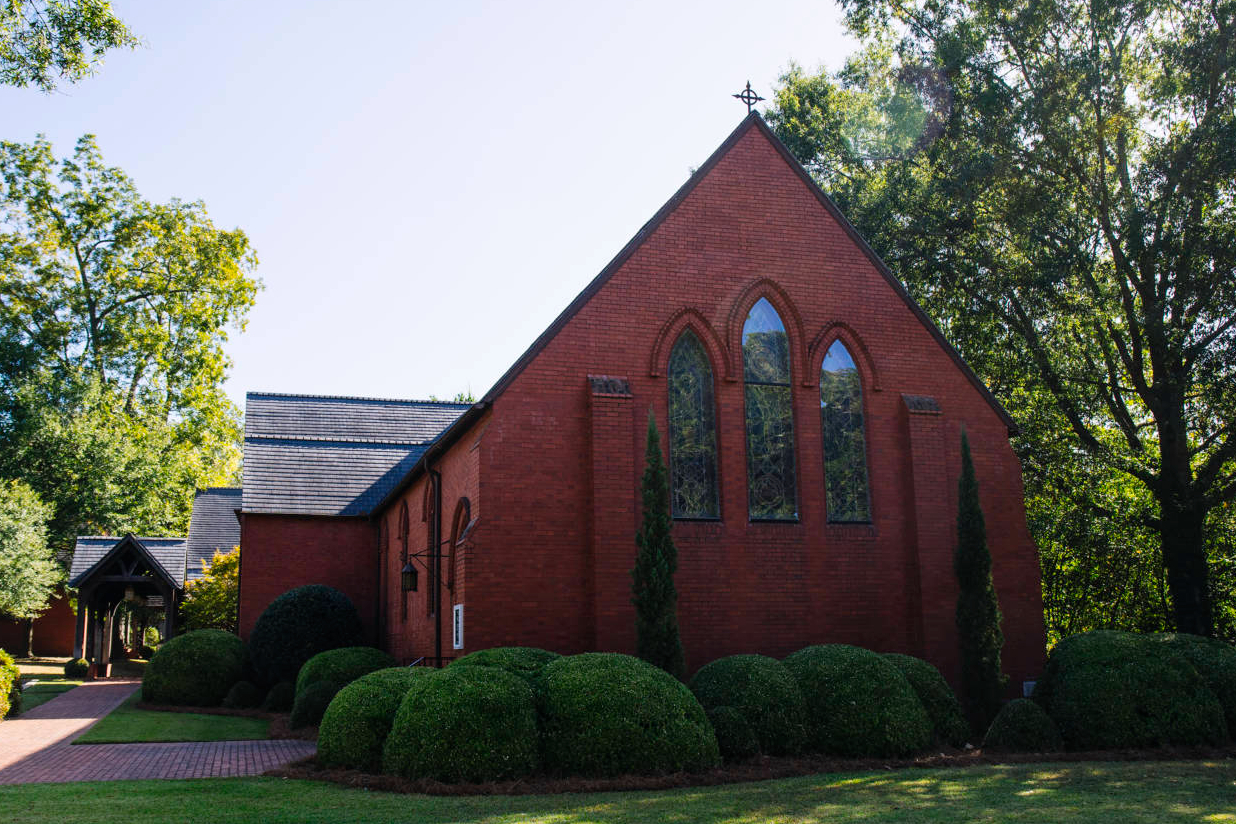
Calvary Church in Americus is where I was confirmed as an Episcopalian in 1979. The beautiful 1921 building was designed by prominent architect Ralph Adams Cram, although he never saw the property. The rector was visiting New York and asked Cram to design the church. With construction activity slowed by WWI, the architect was glad for the commission. Much like the SAH description, I always thought of Calvary’s simple Gothic design as an “ideal country chapel” placed in this small Southern community. This is where I first grew to know and love the liturgy of the Episcopal church.
All Saints Episcopal Church, Atlanta, GA
Upon moving to Atlanta, I joined All Saints. While a large, established congregation, this was a church transitioning in a changing urban neighborhood in the early 1980s. As we were nearing the time to leave Atlanta, Candice and I worked overnight at the church’s homeless shelter. It was a time when national political changes were having real on-the-ground impacts in cities across the country. Churches like All Saints, in conjunction with others in the diocese, were stepping up to meet the need.
Trinity Church, Staunton VA (credit: Mark Mones, SAH Archipedia)
Taylor and Boody Organ in Trinity Episcopal Church, Staunton, VA (photo credit: Taylor & Boody)
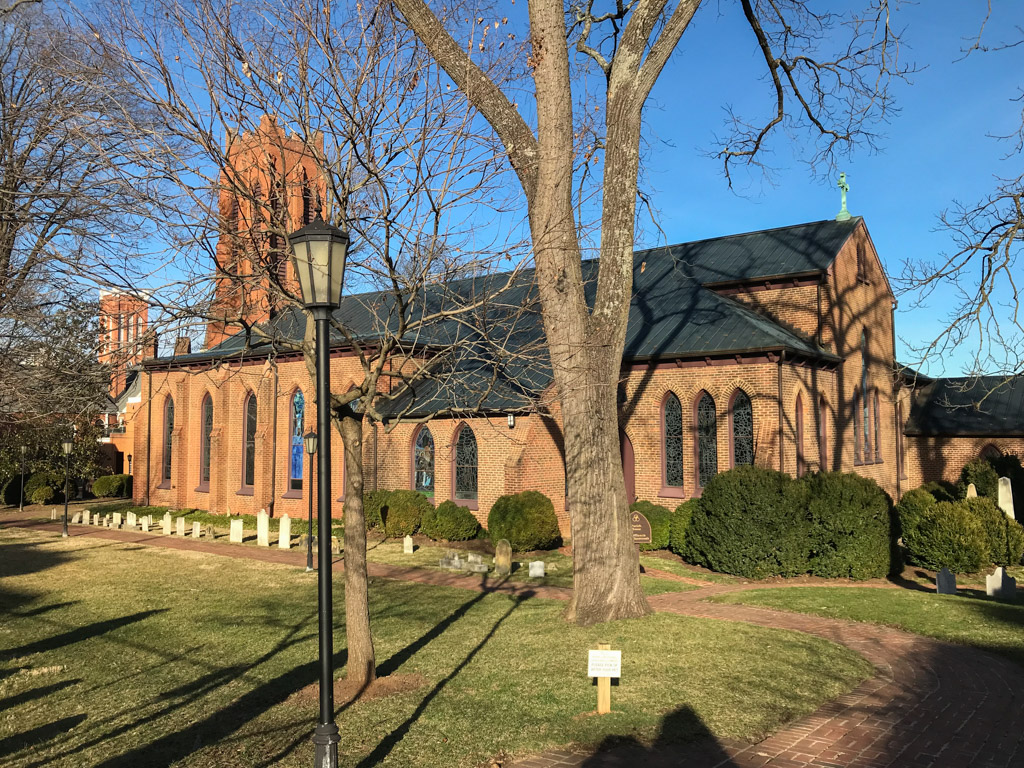
Trinity Church in Staunton holds so many personal memories that my head and heart can barely contain them. Founded in 1746 with the current building constructed in 1855 (with later additions), it was where our children were born and baptized. I experienced some of my most spiritual musical memories there. It was also the first church I attended with a graveyard. The physical presence of the gravestones coupled with the symbolism of being surrounded by those who had passed was powerful, made more so by the fact that the ashes of several dear friends are now buried there.
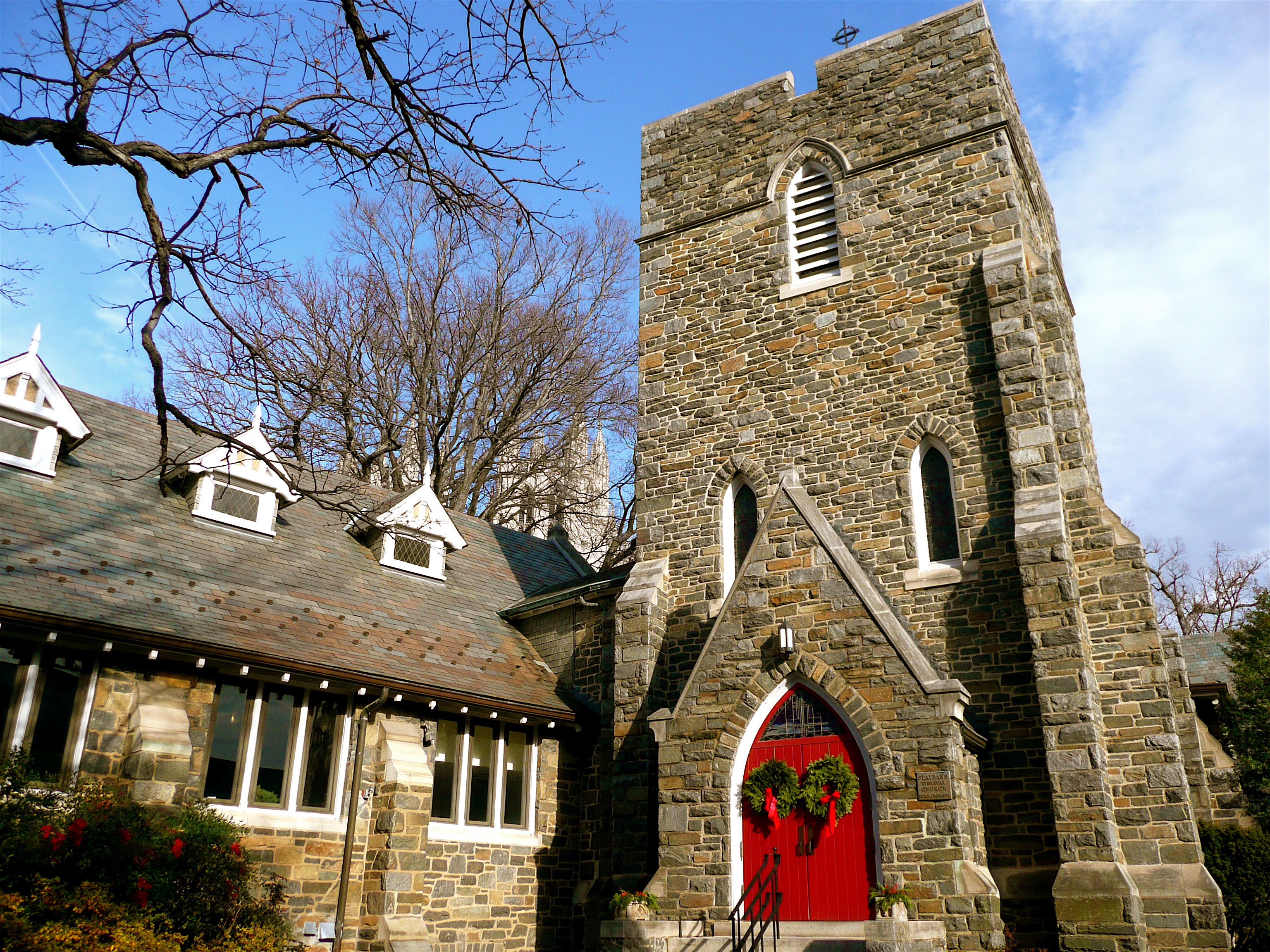
St. Alban’s Episcopal Church, Washington, DC with the National Cathedral peeking over the rooftop (credit: St. Alban’s Parish)
Our family has been members at St. Alban’s parish in Washington for more than two decades, living amidst the joys and sorrows that come with life. It is where I have consistently heard outstanding preaching and theological reflection. And it is where my ashes will eventually lie, giving me a great “view” of another historic house of worship with deep personal meaning — the Washington National Cathedral.
These buildings continue serving their original use, but they have each had to change — sometimes in significant ways — with the times. In my preservation career, I’ve worked on historic houses of worship that were adapted with new uses for new generations. In Tom’s scenarios for a future for historic houses of worship, I am especially drawn to his suggestions for shared space with new users that fill needs in community service. That won’t work in every instance, but local congregations, regional and national church bodies, local governments, and preservationists all have to consider new paradigms with broader collaborations toward conservation.
In the end, historic houses of worship are places of grace. They offer gifts of beauty, extraordinary space, and transcendence that people alive today can only receive from people of the past and do their best to pass them on. They are essential contributors to a generative and creative commons where people can gather and collectively make a life together. They are places of presence. And we are their stewards now.
Recommended.
More to come…
DJB
*The group Frank chaired for some time — Partners for Sacred Places — is the best resource for those looking for hands-on preservation information, along with groups such as the National Trust.
The Weekly Reader series features links to recent books and articles that grabbed my interest or tickled my fancy.
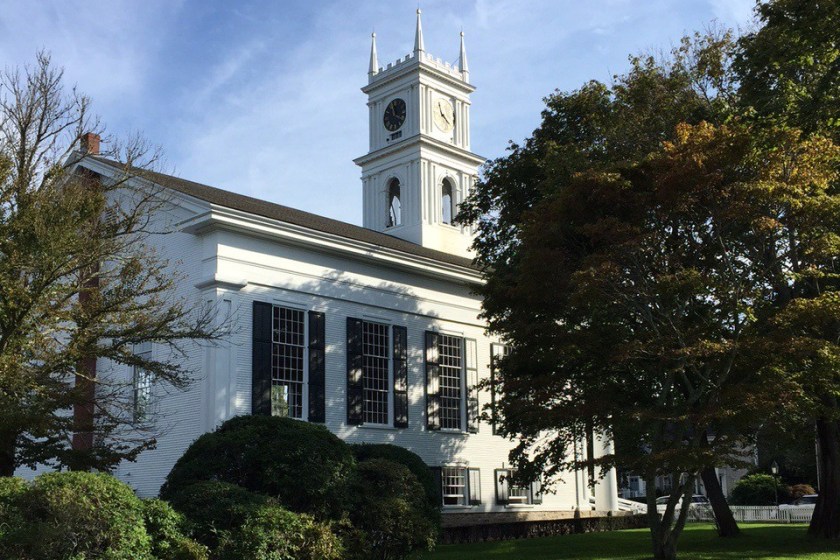
Image: Old Whaling Church, Martha’s Vineyard, photo by DJB
Archbishop Desmond Tutu — outspoken critic of apartheid, teacher, author, lecturer, Nobel Prize winner, former Archbishop of Cape Town, and Archbishop Emeritus of South Africa — passed in Cape Town on the day after Christmas in 2021. A man of great vision, deep spirituality, sophisticated thinking, and infectious joy, he’s often compared to Martin Luther King, Jr. and Mahatma Gandi. But Tutu took issue with those comparisons, once joking that he won the 1984 Nobel Peace Prize mostly because the committee was looking for an anti-apartheid figure whose last name was easy to pronounce.
Desmond Tutu received the Martin Luther King Jr Award for Non-Violence in 1986 for his commitment and role during the struggle against apartheid. Tutu once said, “If you are neutral in situations of injustice, you have chosen the side of the oppressor.” But he also understood the need for forgiveness.
Forgiveness is not just an altruistic act, but one born of self-interest. Forgiveness helps give people the resilience to survive and remain human in the face of all efforts to dehumanise them.
On this MLK Weekend, I want to celebrate the life of Archbishop Tutu and consider his thoughts on hope and love, humor, the religious aspect of voting, and the moral potential of surprise. Many of those thoughts arose during an interview Tutu held with journalist Krista Tippett in 2010.
Hope and love
After her interview, Tippett spoke about the value of people who remind us that love is not the softest force but often the fiercest and is, in fact, “able to shift the world on its axis from time to time.” Tutu had this to say about hope and love:
(I)f you are devoid of hope, then roll over and disappear quietly. Hope says, Man, hey, things can, things will be better, because God has intended for it to be so. … At no point will evil and injustice and oppression and all of the negative things have the last word. And, yes, there’s no question about the reality of evil, of injustice, of suffering. But, you know, at the center of this existence is a heart beating with love … we are, as a matter of fact, made for goodness.
Tutu saw struggles for freedom as more than just wanting to change the complexion of those sitting in the capitol. “It was to change the quality of our community, society.” Those pushing for change wanted to see a compassionate, caring, loving society, a society where you might not be rich, but “you knew that you counted.”
I have a family that likes pulling people’s legs. They can be very funny. When you have to survive in that environment, you have to be pretty sharp yourself. In South Africa we became experts at conducting funerals, and people were angry and hurt over the mistreatment. But we also had this wonderful capacity to laugh. If we hadn’t, we would have gone crazy. … I’m also aware that I was constantly being prayed for. There were times when I’d say something unrehearsed that surprised me, and I’d wonder, “Did I really say that? That was pretty smart.” But it couldn’t have just come spontaneously. Looking back, I have no doubt that some dear old ladies were kneeling down at Eucharist somewhere, praying to help the people struggling in South Africa.”
Tutu then displayed that well-known humor when Tippett asked him — given all the bad things that continued to happen in South Africa — how he could describe this as a moral universe where God is in charge. He laughed and said, “Well, I mean, you must add that I’ve sometimes said to God, it would be nice for you to make it slightly more obvious that you’re in charge.”
Voting as a religious act
This weekend we are in a fierce debate about who gets to vote, an issue where Dr. King gave his life attempting to open the vote to all. Archbishop Tutu was 63 years old before he was able to cast his first vote in South Africa, and when he was asked about how it felt, he spoke about it in a way that raises the issue into a different context that should make us all pause.
How do you describe falling in love? [laughs] I mean, people asked then, when we voted for the first time. It was an incredible experience. For you, going to the ballot box is really a political act. For us, it was a religious act. It was a spiritual experience, because you walked into the polling booth one person, with all of the history of oppression and injustice, and all the baggage that we were carrying. And you walk, and you make your mark, and you put the ballot into the box, and you emerge on the other side. And you are a different person: you are transfigured. Now you actually count in your own country.
The moral potential of surprise
A readiness to be surprised is a move of character. There is so much uncertainty and fear, and — as Tippett notes — this environment “activates our bodies and minds towards rigid views of enemies and threats and obstacles — and possibilities.”
Desmond Tutu believed in a god of surprises. He believed in a world in which improbably surprising turns of events are a given. And he believed that we can never, in this world, communicate the true nature of God.
Do you really think that God would say, “Dalai Lama, you really are a great guy, man. What a shame you’re not a Christian”? [laughs] I somehow don’t think so. I think God is just thrilled, because no faith, not even the Christian faith, can ever encompass God or even be able to communicate who God is. Only God can do that.
As Krista Tippett wrote in her appreciation, “when Desmond Tutu tells you something about God — whatever and whoever you imagine God to be — you believe him.”
With thanksgiving for the lives of Archbishop Desmond Tutu and The Rev. Dr. Martin Luther King, Jr.
More to come…
DJB
NOTE: As the country celebrates the Martin Luther King, Jr. holiday, my posts this week focus on various aspects of understanding, justice, tolerance, love, and reconciliation with the hope they may be useful as we each take our own journeys to create the beloved community.
Image: Archbishop Desmond Tutu (credit: Washington National Cathedral)