Our year in photos – 2014
A cross-country trip and a visit to see Andrew in Copenhagen were part of our 2014 year in photos.
A week would generally be enough time to explore large sections of a city the size of Savannah, Georgia. Time to linger among the live oaks and Spanish moss in the historic squares, eat at the growing list of restaurants, visit the museums, and share stories with friends and strangers in the coffee shops and bars scattered throughout the downtown. Plenty of time…unless one has a conference to run. Well, run is actually much too strong a word. While technically responsible for ensuring that last week’s PastForward 2014 – the National Preservation Conference went off without a hitch, there are many staff members who carry a far heavier load as we worked to reach that goal. Much of my oversight actually took place over the past 18 months. Once the week of the conference comes, I just “enjoy the field trip” as Candice – the former elementary school teacher – says at times like these. At the conference, I often have my day structured by others: be here to welcome this group, then go there …
Saturday evening’s WaterFire Providence – an award-winning sculpture installation featuring 100 blazing bonfires floating atop the water of Providence’s rivers – was capped with a terrific Brown University Chorus concert of Water and Fire-theme music. It was the perfect ending to a wonderful fall Saturday of activities during the university’s family weekend. After a late-night Friday dinner at Gracie’s (if you go to Providence you must eat at Gracie’s, and then have breakfast at Ellie’s, the restaurant’s partner bakery), we slept in a bit on Saturday but made it up in time for a fascinating lecture as part of the Family Weekend Forums. Professor of Medicine Richard Besdine spoke on Fit at 50, Sexy at 70, Nimble at 90: The Fundamentals of Healthy Aging to a room full of parents who looked a great deal like us! (He added the “Nimble at 90” part of the title on the fly, and noted that our children’s granddaughters – Andrew and Claire’s granddaughters – would have a life expectancy of 100.) While there wasn’t anything we hadn’t …
At times, Wednesday’s ride seemed as long as a California redwood is tall. Claire and I were on Day 13 of the Not All Who Wander Are Lost tour (a.k.a., the “length of the country” portion), and perhaps it had to do with it being the 13th day, but there were some weird things happening along the way. We left Portland, Oregon at 8:30 a.m. and didn’t arrive in Eureka, California until around 6:30 p.m. for what was supposed to be a 7 hour trip. (Darn those Google maps algorithms.) The portions on the “straight and narrow” path of I-5 could give a guy and his daughter the blues. Rest areas that we really needed were closing up due to “bear activity.” Ah, but those crooked roads through the mountains, the redwoods, and along the beautiful California coast…now that’s when we felt we were alive and on the edge of the world. We had to take I-5 down to Grants Pass. The Oregon landscape is changing and beautiful through this part of the country, but …
One could look at today’s itinerary for the Not All Who Wander Are Lost tour and think that our main goal was to go from Point A (Seattle) to Point B (Portland) as quickly and efficiently as possible. But those who think that way miss the point of our cross-country trip. We avoided most of Interstate 5 – the main line between Seattle and Portland – and struck out from Gig Harbor, Washington, to get to Astoria, Oregon on the coast via the crooked road. And think of what we would have missed had we taken the straight and narrow way. Why, we wouldn’t have known that Montesano, Washington is the home of the Tree Farm. (It says so right on the sign.) We would have missed the fact that South Bend, Washington is the Oyster Capital of the World. Given the amount of “working forests” one sees in this section of the state, I suspect this is where America’s supply of paper is produced. And who knew that McCleary, Washington will be celebrating the …
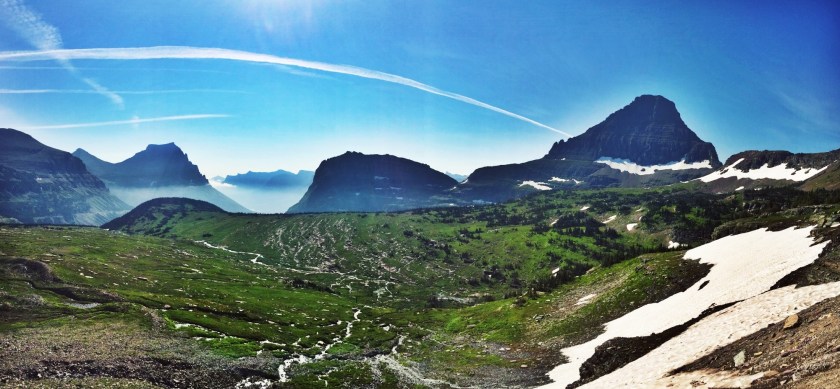
Wow! On a picture perfect August day, Claire and I visited Glacier National Park, The Crown of the Continent. It was an experience we’ll never forget. We had always envisioned this day – at the midpoint in our cross-country road trip – to be one of the highlights. But as first time visitors to this park, we just couldn’t have imagined how wonderful it would be. Knowing that we wanted to beat the crowds, we left our hotel early and drove into St. Mary, the eastern gateway to the park. On the advice of several friends, we planned to focus our visit along the famous Going-to-the-Sun Road – a National Historic Landmark and a National Engineering Landmark. According to the National Park Service website: The road officially received its name, “The Going-to-the-Sun Road,” during the 1933 dedication at Logan Pass. The road borrowed its name from nearby Going-to-the-Sun Mountain. Local legend, and a 1933 press release issued by the Department of the Interior, told the story of the deity, Sour Spirit, who came down from …
On Friday morning, as we began our second week on the Not All Who Wander Are Lost tour, Claire and I drove the 20 miles up from Fort Peck to Glasgow, Montana where we reconnected with U.S. Route 2. Now mind you, we had driven two-and-one-half hours in Montana the day before just to get to Fort Peck – which is in the eastern part of the state. So imagine our surprise when we clicked on the Google maps direction finder to head west to Glacier National Park from Glasgow and the young lady on the smart phone who has become our traveling companion says: Go west on U.S. Route 2 forever. Well, I may be exaggerating a bit. It was actually something like 259 miles. But after a long day of driving through Montana’s plains along the original Hi-Line (New York City’s High Line is late to the party), it seems like forever. This Hi-Line refers to the northernmost route of the Great Northern Railroad and U.S. 2, near the Canadian border. But, as …
Having been warned that we will lose cell and online coverage as we enter the mountains portion of our trip over the next couple of days, I’m writing my next set of “Observations from the road: The prairie edition” from my outpost here on the front porch of the historic Fort Peck Hotel in Fort Peck, Montana. (The beautiful and flat part of Montana, as their website describes it.) You can catch earlier parts of the “Observations” series here (the Central Time edition) and here (essentially the Pennsylvania, Ohio, and Indiana edition). Fort Peck dam was built in the 1930s as a WPA project, and this building was originally constructed to house the workers. It was converted into a hotel in the 1930s, and has served sportsmen, patrons of the Fort Peck Summer Theatre Playhouse, and wayward travelers like Claire and me ever since. The rooms are small and simple but the lobby (where I wrote last evening’s post) is down home and friendly with a well-stocked bar. The only disappointment was that the dining …
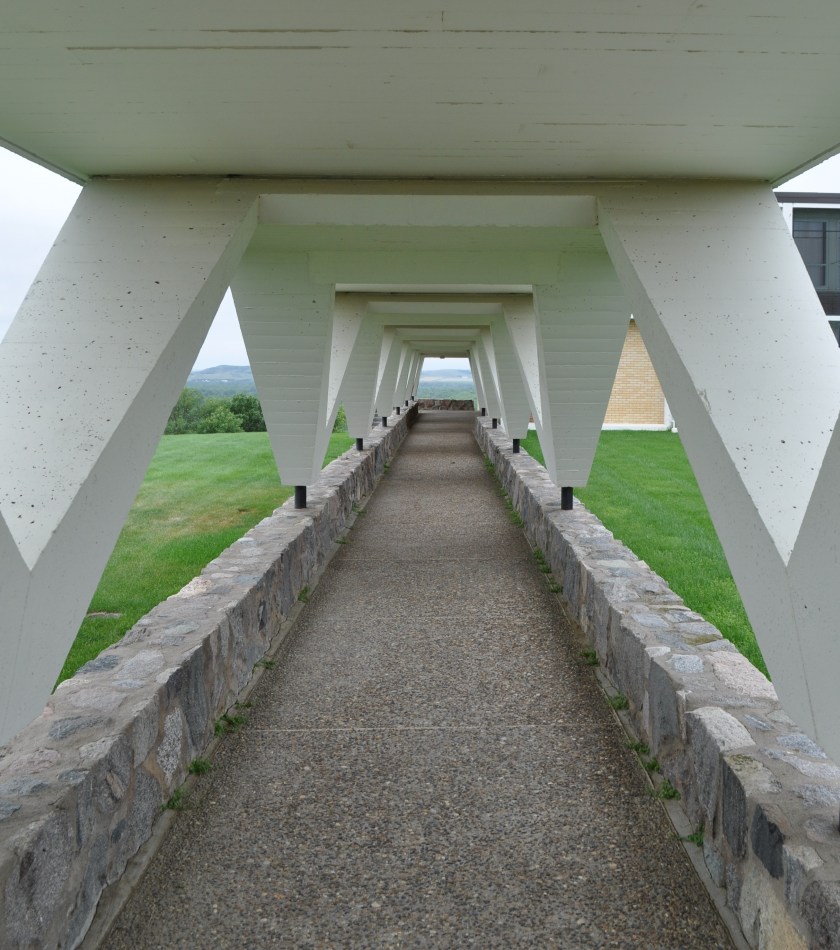
Some of the most amazing finds on the road occur in the most unlikely places. When my colleague Jenny Buddenborg learned I was traveling cross-country with Claire – and taking in North Dakota in the process – she directed me to one of America’s hidden gems: a college campus in Bismarck, North Dakota designed by Marcel Breuer, one of the masters of Modernism. The University of Mary is a small, Catholic school located on rolling hills about 7 miles outside of Bismarck. The university’s website picks up the story from here: In the 1950’s, when the Benedictine Sisters of the Annunciation founded their original priory and later planned for the first campus buildings for Mary College, they asked Breuer if he would create the architectural designs. To their delight he accepted and conceived expansive structures of native prairie stone and exquisite concrete shapes, notable for their interplay of light and shadow. Breuer called it his “jewel on the prairie.” After an hour touring the campus this morning, I wouldn’t disagree. Thanks to Jenny and the …
Claire and I were driving through the heart of Central Minnesota today when the Pokey LaFarge paean to Middle America – Central Time – popped up on the iPhone playlist. Yet another omen! The Missouri is my right arm, the Ohio is my left But I’m livin’ on the Mississippi River where I like life the best I don’t mind the west coast, and I don’t mind the east coast Oh, baby, but I ain’t gonna live on no coast. I’m just a plain ole Midwestern boy, Getting by on Central time So thanks to Pokey’s reminder, here are a few (more) observations from the road – in the Central Time edition. Some oddities really are worth seeing – We went an hour out of our way today to see the largest ball of twine rolled by one person, and it was SO worth it. As the great post on the Roadside America blog puts it, “One runs across more than a few balls on the obsession landscape…But special tribute must be paid to the Mother of the moss gathering …