If you grew up with the Monster Mash and decided — based on that small sample size — that there were no decent Halloween songs, Saturday Soundtrack is here to set the record straight. The really grim and scary songs were all hiding out in the roots music bin, just as the great, old folktales were ones that really hit the mark when it came to ghosts, goblins, and other things that go bump in the night.
The Folklore Center at the Library of Congress had a blog post a few years ago entitled Ghost Stories in Song for Halloween. The first tune recommended was Jean Ritchie singing The Unquiet Grave, “which is both a tender love song and a frank conversation with a ghost.” Writing about Ritchie’s version, the liner notes suggest that the song…
“…is notable for its exhibition of several universal popular beliefs, including a talking ghost, the idea that excessive grief on the part of mourners disturbs the peace of the dead, the troth plight that binds lovers even after death (with the death-kiss perhaps indicating a return of the troth), and the belief that the kiss of a dead person may result in death.“
One of the most haunting versions of this tune was recorded by my favorite Irish band, Solas. And this snippet from the lyrics give a hint of what’s to come.
One kiss, one kiss of your lily white lips, one kiss is all I crave One kiss, one kiss of your lily white lips and return back to your grave…”
Well, you get the idea. Give it a listen.
The late Ralph Stanley became an American icon years after he and his brother Carter formed one of the early bluegrass groups, The Stanley Brothers. His chilling version of O Death for the film O Brother Where Art Thou? was part of the Grammy-winning soundtrack and made his voice recognizable to millions. I’ve also included a video of Ralph Stanley and Patty Loveless singing the murder ballad Pretty Polly. In some traditional versions, the murdered Polly returns to get her revenge by ripping out the heart of the murderer. This version is gory enough.
The blues and jazz cats also have a great number of songs for the season. Nina Simone does her usual masterful job with the Screamin’ Jay Hawkins hit I Put a Spell on You. Of course, no Halloween-influenced roots music list would be complete without at least one song from bluesman Robert Johnson. “Legendarily making a Faustian deal at a mythological crossroads,” Johnson recorded “Hellhound on My Trail” during his second Texas sessions, a year before his mysterious, and untimely death. Hellhound is followed by Elise LeGrow breaking the Bo Diddley classic Who Do You Love “down to a new set of bare bones. Watch her rasping howl bring ‘a tombstone hand and a graveyard mind’ to life.”
The song that took me down this spooky path is the Del McCoury Band’s title track from the album It’s Just the Night, with backing vocals by the classic gospel group Fairfield Four.
“I found your letter in my mailbox today / You were just checkin’ if I was okay / And if I miss you, well, you know what they say / Just once, in a very blue moon…”
Climb under the sheets if you need to, but don’t get spooked.
As we prepare for the election and a torrent of stories — good and bad — in the coming week, I thought it helpful to turn back to a book that reminds us of the importance of stories, how we tell them, and how we process them.* In doing so, I also want to bring in the work of another writer — a fellow at the Yale Journalism Initiative — who speaks to the information crisis we face in America because of the deliberate and extensive efforts of political actors and media giants like Fox to poison the citizenry’s understanding of public affairs.
Bad Stories: What the Hell Just Happened to Our Country by Steve Almond
Let’s begin with Bad Stories: What the Hell Just Happened to Our Country. Steve Almond’s impressive yet troubling book was written about the American psyche in 2018 by the New York Times best-selling author and co-host of the Dear Sugarspodcast (with fellow writer Cheryl Strayed). In it, Almond looks at the many reasons we came to be where we are today as a nation. The author makes the strong case—using examples from Moby Dick and other classics of literature—that we’ve made bad decisions as a country because we’ve told ourselves bad stories for a long time…and “bad stories arise from an unwillingness to take reality seriously.”
Almond writes, “I’ve placed my faith in stories because I believe them to be the basic unit of human consciousness. The stories we tell, and the ones we absorb, are what allow us to pluck meaning from the rush of experience.” He quotes the Israeli historian Yuval Noah Harari, who insists that our species came to dominate the world in part because of “our unique cognitive ability to believe in the imagined, to tell stories that extend beyond our bonds beyond clan loyalties.”
Almond says,
“For most of our history, humans relied upon folklore and religious parable to conceptualize the common good. But much of our progress as a species, Harari insists, is a function of cultures shifting from superstitious stories to verifiable ones, as happened during the Scientific Revolution of the 16th century. Our embrace of reason and empiricism has saved a lot of people from dying of illness and starvation. It has led to a standard of living within many precincts of the world that would have been unimaginable in previous epochs. It has not, however, changed the fact that we still choose the stories by which we construct reality (emphasis added).
What happens, then, when some of the stories we tell ourselves are bad, meaning fraudulent either by design or negligence? What happens when the stories we tell ourselves are frivolous? Or when we ignore stories that are too frightening to confront? What happens when we fall under the sway of stories intended to sow discord, to blunt our moral imaginations, to warp our fears into loathing and our mercy into vengeance? The principle argument of this book is that bad stories lead to bad outcomes (emphasis added).
Almond asserts that we are unwilling to take reality seriously, so we turn to bad stories as some sort of salve for our bruised psyche. He adds, however, that if “bad stories become pervasive enough they create a new and darker reality.” I believe we can already see this new reality in several areas of American life today.
“The crisis we face isn’t only political. It isn’t just economic. It isn’t about public health alone. It’s also an information crisis. Too many people in too many places in this country believe fantastical lies as if they were true.“
It isn’t just manufactured scandal — such as I wrote about recently — that is the problem. It is “lying at scale with the intent to injure.” Stoehr notes that these bad stories are designed “to poison the citizenry’s understanding of public affairs” and create “conditions in which the truth itself is partisan.” As Almond notes, these types of stories are designed to sow discord. And Stoehr insists that while these bad stories may be constructed by conservative media, we really need to be aware of when the mainstream media “play along…enabling the above. They are, in a very real sense, complicit in our betrayal.”
Stoehr’s full piece is worth the read because he elaborates on five lies, five bad stories if you will, “that members of the Washington press corps accept as true or habitually repeat uncritically in their reporting. In the process, they launder these lies, give them credibility and legitimacy, and mask their illicit and injurious origins.”
What are those Big Five lies? I’m going to preview three, and encourage you to read Stoehr’s article to see the other two.
Originalism, which is “the idea that US Supreme Court justices should interpret federal law and the US Constitution ‘as written,’ not as they might wish they were written. It’s a lie.” Historian Joseph Ellis has a great deal to say about this lie in his book American Dialogue, where he quotes Justice William Brennan’s description of originalism as “arrogance cloaked as humility.”
Pro-gun. “The Republicans are not “pro-gun,” writes Stoehr. “They are pro-intimidation. They are pro-anarchy. They are pro-vigilante justice.” Look at all the so-called militia groups inspired by Donald Trump’s language to arm themselves to the teeth, march on state capitols to complain about public health regulations, and plot to kidnap duly-elected governors if you want to see the truth behind this bad story.
The sanctity of life. Anyone who has heard me on this topic in recent years knows where I stand…which is alongside Stoehr calling this out for the hypocrisy it is. The idea that “life” is so precious “abortion must be outlawed” is conditional. What about the sanctity of life when it comes to capital punishment; taking away support for the sick, hungry and poor; or mistreating the 550 immigrant orphans seized at the border?
As a lover of history, I believe in the power of stories. Like each of you, I’ve heard them my entire life. As I have written in the past, people I love told stories that were wrong — bad stories — which perpetuated a false reality that was focused on keeping one race of people under the control of another and to “warp our fears into loathing.”
It has also led me to think about the personal stories I tell myself and others. When I get a (minor) fact wrong I’m fond of saying, “this story may not be factually accurate, but it is true,” meaning that it points us in the right direction. Almond, in a response to a question from his seven-year-old son about the truth of a set of stories, says something similar when he notes that the truth of certain stories isn’t really the point. “A story didn’t have to be true (which I interpret as factual) to produce a good outcome, to help people behave a little more kindly.” Sometimes the intent of the storyteller to either build up or tear down is the determining factor of a story’s value. Stoehr argues that we have too many people with too much power who are working overtime to tell stories to tear down people they hate. They are doing this to sow discord and maintain minority power over the majority.
There is much that has to be done, and we will need work at the national level to begin to reclaim the public’s airways for truth telling. That will require long, hard, tedious, never-ending work. On the personal level, if we can recognize the value of others as well as our role in listening to, understanding, and honoring their stories, I believe we’ll be on the right path to taking reality seriously. And we’ll be helping, each in our own ways, in the work to correct bad stories.
More to come…
DJB
*Earlier versions of my review of Bad Stories first appeared in 2018, shortly after it was published.
Most communities have a place that even in technology-obsessed, locked-down 21st century America remains a surprisingly relevant bellwether institution: the public library.
I was thinking about libraries as I finished reading Our Towns: A 100,000 Mile Journey into the Heart of America by James and Deborah Fallows. Published in 2018, Our Towns is the story of a five-year journey across the country, most of it taken at low altitude in a little propeller airplane. Along the way, the Fallows saw small and mid-sized towns that had faced economic hardship, political crises, and job losses. They also saw “the emerging pattern of American reinvention.” And one of the first places they stopped in each town to gather local information and to gauge the character of the community was the public library.
I thoroughly enjoyed the couple’s take on what America looks like away from the big cities and the corporate media, even if I felt that the focus on the economic development directors of the world and the craft beer revival may have received too much play. (And I love craft beer.) One key element they saw time and time again was the importance of a strong, revitalized downtown to community health and spirit, and in their book they highlighted the work of Main Street America, where I once served on the board. Their primary point — that there exists a great deal of vibrancy off the beaten path — fits with my perceptions taken from journeys across the country and work through the years.
But since the trip took place prior to the pandemic, the upheaval over racial justice, increased environmental devastation through fires and hurricanes, the worst economic downturn since the Great Depression, and the disruptive presidential election, I came away thinking that much of what they found would require some type of 2020 reality check. Thankfully, their Our Towns website has stories that deal with this most challenging of years, produced with the same straightforward, non-judgmental approach that does not gloss over the issues but speaks to the energy and renewal possible across the country.
In America’s public libraries, James and Deborah Fallows found librarians committed to their communities, to reading, to learning, to public service, to the people who use their services, and to innovation. People who are probably very much like my mother, a life-long reader who served for decades as the children’s librarian in our hometown.
Yes, my mother was known throughout our community as “Queen Helen, the Storytime Queen” and I could always count on a little ribbing from my friends when her picture — dressed in her royal robes and crown — appeared in our local paper. But she knew all the children who used the library and their parents as well, and she was adored and appreciated. Mom was eager to point child and parent alike to a book that fit the need in that family at that moment. Her commitment to reading and education was one reason our family established the Helen Brown Scholarship Fund at First Baptist Church in Murfreesboro after her too-early death from cancer. For more than two decades, it has helped young people attend college, even though mother never had that opportunity in her own life. Most of the recipients never knew my mother, but they are blessed by her life and legacy. My sister Carol followed in her footsteps and now serves as the branch librarian at the same public library where Mom spent so many years.
All of these memories and stories came flooding back into my mind as I read an article in Monday’s Washington Post entitled “The pandemic took away our family’s second home: the public library.” Writer Maggie Smith notes that while she misses a wide variety of places where she used to visit, “One of the places my kids and I miss most is the public library.”
Public Library in Staunton, Virginia
When our children were young, my wife and the twins would go to the Staunton Public Library — located downtown in a repurposed and restored historic school building — on a regular basis. There they attended story-time and special events, or just read books that piqued their interest. At the end of each visit they would pick out a dozen or more treasures to bring home in our book box. I would tag along when work allowed, and the cycle repeated itself every week for several years. Smith tells a similar story as she and her children would visit their public library in Bexley, Ohio, once or twice a week. And just like as in Staunton,
“The children’s section is on the basement level, where you can look through the windows and see people’s shoes as they walk in the small courtyard outside. We’d descend the stairs together — or take the elevator when one of the kids was still in a stroller — and round the corner into a wonderland of books, puzzles and toys.”
Our children acquired a life-long passion for reading and writing, and they fit into a family pattern. Mother loved to read and write, and my sister Carol and I acquired that same gene. Smith suggests that we “become readers before we discover we’re writers, and we become readers by being exposed to literature early and often.” It is our public libraries that make this exposure possible, free of charge. “Public libraries,” she adds, “are where readers — and, therefore, writers — are born.”
Smith’s final words resonate with me and so many others who love public libraries and all they embody about what is good about our country. She is especially touched these days when she sees the “Together We Will See It Through” banner hanging on the front door of the Bexley public library since the lockdown began. She writes that she “choked up the first time I noticed it.”
Together we will see this dark, difficult time through — and on the other side, we will gather in our favorite places again. My kids and I will walk back to the library, head downstairs and round the corner to see the faces we know….My son and daughter will be thrilled to be let loose in the stacks again, choosing their own books, and I’ll probably catch up with the librarians, my arms full of poetry and movies. When we leave, I’ll say, “See you soon,” because of course we will.“
In the first two decades of the 21st century, libraries have reinvented themselves* to serve a public that has very different needs from those of the first two decades of the 20th century or even the 1960s and 1970s of my youth. But they have done so in style, and have remained incredibly relevant, to the point that two journalists, flying across America in a small plane to get a sense of how the country is handling all this change, wouldn’t think of starting their search without a stop at the local public library.
More to come…
DJB
NOTE: The Washington, DC public library system has remade itself with a commitment to excellent modern architecture, reinvented public space, and vital city life. Read this article in the Washingtonian magazine about the overall project, as well as this review in the Washington Post of the city’s rehabilitation of the landmark Mies van der Rohe flagship library (although I disagree with some of Kennicott’s opening “woe is the library and America” language. Perhaps he needs to get out into the small towns more frequently.)
One of the challenges in building hope for the future is the need to overcome cynicism. We consider racism, sexism, pandemics, authoritarianism, poverty, environmental degradation, fascism, financial inequality, and other challenges in the world today and we become cynical about our ability to make a difference.
Over the month of October, I have posted a series of observations on the lessons history teaches us as we fight the good fight to keep our democracy. I find two consistent lessons.
First, the life that we see today is not permanent. Change will happen. If we do nothing to save our democracy, there are forces of tyranny ready to step into the breach.
Lesson #2 teaches us that if we push and make great progress towards building a more just society, it will take work — long, tedious, boring, necessary work — to maintain and build upon those gains.
Hope for a better future is required if we are to find the courage to continue with our labor. The reason I turn to history and the places where history happened is because hope is grounded in memory. We can see how those before us faced challenges that looked hopeless — such as freeing the slaves or getting women the vote — and then they set to worked and achieved those things.
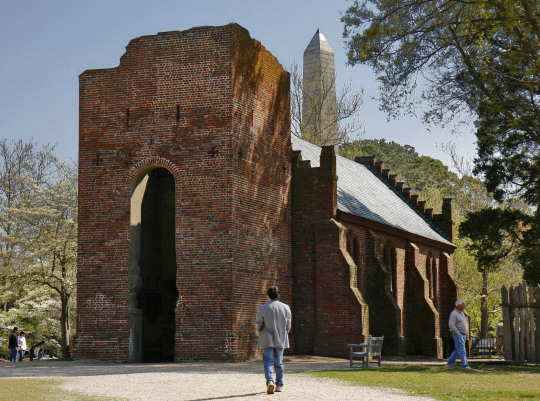
Jamestown
I began this series with my own challenge. In Let’s stop celebrating a past that never existed. Instead, let’s understand and honor the one that did. I suggest that our recollections need a reckoning and a reimagining. A reckoning with the history that did happen and a reimagining through recovered stories with hope for our collective future. In my push against the call for a “restoration” of “patriotic education,” I use my experiences at Jamestown, which I first visited as an 11-year old, to show how we can understand and appreciate a more complex and nuanced story and still love America.
Next I turned to voter suppression in a post entitled History tells us democracy is the objective. Voter suppression has been with us since the day the constitution was ratified. Sometimes it was based on the norms of the day, as when white, male property owners were the only ones with the franchise. Later, it became a tool to retain minority power when the policies of the minority went out of favor. I turn to history, and the small town of Hayneville, Alabama, to show the lengths such groups will go to maintain power, as they did in the case of Jonathan Myrick Daniels.
Touro Synagogue in Newport, RI – a landmark of religious liberty associated with the rights of non-Christian denominations; an affiliate site of the National Trust for Historic Preservation (Photo: National Trust)
In Let’s take a road trip to help understand the history behind religious liberty, I tackle a topic as fresh as the current battle over the supreme court. Many claim that our country’s religious liberty gives them the right to push their views on others through government action and to avoid criticism in the process. But the Constitution doesn’t protect people who have different religious beliefs from criticism. If I want to criticize a conservative charismatic Catholic group for suggesting that women should be subordinate to their husbands, that’s my right. Likewise, if a conservative Catholic wants to criticize the Episcopal church’s support for same-sex marriage, that’s their right. What the Constitution does is to bar courts and governments from preferring one set of religious views over any other set — or over nonreligious views. And that is important to know because any serious study of religious life in America uncovers how quickly the persecuted become the persecutors in this country. To demonstrate that, I go all 2020 on you with a virtual road trip to Providence and Newport, Rhode Island; Orange, Virginia; and Mount Taylor, New Mexico.
Next up in the series is Recovered songs, recovered stories and a tale describing the challenges of wrongful imprisonment and racial violence. Recently, The Bitter Southernerposted a thoughtful article which examines how the popular folk tune Swannanoa Tunnel was taken from the wrongfully convicted black community in Western North Carolina. Forced to build the railroad tunnel as convict labor during the Jim Crow era, those convicts originally wrote the tune in the “hammer song” tradition of John Henry. A historian and a musicologist show how the song was reshaped and romanticized into an English-based folk tune in the 1920s – 1960s to appeal to white audiences before their recent work helped recover the real story and repatriate the recordings with the descendants of the original artists.
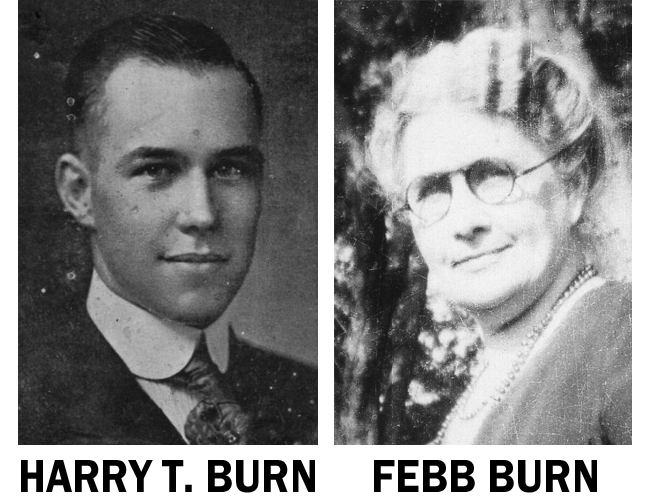
In Be a good boy…and follow your mother’s advice, I turn to the challenges that sexism and the denial of the right to vote to women have brought to our democracy. This story has a great hometown angle, in that Tennessee was the 36th and final state to ratify the 19th Amendment one hundred years ago. The historic Hermitage Hotel plays a role in this drama, where two of the lead actors are a mother and her son. The son, twenty-four-year-old Republican Harry T. Burn, was a first-term legislator from East Tennessee worried about re-election. His mother, Feb Burn — having read a barrage of bitter speeches opposing giving women the franchise — felt compelled to force the issue. She sat down in her front porch chair and penned a few lines in one of the most famous, or at least most effective, mother-to-son letters in history. She wrote:
“Dear Son, … Hurrah and vote for Suffrage and don’t keep them in doubt. … I’ve been waiting to see how you stood but have not seen anything yet…. Don’t forget to be a good boy and help Mrs. (Carrie Chapman) Catt with her “Rats.” Is she the one that put rat in ratification, Ha! With lots of love, Mama.”
Burn thought about that letter and the fact that all of the illiterate, uninformed male tenants on the family farm could vote; yet the intelligent, feisty, college educated widow and successful farmer who was his mother could not. He changed his vote, and the rest is history.
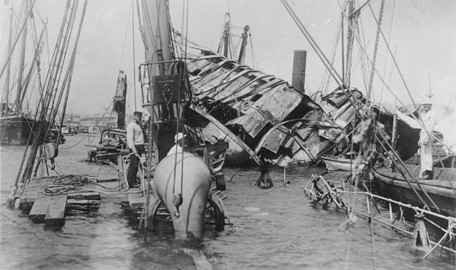
Wreckage of the USS Maine in Havana Harbor
I wrap up the series with Misinformation and the threat to democracy by quoting Teri Kanefield when she says, “Democracy is based on rule of law, which requires a shared truth (a functioning public sphere). Fascism, to thrive, must destroy the common factuality so that myth can take hold.” The fake Hunter Biden laptop scandal is just the latest in a long list of attempts by Donald Trump and his enablers to destroy a shared truth and create a false myth. The use of misinformation and fake news has a long history in America, and I share one of the most famous examples: the 1898 explosion of the USS Maine in Havana Harbor, which William Randolph Hearst and others used as an excuse to go to war with Spain.
In all of these stories, we are reminded again and again of the second of my two over-arching lessons: this takes work The country has made important steps in fighting voter suppression, ensuring religious liberty, facing wrongful imprisonment, calling out racial violence, giving women the right to vote, and combating misinformation. But the forces that want hierarchy and minority rule over democracy have pushed back in every instance. John Roberts and the Supreme Court decide that racism and voter suppression are no longer a problem and just like that, both are back with a vengeance. Slavery is ended but we find new ways to enslave blacks and just call it Jim Crow or mass incarceration. LGBTQ individuals win the right to marry and women are given control over their own bodies and in response religious conservatives pack the courts to put their theology above civic law. Women have the right to vote, yet the president of the United States feels comfortable calling the female Speaker of the House a “nasty woman.” We turn in the 20th century toward a free and responsible press, only to see changes that permit the creation of a giant right-wing infotainment network that distorts information for its own purposes.
Democracies are not permanent, and I included a book review this month on how democracies die. Two Harvard professors who have spent twenty years studying the decline of democracies all around the world write that their research shows that more often than not, it is the slow decline of institutions such as the judiciary and press that lead countries to move from democratic to authoritarian governments. That is certainly the case in 21st century America. But all is not lost.
Keeping a democracy and moving forward toward justice are never ending journeys. That journey has another important step next month on election day.
More to come…
DJB
Image by DJB: A California Condor flies over the Grand Canyon during our visit in 2008. These remarkable birds — now being re-established in the wild after having a brush with extinction — have a 9′ wing span, fly at about 55 miles per hour, and can soar to 20,000 feet and then coast for two hours. Imagine our surprise on our way to breakfast when a California Condor (#72 as tagged on his wings — he was that close) came swooping over our heads looking for his breakfast. It isn’t a bald eagle, but I thought it was an exhilarating image showing — in the environment and the rescue of a magnificent creature once set for extinction — just one of the many things we have to fight for in the United States.
Early in my preservation career, I was privileged to serve five years as the executive director of Virginia’s Historic Staunton Foundation, an award-winning preservation organization recognized over more than four decades for its work to protect and revitalize this historic Shenandoah Valley community. Our children were born during the 15 years we lived in Staunton, it shaped each of us in significant ways, and we still have deep friendships that bring us “home” several times each year.
Just as we like to return to this gem of a community, visionary leadership has made Staunton a year-round destination for tens-of-thousands of visitors annually and has generated national recognition for the city, including more than forty awards and accolades for its historic downtown from national organizations and media in the past ten years. Some of the top ones include :
The Great American Main Street Award
A National Trust for Historic Preservation Award
Best Small Towns in America Award (Smithsonian magazine)
The 15 Most Beautiful Main Streets Across America (Architectural Digest)
That level of success does not occur by chance. Great communities don’t remain that way by accepting whatever proposal comes along. So many in Staunton know this, but at times the leadership of a community needs to be reminded about what it takes to be a thoughtful steward of a national treasure.
Which brings us to 2020, and a proposal by Augusta County to demolish seven historic buildings that surround the downtown courthouse; buildings that grew up as a homegrown judicial campus along Barristers Row and Lawyers Row and are now listed on the National Register of Historic Places. The county proposes to replace these unique structures with an out-of-scale new development that would dwarf the historic courthouse. Staunton’s Historic Preservation Commission and the City Council will consider this proposal in the coming weeks.
In response to this challenge, I recently sent the following letter to Staunton Mayor Andrea Oakes and the members of city council:
Staunton’s national reputation in preservation and downtown revitalization did not occur by chance. Fifty years of work by a bipartisan coalition of government officials, long-time residents, and newcomers strengthened an irreplaceable historic core. As director of Historic Staunton Foundation from 1983 to 1988, I am part of that coalition. It is labor that never ends.
The plans to demolish the buildings surrounding the Augusta County Courthouse for out-of-scale new construction show how quickly a community’s distinctive character can be threatened and the qualities which give it value can be lost. Visitors who spend money at the city’s hotels, inns, restaurants, shops, and cultural events are attracted by Staunton’s historic character. That helps underpin the city’s financial base, support that could be threatened by plans to demolish key historic buildings in downtown.
A study I helped commission in 1995 shows the broad economic impact of preservation across the Commonwealth, including in Staunton. That study demonstrated that buildings in every one of Staunton’s historic districts appreciated at a faster rate of growth when compared with similar properties outside the historic districts. What was most interesting about this analysis was the breadth of housing stock that was affected. Staunton’s historic districts not only provide quality housing for people of more modest means, but reward them with faster rates of appreciation as well. That’s also tax revenue for the city.
National recognition came because the city did not take the path followed by so many failing small towns. The last two decades of my career I served as the Executive Vice President and Chief Preservation Officer at the National Trust for Historic Preservation. Sadly, I have seen hundreds of struggling communities tear down their past while chasing the ephemeral promises of developers. Often, they are enabled by government officials who do not understand what a vibrant historic district means to a community. They forget those whose lives and memories are wrapped up in the brick and mortar of the community’s solid, durable buildings.
Such choices seldom result in the long-term sustainable growth that comes with a community-wide commitment to preservation and reuse.
My family’s fifteen years in Staunton were times that we treasure. They taught me the strength that comes to communities that work to understand, honor, and celebrate the unique history that we pass on to future generations. Staunton needs that strength now to reject calls for demolition and develop a plan that builds on its well-deserved reputation as a city with an irreplaceable past and a rich future.
No matter when each of us has lived, worked, worshipped, raised a family, played, mourned, and celebrated in Staunton, we are all simply stewards for a few years of the wonderful legacy of a vibrant community. Staunton’s contributions over the decades have enriched its citizens, spurred the growth of the Commonwealth, and enlivened the fortunes of the nation. The decisions made by a City Council can irrevocably alter a community’s future. National groups have recognized the benefits arising from Council decisions made in a bipartisan fashion over the past fifty years in Staunton. You have the opportunity to continue that legacy, and I encourage you to take that step.
Sincerely, David J. Brown
Former New York Times architectural critic Herbert Muschamp said that “the essential feature of a landmark is not its design, but the place it holds in a city’s memory.” Staunton has suffered demolitions in the past, but far more often the buildings in the city’s historic core have been saved. These places are landmarks in so many minds, providing the motivation behind the efforts to save them from the wrecking ball, because of their innumerable, varied, and deeply personal connections to people in Staunton and Augusta County.
When those places are lost, communities lose a part of their soul.
I encourage those entrusted with leadership in Staunton to accept the challenge the moment provides and take the path that has brought so much of value to this community through the years.
More to come…
DJB
Image: Historic view of Staunton with the Augusta County Courthouse
Music is a language that helps us process loss. Throughout 2020, Americans have had to call on that language time and again as more than 223,000 of our fellow citizens have lost their lives to COVID. Overall, “25% of U.S. adults say they or someone in their household was laid off or lost their job because of the coronavirus outbreak, with 15% saying this happened to them personally.” On top of this health and economic crisis, we are facing the potential loss of our democracy to minority rule.
So many have suffered personal losses during this year, holes in their lives that shake their soul. For those who find nurture in roots, country, folk, and acoustic music, the death of singer/songwriter John Prine to COVID early in the pandemic still creates a void that is difficult to fill.
But we try.
Thankfully, music provides a way to remember lives and process loss. For this Saturday Soundtrack, I want to focus on the remembrance of a song that, in itself, is about loss: John Prine’s Paradise, from his remarkable first album.
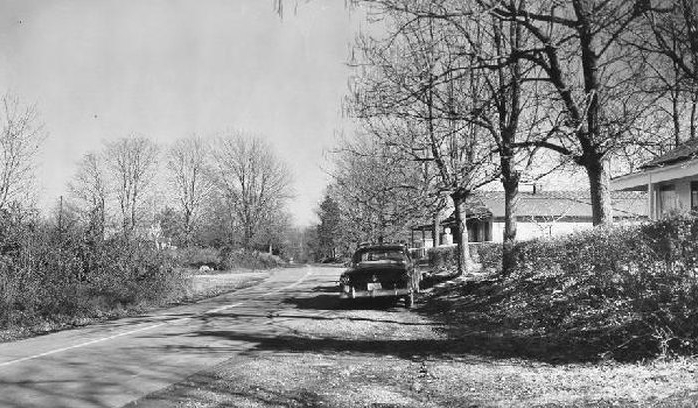
Paradise, located in Muhlenberg County, is Kentucky’s most famous ghost town…thanks to Prine’s musical tale. In his telling, Paradise is well-named, until the arrival of Peabody Coal Company and strip mining. But that wasn’t the only negative impact on the community. Ash from the Paradise Fossil Plants began “pouring from the air like warm, toxic snow” according to one account. The Tennessee Valley Authority stepped forward and convinced the remaining townsfolk to vacate their community, paying them “miniscule amounts to abandon their once happy lives in Paradise.”
I’ve mentioned this song before in my writings, and I was delighted to come across a deeply moving tribute to John, posted earlier this month, by some of my favorite musicians and performers as they sing one of his best-known tunes.
This celebration premiered October 3rd on, “Let The Music Play On”: A Hardly Strictly Bluegrass Broadcast, featuring many of John’s friends. Hardly Strictly Bluegrass is a Bay Area institution in San Francisco and Prine was a regular. His full sets from 2014 and 2017 are available to watch on the HSB website.
The artists in the tribute range from a handful of our most cherished roots musicians to some of the youngest and most innovative performers of our times. These are the type of people who are attracted to John’s music and his sensitivities as a songwriter. As you watch the video you will see in the order of appearance*:
The roots music band Birds of Chicago (with Allison Russell, also of Our Native Daughters, playing the clarinet) (0:00 and again at 0:30)
Then everyone comes back in and out to take it home.
“When I was a child my family would travel / Down to Western Kentucky where my parents were born / And there’s a backwards old town that’s often remembered / So many times that my memories are worn.
[Chorus:] And daddy won’t you take me back to Muhlenberg County / Down by the Green River where Paradise lay / Well, I’m sorry my son, but you’re too late in asking / Mister Peabody’s coal train has hauled it away
Well, sometimes we’d travel right down the Green River /To the abandoned old prison down by Airdrie Hill / Where the air smelled like snakes and we’d shoot with our pistols / But empty pop bottles was all we would kill. [Chorus]
Then the coal company came with the world’s largest shovel / And they tortured the timber and stripped all the land / Well, they dug for their coal till the land was forsaken / Then they wrote it all down as the progress of man. [Chorus]
When I die let my ashes float down the Green River / Let my soul roll on up to the Rochester dam / I’ll be halfway to Heaven with Paradise waitin’ / Just five miles away from wherever I am.” [Chorus]
Paradise is, of course, a song about loss. Loss of youthful innocence and the loss of our environment. In accordance with Prine’s wishes, half of his asheswere spread in Kentucky’s Green River. The other half were buried next to his parents in Chicago.
In my youth, my father took me to Paradise to see “the world’s largest (steam) shovel.” Because that’s what engineers do. I think Daddy came to the realization later in life that Prine’s perspective was right. When Peabody filed for bankruptcy in 2016, many stories referenced that song in their reports.
John Prine was all about the details of life in a world that was cruel at times, but also where love shows through. And those details often focused on the everyday…until he spun them around through his quirky sensibility to see the wonder around us.
Peabody Coal Company’s Steam Shovel
Enjoy this celebration of one who left too early.
More to come…
DJB
*There is no listing of the performers on the official site, so this is taken from the comments section and from my knowledge of some of these musicians.
Image: Paradise Main Street, before Mr. Peabody’s coal train hauled it away
Take any old laptop, add a legally blind store owner, conveniently forget to save security camera tape from the store before it is erased, throw in some Russian disinformation, turn to Rudy Giuliani and Rupert Murdoch — two titans of disinformation — to sell your story and “boom,” just like that you have a faux scandal!
Trying to control the flow of information is one of the chief threats to democracy, and in Donald Trump we may not have a master at the art, but it isn’t for lack of trying. Attorney, professor, and author Teri Kanefield writes, “Democracy is based on rule of law, which requires a shared truth (a functioning public sphere). Fascism, to thrive, must destroy the common factuality so that myth can take hold.”
The fake Hunter Biden laptop scandal is just the latest in a long list of attempts by Donald Trump and his enablers to destroy a shared truth and create a false myth. Trump has been conning people with lies his entire life. But you know you may have lost your touch on that front when even Fox News refused to run the initial story on the Hunter Biden laptop. In a Mediaite report, Chris Wallace of Fox called the story “suspicious” and said, “I can understand the concern about this story. It is completely unverified and frankly, Rudy Giuliani is not the most reliable source anymore. I hate to say that, but it’s just true.”
Let’s go back and remind ourselves of what we know about this case, as verified by multiple real news outlets.
This is not the first attempt at using Ukraine to smear Joe Biden
Last year, Donald Trump tried to blackmail the president of Ukraine into making false claims about Hunter Biden in order to discredit his father. Trump got caught, was impeached, and got away with not even a slap on the wrist from Senate Republicans.
If at first you don’t succeed…
When that scheme didn’t work, Trump then turned to Attorney General William Barr, Senate Republicans, and his personal lawyer, Rudy Giuliani for help in digging up dirt on his likely political opponent. Barr — who also acts like Trump’s personal lawyer — tried to go the “reputable” route and spent a great deal of time and our taxpayer money working with U.S. Attorney John Durham who opened up an investigation and flew around the world in an attempt to find someone the broader public would trust who would lend the slightest credence to Trump’s incredible claims. All of Barr’s effortsseem to have come up dry. Durham’s top assistant has resigned and there’s no report worth even a patently false summary (a Barr specialty) before Election Day. Senate Republicans had a similar lack of success. A year of investigations turned up nothing.
But when you’ve stopped worrying about reputable sources, you can “find” just about anything. Ask Rudy.
The “facts” sound like a cartoon version of spycraft
Giuliani has produced a hard drive. As writer Mark Sumner summarizes it, this is “A hard drive supposedly dropped off in Delaware by a man who lived in California, at a shop owned by a vocal Trump supporter, where the security footage was mysteriously wiped, the blind shop owner could not identify the person who dropped it off, there was no name or contact information provided, and no one ever returned for it.” How very convenient.
The timing is interesting…to say the least
Rudy began pitching this story and an article on the laptop first appeared in the Rupert Murdock-owned New York Post last Wednesday. That story ran only after Rudy failed to get Fox’s news division, among others, to run his unverified story. The Post article suggests that an April 17, 2015, email from Hunter Biden arranged for a top executive at a Ukrainian energy firm to meet with the then-vice president when he was in charge of U.S. policy toward Ukraine. Republicans have long tried — without success — to tie the former VP to his son’s business interests. The Post called the email a “smoking gun.” Fact check: It was not. Although the email and acquisition of the laptop allegedly occurred some time ago, the story only dropped three weeks before the election.
The one real email hints that this may be Russian disinformation
The Fox news division was only able to confirm the veracity of one email. The inclusion of one or more “real” emails in a fake story is a tactic used by Russian intelligence operations. The Mediaite story notes that, “According to an Associated Press report, the mixing of legitimate emails with false ones was a tactic used by Russian intelligence operations in the 2017 French election. Leaked emails that were called “utterly mundane” were included to lend credibility to falsified information designed to undermineEmanuel Macron’s reelection bid.”
There’s a lot more, but basically it appears that Rudy (who has shady ties with Russian intelligence) has pulled together a totally bogus story and got his pal Rupert Murdoch to run an article at the Post. With the article now in the media, the news division at Fox could report on it and the opinion hosts at Fox — like Tucker Carlson and Sean Hannity — could opine away at great length. Fox can now ask Republicans to comment on it. The Post, of course, reports on the comments their story is getting on Fox. Trump retweets it and brings it up at the debate as if he’s talking about real news. A Trump campaign official will rail at PBS news hosts about why reputable news organizations won’t take this story seriously. While Donald Trump tries to create a myth that supports his strange world view, Vladimir Putin laughs.
History tells us that fake news and disinformation are long-standing American traditions. “Fake news has existed as long as American journalism has been around,” notes Jacob Soll, a professor of history at University of Southern California.
The wreckage of the USS Maine in Havana Harbor
One of the best known examples came from Cuba. When I visited the country in 2001, I wanted to make sure I visited the Havana harbor, to see where the USS Maine exploded. A massive explosion of unknown origin sunk the battleship on February 15, 1898, killing 260 of the fewer than 400 American crew members aboard. An official U.S. Naval Court of Inquiry ruled in March that the ship was blown up by a mine, without directly placing the blame on Spain. But that’s when William Randolph Hearst went to work, or at least that’s how the traditional story goes. It may be another piece of misinformation. As the Atlantic noted,
“Hearst built a media empire out of tabloids in the Gilded Age. ‘The 19th century saw the birth of the journalism baron. That’s why Hearst has Hearst Castle in California—he made that kind of money.’ Hearst, who helped instigate the Spanish-American War by publishing false stories about Spain’s persecution of the Cuban people, famously told a correspondent in Cuba, ‘You furnish the pictures, I’ll furnish the war.’”
“Within three months, the United States had decisively defeated Spanish forces on land and sea, and in August an armistice halted the fighting. On December 12, 1898, the Treaty of Paris was signed between the United States and Spain, officially ending the Spanish-American War and granting the United States its first overseas empire with the ceding of such former Spanish possessions as Puerto Rico, Guam, and the Philippines.
In 1976, a team of American naval investigators concluded that the Maine explosion was likely caused by a fire that ignited its ammunition stocks, not by a Spanish mine or act of sabotage.”
It isn’t a coincidence that one of the most famous episodes of misinformation led to the United States moving aggressively into its stage of empire. Our history with places like Puerto Rico remains very troubled in large part because we do not treat the island’s residents as full citizens of our democracy. Controlling the flow of disinformation has huge consequences that can last centuries. If we want to work toward justice and a more democratic government, we need to push for the rule of law and a shared truth.
Yesterday we took a walk through Brookside Gardens. It was a beautiful fall day, the colors were vibrant, and the air was clean. Along the path were small signs of “Garden Mindfulness” with reminders to “feel the air moving across your skin” and to “bring awareness to those parts of the body where you could feel the wind.”
“…sometimes you have to turn your back on your goal to get there, sometimes you’re farthest away when you’re closest, sometimes the only way is the long one. After the careful walking and looking down, the stillness of arrival was deeply moving.”
In these troubled times, we are all on a difficult journey. It is important to recall that sometimes the only way is the long one. Work that is meaningful takes time and the labor continues.
We can reach our goals only when we are mindful that journeys that move us toward justice never end.
She’s a ‘nasty woman.” A “crazed, crying lowlife.” A “dog” who has the “face of a pig.” “Low I.Q.” She is “ugly both inside and out!” A “monster!”
Okay, enough already. I don’t even have to tell you who said all those things. You’ve no doubt guessed correctly.
Sexism in America, like our country’s racism, never went away. But it also never had such a vocal champion in the Oval Office. For centuries, women have taken abuse from men. For much of that time they had few rights and legal remedies to help battle oppression. Sexism and abuse continues, as we see all too well in the actions of the current president, but today women have more rights, more ways to combat mistreatment, and a power that is already being seen across the country. Winning the right to vote in 1920 gave women the opportunity to play a significant role in addressing sexism, and they are taking advantage of that power to push against one of today’s chief threats to democracy.
This year we are celebrating the 100th anniversary of that milestone. I was enjoying a blogging hiatus in August on the exact date of the ratification of the 19th Amendment. However, I wanted to highlight this important achievement as part of my October series on how history and the places where history happened can help us understand the issues we are facing in 2020 as a country and a democracy.
This story, like so many I share, has personal connections.
The fight to gain the franchise for women began in earnest in 1848 at the famous women’s rights convention at Seneca Falls, New York. The vote was only one of twelve rights those gathered together by Lucretia Mott and Elizabeth Cady Stanton called for in their Declaration of Sentiments. The vote soon became a keystone of the women’s rights movement, but it took over seven decades of never-ending work before Congress finally passed the 19th Amendment to the constitution in 1919.
Of course constitutional amendments have to be ratified by three-fourths of the states before becoming law. In 1920, there were 48 states, and the vote for ratification came down to Tennessee. If the state legislature ratified the amendment, Tennessee would be the 36th state to do so and women would be granted the right to vote. If not, then the amendment would likely die.
This story revolves around a hotel in downtown Nashville, and the role it played in the fight over ratification.
I have stayed at the Hermitage, most recently when I was speaking for a conference at another Nashville landmark, the Downtown Presbyterian Church. Both represent places in our history where a practice of hope triumphed over despair.
In 1920, sitting just across the street from the landmark William Strickland-designed state capitol, the Hermitage was a hotbed of lobbyists, plying legislators with drink and probably much more as they debated ratification.
The twenty-four-year-old Republican Harry T. Burn was a first-term legislator from East Tennessee worried about re-election. He sought to avoid having to make a decisive decision on ratification, and twice voted to table the amendment after heated debate on a hot, muggy August day. But the moves to table the amendment, which would effectively kill it, ended up in a 48-48 tie. The House Speaker, an adamant opponent to women’s suffrage, called for an up-or-down vote.
Burn was in a quandary. He wanted to avoid having to go on the record, in order to help ensure his re-election. Yet he believed in the right of women to vote. More importantly, he had a letter in his pocket that he’d just received from his mother, Febb Burn, a strong-willed widow of a farmer who followed the women’s suffrage debate from their family home by reading four newspapers and a dozen magazines. Mrs. Burn would later tell a reporter, “Suffrage has interested me for years.” True to her strong feelings on the topic, she added that she liked the militants in the movement just as much as she did other, more conciliatory suffragists advocating for the cause.
But after having read a barrage of bitter speeches opposing giving women the franchise and realizing that her son’s constituents in McMinn County were fiercely in opposition to women’s suffrage, Mrs. Burn felt compelled to force the issue. She sat down in her front porch chair and penned a few lines in one of the most famous — or at least most effective — mother-to-son letters in history. She wrote:
“Dear Son, … Hurrah and vote for Suffrage and don’t keep them in doubt. … I’ve been waiting to see how you stood but have not seen anything yet…. Don’t forget to be a good boy and help Mrs. (Carrie Chapman) Catt with her “Rats.” Is she the one that put rat in ratification, Ha! With lots of love, Mama.”
Burn thought about that letter and the fact that all of the illiterate, uninformed male tenants on the family farm could vote; yet the intelligent, feisty, college educated widow and successful farmer who was his mother could not.
The pro-ratification lobbyists at the Hermitage, wearing yellow roses to signify their position, had almost lost hope. Burn, who wore a red rose on his jacket lapel, the symbol of the anti-ratification crowd, was not expected to change his vote. Yet seven decades of hope-filled action led a mother in rural Tennessee to call on her son to “be a good boy” and make the moral choice.
And he did.
Newspaper accounts of the day report that the “antis” were up-in-arms over Burn’s change of heart to the “rats”. He dropped his red rose to the floor and affixed a yellow one, offered by a fellow legislator, to his lapel. Burn was accused of everything from accepting bribes to being a “traitor to manhood’s honor.” To defend himself, Burn penned a short note for the House Recordthat gave the reason for his changed vote.
“I believe in full suffrage as a right” he states at the beginning, and then connects that with what he sees as the moral and legal right to ratify. Burns also saw the moment as one made for history, appreciating the fact “that an opportunity such as seldom comes to a mortal man to free seventeen million women from political slavery was mine.” Burn wanted to bring glory to his party with his vote.
And perhaps, with a conviction that makes this political decision such a warm and personal story, he notes, “I knew that a mother’s advice is always safest for a boy to follow and my mother wanted me to vote for ratification.”
Harry Burn added a comment about the Anglo-Saxon purity of East Tennessee Republicans, showing that he was a man of his time. Nonetheless, he stepped beyond some of the constraints of his age to free white women from “political slavery.” Many African American women would have to wait for the passage of the Voting Rights Act in 1965 to take advantage of the franchise.
Burn reportedly stopped by the Hermitage Hotel to express his appreciation to the suffragists who had held out hope against despair, before moving to another hotel where he sought to escape anti-attacks and public abuse. The good news moral of the story is that despite a strong lobbying effort by the anti-suffragists to defeat him, Burn was re-elected later that fall.
Here we are, 100 years later, and women are now leading the fight against those who would kill our democracy and end the right of women to control their own bodies. The numbers are strong, but the shift of men in their support from Trump to Biden showcases one of the ongoing challenges America has with sexism in politics. As William Galston writes for the Brookings Institution:
“If the 2020 election results confirm these survey findings, we will have to rethink the role of gender in recent elections. One hypothesis has been that Trump’s often crude and sexist behavior turned women off from Trump early on. And there’s no doubt that that has been part of the answer to this puzzle. But when we look back at these two races, the key point may not be women’s disaffection from Trump in 2020, but rather men’s antipathy to Hillary Clinton in 2016.
Women in politics and journalism report high levels of threats against them; many containing violent sexual references. Just this week law authorities in Michigan arrested 13 people in a plot to kidnap Gretchen Whitmer, the Democratic Governor of Michigan and one of only 9 female Governors.
In focusing on the dynamics of race and class in the emergence of populism, have we underestimated the continuing power of sexism directed against women who refuse to conform to the gender script?”
My answer to Galston’s question is “absolutely.” Women may have had the vote for 100 years, but sexism remains an issue in our democracy, just as it was when Harry Burn was accused of being a “traitor to manhood’s honor.” Maintaining a traditional hierarchy and control over women is often seen as much more important than maintaining a democracy.
Places like the Hermitage Hotel help tell the story of our history, both personal and collectively. They provide touchstones to the memories that flow through the brick, mortar, wood, and landscapes. And they support hope that is grounded in memory. A hope for religious liberty as at Downtown Presbyterian, or a hope for universal suffrage, as at the Hermitage. In the end, Harry Burn followed his mother’s advice and sided with the ratification forces headquartered at the Hermitage Hotel. And millions of women now honor Febb Burn for her feistiness and courage to speak out then, as millions are doing today by pushing — and voting — to keep our democracy alive.
In my journey to write with clarity and passion, I often turn to what others have to say. I look for inspiration in works such as Yale’s Why I Writeseries.
Writing should be easy, you say. Just turn on the computer and start typing, right? Or go old school, pull out the legal pad, and put pen to paper. Easy peasy.
Getting a bad first draft can be fairly effortless for me. I did it with this short post, for instance. In a rush, I unfortunately called it a day and hit publish. Wrong decision.
Writing well, as opposed to simply writing, is hard.
Understanding why one is compelled to write can be an even more difficult journey. In many ways, each of us needs to answer that particular question, which differs individual to individual, before good writing truly begins to sing.
I came to pick up the slim volume entitled Devotionby the musician and author Patti Smith because I was looking for inspiration and answers to those questions of how and why.
As I read what other writers have to say on the topic, not every choice is a winner; not every path should be followed. Thankfully, at 93 pages, Smith’s offering was short enough to digest in one setting without going down too many unproductive pathways. I generally refrain from posting reviews of books that do not move or inspire me. There are too many good works where I would prefer to direct your attention. But I’ll make an exception in this case. I can quickly move through what I found in Smith’s Devotion and then send you in the direction of works I believe will be more helpful.
Devotion is designed to give the reader a glimpse into Smith’s creative process. The first third — called “How the Mind Works” — reads more like “a week in the life of Patti Smith” while traveling around Europe visiting with her publisher and writing on trains. There is a great deal of what one reviewer described as “overblown language, artistic reverence, and pseudo-revelatory style.” She ends up in England at the grave of Simone Weil and writes a poem about it.
The section which follows — “Devotion” — is a short story about a young skater and her possessive suitor that comes across as dreamy, shallow, tedious, and somewhat creepy. I’ll just leave it at that.
The final section, “A Dream Is Not A Dream,” has Smith as a guest of honor in the Camus family villa. She takes in the beautiful landscape, is granted access to the handwritten manuscript of his unfinished novel The First Man, reads through it, and then ends the book with the question “Why do we write?” Her answer: “Because we cannot simply live.” True, and perhaps even inspiring. But you wouldn’t know it by the book that leads up to that final line.
In the end, Devotion could not fulfill, for me, the promise made in Why I Write. The Yale series asks the authors to explain the motivation that drives their work. Why write is an important question, and one worth exploring. For some, it may be for as simple a reason as that found in Paul Graham’s short essay Writing, Briefly:
“I think it’s far more important to write well than most people realize. Writing doesn’t just communicate ideas; it generates them. If you’re bad at writing and don’t like to do it, you’ll miss out on most of the ideas writing would have generated.”