In this season of celebration and merriment, taking the time to pause and reflect on the precious and sacred nature of life can be a gift we give ourselves.
Our interconnected world remains in the midst of a pandemic that has taken far too many lives much too early. Yet even in the face of the omicron variant we are making progress against this deadly virus. Many of us will be able to gather for a few days this season, something we took for granted until last year’s global health crisis shut down all but the most essential of travel. We have been able to hold friends and loved ones close more frequently in recent months, providing that essential human touch.
May this year’s season — in whatever way you celebrate — bring you happiness, help you treasure what is important in your life, and build hope for a future where love trumps hate.
During a meal with a thoughtful storyteller and friend, the discussion focused on the framing of several recent stories in the news. That was followed by a blog post from another friend and colleague who was pushing back on the conventional wisdom that everyone hated this past year. His year was actually pretty wonderful, and he wasn’t going to let others frame that experience for him.
I’ve turned both conversations over in my mind, thinking about the state of the country and how that story is often defined by leading national media outlets and large social media platforms with an agenda that is not necessarily healthy or truthful. Two specific political examples come to mind, and both have lessons to be learned by those in positions of leadership.
Focus on the crucial story of the moment
Media outlets continue to spend time and staff resources covering a story that — instead of automatically foreshadowing electoral disaster for the Democrats next year — followed the historical trend over the last four decades. We had an off-year election in November when the voters in Virginia and New Jersey went to the polls to elect governors for a four-year term. What happened on November 2nd is that Democrats actually outperformed the normal expectations based upon the historical pattern. But instead of that story, we were told that with “surprise losses” the “Democrats were in disarray.” * Very few outlets then or now lead with the fact that the winner in Virginia — Republican Glenn Youngkin — used a scare tactic based on a lie.
Republicans are successfully galvanizing their base with a disinformation campaign alleging that the widespread adoption of “critical race theory” has led to K-12 students being taught that white people are oppressors and Black people are victims.
But here’s what you need to know about critical race theory: It’s not what they say it is, it’s not being taught at your child’s school, and anyone who suggests otherwise is either misinformed or is lying to you.
Anecdotal conversations with voters (often rural and white) lead in the framing that is so often used by the media. It might be interesting to talk with Black voters to see if they feel that our public schools over-compensate for people of color when teaching about racial history. I haven’t seen too many of those stories.
In any event, the critical political story of our time is that one of our political parties backed an unsuccessful coup d’etat in 2020 and is working hard at all levels now to wrest power in 2022 and 2024 from legitimately elected officials. I don’t expect the national media to back one political party over another. I do expect national media to be pro-democracy. That’s where the resources need to be focused. Those in position of leadership need to understand the crucial story and not be swayed by the narrative-of-the-moment.
Good news gets lost if we don’t make the effort to spotlight it
The famous line about local news — “If it bleeds, it leads” — is another way of saying that bad news sells. Good news — even about an amazing economic recovery — gets lost for a variety of reasons.
Year-end accounts of the U.S. economy are very strong indeed. According to Bloomberg and the Wall Street Journal—which are certainly not giddy media outlets—U.S. economic output has jumped more than 7% in the last three months of 2021. Overall growth for 2021 should be about 6%, and economists predict growth of around 4% in 2022—the highest numbers the U.S. has seen in decades….
The U.S. is “outperforming the world by the biggest margin in the 21st century,” wrote Matthew A. Winkler in Bloomberg, “and with good reason: America’s economy improved more in Joe Biden’s first 12 months than any president during the past 50 years….”
The jobless rate under Biden has dropped from 6.2% at the beginning of his term to 4.2%.
The Biden administration has created 4.1 million new jobs in one year, more than were created in the 12 years of the Trump and George W. Bush administrations combined.
Wages are growing at about 4% a year.
The American Rescue Plan, passed by Democrats in March without a single Republican vote, cut child poverty in half by putting $66 billion into 36 million households.
More than 4.6 million Americans who were not previously insured have gotten healthcare coverage through the Affordable Care Act, bringing the total covered to a record 13.6 million.
When Biden took office, about 46% of schools were open; currently the rate is 99%.
In November, Congress passed a $1.2 trillion infrastructure bill that will repair bridges and roads and get broadband to places that still don’t have it.
Support for consumers has bolstered U.S. companies, which are showing profit margins higher than they have been since 1950, at 15%.
Companies have reduced their debt, which has translated to a strong stock market.
The American economy is the strongest it’s been in decades, with the U.S. leading the world in economic growth…so why on earth do 54% of Americans disapprove of Biden’s handling of the economy (according to a CNN/SSRS poll released yesterday)?
Maybe it is the fact that 57% of those responding to the poll say that the economic news they’ve heard lately has been mostly bad. Only 19% say they are hearing mostly good news about the economy. And we have an energized political opposition that is working to spread misinformation about the state of the economy and the state of the country.
We all have stories about this past year. I agree with my blogger friend that 2021 was better than is often reported. We can all — simple bloggers and national reporters — do a better job at telling our perspectives and getting to the truth if we focus more on the critical stories for our time, find the good news that is taking place, and spend less effort on repeating bad news and misinformation that flies in the face of the facts.
More to come…
DJB
*As I wrote earlier on the blog, over the past 40 years, here is what has happened in those two states in the first year of a new president’s term:
2021 – Joe Biden (D) is in his first year as president. Virginia elects a Republican governor. New Jersey reelects its Democratic governor in a close race, the first time a Democrat has been reelected in NJ in 44 years.
2017 – Donald Trump (R) is in his first year as president. Both Virginia and New Jersey elect Democratic governors.
2009 – Barack Obama (D) is in his first year as president. Both Virginia and New Jersey elect Republican governors.
2001 – George W. Bush (R) is in his first year as president. Both Virginia and New Jersey elect Democratic governors.
1993 – Bill Clinton (D) is in his first year as president. Both Virginia and New Jersey elect Republican governors.
1989 – George H.W. Bush (R) is in his first year as president. Both Virginia and New Jersey elect Democratic governors.
1981 – Ronald Reagan (R) is in his first year as president. Virginia elects a Democratic governor. New Jersey elects a Republican governor by a margin of less than 2,000 votes.
Many had hoped that 2021 would bring, if not a semblance of normalcy back to our lives, then perhaps something resembling a page turned. But the first week of the year made it clear that we would continue to navigate tumult and upheaval in what are unquestionably liminal times for the world. This past week drove that point home. We are all looking for a way through and beyond the present difficulties. *
As we come upon the winter solstice, Krista Tippett reminded the On Being community of what it takes to navigate such a hard, strange time in the life of the world. In an e-newsletter entitled The fullness of things, she writes that 2021 has not lived up to the vision many of us had for what lay beyond 2020, as we were looking for “at least a page turned, a new chapter opened.” But we find ourselves still in “an in-between time of rupture and searching and unmourned losses and so many callings yet to heed, so much change to absorb and propel.”
The wonderful poet and essayist Jane Hirshfield (brings) her reframing reminder that “our human task” is precisely this: to acknowledge “the fullness of things.” The darkness that cohabits with light, even at the best of times; the beauty that persists even as this world absorbs a magnitude of suffering.
The winter solstice, with its darkness and chill, also reminds us that a new year is on the way. Many begin thinking of resolutions, perhaps focused on personal ways to respond to our current reality. Since 2013, I have taken a different route. That year I established several rules of how I want to live day-to-day. Rules for the road of life, if you will.
Computer wallpaper with DJB’s life rules
They came as the result of a more intentional focus on life’s journey rather than relying on a changing list of annual resolutions to respond to the challenges of the moment. These personal guidelines are not quite principles but rather serve as reminders of how I want to live over time. And they are especially helpful in times of disruption and turmoil.
I’ve written — in one way or another — about each of my personal rules over the past twelve months. Here are eight of those stories from More to Come, given in the hope that they will help you think about your cardinal or life rules in this new year, and provide you with hope in trying, liminal times.
Rule #1. Be Grateful. Be Thankful. Be Compassionate. Every Day.
“Gratitude as a discipline involves a conscious choice,” wrote the Dutch priest and theologian Henri J.M. Nouwen, as highlighted in The discipline of gratitude (January 4th). Rule #1 is in that first slot for a reason. It recognizes that gratitude requires intentionality, and it encourages everyday action, not just when things are going well.
I can choose to be grateful even when my emotions and feelings are still steeped in hurt and resentment. It is amazing how many occasions present themselves in which I can choose gratitude instead of a complaint.
Rule #2. Exercise six days a week for the rest of your life.
With the passage of time, walking has become my favorite way to see the world and to get my exercise. Walking is moving at the speed of life, even when life is hard and strange. In Touch the earth(October 1st), Zen master Thich Nhat Hanh has his own distinctive take on walking.
Walking is a form of touching the earth. We touch the earth with our feet, and we heal the earth, we heal ourselves, and we heal humankind. … With every step it’s possible to bring healing and nourishment to our body and our mind.
What I tried to set forth in this album is just: Listen. From every corner that you look at it, we’re all just screaming at each other. Nobody’s really listening. The thing about ‘Listen.’ is that it’s a whole sentence. It’s the most difficult thing to do.
Develop a bucket list focused on time and experiences more than money and possessions
Rule #4. Spend less than you make.
In some ways, the current climate crisis is a result of a period of consumer-focused, debt-fueled consumption. Having been raised in that time period, I have to teach myself to follow this 4th rule again and again. In Stellar (and short) rules for a good life (May 21st), Ryan Holiday includes the admonition to “Value time more than money and possessions.” Define your rules. Then live by them.
Rule #5. Quit eating crap! Eat less of everything else.
Being mindful about what we eat supports us in responding, with hope, to those challenges we face. In The practice of breakfast(May 3rd), I show how my father used breakfast as part of a morning practice, well before that term came to mean what it does today. When he walked into the Tennessee Valley Authority office at 7 a.m., he had already centered his soul, stimulated his mind, cheerfully provided for his family, and exercised. We could all do much worse in beginning our days.
Rule #6. Play music.
This rule may not apply to your life, and it may seem far-fetched to think it can help us navigate times of heartbreak and challenge, but in Happy 100th birthday, my friend (December 18th) I am reminded of a continuum of musicians and the fullness of life each time I pick up my 100-year-old A-4 mandolin.
Helping hands (photo credit: James Chan from Pixabay)
Rule #7. Connect and commit.
One of the key regrets of the dying, as discussed inYour time is sacred (December 13th), is that “I didn’t stay in touch with my friends.” I firmly believe that one of the reasons we are in such a difficult time as a country is that we have lost our connections and our commitments to each other. Real life connection is the essence of wellbeing.
A child of the drum: David learns the art of traditional Japanese drumming (photo credit: Melissa Blunt)
Rule #8. Don’t be a Grumpy Old Man.Enjoy life!
In What if we have it all wrong? Reality and the dislocation of joy (October 4th), I turn to two of my mentors to help me think about joy. Our everyday language would lead an observer to believe that what we see as real is always serious, harsh, and cruel. The words “harsh reality” stand as one idea. Yet, “what if joy, wonder, and peace are what life is really about?” Can the harshness and bitterness that we too often see as reality be a passing phase? “All babies are born with the firm belief that joy, wonder, and peace are the norms of life. … Babies are born with that understanding of life. And slowly, patiently, the elders of the world teach them that their view is wrong.” One day at a time, I’m working on instilling joy into life — even when the world is troubled and unsettled.
Best wishes for a restorative holiday season. And as you welcome the winter solstice and the New Year, remember to be grateful, thankful, and compassionate every day.
The year 1921 was an important one in world history. The pandemicthat began in 1918 had weakened, but it was still causing sickness and death. The Irish War for Independence ended, leading to the creation of the Republic of Ireland. The 1921 Tulsa Race Massacre saw a white mob burn down the community of Greenwood — known as the Black Wall Street — destroying lives, property, wealth, and dreams. Babe Ruth hit his 138th home run, taking over as career leader in that baseball category until his eventual record of 714 was broken by Hank Aaron in 1974. Franklin Roosevelt contracted polio at age 39. Coco Chanel introduced “Chanel No. 5”.
Gibson factory: This is the interior of the factory that was in use in 1920, although this photo is from 1936 (credit: Kalamazoo Public Library)
And at the Gibson instrument factory in Kalamazoo, Michigan, workers are building a number of A-style mandolins.
At last Monday’s Celtic Christmas concert sponsored by the Institute of Musical Traditions, Robin Bullock picked up his Gibson A-style mandolin and announced that he wanted to make sure to play it because the instrument was celebrating its 100th birthday. *
Robin Bullock, Elke Baker, and Ken Kolodner (l to r) at the 2021 IMT Celtic Christmas concert with Robin’s 100-year-old A-style mandolin.
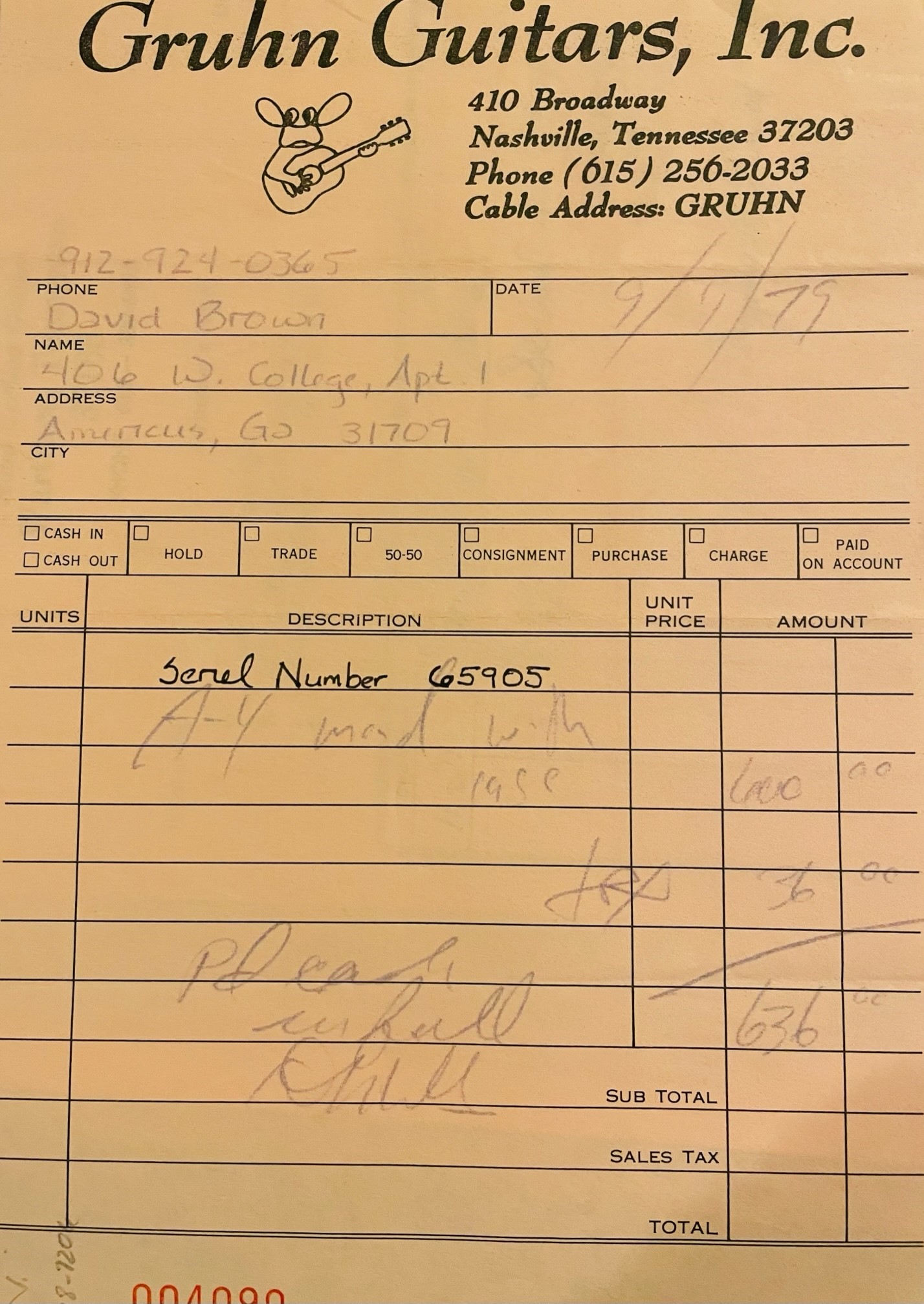
As he proceeded to join bandmates Ken Kolodner andElke Baker in an old-time medley, I had a thought. In that batch of mandolins being brought to life in Kalamazoo in 1921 was one A-4 model with a red sunburst finish and a fleur-de-lis inlay in the headstock. One with the serial number 65905.
My Gibson A-4 mandolin headstock with the fleur-de-lis inlay, serial number 65905
Yes, my Gibson A-4 mandolin also dates from 1921, so it is also celebrating a 100th birthday this year! And anything that reaches 100 deserves to be honored, as we’ll do in this Saturday Soundtrack.
Because there are several great musicians playing A-style mandolins online, they’ll take the lead in showcasing what this versatile old chestnut can do. To begin, here’s a video featuring the three musicians who originally put the thought into my head. This particular IMT performance is from 2015 — when Robin’s mandolin was still a spry 94-years young — but he puts the youngster through its paces on Richmond, Greasy Coat, and the frightfully named Starvation at Hell Creek.
After that appetizer, let’s turn back to when these instruments were first introduced. Mandolins have been around for a long time, and some classical composers — including Vivaldi, Beethoven, and Mozart — wrote specifically for them. When Gibson began making mandolins in Kalamazoo, the company was building off the second wave of mandolin popularity — which began with the Paris Exposition of 1878. The company helped fuel this new interest in the instrument as well as the related members of the mandolin family: the mandola, octave mandolin, mandocello, and mandobass.
Mandolin orchestras are still popular in some parts of the music world, as shown in this video of the Vivaldi Mandolin Concerto in C Major performed at the 8th Osaka International Mandolin Festival in 2013. (You have time to work on your skills before the 12th festival in October of 2022!)
Tone Poems: The Sounds of the Great Vintage Guitars and Mandolins is an album of duets by mandolinist David Grisman and the late guitarist Tony Rice using vintage instruments. Turn of the Century, which opens the album, features instruments that were available when the song was written, and that’s not the 21st century they are referencing. Rice plays an 1891 Martin 1-21 guitar while Grisman takes the lead on a 1905 Gibson A-4 mandolin.
Norman Blake is the first musician I saw play an A-style mandolin in person, and he probably was the key influence that led me to step into Gruhn Guitars in 1979 and check out their inventory of vintage instruments.
The invoice of my $636 purchase of A-4 #65905 in September of 1979
The story I recall from when I bought my mandolin is that it once was owned by none other than Norman Blake himself, although that very well may be a story I invented over time and in my mind! In any event, give a listen to a still-active Blake put his A-style mandolin through the paces on the T.A.G. RailroadRag.
Carl Miner of the band The Greencards plays a beautiful rendition of Jay Unger’s Ashokan Farewell on an A-4 in impeccable condition.
Sad to say, my A-4 did not come into my possession in such good condition. The pickguard has always been missing, with the resulting wear showing on the body. There are other nicks and minor flaws, but hey, it is 100 years old and sounds great.
The only modification I made to the instrument was to add a strap button on the heel (I can hear the purists now). The only repair, by a Gibson-certified technician, was to address a small separation issue at the tailpiece.
Other A-4 models have seen more significant modifications. Multi-instrumentalist Flynn Cohen of Low Lily joins Mandolin Monday for an original microtonal fiddle tune called The Last of Biff played on his modified vintage Gibson mandolin that has two partial-frets and one micro-tuned course. See if you can hear the difference.
In the 1980s, I was listening to a good bit of Tom Espinola and Lorraine Duisit. Their album Feather River featured both musicians playing an A-style mandolin on lovely tunes like Chimes.
Yes, the case is pretty darn old as well!
A-4 number 65905 has now been in my life for 42 years. I don’t play it as much as I should, but since the old box is now 100 I suspect I’ll give it some more TLC and attention. As with all my musical instruments, I see them as living things and I see myself as just a steward. This one was here before me, and it should — with any care at all — outlast me. I hope it gives someone else great pleasure in the future.
For while other companies still produce A-style mandolins, they are no longer a part of the Gibson lineup. I get it, F-style mandolins look stunning! “An F-style mandolin is as much a work of art as it is a functional instrument.” And in the hands of Chris Thile or Sam Bush, an F-style looks as cool as any electric guitar in the hands of a rock star. No one would think of using John Starling’s description of John Duffey (i.e., “the big man with the little instrument”) on one of those two guys, with their hip looks and their stylin’ F-5s. And then there is Sierra Hull. I rest my case.
But if I was worried about stunning looks, then I wouldn’t have bought an A-4, and perhaps would have changed a few other things in my life.
Let’s end the celebration where it began with two pieces by Robin Bullock. First up, Robin plays a medley of two old time fiddle tunes on a 1920 A-style, and he’s added the following comment about the tuning:
This is a pair of old-time Appalachian fiddle tunes, “Coleman’s March” and “Bonaparte’s Retreat”, played on my 1920 Gibson A (affectionately nicknamed The Feral Cat because its previous owner claims it only purrs when it’s in my lap). These tunes are traditionally played with the fiddle retuned to the “Dead Man’s Tuning,” DDAD low to high, so I retuned the mandolin the same way and discovered that the tuning yields some amazing sounds on mandolin. This arrangement continues to evolve over time.”
We’ll end with some J.S. Bach on the mandolin…in this case, Bach’s Allemande from Cello Suite No. 4.
Happy birthday, dear friend.
Enjoy!
More to come…
DJB
*He also said he owned a number of mandolins, and this one was the “youngest.”
The Wednesday Weekly Reader features have included multiple posts focused on fears for the future of democracy. With links to the writings of historians, reporters, lawyers, media watchdogs, and political analysts, I have shared the thinking of the people I read in trying to sort through mounds of online and written information about this threat to our country.
This has been my way of understanding the context of the times we live in. But frankly, I’ve gone down this rabbit hole too many times.
After a year of setting aside space on More to Come (MTC) to curate a collection of articles and clips from writers I admire, it is time for a mild course correction.
A change is on the way
I remain worried about the future of democracy in America. But there are others you can turn to on that topic and go straight to the source, doing away with the middleman.
More to Come is not a platform with thousands of followers waiting with bated breath to hear what I think about today’s events. * I’m happiest when writing pieces that connect the dots between events and places in my life with the things around me. Only a small portion are political in nature.
Beginning in the new year, the focus of the Weekly Reader will shift to serve as the go-to place for my reflections on the books I’m reading. If 2021 is a guide, I’ll average a post every other week. But I’m not changing the name…the Every-other-week Reader is just too cumbersome.
I’m thankful for the following clear thinkers
What follows are my suggestions and links to the writers I’ve found to have useful insights, with a special focus in the area of history, which is my primary interest and specialization. These talented writers and scholars continue to help me sort through the puzzle of life today.
Understanding the historical context for the events in our lives
Heather Cox Richardson
Heather Cox Richardson — This is the easiest and strongest recommendation I can make. Each night or early morning, Richardson — a historian at Boston College — sends out a summary of key events of the day linked to historical events or trends. It is brilliant, and frankly I don’t see how she does it with such consistency and quality. You can pay to subscribe to her Letters from an Americannewsletter on Substack, or you can get it for free. She is the one person I gladly pay to ensure that her insights show up each day.
Richardson describes Letters from an American in these words:
Historians are fond of saying that the past doesn’t repeat itself; it rhymes.
To understand the present, we have to understand how we got here.
That’s where this newsletter comes in.
I’m a professor of American history. This is a chronicle of today’s political landscape, but because you can’t get a grip on today’s politics without an outline of America’s Constitution, and laws, and the economy, and social customs, this newsletter explores what it means, and what it has meant, to be an American.
These were the same questions a famous observer asked in a book of letters he published in 1782, the year before the Treaty of Paris ended the Revolutionary War.
Hector St. John de Crevecoeur called his book “Letters from an American Farmer.”
Like I say, history doesn’t repeat itself, but it sure rhymes.
I especially like Richardson’s take on days with special significance, such as Pearl Harbor Day, the anniversary of the day Lincoln gave the Gettysburg Address, or Veterans Day/Armistice Day, to name three recent ones. Richardson is a reliably progressive voice who also happens to be very smart and very good at what she does.
Joanne B. Freeman (credit: Beowulf Shehan)
Joanne B. Freeman — Richardson also hosts the podcast Now & Then with historian Joanne Freeman. The podcast is accessible from Richardson’s Substack platform.
Freeman was the co-host of the great history podcast Back Story before it ended production. I recommend you read Freeman’s Field of Blood. She’s writing a great deal about political violence and polarization, so her work has a hand-in-glove fit with today’s events.
Ed Ayers (credit: edwardayers.com)
Ed Ayers — The co-founder of Back Story, Ayers is now the founder and Director of New American History, which attempts to show history in more meaningful and memorable ways.
Ed provides insightful analysis and is an excellent writer. I always enjoy his updates. He writes on the Medium platform, where you can see articles such as this summer one: The classroom is a community of trust.
History is the turbulent, unpredictable, and deeply human record of everything that happened before this moment. Through interactive maps, video, audio, an algorithmic engine of journalism, and tools for educators, we hope to make visible what was previously invisible about our shared American story.
Rebecca Solnit (credit: Adrian Mendoza)
Rebecca Solnit — A writer, historian, social critic, and activist, Solnit is simply one of the best writers and thinkers working today in terms of social commentary and the times we live in. Solnit is the author of more than twenty books on feminism, western and indigenous history, popular power, social change and insurrection, wandering and walking, hope and disaster. I highly recommend her books Whose Story Is This?, Call Them by Their True Names (Winner of the 2018 Kirkus Prize for Nonfiction), Men Explain Things to Me, The Mother of All Questions,Hope in the Dark, The Faraway Nearby, and Wanderlust: A History of Walking.
Just put her name in the search on MTC and more than 30 references will come up. Solnit is also writing a regular column now for The Guardian. You need to know her.
Dan Froomkin — Froomkin runs the indispensable Press Watch site, which he calls “an intervention for political journalism.” His “let me rewrite that for you” columns are both very funny and sad beyond belief. Froomkin, to put it mildly, doesn’t suffer fools.
Judd Legum — Legum is the founder of Popular Information, and I very much appreciate his “follow the money” approach to investigative journalism. One of his most important ongoing investigations is into those corporations who are supporting the Republicans who voted to overturn the election on January 6th.
A strong voice in understanding legal issues
Teri Kanefield — An attorney, writer, and commentator, Kanefield produces a weekly post on her blog that delves into the legal aspects of events today while also explaining why those who support democracy cannot simply take the same approach as those who want to kill it.
U.S. Postal Service: White hot center of drama and intrigue
Quitting royal family: An option
There are too many good, smart (and funny) people writing on a variety of topics to claim ignorance of what’s happening today. I encourage you to read:
Greg Sargent on the scope of our political challenges
Nesrine Malik for an international perspective that will still resonate with American readers
Tom Dispatch, as an antidote to the mainstream media
There are so many more that I have not mentioned, but perhaps this will whet your appetite. In this day and age, you don’t need to settle for muddy analysis, bothsiderism, and anecdotal journalism (I’m looking at you, NPR). Whatever you read, come at it with a smart, curious, and open mind.
More to come…
DJB
*I do not have any special access from which to provide insights. I’m not on Twitter, Substack, Instagram, or Facebook to amplify my comments, nor do I want to be.
We all want to live well, being true to the life that makes the most sense to our hearts. It is the how to live well that is a challenge.
Working from her experience with those near death, a former palliative care nurse wrote a bestselling book that is illuminating and instructive. The top five regrets of the dyingcame from Bronnie Ware’s observations during that time, and it led her to focus on how the rest of us spend our waking hours. Like Natalie Goldberg discovered in fighting cancer, Ware arrived at a simple yet challenging answer to the question of how to spend our time to avoid finding ourselves on our deathbeds with regrets for the life we’ve lived.
We all live with a “terminal diagnosis.” The more awareness we can bring to this, the more it will support us to live well, instead of living a life dictated by others.
First regret of the dying: I wish I’d lived a life true to myself, not the life others expected of me
My parents modeled this way of living, telling their five children that they would teach us their values but, as we grew into adulthood, each one of us needed to make choices to become the person we were supposed to be. Their willingness to let go without expectations led us all down different career and life paths: musicians, arts administrator, preservationist, planner, public servants, navy veteran, artistic blacksmith, missionary, authors, parents. It was a good start to living a life true to oneself. Both of our children are now following their passions, providing us with lessons from another generation.
Too many of us fear the risk of such an approach to living. Instead, we have learned to live our lives trying to satisfy other people’s demands. Ware notes that as our individual callings become more prominent, we come to realize that our “own beliefs and preferences may not actually be aligned to those you have been raised with.” There is a healing in this realization.
Second regret: I wish I hadn’t worked so hard
My father loved being an engineer. But it didn’t define him. He wrote about this after he took early retirement and faced his third stage of life without the traditional comfort of being known for his job. Fortunately, his way of living already included what today we call work-life balance, and he moved confidently out of a full-time career into a very productive and satisfying three decades of retirement.
Ware notes that dying people who have this regret learn too late that there needed to be more in their lives than work. When work was taken away from them, “there was nothing left: no identity to support them, no stimulus to inspire them, no joy.”
Third regret: I wish I had the courage to express my feelings
When I was a child, I had no problems expressing my feelings. I laughed when I felt joy, cried at pain, and delighted in new discoveries. Most young children experience a similar life of wonder. But along the way, we are taught how to suppress our feelings as part of learning life skills to navigate challenges and see different perspectives.
Many of those skills are useful, Ware writes, but “some of them hinder your natural expressions, until over time, you think it is normal to never be vulnerable or express yourself honestly.” Too often we never summon the immense courage to express ourselves, “whether that is by being vulnerable and sharing your love, or being strong and sticking up for yourself. But it is absolutely vital to do so if you are going to live your fullest life.”
Fourth regret: I wish I had stayed in touch with my friends
This past Thanksgiving, we did what we have done for years: got in our car and drove 2 1/2 hours to spend the weekend with friends we’ve known for more than three decades. Yes, we have Facebook, LinkedIn, or text connections. But staying in touch is so much more than a “like” on a social media post. Our daughter Claire, who regularly makes time to get together physically and emotionally with friends she has known since grade school, has taught us how to live to avoid this regret.
“Real life connection is the essence of wellbeing. It is natural that some friends may fall away as your lifestyles and tastes change,” writes Ware. Yet dying people “regretted not staying in touch with their old friends, though, because during their last weeks they wanted to reminisce, laugh about the old days, feel understood, and remember they once belonged in an easier world.”
Fifth regret: I wish I had allowed myself to be happier
“Every time you take ownership of your focus and steer it towards something that leaves you feeling a little better, you are opening your heart and life up to more happiness. Life is not a penance. It is a precious gift of time.“
The late Italian-American philosopher Jim Valvano summed up his approach to living a happier and fulfilling life by saying that every day we should “laugh, think, and cry.” Think about it, he said. “If you laugh, you think, and you cry, that’s a full day, that’s a heck of a day. You do that seven days a week, you’re going to have something special.”
Many of the musicians featured in these Saturday Soundtrack posts are like old friends who have been in my life for a long time. I have also committed to discovering music that wasn’t a part of my youth, highlighting musicians brought to my attention recently via recommendations by friends, readers, and other sources. Those new discoveries are gifts, if you will. Since we are in the gift-giving season, I want to revisit a few of those “new favorites” that may be well known to some of you, but that I just discovered in 2021.
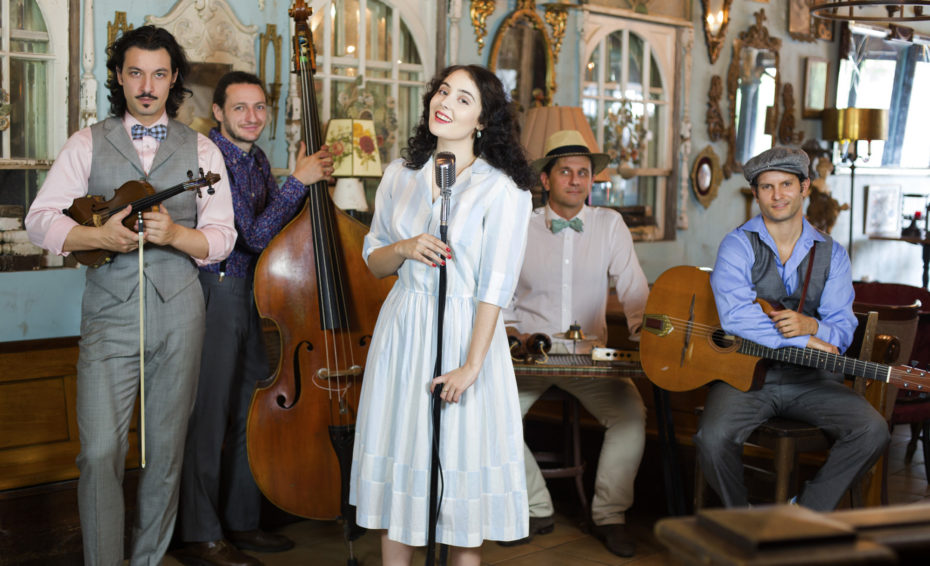
The Avalon Jazz Band (see March 6th review) is fronted by Tatiana Eva-Marie, a Swiss-born and Brooklyn-based singer who grew up in an eclectic musical family. She used the variety of musical styles heard during her childhood to move toward swing jazz. As a long-time fan of the gypsy jazz made popular by theHot Club de France, I am always pleased to find new (and not-so-new) groups such as the Avalon Jazz Band playing in the swing jazz style of 1930s and 1940s Paris.
Avalon Jazz Band
Eva-Marie has a wonderful voice and captures the spirit of the Zazous, the “swing kids” of Paris, albeit with an American twist. She is “what many people would call a ‘triple threat.’ She’s brilliant, beautiful, and talented. She’s basically a Swiss fairy princess, with soul.” And the band is pretty hot as well! To prove both points, take a listen to Runnin’ Wild — and make sure to check out the break by the guy on the washboard rhythm section at the 1:35 mark.
Yasmin Williams (see January 30th review) has a sound and style that stands as “her challenge to widespread preconceptions about the music made by young Black people or acoustic guitarists. It’s Williams’s achievement that she makes that challenge sound so calming and beautiful.”
Yasmin Williams (credit: YasminWilliamsMusic.com)
Williams released her second album, Urban Driftwood, in January, and although it was partially recorded in Takoma Park, Maryland — home to self-styled “American primitive” fingerstyle pioneer John Fahey — her music doesn’t sound like Fahey’s and it certainly isn’t primitive. Her piece Juvenescence is a lyrical, technically challenging tune, played with simple beauty and impressive virtuosity. Since first discovering her music, I’ve heard Williams playing in multiple settings over the past few months. She is clearly an artist on the rise.
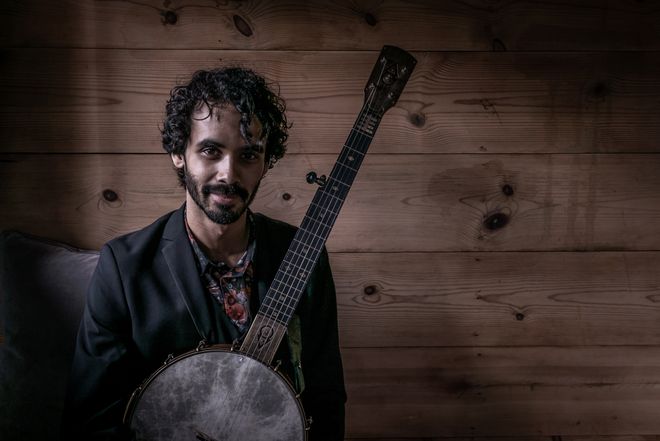
A gay and Black performer working in Appalachian music, Jake Blount (see February 6th review) features “historically informed, beautifully played old-time music.” As noted on his website, “Blount specializes in the music of Black communities in the southeastern United States, and in the regional style of the Finger Lakes. A versatile performer, Blount interpolates blues, bluegrass and spirituals into the old-time string band tradition he belongs to. He foregrounds the experiences of queer people and people of color in his work.”
Jake Blount (credit: by Michelle Lotker via JakeBlount.com)
“I felt the need to go back to the songs my ancestors had sung, initially in the form of spirituals, and then eventually in the form of banjo and fiddle music to sort of understand how they had seen the world because songs are the only direct record they left us,” notes Blount. It is his way of responding to the murder of George Floyd and the Black Lives Matter movement. Goodbye, Honey, You Call That Gone opens the 2020 album Spider Tales. “The tune comes from Lucius Smith, a Black banjo player from Sardis, Mississippi, who often performed in a band with Sid Hemphill.” In this video, Blount is playing the banjo while Nic Gareiss performs with his feet.
Low Lily (see March 27th review) is a Vermont-based band exploring the roots and branches of American folk music. This exploration takes place “with traditional influences and modern inspiration that weaves together a unique brand of acoustic music. Liz Simmons (vocals and guitar), Flynn Cohen (vocals, guitar and mandolin), and Lissa Schneckenburger (vocals and fiddle) are masterful players with deep relationships to traditional music styles ranging from bluegrass to Irish, Scottish, New England and Old Time Appalachian sounds. When you combine this with stellar composition skills and inventive arrangements you get music that is rooted yet contemporary.”
While the band members handle their various instruments with great skill, I was very much drawn to their vocal harmonizing. Hope Lingers On is a personal favorite, with an optimism that comes through even in “our darkest hour.”
Guitarist CharlieRauh(see June 5th review) is an Alabama-born, New York City-based musician who was influenced by Duke Ellington and his “wonderfully lyrical melodic sense intertwined with dense, idiosyncratic harmony.” Rauh notes that “Playing guitar really opened up a lot of creative momentum for me, as I could play chords as well as melodies and form more developed ideas.
Rauh’s music is soft, slow, and beautiful. Here he plays a gorgeous composition, Arolen, from his 2017 release Viriditas.
Kyshona (see September 25th review) — a “music therapist gone rogue” — has a message for a broken world. I absolutely love her music and approach to healing. Kyshona (pronounced Kuh-Shauna) Armstrong began her career as a musical therapist, writing her first songs with the students and inmates under her care. As she began to write independently, she lent “her voice and music to those that feel they have been silenced or forgotten,” making her a unique figure in Nashville’s creative community and songwriting culture.
Kyshona (credit: Kyshona.com)
In the liner notes to Fallen People, she writes:
“In a time when we are all so divided, this song was written as a reminder that each and every one of us has an obstacle we’re trying to overcome, an emotional wound we are living with and a struggle that we’re walking with everyday. THAT is where we can all be united… in the hurting.“
Over the last few years, Kyshona has shared the stage with a host of top-flight performers. I especially enjoy her collaboration — alongside Adia Victoria, Allison Russell, and Kam Franklin — with the talented alt-country singer Margo Price in this spell-binding version of Hey Child from Price’s That’s How Rumors Get Started. When you go past the mass market in Nashville, you will discover some unexpected performances.
Speaking of Adia Victoria(see October 9th review), the South Carolina-born and Nashville-based blues singer-songwriter “wants to make the blues dangerous again” and has important stories to tell.
Adia Victoria (credit Red Light Management)
South Gotta Change is a powerful 2020 single produced by T. Bone Burnett (who also produced her album A Southern Gothic) that Victoria described in a release as “a prayer, an affirmation, and a battle cry all at once. It is a promise to engage in the kind of ‘good trouble’ John Lewis understood necessary to form a more perfect union.”
Trout Steak Revival(see October 23rd review) is “the quintessential Colorado string band. Defined more by expressive songwriting and heartfelt harmonies rather than any one genre, Trout Steak Revival crosses over and blends the bounds of folk, indie, bluegrass, and roots evoking its own style of Americana.”
Trout Steak Revival (credit troutsteak.com)
This band can really swing. While everyone in the band jumps in on vocals, I am especially drawn to those by Bevin Foley, as heard here on this live version of Go On.
Tre Burt(see November 13th review) comes from a working-class background, just like his songwriting hero John Prine. Sacramento songwriter Burt is one of a talented group of musicians today who uses his personal experiences and perspective to reconnect folk music with its African American and protests roots.
Tré Burt (credit TréBurt.com)
In this mini concert from Paste Studios recorded in September of this year, Burt plays three songs live off his most recent You, Yeah You album.
Maggie Rose(see December 4th review) is a new favorite who a consulting client/new reader brought to my attention. Her vocal talents are stellar, and she both writes and interprets songs in a variety of styles. Rose was raised in the DC area and now lives in Nashville, where she is among the growing number of artists broadening the city’s musical palette.
Another friend, in commenting on the post, mentioned that she was listening to Rose cover Carole King’s hit I Feel the Earth Move. Rose puts a different twist on the song in her arrangement, which is worth a listen.
MonaLisa Twins(see November 27th “Sharing the covers” review), with real-life twins Mona and Lisa Wagner fronting the band, are from Austria and seem to be strange ambassadors for the music of the Swinging Sixties. They were 16 when they released their first album (well after the 60s were in the rear-view mirror), yet the connections to groups like The Beatles is clear. In fact, as you look on their online shop, they have released a number of albums of Beatles covers. They are not technically roots or Americana artists, but they often perform these covers using instruments one finds in those genres.
MonaLisa Twins live at the Cavern Club (credit monalisa-twins.com)
Take, for instance, I’m Looking Through You from Rubber Soul, which they posted earlier this month. It may be the only version of this song where the banjo (actually a banjo-guitar) takes George Harrison’s iconic lick (played along with an organ on the original) and makes it work.
But be careful. These young ladies can drive you down the You Tube rabbit hole if you aren’t careful (says the voice of experience). And you may even come up with something — especially if you’ve had twins — that will make you cry.
I hope you can find a gift or two you enjoy in this collection. Let me know your thoughts.
“Yesterday, I was lying. Today, I’m telling the truth.”
Everybody lies. To point out that obvious fact is not designed to promote the belief that everyone is equally culpable in the use of disinformation. Today, a group of people who want to control our country take lying to an extreme.
Being charitable, one could say today’s far-right authoritarian politicians are immune to the truth. But lies are lies.
Democracy is the form of government based on the rule of law, requiring “truth and a shared factuality, or what social scientists call the ‘public sphere.'” It also requires a shared commitment to the public good.
The extremist element that has taken control of the Republican Party has been on a decades-long quest to destroy the federal government as we know it, a government built out of FDR’s New Deal that recognizes our interdependence. These authoritarian extremists do not show much interest in the public good.
“The GOP only has a few actual policy ideas beyond owning the libs and causing blue America as much pain as possible … And it is willing to overthrow democracy to hold on to power. Extreme gerrymandering in statehouses and the U.S. House of Representatives, plus disproportional representation favoring conservative rural whites in the Senate and Electoral College, is stacking the deck in favor of a radical minority — and Republicans have grown brazen about simply stealing elections for themselves even if those advantages prove insufficient.“
Today, too many top Republicans spread lies.
Some actually believe the crazy Q-Anon conspiracy theory that Donald Trump won the 2020 election when he — in fact — lost by sizeable margins.
Others tolerate the lies because of their support of one key element of what’s left of the party’s platform, such as lower taxes on the wealthy.
And then Republicans like Mitch McConnell know the claims by Trump and his supporters are lies, but they support them because they are useful in their quest to dismantle the federal government. McConnell has used his own set of lies around the confirmation process for the Supreme Court.
The Supreme Court deserves special mention. Mainstream media pundits like Paul Waldman are waking up to the fact that every single one of the conservatives on the Supreme Court lied — under oath. It has become clear that they all lied about how they would handle challenges to women’s reproductive rights. Knowing that their female accusers had nothing to gain and everything to lose, I believe that Kavanaugh and Thomas almost certainly lied about their history of sexual harassment and assault. We now have six justices who — under oath — lied about their actions, intentions and agenda in order to get a lifetime seat on the most powerful court in the land.
Why did they do it? Because the last time a conservative nominee to the court said what he truly believed, his nomination was shot down by people like Barbara Jordan who spoke truth to power.
As Atkins points out, authoritarian Republicans are working from a place of weakness.
“Democracy’s defenders have an advantage: They do, in fact, represent the majority of America and are also the main drivers of the country’s culture and economy. Blue counties produce more than 70 percent of America’s GDP. U.S. cities — overwhelmingly blue — are responsible for the vast majority of the country’s cultural and economic output. Blue states are overwhelmingly donors to the states that despise them and seek to disenfranchise them. The nation’s most successful companies are typically located in ultra-liberal areas. And the country is becoming more diverse and more urban every day. Americans under 40 are overwhelmingly progressive. This is the present and future of America.
Successful fascist movements and authoritarian coups generally require “not only a fervent base of cruel, fundamentalist backers. They also need the support, cooperation, and acquiescence of social elites.” Most of all, they need a compliant public to roll over and go along with it.
“Real, normative America is urban and liberal; 83 percent of Americans now live in cities, and that number is growing. The oldest Millennials are now 40 years old and not getting any more conservative; Gen Zers are just as progressive, if not more so; and those two generations are about to dominate the electorate. Big Business clearly knows where the majority of its customers are, to the point where the conservative movement — until recently long allied with Big Business — now portrays itself as the victim of ‘woke’ corporate elites.“
This is the second of a two-part post on the effects of disinformation on our democracy. (Read Part 1.) Next Wednesday I will post one final Weekly Reader for 2021, when I will announce a shift in focus for this segment. Stay tuned.
The book originally came to my attention after chatting with a seat mate on a plane ride. He gave it a strong recommendation and I’m glad he did. It was a fascinating read. Author Seth Stephens-Davidowitz is a social scientist who uses big data sources to uncover hidden behaviors and attitudes. He notes that Google searches are a type of “truth serum” because we undertake those searches anonymously. Tools such as Google Trends can tell us what people — in huge data sets — are really thinking.
“In other words, people’s search for information is, in itself, information,” Stephens-Davidowitz explains. “The power of Google data is that people tell the giant search engine things they might not tell anyone else.”
That’s true about race, politics, and especially sex. People lie about all three things when taking surveys, but they don’t lie when searching for data in the anonymity of their living rooms. The acknowledgement in recent years of the rise of white nationalism in the mainstream media was something that Google searches predicted in 2008…on the night Barack Obama was elected president. There were more searches using the “n-word president” than “first black president” in some states.
A generally positive reviewer did note one challenge with the book’s focus on the value of big data.
I expected a reference to Cathy O’Neil, who shows in her book Weapons of Math Destruction (2016) how programs based on big data introduce a frightening new efficiency into predatory advertising, “distort higher education, drive up debt, spur mass incarceration, pummel the poor at nearly every juncture, and undermine democracy”. Programs designed with the very best intentions fall into deadly self-confirming feedback loops that confirm their efficacy even as they spiral away from the truth and increase injustice.
That’s a fair assessment as Stephens-Davidowitz could have helped us better understand the challenges with using big data in the way he suggests. Yet outside of that concern, the click-bait title, and a few other minor quibbles, this book has much to recommend it. There is great analysis, excellent storytelling, and witty writing throughout. Suffice it to say that this book may change the way you view the world…and truth and lies.
Americans today hear the name Ben Franklin and picture a kindly old grandfatherly type who established the nation’s post office, flew a kite in a thunderstorm to demonstrate the electrical nature of lightning, and helped draft the Declaration of Independence.
Disinformation — deliberately misleading information — is not a new phenomenon. History tells us that incorrect and misleading information has long been used in politics until it confuses the issue or even becomes a part of the accepted narrative.
Sometimes the use of disinformation is just the rough and tumble of political dirty tricks. However, as Matthew Ingram wrote in the Columbia Journalism Review, the issue we face today is often one of scale. When users weaponize falsehoods and harness new technology to spread it widely and quickly, the disinformation can damage our democracy. The scale of that disinformation can swamp the positive.
Overwhelming the good news
When we do hear good news, such as the recent report about vaccination rates and rates of death in my home county, it can get lost in the cacophony of lies and willful obfuscation.
The good news bears repeating:
“Perhaps the most highly vaccinated large county in America, according to New York Times data, is Montgomery County, Md., just outside the District of Columbia. Data from the Centers for Disease Control and Prevention show 93 percent of those 12 and older there are fully vaccinated, compared to around 70 percent nationally. The number dying over the past week is eight times as high nationally — 3.4 per 1 million — as it is in Montgomery County — 0.4 per 1 million — even as Montgomery County is near some virus hotspots.“
Washington Post, December 4, 2021
A key issue is that disinformation — deliberately misleading information — distorts or covers up real problems that people are trying to address in their personal lives. Disinformation is designed to obstruct and restrict constructive conversations between citizens with different points of view, conversations which should be the basis for democracy. The challenge in sorting through all we hear in our dangerously divided times to winnow out the bad and misleading information is more difficult — and more important — than ever.
To begin with, it is important to know that disinformation in America is often designed to bolster the oligarchy.
The paradox is that from the very beginning of the nation, the phrase “all men” in the oft repeated refrain that “all men are created equal” never meant everyone, or even all men in the founders’ worldview. They excluded many groups — people of color, women, indigenous people, paupers. In other words, “freedom depended on racial, gender, and class inequality.” … The corollary to the American paradox states that “If equality depends on inequality for women and minorities, the opposite should also be true. That is, inclusion of women and minorities as equals in American society would, by definition, destroy equality.” This corollary has been behind the weaponizing of rhetoric used by those attempting to maintain oligarchic rule and eliminate democracy in the US by appealing to white men’s fears of becoming subservient to women and people of color.
When you read or hear something, consider the source.
An important first step in the journey towards truth is to, as my grandmother used to say, “consider the source.” In those pre-Internet days, she would also tell us, “Don’t believe what you hear and only half of what you read.”
Grandmother had a very sensitive “BS” radar (although she would never use those words.)
These recent articles, with their focus on “news” sites that take political talking points, mix in some falsehoods, and frame the resulting bogus stories as news, provide similar counsel.
Right up front, Dan Froomkin suggests at Press Watch, that we remember that Fox News is not news. Period. Full stop.
Fox isn’t alone. Writing in Popular Information, Judd Legum outlines how Right-wing operatives deploy a massive network of fake local news sites to spread disinformation. West Nova News — which appears to be a standard local news site — was one of the places carrying a great deal of disinformation about the teaching of Critical Race Theory in Virginia schools. West Nova News is part of a massive network of 1300 websites (there’s the scale) linked to conservative businessman Brian Timpone, including at least 28 that operate in Virginia. Between January and November 2021, the 28 “local news” sites in Virginia published 4,657 articles about Critical Race Theory in schools. CRT is not taught in Virginia schools.
Disinformation will often deliberately miss the point.
Another way that information is weaponized is by deliberately hiding the key point in a story.
In Press Watch, Dan Froomkin has another of his rewrite pieces with Failing to call out ‘critical race theory’ as a racist dog whistle? Let me rewrite that for you! Reporters know “critical race theory” isn’t a real issue, asserts Froomkin. “They know it’s euphemistic shorthand for all sorts of right-wing, often racist concerns about modest attempts to address diversity, equity and inclusion. They know it’s a backlash against Nikole Hannah-Jones’s 1619 Project and its powerful recognition of slavery as a central element of the American narrative.” While news organizations should refute this disinformation campaign, they don’t. Scare stories — such as “death panels” in 2009, “migrant caravans” in 2018, “voter fraud” for decades, and now “critical race theory” in public schools — are too appealing, even though none of those things have ever been a real problem. Foomkin considers it crazy “that reporters are writing so much more about how winning a strategy it is than about what a lie it is.” His rewritten headline reads, “Republicans riling up voters with a lie designed to appeal to racism”
In A Tale of Two Thefts, Judd Legum at Popular Information takes up a similar refrain of deliberately missing the point. Legum notes that “In the United States, only certain types of theft are newsworthy.” A shoplifting crime in a Walgreens in San Francisco — according to an analysis by FAIR, a media watchdog — “generated 309 stories between June 14 and July 12” including in a slew of major publications. In most coverage, the video is presented as proof that there are no consequences for shoplifting in San Francisco. But the man in the video, Jean Lugo-Romero, was arrested about a week later and faces 15 charges. In the meantime, Walgreens settled a $4.5 million class action lawsuit a few months earlier after stealing millions of dollars from its own employees. “How much news coverage did it generate? There was a single 221-word story in Bloomberg Law, an industry publication. And that’s it.” $4.5 million vs. maybe $950. As FAIR wrote, “While basic arithmetic would indicate that $4.5 million is greater than $950, media have demonstrated that the question isn’t how much is being stolen, but who it is being stolen from.“
Technology often makes it worse.
Old-fashioned disinformation such as that practiced by Ben Franklin and Thomas Jefferson was “artisanal” in the words of Matthew Ingram. That’s no longer the case.
Joan Donovan and Brandi Collins-Dexter wrote a piece in the Columbia Journalism Review “about some of the tactics that right-wing groups used to spread disinformation about the 1619 Project and critical race theory. “Our research reveals that the popularity of ‘1776’ owes in part to keyword squatting — a tactic by which right-wing media have dominated the keywords ‘1619’ and ‘critical race theory’ and enabled a racialized disinformation campaign, waged by Trump and his acolytes, against Black civil rights gains.”
Remember that disinformation often includes flat-out lying.
Scaring people about inflation is another way of weaponizing information.
Paul Waldman covers the campaign as he writes in the Washington Post that Inflation is manageable. Inflation panic is out of control. “Inflation is a genuine problem, but it’s hardly spinning out of control,” notes Waldman. “Inflation panic, on the other hand, is getting ridiculous. Right now a highly motivated political opposition and a hysterical media are cooperating to characterize a real but manageable issue as a historic economic catastrophe.” Recent economic news has put Republicans in the position of appearing to root against the economy. But don’t expect a change, as the instinct to weaponize disinformation runs deep.
Tell the truth and make them think it’s hell.
There is historical precedent for how to respond to blatant disinformation. As John Stoehr writes in The Editorial Board, it is blatant because divide and conquer is what the Republican Party does so well. Stoehr suggests that President Biden “make the Republicans deny more things in your favor. Create the kind of heat the press corps loves to cover. This would destabilize the contours of public information. It’s what the Republicans do all the time. Only instead of lying, as the Republicans do, Biden can tell the truth.”
During a 1948 campaign stop in Bremerton, Washington, President Harry Truman delivered a rousing speech attacking the Republicans. One of Truman’s supporters called out, “give ’em hell, Harry!” Truman replied, “I don’t give them hell.I just tell the truth about them, and they think it’s hell.”
Truman pulled off a massive upset and won that election. Give ’em hell, Joe!
More to come…
DJB
P.S. Since I started with good news, I’ll end with good news as well.
Changes in key indicators from November 2020 to November 2021
This is part 1 of a two-part Weekly Readeron the effects of disinformation on our democracy. Part 2 on Friday will look at what happens when leaders lie.